Science, Society, and Culture: Brandon Ogbunu’s Case for a More Creative Scientific Enterprise
Feature Story
By Olivia Hamilton
Last update April 27, 2026
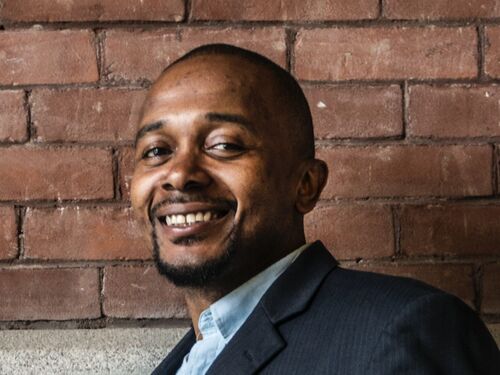
Photo by Stephanie Seguino
Brandon Ogbunu is a computational biologist whose research investigates complex problems in epidemiology, genetics, and evolution; an associate professor in the Department of Ecology and Evolutionary Biology at Yale University; a professor at the Santa Fe Institute; and the founding director of the Yale Initiative for Science and Society.
His work utilizes a range of methods, from experimental evolution, to biochemistry, and applied mathematics, all toward achieving a refined understanding of complex systems and disease phenomena. In addition, he runs a parallel research program at the intersection of science, society, and culture. In this capacity, he has been a regular contributor to Undark, WIRED, Scientific American, and several other publications.
His most recent article in Undark magazine looks at why science communication is central to the practice of science, arguing that explaining and defending knowledge is as essential to the scientific enterprise as publishing research.
Ogbunu is a 2024 award winner of the National Academies’ Eric and Wendy Schmidt Awards for Excellence in Science Communications, which honor exceptional science communicators, journalists, and research scientists who have developed creative, original work to communicate issues and advances in science, engineering, or medicine for the general public.
We asked him about his recent works looking at the intersection of science, society, and culture, and how these inform his views on the state of the scientific enterprise.
In an Issues in Science and Technology event late last year, you and other panelists challenged the idea that science has a clear “social contract” with society. In your view, what does science’s social contract look like today, if it exists at all?
Ogbunu: I think the “contract” was never a firm doctrine, but a soft notion that we scientists are using taxpayer money in the earnest pursuit of knowledge about the natural world. And this is especially true for subfields of science that address practical problems in the world — medicine, meteorology, conservation, etc. This notion might have existed at one point, but I have never heard this articulated by anyone, scientist or citizen-scientist.
What role does science communication play in your view of the social contract in the 21st century and/or the evolution of the social contract?
Ogbunu: An example that I used in a recent essay of mine explored the difference between football on college campuses and science on college campuses. I said that if they banned college football tomorrow, Americans would protest immediately. But when science was attacked, few non-scientists seemed alarmed. I bring this up because this is an example of how we’ve failed to build an effective bridge between the technical science that comes out of our laboratories and the world of people whose taxes support our work. I think the science communication movement can help to reestablish — or invent — a new social contract, one driven by accessibility, conversation, and rigor.
What strategies can science communicators use to improve public understanding not just of scientific findings, but of the scientific process, especially when the value of science itself is being debated?
Ogbunu: I’m a big fan of alternative style products and relics. Many have spoken about putting failures on their CV, for example. I like those sorts of approaches. One thing that I do is give talks where I mention an idea that I was wrong about. I follow up by explaining why I was wrong, and what I learned. I feel like this is a much more engaging — and accurate — way to describe research.
You’ve argued that many of the ways science is organized today are products of history and power. How has that path-dependence reshaped the relationship between science and society?
Ogbunu: One thing I always ask students [is]: Why do you have the college majors available? Why are universities built around departments of biology, history, anthropology, physics, etc. Are these universal and objective ways to organize the natural world? Or do we use them because someone happened to decide upon these at some point, often decades or centuries ago?
This is not to say that these administrative units are bad. No, but it is important to understand which elements of our job are truly natural versus those that are cultural constructions. When you understand this, then you can begin to be more creative about the manner that you do this job. There should be nothing unusual about creating science that is truly accessible to a wide range of people.
In an Undark piece, you argue that individual scientific style — the different ways scientists approach and conduct research — is an underappreciated dimension of science that humanizes the enterprise and fuels discovery. How might highlighting researchers’ scientific style help the public connect with and trust science more?
Ogbunu: Take almost every craft that we enjoy — music, film, and visual art, for example. Those crafts are defined by figures who did things a particular way. Different filmmakers have characteristic shots that they use, prefer some film types over others, use music differently. Style also exists in the way that we do science, but it is rarely named or identified. I think by leaning into the notion that there is style, you help disabuse all of us — scientists or non-scientists — of the notion that there is one way to do science. I truly believe that different manners of working and looking at the world is better for discovery.
How does the way we communicate help or hinder society’s understanding of truth-seeking as a core value of science?
Ogbunu: As many have identified, we’ve done a poor job communicating the process of science to the public. I believe that science, ideally practiced, should truly be an exchange, a conversation, even a dialectic. And so we should put more of the full conversation on display — the back and forth, the incremental improvements, the disagreements.
You wrote an opinion piece in Undark about the importance of meta-science in today’s environment. How might insights from the “science of science” help communicators frame messages about why science matters, and how science works, in ways that build societal support and understanding?
Ogbunu: I think the “science of science” is an exciting field that has helped use the methods and vocabularies of science to ask about the process of science — what is it doing, who gets to participate, who is left out, what kinds of questions do we ask, how is prestige constructed, etc. While historians and philosophers of science have long been successful in addressing these sorts of questions, the science of science is adding another critical lens that can allow us to change aspects of the process.
What changes to academic infrastructure and systems would best support scientists who invest in meaningful science communication?
Ogbunu: In my view, originality and creativity are the key engines of scientific progress. Anything which undermines these traits is getting in the way of innovation. As currently constructed, the tenure and promotion system rewards behaviors that reinforce the status quo, and incentivize chasing network influence, rather than bold or intrepid endeavors.
I think much of this is quite easy to fix, but there is inertia of various sorts. For example, most senior faculty with influence did things the standard way. Or, their allegiance to the canon or institution is often why they advanced. This is not to say that they are not often brilliant or courageous. Many are. But there is a selection bias — those with cavalier attitudes are often selected against at various stages of the professional process. I’ve certainly seen this within my own career. I would have had a far easier time with a simpler scholarly profile. Thankfully, I didn’t waver, and now I’m benefitting from my multiplicity.
Finally, if you could sketch out a vision for how scientists and science communicators should engage with society over the next decade, what key shifts or innovations would you want to see — in how science is conducted, communicated, and supported?
Ogbunu: I have a general disdain for gatekeeping. Fundamentally, I find it absurd that so few people have access to scientific knowledge or the tools to build scientific understanding. I’d like to build a science where we can mine more of the world for scientific ideas and talent.
On the technical science side, we’ve done a poor job of incentivizing creative science, and relied on silly proxies for productivity (e.g., H-Index) that are profoundly shaped by network effects — the easiest way to have a high-impact study is to work with people who have published a high-impact study. You cannot foster innovation in a world where building a network is more important than being creative.
And when it comes to communication, I ask the question: Who said that writing a technical paper is harder than writing a front-facing essay of similar length? In my view, the easiest thing to do in science is write a technical manuscript for my colleagues with the same education. The act of deconstructing a complex idea is far more challenging, and a better test of our scientific wits. I think that this act of putting complex ideas into the minds of many should be treated as a true technical frontier of science.
Related