Steven Strogatz Sees Hidden Unity in a World Full of Math
Feature Story
By Olivia Hamilton
Last update August 27, 2025
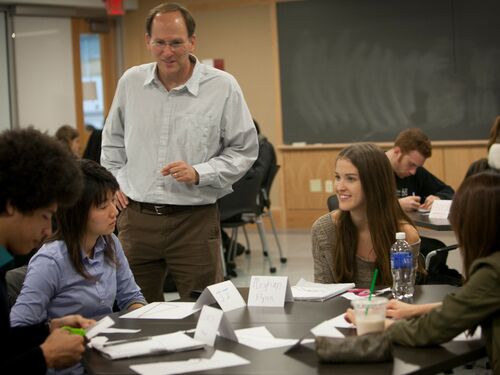
Steven Strogatz, professor of mathematics, teaches an 2014 engaged learning course.

As a researcher who sees math everywhere — around us and inside us — Steven Strogatz has blogged about math for The New York Times and The New Yorker and is the host of The Joy of Why, a podcast by Quanta Magazine that explores the great scientific and mathematical questions of our time.
The Winokur Distinguished Professor for the Public Understanding of Science and Mathematics at Cornell University and a member of the National Academy of Sciences, Strogatz is also the author of Nonlinear Dynamics and Chaos, Sync, The Calculus of Friendship, The Joy of x, and most recently, Infinite Powers, which was a New York Times bestseller. His 1998 Nature paper on small-world networks, co-authored with his former student Duncan Watts, has been cited more than 50,000 times and is among the 100 most-cited scientific papers of all time.
We asked Strogatz — a 2023 top award winner of the National Academies’ Eric and Wendy Schmidt Awards for Excellence in Science Communications — about his love of math, where it shows up in his everyday life, and what sparked his efforts to communicate about it.
What originally sparked your fascination with math?
Strogatz: In high school, my teacher Mr. Johnson once posed a geometry problem he said no student had ever solved … and he admitted he couldn’t solve it either. That was electrifying. I wrestled with it for months, failing again and again, until finally the solution came. That struggle, and the thrill of eventually cracking it, lit the spark for me.
When did you first begin communicating about math beyond your university, and what drew you to do so?
Strogatz: I’ve always thought of myself as a teacher. In 2010, when The New York Times invited me to write a series about the elements of math, I jumped at the chance to share math’s fun and playfulness with readers who might be up for a second chance at the subject.
Your research and communication often tie together different disciplines. What advantages have you found in approaching science this way?
Strogatz: Math reveals hidden unity in things that look unrelated. Take the power grid, a worm’s neural network, and all the actors who’ve ever appeared in a feature film. All these networks are “small worlds,” where every power plant, neuron, and actor is only a few steps away from every other. Interdisciplinarity helps you see these deeper patterns — and ferry tools across fields to reveal the bigger picture.
Your recent series, Math, Revealed, aims to illuminate the presence of mathematics in everyday life. How did you select the real-world applications, and how did the series come about?
Strogatz: I wanted to start with tangible objects — apples, Etch A Sketches — because nobody’s afraid of those, and then let the math unfold from there, taking the reader on a journey into deeper topics like sphere packing or MRI scanning. I pitched the idea to my editor, Alan Burdick, and he teamed us up with the visuals team at the Times. They gave the series a colorful, whimsical look, which helped invite skeptical readers in.
Your books — The Joy of x, Infinite Powers, The Calculus of Friendship — each offer a different window into mathematics. How did you choose the lens for each one?
Strogatz: Each came from a different urge. The Joy of x was math appreciation: a guided tour of highlights. Infinite Powers told the saga of calculus and how it changed the world. The Calculus of Friendship was intimate: a 30-year correspondence with my high school teacher Mr. Joffray that became a parable about friendship and life’s ups and downs. One reviewer called it a tear-jerker.
You’ve said that you “see math everywhere, around us and inside us.” Could you share an example from daily life?
Strogatz: While living in New York as a visiting professor, I noticed strange light patterns in my building’s elevator, coming from the ceiling lights reflecting off the shiny doors and walls. They should’ve formed parabolas but instead traced mysterious curves. I tweeted a photo asking for help. No one solved it, and neither did I. I love that even an elevator ride can pose a math puzzle.
If you had unlimited resources and collaborators, what mathematical problem would you most want to tackle next?
Strogatz: I’d want to make progress on interpretability of AI, especially neural networks and large language models. They’re powerful but baffling. Could math pry open the black box, revealing principles like those that once explained chaos, synchronization, and small worlds — and guiding us on when to trust AI’s answers and when to be skeptical?
Related Resources
More like this


Discover
Events
Right Now & Next Up
Stay in the loop with can’t-miss sessions, live events, and activities happening over the next two days.
NAS Building Guided Tours Available!
Participate in a one-hour guided tour of the historic National Academy of Sciences building, highlighting its distinctive architecture, renowned artwork, and the intersection of art, science, and culture.