The Rabbit Hole of Everyday Questions with Emily Zhang
Feature Story
By Olivia Hamilton
Last update June 3, 2026
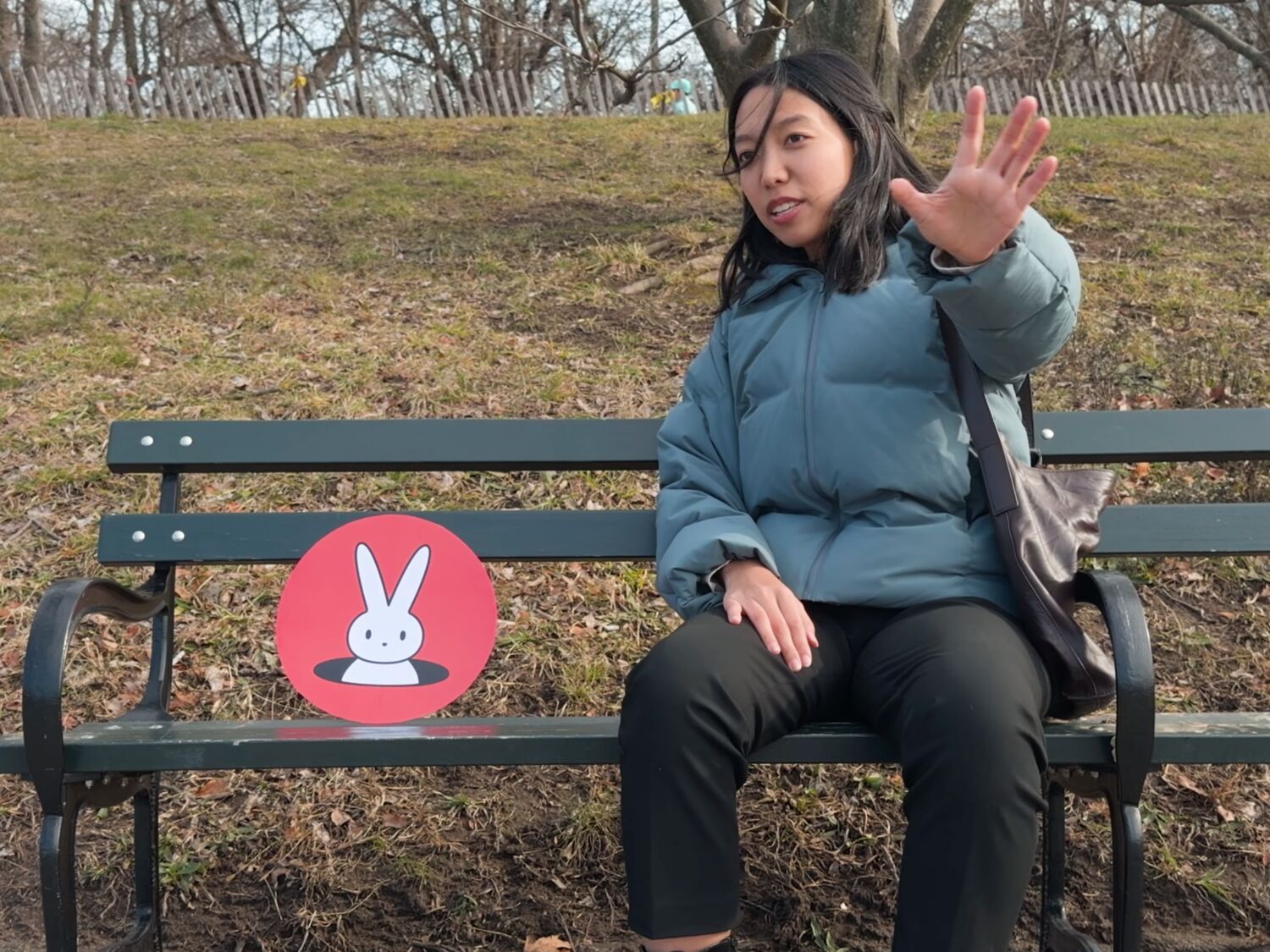
Emily Zhang is a creator who specializes in making science videos for YouTube. Her dozens of videos — on subjects from the physics of bowling to the invention of the blue LED — have received over 300 million views. With a lifelong love of YouTube and an astrophysics degree, she joined the platform’s science channel Veritasium as one of its first employees. There she cut her teeth running company operations and writing, directing, and producing videos, eventually creating some of the channel’s most successful videos from 2021-2024 and later freelancing with over a dozen YouTube channels.
In 2026 she started her own channel, Rabbit Hole, to offer “extraordinary answers to everyday questions,” gaining nearly 200,000 subscribers in three months.
Zhang is a 2025 award winner of the National Academies’ Eric and Wendy Schmidt Awards for Excellence in Science Communications, which honor exceptional science communicators, journalists, and research scientists who have developed creative, original work to communicate issues and advances in science, engineering, or medicine for the general public.
We asked Zhang about Rabbit Hole and her experiences with YouTube as a medium for science communication.
What led you to start your YouTube channel Rabbit Hole, and what was the inspiration behind the name?
Zhang: Toward the end of 2024, I felt like there was a lot of anti-science sentiment popping up — and it felt very surprising to a lot of people, but I feel like if you looked closer at it, it was actually a long time coming. The internet was increasingly shaping how people understood the world, and it was dominating a lot of conversation — not just in science, but around how people perceived anything at all.
But the internet is a space I feel like I recognize and know well, and I realized I wanted to use that space differently. Instead of creating high-octane content that encourages people to live online and live through other people’s lives, I wanted to make something that pushes people back into their own real-world experiences and encourages them to be curious about the objects, systems, and questions already around them. Once I had the idea, it became very immediate. I had to do it.
The name Rabbit Hole came from the fact that I always knew that I was going to cover little, recognizable, everyday topics, and dive into them to the fullest extent possible. So, I was toying with things like Niche or In the Weeds, but Rabbit Hole felt like the true essence of my intention behind the channel, and it was playful! I’m also the Year of the Rabbit so it felt like a perfect title for my own channel.
You’ve described Rabbit Hole as reclaiming curiosity from the internet’s more negative “rabbit holes.” What does that idea mean to you?
Zhang: When people talk about “rabbit holes” online, they usually mean conspiracy theories — taking a coincidence or vague connection and spiraling deeper into fear, anger, or suspicion. But the underlying impulse behind that is still curiosity. There is something addictive about it, and I see why conspiracies do well in the algorithms because they’re trying to uncover something through investigation and research. But why does that curiosity have to be used to try and uncover something bad?
People enjoy investigating things, uncovering mysteries, and feeling like they’re discovering hidden connections, and there’s no reason this curiosity can’t lead you towards the wonders of innovation and human ingenuity. So I wanted to turn that same force of curiosity for good.
We’ve also started associating curiosity with only the biggest, most extreme things — the world’s largest experiment, the most expensive experience, the wildest stunt. But curiosity doesn’t have to be superlative; it can be extremely small and everyday. It can begin with something as ordinary as the salt on your table. I think fewer people walk around on their morning commutes and take in the wonder of the little things around them anymore, because they can just stare at their phone watching some most expensive, biggest, fanciest show ever made. But the real world around them is actually more relevant and can pique curiosity just as well.
What made you decide to build this channel around everyday questions instead of big, headline-grabbing scientific discoveries?
Zhang: People pick the biggest, most impressive, expensive, large things to make media about because they believe it’s what people want to see. Which is true — people do want to see these extreme discoveries, and those stories can be inspiring — but they can also make people feel disconnected from their own lives. You watch someone doing something you could never do, and instead of feeling engaged with your world, you feel like you’re watching someone else’s life from a distance. It prevents you from focusing on your own life and what is interesting within your own life — how you can engage with your local community, or the cool objects around you.
There’s room for inspiration and aspiration to do great things, for sure, but I think that has to start with you seeing a starting point in your own life — something very interesting you can latch onto right here and start working on right now. I wanted viewers to finish a video and immediately engage with something in their own lives; check the salt in their kitchen, look differently at their office chair, or question why something around them was designed the way it was.
That online-to-real-world interface is really important, and it’s something that online creators really struggle to bridge, but I think this is how you do it; you talk about something that anyone can immediately go engage with in their real life.
Your work often starts with deceptively simple questions. What’s your process for identifying which questions are worth going down a rabbit hole?
Zhang: The best questions begin with familiarity. People have to recognize something in it, so I pick everyday objects, everyday things that you already notice.
I love questions where someone initially thinks they know the answer, then suddenly realizes they don’t. It should sound like a question that you would ask at a party, and someone will go, “oh, well, of course … wait, actually I have no idea.” Like — why is salt iodized? Most people know or at least recognize the phrase “iodized salt.” But when I ask about it, people will just say it’s a “health thing,” and they don’t know more. Very few people know the full story. That space between familiarity and mystery is where the best rabbit holes begin.
Your channel is rooted in the idea that science is hidden in plain sight. What do we often miss in our everyday environments and how has working on this channel changed how you move through the world?
Zhang: We are all looking at the same things. Everyone is looking at their kitchen cabinet and seeing ingredients, everyone is looking at a chair. Out on the street, everyone sees a sidewalk and signs and crosswalks. You see all these things, but I feel like these days people are losing the instinct to wonder about them.
I want to bring that instinct back: Why did we design it this way? How did that get here? What problem was this solving? You won’t take anything for granted once you investigate it, and I think that’s a better way to move through the world. Don’t just let your questions fly away. There’s so much fun in chasing those curiosities.
I come up with ideas for this channel every single day — the very premise of my channel makes it far easier than it probably is for other creators. While eating or brushing my teeth, I’ll think of a question because of the things right in front of me, and I immediately write it down to investigate later. It’s very much how I live my life now!
Many of your stories connect science to history, design, and human behavior. How does interdisciplinary storytelling deepen your discoveries?
Zhang: Honestly, it happens naturally when you try to answer a question as comprehensively as possible. When you investigate anything deeply, you often find that there isn’t one way to do it, and there isn’t one person that did it with a specific subfield. It’s usually a bunch of different areas of study, and people, and history, and everything comes together, because that’s how the world actually works! It’s not a conscious decision I make to tell the story a certain way. By simply trying to answer the question as completely as possible, I end up creating an interdisciplinary story. It’s beautiful that that is actually how the world works. If you genuinely follow a question to its roots, it’s often not defined by categories or disciplines at all.
You’ve worked on some of the most successful science videos online. What makes YouTube uniquely powerful for communicating science?
Zhang: So many forms of media depend on you just stumbling upon them. With TikTok or Instagram, you just get served a video in your feed when you’re already scrolling, you don’t go seek it out. Even movies often just pop up in our consciousness because a commercial or preview shows up when you happen to be sitting there. YouTube is different. It’s such an open marketplace, where every thumbnail and title is like a little poster competing for curiosity, and then you get to actively participate in choosing which question or mystery you want answered today.
That is such a powerful thing because it means that, at its best, YouTube rewards good questions above anything, rather than coincidences of scrolling or trending things, or big studio marketing budgets. And because the barrier to entry is so low, anyone anywhere in the world can either make a video about or click to watch the exploration of a fascinating question and immediately explore it, basically for free. To me, it’s such a beautiful flat ground space for all of this discovery to happen.
There’s a lot of discussion about “doomscrolling.” Your channel explicitly tries to counter that. In your opinion, what does a healthier relationship with online content look like and how do you foster it in an online space?
Zhang: A healthy relationship with the internet and being online means using it to supplement your real-life experience rather than using it to replace it.
When I’m online, I hope that it makes me see the world differently, and that when I go out, I appreciate life more. I appreciate an office chair more, or I appreciate the person standing next to me on the subway more because I just watched a video about how everyone is going through something.
Hopefully you can consume the content, and then put it aside, and go into the world with that new knowledge and have a better life. I think what we lose when we doomscroll is that instead of engaging with the world, we are just taking in all these stories and glimpses of humanity, and then just storing them in our heads and continuing to scroll, alone, in our rooms. You can’t do anything with what you’ve learned.
The healthiest relationship with the internet should help you engage with your real life more, not less.
What role do visuals play — not just in explaining, but in creating understanding?
Zhang: I always loved video growing up. I thought it was the most engaging way to learn anything or spend my time. I think there’s something about the human connection of actually having a person look at you through the screen and use their hand motions to help you grasp a concept, or even down to the level of which word in a sentence should be emphasized when spoken.
Especially for technical, more complicated concepts, there’s nothing that compares to being able to explain an idea while visual diagrams and cues change simultaneously on screen. People can follow a process step-by-step while still remembering what came before — books and other mediums can teach very well, but I think it’s that retention of holding many concepts in your head at once that is very hard to do without visuals.
It’s so fun and feels very similar to how our brains work naturally to process information.
You’ve transitioned from working on major channels to building your own. What has been the biggest shift creatively or strategically?
Zhang: At first, it was terrifying. In the past, I’ve always had a net to catch me. If I made a really wild decision, someone would be there to say, “actually, we shouldn’t do that.” Now, no one is there to stop me if I make some weird choice or go down a wrong path. But the freedom that brings is also so exciting.
Also, I now have the confidence, having worked with big channels, to make decisions on my own that I wouldn’t have if I was a newcomer to YouTube. I actually feel more free to do some wild experiments, take risks, make strange decisions, and trust my instincts because of the experience I’ve built over the years. I trust that I understand the space well enough.
I have much less budget now, but in a way, those constraints make me more creative. Instead of relying on a production team to make some visuals for me, I’m building props, printing things out on my printer, making little puppets, and it looks a little cheap, but it’s fun. That, to me, is the point of YouTube. YouTube is all about people making videos in their bedrooms out of pure passion, no studio required. I feel like it’s forced me to return to those roots of YouTube in a great way.
I always loved watching people dressing up in costumes and doing sketches in their bedrooms, and that’s what I’m doing here. I’m improvising props and trying to make it work in my little apartment.
What kinds of questions or topics are you most excited to explore next?
Zhang: Two things: the first one is that I will always be guided by what I think are the most interesting everyday questions above all, so I think for me, these will not only stick to science. This channel isn’t even about science in the slogan; it’s just extraordinary answers to everyday questions. But it turns out that the answer behind so many cool things in the world is science. So, I think, for me, the fact that it ends up being science a lot of the time is just reflecting a truth about the world — that so many things, when you boil them down, are a really cool human discovery.
But yes, the channel may reach beyond science, because at the core, I want to help people find curiosity, whatever the subject is. I want to show that any person can enjoy a science topic and a non-science topic all together, because we all have the same value of chasing our curiosity and wanting to appreciate the world.
Second, no matter how well the channel does, even if I had a really big budget and wanted to do some really big thing, it would always have to come back to an everyday question. So I’m excited to do some topics years in the future, if I have the budget, where I chase down a little rabbit hole that starts with just something in your house, and ends up with me doing some wild experiment in a faraway lab just to understand the core of what goes into this little object. But the video will always start with the little object and end with the little object, because it always has to come back to your own life, even if we go on some wild tangents along the way.
If Rabbit Hole succeeds in the way you hope, what will that look like?
Zhang: I often tell people that, for me, the mark of Rabbit Hole being successful is if I’m out in the world, at an airport, at a bus terminal, sitting in a park one day, and I hear strangers around me connecting with each other over some fun fact that they learned from one of my videos. Maybe two new coworkers are discussing why office chairs have five legs. Maybe two strangers sitting next to each other on the bus start talking about some bus stop video I end up making. To me, that would mean my channel has truly done what it set out to do.
Ultimately, I want people to start connecting with each other. I want people to chase their curiosities, but not just stop there — I want them to actually use that curiosity to connect with each other too. Because I think curiosity is the opposite of fear, and people don’t want to talk to each other because they’re scared of each other or they don’t understand each other. Curiosity is the complete antidote to that. It’s once you replace that instinct of, “I don’t know what to do here. I’m scared,” with, “I don’t know what to do here. Let me ask a question, let me understand it better.” If people chase that instinct and end up connecting with strangers in their real life, that would be the best possible outcome of the internet in general, I think. That’s what I want for Rabbit Hole.
Related Resource