Science and the Greater Everglades Ecosystem Restoration: An Assessment of the Critical Ecosystem Studies Initiative (2003)
Chapter: Appendix F: Monitoring and Assessment Plan Conceptual Model
Appendix F
Monitoring and Assessment Plan Conceptual Model
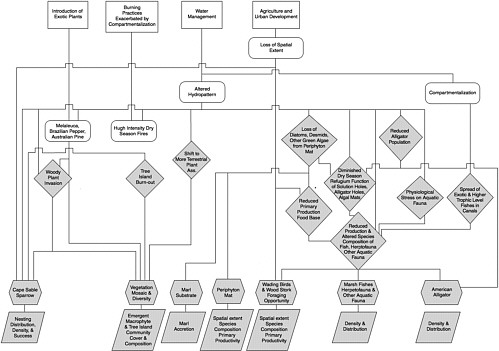
The Comprehensive Everglades Restoration Plan (CERP) Monitoring and Assessment Plan (MAP) is based on nine regional conceptual models and an eco-system-wide model. The nine regional models are fully developed, while the ecosystem-wide model is in the early stages of development. Although the conceptual models form the basis for the MAP, these models have wider application in the broader restoration because they are a representation of the current state of understanding of ecosystem function based on the best science available. These simple, nonquantitative models were used to develop a set of causal hypotheses that explain the impact anthropogenic drivers and stressors have on the natural system. Each of the models details the linkages between drivers, stressors, and ecosystem attributes. The models also identify the most appropriate measures of each attribute. The conceptual models include five major components:
-
Drivers are the major external forces, either natural (e.g., sea-level rise) or anthropogenic (e.g., regional land-use programs) that have large-scale influences on natural systems
-
Stressors are the physical or chemical changes that occur within the ecosystem that are brought about by the drivers. Stressors cause significant changes in the biological components, patterns, and relationships in the natural system
-
Ecological effects are the biological responses to the stressors
-
Attributes, or indicators, are typically populations (e.g., number of roseate spoonbills), species (e.g., American alligator), guilds (e.g., number of nesting birds), communities (e.g., tree islands), or processes (e.g., primary production)
-
Measures are the specific feature(s) of each attribute that must be monitored to determine the attribute response to changes in the stressors
Each of the models includes documentation that describes (1) the dynamics and problems of the specific physiographic region, (2) descriptions of the external drivers, ecological stressors, and attributes, (3) description of the expected ecological response to changes in drivers and stressors expressed as hypotheses, with the degree of associated uncertainty, and (4) preliminary restoration targets for the attributes. The Critical Ecosystem Studies Initiative has funded a number of projects that have contributed to the Marl Prairie and Rocky Glades conceptual model included here to illustrate model structure.