Schrödinger's Rabbits: The Many Worlds of Quantum (2004)
Chapter: 4 A Horror Story Writ Large
CHAPTER 4
A HORROR STORY WRIT LARGE
The experimental results described in the preceding chapter are certainly surprising. But you may well be wondering why they have caused such a huge upset in science, to the point where some of the human race’s most intelligent minds have been prepared to seriously consider wild philosophical ideas like those described by Professor Cope in Chapter 1. So-called observer effects are disconcerting, but they normally affect only tiny things. Quantum effects of every kind normally average out to produce large-scale behavior that obeys classical statistics; your Polaroid sunglasses, for example, reliably shield your eyes from the glare by absorbing an exactly predictable fraction of the photons that reach them, spooky quantum behavior notwithstanding.
If quantum does not actually cause a paradox at the macroscopic scale—as would perhaps be the case if you could transmit real information faster than light and backward in time—the layperson could be forgiven for asking: Can we not just overlook the oddities? Less excusably, many physicists take somewhat the same line, overtly or tacitly. This chapter is devoted to showing how the effects of quantum can be magnified, naturally and artificially, to the point where no one could possibly ignore them. As we go, we shall make a list of what I will call the PPQs—the Principal Puzzles of Quantum.
It Can Be a Big Deal
First, let us demolish the idea that quantum weirdness only ever affects microscopic systems. Quantum effects can be amplified quite easily. The lottery cards of Chapter 1, for instance, are not just a metaphor; they could be manufactured for real. Each card would have to contain some mechanism that created a quantum-linked system when the card was torn. In principle, that could involve a pair of photons exactly like those in the Bell-Aspect experiment; each photon could be stored in an arrangement called a high-finesse cavity, shuttling to and fro between two almost-perfect mirrors. That is technically difficult; a more promising approach would store the link in the spin of quantum-correlated atomic nuclei. When either half of a card was scratched, a mechanism could just measure the magnetization of the local nuclei using the technique called nuclear magnetic resonance (NMR for short) and release a chemical that would turn the relevant spot black or white depending on the result. Using that technology, the cards could be made reasonably small—my guess would be about the size and mass of a pocket PC. They would be expensive, but they would work just as described in the story.
Once a measurement is made, its consequences can always be amplified indefinitely. One possible objection to the test described in Chapter 1 in which one-half of a lottery card is sent to Australia, and then both halves are scratched and measured simultaneously by machines so that there is no time for any speed-of-light message to pass between the cards, might be on these lines: Perhaps the color of the lottery card does not really turn properly black or white until a fraction of a second after the measurement is done. For example, if scratching the card triggers a chemical reaction, it always takes a little time for a stable compound to form. An analogy is one of those fair-ground games where you must throw a ball onto a tray of bottles with funnel-shaped necks. The ball bounces around tantalizingly between one bottle and another. Sometimes, even after it appears to have made its choice and is rattling around in the neck of one particular bottle, it can still spring across to a neighboring one at the last minute. Perhaps the color of the spot is not truly determined until there has been time
enough for speed-of-light signals to bounce to and fro between America and Australia.
To answer this argument, we will scale up the lottery-card experiment to a version where you are on Earth and your partner is on Mars. We will scratch the lottery cards when the planets are far apart in their orbits, so that light takes about 15 minutes to get from one to the other. Moreover, we will assume that your partner has a morbid fear of the color black, so if her spot turns out to be black, she will immediately shoot herself.
You each scratch your card. On Earth, your spot turns out to be white, and you know that if the cards work, your partner is 99 percent likely to be safe. If we are in a classical universe, with no faster-than-light signaling of any kind allowed, your partner’s spot has no way to know this and there is presumably a 50 percent chance that it initially appear black. It cannot know about the result of your measurement for 15 minutes. Do you really believe that all the molecules in the gun, the bullet, your partner’s body, and so on, had not quite decided which positions to be in for a quarter of an hour? And of course you could have scaled up the outcome on Mars (or indeed, Earth) even further, with a device that would trigger an H-bomb if the card turned out to be black, and so on. There is no limit to the amplification that you can do.
A Virtual Time Machine
I have claimed that, in a relativistic universe, being able to send information faster than light implies that you could also send it backward in time. This is not the place to explain special relativity fully, but I want you to feel this point in your bones, and we can describe the essentials quite simply.
Einstein realized that if the speed of light is the same for all observers (the basic assumption from which all of special relativity can be deduced), then the sequence of events can appear different to different observers. We will explore this with a slight extension of his original thought experiment using a railway train as shown in Figure 4-1.
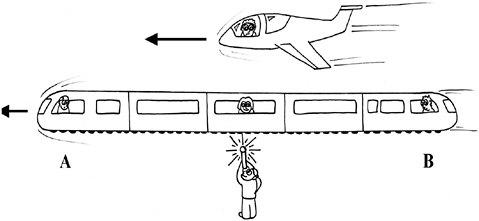
FIGURE 4-1 At the midpoint of the train are three observers—one on the train, one by the trackside, and one on an airplane that is overtaking the train. The observer on the train thinks A and B receive the light signal simultaneously. But the trackside observer thinks that B gets the signal first, and the aviator thinks that A gets it first.
Suppose a lamp mounted at the center of a train flashes. Clearly, two observers on the train, one stationed, say, exactly two cars ahead of the lamp, the other exactly two cars behind it, will see the flash at precisely the same instant. It makes no difference whether the train is stopped or moving.
But we have an apparent paradox if the train is indeed speeding along, and we consider the point of view of an observer who is stationary with respect to the Earth. For convenience, let us suppose that he is standing beside the track at the point where the light is flashed. Because the front of the train is receding from the light pulse, whereas the rear is advancing to meet it, he will unambiguously measure the flash as reaching the rear observer on the train before it reaches the front observer. The difference would be tiny—on the order of 10−13 seconds for a real train—but it can be much larger if we are talking about faster and more widely separated systems, such as imaginary spaceships or real stars or planets moving at high relative speeds. Conversely, from the point of view of an observer moving the other way with respect to the train—say, a pilot overtaking it in an aircraft—the
rear observer on the train receives the pulse after the front observer. How can this be?
The different sequences witnessed are all equally “real”—some observers can quite validly think that A got the signal first, others that it was B. Luckily or otherwise, though, no one can use the fact to send a signal backward in time because, considered as two events in spacetime, the time-and-space point at which A sees the flash and the time-and-space point at which B sees the flash are what is called spacelike separated. This means simply that the spatial separation between them is sufficiently great that it is impossible for any light-speed message to pass from one to the other, in either direction, in the time interval between the two events. This applies from the point of view of any observer. For example, an alien in a fast spacecraft overtaking the train at 99.99 percent of the speed of light will see the train contracted to a tiny fraction of the length it appears to us, and will measure the front observer getting the flash significantly before the rear one, but still without enough time passing for anyone to take a message from the front observer to the rear one in the delay between the two events. No signal can pass between two spacelike separated events in the time available, so neither event can possibly cause the other, or indeed have any effect on the other.
It turns out that any two events in space-time are always unambiguously either spacelike separated or timelike separated from the point of view of all possible observers. If they are timelike separated, then one can have influenced the other, but the order is always unambiguous. In our normal world, the difference is usually very obvious. For example, the events of Columbus setting foot in America and your picking up this book are timelike separated, and Columbus unambiguously happened first: Columbus’s actions might have had an effect on you, but not vice versa, and any alien observers zooming spaceships around in complicated patterns will agree with you on this point.
So the problem that widely separated events may appear to happen in a different order to observers moving at different speeds is purely one of bookkeeping. Back in the Victorian era, when the first transatlantic telegraph wires were laid, people found it very puzzling that they could send a message from London to New York that could
be physically delivered in New York (normally by a telegraph boy on a bicycle, clutching a typewritten sheet) at a time before it had left London, as measured by local clocks in each case. When telegraph wires were laid round the world, even across the Pacific, might it have been possible to send a message around the world to yourself that would arrive before you had sent it? Of course, intelligent people realized that this was nonsense, but before the position of the International Date Line was agreed, the point caused considerable confusion. Jules Verne had fun with these difficulties in Around the World in Eighty Days, and Oxford mathematician Charles Dodgson (best known for his books, Through the Looking Glass and Alice’s Adventures in Wonderland under the pseudonym Lewis Carroll) amused himself by sending spoof enquiries to the telegraph companies about the matter. Nowadays, we all know that claims like “If you fly from London to New York by Concorde you will land before you take off” merely refer to clocks set to different time zones. Of course, you are not really traveling backward in time. Similarly, observers on differently moving spaceships inferring by subsequent observation that distant events happened in different sequences is in no sense a real paradox.
But if you could somehow send messages faster than light, this sequencing problem suddenly would become real. To see how, look at the position in Figure 4-2, where two very long and fast trains are passing in opposite directions. Both trains are equipped with instant
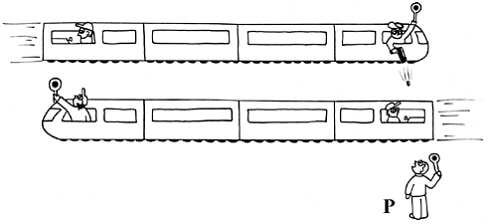
FIGURE 4-2 If the conductor on each train has a device that allows him to send a signal to his engineer instantaneously, P gets his message back before he sends it.
signalling devices linking the engineer at the front with the conductor in the caboose at the rear. You are standing at position P. You ask the conductor of the train passing you if he would be so kind as to send a message to his engineer for you.
The conductor obligingly sends the message, which travels instantly in his frame of reference. As we have just seen, in your trackside frame of reference, it gets there a little earlier than it set out—for convenience, let us say 1 second earlier, though that would be more realistic with spacecraft than trains. There is no obvious paradox yet, but now suppose the engineer of the leftward-going train sends your message over to the conductor of the rightward-going one (he can do this by ordinary slower-than-light signaling, because the trains are close together), and asks that conductor to send the message on to his engineer using his own faster-than-light signaler. Once again, in your trackside frame of reference, this signal arrives a second before it was sent. You get your message back 2 seconds before it was transmitted! And now all the familiar paradoxes of time travel arise. For example, what if the message asks the engineer of the rightward-going train to shoot you—therefore preventing your sending the message that asked him to do this?
We do not really have such an instantaneous communicator, but what we do have is an unlimited supply of lottery cards that (unless we adopt the extreme philosophical positions described by Professor Cope) seem to require an instantaneous communication mechanism for their internal workings. Suppose my partner and I have each taken half a lottery card, and set out in two spaceships traveling in opposite directions. At a certain agreed time after takeoff, when the ships have become widely separated, we each scratch our respective halves of the card. We will find that the now familiar “spooky correlations” occur.
A pretty philosophical problem arises immediately. When we use the lottery cards back on Earth, we have the option of scratching them at different times, so that the two events of left-card-scratch and right-card-scratch are timelike separated and done in an unambiguous order. For example, I might scratch the left card, revealing, say, black, and invite you to scratch the right one a minute later. Under these circumstances, presumably my card acted as the master, decided which
color to be itself, and sent some signal to your card telling it how to behave subsequently. But in our spacelike-separated spaceships, because we are traveling in different directions, from the point of view of a leftward-traveling observer, I scratched off my card first—it was the master and yours the slave—whereas from the point of view of a rightward-traveling observer, your card was scratched first, and mine had to conform with it. Because in special relativity, no frame of motion is better or more correct than any other, there is no way to answer the question of which card influenced which. But for many classical physicists, a far more troubling puzzle is this: From some points of view, whichever card acted as master sent a signal that retrospectively determined the outcome at the other card’s location. How can this possibly be?
To make the horror of the lottery cards clear, a classic science fiction story that I read as a teenager illustrates the point rather vividly. In the story, a conventionally minded physicist is sent to investigate an alleged case of psychic powers. The subject (who appears completely unaware of her own spooky abilities) is a hospital patient in an isolation ward, a blind lady whose only news from the outside world comes from a nurse who reads her randomly selected stories from the local newspaper. The nurse has noticed a strange thing: Whenever she reads the old lady a sob story, it turns out subsequently to have a happy ending, even in circumstances where that seemed very improbable. If the blind lady is read a story about an abandoned baby, the mother later has a change of heart and returns lovingly to collect it; if it is about a cancer sufferer, the person goes on to have a spontaneous remission, and so forth. None of the instances taken on its own is in any way impossible, just lucky, but the odds against this happening for every story the blind lady is read are overwhelming.
At first, the physicist is extremely skeptical. But after many increasingly foolproof tests, he is driven to the conclusion that the old lady does have some kind of psychic power: She can heal other people and situations. Very reluctantly, he accepts that she must be able to perform some kind of unconscious action at a distance, and he is able to integrate this fact into his worldview.
Then the old lady hears a story about an air disaster that hap-
pened a week earlier. The crash happened in remote mountains, and the site has not been found, but there is no realistic hope of survivors. The day after she hears the story, the entire crew and passengers from the airliner limp into a remote village, weary but not seriously hurt. They report that by a million-to-one chance the plane bounced from trees into a snowdrift, without injuring anybody, but in such an inaccessible location that it has taken them this long to make their way to civilization.
The physicist’s hair stands on end as he tries to work out how this can be. Did decaying flesh and bones slide about, reassembling themselves into intact, healthy human beings? Or—in a way even more terrifying—could the old lady’s power reach backward in time, undoing events that had already happened? The scientist spends the rest of his life trying as hard as he can not to think about what really happened on that mountainside. This is really quite reminiscent of some physicists’ attitude to quantum paradoxes.
Tiny Particles Make Huge Waves
Another point I want to emphasize about quantum is the sheer gigantic size the wave associated with every particle can grow to. The two-slit experiment is normally performed in a container roughly the shape and size of a shoebox. But of course the wave associated with a single photon can explore not just two, but an infinity of routes, and over unlimited distances. For a more dramatic illustration, consider the Temple of the Photon, a place I have just invented—although I have been in a Manhattan restaurant whose decor resembled it alarmingly. The Temple of the Photon is a cathedral-like open space with a great complexity of randomly placed pillars, statues, bas-relief sculptures, and so forth. Its distinctive feature is that every surface is coated with a perfectly reflective substance. The only exception is a square canvas on one wall, which is coated with ultrasensitive photographic film. Into the temple we take a low-intensity photon source, which we leave for a week or two. Photons will be emitted at an average rate of one per second, and whatever trajectory each one follows, it will eventually strike the photographic film, because that is the only place it can be absorbed.
When we develop the photographic film, we will see a very complex interference pattern, far more convoluted than the simple stripes of the two-slit experiment. (It will more closely resemble a hologram, which is made in quite a similar way.) But the pattern will include lighter areas and darker areas, and typically some spots that are perfectly black. The only way to work out the pattern, and in particular, where those black spots of perfect cancellation occur, is to trace every possible path that the photon could take from its source to that point on the film, and calculate the length of each trajectory to an accuracy much better than the wavelength of light. The sum of the interference effects from all the infinity of slightly different paths tells us whether the spot will be dark. Changing anything in the building—moving a small statue in one of the side aisles a fraction of a micrometer, say—changes the position of the dark spots. As the pattern builds up, one photon at a time, each and every photon must explore the whole temple—trace every possible trajectory through it—to decide where on the film to alight. If even a few photons missed out on exploring even some of the possible trajectories, they would not know to avoid the dark spots, and the pattern would be contaminated.
It gets more extreme than this. Imagine that back in the early universe, an atom emits a photon. The photon travels through space for 13 billion years, until it eventually strikes the mirror of the Hubble space telescope and expires against an electronic detector, contributing to one of Hubble’s long-exposure, deep-sky pictures. For 13 billion years, that photon has been riding an expanding wave bubble that has mapped out a volume of 1031 cubic light years—all to correctly guide the trajectory of one tiny photon. If the atom emitted a couple of photons in rapid succession, their polarization might be linked, just as in the Aspect experiment. If the Hubble telescope happens to be using an instrument with a polarizing filter, then its measurement effectively causes another photon 26 billion light-years away—far beyond the currently observable universe—not only to “fall off its guide wave” into a specific location, but to do so in a way that correlates with Hubble’s measurement. You might say it forces that incredibly distant surfer to tumble off his board at a particular angle, which we can control to be one of two choices.
The resultant effect does not require cleverly designed lottery cards to amplify its results to macroscopic significance. Systems that involve repeated collisions—whether of air molecules or real-sized billiard balls on a baize-topped table—multiply very small initial effects in an exponential way. This is why many big-money lotteries use a tumbling cylinder of balls to determine the winning numbers: The position of individual balls rapidly becomes completely unpredictable.
Long before chaos theory was invented—in fact, back in 1914—a physicist named Borel demonstrated mathematically that the minuscule change in gravitational attraction caused by moving a small stone a hundred light-years from Earth a few centimeters would completely change the positions of all the individual air molecules within our atmosphere a few seconds after the field alteration reached us. The famous butterfly effect then takes over; tiny alterations in microscopic air currents totally alter the weather pattern of the whole Earth within a few weeks. And chaotic systems like the weather have a very significant effect on human history. If the Spanish Armada had not been scattered by a freak storm as it was on its way to attack England, subsequent European history would have been very different. A similar event affected the Far East a few centuries earlier, when a huge fleet sent from China to conquer Japan was also defeated by bad weather. Something as tiny as the motion of a single subatomic particle not only can, but usually does, alter the whole course of history.
So when a human-made telescope detects a photon that has been traveling through space for millions of years, or a cosmic-ray detector buried beneath Antarctica detects half of a smashed atomic nucleus that has been voyaging for a similar time, the result can have very real implications for events in, say, the Andromeda galaxy. Light from Andromeda takes a million and a half years to reach Earth. The Andromeda that our descendants observe a million and a half years from now will be seen to have evolved in, ultimately, an utterly different way—affecting perhaps such things as which planets in Andromeda do or do not develop life, and whether one spawns intelligent beings that go on to set up a galactic empire—according to which way we put the filter in our telescope.
In a final generalization of our original rather contrived (if poten-
tially makeable) lottery cards, these long-range spooky influences affect not just things that have been in very intimate contact, such as photons or other particles that originally came from the same atom. These are just cases where the spooky link is easiest to observe in practice, as in the Aspect experiment. Any pair or larger group of particles that have once interacted—for example, two electrons that were once in the general vicinity of one another—will show a certain degree of spooky correlation in their subsequent behavior. Any measurement-style interaction with one has a subtle effect on the rest. The photons and other particles that enter Earth’s atmosphere each second are thus directly and indirectly linked to just about every other particle in the observable universe. And when such a particle is measured by striking some terrestrial object, it seems to have some subtle instant effect on all other particles everywhere.
I stress once again that these links are not causative, in the sense that we cannot use them to send any kind of information or message. As with the lottery cards, we can measure—but we cannot force the result of a measurement. We cannot use these effects to explain alleged telepathy, for example. But the universe does in a certain sense appear to behave holistically, as if interactions in every part have subtle effects on every other, and if we did try to explain this behavior by some kind of built-in faster-than-light signaling mechanisms, then those mechanisms would by implication have to be capable of sending signals backward in time. Something strange is indeed happening. Here is our first Principle Puzzle of Quantum.
PPQ 1: Spooky quantum links seem to imply either faster-than-light signals or that local events do not promptly proceed in an unambiguous way at each end of the link.
This puzzle leads directly to another disconcerting feature, the intrinsic randomness of quantum. We have been talking about quantum outcomes, such as whether a photon is reflected or transmitted from a filter, as happening “randomly,” but maybe you took that with a pinch of salt. After all, we call everyday events like spinning a roulette wheel or tossing a coin random, even though someone with a sufficiently clever little computer-and-radar kind of arrangement could predict
the outcome. (Indeed, as I write, a scandal involving something similar at a real-life casino has just hit the headlines.) Could not the “random” part of a photon’s decision which way to go when it hits a filter really just be some function of the way the molecules in the filter are bouncing about at the moment it strikes, for example?
It would seem not. For if we could ever force even a minor-seeming exception to true quantum randomness by tinkering with local conditions, a true paradox would follow. To see how, suppose we have found some lottery cards like those of Chapter 1, but just a tiny bit biased. When you scratch the left-hand card in a strong magnetic field, the probability that you will get white is 55 percent rather then 50 percent. You make a plan as follows:
“DARPA has offered us a fabulous sum if we can send a message faster than light with these cards,” you tell your partner. “So we will take a stack of 1,000 cards and tear them down the middle: I will take the left half of the stack and you the right. I will scratch my cards in the presence of a magnet.
“DARPA will ask me to send you a single binary digit, which will obviously be either 0 or 1. If it is 0, I will scratch the top, 12 o’clock spot on each of my cards. If it is 1, I will instead scratch the 3 o’clock spot.
“You need only scratch the top, 12 o’clock, spot on all your cards. We know that if I am also scratching the 12 o’clock spot, your color will be the same as mine every time; on the other hand, if I am scratching the 3 o’clock spot, your color will be different every time. On average, 550 of my spots will be white in either case. So if I am scratching the same spot as you, you will see about 550 whites. If I am scratching a spot at 90 degrees to yours, you will see only about 450 whites. Tell the DARPA examiner the answer is 0 if you see more than 500 whites, 1 otherwise. The chance we will get it right is greater than 99.9 percent!”
A similar strategy could be devised if there were any quantum systems that in any way departed from the perfectly random behavior predicted by quantum mathematics. Using the loophole, you could indeed send a message faster than light, hence backward in time, with potentially paradoxical consequences. Quantum randomness appears to be truly fundamental, truly unpredictable. This is intuitively hard
to accept, and inspired Einstein’s famous comment that he could not believe that God plays dice with the universe.
PPQ 2: Spooky quantum links seem to imply either faster-than-light signals or that quantum events are truly random.
A third puzzle of quantum is the sheer baroque quantity of calculation the universe must apparently do to determine the outcome of each microevent. For example, the wave associated with the photon described above, emitted early in the history of the universe, seemingly had to explore every inch of billions of cubic light-years of space in order to decide where the photon would eventually alight. The task becomes still more impressive when we consider how clever such a wave sometimes has to be.
Remember the oven-ready chickens version of the two-slit experiment? If each chicken has a bar-code tag attached, then a detection of a chicken passing through a slit might be accomplished by placing a bar-code scanner and printer, as used in supermarkets, beside one of the slits. Each time a chicken flies through the slit, the scanner prints an appropriate line on the checkout roll, thus making a record of its passage in the form of a permanent impression on the surrounding environment. As we have discovered, placing such an arrangement by just one of the slits, say the left one, is sufficient to prevent any interference pattern from forming. The universe somehow knows to stop providing guide-wave interference for all chickens—even those that go through the right slit—once the detector is switched on.
In terms of our guide-wave hypothesis, it follows that the presence of the scanner must be disrupting the guide wave itself as it goes through the left slit. That is conceivable. Any detector has some effect on its environment—for example, a standard bar-code scanner would shine a tiny red laser beam across the slit, and it’s plausible that the beam might disrupt the guide wave. But we can fine-tune the arrangement further. Suppose that we program the scanner to suppress printing when a 4-pound chicken passes through. Chickens of all other weights—3 pounds, 5 pounds, or whatever—are to be recorded as before, but there will be no way to tell that a 4-pounder has passed through by examining the checkout roll afterward. Now when we fire
4-pound chickens through the arrangement, we get a full interference pattern. But when we fire chickens of weights the scanner is programmed to detect, we get no interference. How can the universe possibly “know” to make all 4-pounders form an interference pattern, when all we have done is change the internal programming of a scanner that half the chickens (of every weight) do not even go near?
There seems to be only one logical answer. The guide wave must somehow be so clever that it tests the effect its associated chicken would have if it were to pass the bar-code scanner—putting the computer inside the scanner through its paces even though the chicken is passing through the other slit. The guide wave of any non-4-pound chicken thus discovers that it should disrupt itself when passing the slit.
Can the wave really be that clever? It seems highly implausible. But it is not impossible that the guide wave carries such detailed information about its associated particle in every part of it. An analogous object is nowadays familiar. A hologram contains its whole picture in each part of itself. You can test this by smashing a glass hologram and peeking through one of the fragments, or more safely and less expensively by covering up all but part of the hologram with a paper mask and examining at different angles the bit that remains exposed. Perhaps guide waves behave like that, temporarily fooling the universe in the same way that a hologram can deceive our eyes about the apparent position of an object, testing what would happen if the associated chicken’s label were to pass the scanner. The guide-wave hypothesis survives, barely. Nevertheless, when we consider the potential hugeness of each guide wave in conjunction with its extraordinary cleverness, we are justified in formulating a third PPQ.
PPQ 3: Why does the universe seem to waste such a colossal amount of effort investigating might-have-beens, things that could have happened but didn’t?
Another problem with the wave-rider picture that we have been trying to build is more subtle. So far we have spoken of wave-riding particles as undergoing two kinds of interaction. The first kind was an encounter with another wave-riding particle. The result of that is that each particle continues on its way, but riding a more complicated wave
shape, and now with a curious relationship between the fates of the two particles, which we call entanglement. The second kind was a measurement, something that knocked the particle off its wave altogether, for example, hitting a solid wall of matter. But now we recognize that everything in the universe is just particles riding guide waves, the waves becoming more and more entangled as the particles repeatedly encounter others. So when does a definitive measurement ever get made?
My high school physics teacher had a rough-and-ready answer. Small particles typically have quite long wavelengths associated with them; an atom usually has a wavelength much longer than its own diameter. But large things usually have smaller wavelengths, much tinier than the object itself. Indeed, anything big enough to be seen with the naked eye has an associated wave that is ultramicroscopic. So measurement can be crudely defined as what happens when a little thing interacts with a much bigger one. The wavelength associated with a massive thing like a planet is almost unimaginably tiny, so a measurement interaction with an instrument on the surface of Earth gives a definite result “for all practical purposes,” my teacher claimed.
His story sounded plausible. After all, there are many cases in which frenetic and complicated behavior at the small scale averages out to solid and predictable behavior at the large. Even classically, no one molecule in your body is sitting still. Each is bouncing around at a speed of several hundred meters per second. But when you are sitting still in a chair, the total average momentum of all those trillions of atoms divided by their collective mass is zero, or as near as makes no difference. If we think of measurement simply as what happens when a tiny thing encounters a much larger one, then it should be no surprise that the interaction makes for a more stable result.
To an extent, my teacher had a point. The position of Earth’s center of mass is pretty well defined. However, Earth can potentially enter an enormous number of different states—for example, with different weather patterns on its surface—without affecting its position in space. Chaos theory tells us that there are many situations in which even the tiniest initial difference (whether a photon gets reflected or absorbed when it hits a water surface at an angle, for example) can multiply to produce a completely different worldwide weather pattern
a few weeks later. There is no natural tendency for events always to converge in a single consensus pattern.
Once some one thing is decided for certain, there is a tendency for the rest of the world to fall into a specific pattern in a kind of domino effect, as when the blind scientist touched the surface of the supercooled water and triggered freezing, in our earlier metaphor. But given that everything in our universe, including scientific instruments and even our own brains, is composed of wave-riding particles, what can ever start the fixing process? The situation is a little like a children’s party where Mary knows that she wants to sit next to Billy but avoid Susan; Joanna that she wants to be on Helen’s right but far from Doug unless Jane is between them, and so on. People have an idea about the relative positions they want to occupy, but no one is prepared to be the first to sit down.
And so we come to our final puzzle. It appears that on the one hand the universe must be clever enough to keep calculating an enormous number of diverging possibilities for long periods (perhaps forever) and yet in some mysterious way produces a single actuality that we see as its output.
PPQ 4: Why does reality appear to be the world in a single specific pattern, when the guide waves should be weaving an ever more tangled multiplicity of patterns?
For convenient reference, you will find the four PPQs listed at the back of the book. But what status do these problems have? None is quite a paradox in the strict sense, and yet each somehow feels like it is more than just an aesthetic problem with the theory. The list is, in a sense, merely a personal one. It highlights the features of quantum that my physical intuition finds the most troubling. But I am in excellent company, because these problems also troubled the founding fathers of quantum, some of the greatest physicists who ever lived, including Einstein himself.