Schrödinger's Rabbits: The Many Worlds of Quantum (2004)
Chapter: 3 Collapse by Inference
CHAPTER 3
COLLAPSE BY INFERENCE
If observing or measuring a particle involves doing something physical to it, then it is believable that such observation always has an effect on the particle, “knocking it off its guide wave” in the picture we have been trying to construct. So far, however, we have considered just two kinds of measurement; photons or other particles hitting a wall of detectors at the back of a two-slit experiment, and in the case of particles heavier than photons—electrons or oven-ready chickens—spraying light on them from an external source while they are still in flight through the experiment. Obviously, many other kinds of measurement are possible.
One option in the two-slit experiment is to respect the privacy of the particles while they are in flight, but place detectors at each of the slits to record which slit they pass through. If the particles are large things like bowling balls or oven-ready chickens, you can imagine all sorts of simple gadgets that could do the job—a lever that the object pushes as it passes, a beam of infrared light that it interrupts, a weight-detecting platform, and so on. If the objects are small things like electrons, the technology becomes a bit more subtle, but there is still a range of choices: various different electrical and magnetic effects can be used.
By now you will probably not be surprised to hear that in fact, placing such detectors at the slits destroys the interference pattern. When you think about it, any kind of detector cannot avoid doing something to a particle passing it—hitting a lever slows it down, shining a beam of light on it gives it a slight push, and so forth. Presumably the particles are getting knocked off their guide waves by their interaction with the detectors.
But now for the twist. What if we place a detector by just one of the slits—say, the left-hand one? Electrons going through the left-hand slit will no doubt be knocked off their guide waves. But you might reasonably suppose that if an electron goes through the right-hand slit, it will carry right on surfing. In that case the results at the back wall of detectors should be intermediate between those of Figure 2-1 and those of Figure 2-2. Half the electrons should arrive still riding waves, and therefore contribute to a partial interference pattern.
But what happens is that the results are exactly as shown in Figure 2-1. The mere presence of the detector at one slit completely abolishes the interference pattern—even though the detector does absolutely nothing, and registers nothing, in the case of electrons that pass through the right-hand slit. It would appear that the statement, “Measuring which slit the particle goes through knocks it off its guide wave” is to be taken literally—even when the knowledge gained is of an inferential kind, because of course we do not need two detectors to know which slit every electron passed through. If our electron detector clicked, it was the left-hand one; if it did not click, then by logical deduction, it was the right-hand one.
This is disconcerting, but there is still a way to cling to the classical picture. Any kind of detector—even of the most passive sort—has some effect on its surroundings, even when it is not detecting anything.1 Just possibly, even the most innocuous detector somehow disrupts any guide waves passing nearby, which explains why a detector beside one of the slits is sufficient to destroy the whole of the interference pattern.
It gets worse, though. So far, we have considered only the behavior of isolated particles. In terms of our surfer analogy, each surfer has been doing his own thing, riding his own guide wave, and ignoring
everybody else. This is a good approximation for photons, which are lightweight compared to solid matter and do not normally interact significantly with one another. We can think of each photon as riding its own guide wave, and the guide wave being sculpted by the bulk matter—walls, mirrors, and so on—with which it comes in contact. It is also a good approximation for isolated electrons that are flying through a vacuum. But these are rather special cases. It’s time to consider what happens when particles interact.
We’ll start with a simple example. Suppose that two electrons are fired from opposite sides of a vacuum chamber. If the trajectory of each is not known with perfect precision, that uncertainty will be greatly increased after they undergo a near collision in the center of the chamber. As they approach the center point, they will repel one another strongly, and as any pool player knows, the tiniest difference in alignment can make the difference between the particles rebounding toward their starting points, or being deflected sideways at some large or small angle. After the collision, both electrons will be flying out from the center in opposite directions, but there is no telling in which directions. We can regard them both as riding a circular guide wave that expands outward from the center of the chamber like a ripple. The guide wave behaves in the fashion we have come to expect—for example, it will generate an interference pattern if we make it pass through a pair of slits.
But when one of the electrons eventually gets measured—for example, by hitting a detector we have placed somewhere in the chamber—something very remarkable happens. Because the electrons are traveling in opposite directions, measuring where one of them is also tells us where the other is. Measuring one of the electrons also knocks the other one off its guide wave!
The technical term for such a relationship between two particles is entanglement, and it crops up rather often. Indeed, not just two particles, but a whole slew of them, can quickly become entangled. Imagine a boxful of electrons or atoms bouncing about like balls on a pool table. They are all riding their guide waves, and the possible arrangements tend to get ever more convoluted. The guide waves seem in some sense to be trying out every possible game of atomic pool that
could theoretically take place. But examining just a few of the atoms—flashing a light on one corner of the pool table, so to speak—knocks all of them off their guide waves, effectively causing all of them to revert to behaving like particles. Is this kind of indirect effect capable of an ordinary physical explanation?
Actually, it has quite a good classical analog. Imagine a blind scientist investigating the properties of waves using a ripple tank, a shallow tank of water that is agitated to create patterns of waves on the surface. (These devices still exist, and were the best way to study wave patterns until modern computer simulations overtook them.) Because he cannot see the surface, the scientist has scattered smooth plastic beads that float on it and move with the ripples. He feels for the beads’ position with his sensitive fingertips and thus performs useful measurements.
Unknown to him, however, the thermal control system, which is meant to keep the water at exactly constant temperature, is malfunctioning and causing the water temperature to drop below 0°C. Now it is a surprising but well-known fact that water that is very pure, containing no grains of dust or similar impurities to act as seeds round which ice crystals might start to form, can remain liquid at well below its usual freezing point. As soon as any such item is inserted, however, the entire volume of supercooled water turns almost instantaneously to ice.
This kind of instant freezing (physicists call it a phase change) appeals to me strongly as a metaphor for quantum collapse. For example, if we use a fluid that forms crystals with a well-defined orientation, the question “In which direction does the axis of orientation of the crystals lie?” has no meaning while the substance remains liquid, just as a quantum system has no specific state before measurement. It is making the measurement—touching the surface of the liquid with the tip of some instrument—that brings the definite orientation into being.
The relevant point here, however, is that the freezing is contagious, the state change rapidly spreads out through all the liquid in the vessel. This point inspired Kurt Vonnegut’s famous satirical novel Cat’s Cradle, in which a deranged scientist flings a seed crystal of the imagi-
nary Ice-9 into the sea. The crystal triggers all the world’s seas to turn solid within seconds, the effect rapidly propagating up even to semi-isolated bodies of water like the Great Lakes.
Back to the blind scientist: Each time he reaches out to feel for the position of the beads in the ripple tank, as soon as his fingertips touch the surface of the water the whole tank freezes instantly. So from his point of view, he always discovers the beads stationary in specific positions—yet those positions always form a mathematical pattern consistent with their having been propelled about by ripples until that moment. This is really quite similar to what happens when a quantum system is examined.

So far, so plausible. But unfortunately the contagious collapse effect can be made even more startling. The key is very simple. Only very small systems normally show quantum wave-guided behavior we can easily detect, but what if we take the component parts of such a system, and separate them by a real-world-noticeable distance—an inch, perhaps, or even a mile? The mathematics of quantum predict that when we measure one of a pair of entangled atoms, thus allowing us to infer something about the other atom’s position and state, the inferential knowledge gained knocks the other atom off its guide wave—and this happens instantly, however far apart the two atoms are at that moment.
At first encounter this sounds not just improbable, but impossible. In a relativistic universe, a signal that travels faster than light can also travel backward in time. But if this instant collapse did not happen, a terrible hole would open up in the fabric of quantum mechanics. By making simultaneous measurements on each of a widely separated particle pair, you could gain more knowledge about them than Heisenberg’s uncertainty principle allows. This implication of faster-than-light “spooky links” between entangled particles is called the EPR paradox, after Einstein, Podolsky, and Rosen, who predicted the effect a lifetime ago. It led Einstein to believe that quantum theory must be wrong, or at any rate incomplete. It would seem that some kind of influence between the two atoms must travel faster than light,
and in a relativistic universe a signal that travels faster than light can be used to send a message backward in time. In terms of our surfer analogy, it might seem that we could send the message just by kicking one surfer; his telepathically linked twin would instantly clutch his head and fall off his surfboard. In practice, sending a faster-than-light signal is not so easy as that. The basic problem is that the intended recipient of the signal has no way to inspect the second surfer without instantly making him tumble off his board anyway.
Indeed, turning Einstein’s original thought experiment into a doable laboratory test turned out to be immensely hard. Quantum limitations apart, tiny things like individual atoms and photons are tricky things to measure in the hot, noisy environment of the Earth’s surface. The breakthrough came when physicist David Bohm, whom we will meet again in a later chapter, described how “spooky links” could best be demonstrated, not by trying to measure the positions of two particles simultaneously, but in a more subtle way. In the 1960s, John Bell, a remarkable physicist whose day job was designing equipment for CERN, Europe’s institute for particle physics research, developed Bohm’s original proposal into a foolproof test.
While all particles possess the attributes of position and velocity, most also carry some internal information. Electrons have a property called spin, and photons a property called polarization. Spin and polarization are not the same thing, but they have a lot in common. Each can be regarded as a little arrow attached to the particle pointing in some arbitrary direction. In our surfer analogy, the surfer could indicate his polarization or spin by holding his arms at a particular angle as he stands on his board. Just as Heisenberg’s uncertainty principle says that we can never measure both the position and velocity of a particle precisely, we are forbidden from ever measuring the exact direction of the arrow. We can get only a yes or no answer to a question about polarization or spin. It is as if the surfer can fall off his surfboard to the left or to the right, but give us no more than this hint as to what angle he was originally poised at.
What does this mean in a practical experiment? It is certainly possible to produce a photon that has been polarized at a particular, pre-
cise angle. In fact it is easy, for this happens whenever light passes through certain types of transparent material—for example, the lens of a pair of Polaroid sunglasses. If you take off your sunglasses and hold them at an angle of, say, 22 degrees to the horizontal, you can think of all the photons of light that pass through the lenses emerging with their little attached arrows pointing at just this angle.
The polarization of a photon is also easy to measure—it is far simpler than measuring any other property of fundamental particles. Again, the only equipment you need is another polarizing filter. You might think of the filter as a sort of portcullis gate that makes it likely that a photon whose arrow is pointing roughly parallel to the bars of the portcullis will slip through unscathed. What happens to those photons that don’t get through depends on the type of material chosen for the filter. Sunglass lenses absorb those photons that don’t make it, but in the laboratory we more usually choose a material that reflects the photons that are not transmitted, so that we can measure both sets if we wish. But the key point is that one photon can give us only one bit of information about its polarization. Like a yes-or-no answer, it can either get transmitted or not.
It is meaningful to speak of an individual photon being polarized at an exact angle, say 22 degrees, because this means that this is the only angle at which we can set a second polarizing filter that makes the photon certain to pass through it. The photon is also certain not to be transmitted if it hits a filter rotated 90 degrees from this direction. At intermediate angles the probability that the photon will pass through unscathed is given by cos2θ, where θ is the angle between the photon polarization and the direction of the filter’s axis. Whatever happens to the photon, the interaction with the filter resets the angle of its arrow, so that single bit of information—transmitted or reflected, which we can record as the number 0 or 1—is all the information about its polarization that we can ever actually read from an individual photon. All else is supposition.
Now we know everything necessary to understand perhaps the strangest experiment in the history of science, first performed in a foolproof way by Alain Aspect and colleagues in the 1980s.
The Bell-Aspect Experiment
Although photons do not normally interact much with one another, certain reactions can eject a pair of photons that travel in opposite directions but are entangled in the sense that their angles of polarization match exactly—even though an observer can never know precisely what that angle is. We know that if one of the photons hits a polarizing filter, it will be either transmitted or reflected. If it is transmitted, its angle of polarization changes to the same angle as that of the filter; if it is reflected, its new angle of polarization is exactly at right angles to that of the filter.
The rules of quantum guide waves tell us that at the moment one photon hits a polarizing filter, the polarization of the other photon instantly copies the change—to match the angle of the filter that its twin has just met. If we set the filter that the left photon is about to hit to 22 degrees, we immediately force the polarization of both photons to change to either exactly 22 or exactly 112 degrees, depending on whether the left photon is transmitted or reflected. In terms of our surfer analogy, this is much more subtle than knocking one surfer off his board and making the other follow suit. We are instead forcing one surfer to lean at exactly one of two possible angles, knowing that this will make his twin instantly twist to exactly the same angle.
It does seem like we have invented a faster-than-light communicator! To set up this useful device, imagine a spaceship orbiting slightly earthward of the midpoint between Earth and Mars, which we will assume are currently 200 million miles apart so that light takes approximately 20 minutes to travel between them. The spaceship has an apparatus for emitting polarization-correlated photon pairs, which reach Earth and Mars respectively about 10 minutes later, but with the Earth one arriving just before its Martian twin.
To send you an instant message, I will try to signal a 0 by holding up a polarizing filter in either a vertical or a horizontal position—it makes no difference which; both photons will be forced to a polarization angle of either exactly 0 or exactly 90 degrees, but I have no control over which of those values will be adopted. To signal a 1, I will hold up the filter at an angle of either 45 or 135 degrees. Again, it makes no difference which; both photons will be forced to either 45 or
TABLE 3-1 First Attempt at Faster-Than-Light Signaling
|
Filter Relative Angle |
My Photon Is |
Your Photon Is |
Overall Result at This Angle |
|
0 |
Transmitted |
Transmitted always |
|
|
|
Reflected |
Reflected always |
|
|
|
|
|
50/50 |
|
45 |
Transmitted |
Transmitted 50%, Reflected 50% |
|
|
|
Reflected |
Transmitted 50%, Reflected 50% |
|
|
|
|
|
50/50 |
135 degrees polarization. A moment later, you receive the other photon on Mars, and measure its polarization. If it turns out to be either vertical or horizontal, you write a 0; if it is slanted at 45 or 135 degrees, you write a 1.
Unfortunately, there is a snag in the scheme. You have no way to measure the polarization of the second photon exactly; you can only observe whether it is transmitted or reflected by your filter. Have a look at Table 3-1.
Whether I am holding my filter at 0 or 45 (or 90 or 135) degrees, the chance that your photon will be transmitted as opposed to reflected remains exactly 50 percent. The system is completely useless for sending messages. Of course there is a certain correlation between events at either end—if I hold my filter at the same angle as yours, the two photons always behave in the same way; if my filter is at 45 degrees to yours, they might behave differently, but this correlation only becomes apparent afterward, when we meet up to compare results.
There doesn’t have to be any kind of link or conspiracy between the photons to produce the correlation. If each photon independently follows the rule “If I meet a filter at the same angle as my polarization vector, I get transmitted with 100 percent probability; if I meet a filter at 45 degrees to my vector, I get transmitted with 50 percent probability; if I meet a filter at 90 degrees to my vector, I get transmitted with 0
percent probability,” then we get exactly the results in the table. To quote a well-known metaphor, it is no more surprising than opening a suitcase containing a right-hand glove and instantly deducing that your partner’s suitcase must have the left-hand one.
That is really rather disappointing. A machine for sending signals faster than light would be most valuable, as would one for sending signals backward in time; it would be nice to be able to place a really sure bet on tomorrow’s horse race. It must be worth another try. Let us try some more angles, shown in Table 3-2, and see if we spot anything promising.
By now, it should not surprise you that the final column is stubbornly 50/50 every time. Whatever I do with my filter, it is pure chance whether your photon is transmitted or reflected. No faster-than-light sending of information is permitted; we must forget that sure bet on the horses.
The interesting bit, however, is the figures in the other columns. At first sight they look quite innocuous. But hang on one moment… how does the universe know the figure in column 1, the relative angle between the two filters? My photon discovers the orientation of my filter when it bumps into it, and your photon discovers the orientation of yours, but neither should, on a classical picture, know anything about the orientation of the other filter, which is necessary to know the relative angle.
John Bell realized that if the photons are acting independently and always act oppositely when the filters are at 90 degrees, then the probability of getting an opposite result at smaller angles of difference should always be at least in proportion to that angle. His proof is now called Bell’s inequality, and involves slightly arcane mathematics, but it is also capable of visual portrayal. Indeed, we met it in Chapter 1, and Figure 3-1 makes the link.
If the two lottery cards of the conjuring trick are replaced by polarizing filters that are dialed to the positions of the spots my partner and I pick, then however the photons are internally programmed—by whatever rules the lottery card color gets filled in—it should be impossible to choose angles 6 degrees apart and yet get the same result 99 percent of the time, as happens in the conjuring show and also with
TABLE 3-2 Second Attempt at Faster-Than-Light Signaling
|
Our Filters Are at Relative Angle |
My Photon Is |
Your Photon Is Transmitted with Probability % |
Overall Result at This Angle |
|
|
0 |
Transmitted |
100 |
|
50/50 |
|
|
Reflected |
|
0 |
|
|
6 |
Transmitted |
99 |
|
50/50 |
|
|
Reflected |
|
1 |
|
|
12 |
Transmitted |
96 |
|
50/50 |
|
|
Reflected |
|
4 |
|
|
18 |
Transmitted |
90 |
|
50/50 |
|
|
Reflected |
|
10 |
|
|
24 |
Transmitted |
83 |
|
50/50 |
|
|
Reflected |
|
17 |
|
|
30 |
Transmitted |
75 |
|
50/50 |
|
|
Reflected |
|
25 |
|
|
36 |
Transmitted |
65 |
|
50/50 |
|
|
Reflected |
|
35 |
|
|
42 |
Transmitted |
55 |
|
50/50 |
|
|
Reflected |
|
45 |
|
|
45 |
Transmitted |
50 |
|
50/50 |
|
|
Reflected |
|
50 |
|
|
48 |
Transmitted |
45 |
|
50/50 |
|
|
Reflected |
|
55 |
|
|
54 |
Transmitted |
35 |
|
50/50 |
|
|
Reflected |
|
65 |
|
|
60 |
Transmitted |
25 |
|
50/50 |
|
|
Reflected |
|
75 |
|
|
66 |
Transmitted |
17 |
|
50/50 |
|
|
Reflected |
|
83 |
|
|
72 |
Transmitted |
10 |
|
50/50 |
|
|
Reflected |
|
90 |
|
|
78 |
Transmitted |
4 |
|
50/50 |
|
|
Reflected |
|
96 |
|
|
84 |
Transmitted |
1 |
|
50/50 |
|
|
Reflected |
|
99 |
|
|
90 |
Transmitted |
0 |
|
50/50 |
|
|
Reflected |
|
100 |
|
|
Probabilities are rounded to the nearest percent. |
||||
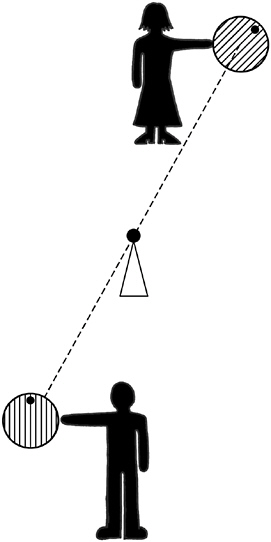
FIGURE 3-1 The lottery cards shown as polarizing filters.
real-life photon pairs. There really does seem to be some spooky link between the photons, across whatever distance of space, causing correlations that are otherwise inexplicable. No kind of hidden local variable theory can explain this behavior. If we are still clinging to the particles-plus-guide-waves story, we must also assume some kind of faster-than-light link between the particles.
There are other ways to look at things, of course. We have encountered two mysteries in this chapter. The first was that observing one slit of a two-slit apparatus can seemingly change the behavior of particles that go through the other slit, an arbitrary distance away. The second was that observing one photon of a correlated pair can seem-
ingly change the behavior of its partner, an arbitrary distance away. Occam’s razor suggests that we should seek a single explanation for both mysteries. One such hypothesis is this: “The acquisition of knowledge about a system by an observer, even inferential knowledge, can somehow change the behavior of that system—or at any rate what the observer subsequently sees—in a way unprecedented in classical physics, where the observer plays no special role.”