Schrödinger's Rabbits: The Many Worlds of Quantum (2004)
Chapter: 1 A Magical Universe
CHAPTER 1
A MAGICAL UNIVERSE
As a teenager, I was a great fan of science fiction and fantasy. The stories I most enjoyed were those set in a universe very like our own, but with an extra twist—some magical feature that made it much more fun to live in than the mundane world I knew. Then I grew up and discovered something wonderful. Our own real universe does in fact contain at least one magical feature, a built-in conjuring trick that seems to violate all the normal rules. Here is a demonstration.
Imagine that a conjurer of impressive reputation is in town and one night you go along to his show.
“For my next trick,” he says, “I want a couple from the audience.” To your embarrassment he points straight at you and moments later you find yourself on stage with your partner.
“I would like to give you a chance to get rich,” he says, pointing to a large pile of scratch-off lottery cards, all seemingly identical, and looking like the one in Figure 1-1.
“All you have to do to win a prize,” he goes on, “is select one of these cards, and tear it in half between you. Each take your half of the card and scratch off 1 of the 60 silvered spots on the clock face to
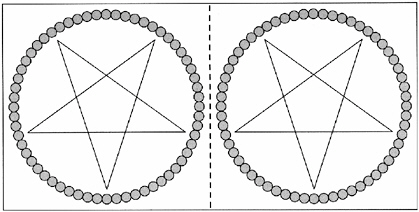
FIGURE 1-1 Lottery card.
reveal the color, either black or white. If the spots you scratch turn out to be different colors, you win $500. And it costs only $10 to play!
“Of course each of you is allowed to scratch off only one spot on your respective half of the card. And there is one further rule: To win the prize, you and your partner must choose spots exactly one place apart on the clock face. For example, here is a card that won for two lucky, lucky people on yesterday’s show.” He shows you and the rest of the audience the card shown in Figure 1-2.
“You must allow me some secrets, so I will not tell you exactly how the cards are colored. But I will tell you this much. Half of all the

FIGURE 1-2 Winning lottery card.
spots are black, and half white. Also if you and your partner were to scratch off the same spot on each clock face, you would always get the same color—both spots would be black, or both white. But if you were to scratch off spots exactly 90 degrees apart from each other, you would always get opposite colors; white and black, or black and white.”
It seems like a bargain, but you hesitate. How do you know he is telling the truth? “I’m from this town, and you’ve got to show me,” you reply, to cheers from the rest of the audience. The conjuror nods, unsurprised.
“Be my guest,” he says. “You and your partner may choose any card from the pile, and perform either of those two tests—scratch the same spot on each half, or spots 90 degrees apart on each half. Do that as many times as you like. If you prove me a liar, I’ll pack up my magic show and take an honest job!”
You and your partner duly pull out and test numerous cards. The results confirm the conjurer’s predictions, as shown in Figure 1-3a and b.
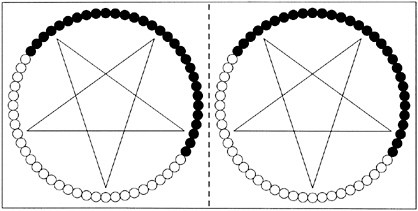
Is it worth playing the game? You think carefully. First, the left and right halves of each card must be identically colored—otherwise you would not be sure of getting the same color every time you scratch spots in matching positions. Second, there must be at least one place in each 90-degree arc where the color changes between black and white. If any card had an arc of more than 90 degrees all one color, you could sometimes scratch spots 90 degrees apart and get the same color.
The most obvious guess—and no doubt what the conjurer intends you to think—is that the cards are colored in four quarters, as shown in Figure 1-4a. There cannot be fewer segments, as shown in Figure 1-4b, because then you could scratch spots 90 degrees apart and get the same color, which never happens. They might be divided into more segments, as shown in Figure 1-4c, but that would actually increase your chances of winning—there are more black-white boundaries to hit.
As you go round the circle, from spot to spot, you take a total of 60 steps. At least 4 of those steps—maybe more, but certainly no fewer—involve a color change, stepping from a black spot to a white one or vice versa. It follows that the chance of a color change on any particu-
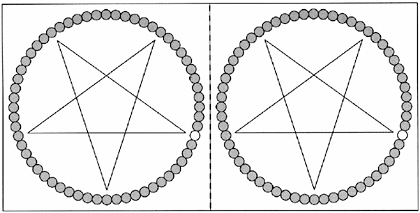
FIGURE 1-3a Corresponding spots scratched: colors always the same.
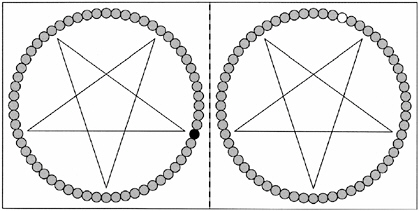
FIGURE 1-3b Spots 90 degrees apart scratched: colors always opposite.
lar step is at least 1 in 15. At those odds, it is certainly worth risking $10 to win $500, and you accept the bet and select a card. The conjurer beams.
“To make the game a little more dramatic, I will ask you to tear the card in two between you, and each take your half into one of the curtained booths at the back of the stage.” He points to two curtained cubicles rather like photo booths. “Each of you should scratch a spot of your choice, then stand and hold the card above your head. After a few seconds the curtains will be whisked away, and you and the audience will see immediately whether you have won. Of course, you can


use any strategy you like to decide which spots to scratch. You may confer in advance, you may decide at random, you can toss coins or roll dice if you think it will help.”
He watches with a smile as you and your partner choose a card, tear it apart, and depart to your respective booths. You have in fact decided in whispers that you will scratch off spots number 17 and 18, as measured clockwise from the top. You scratch off your spot and it is revealed as black. You hold the card above your head as instructed. But when a moment later a drumroll sounds and the curtains are whisked aside, the audience sighs in disappointment; your partner’s spot is also black. You have lost the game.
As you take your seats again, you are not particularly surprised or disappointed. After all, you reckoned you had only 1 chance in 15 of winning. But now the conjurer proceeds to call up more of the audience, two by two, and put them through the same procedure, 100 couples in all. Out of the lot, only one couple wins—you would have expected six or seven. The winning odds appear to be 1 in 100 rather than 1 in 15, and the conjurer has made a tidy profit. There seems to have been some mistake in your logic.
You are feeling quite worried. If your reasoning can mislead you this badly, you are obviously at risk of being cheated right, left, and center. As the crowd flocks toward the exits at the end of the show, you are therefore delighted to see your longstanding friend and colleague, Emeritus Professor Cope. Professor Cope might be old, but he is the most impressive guy you know. This man has Einstein’s scientific intuition, Popper’s philosophical insight, and James Randi’s fraud-busting ability, all combined in one person. He sees your troubled expression, and smiles.
“Don’t worry,” he says. “I’m quite sure all is not as it seems. I’m going to investigate this setup. I’ll drop by on Monday and tell you what I’ve discovered.”
But on Monday, Professor Cope does not look triumphant. He brushes aside your offer of tea.
“The conjurer we saw was not cheating in any obvious way. In fact, he turns out not really to be a conjurer at all. The only special thing about him is that he had the luck to come across the supplier of
these extraordinary cards. I managed to track down this supplier, and ordered a big batch for myself. I’ve been testing them under controlled conditions, and the results are still exactly the same as you saw at the show the other night.”
Your mouth falls open. “But how can that be?” you ask.
Professor Cope smiles. “To quote a respected source, ‘When you have ruled out the impossible, what remains, however improbable, must be the truth.’ The only way to get the results we see is if the two cards contain some internal mechanism that changes the spot color depending on circumstances. For there is no fixed coloring that can explain the results.
“But the card halves must also be in some kind of radio contact with one another. If they operated independently, there is no way the colors could then always match when you scratch the same place on each. One card half on its own could not tell whether the other half had that same spot scratched, or a different one.
“So the two halves must be in communication. Each half somehow knows which spot was scratched on the other, hence the angle between the two spots, and the color revealed on each card is selected accordingly. It is amazing even in these days of advanced electronic technology, but each card must include something like a miniaturized radio transmitter and inks that can change color. I am going to prove my hypothesis by separating the two halves of a card in such a way that communication between them is impossible. Then we will see the mysterious correlation between the two parts vanish. I will tell you the result next week.”
But the following Monday, Professor Cope does not look any happier.
“I tried testing halves of the lottery cards in lead-lined cellars several miles apart, and still got the same disconcerting results. So I borrowed two of those special security cabins-on-stilts used by the military and diplomats for top-secret conferences inside embassies. They are designed to allow absolutely no signal of any kind to leak out. Yet when lottery cards were scratched inside each of them, the results were still the same.
“Then I had a better idea. It occurred to me that there is no such
thing as a perfect shield for radio and other waves. So I tore a big batch of cards in half, and mailed one set of halves to Australia. I also built a mechanism that allowed a card to be scratched, and the color revealed to be permanently recorded at an exactly timed instant. The whole process takes only a fraction of a second. I had my colleague in Australia build a similar apparatus.
“We proceeded to scratch cards here and in Australia at exactly synchronized moments. Now according to Einstein’s theory of relativity, nothing can travel faster than light—neither matter nor radiation of any kind. As many popular accounts have described, if you could send a signal faster than light, you could also send one backward in time.
“The distance from here to my colleague’s laboratory in Sydney, even if you take a shortcut through the center of the Earth, is nearly 8,000 miles. It takes light about a 20th of a second to make the journey, a time just perceptible to human senses. My automatic card-scratching-and-color-measuring apparatus works much faster than that. So there was absolutely no way that either the card here could send a signal to its twin in Australia, or the Australian card could send a signal here, before both cards had to decide what color to reveal.”
He pulls a whiskey bottle from his pocket and takes a swig. “I would have bet my life’s work that under these circumstances, the strange correlations would disappear. But they did not.
“Well, no one is going to call me an intellectual coward. If I have proved the existence of faster-than-light, backward-in-time signaling of unlimited range, so be it. One card half must be sending an instantaneous and undetectable signal to the other. There you have it!”
You shake your head sadly as you see him out. But the following evening, he calls in looking much happier.
“Forget all that nonsense I was talking yesterday about faster-than-light signaling,” he says. “After I left you, I spent some time trying to figure out how to harness the cards’ instant links to transmit information. It would be handy to be able to talk to an astronaut in distant space without the normal time lag while the radio waves go to and fro, and even better if you could send a message with tomorrow’s racing results back in time to yourself! But there is no way to use the cards to
do these things, because you have no way to influence the color of the spot you scratch off. It is always 50-50 whether it is black or white. It is only after you compare the card with its other half that the strange correlation is revealed.
“I decided that because any supposed faster-than-light signaling mechanism is not available outside the cards’ internal workings, Occam’s razor—that rule of science that demands that one should always seek the simplest explanation, avoiding unverifiable hypotheses—required me to dispense with it. I now have a better theory.
“The correlations are surprising if you and your partner can make genuinely free or random decisions as to which spots you are going to scratch. But suppose those decisions have in fact been preordained for all time? You feel subjectively that you are freely choosing which spot to scratch, but actually the movement of the electrons that would make your neurons fire in that way was inevitable from the start of the universe—there is no free will. Similarly, if you use a randomizing device like dice or a roulette wheel to help you choose the spots, its motion and outcome were also predictable.
“The lottery cards must have been manufactured by an all-knowing alien who simply knew in advance exactly which spot on each half would be scratched, and printed the cards accordingly. Try as you will, he has foreseen your every move! This might sound startling, but it explains away the apparent paradox.”
You do not know what to think as Professor Cope takes his leave. It certainly seems an alarming amount of philosophical baggage to explain a set of trick lottery cards. At six o’clock the next morning the doorbell rings again. You stagger down bleary-eyed in your bathrobe to find a disheveled but triumphant Professor Cope on the doorstep. The whiskey bottle protruding from his pocket is nearly empty.
“I have it,” he says happily. “It is amazing how late-night thought, assisted by strong liquor on an empty stomach, can strengthen one’s facility for philosophical reasoning. I was worrying about a non-problem! You would agree that science can concern itself only with things that are actually observable, rather than mere hypotheticals?”
“I suppose so,” you agree cautiously.
“Good! Now, you are a conscious observer and, as such, the only
hard data you are entitled to reason about are the things that you have actually observed. All that precedes observation is mere will-o’-the-wisp, hypothetical, unreal. Let us consider your point of view at the moment you scratch off the lottery card. You see a color, black or white—perfectly reasonable. A little later you see your partner’s card, which is also black or white—perfectly reasonable. The only problem comes from your worrying about the hypothetical ‘I wonder what my partner’s card was?’ in advance of actual knowledge, when it was still an open question. Your partner’s card wasn’t anything until you found out what it was! When it did become something, it conformed to the claimed statistics for the admittedly unusual cards. But there is no problem for physics, as long as you have a formula to calculate the statistics. And no problem for philosophers, as long as you do not ask questions that are in fact meaningless because you are confusing hypotheticals with hard data. So, no problem!”
This is all a bit much at 6 a.m. “But isn’t that a bit solipsistic?” you ask. “I mean, what about my partner’s point of view? Are you really saying that it was meaningless for her to wonder what color the spot on my card was until she saw it? Confound it, I had seen it, and it was black, not hypothetical!”
“Solipsism, schmolipsism,” says Professor Cope crossly. “I have explained things from your point of view, the only one you should legitimately be concerned with.” And he turns on his heel.
It is sad to have witnessed the decline of a once great mind, but you do not see Professor Cope for some time after that, and gradually you forget about the matter. After all, you have plenty of practical everyday problems to worry about. Then one day, Cope strides confidently up to you in the shopping mall and grasps you by the arm.
“I am sorry about the nonsense I was talking a while back,” he says immediately. “I have given up the philosophizing business, and gone back to hard physics. I now have a perfectly consistent explanation for the lottery cards that does not involve dubious philosophical assumptions, backward-in-time signals, or any other rubbish of that kind. Let me buy you lunch. In fact, in a sense I will buy you a lot of lunches.”
He steers you into a nearby restaurant, and laughs inordinately when the host asks how many in your party. “Just two,” he finally gets
out, “that is, as far as you are concerned, young man.” As you start on the soup, he launches into his new story.
“Like all conjuring tricks, it is quite simple when you see how it is done,” he says. “The truth is, the maker of the lottery cards had a rather special kind of duplicating machine.”
“Well, I suppose it takes something a bit fancier than a standard printing press to make those scratch-off cards—” you say, but break off, because Cope is shaking his head vigorously.
“I am talking about something rather grander than that. Those lottery cards were manufactured by an all-seeing and all-powerful alien who can duplicate multiple versions of the universe at will!
“At the point where two people scratch off spots on the two separated halves of one of his lottery cards, the alien simply multiplies up the numbers of versions of reality to produce statistics that will conform to his rules. Thus if you each scratch off a spot in the same place, he creates two versions of the universe. In one, you and your partner both hold a black spot; in the other you both hold a white. From your point of view—that is to say, from the point of view of any one version of you—the spot color is entirely random and unpredictable, yet you will always find that it is the same as your partner’s.
“If you scratch off spots 90 degrees apart, the alien again creates two versions of the universe, but this time in one version you hold a black spot and your partner a white; in the other you hold a white spot and your partner a black. Again, from any individual’s viewpoint the color of their spot is unpredictable, but it will always be the opposite of their partner’s.
“Now for the clever bit. If you scratch off spots exactly one place apart, the alien creates 200 versions of the universe. In one of those, you hold a black spot and your partner a white. In 99, you and your partner both have black spots. In another 99, you both hold white spots. And in a final one, you hold a white spot and your partner a black. Again, you—or to be more precise in my language, any one version of you—experience getting a spot of entirely unpredictable color, but then find that your partner holds the opposite color just 1 percent of the time.” He beams proudly. “A beautifully simple idea, is it not?”
But you have already picked up your coat. There are limits to the
nonsense you will listen to, even in return for a free lunch. You have decided that the best way to retain your sanity is to try and forget the whole business.

In real life, we cannot escape the challenge so easily. As many readers will of course have realized, the apparently extraordinary lottery cards are merely behaving in the way that all the material in our mundane, everyday world does. Very similar effects can be demonstrated using the simplest particles of which our universe is built, the photon and the electron, the basic units of light and matter. Measuring the spin of an electron, or the polarization of a photon—scratching its lottery card, so to speak—seemingly has an instantaneous effect on the outcome of a measurement of another particle some distance away.
The formal name for this puzzle is the EPR paradox, after its originators Einstein, Podolsky, and Rosen. It is the most puzzling feature of the modern formulation of physics known as quantum theory. For half a century, attempts by physicists and philosophers to explain this behavior have verged on the bizarre. They are only mildly caricatured above. The purpose of this book is to find a more commonsense account of how the conjuring trick is done.