Schrödinger's Rabbits: The Many Worlds of Quantum (2004)
Chapter: 10 Harnessing Many-Worlds 1: Impossible Measurements
CHAPTER 10
HARNESSING MANY-WORLDS 1
Impossible Measurements
The Gap in the Curtains
In the final chapter, we will look at some controversial tests that might prove the correctness of the many-worlds interpretation beyond doubt. But there is one kind of experiment that has already been done successfully and could be said to demonstrate not only that worlds in which history unfolds differently are real, but also that communication between worlds is possible, at least in a carefully defined and limited way.
The basic procedure is known as the Elitzur-Vaidman experiment, after its original proposers. I had the privilege of meeting Lev Vaidman several times when he spent an extended period in Oxford. A small and rather gnomish man, he reminds many people of a younger version of Roger Penrose. But their views on quantum physics could not be more different. Vaidman is a strong supporter of the many-worlds view, and he fascinates his students by proposing highly imaginative thought experiments that more staid academics might dismiss as science fiction.
There is nothing hypothetical about the Elitzur-Vaidman experiment, however: it has now been performed many times, in increasingly sophisticated variants. The basic piece of apparatus involved is
something called a Mach-Zender interferometer, illustrated in Figure 10-1. As a tool for discriminating between wavelike and particle-like behavior, it is to the two-slit experiment what a Harley-Davidson is to a pushbike. A beam of light is fired from point O, as shown by the arrow. It encounters at A an optical component called a half-silvered mirror, which reflects half of the light energy upward toward B; the other half carries on toward C. Reflected back together by standard mirrors at B and C, the beams recombine at another half-silvered mirror D, where again half of each is reflected and half transmitted, all the light ultimately reaching detectors E and F.
How many photons end up at E, rather than at F? If photons were classical particles, the answer would be obvious. At each of the two half-silvered mirrors, each photon has an equal chance of being transmitted or reflected. So one-quarter would end up following each of the four routes: ABDE, ABDF, ACDE, ACDF. In the end, half would reach

FIGURE 10-1 Mach-Zender interferometer, the perfect wave-or-particle detector.
E and half F. But in reality, photons—even individual photons—also show wavelike behavior. We can arrange the geometry so that the routes ABDE and ACDE are exactly the same length, but the routes ABDF and ACDF differ in length by a small amount, exactly one half-wavelength of the light being used. Now, the detector at F receives no photons because the waves cancel as shown, just as they do at the center of a dark band in the two-slit experiment. All the photons arrive at E.
Now for the clever bit. If, in the two-slit experiment, we close one of the slits, of course the interference pattern disappears. This means that an observer who was initially positioned at the center of one of the dark bands in the interference pattern, and therefore saw no photons at all when both slits were open, now starts to receive some. Something similar is true when you block one of the routes through the Elitzur-Vaidman layout, for example, by placing an obstacle as shown in Figure 10-2.

FIGURE 10-2 Mach-Zender interferometer with bomb.
Now half of the photons sent from O try to take the lower route via C and are absorbed by the obstacle. But the remaining half travel safely via B, and then half end up at E and half at F. With no interference to cause complications, they behave like classical particles.
Suppose that you have a setup like this, and you do not know whether the path via C is blocked? Ever the showman, Vaidman dramatizes the situation. Suppose the potential obstacle is a bomb wired up to a photon-detector detonator. Is it possible to test if the detonator is there without setting the bomb off? Extraordinarily, it is feasible to do this. If the detonator is not there, the situation is that of Figure 10-1: A photon fired into the apparatus always ends up at point E, and the detector at F never registers. If, however, the detonator is present, as in Figure 10-2, a photon fired in from O has a 50 percent chance of continuing toward C and setting off the bomb. But if the photon is instead reflected via B, it then has a further 50/50 chance of ending up at E or F. Each photon we fire therefore has a one in four chance of registering at F, warning us that the detonator is there without setting the bomb off.
How can this have happened? How can a photon that never went near the detonator tell us whether it is present? It is tempting to think in terms of some kind of prober waves or guide waves that must have done the job. But these would of course correspond exactly to Bohm’s pilot waves. As we saw earlier, there are almost insuperable problems with this concept, including pathologically nonlocal behavior. If we think in terms of interfering many-worlds, however, there is a far simpler explanation. Whenever a photon hits the half-silvered mirror A, two worlds are effectively created. In one of them, the photon continues toward C. In the other, the photon is reflected upward via B. These worlds continue to interfere—until a photon measurement is made in either of them. Suppose the photon in our world happens to go via B. It continues to be affected by its counterpart in the parallel world that went via C—but only up to the point where the counterpart is measured by being absorbed. If the path via C is clear, this results in interference that prevents a photon from being detected at F, as in Figure 10-1. But if the photon following path C is measured by striking the bomb detonator, as in Figure 10-2, the link between our world and the
parallel one is disrupted at that point; it has no further effect on our own. Interference ceases, and it is possible for our own photon to hit F.
How has the trick, which alarmingly resembles the communication of information between worlds, been accomplished? The absence of a signal can contribute information, like the famous example of the dog in the Sherlock Holmes story that did not bark in the night. The present situation is more like a general who sends a scout to see if the enemy is hiding behind the next hill. “If all is clear, detonate this green flare,” he tells the scout. He does not need to give him a red flare to signal the presence of the enemy, for in that case the scout will be dead: The mere absence of a green signal at the prearranged time will tell the general all that he needs to know, one bit of information. The spooky thing about analogous quantum measurements is that we are using a signal not from another hilltop, but from another world. If an “OK” interference signal does not come, our scout—our otherworldly shadow photon—has fallen out of communication.
The Elitzur-Vaidman bomb detector is not very efficient: It is twice as likely to set the bomb off as it is to give a useful warning. It is ironic that a much more effective method has been devised and demonstrated by one of the arch-opponents of many-worlds, Anton Zeilinger.1 It uses the basic setup shown in Figure 10-3.
The core of the device is a racetrack, with a mirror at each corner, round which a photon can circulate many times. There is a switching system, S, by means of which a photon can be introduced into the system, and extracted at a chosen later time. At R is an optical component called a polarization rotator. It turns the polarization of every photon that passes through it by a fixed amount, say, one degree clockwise. If we introduce a vertically polarized photon into the system, allow it to circle 90 times, then extract and measure it, we will find it is now horizontally polarized.
So far, so obvious. But now we introduce an alternative path into the system, as shown in Figure 10-4.
The mirrors K and L are more sophisticated variants of the half-silvered mirrors used in the previous bomb tester. They have the property of allowing vertically polarized photons to pass unhindered, whereas horizontally polarized photons are always reflected. So any


horizontally polarized photon that hits K makes a dogleg via the conventional mirror M before rejoining the main flow at L.
But what about photons with a polarization intermediate between vertical and horizontal? In wave terms, it is appropriate to think of each individual photon getting the horizontal component of its polarization vector diverted via M, leaving the vertical component to travel via the outer racetrack. The vertical and horizontal components reunite at L, yielding a photon whose polarization is just exactly whatever it was before hitting K. Considered as particles, however, individual photons get diverted via M with a probability proportional to sin2a, where a is the angle of polarization relative to the vertical. Because the square of a small number is an even tinier number, a photon whose polarization is tipped only 1 degree from the vertical has only about 1 chance in 3,300 of being diverted.
Let us contrast the situations where there is, and is not, an obstacle in the path via M, as shown in Figure 10-5.

FIGURE 10-5 Zeilinger bomb tester with bomb.
If there is no obstacle at M, the diverting mirrors have no net effect. A photon that has a nonvertical polarization before hitting K has that same nonvertical polarization after leaving L. So the photon will still rotate polarization 90 degrees after 90 transits, just as in the basic setup of Figure 10-3. The presence of the mirrors K, L, and M makes no difference. But what if we introduce an obstacle into the route via M? Now the horizontally polarized component of each photon created at K gets absorbed, never reaching L. The photon will go round and round the track, knocked 1 degree from the vertical each time it hits R, but restored to the vertical at K, and remaining vertical at L. Extracted after 90 transits, it will still be vertically polarized. If we get back a photon that is vertically as opposed to horizontally polarized, it therefore warns us: Beware, there is a bomb.
Now for the extraordinary bit. Because the photon considered as a particle has only about 1 chance in 3,300 of being diverted via M on each circuit, the chance that it has gone this way during any of its 90 circuits is still only about 1 in 37, and the bomb is correspondingly unlikely to detonate. We have achieved something even more impressive than exchanging information between one world and another. We have in some sense communicated a bomb warning from a small set of worlds where the bomb detonated to a set 36 times larger that remains safe.
In principle, this could be increased to any ratio we wanted; for example, to double it, we just reduce the power of the polarization rotator to one-quarter degree per circuit and allow the test photon to circulate 360 times. Like the general who sacrifices one scout to protect the rest of his army, we can sacrifice a small number of worlds to save many others. Of course the chance that your world will be the one in which the bomb goes off never quite shrinks to zero—just as however large the general’s army, there is always a chance that you will be picked to be the scout.
It is this ability to share information profitably between worlds—to export information generated in one world to a potentially unlimited number of others—that, in the view of David Deutsch and his colleagues, will open up the extraordinary potential of quantum computers. Although Anton Zeilinger sees things differently, I once heard
him make a practical point about experimental design that could be interpreted almost poetically from the many-worlds viewpoint. He pointed out that quantum spookiness becomes most apparent when we measure things at small angles. Probabilities we might expect to be proportional to a are instead proportional to the much smaller quantity a2. This was true of the lottery cards in Chapter 1. If the spot color changes from black to white at some place on a 90-degree arc and they were classical cards, then two marks scratched 6 degrees apart should have had a 1-in-15 chance of being a different color, but spooky quantum effects reduced this to nearer 1 in 100.
We have just seen that small measurement angles are similarly the key to efficient quantum bomb detection. Long ago I read a story by John Buchan, called “The Gap in the Curtains,” about an attempt to foresee the future. Peeking through gaps at narrow angles turns out to be, in sober fact, the way to peer between the curtains that normally hide parallel worlds from our sight.
Lifting the Veil
A third, and even spookier, type of bomb detector is shown in Figure 10-6.
The central object is a block of transparent material resembling a large gemstone called a monolithic resonator. This is an intimidating name for a very simple device whose key property is that it can, in principle, trap light in an endlessly circulating path. If the two triangular prisms at the bottom of the diagram were removed, then a photon circulating within the octagonal block would never be able to escape, because the refractive index is high enough that total internal reflection occurs in turn at each of the points A, B, C, and D. Of course the photon does not really circulate forever, because the block can never be made perfectly transparent, but an average photon lifetime of thousands of circuits is perfectly possible.
If, however, we bring two triangular prisms up to almost touch the resonator at points A and B, as shown, total internal reflection at these points is now said to be frustrated. As a photon bounces round and round within the monolith, it has a small chance of escaping at

FIGURE 10-6 Monolithic bomb detector.
either of these corners. Conversely, we also have a way of injecting photons into the monolith, for example, from O. The behavior of the system turns out to be most interesting if we adjust the tiny gaps between the prism and the monolith so that, under normal circumstances, reflection is much more likely than transmission. Then a photon fired in from O, behaving in a particle-like way, is most likely (say, 99.9% probable) to get reflected straight down to F, without ever entering the monolith at all. On the other hand the occasional photon that does get into the monolith will typically circle a few hundred times before escaping at either E or F.
However, this scenario ignores the wavelike properties of light. Suppose we spray into O a continuous wave of light using a laser, for example. Now we can expect interference; the whisper of light that enters the monolith and is reflected round the path A, B, C, D, and back to A has a chance to interfere with a later portion of the wave. If we make the path lengths right, we can arrange that constructive in-
terference increases the amount of light entering the monolith at A, while reducing the amount that goes downward toward F (made up of reflected light coming from O plus straight-through light coming from D). Each cycle, more and more light gets into the monolith; since interference effects inhibit its escape toward F, ultimately almost all will leak out at E.
All this is perfectly understandable in classical terms, but we have been talking about a continuous wave of laser light. What if we reduce the incoming light to a single photon? The wavelength of the photon is tiny—of the order of a millionth of a meter—compared to the path length round the monolith, many centimeters. Surely the photon cannot interfere with itself? Incredibly, we find that it does. Somehow the mere availability of the path round the monolith makes the photon overwhelmingly more likely to be sucked in at A, rather than reflected downward to F.
And so we have our last and most sophisticated form of zero-interaction bomb detector. We can include at the top of the monolith a bath of transparent liquid of the same refractive index as the glass of the monolith—completely invisible to the eye, although I have drawn it faintly shaded to help us see what is going on. If the path round the monolith is blocked, as in Figure 10-7, a photon fired in from O behaves in a particle-like manner, and is almost certain to be reflected straight down into F, without entering the monolith or setting off the bomb. But if the path round the monolith is clear, as in Figure 10-6, the mere possibility that the photon can go round the path as many times as it likes is enough to ensure wave like behavior: The photon is almost certain to be sucked into the monolith, and eventually detected at E.
This is what the math of quantum mechanics predicts, but surely it is too bizarre to be explained in intuitive terms? Actually, it can be explained quite well even in terms of the guide waves of Chapter 2. In the surfer-and-guide-wave picture, we must think of the surfer as occupying a position that is uncertain not merely in the sense of not knowing where on one particular wave front he is, but also in the sense of not knowing on which of a series of possible wavefronts he is riding. This new kind of guide wave consisting of a whole series of waves is

FIGURE 10-7 Monolithic bomb detector with bomb.
called a wave packet, and is illustrated from the side in Figure 10-8; on measurement, the photon will be found occupying some particular position within the packet, as indicated by the denser shading. The photon may be tiny, but the guide-wave packet can and does interfere with itself.
The monolithic detector, described in a brilliant 1997 paper by Harry Paul and Mladen Pavicic, is much more efficient and practi-
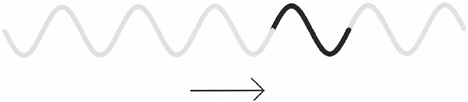
FIGURE 10-8 Photon wave packet.
cable than the previous types.2 Why was it not the first to be invented? Probably because, although the mathematics of its operation are straightforward, it is hard to see intuitively why the device works in terms of the so-called Copenhagen interpretation. Yet I will stick my neck out and suggest that in terms of many-worlds, we can paint a simple if startling picture of what is going on.
The functioning of the device depends critically on the fact that we do not know the times individual photons leave the source, so that the wave packets describing them are of macroscopic length. If we tried to measure the moment of emission of each photon, the wave packets would be much shorter, and the interference effects would disappear. This is just like trying to measure the direction of the photons used in the two-slit experiment. If you try in any way (for example, by measuring the recoil of the source) to ascertain which direction each individual photon goes, and therefore which of the two slits it is going to pass through, the interference pattern disappears. The interference pattern results from making sure that the worlds in which the photon goes left as opposed to right remain in communication until the measurement on the photographic plate is made.
In the case of the monolithic detector, however, the worlds that must remain in communication are not those in which the photon went left or right, but those in which it left the source earlier rather than later. From the point of view of a world in which we get a click at detector E, and thus know in an almost risk-free way that there is no bomb present, there are ghost worlds in which the photon left the source earlier, raced once around the monolith, passing through the bath of liquid at the top, and then effectively beckoned subsequent ghost photons in, until a growing horde of ghosts that had already been round the monolith once, twice, thrice, and so on acquire enough substance to usher in the actual photon of the world we perceive as real—so that it is not detected at F, as in the absence of the ghostly encouragement it almost certainly would be. The parallel with the ghosts of the Marshes of the Dead beckoning Frodo in to join them in Tolkien’s Lord of the Rings is almost irresistible! But here, the ghostly scouts beckon the photon in only if it is indeed safe to enter the monolith.
You might feel that this latest example of many-worlds effects is even spookier than those earlier in this chapter. And you are right, because we are now making use of a world that is in a sense ahead of our own in time, a world in which the photon will already have triggered the bomb if it is present. The importance of the monolithic reflector is that it delays a photon by trapping it, unmeasured, for a significant period—thus preserving communication with that other world. In present-day apparatus the time lag involved is only a few nanoseconds, corresponding to a wave train a few meters long, but in principle this time could be greatly extended. You might be making use of information from worlds where, if a real bomb had been present, you would already have been dead. What are we to make of this?
I would suggest that it might well throw light on a puzzle we have already touched on: the alarming phenomenon of particles that appear to quantum tunnel faster than the speed of light. This is analogous to thinking that the photon in Figure 10-7 must have gone faster than the speed of light in order to have had time to explore the region of space that contains the bomb. The truth is subtler: We are making use of information from other-worldly variants of the photon that traveled no faster than light, but simply left the source earlier. Similarly in the quantum tunneling case, as long as the “tunneling” particle is still in flight we remain equally in touch with worlds where it departed the source earlier and where it departed the source later. The key insight is this: The fact that interaction in either world causes the link to collapse prevents any faster-than-light messages from being sent via such particles, even though they might be effectively displaced in time in different worlds.
Zero-interaction measurement devices might well be capable of practical applications. How wonderful it would be if we could, for example, take an X-ray of a pregnant woman without the usual danger of damage to the fetus from high-energy photons—because the photons making the photograph, or at least the vast majority of them, did not pass through her body at all. Although medical applications are still some way off, interaction-free measurement and testing in other
contexts might well be realistic. Adrian Kent and David Wallace have recently coauthored a paper describing a kind of testing device based on the principle.3
It is truly ironic that one often hears statements like, “In a quantum world, you cannot measure any object without affecting it at least slightly.” That is the precise opposite of the truth. In a classical world, we would really not be able to measure anything without affecting it, because every photon or electron would have some effect on whatever it struck, however gently. Only in a quantum world does it become possible to measure something without affecting it at all.