Schrödinger's Rabbits: The Many Worlds of Quantum (2004)
Chapter: 9 Introducing Many-Worlds
CHAPTER 9
INTRODUCING MANY-WORLDS
Whenever we test a small piece of our universe experimentally, we find that up until that moment it has been behaving as a chunk of Hilbert space, developing not as a single history, but as a nest of interacting probability waves. This description of nature is by far the most accurate that has ever been achieved. Quantum theory makes possible immensely precise predictions of timings and frequencies of microscopic processes, which have been confirmed to an astonishing number of decimal places. The waves of Hilbert space are simply the waves Schrödinger derived a lifetime ago, although we now have better mathematical tools (and of course, computers) to help us work out their behavior. The essence of the many-worlds interpretation is breathtakingly simple. Let us assume that what the math tells us is correct. We can then explain what is going on in terms of three emergent phenomena: entanglement, decoherence and consistent histories.
The math implies that an isolated system, say, a bunch of atoms bouncing around in a sealed container, explores all the ways the atoms might go. It is not a question of atoms surfing guide waves, as in the original picture we tried to construct, but of the atoms themselves trying out all the possible paths, going every-which direction. The
waves of Hilbert space explore every possible way the system might develop. If we put a second isolated system containing some kind of observation apparatus in contact with the first system, neither undergoes any kind of collapse. Rather, the mathematics of entanglement tell us that the high-probability areas of the joint Hilbert space thus created will develop as consistent histories. For example, if the small system is a radioactive atom (one that can spontaneously split apart), and the large system is a radiation detector with an electronic memory consisting of a capacitor that becomes charged when a radioactive particle is detected, then the states atom-split-capacitor-charged and atom-whole-capacitor-uncharged quickly become much more likely than atom-split-capacitor-uncharged and atom-whole-capacitor-charged. Likewise, if the small system is Schrödinger’s cat apparatus and the large system is a cat-loving astronaut, live-cat-happy-astronaut and dead-cat-sad-astronaut become much more likely than live-cat-sad-astronaut and dead-cat-happy-astronaut.
Why are the happy and sad versions of the astronaut not aware of one another? The mathematics of decoherence tell us that the interference between developing outcomes that are significantly different above the microscopic level fade very rapidly. History lines whose only difference is that one electron has gone through the left slit of a two-slit experiment instead of the right one interfere with one another quite significantly, but history lines where lots of particles are all in different positions (such as the atoms of the cat’s body and the electrons within the astronaut’s brain in the above example) interfere with one another only to a very tiny extent. As the philosopher Daniel Dennett and others have pointed out, the things that we consider to be real, including ourselves, are simply stable, persistent patterns: The happy-astronaut-live-cat pattern is one such. As far as she—that is, that particular pattern of her—is concerned, she inhabits a single history in which the cat was lucky and lived.
The many-worlds interpretation is sometimes claimed to beat all others by Occam’s razor, on the grounds that it requires no new physical assumptions. Accepting it requires only the moral courage necessary to accept that the same rules that apply to small isolated systems, like bunches of atoms, also apply to larger isolated systems without
limit, therefore including the largest possible one—our universe taken as a whole.
The no-assumptions claim can be challenged. In fact, even the most prominent supporters of many-worlds nowadays acknowledge that some postulates must be made to accommodate the theory, an issue we’ll look at in more detail later. But many-worlds has more going for it than Occam’s razor. Chapter 7 prepared us for the fact that there might be many ways to look at physical reality, none uniquely more correct than the others. But many-worlds is still preferable to other interpretations for the same reason that the cabin boy’s tick-tack-toe was a better game than the ideas of the other crew members. It is easier for our minds to grasp. It enables us to keep to the intuitive picture that Faraday, Einstein, and other great physicists have struggled to preserve, a universe of three dimensions of space and one of time, in which nothing is random and locality reigns supreme.
That’s quite a claim. Let us first lay out the evidence in its favor; we will come to some reservations later. We are now in a position to resolve our Principal Puzzles of Quantum. We will take them in reverse order.
PPQ 4
Why does reality appear to you to be the world in a single specific pattern, when the guide waves should be weaving an ever more tangled multiplicity of patterns?
Answer
Your mind in a specific state is a pattern of information—or speaking physically, your brain in a specific state is a pattern of positions of atoms and electrons. The mathematics of decoherence predict that two brain patterns that initially differ by a trivial amount—say, because one particular photon happened to be transmitted rather than reflected when hitting your cornea, thus reaching your retina—very quickly cease to have any significant effect on one another as the difference grows.
(Oxford philosopher Michael Lockwood prefers many-minds. His point: the large Hilbert Space within which all physically possible histories unfold contains mind-patterns that have seen and recorded different versions of events. However this viewpoint leads to philosophical complications; so, I shall stick with a physicist’s perspective: A mind is just an information package embedded in a world-line.)
PPQ 3
Why does the universe seem to waste such a colossal amount of effort investigating might-have-beens, things that could have happened but didn’t?
Answer
It does not waste any effort investigating might-have-beens. The interference patterns that seem to demonstrate that the universe tried out things that didn’t happen—how did the universe know whether the bar-code reader would have registered the chicken going through the other slit?—correspond to outcomes that in fact also happened. However, the world patterns in which they happened decohered rapidly from those in which they didn’t as soon as the interaction we call measurement occurred. We now understand that taking information about a system, recording the result permanently in a larger outside environment, is actually what causes decoherence. The terms “permanent” and “larger outside environment” might sound like a cheat, but all I mean by them is an environment containing enough particles that a spontaneous reversal of the recording process becomes unlikely, like the dots of ink on a sheet of paper all just happening to leap back into the bottle they came from.
PPQ 2
Spooky quantum links seem to imply either faster-than-light signals or that quantum events are truly random.
Answer
Assuming many-worlds, the laws of physics do not imply any randomness at all. When, for example, a photon hits a polarizer, the result is quite deterministic. It gives rise to two event-patterns in Hilbert space, one in which the photon is transmitted and one in which it is reflected. There will also arise two different patterns corresponding to the present “you,” matching each outcome.
PPQ 1
Spooky quantum links seem to imply either faster-than-light signals or that local events do not promptly proceed in an unambiguous way at each end of the link.
Answer
Locality has always been claimed as a benefit of the many-worlds approach, but the point was not proven until quite recently, in a brilliant paper published in 2000 by David Deutsch and Patrick Hayden.1 Here, however, we will give a nonmathematical picture of how the correlations of EPR can arise from local effects alone.
To explain the process, we will go back to the lottery cards of Chapter 1 and expand on the notion that causing quantum decoherence—here, by scratching a lottery card and observing whether you get a black or a white spot—gives rise not simply to two worlds, but two sets of local worlds.
Later, we will consider whether these sets should really be considered infinite, but for illustration purposes we shall assume that each time a spot is scratched, it gives rise to exactly 100 versions of local reality in which the spot is white and another 100 versions in which the spot is black. So when you go into your booth to play the lottery game, when you scratch your card you might think of yourself as creating 200 versions of your booth, each floating around in a grey void a little bit like Dr. Who’s Tardis in the old BBC television series. Half of these booths contain versions of you holding a card with a white spot,
and the other half have versions of you holding a card with a black spot.
Your partner has similarly created 200 versions of her booth. The subtle bit is how the various booths get allocated to different consistent histories. Here is a crude metaphor for what occurs. Imagine that each version of each booth stretches out a ghostly tendril. At the the end of each tendril is a label with information like, “left booth, spot number 3 scratched, revealed color white.” Shortly we are going to use the tendrils to pull together 200 complete classical-looking worlds, each containing one booth with you in it and one booth with your partner in it. We can make the correlations between your and your partner’s colors anything we like simply by joining up the tendrils in an appropriate way.
For example, if you have both picked the same spot, we pair the 100 versions of you holding a black card with the 100 versions of your partner holding a black card, and the 100 versions of you holding a white card with the 100 versions of your partner holding a white card. The results all match in all the resultant worlds, as they are supposed to.
If you each pick a spot at 90 degrees to your partner’s, we pair the 100 versions of you holding a black card with the 100 versions of your partner holding a white card, and the 100 versions of you holding a white card with the 100 versions of your partner holding a black card. The results are opposite colors in all the worlds.
If you and your partner pick spots one place apart—as you will have if you are trying to win the game—we pair just one version of you holding a white card with one version of your partner holding a black card, and just one version of you holding a black card with one version of your partner holding a white card. Then we pair up the remaining 99 versions of you holding a white card with the 99 versions of your partner holding a white card, and the 99 versions of you holding a black card with the 99 versions of your partner holding a black card. Everyone is accounted for, and you have won in just 2 worlds out of the 200, as expected.
Of course this sorting of diverging worlds does not really involve
tendrils with labels on them. It is a process whereby each version of the world containing you comes to be potentially more and more affected by one particular version of the world containing your partner, and less and less by the other versions. You could imagine the process as analogous to pulling entangled skeins of wool gently apart into sheets; or even as resembling the biological process of meiosis, in which chromosomes are duplicated and then in due course spliced back together in appropriately matching ways. But the key point is that nothing happens that would require the propagation of faster-than-light influences. The process of quantum collapse—the process of scratching the card, and even your consciously seeing the result—can happen fast. At that point your Tardis-booth already “knows” what kind of partner is appropriate for it to hook up to. But it does not need to exchange information with the maybe far-off partner booth at that point. This is the difference between selecting a partner in a video dating booth, and immediately writing down (or even dialing) their telephone number, which is perfectly possible, and having an actual faster-than-light exchange of messages with your partner-to-be, which is not. Many-worlds respects the spirit as well as the letter of special relativity.

With all this going for it, you might expect that the case for many-worlds would be considered cut and dried. From my perspective in Oxford, where so many of the leading supporters of many-worlds (some of whom we’ll soon meet) live and work, it sometimes feels that way. And yet many-worlds is not universally accepted in the worldwide scientific community. Max Tegmark, one of the few leading American physicists who actively supports many-worlds, has published the following results of an informal poll he took at a recent international conference on quantum physics.2
Copenhagen: 4—Believers in the modern Copenhagen interpretation in the broadest sense, the idea that the unmodified Schrödinger wave equation gives rise to a collapsed single reality when perceived by a conscious observer.
Collapse mechanism yet to be discovered: 4—Believers in the idea that the Schrödinger wave equation must be modified to include some physical collapse mechanism (for example, Roger Penrose’s, which we’ll meet in Chapter 14) that gives rise to a single-valued reality.
Pilot waves: 2—Believers in some form of Bohm’s pilot-waves notion, that a single reality is traced out by particles surfing on guide waves that in a sense explore all the developments that do not really happen.
Many-worlds: 30—Believers in the idea that collapse never happens, and the universe keeps exploring many different outcomes, which should be considered equally real.
That looks pretty convincing so far: a 75 percent vote for many-worlds, with the opposition split. But there is a further figure: 50 (of the total of 90) physicists in the hall were undecided, or at least unable to agree with any of those four broad choices. That is rather appalling. In one sense, many-worlds is becoming the only game in town. The opposition to it is fragmented and dwindling. But looked at another way, it has a long way to go. Only a third of the specialists in the field were willing to stand up and be counted as many-worlds supporters. Let us look at the reasons—some justifiable, others less so—for this situation.
One problem might be, ironically, that many-worlds is one of those scientific theories that was proposed ahead of its time. Back in the 1950s, before most of the current generation of quantum physicists were even born, Hugh Everett III, student of the famous John Wheeler, wrote a Ph.D. thesis outlining his proposal, which in retrospect seems astonishingly obvious: Why assume that quantum collapse occurs at all? Why not simply believe what the equations are telling us, that the universe is tracing out all possible histories, rather than just one privileged one?
Everett was able to demonstrate that, in simple but suggestive cases, the development of the probability waves of Hilbert space tends naturally to give rise to different branches of outcomes whose subsequent histories the evolving wave continues to trace out.
Unfortunately, at the time Everett was writing, the mathematics of
decoherence had (inevitably) yet to be properly worked out, and it was not entirely clear why histories that were different should continue to diverge and interact with one another less and less, as is of course the case. This valid problem caused another physicist, Bryce de Witt, to try to advance Everett’s theories in a way that in retrospect was unhelpful. It was de Witt who coined the term “many-worlds,” and sought a mechanism that would cause different worlds to diverge completely from one another, cleaved apart by outcome lines that had zero probability. We can explain his idea with the version of the two-slit experiment diagrammed in Figure 9-1.
The height of the wave function indicates that the particle involved is more likely to turn up in some places than others, but at some points it can drop to zero; interference cancellation is perfect, and the particle should never be detected in such a position. De Witt tried to interpret such points as fault lines, splitting the universe permanently into distinct versions, each corresponding to one of the possible regions in which the particle might end up. This is neither correct nor necessary. There is no point at which outcome worlds diverge completely. They continue to interfere with one another, although in a way that decreases rapidly with time. But they never actually split.
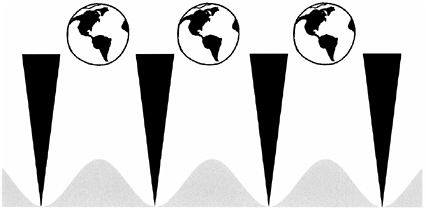
FIGURE 9-1 De Witt viewed zero-probability outcomes as giving rise to segregated worlds, like lane barriers forcing automobiles to diverge toward different destinations at a road junction.
When Everett first developed his theory, he made no reference to splitting worlds. Rather, his theory describes a single universe that processes many different versions of events. A good metaphor for this grander vision of the universe—often called the multiverse, to distinguish it from the single version of reality visible to a single version of a single observer—is a type of computer that was proposed during the 1980s. This was an optical computer consisting of bundles of glass fibres and other light-transmitting components, joined in the same kind of arrangement as the wires in an ordinary electrical computer. But the optical computer would be able to do many things at once, simply by shining in slightly different wavelengths of light using appropriately tuned lasers.
To observe the result of a calculation input using, say, a blue laser of wavelength 2,345 Angstroms, you would just use a corresponding blue filter at the far end to screen out all the light bouncing around the system from other users. Thus a single set of hardware could simultaneously process different calculations for different users. For example, rival weather forecasters could use the same hardware at the same time to generate different predictions for the weather. In just the same way, Everett’s multiverse-wavefunction simultaneously calculates many versions of what we call reality.
According to Everett, you see a single version of reality because the countless divergent versions of patterns of neuron firings in your brain very rapidly cease to affect one another, just as 2,345-Angstrom calculations in the computer described above are affected only by light very close to that particular wavelength. Other versions of reality—which of course include other versions of your brain—quickly become imperceptible to your own version.
However, thanks to de Witt, the false image of universes actually splitting quickly became associated with many-worlds. Famously, John Wheeler ultimately rejected his pupil Everett’s theory as having too much conceptual baggage. Perhaps the notion of the universe repeatedly splitting was the major part of that baggage.
Improbable Numbers of Worlds
The main feature of many-worlds that both physicists and laypersons find disconcerting is the sheer vastness of the multiplicity it implies. Philosophers use the term “ontological extravagance.” That is just a grand way of saying what Paul Davies and others have put more pithily: If many-worlds obeys Occam’s razor insofar as it is economical in assumptions, it is vastly extravagant in worlds. Is it more sensible to prefer fewer assumptions, or fewer invisible worlds?
In the history of science, however, there are many excellent precedents for accepting economy of assumptions over economy of worlds. Just a few hundred years ago, most astronomers believed that the universe consisted of our own solar system, a single sun orbited by half a dozen planets. The stars seemed mere insignificant pinpricks of light, although their lack of apparent motion as the Earth traced out its billion-kilometer orbit implied that that they were in reality distant and, therefore, bright objects. But then it was noticed that the apparent positions of some stars relative to others does shift slightly, just as would be expected to happen by parallax if they were all at different ranges. Careful measurement enabled the distance to the nearer stars to be calculated. To appear as bright as they do, it turned out that they must be objects quite similar to our own Sun in size and power. They might even possess planets of their own.
The progress did not stop there. About 100 years ago, the universe was thought to consist only of our own galaxy. But scattered among the normal stars, which are pointlike even when viewed through the most powerful telescope, were fuzzier, more extended objects. At first they were assumed to be clouds of dust and gas within our own galaxy, but under closer examination, some of them displayed a pattern of luminosity quite different from that which such a cloud could generate, unless previously unknown physics was involved. The choice was between positing a new law of physics or accepting that we live in an incomparably vaster universe than conceived up to that point, containing a hundred billion galaxies. Many astronomers had great difficulty coming to terms with the latter view, although very few people would doubt it today. We now accept that the universe contains not
one sun, but 1022—all this from deductions about tiny points of light, even the nearest of which we may never get to visit.
Accepting the reality of the many worlds of quantum is merely the next step on a ladder we have already learned to climb. The idea that we live in a vast Hilbert space is admittedly startling at first encounter, just as the idea that we live not on a flat plane but on a round lump of rock plunging through a vastness of vacuum was startling when the human race first encountered it.
We can never see those other world lines, with different histories from our own. But here is a parable that might help convince you. Imagine that you are traveling on a ship, and you don a pair of special glasses that let you see a little way into diverging quantum world lines, an extrapolation of the kind of experiment described in Chapter 10. To your astonishment, you see that the ship keeps blurring and then separating into two equally solid-looking copies, which rapidly diverge to left and right. Sometimes you are on the right-hand ship, and sometimes on the left-hand one. You can get only a very brief glimpse of the other ship each time, but you can see yourself on it, and you can just see the events on board beginning to diverge from those of your own vessel before it becomes lost in the mist.
Should you arbitrarily assume that each time a duplication occurs, you always happen by good luck to be on the only ship that is real? Or are the ships you do not happen to be aboard just as entitled to reality? To me, the claim that the other yous are unreal is as silly as those philosophical games in which you are asked to consider that you might be the only real person on an Earth populated with 6 billion cleverly programmed but nonconscious robots. It is a gross violation of the Copernican principle of mediocrity to think that your particular world line must be the uniquely special one every time a divergence occurs.
If only we could do a clear and unambiguous communication-between-worlds experiment. Then there would be no room for argument about the reality of many-worlds. Unfortunately, the laws of physics do not seem to allow such a thing.
This is frustrating because two potentially useful methods of harnessing the power of many-worlds, which we will look at in detail
shortly, can be described in terms of sharing resources between worlds, or even sharing information between worlds. For example, a loose way of describing the operation of a quantum computer is as follows: As worlds start to diverge, hundreds of billions of different copies of the computer come into existence. Each of these computer copies can work on a different calculation. The shared result of their labors, however, can be made available to all the diverging worlds created when the bubble of Hilbert space describing the computer is systematically collapsed by measurement at the end of the calculation.
This makes it sound as if Hilbert space might possibly be used as a kind of mailbox for communicating between worlds. Unfortunately, the mathematics that describes Hilbert space rules this out because it implies that everything that goes on in Hilbert space is reversible. As soon as you try to take information out of Hilbert space, that reversibility is destroyed. Such acts of measurement, by definition, cause decoherence. You can preserve multiworld access to a bubble of Hilbert space only by allowing it to evolve undisturbed. It reminds me of C.S. Lewis’s “Wood Between the Worlds” described in The Magician’s Nephew. Any Hilbert space accessible from more than one world line must be a timeless place, in which we can leave no permanent mark.
The Sociological Problem: Fear of Being Misunderstood
Asking prominent physicists whether they really believe in many-worlds is a tricky business. Undoubtedly, one reason why physicists are reluctant to come out as many-worlders is the fear that their views will be misunderstood or caricatured in a science-fictional kind of way: “Tell me, Professor, might we be able to set up a quantum radio link to a world where the South won the American Civil War?” These fears are not groundless. It is a fact that science-fiction writers were exploring the notion of parallel worlds long before Everett came up with his many-worlds perspective on quantum mechanics. A follower of Everett treads a tricky path. If asked, “Are there worlds somewhere out there where the South won the Civil War?” the honest Everettian
must reply, “Yes.” Explaining why we can never see such a world, or talk to its inhabitants, is a subtler matter.
Yet the fact that we can never visit a place is no grounds to deny its existence. Even in the classical universe, we can see distant galaxies that we can never possibly visit, because even if we were in a rocket traveling just a whisker short of the speed of light, the continuous expansion of space that has been going on ever since the Big Bang would carry them beyond the edge of the portion of the cosmos accessible to us before we got there. Yet we do not doubt that those galaxies are as real as our own. An alien living in such a galaxy would have no fear that he would blink out of existence at the moment he passed out of Earth’s sight.
But I do not mean to imply, of course, that all physicists who are reluctant to endorse the many-worlds hypothesis are doing so out of stubbornness or moral cowardice. There are genuine issues still to be resolved, dragons lurking in the undergrowth of many-worlds, and we shall come to them in later chapters. But first let us look to the positive. There are remarkable ways to harness the power of quantum that would be much harder to understand, or for that matter to invent in the first place, without the benefit of many-worlds insight.