Schrödinger's Rabbits: The Many Worlds of Quantum (2004)
Chapter: 13 The Terror of Many-Worlds
CHAPTER 13
THE TERROR OF MANY-WORLDS
Parallel worlds are appealing as an abstract notion, a hypothetical device for making the sums come out right. But if those other worlds are real, then the philosophical consequences are awesome. Every decision that you take must take into account the consequences not just for one you, but for many. For according to the many-worlds hypothesis, the you that exists now will in an instant no longer be a single self but a multitude, each one of them feeling like the sole descendant of the you that exists now. To what extent should you care about the fate of each member of that multitude?
Philosophers have been pondering the puzzles and paradoxes of personal identity—crudely put, what it is that makes you uniquely you—since long before the many-worlds hypothesis was invented. They have done so with the help of thought experiments that are distinctly reminiscent of Star Trek. Anyone who has done a modern philosophy course might have been challenged with problems like these:
A scientist has developed a machine that can duplicate human beings, complete with their thoughts, memories, and so on. You are told that yesterday, without your knowledge, he duplicated a copy of you. He kept the copy in a lab cell for a few hours, doing IQ tests and so forth, before euthanizing it. How concerned are you to hear this?
The scientist took a copy of you this morning, which he is testing now. He will euthanize it this evening. Of course the copy is protesting that it is the real you. How concerned are you to hear this? Would you be willing to change places with the copy?
The scientist is going to take another copy of you tonight while you sleep. Tomorrow you will wake in your own bed and go about your life as normal, but the copy will awaken in the lab cage and be tested for a few hours before being destroyed like the rest. Knowing this, when you wake tomorrow morning, will you feel scared to open your eyes?
You probably find at least the last of these scenarios alarming. And yet looked at another way, the theoretical possibility that some alien scientist is already making a thousand copies of you every day, and testing them in unpleasant ways before destroying them, can never have the slightest effect on the real you.
It is understandable if your immediate response to the above parable is to resolve to stay well away from deranged alien scientists. But of course many-worlds implies that this kind of duplication of many versions of yourself, who will eventually go on to live out quite different experiences, is a natural process that is unceasing and can never be turned off. Should this be seen as causing problems, or opportunities, for your decision making? Our first example is a tale that has become a classic. It is a challenge that has now been made many times to those who claim to believe the many-worlds hypothesis, and goes something like this:
If you believe in many-worlds, there is an infallible way for you to get very rich. All you need to do is buy a single ticket in a big-money lottery and wire yourself up to a machine that will kill you instantly and painlessly if your ticket does not win. The chance of winning such a lottery is only about 1 in 100 million. But the odds do not matter as long as they are finite. If you believe in many-worlds, then you believe that there is literally an infinite number of versions of yourself in universe-variants that are diverging all the time. After the lottery is run, and the machine has killed you (in an infinite number of worlds) or not killed you (in an infinite number of others), then all the versions of you still alive will be extremely rich.
Of course in a sense, there will now be only 100 millionth as many versions of you as there were before the machine operated. But infinity divided by 100 million, or any other finite number, is still infinity. So in fact there are just as many versions of you as there were before, but now they are all multimillionaires.
As far as I know, no one has yet tried this procedure. But some of the excuses I have heard many-worlders give for declining are disturbingly weak, on the lines of, “I would not like to think of all the versions of my wife and children left poor and grieving in the world-lines where I did not win.” This leaves open the question of how to justify declining the option if you have no dependents. Indeed, if you really believe in the logic of quantum suicide, it is arguable that you should seek even more extreme options. Why not wire yourself up to a skullcap containing an EEG that monitors your brain waves to detect whether you are happy and kills you instantly and painlessly at the first hint of pain or sadness? Come to that, why shouldn’t we all wear such skull-caps—all 6 billion of us—connected together in a network that painlessly annihilates the whole planet the instant even one person is unhappy? The entire human race would be guaranteed everlasting bliss!
Max Tegmark received a lot of correspondence on the subject of quantum suicide following popular articles in New Scientist and Scientific American, and has posted the following cautionary note on his Web site.1
I think a successful quantum suicide experiment needs to satisfy three criteria:
-
The random number generator must be quantum, not classical (deterministic), so that you really enter a superposition of dead and alive.
-
It must kill you (or at least make you unconscious) on a timescale shorter than that on which you can become aware of the outcome of the quantum coin toss—otherwise you’ll have a very unhappy version of yourself for a second or more who knows he’s about to die for sure, and the whole effect gets spoiled.
-
It must be virtually certain to really kill you, not just injure you. Most accidents and common causes of death clearly don’t satisfy all three.
I do not necessarily agree with him on the first point, because chaos effects very rapidly amplify different quantum outcomes into
macroscopic ones. For example, many big-money lotteries use a tumbling cylinder of numbered balls to determine the winning number. Such a machine is a very powerful chaos amplifier, the tiniest difference in, say, the position of an electron on the other side of the world will quickly change the position of the balls. Almost any honest random number generator is rapidly influenced by quantum-level effects.
Tegmark’s second point is certainly true, but its implementation is rather trickier. Suppose that your instant suicide machine will not operate until a few minutes after the lottery outcome has been decided. For example, you might have set it up to be triggered by a message from one of those commercial services that send you an e-mail or a text message containing the lottery result. Of course if you see the lottery result before the suicide machine operates, you should be terrified. Presumably you would struggle to escape the machine if you could. But what if you preserve your ignorance by switching off the television, just as if you were trying to avoid seeing a spoiler that would give away the ending of a detective film. How should you feel during the next couple of minutes, knowing that you are now almost certainly going to die, even though many people very similar to you, whose lifelines diverged a few minutes ago, will survive and be happy? I would certainly be terrified—I would want to be unconscious under deep anesthesia for this period.
Tegmark’s third point I unreservedly agree with. The chances of winning a big-money lottery are very tiny, on the order of 1 in 100 million to 1 in a billion. That is much smaller than the per-flight risk of being killed in an airplane crash, or the per-lifetime risk of being hit on the head by a falling space rock. In fact, when you next buy a lottery ticket (if you are in the habit of doing so), you might like to reflect that even without going to the trouble of constructing a diabolical suicide machine, you are a lot more likely to be killed in a bizarre accident before the lottery is run than you are to win it. If your lottery machine has, say, a 1 percent chance of malfunctioning and leaving you injured or brain-damaged rather than dead, then your rational expectation is a million to one that you will emerge from the experiment poor and crippled rather than intact and rich. To make it a hundred times more likely that you would survive rich than survive poor and crippled, the
mechanism would have to have less than 1 chance in 1010 of failing during operation. I doubt that any comparable machine constructed by humans has achieved that level of reliability, much less a novel design that has not been tested in full operation.
There is a much more worrying corollary to this lottery story, which was articulated by the philosopher David Lewis. He pondered the fact that in a quantum multiverse, every possible cause of death is just a variant of this style of Russian roulette.
For example, suppose you die of being run over by a truck when you cross the road in a hurry without looking properly. A very tiny change in events might have spared your life. For example, the human retina is potentially sensitive to the impact of individual photons, though the neural processing circuits in your optical nerve usually screen out such tiny fluctuations. But the impact of a single extra photon might have tipped those neural circuits into warning your brain of a fast-moving object in your peripheral vision and saved your life. There will be countless parallel worlds where that occurred.
Even once you are physically in the path of the truck, your death is far from certain. The trajectories of the air molecules around you might add up so as to cause them to give you a sideways push just before the truck hit you, in a scaled-up version of Brownian motion, reducing the impact to a survivable level. Of course that is very unlikely; Brownian motion normally affects only tiny objects in this way. The odds against it might be on the order of 1 in 10100. But it is physically possible right up to the last instant before the truck hits you, and that still leaves an infinity of survivors. Even after the truck has hit you, the molecules in your body might bounce around in such a way that your tissues are not destroyed, all accelerating in perfect synchrony. And so on. David Lewis reasoned that there would always be surviving variants of you in some of the subsequent physically possible histories, and feared the implications.
Previous thinkers who had the same idea (certainly Huw Price, anecdotally, many others) welcomed it as a delightful discovery. We are immortal, our consciousness can never be extinguished, rejoice! But we can all remember childhood fairy stories where people are granted magical wishes by some genie or fairy godmother, make ill-
thought-out choices, and regret them. An error that appears in many such stories is to wish for immortality, but forget to wish for perfect health and youth, so that you get ever older, iller, and more infirm without the ultimate relief of death. David Lewis realized that even if a truck cannot kill you, it can still maim. In fact a freak bouncing of molecules just sufficient to spare your life (but leaving you horribly crippled) is vastly more likely, relatively speaking, than one that leaves you altogether unscathed. He feared that we were all caught in the horrible trap of the fairy story just described, and pointed out that though we might devoutly wish we could die, the rules of the universe do not follow our wishes. Maybe we are all doomed to live forever.
In a paper “How Many Lives Has Schrödinger’s Cat?” delivered in Canberra in June 2001, Lewis made his views clear. His lecture ended with these chilling words2: “What you should predominantly expect, if the no-collapse hypothesis is true, is cumulative deterioration that stops just short of death. The fate that awaits us all is the fate of the Struldbruggs [the immortals in Jonathan Swift’s Gulliver’s Travels]….3 How many lives has Schrödinger’s cat? If there are no collapses, life everlasting. But soon, life is not at all worth living. That, and not the risk of sudden death, is the real reason to pity Schrödinger’s kitty.”
Although his words are light, I am told by those who worked with him that he was terrified by this hypothesis.4 By a cruel coincidence, he died suddenly and unexpectedly from diabetes within weeks of giving that lecture—at least in our version of reality. His paper is about to be published posthumously as I write. He must have died a badly frightened man, and the psychological impact on his colleagues was considerable.
Should we really fear becoming Struldbruggs? A year ago, I was at a seminar where David Deutsch was asked whether he feared this scenario. His answer was that he did not fear world lines in which he might enjoy a very extended life, because in the vast majority of such instances, this would come about due to advances in science and medicine in which he would be voluntarily enjoying a reasonably healthy existence. To an extent I can see his point. After all, a world in which remarkably unlikely medical breakthroughs have occurred is far less improbable than one where remarkable second-by-second violations
of the usual statistics of Brownian motion conspire to keep your brain indefinitely alive in a body that has effectively ceased to function. But I am not entirely reassured. Even in our presumably high-probability world line, large numbers of people are already being kept alive long after the point where their quality of life has become negative. In any case, the putative coming into existence of large measures of worlds where I am long-lived and happy does not comfort me about what I will inevitably experience when I am finally hit by a truck, or suffer some comparable accident normally considered life terminating.
Max Tegmark does not fear the cannot-die scenario for the more comforting reason that the fading of consciousness is a continuous process. Although I cannot experience a world line in which I am altogether absent, I can enter one in which my speed of thought is diminishing, my memory and other faculties fading, as happens gradually in old age, and rapidly but not instantly if you become unconscious from more immediate causes. He is confident that even if he cannot die all at once, he can fade gently away.
David Wallace puts a similar argument in a slightly different way, invoking extension in space rather than extension in time—our consciousness is not located at one unique point in the brain, but is presumably a kind of emergent or holistic property of a sufficiently large group of neurons.5 Thus the left half of my brain, containing a certain degree of consciousness, can enter a world line where the right half has just been crushed by a truck. A group of 1,000 neurons in my hippocampus can enter a world line where the rest of my brain has been destroyed, and so on. Again the prediction is that our consciousness might not be able to go out like a light, but it can dwindle exponentially until it is, for all practical purposes, gone.
Just in case you are now feeling too comfortable, there is a second quite different, but almost equally nightmarish, implication of many-worlds. You recall that part of the solution to the problem of picking out sensible worlds from the infinite choice that the equations of Hilbert space describe is that it is only those world lines where the laws of physics continue to work sensibly that can contain IGUSes, in other words, conscious entities like ourselves. It is an understandable prejudice that these are the only lines that are worth thinking about and
that alternative snapshots of reality implicit in the equations can simply be ignored.
We have a strong subjective prejudice that the number of versions of reality is in some sense increasing. As time passes, the multiverse seems to generate more and more realities incorporating the you of the present moment, tracing out different future histories. But this dear reader, is not the whole story. It is equally conceivable that corresponding to the present you, there will develop not only versions of you that will continue to exist long term in diverging but sensible world lines, but other you’s that are doomed to rapid extinction in lines where the laws of physics are ceasing to operate consistently. As Michael Lockwood, Simon Saunders, and others have pointed out, evolution is driven by the ability of IGUS-like patterns to preserve and reproduce themselves in worlds that continue to follow sensible rules, and so evolution inevitably designs our brains to cope with those lines.
But what if there are discards, patterns that remain self-aware for at least a little while in a universe that is ceasing to obey the familiar rules? Perhaps in each second of your life, for every you that continues to enjoy a familiar existence, there are created an infinite number of failing versions who have time to wonder what is going wrong before their existence fades out, in something like the manner described by Thomas Disch in the classic Echo Round His Bones.
The surviving yous would never become aware of this process, of course, just as you would never become aware of the activities of the hypothetical alien we posited at the start of the chapter who persistently takes copies of you and subjects them to different fates. And do not be falsely reassured merely because the version of you now reading this book has been a winner for many years, always one of the versions that stayed in a sensible reality. Consider fish like sturgeon, which lay hundreds of thousands of eggs which develop into free-swimming larvae; on average, only two—one male, one female—will grow up and breed successfully. (Biologists know this because if the net population growth per generation were even a fraction of 1 percent, the ever-growing total mass over the millions of generations of fish that have occurred would soon vastly exceed the total amount of organic matter available on Earth.) Imagine how confident each larva could feel,
knowing that not one of its ancestors has ever been eaten before reaching breeding age, in an unbroken line of succession stretching back millions of years. Yet in a sea full of predators, the life expectancy of most of the larvae is measured in hours rather than days. We could be in an even more extreme version of their predicament.
Do such cast-off versions of you really exist? At present, I don’t think anybody can meaningfully answer that question. Sweet dreams….
Now to a more positive prospect. There is a classic problem involving personal identity and probability that appeals to many-worlders for several reasons, but especially because it might be more straightforward to solve in a many-worlds context than in a classical single reality. It is nowadays called the Sleeping Beauty problem, although it was first written up in 1997 as the Paradox of the Absent-minded Driver, and an oral version might be older than that. 6
The story is that you volunteer to be a human guinea pig for an experiment with the following procedure. You will be given a drug that will put you to sleep for a short period. While you are asleep, the experimenter will toss a coin. If it comes up tails, he will awaken you, and that will be the end of the experiment; you will go on your way. But if it comes up heads, he will awaken you and then ask you to swallow a second pill. This one will put you to sleep a second time and also erase your short-term memory so that you have no memory of the brief period of awakening. (There are real medicines that work very like this, such as the infamous “date-rape” drug Rohypnol.) After the experimenter wakes you from this second period of sleep—of course, you will have no way to know it is your second awakening—the experiment will end and you will go on your way. Figure 13-1 shows the two ways that events can proceed.
The experimenter explains that on every awakening you will be asked a simple logic question to see whether your thought processes are working clearly. This all seems harmless enough, so you swallow the first pill and lie down on the scientist’s lab couch. In due course you awaken.
“I would like to ask you the following question,” says the scientist. “What is the probability that the coin fell heads up?”
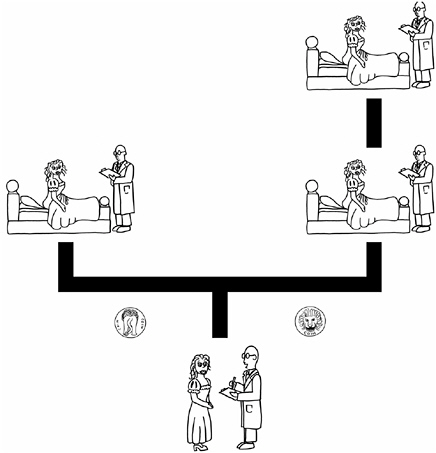
FIGURE 13-1 Quantum Sleeping Beauty.
You ponder. Surely the answer must be simply one-half, assuming it was a fair coin. But then a curious point occurs to you. If the coin fell heads up, there are two occasions on which the scientist will ask you this question. But if the coin fell tails up, there will only be one such occasion. There is therefore a good case that the correct answer is two-thirds!
The problem can be made more dramatic if we raise the stakes a little. Suppose that instead of tossing a coin, the scientist spins a roulette wheel with 100 numbers on it. He tells you that if it comes up one particular number, he will wake you and put you back to sleep 10,000 times before ultimately killing you! However, if it comes up any other
number, he will let you go on your way unharmed after waking the first time.
You are forced or tricked into taking the first sleeping pill. You awaken. How scared should you feel? By one reckoning, the chances are 99 percent that the roulette wheel spared you and you will shortly be allowed to walk away. But by another reckoning, if you draw an outcome tree like that in Figure 13-1, there are 10,000 awakening-instances on the fatal branch of the tree, and only 99 on the branches in which you survive, so you are probably doomed.
If you tend toward the optimistic point of view—on awakening in this second experiment, you would feel 99 percent confident of survival—let me introduce a slight variation that does not really change the odds at all. The room in which the experiment is done contains an independent witness who observes every awakening of every subject the scientist does this experiment on. (He repeats the experiment with hundreds of subjects, most of whom of course survive.) As you awaken, you see the witness observing you with an enigmatic expression before getting up from her chair and leaving, because although she knows the roulette-wheel outcome, she is not allowed to give you any clue. Your blood chills as you realize that she has gotten up from her chair like this on thousands of occasions, and on 99 percent of those occasions the subject before her has been doomed. It seems that whereas before going to sleep, you were 99 percent confident of survival, on awakening you should feel very afraid….
The Sleeping Beauty problem, as it is called, has no agreed-upon answer. But Lev Vaidman has written a paper in which he claims that he and Simon Saunders, two many-worlders, have a straightforward answer to the first case if the coin is replaced by a quantum-random device, such as a photon which can be absorbed or reflected. 7 Because then the ignorance interpretation of probability does not apply; both world lines have equal measures of existence by Everett’s rules and hence so does each of the three episodes of awakening. When you awaken, what mathematicians call your rational expectation that the coin fell heads up should be two-thirds. By consistency, the answer should be the same even if a classical randomizing device such as a
coin was in fact used. Similarly, in the second case, when you awaken, your expectation that you will survive should be only 1 percent.
This answer to the Sleeping Beauty problem remains controversial. But the tale is at least a charming classical introduction to the kind of philosophical conundrums that arise in many-worlds reasoning about the self.

At the moment the philosophy of many-worlds clearly contains more questions than answers. But in terms of practical everyday choices, where does this leave the reader? The best I can do is to quote the opinions of those most knowledgeable in the field. A year or so ago, sitting next to David Deutsch at a dinner, I had the chance to ask him,
“Is there any decision that you would take differently on account of believing that you are in a many-worlds universe, rather than in a classical one?”
Rather typically, he smiled and answered, “Yes. I would answer the question, ‘Do you believe that you are in a many-worlds universe?’ differently.”
But on being pressed, he gave his more serious answer, which boils down to No. He believes that it would be crazy to behave in any other way than in proportion to the measure of existence of the possible worlds consequent on your actions. In every practical life decision, including those involving gambling using either classical or quantum random number generators and those that involve risk—the possible termination of his own existence—he would make exactly the same choices in a quantum multiverse as in a classical universe. Most quantum thinkers whose opinions I respect agree with him.
But there are dissenters. Some physicists are more equivocal, commenting that in their old age, with no remaining dependents and relatively little life expectancy at stake, they might be tempted to some form of the quantum-roulette gamble. To me this is merely a version of what I call the “Krakatoa argument.” If you know that the volcano on an island is about to blow shortly, and your available funds are only half the amount needed to buy a place on the last boat out, then it is
perfectly reasonable to go into the casino and bet all your money on the red—even if the odds are slightly poorer than even. In the same spirit, if you reach a point of old age and infirmity where only immensely costly medical and nursing care would improve your quality of life to a level where it was worthwhile to continue, the time might come to attempt the quantum-roulette gamble. Of course you could also argue that by then the roulette gamble is a sensible choice even if you believe only in a single world.
Another advantage of postponing your decision for as long as possible is that, by then, physicists and philosophers may have revised their advice. Many-worlds is not yet proven. And there is the possibility that we live in a multiverse of finitely many worlds, a possibility we will consider in the last chapter. That makes a fundamental difference to quantum Russian roulette and similar games. Infinity divided by 100 million is exactly the same infinity as before. But a merely very large number divided by 100 million is that many times smaller; for example, 10100 divided by 100 million shrinks to 1092, killing the overwhelming majority of potential future yous. Personally, I will be sticking with Deutsch’s advice.