Schrödinger's Rabbits: The Many Worlds of Quantum (2004)
Chapter: 14 The Classical Warrior: Roger Penrose
CHAPTER 14
THE CLASSICAL WARRIOR
Roger Penrose
What if quantum theory is, after all, incomplete? What if there is some as-yet-undiscovered physical mechanism that can bring about quantum collapse, and by implication undermines the case for many-worlds? This is now a minority view, but it is a possibility that some physicists still take seriously.
The first reasonably watertight specification for such a collapse principle was formulated in the 1980s by three Italian physicists—Ghiradi, Rimini, and Weber—following a program suggested by Philip Pearle. In their honor, specific physical collapse mechanisms postulated ever since tend to be referred to as GRW-based mechanisms. Their basic point was very simple. Systems in which quantum behavior had at that point been observed involved very small numbers of fundamental particles, most typically one (as in the two-slit experiments that had been performed by that point), or at most just a few hundred. Suppose that there is some mechanism that collapses the quantum wave function at random intervals—so that, for example, an object described by a spread-out wave function suddenly pops back into existence in a single well-defined place—but the mechanism works in such a way that individual particles are collapsed only at very
long intervals, yet systems containing huge numbers of such particles are collapsed at very short ones.
An appropriate collapse probability might be on the order of 10−16 per particle per second. Obviously, the chance of a particle collapsing into a single position in the tiny fraction of a second during which it flies through a two-slit experiment (or any other experiment done on a human timescale) is utterly negligible, so wavelike behavior is observed. On the other hand, anything large enough to be considered as a classical measuring device—an observer, be it a cat, a human, or a laboratory instrument—contains something on the order of 1024 to 1029 particles. Accordingly, such a system would be expected to collapse to a single location and state in a tiny fraction of a microsecond. Since GRW put forward their program, several people have suggested specific candidates for such a collapse mechanism.
The most prominent of them is Professor Sir Roger Penrose, and his ideas deserve special consideration because he has done considerable work devising experiments which could actively verify them. Now in his mid-70s, Penrose is one of those scientists who has remained remarkably undiminished by age; in both mental and physical agility, he could easily pass for a man in his 50s. In many ways he is the last and most impressive representative of the old school of quantum thought. He epitomizes it especially well because on the one hand, he is seeking a very specific and reductionist physical mechanism to explain quantum collapse; yet on the other, he assigns at least as much importance to more philosophical issues, and specifically to the possibility of a link between quantum and the nature of human consciousness. To me, and perhaps to others who embrace the new school of thought, this is both slightly paradoxical and eerily reminiscent of the attitudes of such past figures as von Neumann and Bohm.
Penrose is now retired from his distinguished post as Rouse Ball Professor of Applied Mathematics at Oxford University. The achievements that first raised him to worldwide prominence date to the 1970s. Their common link is geometry, because his ability at mathematics is combined with extraordinary visual insight. At the recreational level, he has invented paradoxical shapes of the type made famous by Escher. His discovery of ways to tile a plane in a pattern that is nonrecurring,
infinitely varied, and not predictable by any computer algorithm is a beautiful illustration of a deep problem in mathematics. In physics, his work on matrices called twistors has suggested ways in which the warped fabric of space-time described by general relativity might be reconciled with quantum theory. And I am just old enough to remember the furor when he and Stephen Hawking first revealed their work on the nature of black holes.
These achievements were a third of a century ago. Yet Penrose today is more famous even than he was then. I had a recent reminder of this when he was due to give a talk in a lecture hall that is usually amply large enough for the seminars held there. I turned up well in advance to find it full to bursting. Not only was every seat occupied, but the entrances, stairways, aisles, and even the platform at the front were packed solid with young students willing to stand or crouch in uncomfortable positions for the privilege of hearing him speak. It would have been quite impossible for Penrose himself to get into the room, and we all had to trek across town to a much larger lecture theatre before the talk could go ahead.
Most of that audience had not been born when Penrose made the discoveries for which history will remember him. The work that has brought him back into the public eye is on a significantly different topic. Like many physicists, in his later years he has become increasingly interested in more philosophical issues, questions that are hard not merely to answer but even to formulate. This new focus has led him to propose not one, but two, controversial hypotheses concerning quantum theory, which have led him into significant conflict with his colleagues even as they have raised his profile with the wider public. There is now a significant rift, which has cultural as well as ideological dimensions, between him and the newer generation of physicists.His views on foundational issues, the bedrock on which physics is grounded, differ profoundly from those of many younger scientists. I once dared to bring up David Deutsch’s name in a discussion on the philosophy of mathematics, to be told sharply: “David and I seem to disagree on just about every conceivable point.”
But Penrose’s enduring creativity and mental sharpness are not in doubt. The willingness to formulate new hypotheses, to challenge es-
tablished wisdom wherever puzzles remain, is essential to scientific progress. With respect to quantum physics, Penrose is in the rare position of having been active through both the major epochs in which quantum interpretations were generated. Earlier in his career he knew David Bohm when they both worked at Birkbeck College in London, yet he has remained active and innovative right through to the present day. His views certainly deserve a hearing, and in this chapter we will examine both of his major hypotheses with respect to quantum.
Collapse by Gravity
Penrose has gone looking for a plausible mechanism that might cause collapse along the lines suggested by GRW, and found an answer suggested by a well-known dichotomy between quantum theory and general relativity. It is known that if general relativistic effects (broadly speaking, gravity) were subject to quantum fluctuations in the way that other fields and energies are, mathematical infinities would arise. In physical terms, the structure of space-time would be violently unstable. A quantum fluctuation in a tiny region of space-time would very rapidly grow, perhaps spawning exotic entities, such as black holes or wormholes, at a colossal rate. We do not observe anything like this, so we know that at least some correction is required to current theory. Penrose has tried to fix two problems with one solution by suggesting that such uncertainties in gravitational field energy tend to cancel themselves out, producing the process we call quantum collapse as a side effect.
Gravitational attraction, in the modern Einsteinian picture, is caused by a warping of space-time. In a well-known analogy, this can be crudely visualized as like the bending of a rubber sheet when a heavy ball is placed on it. The heavy ball makes a dimple, and smaller balls placed on the sheet tend to roll down into the dimple just as small objects tend to fall toward the surface of a planet. Even though we normally think of gravitational pull as associated with large objects, such as Earth or another planet, in fact all matter produces gravitational effects. Even two atomic nuclei attract one another gravitationally, and therefore produce tiny dimples in space-time.
If you reject the guide-wave hypothesis (as most modern physicists, including Penrose, do), then an object whose position has acquired a wavelike uncertainty really can be thought of as being in two or more places at once. But what about its associated gravitational field? If the object in Figure 14-1 could be in either of two positions, does it curve space-time as in Figure 14-1a, Figure 14-1b, Figure 14-1c, or what?
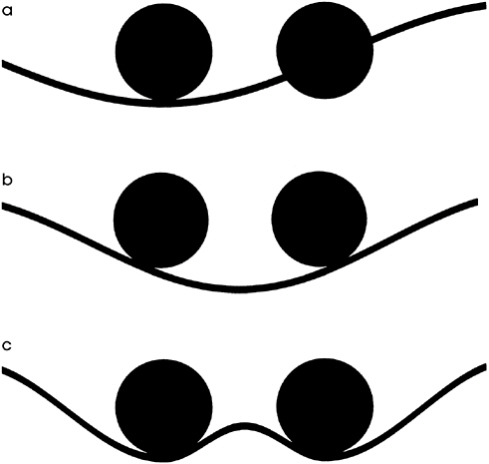
FIGURE 14-1 (a) Space curves as if only one version of the ball (say, the left one) has real mass.
(b) Space curves as if the mass of the ball is at the midpoint of its two possible positions.
(c) Space curves as if there are two versions of the ball, each with real mass.
Penrose’s hypothesis can be expressed in terms of the picture of Figure 14-1c, where space-time starts to be deformed as if by two different objects. Like an elastic band being stretched, this kind of double dimple stores energy. Penrose suggests that the fabric of space-time resists this kind of thing, and that the higher the energy stored in the double dimple, the more likely quantum collapse is to pop the object into a well-defined location.
How great an uncertainty in the gravitational field is needed to cause quantum collapse? Here Penrose resorts to an admitted guess. He speculates that the collapse time, T, in an isolated system (that is, one that is not currently interacting with or being observed by a larger system) is of the order h/2πE, where h is Planck’s constant, the tiny quantity we met in Chapter 2, and E is the energy that would be released by allowing the two versions of the object to fall to their common center of gravity.
For everyday masses—billiard balls, say—the expected collapse time, T, would of course be very short indeed. However, it becomes more significant for tiny objects, and Penrose has calculated the following approximate collapse times:
Beryllium ion ~ 100 years
Water drop 2-µm diameter (just visible in microscope) ~ 1/20 second
Cat ~ 10−37 second
You may find it interesting to compare these with the collapse-by-decoherence times given in Table 7-1.
There are hand-waving elements to Penrose’s argument, but one very important thing sets him ahead of others who have proposed GRW-type collapse mechanisms. He has been brave enough to propose a method of testing his theory, and put considerable effort into refining it toward practicality. By chance I was privileged to hear his very first public description of the suggested experiment in a lecture to Oxford students, the day before he gave it a more formal presentation at Imperial College in London.
The proposed apparatus is our old friend the Mach-Zender inter-
ferometer, which we met being used as a bomb detector in Chapter 10, illustrated in Figure 10-1. Wavelike behavior in this device ensures that the photons all arrive at detector E. Wavelike behavior of course requires that we do not make any measurement of which of the two possible routes the photon takes through the main part of the apparatus.
Suppose we replace the fixed mirror at B with one that is free to move? It will now recoil slowly if the photon hits it, but the effect is so tiny that under normal circumstances it will be swamped by other uncertainties in the mirror’s position and motion, so no interference-destroying “measurement” will take place.
But what if we make the distances BD and AC very large—on the order of thousands of kilometers? Then the mirror will have time to move a significant distance while the photon is still in flight. In fact, if Penrose’s theory is correct, the uncertainty in the mirror’s position caused by the lack of definiteness as to whether the photon went via mirror B or by the alternative route becomes so large that gravitationally induced collapse occurs. The mirror “pops” into one position or the other. At that moment the photon gets localized on one route or the other. When it arrives at the detectors, it will behave in a particlelike way, with an equal chance of being detected at E or at F. This differs from the predictions of orthodox quantum theory.
This would be a very difficult experiment to do. The only practicable way to get the long photon path lengths required would be to mount the experiment aboard a pair of satellites, which would of course be very expensive. Penrose speculated on ways to get around this problem. One possibility would be to use an X-ray or gamma-ray photon, whose energy and momentum is much higher than a visible photon. Unfortunately, it is also much more difficult to generate and handle such photons.
For several years, Penrose (whose retirement has been more nominal that actual) worked with Oxford graduate student William Marshall and others on ways to make the experiment practicable. One possibility Marshall told me they were exploring involved bouncing the photon repeatedly between two closely spaced mirrors on each leg of the apparatus. Using mirrors tuned to the relevant wavelength to
create what is called a high-finesse cavity, the photon could be made to bounce millions of times before continuing on its way. This would have two benefits. The first is to increase the delay time before the photon is measured to a reasonable value while keeping the apparatus quite compact. The second is that if the mirror that is allowed to move is one of the cavity mirrors, it will get kicked not once by the photon, but a huge number of times. (Think of a tennis ball bouncing rapidly between your racket and the ground when you hold your racket close to the ground.) The repeated photon bounces have a much bigger effect on the position of the mirror than a single reflection would do. If the mirror is mounted on a flexible support, a silicon cantilever, and made to vibrate to and fro to start with, the effect of the photon could in theory cause it to end up in a significantly different position to that it would otherwise have occupied, at the opposite end of its swing. By Penrose’s argument, the mirror will spontaneously collapse itself into one of those two positions, thereby determining definitely which cavity the photon is in and abolishing interference effects.
In 2002, Penrose and Marshall published a paper describing this more sophisticated version of the experiment.1 However, the authors’ own calculations show that using off-the-shelf technology, it would be about 100,000 times less sensitive than required to prove Penrose’s hypothesis. Definitive results will not be coming anytime soon.
In the absence of experimental proof, what is the current establishment’s verdict on Penrose’s gravitational collapse? It has to be said that it is fairly dismissive. Stephen Hawking probably speaks for many when he says that decoherence explains collapse so well, without needing to invoke any new physics, that it has simply become superfluous to look for alternative mechanisms. My own feeling is that this might be a little harsh. At the very least, Penrose’s highlighting of the fact that different quantum outcomes can rapidly lead to presumed interference between outcome worlds where the very shape of space-time is significantly different is worthy of further pondering, and experimental investigation if possible.
The bottom line, however, is that Penrose’s collapse mechanism does not resolve what we have identified as the one true dilemma of quantum theory: the nonlocal nature of collapse. Penrose agrees that
if we were to entangle two systems and move them a light-year apart, collapsing one of the systems—by observation or by gravity—would instantaneously change the expected results of a measurement on the second system. It would seem that you could send a “forbidden” faster-than-light message in this way; by fiddling with the mass that triggers the quantum collapse, you could select which of the two distant detectors the photon would arrive in, right up to the last moment.
This does not necessarily cause paradox, however. The backward-in-time signaling we discussed in Chapter 4 depended on the fact that we had two pairs of faster-than-light signalers in two different frames of reference, aboard trains moving in different directions. There are still a few physicists who hope that, special relativity notwithstanding, the universe will turn out to have one preferred stationary frame of reference after all, violating the principle called Lorentz invariance—that the laws of physics look the same to all particles, whatever their velocity. If there were such a unique frame of reference, then faster-than-light information transmission with respect to that frame only would not equate to backward-in-time signaling, and would not cause paradoxes. One such model was formulated in 1949 by Howard Robertson of the California Institute of Technology, and developed further in the 1970s by Reza Mansouri and Roman Sexl of the University of Vienna. As recently as 1998, a set of Lorentz-violating interactions was postulated by Sidney Coleman and Sheldon Glashow at Harvard University. But no evidence for Lorentz violation has ever been discovered, and conventional relativity remains, to put it mildly, the overwhelmingly more accepted paradigm.
Penrose’s genius notwithstanding, his fondness for his gravitational-collapse hypothesis might, at the end of the day, reflect the fact that most of his life was lived before the experiments of Aspect and others, which have unequivocally proved that nonlocality is real. Before nonlocality was proven, finding a plausible collapse-causing mechanism was perhaps the most urgent problem of quantum theory. But now nonlocality must be faced, and no local collapse mechanism, however cleverly devised, can appease its dragons.
Collapse in Mind
Penrose’s second hypothesis about quantum collapse is very much more speculative than the first. It is ironic that thanks to his popular books, in particular The Emperor’s New Mind,1 it is by far the best known of his ideas to the general public. In an earlier chapter, we mentioned the dubious hypothesis that conscious observers play a special role in the establishment of reality. Later, we discussed the likely manufacture of quantum computers in the near future. Somewhere between these two poles of wild and solid speculation comes Penrose’s notion that the human mind might itself be a quantum computer. His declared motive is to explain how our minds can have certain capabilities that he claims would be impossible for any computer operating according to the principles of classical physics.
The vast majority of scientists today accept that the human brain is a form of computer. Of course it differs from the one on your desktop in many ways. The most striking is that your computer has a single processing unit that is doing just one thing at any one time, whereas your brain consists of some 100 billion neurons all operating at once, each acting like an independent computer that reads electrical signals from up to 10,000 other neurons it is hooked up to on the input side, and then broadcasts its own signal to a different batch of neurons on the output side. Some neurons connect to locations outside your brain, for example, receiving signals from the retinal cells in your eye, or telling muscles to contract. Thus your brain is also able to interact with the external world.
But does the power of 100 billion processors make your brain fundamentally different from a desktop computer? The answer turns out to be no. One of the foundations of modern computer theory, invented by the British mathematician Turing during the Second World War, is that any computer that operates according to the laws of classical physics, massively parallel or otherwise, can be exactly simulated by a very basic computer capable of executing just one simple instruction at a time, provided you give it enough time and enough memory with which to work. Such a machine can be—and has been—built from a simple construction toy like Lego, yet it can in principle exactly
simulate the workings of any computer based on traditional physics, from your desktop PC to an organic brain.
If you accept that your brain works by classical physics, then the only difference between it and your desktop PC is scale and programming. We already know how to program an electronic computer to simulate the workings of a small group of neurons performing a simple task, but to simulate the human brain a computer would require at least 1017 binary digits of memory. The computer on your desktop probably has a memory size on the order of 109 binary digits, insufficient to simulate the brain of an insect, even if we knew how to program it appropriately. The task of replicating the human brain is still—thankfully, for moral reasons—way beyond us.
But Penrose feels strongly that the difference between the human brain and a computer is more than mere scale and programming. He believes that human intuition, or more precisely what he regards as the ability of our minds to transcend algorithmic reasoning (that is, step-by-step reasoning using a fixed set of rules) proves that there must be some beyond-Turing-machine aspect to our minds. He describes in particular the “aha” moment when we have been worrying at some problem in an unimaginative step-by-step way without making any progress, then suddenly a lateral-thinking method of going forward, by seeing things in a new way, seems to pop into our heads without warning. To him, this seemingly instant condensation of nebulous thoughts into a coherent solution is strongly reminiscent of quantum collapse.
Penrose highlights one example that he feels proves his point. It arises from an attempt 100 years ago by the remarkable mathematician Hilbert (whose Hilbert space and Hilbert hotel we have already met) to formulate a mathematical language with a comprehensive set of axioms and rules that, within the context of a given mathematical system, will allow any proposition—that is, any grammatically meaningful statement—to be explicitly demonstrated to be either true or false. Because such a language contains a finite number of symbols, there is a finite number of statements of given maximum length that can be made. Because there are also a finite number of rules for manipulating the symbols, an appropriately programmed computer
could easily fiddle about with the axioms to deduce further true statements from them—it becomes an entirely mechanical process. Conversely, the computer could fiddle about with any arbitrary statement it was given until it was either reduced to some combination of the axioms, or shown to contradict one or more of them.
However, a perfect system of this kind, in which every proposition can be proved true or false by applying such a sequence of steps, turned out to be very elusive. Finally a mathematician called Gödel discovered a remarkable thing. Any such system must necessarily contain some statements that are in fact true, but that can never be proved within the rules of the system. The essence of his proof was to list all the possible propositions that can be made, and all the possible correctly formulated proofs, in a kind of alphabetical order, demonstrating that some of the proofs we might expect to find will inevitably be missing.
Penrose claims that a Turing-machine type of artificial intelligence would find it impossible to understand how such a Gödel-undecidable statement might in fact be true, despite lacking a formal proof in terms of the rules. Other people, myself included, cannot really see what he is driving at. What do we mean by “true”? Each of us has an intuitive definition, arising from the experience and mental development of a lifetime. When we are given a mathematical rule system of the kind described above, we can temporarily accept a redefinition of truth as “provable by manipulating the symbols according to certain specified rules.” But of course we have not really forgotten our broader notion of truth, and when we find the rule system inadequate, we appeal to that broader intuition.
Penrose might well be right in his feeling that a human “aha” moment of intuition represents a collapse of multiple tentative threads of thought into a single successful perception. And this is certainly analogous to what happens when the parallel “thought processes” of a quantum computer collapse into a single outcome at the end of the computation. But of course there is no need to invoke quantum to explain why the brain is capable of massively parallel processing. We noted at the start of this section that the brain has a hundred billion neurons at its disposal. Of course our brains use parallel processing,
and no doubt our apparent thread of consciousness is a retrospectively constructed story in which the work of unsuccessful subnetworks is jettisoned, and we remember only the reports of the successful networks—this is rapidly becoming the consensus view among neuropsychologists.
Gödel’s theorem is a fascinating mathematical result with real practical implications, in particular that there might be many reasonable-sounding problems that a conventionally programmed computer would require an infinite time to solve.2 Penrose’s appeal to quantum seems to be based on the hope that some kind of ultra clever quantum collapse might give our minds flashes of intuition about those beyond-infinity solutions. But when we come to study real quantum computers, we see that they outperform classical ones only quantitatively rather than qualitatively. The advantage can potentially be impressive, but it is never infinite. Penrose himself seems to acknowledge that to return information about results that could not be found in finite time by a Turing-machine computer, quantum collapse would have to possess properties additional to and even weirder than those it is already known to have.
What has made Penrose’s quantum consciousness so popular with the public, and inspired him to work on it for so long? Probably it is the enduring longing to believe that the physical basis, as distinct from the mere software, of human beings in some way transcends our mundane material world. Once, all living things were assumed to be endowed with some special vital force. As experiments probed first animal and then human cadavers, the body was seen to be mere ingenious machinery. The physical mystery retreated toward a last hideout somewhere in the brain. Around the time I was born, some doctors were still trying to weigh bodies at the point of death, attempting to detect a small reduction in the weight as the soul departed. (They did find a tiny reduction following the last breath. I suspect it was the buoyancy of the body-temperature air in the lungs, lifting the body like a hot-air balloon with a force of a fraction of a gram.) The human mind is a wonderful thing, but it needs no unique physics to explain it.