Schrödinger's Rabbits: The Many Worlds of Quantum (2004)
Chapter: 8 A Desirable Locality
CHAPTER 8
A DESIRABLE LOCALITY
We have a choice of stories to tell ourselves about quantum, a choice of arenas in which to play physics against the gods. But what gives us an expectation that a straightforward account is possible? Surely physicists, of all people, have of necessity long been accustomed to accepting esoteric and unlikely stories?
Well, actually, no. For at least 2,000 years, right up until quantum came along, science had progressed by taking exactly the opposite attitude—that the universe should be understandable, and that we could find straightforward ways to visualize what is going on. Nay-sayers—those philosophers who pointed out, rightly enough, that there is no reason the universe needs be comprehensible even in principle, let alone by our limited minds—were cheerfully ignored.
And the approach worked spectacularly well. Blindly optimistic though it was, the expectation that the universe should conform to simple principles that were not only understandable, but even aesthetically pleasing to our ape-evolved brains, yielded breakthrough after breakthrough. So the frustration many physicists now feel about being unable to understand quantum is not the mild disappointment of a gambler whose ticket has failed to win the lottery. It is the fierce rage of a player who sees his winning numbers come up one after
another—then gets home only to discover that Schrödinger’s cat ate his lottery ticket.
However, the statement that, without quantum, the rest of modern physics is easy to accept needs a little justifying. There is a myth about scientific progress that goes something like this:
In the good old days—say, around Isaac Newton’s time—the laws of physics conformed to reasonable intuition. All objects, from billiard balls to planets, moved and interacted in a logical fashion in a universe that was easy to visualize. But then special relativity was invented. We had to accept that basic intuitions about space and time hard-wired into our brains were wrong. General relativity made matters worse still. When quantum theory joined the trio of new understandings, it merely underscored the lesson: The universe can be understood only in terms of highly abstract concepts. Let’s face it, three strikes and we’re out—we’ll never get back to a simple world-picture we can visualize. It can only get worse from here on.
This myth is totally misleading. In some very important ways, the development of special and general relativity actually restored a simple intuitive picture that had been wobbling ever since Newton. And that leaves quantum sticking out like a sore thumb.
However, there are several aspects of modern physics that are admittedly a little startling at first encounter. So before trying for an intuitive picture of the universe that includes its quantum aspects, let us first perform a limbering-up exercise. If we overlook quantum weirdness, can we visualize the world without difficulty, including its relativistic aspects? In what follows, please keep a careful watch for the following distinction: Is the world behaving weirdly? Or does it just look as if it is behaving weirdly, as we see it from unaccustomed perspectives?
Hello, World
As we go from newborn babe to adult, our worldview gets refined by successive approximations. Later, it is easy to forget how hard the early stages were, so we will take things right from the start.
We are born with the laws of physics already programmed into
our brains, at least after a fashion. We know this because of an ingenious technique called the gaze test, invented by developmental psychologist Karen Wynn. You cannot ask a day-old baby what it is thinking. But babies, almost from the moment of birth, gaze in curiosity at the world about them. If something happens in front of them, they normally watch as events unfold, then look away. However, if something occurs that the baby finds surprising, it stares for a much longer time. These “gaze time” measurements are quite objective and can be recorded on videotape for later checking, so these data on baby thought processes are much more reliable than investigations that rely on anecdote, or on the mother’s interpretation of early-stage baby talk.
For example, suppose an experimenter places three apples on a tray, then lowers a curtain that blocks the baby’s view of it. The (empty-handed) experimenter approaches the tray and fiddles about with the contents, then withdraws, and raises the curtain again. If there are still three apples on the tray, albeit in different positions, the baby glances briefly at them, and then its attention wanders to other things. But if there are now two apples, or four, the baby stares. And stares. And stares.
Similar simple conjuring tricks establish that babies have a whole set of built-in expectations about the world. For example, they differentiate between the animate and the inanimate. Using criteria that are not yet wholly clear, they place the things they see into either the class of the animate (objects that have the power to move themselves and things they come into contact with), or the class of the inanimate (objects that are inert). Thus, a baby is mildly interested but not astonished when a sleeping cat wakes up and walks away, or when a human pushes a building block across a table with her finger. But if the building block starts moving apparently of its own accord, the baby gazes in wonder.
These tests prove more than is at first sight apparent. For example, the first test is used to establish that babies have the innate ability to distinguish numbers up to about four. But it also demonstrates that babies start with a built-in expectation of conservation laws—apples, or other objects, do not simply pop in and out of existence. Nor can they be teleported; otherwise, any missing or extra apples could sim-
ply have been transmitted to or from somewhere out of the baby’s sight. An object is expected to move only by means of a continuous progression. (I am tempted to say that even a day-old baby knows that the science of Star Trek is nonsense.) Likewise, the test with the building block proves not just that a baby distinguishes between animate and inanimate, but more subtly that it expects objects to affect one another only when they are in physical contact. A baby is not surprised when a block moves if somebody’s finger is touching it.
A key concept is already emerging here: locality. Objects move locally, rather than jumping around in space, and they interact locally. Indeed, if it were otherwise, it is difficult to see how a baby could make any progress in comprehending the physical world. Of course a baby’s brain does not have all the information it needs about the world preprogrammed into it—far from it. The built-in expectations serve as a kind of bootstrap, an outline framework of rules that will be repeatedly refined and modified. For example, a baby has a built-in expectation that objects, including itself, will fall unless they are supported by other objects. Yet in due course, it learns to accept birds, balloons, and aircraft as exceptions to the rule. This progress, modifying our ideas as we go along, continues for quite some time. As we grow up, the data we get from personal experimentation, such as pushing our toys about, are increasingly supplemented by information taught to us by others. The next section roughly charts the stages by which the worldview of a modern child progresses. Just as the development of the human embryo approximately recapitulates our evolutionary history—for example, at one stage it has gills—so the child’s conceptual progress approximately reprises the historical stages by which scientific understanding has progressed.
Worldviews, Infant to Adult
Nursery Physics
The world is a flat and stationary surface that goes on forever. The Sun, Moon, and stars are high up above, stuck on some kind of invisible dome. An invisible force pulls everything in the same downward
direction, making any object fall unless it is supported by something else. Inanimate objects stop moving as soon as you stop pushing them. Objects have definite positions. Objects can affect one another only if they are touching.
Elementary School Physics
The world is round. Gravity pulls you toward the center wherever you are. The Earth, Sun, Moon, and countless stars all hang floating in a space of three dimensions, with the Earth turning as it goes round the Sun. Objects keep moving in the same direction unless some force, such as friction, stops them. Objects have definite positions. Time is marked by clocks, and events happen at definite times. Objects can sometimes affect one another without touching, for example, by electrostatic forces, by magnetism, or by light or radio waves—these are all encountered as different phenomena.
High School Physics
As well as physical matter, space contains invisible spread-out entities called fields. An electric charge creates an electric field around itself. Moving electric charges (such as the current in a wire) create magnetic fields. Accelerating electric charges (such as the alternating current in a radio antenna) generate waves made up of rapidly varying electric and magnetic fields that travel at the speed of light. Electricity, magnetism, and electromagnetic waves are merely different aspects of the same phenomenon.
College Physics
There is no such thing as absolute rest. Measures of distance, such as the distance between two stars, and times, such as the time lapse between two events, depend on the motion of the observer. Time can pass at different relative rates for different observers. The structure of space-time is warped by gravitation. Any object falling under gravity, such as a planet orbiting a star, is actually traveling in a straight line
relative to the region of space immediately surrounding it. Nevertheless, any one observer still sees that all objects occupy definite positions, and all events happen at definite times.
Scary Physics
The world is described by the equations of quantum mechanics, which don’t tell you for certain what is where. Objects can no longer be thought of as having definite positions or speeds. Maybe even cats can no longer be thought of as definitely alive or dead.
Join the Flat Earth Society!
We have all had to revise our ideas many times in order to attain a proper grasp of physics. Each time, some things that were previously believed true had to be accepted as false, or at most as mere approximations to the new, better truth. Luckily, human beings seem to cope remarkably well with learning in this way. Serious students of almost any subject, not just physics, become hardened to hearing a lecturer say: “Everything you were taught last year was nonsense, a story designed to prepare your mind for the real truth, which is as follows….”
However, not everyone can ascend the paradigm ladder successfully. Back when I was a college freshman, a fellow student jokingly wrote to the agony column of one of Britain’s tabloid newspapers along the lines of:
“Dear Marje, I believe the earth is flat, and my friends make fun of me for it. Please help me.”
Back came the reply:
“Do not worry. There are many people who feel exactly as you do….” The letter went on to give details of a Flat Earth Society, which then met weekly or monthly in London. This was some 20 years ago—already quite some years after beautiful, high-quality photographs of the round Earth taken by various sets of Apollo astronauts had started appearing in practically every newspaper and magazine on the planet. I recently went looking for Flat Earth societies still in existence with a view to interviewing some of their members. Alas, either the preva-
lence of orbiting astronauts or other factors appear to have finally put paid to this view as an organized school of thought. Although you will find many spoof references on the Web, the last sincere Flat Earth Society seems to have expired some years ago.1
There are useful lessons to be learned from the flat-earth hypothesis, however. Because almost nobody nowadays feels threatened by the concept that the world is a sphere, we can look at the difficulties in going from one worldview to another more clearly and dispassionately than might be the case with some of the steps we will have to take later. The durability of flat-earth belief shows how hard it can be to accept a new concept, even one that is well within our capability to visualize and does not contradict the evidence of our senses. After all, we understand from infancy that the universe is a three-dimensional place, containing three-dimensional objects. It is also basic to understand that if a circle or sphere is very large, its curvature is very small, so that the curvature of the Earth is not easily noticeable by inspecting your immediate neighborhood. Yet it can still be disconcerting to abandon the “world is flat” view, which starts as our default perspective.
I happen to be able to remember unusually far back into my own childhood. I know this because when I was two, my family traveled to Australia and back by ocean liner, and I have clear memories of the voyage, the only one we took during my childhood. I can remember how profoundly disconcerted I was to be told that, even though people in Australia were standing upside down relative to people in England, they did not fall off the world because “gravity is a force like magnetism that pulls you toward the middle of the Earth wherever you are.” I thought that when we arrived in Australia I would feel upside down, but much like a character using magnetic boots to walk on the ceiling in a cartoon film, there would be a spooky force pulling my feet up toward the ground. Told that the Earth was turning and rushing through space at great speed, I went down to the bottom of our garden, far from the noise and vibration of the road traffic. Even there, I could not feel the slightest sense of motion.
By now, you are probably smiling at the naivete of my two-year-old self. You no doubt have a clear mental image of the Earth as a sphere, illuminated by sunlight on only one side at any given moment,
and pulling everything on its surface toward its geometrical center by the force we call gravity. Of course, the local direction of downward, and the local time of day, is different on each part of the surface.
Some readers will remember their own discomfort and amazement at first being told that the world was round. It is an historical fact that the notion of the flat Earth clung in many people’s minds thousands of years after scientists knew that it was spherical. Historian Jeffrey Russell has thoroughly debunked the myth that the ancient Greeks’ discovery that the Earth was round was either forgotten, or opposed by any mainstream church, during the so-called Dark Ages.2 Throughout recorded European history, mainstream natural philosophers have never seriously doubted that the Earth is a sphere. The only informed debate in Columbus’s day concerned exactly what the diameter was. But that did not stop huge numbers of people preferring the notion of a flat Earth, almost up until the present day. Revising one’s ideas can be painful even when the new picture is well within our intuitive capacity to grasp.
Action at a Distance
In historical terms, the junior school period represents a giant leap forward: from the Middle Ages to the Newtonian worldview, which dominated from the 17th to the 19th centuries. I suspect that to many people, this intermediate period represents a kind of golden age or comfort zone. The workings of the solar system, the nature of gravity, the basic rules of mechanics involving momentum and friction, were very well understood. But no one stopped to worry overmuch about the nature of space and time, which were assumed measurable with respect to some kind of absolute grid or framework. We lived in three fixed dimensions of space, and one of time, and that was that. And although some questions about the nature of light, and a few oddities like magnetism, remained obscure, these were mere details that could be overlooked.
I would beg to disagree. The deceptively friendly Newtonian picture actually robs us of something beyond price, the key feature whose assumption enabled us to make sense of the universe from the cradle,
and that is what I shall call the principle of locality. That is a more formal name for the rule, “Things affect other things only when they are very close to them.” In our cradle physics, the force of gravity was not troubling from that point of view, because it was assumed to be universal and unidirectional, not coming from any particular object. But once the force of gravity is understood as due to the Earth’s mass—in fact, the sum of tiny attractions from all the trillions of quintillions of quintillions of particles that the Earth comprises, acting over a range of many thousands of kilometers—then we have the phenomenon that Hooke and Newton called “action at a distance.” Newton assumed correctly that gravity had an effectively infinite range, becoming weaker at great distances, but never reducing to zero, but he also assumed incorrectly that its effect was instantaneous—so that moving an object a million miles away would instantly change the effect its gravity had on Earth.
The Friendly Field
Gravity was not the only nonlocal force in the Newtonian world-picture. Two other kinds of action at a distance were also known, although they appeared to affect only certain kinds of matter. These were the forces that we nowadays call electrostatic and magnetic. Although both phenomena had been studied before, magnetism by Gilbert and electrostatics by Charles Du Fay, British scientist Michael Faraday’s research in the early 19th century went much deeper.
School pupils today still learn of Faraday the experimenter, investigating the intimate relationship between electricity and magnetism, but it is less well known that his deeper motivation was philosophical. He was profoundly and instinctively opposed to the notion of action at a distance, and wondered if electric and magnetic forces could be explained in any other way. This led him to the concept of lines and fields of force. As a simple example, consider the two pith balls shown in Figure 8-1.
Both balls in Figure 8-1 are positively charged and they repel one another as shown. One way to think of what is going on is that each acts on the other directly at a distance, as indicated by the double-

FIGURE 8-1 Do charged objects repel one another by direct force, as on the left, or via fields, as on the right?
arrow on the left. But an alternative interpretation, shown on the right, lets you consider that each charged ball surrounds itself with an invisible field that extends through space, which we would nowadays call an electric field. Each ball is pushed, not directly by the other, but by the field that surrounds it. Similarly, you can think of magnets either as operating on one another directly, or as being surrounded by magnetic fields.
Faraday’s contemporaries were initially scornful of his field notion. It seemed to violate Occam’s razor; why postulate an unnecessary, invisible entity? Some modern philosophers of physics might have dismissed the idea for a rather different reason, that the question of whether the electric field was real or not was merely a matter of interpretation. If an electric field is discernible only by the force it exerts on a charged body, then surely the question of whether the field is “really” there when no charged body is present is an untestable, angels-on-the-head-of-a-pin kind of proposition. We are therefore free to think of electric forces in terms of action at a distance or in terms of fields, as we please. The only thing that deserves to be called real is the mathematical algorithm that enables us to calculate the forces exerted, the inverse-square rule.
Fortunately for scientific progress, Faraday was not sophisticated enough to dismiss his field notion for either of these reasons. He felt very strongly that electric and magnetic fields were real things. And as so often happens in science, what started as mere interpretation turned out to have real and testable consequences. Faraday speculated that if a field had a reality of its own, then moving the source need not change the state of the whole field instantaneously. Just as real substances have finite elasticity, and transmit impulses at finite speed—for example, when you tap one end of a wooden ruler, the other end does not move until an instant later—so might electric and magnetic fields. Faraday’s extraordinary intuition led him further, to speculate that radiation such as light might in fact be vibrations in the lines of force of his field, that gravity also might be transmitted at finite speed through the medium of a field, and even that the particles of which matter is made might be no more than knots in these fields.3 Arguably, he thus predicted important elements of both special and general relativity, and even string theory.
However, Faraday lacked the mathematics to develop his predictions quantitatively. This was done by the Scottish scientist James Clerk Maxwell. Like Einstein, Maxwell was primarily a visual thinker. His insights were developed in terms of lines and areas, surfaces and volumes, topology and geometry. Although he was very competent in math, it was his servant, not his master. The entities that he described had to have visualizable meanings, even though they described invisible things—a lesson for today’s quantum physicists. Thus he was soon deriving such useful quantities as magnetic pressure, measured like ordinary pressure in pounds per square inch, and magnetic energy. It turned out that a strong magnetic field could be thought of as storing energy, just like a compressed gas, so much per unit of volume.
There is a symmetry between electric and magnetic fields that is normally obscured because in the laboratory we can find plenty of particles carrying an electric charge—protons and electrons—but no corresponding ones with magnetic charge. Nevertheless, an electric field can also be created by a change in a magnetic field, and vice versa, in a yin-and-yang relationship. This led Maxwell to an intriguing possibility: Could you create an electric-magnetic field that existed inde-
pendently in its own right, with no associated physical object? The answer turned out to be that such a phenomenon could exist, but would never be stationary: It would propagate through empty space like a wave or ripple at a speed that was very high, but could be calculated from two known electrical properties of the vacuum, called the permittivity and the permeability. The speed of the predicted wave exactly matched the measured speed of light.
Maxwell died tragically young, at the age of 48, but his famous “Treatise on Electricity and Magnetism” was developed by colleagues George Fitzgerald, Oliver Heaviside, Oliver Lodge, and others into a complete and beautiful picture. Electric and magnetic fields can be thought of as represented by little arrows having magnitude and direction—we now call them vectors—associated with every point in a volume of space. If you draw an imaginary surface around that volume, then the difference between the quantity of flux arrows going into and out of the surface defines the net amount of electric charge within it. More complicated geometrical calculations yield more subtle quantities, such as the energy associated with a given volume of a magnetic field. And so we can design the electric generators, motors, and many other devices on which our modern civilization depends.
But what is important to us is that, at least as far as electric and magnetic forces were concerned, Faraday and Maxwell had abolished action at a distance and restored locality. They had demonstrated beyond reasonable doubt the existence of fields—invisible entities that were real enough to contain energy of their own—and that objects interacted not with far-off things, but only with the electric and magnetic fields immediately surrounding them. There is no instantaneous electromagnetic interaction at a distance: With sufficiently delicate instruments, you might be able to detect the field due to a magnet a million kilometers away from you, but if somebody suddenly moves that magnet, the magnetic field around you will not instantly change. Any such change can propagate out only like a ripple at finite speed, and the maximum speed is, by definition, the speed of light, the speed of an unencumbered electromagnetic wave in free space.
There are at least three reasons to celebrate Faraday’s and Maxwell’s abolition of the action at a distance of the Newtonian picture. The first
is simply that such remote action is upsetting to our early intuition, our instinctive baby expectation that objects can interact only by touching. I can still remember how spooky it was when, as an infant, I was first shown how a horseshoe magnet could snatch up its keeper bar when it was still a good inch away from it. The touching rule is of course only a rule of thumb that evolution has found advantageous to install in us, but it is a very useful rule for simplifying what might otherwise be an incomprehensible world.
The second reason is the theoretical worry that if objects can directly affect one another from far away, it undermines the hope that we can ever properly test the laws of physics by experiment. If the actions of processes on, say, Alpha Centauri can directly and instantly affect the behavior of equipment in a terrestrial laboratory, raising the possibility of self-amplifying feedback interactions, then we can never perform an experiment on a truly isolated system.4
The third reason is simply that instant long-range interactions make it much harder to construct simple predictive models of the world. This applies to all kinds of models, including traditional ones based on fearsome-looking differential equations, but is easiest to see by using a more modern device, the cellular automaton. Ever since the computer was invented, the cellular automaton has been the physicist’s tool of choice for modeling systems that occupy an extended volume of space—which is to say, just about everything the real world contains, be it a solid, liquid, gas, or something more exotic. A simple example is shown in Figure 8-2, which depicts fluid flow.
We can calculate forward from the picture on the left to that on the right quite economically, provided that each cell is directly influenced only by the cells immediately around it. For example, to find the new state of the cell which is shown shaded on the right, we need take into account the previous state only of the cell itself and its immediate neighbors, as shown lightly shaded on the left. If nonlocal influences were at work, we would have to take into account the state of all the other cells, in principle extending an indefinite distance in every direction, and the amount of calculation involved would be vast. If on the other hand there are no nonlocal influences, it opens the door not only to the idea that the universe can be economically modeled, but

FIGURE 8-2 Modeling the flow of a turbulent fluid by computer simulation: one time step takes you from the left picture to the right one.
even to the possibility that it might actually be something as understandable as a kind of local cellular automaton, a hypothesis we will return to in the last chapter.
Faraday himself will remain an inspiration to us in two ways. First, the specific concept of locality, that forces can operate only on nearby things, has turned out to be of immense importance. But even more, his attitude—a stubborn practical man’s insistence that the universe shall be intelligible, and shall conform to our notions of commonsense, however difficult this goal might sometimes seem—will guide us in our quest.
But now it is time to graduate from high school….
A Moving Perspective
Maxwell’s brilliant work had of course left one interpretational question hanging: Given that light is an electromagnetic wave, in what medium can the wave be considered to be traveling? After all, sound waves are a movement of air molecules, and sea waves a movement of water particles; even though light waves are rather more abstract, surely they must travel in some kind of supporting medium? As far back as the mid-18th century, the great mathematician Euler had hy-
pothesized a medium that filled all space, called the ether, and that “sunlight is to ether what sound is to air.”
However weak the interactions between ether and ordinary matter, ether should have at least one detectable property—its speed with respect to Earth. To see why this is so, imagine that the ordinary atmosphere has no detectable properties except for its ability to carry sound, and you want to know whether there is a wind blowing. Sound travels in air at 330 meters per second, so if you station observers in a circle 3.3 kilometers in radius and set off an explosion in the middle of the circle, each observer should hear the bang exactly 10 seconds later if the air is still. However, if there is a gale blowing from the north at 30 meters per second, the sound reaching the northernmost observer in the circle is delayed by about 1 second, taking 11 seconds to reach him, whereas it will reach the southernmost observer 1 second early, after only 9 seconds. In fact, a wind of any speed and direction causes some observers on the circle to hear the sound earlier than others.
In exactly the same way, any ether wind with respect to Earth’s surface should be detectable because light would travel slightly faster in some directions than others. No one knew whether the solar system was moving or stationary with respect to the ether, but because the Earth orbits the Sun at some 30 kilometers per second, continually changing direction as it does so, it could not possibly be stationary with respect to the ether the whole time. A variation in the apparent speed of light on the order of 1 part in 10,000 should have been easily detectable with late Victorian instruments.
It was Maxwell who first described a practical experiment to detect this ether wind, but he died of cancer before it could be carried out. It is extraordinary to think that had he lived a little longer, he might well have anticipated Einstein in the development of special relativity.
Of course, no ether wind could be detected when the experiment was eventually performed by Michelson and Morley. Precise astronomical observations ruled out other possibilities, such as the idea that Earth somehow dragged the local envelope of ether along with it. In that case, the effects of ether current should show up as subtle variations in the timing of such events as eclipses. It could hardly be the
case that all the ether in the solar system was being dragged along in step with our particular planet. Similarly, measurements on stars that orbited one another rapidly ruled out the idea that light traveled with a fixed speed relative to its source, like a bullet fired from a gun. There really did appear to be a deep paradox here.
It was of course Einstein who solved it, with the bold postulate that space and time are not absolute, but vary with the motion of the observer in such a way that light always appears to move at constant speed. For example, if a spacecraft were to pass Earth at very high speed, then from our point of view its clocks would appear to be running slightly slow, and the ship and everything aboard it would appear contracted in its direction of motion. Conversely, observers on the spacecraft would perceive the rest of the universe as spatially distorted relative to our viewpoint. In general, we would not agree with the occupants of the craft on either the distances and directions of objects or the timings of events that we could both observe.
These effects sound very bizarre, but the apparent distortion of objects moving at very high speeds is really just an unfamiliar kind of perspective. Even the most basic rule of perspective—that faraway objects look smaller—is not hard-wired into our brains. Here is a true account, from an anthropology textbook, of a Bushman who was brought outside his native forest for the first time in his life.
Turnbull studied the Bambuti pygmies who live in the dense rain forests of the Congo, a closed-in world without vast open spaces. Turnbull brought a pygmy out to a vast plain where a herd of buffalo was grazing in the distance. The pygmy said he had never seen one of these insects before; when told they were buffalo, he was offended and Turnbull was accused of insulting his intelligence. Turnbull drove the jeep toward the buffalo; the pygmy’s eyes widened in amazement as he saw the insects ‘grow’ into buffalo before him. He concluded that witchcraft was being used to deceive him. 5
Does special relativity make reality harder to visualize? I would argue that it does not in any fundamental way, because we already had to get used to the fact that objects look different from different perspectives, and that different observers might naturally have used different coordinate systems, long before relativity came along. Special relativity asks us to take only one small further step—to the idea that
the observer’s natural coordinate system and perspective viewpoint vary not just with position but also with speed. The universe can look different even to two people in the same place, if they are moving at different velocities—just as we already know that it might look different to observers in different places. But things only look different—cause and effect, the flow of events, are the same to all observers. If an occupant of our imaginary spacecraft makes himself a cup of tea, in our telescope we see him putting the kettle on, getting a teabag, and so forth. If he seems to move rather slowly, and the kettle looks rather squashed, this is just an extension to the rules of perspective we have always accepted. From the astronaut’s point of view, the kettle is its usual shape and he is doing everything at normal speed.
The aspect of special relativity that initially seems hardest to accept is the idea that time can appear to flow more slowly in a frame moving fast with respect to yourself. You might find it helpful here to consider that Doppler effects would produce similar oddities even in a nonrelativistic universe. First, consider sound. Suppose that a train is traveling toward you at one-tenth the speed of sound, 70 miles an hour. You will hear the pitch of its whistle as about one-tenth higher than it really is. If your ears were good enough to hear a conversation taking place aboard the train, the pitch of everybody’s voice would also sound higher, and moreover, you would hear 10 seconds’ worth of conversation in only 9 seconds, because the sound of the last word would have less distance to travel to reach you than the sound of the first word, and so would reach you in less time. If you were blindfolded, it would seem exactly as if life aboard the train were happening 10 percent faster than normal. After the train passed you and was receding, everything you heard would seem correspondingly slowed by the same factor.
In exactly the same way, even in a universe in which light really was an ether wave, life aboard a spaceship coming toward you at a tenth the speed of light would look as if it were happening 10 percent faster than normal—or 10 percent slower if the spacecraft was receding. In our universe, you have to add on the relativistic correction as an additional factor to this Doppler effect, an additional slight slowing of events on board the craft. Actually, even at a tenth the speed of light,
the Doppler effect is much bigger than the relativistic correction: It is only at more than half the speed of light that the relativistic correction overtakes the Doppler one. There is really nothing surprising about events in a fast-moving frame of reference seeming to happen at a different rate.
General relativity asks us to stretch our minds a little further and accept that the fabric of space is warped by the force we call gravity, just as the Earth’s surface is not flat under our feet but bends slightly. An object falling freely under gravity is actually traveling in a straight line in the warped space that immediately surrounds it.
The subtlety that I think confuses many people, and that is not adequately explained in some of the texts I have seen, is that the warping an object encounters once again depends on its speed as well as its position. For example, consider three spacecraft at a point 100 miles above the Earth traveling at different speeds but all falling freely under gravity. Each travels in a straight line from its own point of view, but with different results, as shown in Figures 8-3a-d. The sounding rocket falls back to intercept the Earth’s surface (shown as a thick black line), the orbiting satellite maintains a constant distance from the surface, the interplanetary spacecraft traveling at escape speed increases its distance from the surface. Note that because photons themselves travel so fast compared to Earth’s escape speed, what any observer in the vicinity of Earth actually sees through a telescope corresponds almost exactly to the “flat-space” view, irrespective of the observer’s own velocity. If we lived in the vicinity of a dense massive object like a neutron star, general-relativity-related perspective effects would be familiar to us.
Once we have accepted the new perspective rules, the relativistic universe actually gives us a priceless benefit. It restores locality with an emphasis that has been lacking in every picture since our original nursery physics. Objects interact only with things that they are physically touching—granted that those things are fields rather than physical objects. All forces, electromagnetic and other, exert their effects through the medium of fields, and disturbances in fields—even the rather special distortion-of-space field that is gravity—can propagate no faster than light. There is no action at a distance. And that makes
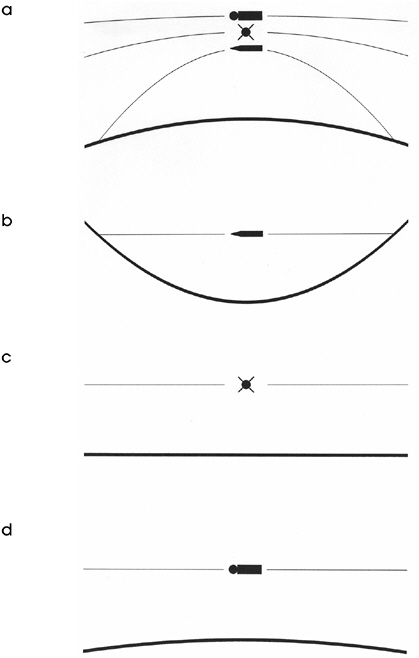
FIGURE 8-3 View of a sounding rocket, a satellite, and an interplanetary spacecraft 100 miles above Earth’s surface. In fact, each object is traveling in a straight line with respect to its own perception of space.
(a) Flat-space view
(b) Space as experienced by the sounding rocket
(c) Space as experienced by the satellite
(d) Space as experienced by the interplanetary spacecraft
the universe relatively straightforward to understand and model. It is a cosy place in which only things in your immediate neighborhood affect you.
If only we could integrate quantum into this neat local picture, we could perhaps play against the gods on fair terms, in an arena which our brains are wired to understand.