Schrödinger's Rabbits: The Many Worlds of Quantum (2004)
Chapter: 15 The New Age Warrior: Anton Zeilinger
CHAPTER 15
THE NEW AGE WARRIOR
Anton Zeilinger
There is a hoary old joke: What do you call a physicist who works on quantum theory? Why, a quantum mechanic, of course! The joke is funny (at least to physicists) because most quantum theorists are just about as far from being practical, applied types as it is possible to get. They tend to live in mathematics or philosophy departments rather than physics buildings, regard running a computer simulation as getting their hands dirty, and probably have not been in an honest-to-goodness laboratory since their undergraduate days. You simply cannot imagine them doing the kind of physics experiment that involves spanners and grease.
By these standards, Anton Zeilinger is indeed a quantum mechanic. His excellent physical intuition has enabled him to devise some of the most dramatic experiments to date to test the foundations of quantum mechanics. For example, it was he who first upgraded the two-slit experiment—which caused such excitement when it was first performed with electrons rather than photons—to work with buckyballs, giant molecular cages comprising 60 carbon atoms. Even these football-like structures, each with a definite rigid shape and containing hundreds of fundamental particles, can be demonstrated to be
“in two places at once”—or at the very least, exploring two paths at once.
When I first met him, Zeilinger was perfecting a larger-scale version of the Aspect experiment, in which the photon paths could be extended up to several kilometers. He was determined to overcome several potential criticisms of the original Aspect setup. His main goal was to ensure that the choice of polarization measurement for each photon was truly random, because in Aspect’s experiments the measurement direction was selected using acoustically driven optical switches that flipped at regular (albeit very fast) intervals, so it was, in principle, predictable in advance.
After describing his new experimental design to a colloquium at Oxford, Zeilinger asked the audience to suggest better ways to make the measurement directions at each end of the experiment completely independent and unpredictable. For example, you could use tables of random numbers generated in advance to set the directions; but it might be better still to decide them only at the very last moment when the photons were in flight, using a real-time random-number generator of a type developed for cryptography. Another alternative suggested was that two human observers, each armed with a toggle switch, could consciously decide the direction of each measurement as suited their whim. Of course I am sure that Zeilinger had already thought of all these ideas, and more, for himself. The purpose of his canvassing the physics community was to make sure that after the experiment was done no one could turn round and say, “Ah, but your measurement choices were not sufficiently random. What you should really have done is this….”
Most experimenters who test the foundations of quantum theory are hoping that sooner or later they will turn up something unexpected. After all, for confirming a well-accepted physical theory to an extra decimal place, an experimenter can expect at most a pat on the back. It is discovering something new—for example, something that throws new light on the elusive quantum collapse process—that brings the chance of greater rewards. At a dinner when I had the chance to question Zeilinger in more depth, it became clear that he does not expect the unexpected to turn up at any point—he believes the ortho-
doxy will be confirmed every time. As we talked, I became increasingly puzzled as to the motive for his admittedly beautiful experiments. Eventually I asked, “Are you trying simply to rub the theorists’ noses in the fact that the problems of quantum theory are real, and cannot be ignored as they are demonstrated at ever larger scales?” He beamed and replied, “Yes, that is so. Exactly!”
He has continued to enjoy tweaking the theorists’ noses. For example, he designed a new version of the buckyball interference experiment to work with hot buckyballs, ones at such a high temperature that they emit several infrared photons on the way through the two-slit device. He asked various theoreticians whether they expected an interference pattern to be produced. They predicted that it would not, on the basis that the infrared photons striking the walls of the experiment would constitute “measurement”—an irreversible interaction with the environment that would destroy interference. But Zeilinger predicted that he would get an interference pattern after all, because the wavelength of the infrared light emitted by the buckyballs was so long that it did not convey sufficiently accurate information about their position to tell the environment which slit they were going through. And of course he was right.
When I first asked Zeilinger which interpretation of quantum theory he favored, he was reluctant to reply. Eventually he said, “I think there is a need for something completely new. Something that is too different, too unexpected, to be accepted as yet.”
“Some variant of many-worlds?” I asked, expecting the answer would be yes. He brought his hand down on the table with a thump and gave a monstrous Teutonic snort.
“No, I do not think many-worlds is right at all. Absolutely not!” And he would not be drawn further. But now, several years later, he has come clean; he does indeed have a radical suggestion, which is new in essence and certainly deserves to be taken seriously. His view is based on one of the most fundamental differences between a universe made up of quantum systems, and one that is classically continuous: A quantum system can contain only a limited amount of information.
Continuous Is Infinite
The difference is rather neatly illustrated by a humorous science fiction story written many years ago by Martin Gardner. In the story, an alien lands on Earth and offers the human race the entire sum of his incredibly advanced race’s knowledge, helpfully translated into English. (Apparently Gardner gets a lot of correspondence from people who claim to have had an alien land in their backyard who makes a similar offer. He writes back, politely asking the alien to give the answer to any one of several mathematical problems known to be soluble, although so far unsolved by humans. He never hears back.)
The alien’s offer is gratefully accepted. He produces a glass rod from his spaceship. “This rod encodes the entire contents of the Library of Zaarthul,” he says. “All you have to do is measure the ratio of its length to its width with an accuracy of 1 billion decimal places. The numbers spell out an English translation in a simple two-digit code where 01 stands for A, 26 for Z, and so on.” Then he seals up his saucer and flies off. The human scientists try to measure the length and width of the rod as best they can, but they never get beyond the first few letters of the message.
Gardner was jesting, of course, because glass rods and other physical objects are made up of the quantized units we call atoms. The rod would be about 108 atoms wide by 109 atoms long, and so its length/ width ratio could encode some eight or nine decimal digits of information at most. However, if we lived in a universe where objects were made of a continuous substance that could be subdivided indefinitely, it would be possible in principle to make Gardner’s rod. In fact if we lived in a nonquantum universe, it would be positively wasteful for the alien to use such a large physical object. Consider the classical picture of an electron as a tiny spinning top, with its axis of rotation pointing in a specific direction. The alien need hand over only one electron, as shown in Figure 15-1. “Measure the angle between the spin axis of this particle and Galactic North, accurate to one billion decimal places,” he says. (Of course “Galactic North” would need to be very precisely defined, perhaps with respect to a master compass consisting of another electron.)
However, in reality, electron spin is a quantum property. The only

FIGURE 15-1 An electron encoding a large amount of information.
measurement we can make is whether the spin is up or down relative to an arbitrarily chosen plane. This yes/no answer can yield only a single bit of information and so, in our universe this refinement of the alien’s encoding scheme would be not just technologically difficult, but fundamentally impossible.1 Indeed, modern theory implies that there is an upper bound on the amount of information that any object or system can contain. For a macroscopic object like a glass rod, it becomes very large but certainly not infinite. Correspondingly, only a finite amount of information is required to describe a given object not just approximately but perfectly—to record all the information about it that the universe contains.
This has profound implications for physics. The whole universe we perceive contains only a limited amount of information. It could be described completely by a sufficiently long string of zeros and ones. Our world might therefore be indistinguishable from a digital computer simulation of itself, just as hypothesized in countless science fiction stories. This contrasts completely with a classical, continuous universe for which the simulating computer would have to record an infinite number of digits just to specify the exact position, velocity, and spin of a single fundamental particle.
A picture in which information is both finite and conserved now underpins the thinking of physicists at every scale, from string theory to cosmology. For example, the property of black holes that physicists nowadays find most puzzling is not their capacity to swallow matter (which can eventually escape as Hawking radiation), but their apparent ability to permanently swallow information.
The Information
This information-based view of physics is now decades old, so what is Zeilinger’s new insight? It is so simple that it took a genius to see it, as is often the case. But to understand it, we must first think rather hard about what we mean by information.
In information theory, the basic unit of information is the bit; something that can have either of two values. In a computer, one bit is represented by a microscopic switch that can be either on or off. However, a bit, or a sequence of bits, can be interpreted in different ways. For example, a logician tends to think of a bit as denoting the truth value of some proposition, recording whether it is true or false. For a mathematician, the normal use of a bit is as a binary digit. A set of binary digits can represent an integer number, as we saw in the chapter on quantum computing. But the same set of digits could also be denoting a letter in the standard alphabet used to display text characters, or the color of a pixel to be displayed on the screen, or the timbre of a musical note to be played, or many other things. As far as the computer is concerned, a bit is just a bit, a switch that is on or off. But the human programmer can use it in different ways depending on what he is trying to make the computer do. A rival computer programmer, trying to understand what a program is doing by looking at the binary bits it generates, will not get very far until he can interpret what kind of information is being represented by each bit—even though the computer itself could not care less and can function perfectly well without this knowledge.
If we view the universe as a sort of giant computer manipulating a large but finite number of bits, there is still the question of how to interpret the information the universe-computer is storing and pro-
cessing. The most natural assumption is that each bit of information relates to a particular point in space-time. This is very like the way that computer models of physical systems like the weather work. The difference is that whereas weather simulations on present-day computers have to divide the atmosphere into imaginary cubes measuring kilometers on each side, a true universe-simulation would hold information at a vastly finer scale, of the order of a Planck length.2
Zeilinger’s approach is radically different. He prefers to think that a given bit of information held by the universe-computer can be interpreted, not as information about what is going on at a specific point of the space-time continuum, but as the logical value (true or false) of statements that can be made about quantum systems. This interpretation allows for the fact that a quantum system considered as a whole can contain information that is not present in its constituent parts.
Nonlocal Information
Figures 15-2 and 15-3 illustrate the principle of distributed information.

FIGURE 15-2 An entirely random pattern.
If you examine either picture on its own, the dot pattern does not merely look random to the unaided eye, it really is arbitrary, and even the best code-breaking machines at the National Security Agency could not extract any meaningful information from it. Yet if you hold the page up to a bright light, you will see a very clear and unambiguous pattern, which of course you are free to interpret as the figure “0,” or the Eye of God looking at you, as you please.3
How is this possible? We will illustrate with an anecdote. Let us suppose that you are the general in charge of a besieged castle. You want to send a message to your king telling him how many days you can hold out before you will have to surrender if help does not arrive. You have a number of brave volunteers prepared to sneak out at night and try to make it through the enemy lines, which is fortunate because radio has not been invented yet. However, there is a dilemma. You know that if the messenger is intercepted, the result will be disastrous because the enemy will discover exactly how long it has to wait in order to achieve victory.
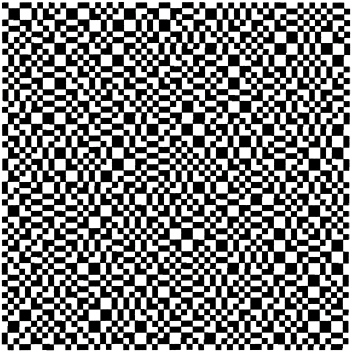
FIGURE 15-3 Another entirely random pattern.
Then you have a brainwave. One messenger might be intercepted, but if two set out in opposite directions, the chance that they will both be captured and forced to divulge their information is small. You could divide the message crudely, for example, so that one man carries a note saying “One hundred” and the other “and sixteen,” but that is not very satisfactory. You really need a way to divide the message so that each note on its own carries no useful information at all, yet both taken together convey the full meaning.
Then the castle mathemagician approaches you bearing a stylus and a piece of parchment. “Sire,” he says, “I have a way. The essential problem is that we need to send the king an 8-digit binary number, namely 01110100”
“Quite so,” you say, being rather advanced in binary math by the standards of the era.
“Well, I have it,” he says. “We will simply send out two messengers, each bearing an 8-digit binary number, and each bearing the magic word “XOR” in the corner. That will tell my colleague Merlin exactly what to do when the messages arrive at the king’s castle.
“The number we want to send will be encoded as follows: If a digit in the final message is to be 0, then the two submessages will each have the same digit in that place. If the digit is to be 1, then the two sub-messages will have different digits in that place.
“Here is how we will generate the submessages. The first digit of the final message is to be 0, so we must write the same digit in both submessages, but we have a free choice whether that digit shall be a 1 or a 0. We will choose by tossing a coin, heads for 1, tails for 0. If I might borrow a coin….”
You give him a gold coin; he tosses it and it lands heads, so he writes a 1 in both submessages.
“The second digit of the final message is to be a 1, so the first digits of each submessage should be different. We will use the coin again. If it falls heads we will insert 1 in the first message and 0 in the second; if tails, 0 in the first message and 1 in the second.” He tosses it; it lands tails. He continues in the same way until the strings below have been generated,
|
Submessage 1 |
10101001 |
XOR |
|
Submessage 2 |
11011101 |
= |
|
Final Message |
01110100 |
|
“Now the marvellous thing is, Sire, that considering the first submessage on its own, each digit was set depending on the toss of a coin. The string is therefore completely random. And considering the second submessage on its own, each digit also depended on the toss of a coin, and it is also completely random. And yet both messages taken together yield the number we want to convey. On receipt of the two pieces of paper, Merlin has only to compare the successive digits, writing down 0 if they are the same in both messages, but 1 if they are different. Why, thank you very much, Sire.”
And off he goes, clutching the coin. What he has said is perfectly true. Each number taken on its own is random. Yet their relationship contains a message.4
To fully understand the ways a quantum system can contain information, we need to take one further step. The nonlocal correlations we have seen so far each required some information to be held locally, as pixel patterns in the first case and binary numbers in the second. Even though the information in one submessage, or one page of pixels, was not useful to us on its own, it was still information in the strict sense of the word. The remarkable thing about quantum systems is that they are also capable of containing only nonlocal information. Fortunately, even this can be illustrated with a classical analogy.
Let us embark on another exotic adventure. This time we will suppose that you are a secret-service agent in a foreign country trying to communicate with a colleague who has been imprisoned locally. Unfortunately the guards will not allow him to be given any kind of object or message, with one exception. Under local custom, some friend of the prisoner is permitted (and indeed required) to pay for his meals by giving the guards two coins, a nickel and a dime, each day. For local cultural reasons, the guards toss the coins in sight of the prisoner, allowing him to see whether they land heads or tails, before they are spent.
This suggests a cunning plan to you. A normal coin does not store any information that can be revealed by tossing it, in the sense that heads are just as likely to come up as tails. However, you discover that by cleverly tampering with the coins you send, you can make them nonrandom; you can make each one always fall heads, or always tails, as you please. If your friend knows this, you can send him a binary message with heads coding for 1 and tails for 0 at a rate of two bits per day, one bit per predictable coin. With patience, a message of any length can be sent.
Unfortunately, disaster strikes. The guards turn out to be not so stupid as they appear. Before taking the coins to the prisoner, they first toss each one a few times out of his sight. If any coin keeps landing the same way up every time, they treat it as suspect and substitute an untampered one. Your scheme is foiled!
Fortunately, you come up with a better one. You start rigging the coins more subtly, perhaps by inserting tiny, cleverly placed magnets. The result is that while each coin individually is equally likely to land heads or tails, the two coins tossed together will always land either the same way up (both heads, or both tails) or opposite ways up (one head, and one tail) depending on how you place the magnets. Each coin on its own contains no information; there is no predicting whether it will land heads or tails on any given toss. However, both coins tossed and viewed together can code one bit of information, say, 0 (if they come up the same way) or 1 (if they come up as opposites). An equivalent coding is to say that your friend should write down a 0 if the logical proposition “The coins have landed the same way up” is true, and 1 if it is false. Now the guards (who are not all that bright) accept your coins as random, and you will be glad to hear that your friend eventually escapes with the aid of the information that you send him at one bit per day.
The idea of a system whose parts appear individually quite random, yet exhibit curious correlations when taken together is no doubt reminding you of something, namely the photons in the Bell-Aspect experiment. Of course the coin correlations are not really spooky, because they occur between objects that are not widely separated, but interacting via well-understood forces. However, it might be instruc-
tive to remember that there was a time when the apparent action-at-a-distance effect of a magnet appeared just as spooky to contemporary philosophers as EPR correlations seem to us today.
Zeilinger’s Informational Principle
Now at last we are in a position to understand the full flavor of Zeilinger’s new hypothesis. Conventionally, the information-carrying properties of quantum systems are derived from fiercely complicated equations. Zeilinger’s approach is to assume as an axiom that the amount of information the universe holds about a quantum system is finite and bounded. In his view, an experimenter who tries to measure incompatible information about a quantum system is making the same kind of mistake as a rookie computer programmer who tries to read 16 digits from an 8-digit register. The extra information simply is not there—anywhere. His insight can be applied straightaway to the most basic demonstration of quantum properties, the two-slit experiment. We know that if we fire a succession of photons or other particles through two adjacent slits, interference will normally produce a pattern. The pattern develops slowly; a clear interference-band picture requires many bits to define it. If you watch the pattern build, it is much like downloading a picture from the Internet through a slow modem. The first few hundred bits give only a blurry view, which becomes gradually sharper as more bits are transmitted, as shown in Figure 15-4.
But if any attempt is made to measure which of the two slits each particle passes through, however delicate or indirect the means employed, the interference pattern is destroyed, as in Figure 15-5. In Zeilinger’s view, this is because each particle carries just one bit of trajectory information. We can use this bit either to get which-slit information or to increase the definition of the picture on the photographic film, but not both. If we measure the trajectory of every particle, because it takes exactly one bit (coding, say, 0 for left and 1 for right) to specify which slit, there is no capacity left over to code picture information, and your film will show a random pattern of dots. If you measure only, say, half of the photons, the pattern that builds up
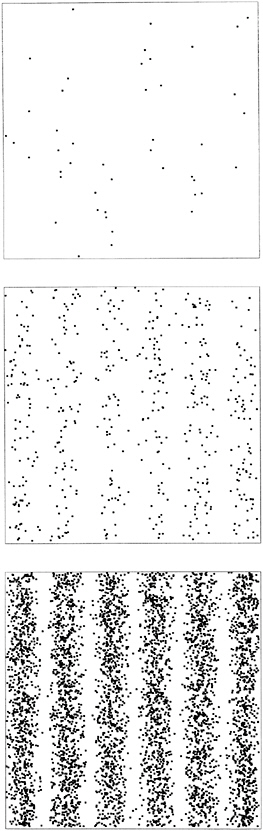
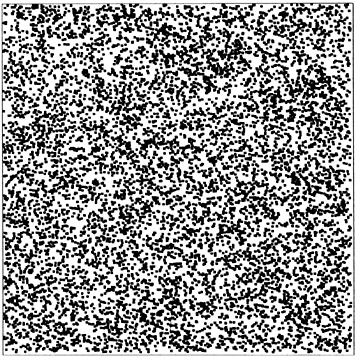
FIGURE 15-5 No pattern.
will be blurred as in Figure 15-6, because only the nonmeasured photons can contribute picture information. Each bit can be used only once; trying to obtain both trajectory information and interference-picture information from a limited number of bits is much like trying to use the same area of computer memory for both numerical and picture data—something inevitably gets corrupted.
Zeilinger’s view seems to imply that much (or perhaps even all) of the information the universe-computer contains is relational in nature—it can know the relative status of two variables, without storing any information about their absolute values. In terms of our parable of the besieged castle, the computer knows the contents of the overall message to Merlin—but it holds no data about the individual submessages carried by the two runners. This leads Zeilinger to the idea that the fundamental information in the universe-computer should be regarded as logical true-false values of statements about quantum systems.
Zeilinger has proved that properties of quantum systems that are

FIGURE 15-6 Partial pattern.
often considered weird, like the correlations obtained in nonlocal measurements, follow logically from this principle. His starting point is a simple system, the two photons of the Bell-Aspect experiment. Zeilinger finds that the universe-computer holds only two bits of information to describe their joint polarization, measured at whatever angles. These two bits can be considered as the truth values of the two statements,
“The polarization of the two photons, measured in parallel directions, will be the same.” (Always TRUE.)
“The polarization of the two photons, measured at right angles, will be the same.” (Always FALSE.)
For this system, all that the universe-computer contains is relative information. There is no information capacity left to store the states of the individual photons. Zeilinger finds that from these assumptions, he can recreate the spooky correlations of the Bell inequality. He goes on to derive a more general result, which, exceptionally for this arcane field, can be rewritten in simple English: “Spooky correlations can arise
in a simple quantum system when more than half of the available information is used to define joint properties.”
Thus the two-photon system of the Aspect experiments turns out to be, surprisingly, a lot more quantumy than the minimum necessary for Bell correlation effects to occur.
An Informational Interpretation?
Zeilinger has certainly found an interesting new way to look at entanglement. His success in explaining nonlocal behavior from straightforward assumptions is solid Occam’s-razor justification for his hypothesis that, at the most basic level, the universe might contain information about individual quantum systems rather than individual localities. He presumably hopes that his approach can be extended mathematically to determine the behavior of more complex entangled systems. If this were to throw light on the way that relative information in small systems tends to “turn absolute” in larger ones, it could provide a new way to look at quantum collapse. Unfortunately, previous attempts to extend such “measures of quantumness” to large systems have run into a morass.5
Zeilinger’s view also shares a problem with much less worthy attempts to brush aside the problems of quantum, namely the questions: If the universe is intrinsically nonlocal, why is the illusion of locality so strong? Why do causative effects always propagate at less than the speed of light? Why are forcelike interactions stronger at short ranges? Nevertheless, if it turns out to be possible to generate further real physics from an extension of his axioms, his ideas will have to be taken very seriously. Perhaps it will turn out that quantum is the real stuff, and the illusion of locality arises as an almost incidental feature of the algorithm the universe-computer is running.
Personally, however, I do not believe that Zeilinger’s approach will lead to the best way to understand the quantum world. When we discussed the merits of different interpretations in the context of tick-tack-toe, we decided that it was vital to find a game that humans are intuitively able to play. In terms of the tick-tack-toe analogy, Zeilinger’s method is like trying to play the adds-to-15 game. Our human minds
are designed to perceive the world in a visuospatial way more easily than in terms of abstract logic. However mathematically successful Zeilinger’s approach turns out to be (and it still has major obstacles to overcome), we would still need the equivalent of a magic square to translate his informational universe into one we can readily visualize.