Health Implications of Perchlorate Ingestion (2005)
Chapter: Appendix D Sensitivity of Perchlorate-Induced Iodide Uptake Inhibition to Serum Iodide Concentrations
Appendix D
Sensitivity of Perchlorate-Induced Iodide Uptake Inhibition to Serum Iodide Concentrations
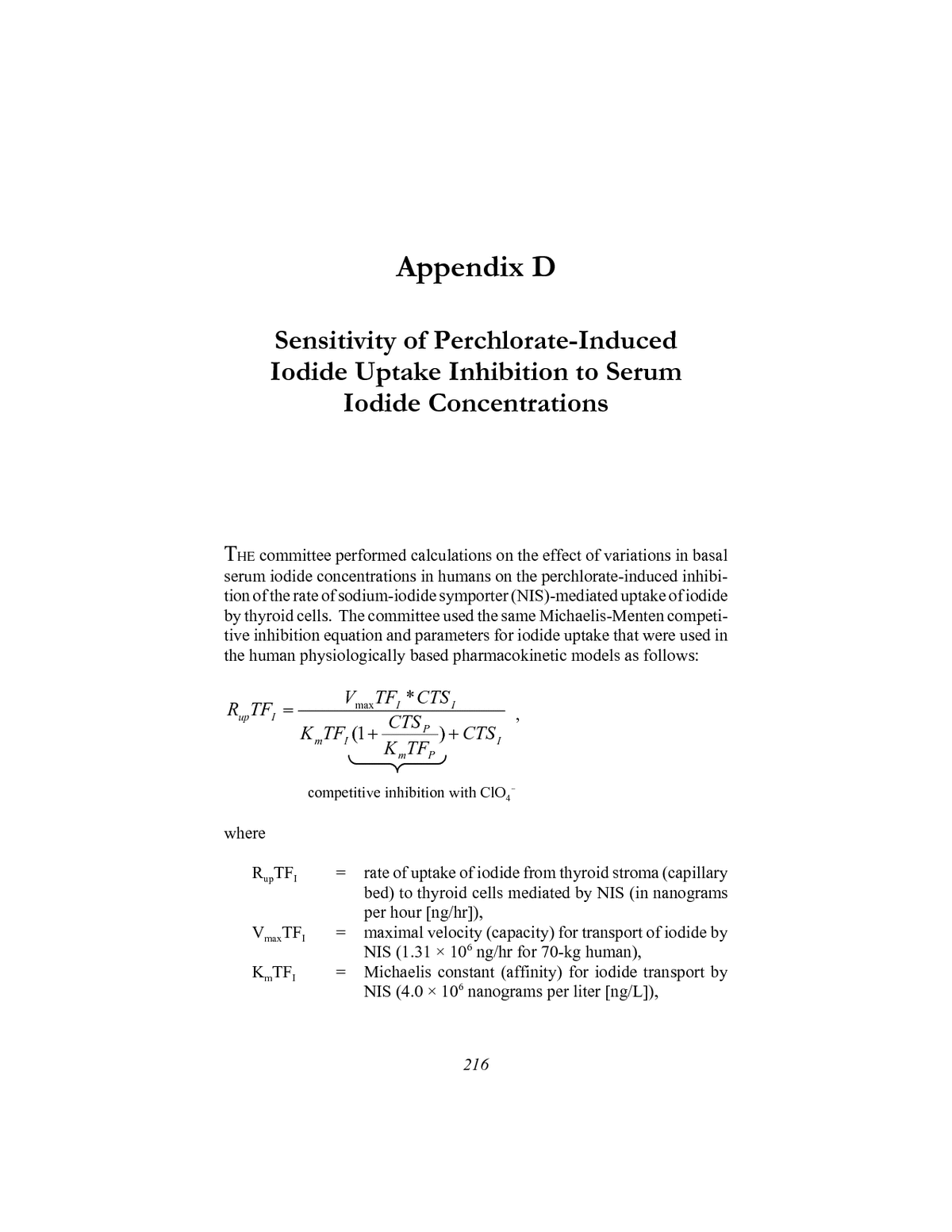
THE committee performed calculations on the effect of variations in basal serum iodide concentrations in humans on the perchlorate-induced inhibition of the rate of sodium-iodide symporter (NIS)-mediated uptake of iodide by thyroid cells. The committee used the same Michaelis-Menten competitive inhibition equation and parameters for iodide uptake that were used in the human physiologically based pharmacokinetic models as follows:
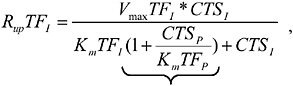
competitive inhibition with ClO4−
where
|
RupTFI |
= |
rate of uptake of iodide from thyroid stroma (capillary bed) to thyroid cells mediated by NIS (in nanograms per hour [ng/hr]), |
|
VmaxTFI |
= |
maximal velocity (capacity) for transport of iodide by NIS (1.31 × 10⁶ ng/hr for 70-kg human), |
|
KmTFI |
= |
Michaelis constant (affinity) for iodide transport by NIS (4.0 × 10⁶ nanograms per liter [ng/L]), |
|
KmTFP |
= |
Michaelis constant (affinity) for perchlorate transport by NIS (1.8 × 10⁵ ng/L), |
|
CTSI |
= |
concentration of iodide in thyroid stroma (capillary bed) (in ng/L, to simulate a range of steady-state concentrations), |
|
CTSP |
= |
concentration of perchlorate in thyroid stroma (capillary bed) (in ng/L, to simulate a range of steady-state concentrations). |
The committee calculated the percent inhibition of the iodide uptake induced by perchlorate at various concentrations that span the range of values measured in humans, from a typical basal iodide concentration of 1.5 micrograms per deciliter (µg/dL) to 15 µg/dL. The calculations assume that steady-state thyroid stroma concentrations are the same as serum concentrations of perchlorate and iodide. Results are shown in Figure D-1.
The overlapping curves in Figure D-1 show that variations in basal iodide concentrations have no effect on the competitive inhibition by perchlorate of the rate of iodide uptake by thyroid cells. Thus, one could conclude that serum iodide concentrations (assumed to be the same as thyroid stroma concentrations in these calculations) in humans ranging from 1.5 to 15 µg/dL would not alter the sensitivity of a study performed to evaluate the impact of perchlorate on the determination of iodide uptake by thyroid cells via the NIS.
The committee also ran calculations of ever-increasing basal iodide concentrations to determine the concentrations that would have to be present before a decrease in sensitivity to perchlorate would be observed. These simulations are shown in Figure D-2.
As shown in Figure D-2, a basal iodide concentration over 100 µg/dL would be needed to shift the dose-response curve for the effects of perchlorate on the inhibition of iodide uptake by thyroid cells; that is, concentrations would have to approach the Michaelis constant (affinity) for NIS transport of iodide. Such high concentrations do not seem plausible. Thus, the committee concludes that humans who have serum iodide concentrations of 0-100 µg/dL would be equally sensitive to perchlorate’s effects on thyroid iodide uptake (all other things being equal).
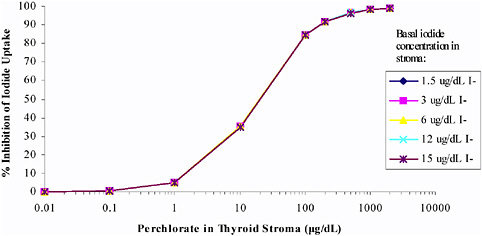
FIGURE D-1 Dose-dependent inhibition of iodide uptake by perchlorate over a range of basal iodide concentrations in thyroid stroma (1.5-15 µg/dL). Abbreviations: I−, iodide; µg/dL, micrograms per deciliter.

FIGURE D-2 Dose-dependent inhibition of iodide uptake by perchlorate over 105-fold range in basal iodide concentrations in thyroid stroma (1.5-10,000 µg/dL). Abbreviations: I-, iodide; µg/dL, micrograms per deciliter.