An Assessment of the National Institute of Standards and Technology Measurement and Standards Laboratories: Fiscal Years 2004-2005 (2005)
Chapter: Appendix A NIST Organizational Structure and Staffing Trends
A
NIST Organizational Structure and Staffing Trends

FIGURE A.1 Organizational structure of the National Institute of Standards and Technology.
The organizational structure of the National Institute of Standards and Technology (NIST) is presented graphically in Figure A.1. The organizational structure of the seven NIST Measurement and Standards Laboratories, including their divisions and the groups within each division, is outlined in the following list.
ORGANIZATIONAL STRUCTURE OF NIST LABORATORIES
BUILDING AND FIRE RESEARCH LABORATORY (BFRL)
Materials and Construction Research Division
Structures
Construction Metrology and Automation
Inorganic Materials
Polymeric Materials
Office of Applied Economics
Building Environment Division
HVAC&R Equipment Performance
Mechanical Systems and Controls
Heat Transfer and Alternative Energy Systems
Computer-Integrated Building Processes
Indoor Air Quality and Ventilation
Fire Research Division
Fire Fighting Technology
Fire Metrology
Analysis and Prediction
Integrated Performance Assessment
Materials and Products
CHEMICAL SCIENCE AND TECHNOLOGY LABORATORY (CSTL)
Biotechnology Division
DNA Technologies
Bioprocess Measurements
Structural Biology
Biomolecular Materials
Process Measurements Division
Fluid Flow
Process Sensing
Thermometry
Pressure and Vacuum
Thermal and Reactive Processes
Fluid Science
Surface and Microanalysis Science Division
Microanalysis Research
Surface and Interface Research
Analytical Microscopy
Physical and Chemical Properties Division
Chemical Reference Data
Computational Chemistry
Experimental Properties of Fluids
Theory and Modeling of Fluids
Cryogenic Technologies
Analytical Chemistry Division
Spectro-chemical Methods
Organic Analytical Methods
Gas Metrology and Classical Methods
Molecular Spectrometry and Microfluidic Methods
Nuclear Methods
ELECTRONICS AND ELECTRICAL ENGINEERING LABORATORY (EEEL)
Office of Microelectronics Programs
Office of Law Enforcement Standards
Quantum Electrical Metrology Division
Fundamental Electrical Measurements
Applied Electrical Metrology
Quantum Devices
Optoelectronics Division
Sources, Detectors, and Displays
Optical Fiber and Components
Optoelectronic Manufacturing
Semiconductor Electronics Division
Enabling Devices and ICs
CMOS and Novel Devices
Electronic Information
NIST AML Nanofab
Electromagnetics Division
Radio-Frequency Electronics
Radio-Frequency Fields
Magnetics
INFORMATION TECHNOLOGY LABORATORY (ITL)
Mathematical and Computational Sciences Division
Mathematical Modeling
Mathematical Software
Optimization and Computational Geometry
Scientific Applications and Visualization
Information Access Division
Speech
Retrieval
Image
Visualization and Usability
Digital Media
Software Diagnostics and Conformance Testing Division
Software Quality
Standards and Conformance Testing
Interoperability
Advanced Network Technologies Division
High Speed Network Technologies
Wireless Communications Technologies
Internetworking Technologies
Statistical Engineering Division
Metrology Statistics and Computation
Statistical Modeling and Analysis
Boulder Statistics
Computer Security Division
Security Technology
Systems and Network Security
Security Management and Assistance
Security Testing and Metrics
MANUFACTURING ENGINEERING LABORATORY (MEL)
Precision Engineering Division
Large-Scale Coordinate Metrology
Engineering Metrology
Surface and Microform Metrology
Nanoscale Metrology
Manufacturing Systems Integration Division
Systems Integration for Manufacturing Applications
Design and Process
Enterprise Systems
Manufacturing Simulation and Modeling
Manufacturing Standards Metrology
Manufacturing Metrology Division
Mass and Force
Machine Tool Metrology
Manufacturing Process Metrology
Sensor Development and Application
Fabrication Technology Division
Intelligent Systems Division
Machine Systems
Control Systems
Systems Integration
Perception Systems
Knowledge Systems
MATERIALS SCIENCE AND ENGINEERING LABORATORY (MSEL)
Ceramics Division
Electronic and Optoelectronic Materials
Characterization Methods
Nanotribology
Data Standards and Technology
Nanomechanical Properties
Materials Reliability Division
Materials Characterization
Process Sensing and Modeling
Structural Materials
Materials Evaluation
Polymers Division
Characterization and Measurement
Electronics Materials
Biomaterials
Multiphase Materials
Processing Characterization
Multivariant Measurement Methods
Metallurgy Division
Thin Film and Nanostructure Processing
Magnetic Materials
Materials Performance
Thermodynamics and Kinetics
NIST Center for Neutron Research
Reactor Operations and Engineering
Neutron-Condensed Matter Science
Research Facility Operations
PHYSICS LABORATORY (PL)
Electron and Optical Physics Division
Photon Physics
Far UV Physics
Electron Physics
Optical Technology Division
Optical Thermometry and Spectral Methods
Optical Properties and Infrared Technology
Optical Sensor
Laser Applications
Time and Frequency Division
Ion Storage
Time and Frequency Services
Atomic Standards
Optical Frequency Measurements
Atomic Physics Division
Atomic Spectroscopy
Quantum Processes and Metrology
Plasma Radiation
Laser Cooling and Trapping
Ionizing Radiation Division
Radiation Interactions and Dosimetry
Neutron Interactions and Dosimetry
Radioactivity
Quantum Physics Division
STAFFING TRENDS, FY 1995-2004
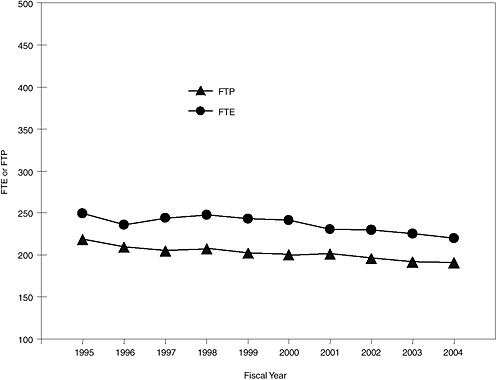
In Chapter 1 of this report, Figure 1.1 presents aggregate data on staffing trends for the seven NIST Measurement and Standards Laboratories for the past decade. In this appendix, Figures A.2 through A.8 provide laboratory-by-laboratory staffing trends for the same period of time.
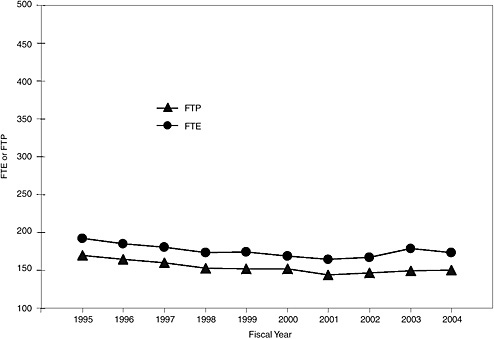
FIGURE A.2 Building and Fire Research Laboratory employment trends, 1995-2004. NOTE: FTP = full-time permanent employees; FTE = full-time-equivalent employees (FTP + other than FTP).
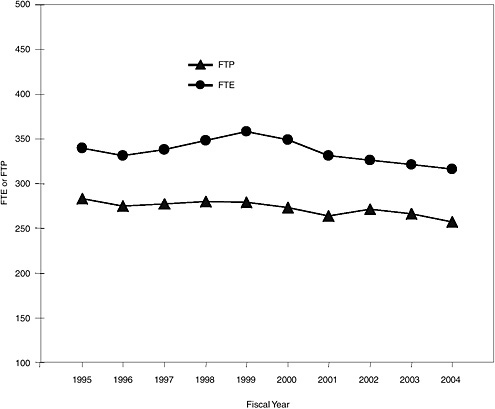
FIGURE A.3 Chemical Science and Technology Laboratory employment trends, 1995-2004. NOTE: FTP = full-time permanent employees; FTE = full-time-equivalent employees (FTP + other than FTP).
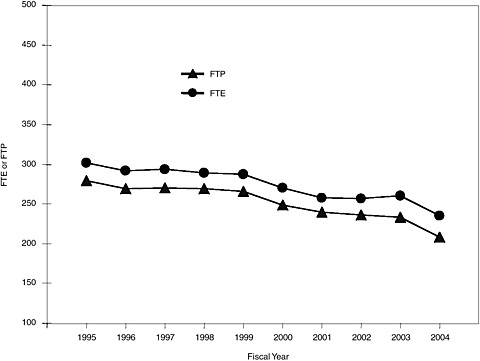
FIGURE A.4 Electronics and Electrical Engineering Laboratory employment trends, 1995-2004. NOTE: FTP = full-time permanent employees; FTE = full-time-equivalent employees (FTP + other than FTP).
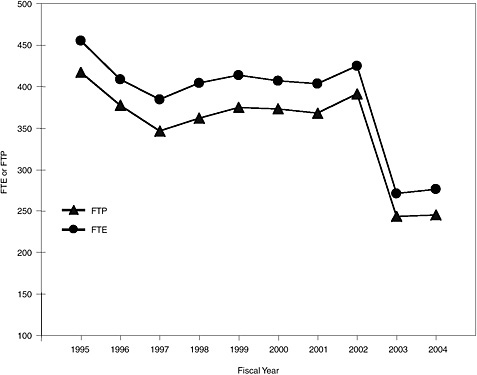
FIGURE A.5 Information Technology Laboratory (ITL) employment trends, 1995-2004. Data from FY 1995-1996 reflect combined spending for the Computer Systems Laboratory and the Computing and Applied Mathematics Laboratory. In FY 2003, Consolidated Computer System and NIST overhead-supported ITL activities were transferred to the NIST Chief Information Officer. NOTE: FTP = full-time permanent employees; FTE = full-time-equivalent employees (FTP + other than FTP).
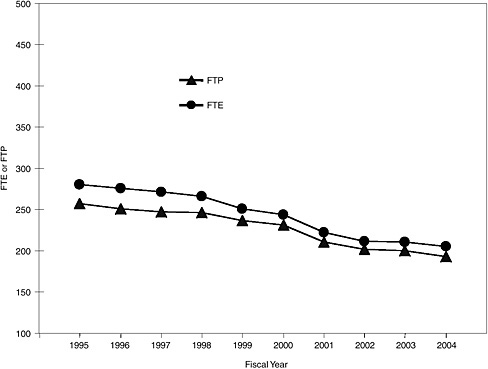
FIGURE A.6 Manufacturing Engineering Laboratory employment trends, 1995-2004. NOTE: FTP = full-time permanent employees; FTE = full-time-equivalent employees (FTP + other than FTP).
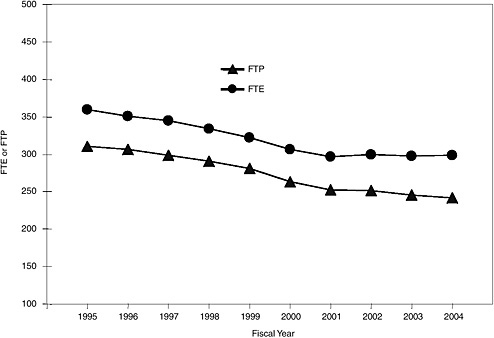
FIGURE A.7 Materials Science and Engineering Laboratory employment trends, 1995-2004. NOTE: FTP = full-time permanent employees; FTE = full-time-equivalent employees (FTP + other than FTP).