Snooze... or Lose!: 10 "No-War" Ways to Improve Your Teen's Sleep Habits (2006)
Chapter: Part II How to Help Teens Feel and Be Their Best -- 6 Off the Charts: Measuring Teen Sleepiness
6
Off the Charts:Measuring Teen Sleepiness
Not long ago, when I walked out to my clinic’s reception area to greet my next patient, I found her sitting with a magazine on her lap—fast asleep. From her bedraggled look—hair uncombed, shirt button missing, belongings scattered at her feet—and her ability to fall asleep in a noisy waiting room in the middle of the afternoon, I was pretty sure she was a youngster with a major case of sleep deprivation.
But she didn’t agree. When we chatted in my office and I asked her why she had come to see me, she said her pediatrician had sent her because she hadn’t found anything that would account for the moodiness and drop in grades that her parents were worried about. But Mara herself was sure nothing was wrong. She told me she felt perfectly fine and wasn’t sleepy at all.
As part of her evaluation, I asked Mara to keep a sleep log (see page 133 for a sample of my sleep log) and come to my sleep lab to take a daytime napping test. And, lo and behold, the results showed that Mara was not just sleepy but pathologically sleepy.
Why didn’t she know this? And why couldn’t her parents or her pediatrician recognize it?
A big problem with sleep deprivation is that it’s not always easy to spot—either by the person who’s experiencing it, like Mara, or by the people in that person’s life. And that goes for adults as well as adoles-
cents and younger kids. As far as teenagers go, sometimes some of the symptoms—such as being moody or falling behind in school or being sleepy—are attributed to rebelliousness or laziness or typical adolescent behavior, not an underlying physical cause. And some sleep-deprived people just function better than others, doing fairly well though definitely not their best. Younger adolescents don’t always have the judgment to understand that being sleep deprived is interfering with their lives. Others who are severely sleep deprived may have additional problems that mask or share symptoms with sleep deprivation, such as attention deficit disorder (ADD) or depression, and that makes it extremely difficult to diagnose them. (For more on the links between sleep deprivation and ADD and depression, see Chapter 11.)
So how can you tell if your teen is truly sleep deprived—and to what degree?
There are several ways to tell. If you think your teen has a sleep problem, you can send her to her doctor. If your teen checks out well there, and no other medical condition is found, an evaluation by a sleep specialist like me will provide valuable information. (To find a certified sleep specialist in your area, search under “Patient Resources” on the American Academy of Sleep Medicine’s Web site, www.aasmnet.org. Your local medical society should also be a good resource for sleep doctors in your community.)
You can also gather and assess important information yourself, along with your teen. This chapter includes a number of sleepiness tests and scales as well as a description of typical symptoms to look for to help you make a determination. You’ll also find several Web site addresses where your teen can test herself on sleep-dependent performance. And I’ll give you some ideas for informal tests you can create yourself.
What Does a Tired TeenLook and Act Like?
Some of the more obvious signs of sleep deprivation may already be pretty clear to you—you see them in yourself as well as
SNOOZE NEWS
A recent BBC Radio show detailed asurvey that showed that adolescentswho slept fewer than six and a halfhours on school nights or had morethan a two-hour difference betweentheir school-night and weekendbedtimes complained more aboutdepression than those who gotmore sleep.
your teen. There are the bags under the eyes, the constant yawning, the dozing off at inappropriate times. But many sleep deficit symptoms are not quite so recognizable. For instance, we talked in Chapter 2 about the fact that many exhausted teens get headaches, but if you hadn’t read that chapter you probably wouldn’t have thought, “Lots of headaches. It could be sleep deprivation.”
To give you a better picture of what a sleep-deprived teen might look like, the following list names the top 13 symptoms my adolescent patients exhibit:
Yawning
Falling asleep at inappropriate times
Trouble getting out of bed in the morning
Taking more than 20 minutes to fall asleep at night
Frequent headaches
Sallow skin
Bags under the eyes
Irritability bordering on hostility
Clumsiness
Lack of verbal output (doesn’t talk very much)
Doesn’t respond to questions (I have to repeat them)
Sullenness
Has a low mood or is depressed (occasionally the opposite, giddiness, can be seen)
In addition, many adolescent patients’ grades deteriorate, and they’re also often tardy or absent from school. (Luckily, some school administrators and counselors now associate sleep deprivation with reduced school performance and absenteeism and recommend that chronically tardy and underperforming students seek help. However, recently I saw an 11th grader who had been arrested for truancy despite his mom calling to report that he was home asleep.)
Even knowing all this, though, it can be hard to tell if your teen is exhibiting some of the symptoms because of teens’ outstanding ability to mask themselves with their makeup and fashion statements. But here a photo can help. Take a look at a photo of your teen from a year
One Teen Says … “During the school year I get about five hours of sleep a night. I setmy alarm for 5:30 so that I have enough time to shower and get myhair and makeup all set before the bus comes. I’m really out when Isleep, though, so I set seven different alarm clocks all over the room. Iusually don’t hear the first couple, and then when I start to hear them Iwait until the seventh one goes off so that I can stay in bed until thelast second.” |
or two ago and compare it to one from today. Does the older picture show a bright-eyed and bright-skinned youngster? Does it show an adolescent bursting with energy and actually smiling for the camera? Even if the clothes worn for the photo were baggy or sported colors that made you want to avert your eyes, was your teen fairly well groomed and pulled together?
Showing your teen the two photos might be helpful to her understanding of a potential sleep problem as well. And looking at two other photos might make a light bulb go off, too. Try taking a photo of your teen—or encourage your youngster to take one—on the day after a night of little sleep. Take another on a day after your teen has logged at least eight hours of sleep or even after a weekend night of 10 hours of sleep (the more, of course, the better). The difference may be startling—and an eye opener. Your teen might also be interested in comparing photos of friends under the same circumstances or taking photos of friends and trying to guess how much sleep they got the night before.
Using Professional SleepinessAssessment Tools
Looking closely at your teen and thinking carefully about her behavior will go a long way in helping you decide if there is a possible sleep problem. But professional measurements can be extremely useful too. In my practice I use a number of sleepiness scales and questionnaires to help me make a determination, and I’m including some of them here so that you can use them as well.
Adolescent Sleepiness Scale
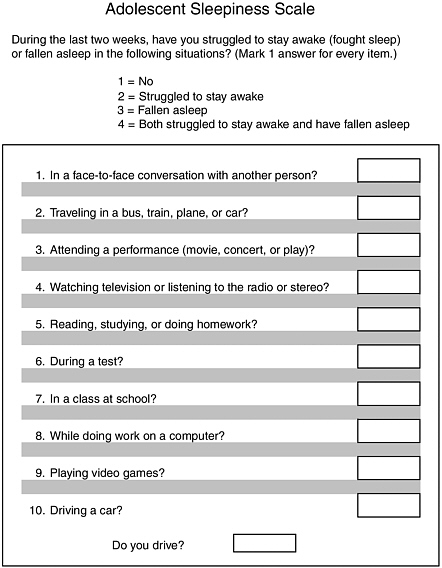
The Adolescent Sleepiness Scale is a 10-point subjective assessment of alertness.* It’s particularly useful because it asks teens to determine how hard it is to stay awake while doing typical activities such as reading and talking with friends or teachers. The test can be repeated at intervals to check your teen’s progress in getting more rest.
* | SOURCE: Wofson AR, Carskadon MA, et al. Evidence for the validity of a sleep habitssurvey for adolescents. Sleep 26(2):213-216, 2003. Seewww.sleepforscience.orgforthe entire Sleep Habits Survey. |
Scoring
A total score over 10 should be reviewed carefully, with all positive responses evaluated. A score between 15 and 20 signals a significant degree of daytime sleepiness and should alert you and your teen that she needs to get more sleep.
The Epworth Sleepiness Scale
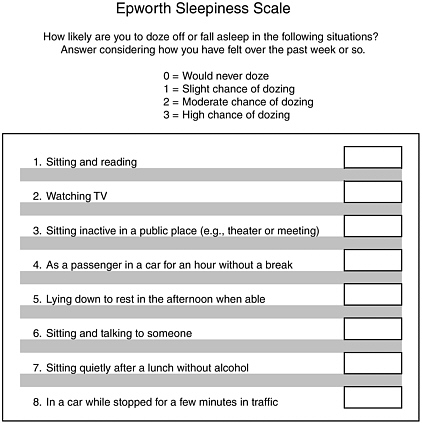
This scientifically validated measure of sleepiness* is used widely to assess adult daytime sleepiness over the past week or so. You can answer the questionnaire yourself, to get an idea of your own sleepiness level in an effort to lower it, or encourage your 20-something daughter to fill in the blanks. There are eight questions with a 24-point scale.
Scoring
1–7: You’re getting enough sleep
8–9: You’re borderline
10 or higher: You’re sleepy
Stanford Sleepiness Scale
Another way to evaluate daytime sleepiness is with the Stanford Sleepiness Scale.* Rather than assessing how sleepy you’ve felt over

Pediatric Daytime Sleepiness Scale*
Please answer the following questions as honestly as you can:
the past few days or weeks, however, this test checks how alert or tired you feel every few hours during one day. The test can be taken by both adults and adolescents and provides information about how your alertness varies during different times of the day. It also points out the most problematic times of the day. If you like, you can rate your teen later in the evening to get a sense of how late her internal clock is delayed, but you can take the test at any time and as frequently as you like. I’ve found that rating yourself every two hours provides a good picture of how your daytime alertness varies.
Scoring
Ideally you want a rating of 1 for every test. But remember that people entrained to the normal day-night cycle typically feel less alert in the mid- to late afternoon. Any score higher than 3 indicates that you may be seriously sleepy.
The Pediatric Daytime Sleepiness Scale
The Pediatric Daytime Sleepiness Scale (PDSS) was created to meet the need for a sleepiness measurement for elementary and middle school children. Students between the ages of 11 and 15 were first studied to determine the relationship between daytime sleepiness and school performance, and the scale is now widely used to question sixth, seventh, and eighth graders about their sleep habits. While the scale has not been validated for older teens and students in their early twenties, it’s a good way to see how sleepy younger teens are. It’s also helpful for catching sleep deficits from which your younger children suffer before poor habits become ingrained. Repeat the test as often as you like to measure your young teen’s progress.
Scoring
When the PDSS test was first given to sixth through eighth graders, there was a clear correlation between higher scores and worse academic performance, worse mood, and especially anger and more frequent illness. In that sample, sixth graders had an average score of 11.8; seventh graders, 12.9; and eighth graders, 13.8. Scores above these averages signal that a young teen may have a sleep problem. A
score of 16 or higher is likely to be associated with a negative impact on daily functioning.
Using Additional ProfessionalAssessment Tools
In addition to using the assessment tools in the previous section, you and your teen can gather important information with tests that measure what are often sleepiness-related conditions. Three tests are included here: one that measures the ability to pay attention, one that measures headache occurrence, and one that identifies symptoms of depression (for more on the link between these and other conditions and sleep deprivation, see Chapter 11).
The Divided-Attention Test
Because sleep-impaired teens can resemble alcohol-impaired teens—Chapter 2 noted that sleep deprivation produces psychomotor response impairments equivalent to those caused by consuming alcohol at or above the legal limit and that, after teens are awake for more than 16 hours, they drive as though they had a blood-alcohol level of 0.05 to 0.1 percent—I’m including this test developed by the National Highway Traffic Safety Administration. Used to determine whether drivers are driving drunk, the test includes physical exercises that sober people can easily perform. It’s called the Divided-Attention Test because the exercises require test takers to divide their attention between listening to and following instructions and doing certain physical movements—something with which a sleep-deprived person will have difficulty.
There are two parts to the test:
The Walk-and-Turn Test, which asks test takers to take nine steps, heel to toe, in a straight line, then turn on one foot and walk in the same manner in the opposite direction
The One-Leg Stand Test, in which test takers stand with one foot about six inches off the ground and count out loud by thousands (1,001, 1,002, etc.) until they’re told to put their foot down, usually about 30 seconds
Scoring
In the Walk-and-Turn Test, police officers look for seven signs of impairment:
Can’t keep balance while listening to the instructions
Begins before the instructions are finished
Stops while walking to regain balance
Does not touch heel to toe
Uses arms to keep balance
Loses balance while turning
Takes the wrong number of steps
In the One-Leg Stand Test, officers look for four signs of impairment:
Swaying while balancing
Using arms to balance
Hopping to maintain balance
Putting down the foot
In both tests, 65 to 68 percent of test takers who exhibit two or more signs of impairment have a blood alcohol level of 0.10 or greater. Sleep-deprived teens will likely be impaired to a similar degree and experience a serious reduction in motor response time.
Evaluating Headaches
As I’ve mentioned already, and will go into detail about in Chapter 11, headaches frequently accompany sleepiness. To help distinguish between sleep deprivation headaches and more serious migraines, I recommend that you encourage your teen to take the quiz at www.headachequiz.com. You can also ask your teen to check out the symptoms of migraines below. If you suspect your teen has migraines, consult her doctor and pay careful attention to her sleep needs.
Symptoms Suggestive of Migraine Headaches
Visual disturbance: jagged or zigzag lines, reflective appearance, shimmering, flashing lights, or peripheral or central loss of vision
Headaches that involve only one side of the head
Nausea or vomiting
Sensitivity to light or sound
Pounding or throbbing sensation
Speech disturbance
Numbness, tingling, or weakness
Depression Screening
Tired adolescents often exhibit a low mood as well as decreased interest in schoolwork and activities—which may be signs of depression. To help sort out sleepiness from depression, take a look at the depression screening test developed by the New York University Medical Center, which is available online at www.med.nyu.edu/psych/screens/depres.html. (Do remember, though, that having symptoms of depression does not necessarily mean you have depression.) If your teen’s test result is negative but you still suspect she has clinical depression, be sure to have her evaluated by a professional. Depression and impulsiveness can be a lethal combination in adolescents.
Using Informal Assessment Tools
Professional measurements are definitely great sources for gathering important information on sleep deprivation—I rely on them in my practice to add to what I observe in and hear from patients. But if it’s difficult for you to get your teen to take any of the tests included here, or you just want to round out your understanding with additional input, you can gather valuable information from informal sources.
Online memory games and puzzles are great—and enjoyable— ways to see how your teen’s memory and reaction time stack up, helping you determine if she is sleep deprived (you remember from Chapter 4 that poor sleep can equal poor learning). The idea is to see how well your teen compares to others playing the same game and to learn how speedily she reacts during the time allowed. By playing the game several times, after a good night’s sleep and after a night of little sleep, you and your teen will have evidence that sleep loss impairs performance—and that sleep deprivation is in play. (See Resources for several of my favorite Web sites that offer a variety of memory games.)
In addition to playing the Web games, you or your teen can devise memory tests of your own. For example, you could develop a list of 20 words, read them to your teen, wait 10 minutes, and then see how many words your teen can write down. Or your teen could take a timed test in which she has to come up with as many names of animals—or states or trees—as possible. Or teens could test each other on how many mental math problems they can work in a certain time period. Being able to remember only a few words or name only a few animals or do only a few problems would be a strong indication of sleep-deprived performance.
My own 12-year-old niece proved the sleep-performance link by giving fellow students at her middle school an informal memory test. As part of a science project, she read a list of 20 words to a number of students during lunch period and then tested their recall at the end of the school day. The next day she tested them again—and asked how much sleep they had gotten on each of the nights before questioning. Just as she had hypothesized, those who had slept more recalled more words.