Toward Sustainable Agricultural Systems in the 21st Century (2010)
Chapter: 3 Improving Productivity and Environmental Sustainability in U.S. Farming Systems
3
Improving Productivity and Environmental Sustainability in U.S. Farming Systems
The widespread implementation of management practices that improve productivity and environmental sustainability, along with new environmental policies and regulations in the last 20 years, have been effective in reducing many detrimental effects of agriculture. Research aimed at understanding how these management practices and engineering approaches work continue to provide additional tools for progress toward the sustainability goals outlined in Chapter 1. This chapter briefly discusses some of the management approaches and practices that are relevant to productivity and environmental sustainability and have an impact on agriculture’s natural resource base (goals 1 and 2 in Chapter 1). Table 3-1 illustrates the relationships between the two sustainability goals and subgoals, management activities and specific practices that can be used to reach the goals, and a selection of potential indicators that are or could be used to assess progress toward specific goals.
Each section in this chapter discusses how specific practices can contribute to crop or livestock productivity and improve various aspects of environmental sustainability or enhance the quality of a resource. The extent to which the practices are adopted by farmers is discussed if data are available. However, a practice by itself might improve sustainability in relation to one goal but might have a negative effect on another; hence, the disadvantages of each practice are also discussed. A farm is a system that contains multiple interrelated elements, and the interrelationships between environmental conditions, management, and biological processes determine such outcomes as the environmental impact, efficiency, and resilience of the farm (Drinkwater, 2002). Some of the disadvantages of certain practices might be overcome if a complementary practice is used. In other words, the collective outcome of several agricultural practices would be different from simply adding the anticipated outcome of individual practices. Therefore, many in the scientific community have been adopting a “systems” approach, which emphasizes the connectivity and interactions among components and processes and across multiple scales, to understand and harness complex processes. “Systems agriculture” is an approach to agricultural research, technology development, or extension that analyzes agriculture and its component farming
TABLE 3-1 An Illustration of Activities and Practices Used to Achieve Agroecological Sustainability Goals and of Indicators for Evaluating Sustainability
|
Agroecological Sustainability Goals |
Examples of Indicators |
Activity |
Examples of Practices |
|
1. Satisfy human food, fiber, feed, and fuel needs |
|
|
|
|
a. Sustain adequate crop production |
• Yield per unit area, yield per unit resource use (energy, water, and nutrients) |
• Crop management |
• Fertility, pest, and water management (see below for specifics). Plant breeding and genetic modification to improve yield and stress tolerance. |
|
|
|
• Plant breeding |
• Crops bred for increased resistance to biotic and abiotic stresses, enhanced nutrient use efficiency, and yield stability |
|
b. Sustain adequate animal production |
• Production per unit land, production per animal, production per unit resource use (energy, water, nutrients), mortality, duration of productive life, conversion of feedstuff to human edible products, animal health |
• Animal husbandry |
• Use of local feedstuffs, careful use of resources (labor, water, energy), breeding for increasing feed efficiency, animal health and welfare, herd health management (disease prevention), improved housing environments, judicious use of antibiotics, waste management, manure applications to field, and advanced treatment technologies for manure |
|
2. Maintain and enhance environmental quality and resource base |
|
|
|
|
a. Maintain or improve soil quality |
• Soil nutrient levels, nutrient use efficiency |
• Soil-fertility management |
• Fertilizer and organic amendment application, use of soil and tissue tests, nutrient budget calculations |
|
|
• Soil organic matter content, microbial and macrofaunal populations and communities |
• Organic-matter management |
• Conservation tillage, organic amendments, composts, green manure |
|
|
• Soil physical structure such as bulk density, water-holding capacity, aggregate stability, porosity, water infiltration rate |
• Organic-matter management |
• Conservation tillage, organic amendments, compost, green manure |
|
b. Maintain or improve water quality |
• Fertility inputs, field or farm nutrient budget balances, nutrient, pesticide, and pathogen concentrations in water courses, leaching estimates, nutrient or water model outputs |
• Soil-fertility management |
• Use of nutrient budgets, use of slow release fertilizers and organic amendments, plant nutrient tissue tests, soil nutrient tests, manure disposal |
|
|
• Ground cover, USLEa, direct measures of nutrient, sediment and pesticide fluxes, area in cover crops or perennial vegetation, soil aggregate stability, water-holding capacity, porosity, water infiltration rate |
• Crop-vegetation management, nutrient management, and erosion and runoff control |
• Plant cover crops, use of organic amendments, soil and tissue tests, conservation tillage, mulches, grass waterways, buffer strips, riparian vegetation, treatment wetlands |
|
c. Conserve freshwater supply |
• Crop water use efficiency, water consumption, ground water overdraft, pumping rates |
• Irrigation management |
• Drip irrigation, irrigation scheduling based on evapotransporation or soil moisture |
|
d. Reduce pesticide use |
• Pest populations, natural enemy populations, weed biomass, percent weed cover, vegetation diversity, presence of perennial habitat |
• Management of pest complex |
• Integrated pest management practices, biological and ecological approaches, soil organic matter management, crop breeding |
|
e. Conserve and enhance biodiversity |
• Biodiversity estimates (for example, number of plant species, number of species within selected animal groups, habitat diversity, landscape complexity, and connectivity) |
• Habitat management |
• In-field insectaries, hedgerows, riparian vegetation, habitat corridors, natural habitat fragments |
|
aUniversal soil loss equation. |
|||
systems in a holistic way. Chapter 5 uses a few farming systems to illustrate how systems research is conducted and how the practices can work together to achieve multiple environmental, economic, and social sustainability goals.
The following sections, however, focus on a series of activities that constitute crop and animal production, and highlight particular practices that are seen, or have the potential, to enhance sustainability. The emphasis is on developments that have occurred over the last 20 years.
SOIL MANAGEMENT
Management of soil to improve sustainability is a complex matter that requires a thorough understanding of its physical, chemical, and biological attributes and their interactions. Proper soil management is a key component of sustainable agricultural production practices as it produces crops and animals that are healthier and less susceptible to pests and diseases. It provides a number of important ecosystem services, such as reduced nitrogen runoff and better water-holding capacity (NRC, 1993). Mismanagement of soil can result in physical, chemical, and biological degradation (Lal, 2004b), as discussed in Chapter 2. Soil management is critical to improving environmental sustainability of farming systems. Proper soil management practices aim to:
-
Maintain or build up soil organic matter.
-
Improve soil structure by increasing soil aggregates. The soil aggregates would in turn enhance water-holding capacity of soil.
-
Minimize erosion. Reduction in wind erosion would improve air quality. Reduction in water and tillage erosion would improve water quality by reducing sediment loading.
-
Enhance soil microbial activities and diversity.
-
Reduce soil-borne pathogens.
Conservation Tillage
One of the most important changes in U.S. agriculture in the last 20 years has been the movement away from conventional tillage to conservation tillage. Conventional tillage, such as moldboard plowing, results in considerable disturbance of the soil and breaks down its aggregate structure. Because aggregation reduces soil density and helps to maintain a balance of air and water in the soil, disturbance by tillage that breaks aggregates apart can result in soil compaction and reduced oxygen levels. Although conventional tillage contributes to weed and pest control, it also destroys habitats or disrupts the life cycle of some beneficial organisms (for example, earthworms and microorganisms) and reduces soil organic matter in the surface layer.
Increased soil erosion as a result of intensive tillage is long recognized (NRC, 1989). Tillage erosion is the downslope displacement of soil through the action of tillage (Lindstrom, 2006) and results in soil loss on hilltops and soil accumulation at the base of slopes. Because water erosion tends to be more important at the base of slopes than at hilltop positions, tillage erosion tends to reinforce water erosion (Government of Manitoba, 2009) and thereby increases sediment runoff and sediment loading into surrounding surface water. Phosphorus, herbicides, and other contaminants that absorb readily to soil particles move with sediment into surface water. Phosphorus from agricultural fertilizers enriches the receiving bodies of water and can cause large blooms of algae.
Conservation tillage is an agricultural practice that reduces soil erosion and water runoff, increases soil water retention, and reduces soil degradation. Conservation tillage, including ridge-till, mulch-till, and no-till practices, is any tillage and planting system that leaves 30 percent or more of the soil surface covered by crop residues after planting to reduce soil erosion by water. No-till leaves 50 to 100 percent of the soil surface covered from harvest to planting, depending on the crop residue, because it uses specifically designed seed planters or drills to penetrate all remaining surface residues (Huggins and Reganold, 2008). Comparisons of conventional tillage practices to conservation tillage in corn, soybean, and winter wheat found that systems that use conservation tillage tend to use more herbicides for each crop, but less insecticides (USDA-ERS, 2005).
Impact of Conservation Tillage
Physical Properties of Soil
Soil under no-till management has been shown to have a higher proportion of water stable aggregates (Karlen et al., 1994a; Abid and Lal, 2008), and the aggregates have larger geometric mean diameter and mean weight diameter compared to chisel-plowed soil (Abid and Lal, 2008). The large aggregates contain finer soil textures that assist in retaining more water than small aggregates. Arshad et al. (1999) compiled data collected from two sites in northern British Columbia to ascertain the long-term effects of conventional tillage and
no-till on soil components thought to be important in surface soil structural improvement. They observed that soil water retention was greater under no-till compared with conventional till without dramatically altering bulk density because of redistribution of pore size classes into more small pores and less large pores.
No-till and other conservation tillage systems can work in a wide range of climates, soils, and geographic areas. Continuous no-till is also applicable to most crops, with the notable exceptions of wetland rice and root crops, such as potatoes. However, no-till crop production on fine-textured, poorly drained soils can be problematic and often results in decreased yields. Yields of no-till corn, for instance, are often reduced by 5 to 10 percent on those kinds of soils, compared with yields with conventional tillage, particularly in northern regions. Because the crop residue blocks the sun’s rays from warming the earth to the same degree as occurs with conventional tillage, soil temperatures are colder in the spring, which can slow seed germination and curtail the early growth of warm-season crops, such as corn, in northern latitudes (Huggins and Reganold, 2008).
Soil Organic Matter
The amount of organic matter in soil subject to conventional tillage has been compared to soil subject to conservation tillage or no-till in different locations. Dell et al. (2008) quantified the impacts of no-till and rye (Secale cereale L.) cover crops on soil carbon and physical properties. They found that the no-till fields had 50 percent more carbon particulate and mineral-associated pools in the upper 5 cm compared to conventional tillage. The sizes of the carbon pools below 5 cm in the two fields were similar. The stability of the soil aggregates is proportional to the carbon pool size. Another study by Motta et al. (2007) compared soil organic carbon at different depths of the soil in cotton fields subject to conventional tillage and no-till. They found that the no-till fields had much higher particulate organic carbon within the top 3 cm. Some scientists have questioned if substantial soil carbon sequestration can be accomplished by changing from conventional plowing to conservation tillage. Baker et al. (2007b) argued that soils were sampled to a depth of 30 cm or less in essentially all cases where conservation tillage was found to sequester carbon. In the few studies where sampling extended deeper than 30 cm, conservation tillage has shown no consistent accrual of soil organic carbon. Instead conservation tillage showed a difference in the distribution of soil organic carbon, with higher concentrations near the surface in conservation tillage and higher concentrations in deeper layers under conventional tillage. Blanco-Canqui and Lal (2008) assessed the impacts of long-term no-till and plow-based cropping systems on soil carbon sequestration in the top 60 cm of soils across Kentucky, Ohio, and Pennsylvania. They found that no-till farming increased organic carbon concentrations in the upper layers of some soils, but it did not store more organic carbon than plowed soils for the whole soil profile. In fact, total soil profile organic carbon was significantly higher in plowed-based soils in a number of the areas sampled. In another study, Christopher et al. (2009) found that the soil organic carbon pool in the whole soil profile (0–60 cm) was never greater in no-till than conventionally tilled fields across 12 contrasting but representative soils in the Midwestern United States and was actually lower in the no-till soils in some areas.
Soil Microbial Activity and Diversity
Bacteria, fungi, and nematodes are important in maintaining the physical structure of soil. In a study of soil quality with data collected following a long-term tillage study on continuous corn, Karlen et al. (1994a) found that plots managed using no-till practices have higher microbial activity and earthworm populations. Motta et al. (2007) also found higher microbial biomass in no-till cotton fields compared to conventional-till ones.
Soil Erosion
The greater the percentage of ground cover (residue or mulch), the lower is the soil loss ratio (Figure 3-1) due to water and wind. The soil loss ratio (SLR) is an estimate of the ratio of soil loss under actual conditions to losses experienced under the reference condition of clean-tilled continuous-fallow conditions (the reference condition). Leaving 30 percent of the soil surface covered with residue, as with conservation tillage, reduces erosion by half as compared with bare, fallow soil. Leaving 50 to 100 percent of the surface covered throughout the year, as no-till does, reduces soil erosion dramatically.
Montgomery (2007) looked at numerous studies on conventional (n = 448) and conservation (n = 47) agricultural systems and found an average net soil loss of 3.9 mm/yr under conventional agriculture and 0.12 under conservation agriculture that included conservation tillage, no-till methods, and terracing. Montgomery further examined 39 studies involving direct comparisons of soil erosion under conventional and no-till methods representing a wide variety of settings with different erosion rates and showed that no-till practices reduce soil erosion up to 1,000 times, enough to bring agricultural erosion rates into line with rates of soil production.
Sediment Loading and Water Quality
Agriculture is a major contributor to sediment pollution, primarily because of improper farming practices that increase soil erosion. Farming on steep slopes, excessive heavy tillage, and lack of conservation practices are principal causes. A number of studies document the effectiveness of conservation or no-till on reducing sediment in runoff. Blevins et al. (1990) compared the contributions of no-till, chisel-plow tillage, and conventional tillage systems used in corn production to sediment losses and surface runoff on a Maury silt loam. Over a four-year period, they measured soil losses of 20, 0.71, and 0.55 Mg/ha from conventional, chisel-plow, and no-till systems, respectively. Amounts of nitrate (NO3–), soluble phosphorus, and atrazine leaving the plots in surface runoff were greatest from conventional tillage and about equal from chisel-plow and no-till. Chichester and Richardson (1992) compared the effect of no-till and conventional chisel-till soil management on runoff
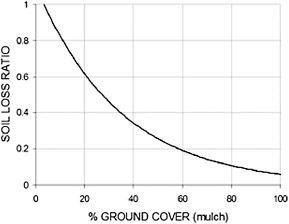
FIGURE 3-1 Soil loss ratio and percent ground cover.
SOURCE: McCarthy et al. (1993). Reprinted with permission from the University of Missouri Extension.
water volumes, sediment loss, and nitrogen and phosphorus loss from small watersheds on a clay soil. They found that runoff volume was not changed by tillage system, but sediment loss and nitrogen and phosphorus losses in runoff were far less, on average, from no-till than from chisel-till. Average annual quantities for sediment and nutrient losses were: 160 kg/ha and 1575 kg/ha for sediment, 3.8 kg/ha and 8.1 kg/ha for nitrogen, and 0.8 kg/ha and 1.5 kg/ha for phosphorus for no-till and chisel-till, respectively. Although erosion remains a significant problem in the United States, conservation and tillage changes have resulted in substantial improvements over the last 30 years. Soil erosion on cropland declined, as a result of changes in tillage practices and land retirement, from 3.1 billion tons per year in 1982 to 1.8 billion tons per year in 2001, while sheet and rill erosion dropped by almost 41 percent, and wind erosion dropped by 43 percent during the same time period (NRI, 2003).
Air Quality
With the advent of reduced and “zero” tillage in the past few decades made possible through the use of herbicides, releases of carbon dioxide (CO2), nitrous oxide (N2O), and particulate matter from agricultural soil have been reduced (Robertson et al., 2000; Madden et al., 2008). Reduced tillage reversed some of the soil carbon decline in surface soils. The impacts of tillage and different cropping systems on soil carbon (discussed earlier in this chapter) can be translated with reasonable accuracy into changes in CO2 flux over time. When CO2 flux is calculated and N2O and methane (CH4) fluxes are measured, the overall atmospheric impact of production systems can be assessed. Unfortunately, there are few production systems where such gaseous flux measurements have been done over a sufficient time span. One of the best sources of data comes from the Long Term Ecological Research (LTER) sites funded by the National Science Foundation (NSF). The LTER data in Box 3-1 are presented not to represent overall U.S. agricultural fluxes, but rather to show comparisons for the predominant gases between natural and managed systems, and the contribution of key management practices. The net greenhouse-gas emissions from agriculture in the United States were estimated to be about 50 g of CO2 equivalent/m2 per year (West and Marland, 2002). That estimate is comparable to the data presented in Table 3-2 in Box 3-1. A large database, several models for soil carbon accumulation, and ongoing research at the Natural Resources Ecology Laboratory in Colorado are focusing on the carbon accumulation potential of soils under different management (Easter et al., 2007).
Data from other long-term organic comparisons in California, Wisconsin, and Pennsylvania give similar effects for carbon sequestration. Studies conducted on finer-textured soils (most other than the Michigan trial) show higher levels of carbon sequestration and hence could be expected to show greater global warming mitigation potential. None of those studies monitored greenhouse gas over the long term. The bottom line is that agricultural systems can be designed and managed to compare favorably with natural ecosystems if moldboard plowing is eliminated in favor of either reduced or zero tillage.
Zero-till can also reduce emissions of particulate matter, especially if the practice is used with mulching or cover cropping. For example, in the dryland areas of wheat production on the eastern side of the Cascades and in portions of the Great Plains, clean fallow for moisture conservation has long been practiced. The fallowing leads to occasional high wind-blown soil erosion with increasingly unacceptable air quality problems (Sharratt and Lauer, 2006). New programs for crop rotation, weed and disease control, and reduced-till planting in the dryland wheat-growing area of eastern Washington are promising (Schillinger et al., 2007). Barley grown every other year seems to reduce rhizoctonia bare-patch area in wheat. Risk due to uncertain rainfall appears higher in crop rotation
|
BOX 3-1 Tillage and Rotation Effects on Climate Change Greenhouse-Gas Emissions and Energy Use The Kellogg Biological Station in southwestern Michigan is the only Long Term Ecological Research (LTER) site devoted to agricultural systems comparisons. It includes comparisons between agricultural and natural ecosystems in various stages of disturbance, making it unique. Greenhouse-gas flux measurements provide comparative data for agricultural systems and natural ecosystems at varying maturity stages (Robertson et al., 2000). Four corn–wheat–soybean rotations were replicated: (1) conventional chemical inputs and conventional (moldboard) plowing, (2) conventional inputs and zero tillage, (3) reduced chemical inputs, and (4) organic with no chemical inputs. Systems 3 and 4 included a winter legume cover crop following the corn and the wheat portions of the rotation. The trials were carried out on a silt loam soil that had been in continuous cultivation since the mid-1800s. Data are from the first eight years of the trial from 1991 to 1999. The net greenhouse warming potentials for the several agricultural systems and for comparison natural ecosystems in various stages of maturity are shown in Table 3-2. The annual crop rotations produced surface soil carbon changes consistent with those of other long-term trials in the U.S. corn belt. Conventional tillage with rotation had no change, indicating the long-term soil carbon equilibrium under conventional management with moldboard plowing that existed at the start of the experiment. No-till had the highest added carbon in soil and had negative CO2 release (–110 g/m2 per year of CO2 equivalent). The low-input and organic systems were next. Perennial crops (alfalfa and poplar) had significantly higher carbon sequestration than annual crops. Natural communities added soil carbon depending on their length of time in development. The early succession treatment was kept in grasses and other herbaceous plants by annual mowing. That treatment was thus similar to a standard set-aside common to many farms enrolled in the U.S. Department of Agriculture (USDA) National Resource Conservation Service (NRCS) conservation programs. Such treatment has large carbon sequestration in the early decades following implementation, and therefore a significant greenhouse warming mitigation effect. Inputs calculated as CO2 equivalents differed according to cropping system. Nitrogen fixation by legumes and from denitrificaton emits N2O as a byproduct. It was roughly the same for the annual crop systems and for alfalfa in those systems. The biological pathways for nitrogen fixation and “leakage” and those for commercial fertilizer bioconversion differ, but the net effects on N2O evolution are similar. Denitrification is higher when soils high in nitrogen experience waterlogging, producing low oxygen levels when soil temperatures are high. In LTER, the systems without fertilizer and with fewer legumes showed lower N2O evolution. All systems oxidized CH4 (removed it from the atmosphere), with the natural communities oxidizing slightly more than the commercial systems because of the canopy composition. |
than in the traditional wheat-summer fallow. Modified tillage implements that undercut the root zone have promise. Some farmers in the area used no-till planting with rotations with success. The results are not ready for widespread adoption; continued research is essential. This research program appears to be a flagship program for low-rainfall cropping systems in the Pacific Northwest.
Energy Use
In 2006, no-till was practiced on 62.4 million acres of cropland in the United States and resulted in an annual savings of 243 million gallons of fuel for tillage (Table 3-3). The energy saving was estimated solely on the basis of reduced requirements for direct energy inputs for tillage. That estimate did not include the additional efficiencies gained from increased productivity as a result of increased soil quality as described above for enhancement of ecosystem services. When calculated for a 2100-acre Michigan corn–oats–soybean–wheat rotation farm, diesel fuel savings over conventional tillage would have been 28 percent for mulch-till, 27 percent for ridge-till, and 52 percent for no-till (USDA-NRCS, 2008a). In drier areas such as the western Corn Belt, returns are uncertain because of high variability in
|
TABLE 3-2 Relative Radiative Forcing Potential for Different Management Systems Based on Soil Carbon Sequestration, Agronomic Inputs, and Trace Gas Fluxesa
Comparison of net effect on greenhouse-gas emissions showed that no-till had the least greenhouse-gas impact among the annual cropping systems. Conventional tillage and chemical use had the highest greenhouse-gas emission impact. The low-input system had lower greenhouse-gas impact than conventional tillage, but its yields were lower. The organic system had yields close to those of zero-till, followed by low input. Perennial systems and early succession communities had the most positive effects on reducing greenhouse-gas emissions. |
||||||||||||||||||||||||||||||||||||||||||||||||||||||||||||||||||||||||||||||||||||||||||||||||||||||||||||||||||||||||||||||||||||||||
rainfall. The accounting of long-term effects, including impact of increased surface organic matter and changed fertilizer requirements during the transition period, complicates total energy balance considerably. In U.S. studies, outputs are most often calculated as energy content of the harvested product. That measure of output complicates comparisons because
TABLE 3-3 Energy Savings and Production Potential from Conservation Practices and Measures in the United States
|
Conservation Practice |
Conservation Measurement |
Resource Savings |
Energy Costs Reduction |
|
|
On-farm (per acre) |
Total |
Million $ |
||
|
Crop residue management |
62.4 million acres of no-till (CTIC) |
$11.70 |
243 million gallons |
730 |
|
|
Conversion of additional 50 million acres to no-till |
$11.70 |
195 million gallons |
585 |
|
SOURCE: USDA-NRCS (2006). |
||||
different crops in the rotation produce considerably different energy amounts, and their relative yields change dramatically over years; hence, long-term studies are needed for meaningful comparisons, which partly explains the paucity of such comparisons.
Disadvantages of Conservation Tillage
Potential problems with conservation tillage include weed control, soil crusting and compaction, flooding or poor drainage, delays in planting because fields are too wet or too cold, carryover of diseases or pests in crop residue, fewer options to work fertilizers and pesticides into the soil, new machinery requirements, increased risk of shifting weed populations that are resistant to specific herbicides, and the need for above-average farm management skills (Peigne et al., 2007; Huggins and Reganold, 2008). Because conservation tillage increases the size and prevalence of macropores in soil, there has been concern about increased leaching of pesticides to ground water in particular during heavy rainfall (Shipitalo et al., 2000). In some cases, tillage residues such as rye can have allelopathic effects on seed germination in other crops, especially when seeds are planted directly into recently killed rye residues or some mow-killed mulches (Mitchell et al., 2000). High carbon-to-nitrogen ratios in crop residues can also cause problems such as reduced nitrogen availability (Gebhardt et al., 1985; Troeh and Thompson, 2005; Baker et al., 2007).
Some of the problems mentioned above might be more prevalent in vegetable production systems than in field crops. Successful vegetable production with conservation tillage depends on careful crop selection. Crops that germinate quickly and grow rapidly in the first few weeks after planting are more competitive with weeds than crops that initially grow slowly. Cool-season vegetables perform better in spring no-till plantings than warm-season crops (Hoyt and Konsler, 1988). The availability of specialized equipment for planting horticultural crops in no-till systems can be a limitation, but large-seeded vegetables such as sweet corn, snap beans, and squash have been successfully planted with no-till planters designed for field corn or soybean, and no-till planters for planting cabbage, broccoli, and other vegetable transplants in no-till soils have been developed (Hoyt, 1999; Peet, 2008).
The impact of reduced tillage and no-till on rates of chemical use and on nutrient leaching has been mixed because it depends on whether herbicide and pesticide uses are increased as a result of reduced tillage and how nutrients and agricultural chemicals are applied (Lal, 1991; Daverede et al., 2003). There is, however, evidence that pesticide leaching and NO3– in drainage water is higher under no-till conditions because of movement through intact macropores (Isensee and Sadeghi, 1996; Stoddard et al., 2005). In addition, higher average concentration and load of soluble phosphorus have been found in runoff water of no-till systems compared to other tillage systems (McIsaac et al., 1995). Moldboard plowing has been shown to reduce nitrogen and phosphorus runoff by redistributing the nutrients into the soil profile (Gilley et al., 2007). Similarly, Garcia et al. (2007) and Quinke et al. (2007) proposed and demonstrated a promising strategy of tilling one-time only with a moldboard plow to reduce phosphorus in runoff, followed by no-till management. They observed a significant reduction in soluble phosphorus accumulation in runoff with no negative effects on soil quality or crop yield. Further research is needed on management of no-till systems to reduce negative water quality effects.
In organic farming systems, reduced tillage raises specific challenges because the use of herbicides to kill the preceding crop is prohibited. Nonetheless, the sparse research on reduced tillage methods (strip till, ridge till, or shallow tillage) has shown promising results (Schonbeck, 2009). The choice of crop rotation, cover crop, and cover crop management is
critical. Winter-hardy cover crops that are amenable to no-till, no-herbicide management can be killed by mowing or rolling in early summer. Non-winter-hardy crops planted two to three months prior to the anticipated frost-kill date can be used to form in situ mulch and suppress winter and early spring weeds. Even with the use of managed cover crops, continuous no-till does not yet appear feasible under organic systems and more research is needed in this area. A high standard of management is required to successfully implement conservation tillage practices in organic systems, and the practices need to be tailored to local soil and site conditions (Kuepper, 2001; Peigne et al., 2007).
Adoption of Conservation Tillage
The passage of the Food Security Act by Congress in 1985 tied soil conservation practices to farmer eligibility for government-sponsored crop deficiency payments, crop loans, storage payments, federal crop insurance, and disaster payments. The overall purpose of the act was to remove incentives to produce crops on highly erodible land, and the program affected more than 125 million acres nationwide. In 1990, 26 percent of planted crop acreage was under conservation tillage practices; that number rose to 41 percent in 2004 (CTIC, 2004). Among the conservation tillage practices, no-till has been used on an increasing proportion of land (from 17 million acres in 1990 to 61 million acres in 2004; Figure 3-2).
Although weed control with conventional herbicides was successfully used on millions of acres of no-till (Derksen et al., 2002) before genetically engineered (GE) crop varieties with herbicide tolerance (HT) were introduced, GE corn, soybean, and crop varieties with HT might have further encouraged the adoption of conservation tillage practices, because
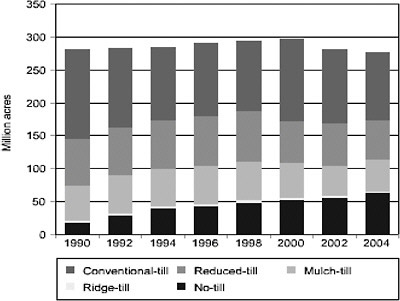
FIGURE 3-2 Area of cropland in the United States managed by different tillage systems from 1990 to 2004.
SOURCE: USDA-ERS (Sandretto and Payne, 2006).
they allow farmers to replace cultivation and tillage with chemical means of controlling weeds on those major crops. USDA survey data in 1997 showed that 60 percent of the acreage planted with HT soybean was under conservation tillage compared to about 40 percent of conventional soybean. By 2008, HT soybean varieties occupied more than 92 percent of the U.S. soybean acreage, HT cotton was grown on 68 percent of the total acreage, and HT corn on 63 percent of the acreage (USDA-ERS, 2009). However, HT crops are not a prerequisite for successful herbicidal weed control in conservation tillage because many farmers still grow non-GE crops successfully with conventional herbicides. Such practices as mulching, cover cropping, and crimping or rolling crop residues also can be used with conservation tillage to suppress weeds.
Cover Cropping
Cover cropping is the practice of using vegetative crops, such as clover or vetch, to prevent soil erosion, control weeds, and provide nitrogen to a subsequent crop. Cover crops grown in rotation between cash crops provide ground cover to protect the soil. They can also be used to provide other services, notably by being tilled into the soil to maintain soil organic matter and provide nutrients to subsequent crops (green manures) or being used to trap excess nutrients in the soil profile following harvest of the primary crop to prevent leaching losses (catch crops). Perennial cover crops can be used as ground covers in orchards.
Impact of Cover Cropping
Productivity
The impact of cover crops on yields can be difficult to quantify, but some studies have shown increased yields in cash crops when they are planted after certain cover crops. Sweeney and Moyer (1994) found that when hairy vetch or red clover were grown and then used as green manure, the yield of the sorghum crops in the eastern Great Plains immediately after was 79 to 131 percent higher compared to continuous grain sorghum. Summer cover crops have been shown to produce higher yields of conventionally grown and organically grown lettuce (Ngouajio et al., 2003) and of okra (Wang et al., 2006) compared to fallow. Preliminary results from a decade-long study in south central Colorado on cover crops and crop rotations show that the yield and quality of potatoes are 12 to 30 percent higher if they were planted after sudangrass was grown and plowed in as green manure, than if they were planted after wet fallow of the plot (Delgado et al., 2008). The ability of cover crops to replace or reduce the amount of chemical nitrogen fertilizer needed when used in combination has also been well established (Kramer et al., 2002; Cherr et al., 2006).
Soil Quality
Cover crops reduce soil erosion by wind and water, and therefore decrease particulate matter in the air and sediment runoff into surface water (Langdale et al., 1991). Cover crops also add to the soil organic matter pool (Sullivan, 2004). In turn, organic matter has a profound impact on soil quality as it enhances soil structure and fertility, increases water infiltration and storage, prevents surface crusting of the soil (Roberson et al., 1995), reduces the loss of nutrients and sediment in surface runoff, and reduces leaching losses of nutrients, especially nitrogen (Brady and Weil, 2008; Plaster, 2009). Decayed root channels of cover crops alleviate soil compaction problems. Williams and Weil (2004) found that soybean yields responded the most to the preceding cover crop at the test site that was most affected by
drought and soil compaction, suggesting that the soybean plants used existing root channels to access subsoil water. Cover cropping has also been found to enhance soil microbial numbers and enzyme activities (Mullen et al., 1998; Steenwerth and Belina, 2008).
Water Quality
Cover crops increase soil biomass and therefore transpire more water, allow more rainfall to infiltrate into the soil, and decrease runoff and potential erosion to a greater extent than fallow (Dabney, 1998). Beyond taking up nutrients, cover crops also improve water quality by reducing erosion by protecting aggregates from the impacts of raindrops, reducing soil detachment and aggregate breakdown (Dabney et al., 2001).
Winter cover crops can reduce water flows, nitrate concentrations, and total nitrate load, particularly under some surface runoff or tile drainage landscapes. The effectiveness of cover crops in improving water quality varies with the growth of the cover crop, climatic conditions, and management of the main crop. More growth of the cover crop will result in greater reductions in nitrate leaching, but the growth of the cover crop can be limited by cold temperatures, water stress, nutrient availability, and delays in establishment. The lack of precipitation and soil freezing can greatly reduce NO3– leaching losses and thus reduce the impact of the cover crop. Reducing nitrogen fertilizer rates and applying nitrogen fertilizer closer to the time of crop uptake will also reduce losses from NO3– leaching and the impact of the cover crop (Kasper et al., 2008). Reductions in NO3– loadings because of rye or ryegrass cover crops range from 13 percent in Minnesota (Strock et al., 2004) to 94 percent in Kentucky (McCracken et al., 1994). Wyland et al. (1996) found that nitrate leaching was reduced by 65 to 70 percent in a broccoli system with a cover crop compared to a fallow rotation. In a meta-analysis of cover crop studies, Tonitto et al. (2006) found that over-wintering nonlegume and legume cover crops generally reduced nitrate leaching when compared to fallow fields.
Sharpley and Smith (1991) summarized research on the effect of cover crops on total phosphorus losses and found that reductions ranged from 54 (Yoo, 1988) to 94 percent (Pesant, 1987). They pointed out that the effects of cover crops on soluble phosphorus in runoff were variable and did not always result in reductions. Soluble phosphorus can be lost in runoff flowing over plant residues. However, some plant water use and infiltration can be expected, which would likely reduce the volume of runoff (Kasper et al., 2008).
Water Use
Cover crops can reduce evaporation from the soil surface. Baker et al. (2007) found that the introduction of a rye cover crop in a corn–soybean rotation in Minnesota lowered evaporation from soil because the rye and its straw residue reflected sunlight. A two-year corn–soybean rotation with a rye cover crop increased water use efficiency by nearly 35 percent compared to a traditional corn–soybean rotation (Baker et al., 2007). Winter cover crops can improve rainfall infiltration and enhance water storage in areas where rainfall occurs mostly in winter as short periods of heavy rain, such as the Sacramento Valley in California (Joyce et al., 2002). Cover crops are more suitable for humid and subhumid regions where precipitation is more reliable than for semiarid regions where precipitation is limited (Unger and Vigil, 1998).
Nutrient Management
Cover crops help support soil microbial communities, which break down organic matter and make nutrients available to subsequent crops. However, cover crop roots also increase nutrient accessibility. First, leguminous crops fix nitrogen through a symbiotic
relationship with bacteria that live in root nodules. The bacteria convert nitrogen into ammonium (NH4+), which is accessible to the plants. Annual cover crops are generally seeded in the fall or winter and die at the end of the season. They are mowed several times during the growing season to add biomass, and hence nutrients, to the soil. At the end of the growing season, they can be plowed into the soil and used as green manure (Sullivan, 2003). If legumes are used in biodiverse rotations, they can provide at least a portion of nitrogen needs and, with longer rotations, all of the needs. With high nitrogen availability to the crop as needed for high yields, N2O emissions appear inevitable (Dusenbury et al., 2008).
Weeds, Insects, and Diseases
Cover crops can suppress weeds by creating an environment too shady for weeds or by allelopathy1 (Teasdale, 1998), provide habitats for beneficial insects and pests (Costello and Daane, 1998), and suppress diseases (Griffin et al., 2009). Those impacts will be discussed in detail in a later section of this chapter on weeds, pests, and disease management in crops.
Disadvantages of Cover Cropping
To include cover crops in a rotation, the growing season has to be long enough to establish both the main crop and cover crop for the rest of the year (Lu et al., 2000). The cover crops have to be selected carefully for several reasons. First, cover crops might use more water than cash crops in low-precipitation areas. Second, their common pests could affect the main and field crops (Lu et al., 2000). Third, if they are not managed properly, they could increase NO3– leaching (Moller et al., 2008). For cover crops used as green manure, the risk of NO3– leaching is much higher if the cover crops are plowed under in autumn than in winter (Moller et al., 2008) because of the effect of temperature on nitrogen mineralization. When used as a nitrogen source, the timing of nitrogen release from the cover crop can be difficult to predict, as it depends on weather conditions, the carbon-to-nitrogen ratio of the cover crop, and soil microbial activity. Furthermore, different legume species fix nitrogen at various levels, and nitrogen fixation is also dependent upon environmental conditions and soil microbial activity (Luna, 1998; Sullivan, 2003).
Cover crops can also improve pests’ survival (Bugg and Waddington, 1994; Connell and Vossen, 2007). Studies have found mixed results as to whether cover crops reduce, increase, or have no effects on pest populations (Hanna et al., 2003; Hooks and Johnson, 2004; Wyland et al., 1996). Rothrock et al. (1995) found higher bacterial and fungal populations in a cropping system that includes hairy vetch than in one that includes winter fallow, but they did not observe significant differences in other cover crop treatments. The precise effect of cover crops on beneficial insect and pest complexes and on soil-borne diseases is likely to depend on several factors, including the composition of cover crops, the prevalence and types of pests and pathogens at the location, temperature, irrigation management, and tillage.
Adoption of Cover Cropping
Despite their benefits on soil and water quality, cover crops are not widely planted. The USDA Economic Research Service (ERS) has data on crop area with winter cover crops in
1997 (Figure 3-3). Less than 10 percent of corn, soybean, cotton, and potato acreage include cover crops in the rotation (Padgitt et al., 2000). A more recent study examined whether cover crops were used in the U.S. Corn Belt by surveying 3,500 farmers in Illinois, Indiana, Iowa, and Minnesota (Singer et al., 2007). Although 96 percent of the farmers surveyed believe that cover crops are effective in controlling soil erosion and increasing soil organic matter, only 18 percent of the farmers surveyed have used cover crops. The low rate of adoption of cover cropping partly is due to the seeding costs, as discussed in Chapter 4, and the complexity of management (Cherr et al., 2006). About 56 percent of the respondents said that they would plant cover crops if cost-sharing were available (Singer et al., 2007).
CROP AND VEGETATION DIVERSITY MANAGEMENT
Crop diversity (that is, diversifying the types of crops grown and including different genetic varieties) is a method of managing risk on farms. Diversity on the farm can also be accomplished by integrating crop with livestock, a system discussed in Chapter 5. Numerous studies have documented the effect of crop diversity to reduce crop pest and
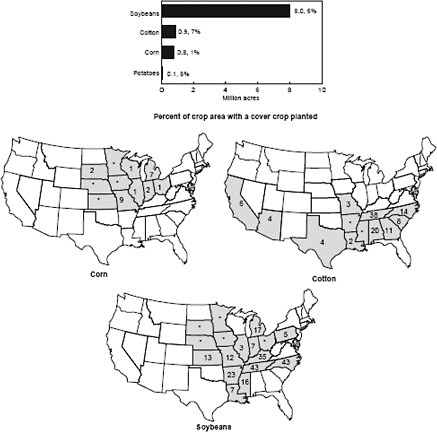
FIGURE 3-3 Crop area in the United States that was planted with winter cover crops in 1997.
SOURCE: USDA-ERS (Padgitt et al., 2000).
diseases, maintain soil fertility, and enhance water use (Power, 1990; Matson et al., 1997). However, the effects of diversity can be variable (Andow, 1991) depending on the kind of diversity present and the functional diversity (Moonen and Barberi, 2008; Shennan, 2008). Nonetheless, high levels of crop diversity continue to be the primary means of controlling risk in many subsistence farming systems throughout the world (Rhoades and Nazarea, 1999). Practices such as rotating crops, preserving genetic variety, planting crops together, incorporating cover crops, and managing noncropped land properly could increase the robustness and resilience of farming systems against the unpredictability of pest problems and against varying market conditions.
One of the premises of sustainable agriculture is that the tradeoff between higher productivity and loss of biodiversity is not inevitable (NRC, 1992; Thrupp, 1997). Increasing crop diversity has the potential to improve sustainability by achieving the following objectives (Box 3-2):
|
BOX 3-2 Agrobiodiversity and Its Relevance to Agricultural Sustainability Biodiversity consists of genes, species, populations, and landscapes, along with the composition, structures, functions, and interactions that occur at each level of the ecosystem (Noss, 1990). Agricultural biodiversity, commonly known as agrobiodiversity, “encompasses the variety and variability of animals, plants and microorganisms which are necessary to sustain key functions of the agroecosystem, its structure and processes for, and in support of, food production and food security”(FAO, 1999). Agrobiodiversity includes genetic resources, as well as domesticated and nondomesticated species and populations (within or outside of farming systems) that support food provision, including soil microorganisms, pollinators, and aquatic organisms. In addition to providing valuable crops and livestock species, biodiversity in agricultural systems performs many ecological services, including recycling of nutrients, pollination, management of organisms that are undesirable for agriculture, regulation of the local hydrological cycle and microclimate, and storage of carbon (Altieri, 1990; Thrupp, 1998). The roles of biodiversity in agriculture can be defined in several ways, including: a) the utilitarian value (direct use) of components of biodiversity, such as medicinal values from particular species; b) functional values which biodiversity provides to support life and protect ecological integrity; c) serendepic or “option” value, which is the potential future value from particular species or genes for future generations; and d) the intrinsic value, which refers to cultural or aesthetic benefits (Swift et al., 2004). The functional values from agrobiodiversity services include formation of soil organic matter, nutrient cycling, useful watershed functions (for example, trapping sediment and mitigating runoff), and mitigation of pests and diseases—which are often known as ecosystem services. (See also Chapter 4 of this report for additional information on the valuation of ecosystem services.) Although biodiversity in farming systems is increasingly recognized as a fundamental basis of sustained agricultural production and food security, biodiversity has been seriously eroded through the expansion of monocultural agriculture production systems and intensive use of agrochemicals, and other conventional patterns of agricultural development in many parts of the world. Commodity policies supporting monocultural production systems are among factors that have contributed to such losses internationally (Darymple, 1986; NRC, 1993; Thrupp, 1998). The decline of diversity of genetic resources, crop varieties, beneficial insects (including pollinators), soil and aquatic organisms, and other elements of biodiversity can seriously hinder sustainable production and can lead to irreversible biological losses (UNDP, 1995; FAO, 1996). However, there is ample evidence to show multiple benefits of integrating, conserving, and enhancing biodiversity in agriculture at various levels and in a range of farming systems. The conservation of biodiversity is now recognized by scientists and practitioners as an important element of sustainable agriculture (UNDP, 1995; FAO, 1996). Numerous scientific studies and practical experiences have shown that biological diversity contributes to the resilience and stability of farming systems (UNDP, 1995; FAO, 1999; Swift et al., 2004). More specifically, for example, recent studies reveal that soil biodiversity has a significant role in relation to soil |
-
Reduced pesticide and herbicide use.
-
Improved resilience of the system to adverse environmental conditions.
-
Greater conservation of biodiversity.
-
Improved soil fertility and soil organic matter.
Crop Rotations
The environmental benefits of crop rotations are well documented (NRC, 1989). They include better control of weeds, pests, and diseases; increased soil moisture; increased availability of nutrients; and higher yields. Crop rotations can enhance accumulation of soil organic carbon. Including legumes in a rotation supplies symbiotically fixed nitrogen to the soil (Havlin et al., 1990). Studies have shown positive effects of crop rotations on soil microbial community composition, particularly mycorrhizae (Johnson et al., 1992).
|
health in agriculture. Each gram of soil can contain thousands or even millions of diverse microscopic organisms (Torsvik et al.,1994.) Although not generally visible to the human eye, “soil is one of the most diverse habitats on earth and contains one of the most diverse assemblages of living organisms” (Giller et al., 1997). Soil organisms incorporate plant and animal residues and wastes into the soil and digest them to create soil humus—the organic constituent that is important to good physical and chemical soil conditions, and they recycle carbon and mineral nutrients. The activities of soil organisms interact in a complex food web; the diverse soil organisms and their functions are valuable to both human societies and ecosystems (FAO, 2003). Although researchers have increased their knowledge about soil biodiversity and microbiology in farming systems, scientific understanding of the role of biodiversity in soil is still somewhat limited. Research has been constrained because of the tremendous diversity of soil organisms and by technical challenges. Yet, there appears to be great potential in this field for gaining insight for sustainable farming systems. The following list contains examples of successful management practices that conserve or enhance agrobiodiversity at different levels and also have documented benefits towards increasing sustainability in many farming systems. Other examples illustrating the roles of biodiversity (at different levels) are mentioned within this chapter and in the case studies (Chapter 7) of this report.
More research is needed to better understand the functions and values of biodiversity at different levels in farming systems, and how much biodiversity, and of what kinds, is needed to achieve sustainability goals. |
Impact of Crop Rotation
Productivity
Rotation has been shown to have beneficial effects on yields. Rotating corn with soybean can produce yield advantages of 5 to 30 percent compared to continuous corn (Lauer, 2007). In a rotation of spring wheat with field pea in North Dakota, gains of 9 to 11 bushels/ac were found in four of six years in spring wheat grain, while nitrogen gains in those years were 13–28 lbs/ac (Carr et al., 2006). Rotation length has been proven important to the productivity of alternative systems. When comparing continuous corn planting with two-year rotations of corn–alfalfa and corn–soybean and five-year rotations of corn–corn–oat–seedling alfalfa–alfalfa, corn–corn–corn–alfalfa–alfalfa, and corn–soybean–corn–oat with alfalfa seedling–alfalfa, Stanger and Lauer (2008) found that the two-year rotations did not improve grain yield trends, while the five-year rotations not only enhanced yields, but also decreased the need for nitrogen inputs. Peanut yields also increased in tandem with extended rotation lengths (Jordan et al., 2008). In an experiment that compared conventional, high-input, two-year rotations of corn and soybean with low-input and organic rotations, rotation length greatly affected productivity. When compared with conventional, high-input, two-year rotations of corn and soybean, two-year organic corn-soybean rotations produced only 70 percent of corn yields and 80 percent of soybean yields (Porter et al., 2003). Yields from two-year rotations provided with low levels of inputs fared somewhat better, averaging just under 90 percent of the conventional yields for both crops. However, when oats and alfalfa crops were added to expand the rotation to four years, corn yields from the organic system jumped to more than 90 percent of the high-input corn. Corn that received low levels of inputs almost equaled the conventional system’s productivity. The four-year rotation did not impact organic soybean yields, but low-input soybean yields slightly exceeded those of the traditionally produced crop.
Corn seems more responsive than soybean to rotation length and crop diversity (Cavigelli et al., 2008; R.G. Smith et al., 2008). In a three-year Michigan study that examined the impact of rotation length and complexity on crop productivity, corn yields increased linearly with the addition of crops to the rotation system, even though no synthetic inputs were introduced. Corn yields in the most diverse rotation (corn–soybean–winter wheat with two cover crops per main crop) were more than 60 percent higher than corn in the two-year corn–soybean rotation that had no cover crops (R.G. Smith et al., 2008). In fact, corn yields in that system were more than 80 percent of average yield per hectare for Michigan corn. Soybean was less responsive than corn to rotation length and diversity; however, yields still increased approximately 30 percent and exceeded Michigan’s average.
Soil Health
Crop rotation has also been shown to contribute to improved soil health. Studies have found organic carbon and nitrogen to be higher in rotation systems than in continuous soybean and continuous corn systems (Varvel, 1994). Rotation length, particularly the inclusion of forage crops, positively affected organic carbon (Karlen et al., 2006). Some studies have also demonstrated that soil microbial biomass is higher under rotation systems (Collins et al., 1992; Moore et al., 2000).
A comparison of soil quality between a conventional system with a two-year wheat–pea rotation and an organic system with a three-year wheat–pea–green-manure legume rotation in eastern Washington State showed significantly better soil quality and less soil erosion in the longer-rotation organic system (Reganold et al., 1987). Comparing the same farms for financial performance, Painter (1991) found that the conventional system achieved a
33 percent higher net return than the organic system, with both systems receiving government subsidies but no price premiums for the organic system. The main reason for this difference is that the shorter-rotation conventional system received greater wheat subsidy payments (wheat grown more often), even though the organic system reduced soil erosion and had potentially less environmental pollution from agrichemicals. Without government subsidies, Painter (1991) found the conventional system achieved a 10 percent higher net return. Thus, it is not surprising that farmers often do not adopt longer crop rotation systems because these systems reduce profitability or economic sustainability, even if they are more environmentally sustainable.
Air Quality
Complex crop rotations such as corn–corn–soybean–wheat with red clover under-seeded can result in higher net returns, and might substantially lower greenhouse-gas emissions, than continuous corn (Meyer-Aurich et al., 2006).
Water Use
Soil water can also be affected by crop rotation. Bordovsky et al. (1994) found that changing a continuous cotton system to a cotton–wheat rotation increased soil water and improved yields. Soybean and corn rotations also improved water use efficiency, leading to increased root activity and yields (Copeland et al., 1993). Pala et al. (2007) showed that water use efficiency can depend on the type of rotation used; continuous wheat was the least efficient system for water use, but the types of crops built into the rotation improved yields based on how much water each used during its growing season.
Crop rotations can be designed to improve water use and to reduce saline seep. One example is the Triangle Conservation District Saline Seep Project in Montana. Local farmers are changing their land use and management over the water recharge area by switching to a flexible cropping system. The new system ensures that crops grown in sequence will use all available soil water, regardless of vagaries in the weather. The Saline Seep Program in the Central Rolling Red Plains area in Texas focuses on “salt” spots that hamper crop production in cultivated fields. Subsurface drains and deep-rooted vegetation that uses large amounts of available soil moisture are proven methods to reduce accumulations of salty water in shallow water tables (USDA-NRCS, 1997).
Disadvantages of Crop Rotations
Crop rotations require increased management skills because of the complexity involved in finding the right combination of crops to improve yields while also potentially reducing input expenses. As noted earlier, crop rotation patterns can potentially create water stress, thereby reducing yield and profitability (Pala et al., 2007). The unpredictability and variability of insect and disease pressures can also lower the economic incentive to pursue crop rotations. The economic aspects of crop rotations and cover crop use in rotations are discussed in Chapter 4.
Adoption of Crop Rotations
Most major crop production involves rotational cropping of some form, with the exception of cotton (Figure 3-4). The corn–soybean rotation is the most common system for corn and soybean. In the 10 major producing states, 80 percent of soybean acres and 75 percent of corn acres used that rotational system as of 2002.
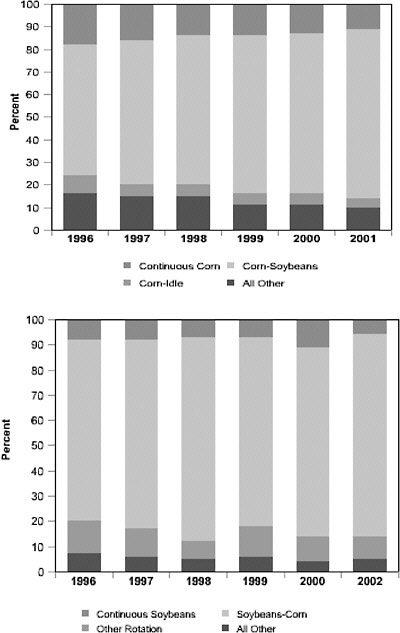
Although the environmental benefits of crop rotations are well known, many farms specialize in a few crops so that production can be streamlined—that is, using the same planter, harvester, and marketing infrastructure for all crops (Cook, 2006). Rotations more complex than corn–soybean could be difficult to manage and not as profitable (Stanger et al., 2008). Other factors that might discourage farmers from adopting extensive crop rotations:
-
Herbicide carryover.
-
Farm rental arrangements.
-
Increased management skills and information needed.
-
Altered or new equipment to match changed farming practices.
-
Additional storage units for wider variety of crops produced.
-
Commodity prices and subsidies.
Intercropping
Intercropping is the agricultural practice of cultivating two or more crops in the same space at the same time (Andrews and Kassam, 1976). It is generally associated with the planting of two or more different food crop species in the same field, but it can also include different varieties of the same crop species. Intercropping systems are common in subsistence, small-scale farms in tropical areas as the practice increases crop genetic diversity and reduces the risk of crop loss. In the United States, intercropping is generally associated with small-scale, sustainable, and organic agricultural systems; it is much less common on large-scale mechanized farms.
Strip intercropping is the practice of growing two or more crops in strips that are wide enough that each can be managed separately, yet narrow enough that the strip components can interact. In theory, the interactions (physical, biological, ecological, and management) between the crop components enhance biomass yield and provide key ecological services such as nutrient cycling, biological pest control, and water and soil conservation. The challenge in strip cropping is to identify the correct assemblages of species to maximize their biological synergisms, while having compatible use of agricultural equipment and conservation tillage practices (Altieri and Nicholls, 1999).
Impact of Intercropping
Productivity
Research on strip intercropping in the United States has primarily been with corn and soybean, and the results have been mixed. One five-year study showed that corn yield increased when planted in strips with soybean, but soybean yields decreased (West and Griffith, 1992). Lesoing and Francis (1999) found that a maize, soybean, and grain sorghum strip intercrop produced up to 4 percent higher total yields than the individual crops in monoculture. A few technologically progressive farmers have successfully combined strip intercropping of HT soybean and corn with precision agriculture and the use of autoguidance farm equipment (C. Mitchell, presentation to the committee, August 5, 2008). Carr et al. (2004) suggested that intercropping forage with pea could enhance forage yield and quality. However, the best way to compare intercrop yields with monocrop yields is uncertain. That is, as posed by Shennan (2008), would it better to compare monocropping and intercropping systems that are similar (for example, similar densities and nutrient inputs), or would it be better to compare systems that are managed optimally?
Nutrient Management
Intercropping grain crops with legumes often produces a yield increase, as a result of transfer of nitrogen either from legume to nonlegume through root exudates or from transfer of residual nitrogen to a nonlegume crop that grows after the legume has been harvested (Vandermeer, 1995; Narwal, 2005). Corn that is intercropped with soybean instead of grown separately after soybean (or vice versa) has been shown to reduce nitrate leaching losses with subsurface drainage water (Kanwar et al., 2005).
Disadvantages of Intercropping
As mentioned above, the results of intercropping can be uncertain. Some experiments have shown no or inconsistent yield benefits (Hesterman et al., 1992; Pridham and Entz, 2008). Furthermore, if crop choices or timing differences in crop life cycles are not managed correctly, the two crops can compete with each other for water and nutrient resources with negative yield results (Brainard and Bellinder, 2004). One experiment found that intercropping was beneficial for the soil microbial community of sorghum but not of soybean, indicating the two crops competed with each other (Ghosh et al., 2006). Even with proper management, yields of intercrops can be easily influenced by growing conditions. Although growing conditions affect all agricultural systems, there is evidence to suggest that the complexity of intercropping can make that system more vulnerable to environmental stresses. Combined with the greater degree of management skills required to operate this system, yield uncertainty may hamper the adoption of intercropping.
Cultivar Mixtures
The preceding sections discuss diversity in the context of diversifying crop species. This section discusses diversity in the context of using mixtures of cultivars of the same species. In western agriculture, most crops are grown from uniform, genetically identical seeds or clonally propagated planting stock. Ecological principles, however, suggest that genetic diversity within species and cultivars can also increase fitness and productivity of the population (Hooper et al., 2005).
Impact of Cultivar Mixtures
Increasing the number of genetic varieties of a particular crop species in the same field can increase crop yield and improve resistance to diseases (Smithson and Lenne, 1996; Cowger and Weisz, 2008). Tilman et al. found that mixed species of native prairie grasses had higher productivity than monocultures (Reich et al., 2001; Tilman et al., 2006). Cultivar mixtures or blends have been shown to control powdery mildews and rusts of small grains (Mundt, 2002). Blends of wheat cultivars have been shown to have more stable yields than sole cultivars if the cultivars used in the mixtures had complementary disease resistance traits and similar growth and maturity characteristics (Pridham et al., 2007; Cowger and Weisz, 2008). Managing genetic diversity across farms and at the community level, in addition to the individual farm level, is important to managing crop performance and the risk of pest outbreaks (Hajjar et al., 2008).
Disadvantages of Cultivar Mixtures
Potential disadvantages of mixing cultivars include the added time and cost involved in the mixing, incompatibility of the varietal components in particular with regard to plant
height and maturity (Bowden et al., 2001), and the loss of the opportunity to adjust management practices to the specific requirements of each variety (for example, plant density, fertilization, and planting date). Cultivar mixture with greater complexity, such as the use of noncrop vegetation on farms, requires farmers and operators to possess greater management skills and knowledge than unmixed cultivars. Marketing restrictions and processing quality are often cited as major limitations to the use of mixtures. However, cultivars of the same market class and quality characteristics can often be bulked without adversely impacting postharvest processing.
Management of Noncrop Vegetation
Filter strips, set-asides, riparian buffers, wooded areas or woodlots, hedgerows, in-field insectaries, and other areas of (usually native) plants provide a range of ecosystem services in agricultural landscapes. The range of services include a reduction in soil erosion, buffer strips along riparian areas, habitat for wildlife, and a general increase in plant and animal diversity. Vegetation diversity in agricultural landscapes may also improve biological control of certain pests. (See the section on pest management for further discussion.) Many of the practices for reducing erosion have been well studied and documented in the scientific literature for many years (Pope and Stoltenberg, 1991) and there are detailed guidelines for their use in the USDA-NRCS National Conservation Practice Standards (NHCP) (USDA-NRCS, 2009). The use of buffer strips to mitigate pesticide and nutrient inputs into water will be discussed in the context of water management.
Impact of Noncrop Vegetation on Biodiversity
Farms with more noncrop habitats tend to have a higher diversity of bird species (Henderson et al., 2000; Freemark and Kirk, 2001). Filter strips provide sites for over-wintering bird populations (Smith et al., 2005). Studies in the United Kingdom demonstrate the positive effect of noncrop vegetation on biodiversity. Hedgerow habitats provide refuge for beetles and spiders, and that increase in biodiversity has the added benefit of biocontrol of crop pests (Pywell et al., 2005). R.G. Smith et al. (2008) showed that growing grassy strips in the margins of arable fields increases the biodiversity of the soil macrofauna within fields and across the farm. The abundance and species richness of butterflies have been found to be positively correlated to the width of filter strips in the Midwestern United States (Davros et al., 2006).
Disadvantages of Noncrop Vegetation
In addition to the loss of land to crop vegetation, another perceived risk of noncrop vegetation is the increased risk of E. coli O157:H7 contamination of crops by wildlife. Wild pigs were suspected to be the source of contamination in the 2006 case of food-borne-illness outbreak caused by E. coli O157:H7 in leafy spinach (Jay et al., 2007). Studies have shown that some commensal wildlife species are known sources of E. coli O157:H7, whereas others are not (Beretti and Stuart, 2008). Because noncrop vegetation encourages the presence of birds and rodents around the field (Smith et al., 2005; Salmon et al., 2008), the presence of noncrop vegetation is perceived as increasing the risk of crop contamination by wildlife. Whether there is an actual link between wildlife and crop contamination has yet to be established. On the other hand, edge-of-field vegetated buffer strips have been shown to be effective in reducing fecal coliform bacteria in runoff from pastureland amended with
manure (Sullivan et al., 2007), suggesting that field margin vegetation may reduce the spread of E. coli.
Plant Breeding and Genetic Modification of Crops
Genetic diversity in major crop species is to a large extent a product of plant breeding over the millennia. Most crops grown in the United States today have been bred to contain desirable genes for higher yields or biomass, resistance to biotic and abiotic stress, greater adaptation, and increased shelf life and processing characteristics, as well as other traits with market value. In general, these crops have been developed for conventional farming systems where environmental constraints are minimized through inputs such as fertilizer, irrigation, and pesticides.
Successful beginning of a plant breeding program depends on the identification of parental lines that contain traits of interest. Many of the older (or heirloom) varieties of crops that were in cultivation prior to the introduction of hybrid varieties and synthetic agrochemicals in the 1950s may contain valuable traits for sustainable agricultural systems, such as sensory qualities related to taste and smell, enhanced nutritional value, resistance to pests and diseases, greater biomass and ability to compete with weeds, and greater nutrient and water-use efficiency. Their negative traits may include susceptibility to diseases and pests, low yields, lodging, longer maturity dates, and a more limited postharvest shelf life. The decision to use older varieties and landraces in a breeding program would need to take into account the inherent difficulty of transferring desirable traits into improved varieties and the time needed to carry out this type of breeding program. The identification of sources of these traits may require a reevaluation of older varieties and landraces obtained from gene banks and seed saver sources for their potential use as parents. For example, cereals with long straw were grown worldwide prior to the introduction of modern short straw varieties in the 1960s. In certain organic systems, long straw varieties are now grown for their ability to compete against weeds and provide more bedding material and fodder for livestock in mixed crop–livestock systems. These reintroduced older varieties can serve as parental lines to develop new varieties for organic systems (Wolfe et al., 2008). Research is needed to understand what specific characteristics are present in older varieties and landraces that would be important in sustainable cropping systems and to develop breeding strategies that maximize the performance of those traits.
When desired traits are not available within the germplasm of a particular crop species, breeders may use interspecific hybridization (or wide-crossing) to transfer desirable genes or alleles from related species and genera. Mutation breeding has also been used with some success to create pinpoint mutations and new genes by exposing plants and seed to radiation or chemicals, followed by selection for specific traits (Aholoowalia et al., 2004).
There has been much less research on breeding crops for nonconventional production systems than for conventional production systems in the United States. The volume of seed sown has been insufficient to provide a financial incentive to private seed companies. Public breeding programs that could assume more risk and a longer time frame needed to carry out this research depend largely on royalties derived from varieties grown in conventional production systems. Consequently, many farmers who have adopted sustainable cropping practices continue to use varieties developed for conventional agriculture (Van Bueren et al., 2002; Murphy et al., 2005).
Plant breeders are using genotype x farming system interaction studies to gain insight into whether plant breeding should be done directly in organic systems, although the research in this area is very limited. Using wheat as a model crop, Murphy et al. (2007)
found significant genotype x system interactions, significant genotype changes in ranking, and 5 to 31 percent yield gains across sites from direct selection in organic systems compared to breeding lines developed through indirect selection in conventional systems. They concluded that wheat cultivars developed for conventional farming systems are partially responsible for the lower yields often found in organic farming systems. Ceccarelli and Grando (1991) evaluated more than 800 barley breeding lines in 8–10 environments classified as low yield (LY) or high yield (HY) and found that the best lines selected in LY outperformed the best lines selected in HY when evaluated in LY. Wolfe and others (2008) summarized these and other studies and found that the likelihood of obtaining significant correlations of variety performance under organic and conventional conditions depends on the farming systems under consideration and the environmental conditions that exist during the evaluation period. Under less extreme conditions, they found that selection under organic condition could reliably be done in a later stage of the breeding process, with the early generation selections done under conventional conditions. If the objective of a breeding program is to develop varieties that perform well under both conventional and organic systems, the inclusion of organic test sites in the selection process increases the chances of selecting broadly adapted genotypes (Burger et al., 2008).
In organic agriculture and other systems with limited input of agrichemicals, the traits of importance in a breeding program include improved nitrogen and nutrient-use efficiency, ability to interact with beneficial soil microbes, improved competitiveness against weeds, resistance to insects and insects currently controlled with chemical pesticides, high yield levels and yield stability, and good product quality. As organic and other sustainable farming systems generally require more complex crop management practices, these factors (such as crop rotations and cover crops) also need to be taken into account (Van Bueren et al., 2002; Murphy et al., 2007; Wolfe et al., 2008).
Breeding methodologies that have been traditionally used to develop varieties for conventional agricultural systems can also be used to develop varieties for nonconventional farming systems. The choice of breeding method employed will depend on the crop and on the inheritance and heritability of the traits of interest. Evolutionary plant breeding is an alternative breeding method that has been proposed for variety development for organic and low-input farming systems. Genetic variation and evolutionary fitness in a crop are maximized through the creation of heterogeneous composite cross-populations formed through hybridization that are subjected to natural and artificial selection in successive generations in a natural cropping environment (Phillips and Wolfe, 2005). Evidence suggests that composite cross-populations may be an efficient way of developing heterogeneous crops and superior pure lines for low-input systems characterized by unpredictable stress conditions, when higher yield is not the primary selection criteria (Soliman and Allard, 1991). However, information on effectiveness of this breeding method relative to other methods is sparse. A variation on this approach is Evolutionary Participatory Breeding, a combination of evolutionary breeding and farmer participatory plant breeding. This method uses the skills and knowledge of both breeders and farmers to develop heterogeneous breeding populations and has been principally employed in the development of varieties for resource-poor farmers in developing countries, but could be an effective breeding method for sustainable farming systems throughout the world (Murphy et al., 2005; Dawson et al., 2006).
A current bottleneck for breeding crops adapted to organic agriculture is the limited amount of cropland areas available and the need for equipment that meet certified-organic standards for breeding trials. Presently, most land-grant universities do not have extensive areas of organic land that could be dedicated to plant breeding trials. Similarly, few seed companies maintain or lease large acreages of organic testing sites. Participatory breeding
programs have been used in Europe to address those issues (Chable et al., 2008; Ghaouti et al., 2008; Wolfe et al., 2008).
Molecular Markers and Genetic Engineering in Cultivar Development
Classical or conventional plant breeding, which involves sexual recombination and phenotypic selection of plants with superior traits, continues to be the primary mechanism to improve crops for both conventional and sustainable farming systems. Field evaluations and selections are a critical component of any breeding program. In recent years, the development and use of molecular or DNA markers—sequences of DNA associated with particular genes or traits—has become routine in breeding programs for the selection of progeny in a number of crops including corn, soybean, rice, wheat, cotton, tomatoes, cassava, and others (Buckler and Thornberry, 2002; McCouch et al., 2002; Frydman et al., 2004; Guimaräes et al., 2007). Marker-assisted selection (MAS) and breeding hold great promise for revolutionizing plant breeding because they can greatly increase selection efficiency and reduce the time and cost needed to develop improved varieties. They can also facilitate the exploration and utilization of natural genetic variation in older varieties, landraces, and wild relatives to expand the genetic base of crops and provide more flexibility to develop crops for the future (McCouch, 2004; Zicheng et al., 2006; Heffner et al., 2009). At present, the routine use of MAS in plant breeding is limited to a few crops, primarily for simply inherited, monogenic traits. However, with recent developments in gene-based marker development, more efficient quantitative trait locus (QTL) mapping procedures, and lower cost genotyping systems, MAS use for more complex traits is likely to increase. However, before MAS can realize its full potential in public sector breeding programs, some fundamental issues remain to be resolved, including the development of high-throughput precision phenotyping systems for QTL mapping, improved understanding of genotype by environment interaction and epistasis, and development of publicly available computational tools tailored to the needs of these breeding programs (Guimarães et al., 2007; Xu and Crouch, 2008).
When desirable genes are not available, genetic engineering of crop plants can make a contribution, even though it is a contentious area of breeding. Genetic engineering is the purposeful alteration of a plant’s genome via the use of recombinant DNA technology to introduce genetic material into a crop to give it a desirable trait. The introduced gene or genes can be from the same species or a different species, including bacteria or animals. Once the genes have been successfully introduced into a plant, conventional plant breeding methods are then used to incorporate the genes into commercial varieties.
Within a decade, the number of GE crops available to farmers will significantly increase. Many major U.S. universities, in addition to private seed companies, have active research programs on the use of GE technologies for crop improvement, especially for specialty crops where there is less involvement by the private sector. Traits of interest include drought and salt tolerance, disease and insect resistance, cold and heat tolerance, nutrient use efficiency, improved fruit and nutritional quality, delayed senescence and accelerated ripening, and yield. A large number of those GE lines are now in trials (Table 3-4).
A new technology being developed for crop improvement is “gene silencing” or RNA interference (RNAi). RNA is the courier that delivers a gene’s instructions to make a protein. Gene silencing directs a natural mechanism to degrade the RNA instruction of a specified gene and prevents the gene from making its protein. Gene silencing switches off the activity of only the targeted gene so that the precise function of that gene can be determined. An overview of research on gene silencing for crop improvement was included in the NRC report Emerging Technologies to Benefit Farmers in Sub-Saharan Africa and South
TABLE 3-4 Crops on Which Transgenic Research Has Been Conducted
Asia (NRC, 2008a). The research suggests that this technology may have potential to control viruses, bacteria, nematodes, and some insect pests in plants, and have applications for use against parasitic plants and fungi. It is also being investigated for switching off genes involved in the production of undesirable fatty acids in oilseeds. More research is needed to understand whether plants can discriminate between RNAi’s that move between plants and pests, what size of RNA can be moved, and if an organism can develop resistance to RNA. However, if gene silencing techniques are successful, they have the potential to provide solutions to some of the more difficult pests and diseases in crops (NRC, 2008a).
Impact
Plant breeding has been improving yield through increased productivity, improved pest and weed resistance, and improved drought tolerance for decades. The impacts of biotechnology-derived crops are summarized by Johnson et al. (2008). Adoption of GE crops is associated with increased yield and decreased pesticide use in many cases (Fernandez-Cornejo and Caswell, 2006).
Disadvantages
Although GE crops have been widely adopted since their introduction in 1996 and are now grown on millions of acres worldwide, concerns about their effects on human health, the environment, and other aspects of sustainability persist. Lemaux (2008) reviewed a number of studies and concluded that there are no scientifically valid demonstrations that
food safety issues of foods containing GE ingredients are greater than foods that do not contain them.
Some of the environmental concerns are not unique to cropping systems using GE. For example, the effect of GE crops on nontarget organisms is a concern, just as the effect of pesticides on nontarget organisms is a concern in conventional crop production (Marvier et al., 2007). Likewise, pests could evolve resistance to synthetic pesticides or transgene-derived proteins (Lemaux, 2009). Other issues include the potential of horizontal and vertical gene transfer from transgenic organisms to others (Pilson and Prendeville, 2004; O’Callaghan et al., 2005).
GE crops are banned in certified organic crop production systems, and there is significant resistance to GE crops in European and other countries. Hence, contamination of organic crops or crops intended for export to markets that do not accept GE crops is a concern.
Adoption
The percentage of acres planted with GE crops has been increasing in the United States (Figure 3-5) (USDA-ERS, 2009). Corn varieties with stacked genes (containing both HT and Bt genes) were grown on 46 percent of the total corn acreage in 2009 (USDA-ERS, 2009).
WATER-USE MANAGEMENT
To meet sustainability goals of conserving water resources, water management is critically important. The “drivers” for managing water use are the timing, intensity, and amount
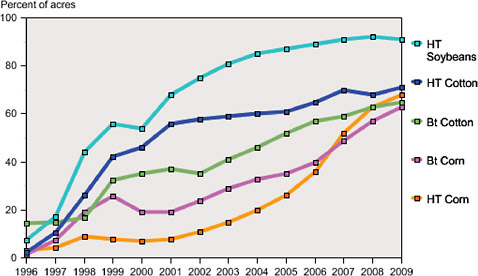
FIGURE 3-5 Adoption of GE crops in the United States.
SOURCE: USDA-ERS (2009).
of water being applied by precipitation, irrigation, or both for all agricultural lands. Those parameters in conjunction with evapotranspiration (ET), the amount of water that evaporates from the soil surface and transpires from the crop, determine the amount of excess water that drains from a field at any given location and time.
Because irrigation is the dominant form of water use, measures that improve the efficiency of water application and minimize water loss are most effective in conserving water and energy in regions facing limited supply (Table 3-5). Water-use efficiency is a complex subject, however, with many different definitions (Molden et al., 1998). From a systems perspective, comparing the amount of water withdrawn from a river or aquifer to the amount actually used beneficially by the crop might be most useful. Factors within the overall efficiency affecting performance are conveyance from the source to the farm, uniformity of application to the crop, and drainage losses following application. Globally, many systems perform poorly, resulting in only 30 to 50 percent of the water withdrawn actually being taken up by the crop (Faurés et al., 2007). However, water lost in that way from one farm might have a beneficial use elsewhere, so it is important to look at basinwide efficiency when estimating true water savings. In addition to managing water consumption, precipitation can be captured or water can be reused to improve the long-term sustainability of water use in agriculture.
Irrigation Scheduling
Quantitative irrigation scheduling methods rely on one of two approaches: soil or crop monitoring or a combination of both; or soil water balance computations. For the monitoring methods, the soil water content or matric potential is measured at several places in the field to decide when to irrigate. Methods based on plant measurements generally involve monitoring leaf water potential or canopy temperature. Soil water balance calculations require estimates of soil storage capacity, rooting depth, allowable depletion, and crop evapotranspiration to develop an irrigation schedule (Martin et al., 1990).
If direct monitoring of plant or soil water status is not possible, irrigation volume required for the crop could be estimated if evapotranspiration demand is known (Jensen et al., 1970).
TABLE 3-5 Energy Savings and Production Potential from Irrigation Water Management.
|
Conservation Measurement |
Resource Savings |
Energy Costs Reduction |
|
|
On-farm ($ per acre) |
Total |
Million $ |
|
|
Improving pumping system efficiency 10 percent on 16 million acres |
15 |
80 million gallons |
240 |
|
Conversion of medium pressure sprinkler system to low |
40 |
560 Kwhr/acre |
390 |
|
Conversion of high pressure sprinkler system to low |
55 |
770 Kwhr/acre |
120 |
|
SOURCE: USDA-NRCS (2006). |
|||
Impact of Irrigation Scheduling
Irrigation scheduling has been shown to significantly reduce water usage compared to traditional methods in a number of studies. For example, Mohammad and Al-Amoud (1993) achieved both higher wheat yields and a 25 percent decrease in water use when central pivot sprinkler irrigations were scheduled based on a calculation of evapotranspiration demand in Saudi Arabia. Clawson and Blad (1982) were able to reduce irrigation water additions to corn from 283 mm to 127 mm without significant yield reduction by precisely monitoring canopy temperature. An extension project in north central Nebraska also showed that irrigation scheduling reduced energy costs, applied less water, and led to higher harvested yields for center-pivot irrigated corn. Furthermore, there was in increase in annual return by $5.40 per hectare (Kranz et al., 1992).
Adoption of Irrigation Scheduling
A successful example of large-scale use of irrigation scheduling is the California Irrigation Management Information System (CIMIS), an integrated network of more than 125 automated active weather stations located throughout California. Specific weather parameters are collected on site and accessed daily by a computer at the Department of Water Resources. Reference Evapotranspiration (ETo) is calculated from this data and stored in a database along with the collected climatic data, where it can be accessed by Internet users. At present, approximately 6,000 registered CIMIS users from diverse backgrounds access the CIMIS computer directly (State of California, 2008).
Washington State University has also developed the Washington Irrigation Scheduling Expert (WISE) software and web-based information system to supplement scientific irrigation scheduling (SIS) used by farmers in the area. In 2002, half of the acreage being scheduled was for potato and fruit trees. Farmers surveyed said that energy savings and ensuring the quality of high-value crops were the main reasons for adopting the system (Leib et al., 2002).
In New Mexico’s Mesilla Valley, pecan farmers have been slow to adopt new soil-based or climate-based irrigation scheduling technologies because these technologies require high in-season labor input. Kallestad et al. (2008) developed a simple, practical irrigation scheduling tool specifically for flood-irrigated pecan production using 14 years of archived climate data and model-simulated consumptive water use. Eventually, the hope is that these farmers will convert to using Internet databases as their main resource for climate and irrigation information (Kallestad et al., 2008).
Gravity Systems
Improving the uniformity of irrigation water application is one of the most effective means by which agriculture can save water. Nonuniform irrigations are wasteful, because water has to be added at rates greatly exceeding those needed by the parts of the field receiving the most water to avoid yield decreases on the parts that are receiving less water. Water is not pumped in gravity irrigation, but flows and is distributed by gravity. Gravity-flow systems distribute water laterally across the entire field or into furrows.
Various land treatments, system improvements, and water management measures have been developed to reduce water losses under gravity-flow systems. For example, precision laser-leveled irrigation is practiced on 3.7 million acres, mostly in the Southwest, Delta, and Northern Rockies regions. Improved gravity systems generally involve on-
farm water conveyance upgrades that increase uniformity of applied water and reduce percolation losses and field runoff. Improved ditch systems, lined with concrete or another impervious substance, account for only 20 percent of gravity acres served by open ditches. Improved water management practices for gravity irrigation remains an area of significant growth potential, with many available technology or management improvements such as alternate row irrigation, furrow modification, tailwater reuse, or soil amendments not in widespread use (Schaible and Aillery, 2006).
Disadvantages of Gravity Systems
Water losses are comparatively high under traditional gravity-flow systems, with field application efficiencies typically ranging from 40 to 65 percent. However, improved gravity systems using laser-leveling and proper water management may achieve efficiencies of up to 80 to 90 percent (USDA-NRCS, 1997).
Adoption of Gravity Systems
Total acreage in gravity systems has declined by 26 percent since 1979, but still accounts for 44 percent of irrigated acreage nationwide, primarily in the Southwest, Central Rockies, Southern Plains, and Delta regions (USDA-NASS, 2010). Furrow application comprises about half of the acreage in gravity-flow systems, with border or basin or uncontrolled-flood application accounting for the remaining. Much of the uncontrolled flooding is used for hay and pasture production in the Northern and Central Rockies.
Sprinkler Irrigation
Sprinkler irrigation is a planned system in which water is applied by means of perforated pipes or nozzles operated under pressure to form a spray pattern (USGS, 2009b). Like gravity systems, pressurized systems improve irrigation uniformity. Pressurized systems include a variety of sprinkler and low-flow irrigation techniques to distribute water across a field. Low-energy precision application (LEPA) irrigation refers to methods by which water is delivered directly to the surface at very low pressure through drop tubes and orifice-controlled emitters, rather than spraying water into the air at moderate to high pressures. The applicators are generally attached to moving center pivot or linear advance lines to allow continuous advance over large areas. Lyle and Bordovsky (1981) initiated the concept on a lateral move system, although the vast majority of applications today are on center-pivot systems.
Impact of Sprinkler Irrigation
Field application efficiencies for properly designed and operated sprinkler systems range from 50 to 95 percent, with most systems achieving 75 to 85 percent (USDA-NRCS, 1997). Coates et al. (2006) have also worked on individual micro-sprinkler systems that regulate the amount of water each tree receives, which has promising application for orchard management.
The low-pressure center-pivot and linear-move systems combine high application efficiencies with reduced energy and labor requirements. In addition, center-pivot irrigation has been shown to improve the ground water contamination level, although it might not be the most economical irrigation system available at present (Kim et al., 2000).
Adoption of Sprinkler Irrigation
Acreage for all pressurized systems expanded from 19 million acres in 1979 to 30 million acres (57 percent of total irrigated acreage) in 2003, of which sprinkler systems alone accounted for 27 million acres. Acreage in sprinkler systems has continued to expand in recent years, with an increase of about 4 million acres from 2003 to 2008 (USDA-NASS, 2010). Center-pivot sprinkler systems accounted for roughly 79 percent of sprinkler acreage in 2003, increasing by nearly 13 million acres from 1979. Nearly two-thirds of the increase is attributable to net increases in irrigated area under sprinkler, while about one-third reflects the replacement of other sprinkler types with center-pivot systems. Low-pressure center-pivot systems account for 46 percent of center-pivot acreage and are especially popular in the Southern Plains where irrigation relies heavily on higher-cost groundwater pumping (Schaible and Aillery, 2006).
Trickle or Drip Irrigation
Trickle or drip irrigation applies water directly to the root zone of plants using applicators (for example, orifices, emitters, porous tubing, and perforated pipe) operated under low pressure. The applicators could be placed on or below the surface of the ground (USGS, 2009a). Shifting to trickle or drip irrigation has been the greatest strategic improvement in water-use efficiency and energy savings over the past three decades. Precision water application results in a significant conceptual and process-related change in energy use for those crops where it applies. Most orchards and vineyards are converting to these systems, and nearly all newly planted ones are using precision water application, as are a broad range of annual horticultural crops. The application tubes are placed in close proximity to the tree or vine of crop plants, and water is applied as needed, monitored by a host of newly engineered moisture and plant stress-sensing devices (Locascio, 2005).
Impact of Trickle or Drip Irrigation
Energy savings for systems changes are region- and crop-specific. In the central coast region of California, the better vegetable growers are saving upwards of 25 percent in water pumping, fertilizer, and herbicide costs by using subsurface drip irrigation technologies (California Energy Commission, 2008). The USDA-NRCS energy estimator (2008b) calculated, based on research reports for the costs of irrigation for orchards in the Michigan area, that the energy savings in a 100-acre orchard could be up to 20 percent by adding a flow meter, irrigation scheduling, and maintenance and upgrades to a basic diesel-powered sprinkler system. Use of a micro-irrigation system (after installation costs), with suggested management would reduce pumping costs from $488 per acre/year for a well-managed, well-maintained sprinkler system to $390 per acre/year, a 20 percent savings. Those savings are only for the direct cost of diesel fuel for pumping and do not include additional savings for fertilization, pest and disease control, and weed control. When switching from sprinkler to micro-systems the capital energy costs should be assigned, with repayment over time in a manner similar to payback of financial capital investments.
Adoption of Trickle or Drip Irrigation
Low-flow systems, including drip, trickle, and micro-sprinklers (with application efficiencies of 95 percent or greater) were used on 3 million acres in 2003, mostly for vegetables
and perennial crops such as orchards and vineyards, although experimentation and limited commercial applications are occurring with some row crops (Schaible and Aillery, 2006).
Regulated Deficit Irrigation
Deficit irrigation refers to applying water below the crop’s full evapotranspiration requirements so that it is allowed to withstand mild water stress (J.M. Costa et al., 2007). Studies have shown that deficit irrigation can be applied to various crops including cotton and potatoes with little or no negative effects on yield (Henggeler et al., 2002; Shock and Feibert, 2002). While deficit irrigation is not controlled, regulated deficit irrigation (RDI) subjects crops to moisture deficit during stress-tolerant growth stages to minimize negative effects of yield.
Impact of Regulated Deficit Irrigation
Regulated deficit irrigation could be applied to a variety of crops including grapes, pistachios, and stone fruits (Cooley et al., 2009). Cooley et al. (2009) estimated that RDI can reduce water use by 20 percent for almonds and pistachios and up to 47 percent for vineyards, but actual water savings depend on many factors including crop type, climatic conditions, and sensitivity of growth stages to stress.
RDI might improve some quality attributes but reduce quality of others. For example, Delicious apples from trees grown under RDI had higher levels of soluble solids but were smaller than apples from well-watered trees. Pistatchios grown under RDI had significantly higher shell splitting at harvest (positive effect), but also lower fruit weight compared to pistachios grown without water deprivation (Goldhamer and Beede, 2004).
Disadvantages of Regulated Deficit Irrigation
Only some crops are suitable for regulated deficit irrigation, and growers need to have a clear understanding of crops’ responses to water stress during different stages of growth and development and under different environmental conditions (Kirda, 2002; Cooley et al., 2009). For example, pistachios are particularly tolerant of stress during the shell-hardening phase, but not while they are in bloom or during the nut-filling stages (Cooley et al., 2009).
Water Reuse
A variety of sources of water of marginal quality can potentially be used to augment the supply of water for agriculture. Domestic waste water, if properly reclaimed, can serve a variety of uses beneficial to agriculture, either as a source of irrigation water or to free up high-quality water that was being used for an activity (such as landscaping) that can utilize reclaimed water without health risks to the public (Haruvy, 1997). At the present time, waste water provides only a small portion of the national water resource for agriculture. Saline water has some potential for augmenting water use in agriculture, primarily through reuse of drainage water on more salt-tolerant species or using cyclic rotations of good quality and saline water to grow a range of sensitive and more tolerant crops (Shennan et al., 1995). Those are especially attractive options for western San Joaquin Valley of California, where shallow saline ground water is affecting yields, and offsite disposal of drainage water collected by tile lines is prohibited (Benes et al., 2004).
Disadvantages of Water Reuse
The greatest concern with reuse is the biological and chemical quality of the reclaimed water. Removal of pathogens and anthropogenic chemicals is an important requirement for any wastewater treatment system. The reclaimed water would have to be monitored carefully to reduce chances of any harmful pollutants entering into an agricultural production system (Banin, 1999; Falconer et al., 2006).
Adoption of Water Reuse
In 1995, some 805,000 acre-feet per year of reclaimed water was used in the United States for irrigation, primarily in California and Florida (Solley et al., 1998). That amount was less than 2 percent of the total water reclaimed in the United States, most of which was released to streams or ground water.
Small Dams
The many adverse environmental consequences of large dams have spawned proposals for alternative means of water capture. A recent committee of the National Research Council recommended that managed underground storage and recovery should be seriously considered as a tool in a water manager ’s arsenal besides small surface water storage practices used extensively on agricultural lands (NRC, 2008b).
Impact of Small Dams
Small dams and other impoundments also provide temporary water storage of runoff from large storms, thereby reducing downstream flooding. Additional benefits include water storage for irrigation or livestock supply, municipal or industrial uses, and recreation, including fishing, boating, and wildlife habitat. USDA-NRCS estimates that these small dams yield an annual benefit of nearly $1.6 billion and prevent more than $700 million in damages annually through their control of flooding. These small watershed dams in the United States represent a $15 billion national infrastructure investment and beneficially impact hundreds of thousands of lives everyday (USDA-NRCS, 2008c).
NRCS has conservatively estimated the cost of rehabilitating small watershed dams to be between $500 million and $600 million. While the average rehabilitation cost per dam is approximately $242,000, local sponsors typically do not have sufficient resources to complete the necessary repairs to ensure the safety and critical functions of these small dams (USDA-NRCS, 2000).
Water quality impacts downstream of these small dams can be slight or significant, depending on sediment and nutrient inputs from upstream, water residence time in the impoundment, and whether surface (warmer) or deep (colder) water is released downstream. Sediments can be flushed or removed from behind these small dams during periods of dry-up or drought.
Some of the newer small dam designs have increased the flexibility in water storage capabilities, improved dam safety, and enhanced water quality and wildlife habitat benefits (Hanson et al., 2007; Hunt et al., 2008). Small dams have been endorsed by many federal and state agencies, the National Watershed Coalition, Ducks Unlimited, and many environmental groups (USDA-NRCS, 2008c).
Disadvantages of Small Dams
Excessive nutrients in slow-moving water that is impounded or stored from upstream agricultural uses can cause algae blooms, growth of aquatic plants to nuisance levels, and oxygen depletion because of organic matter decomposition. However, with proper management and maintenance, small dams can provide water storage and environmental benefits that outweigh the limitations (Lowrance et al., 2006).
Siltation and minimum storm water storage leading to spillway or dam failures are another concern. More than half of the small dams in the United States are now more than 40 years old and well beyond their original evaluated life (Hanson et al., 2007). Sediment pools have filled, and structural components have deteriorated on some of these dams. Public safety and environmental and social concerns will need to be addressed by rehabilitation or by using newer design and construction methods (Hanson et al., 2007).
WATER QUALITY MANAGEMENT
Reducing pollution of surface and ground water is a major goal for moving agriculture toward sustainability. As mentioned in Chapter 1, agricultural runoff and leaching contaminates ground water with agrichemicals and pollutes surface water as a result of sediment and nutrient runoff. Some of the most important landscape features affecting nutrient losses are surface drains (for example, waterways and drainage canals), mitigating features (for example, buffers and vegetative filter strips), or subsurface tile drainage, and whether those features are in place because they affect the relative volumes of surface runoff and subsurface drainage. On a smaller scale, the most important factors that determine the volume and timing of surface runoff are the rate of water infiltration in soil and rainfall. Factors that affect water infiltration in soil were discussed earlier in the context of soil management. Water-soluble pollutants move with water whereas those bound to soil particles move with sediment. Nutrient management is also key to protecting water quality, by ensuring that excess levels of nutrients do not build up in the soil and hence become vulnerable to runoff and leaching.
Drainage Water Management Systems
Drainage water management (DWM), often referred to as controlled drainage or water table management, is the practice in which the outlet from a conventional drainage system is intercepted by a water control structure that effectively functions as an inline weir. The drainage outlet’s elevation is then artificially set at levels ranging from the soil surface to the bottom of the drains. Drainage water management systems are installed primarily to regulate drainage, thereby improve productivity, but they can be designed and managed to achieve additional environmental goals simultaneously (Evans et al., 1996). At the field scale, the drainage outlet can be set at or close to the soil surface between growing seasons to recharge the water table. The recharge temporarily retains soil water containing nitrate-nitrogen in the soil profile where it might be subjected to attenuating and nitrate transformation processes, depending on soil temperature and microbiological activity. In addition, it is possible to raise the outlet elevation after planting to help increase water availability to then-shallow plant roots, and to raise or lower it throughout the growing season in response to precipitation conditions. In some soils, water may even be added during very dry periods to reduce crop loss from drought, a related practice called subirrigation. Although
there have been reported instances where subsurface DWM has resulted in reduced nitrate concentrations in the drainage outflow (from denitrification of the soil water within the soil profile), the general consensus is that the dominant process leading to reductions in nitrate loads is a reduction in drain outflow. With less water leaving the field through the tile drain, significantly less nitrate flows out of the drain, even with no change in nitrate concentration (Cooke et al., 2008).
Impact of DWM on Productivity and Water Quality
Researchers in North and South Carolina were among the first to recognize the potential of DWM to reduce nutrient losses from drained lands (Gilliam et al., 1979; Skaggs and Gilliam, 1981). They conducted field research and demonstration projects to determine the effectiveness of the method (Gilliam et al., 1978; Doty et al., 1985), developed design guidelines (Gilliam and Skaggs, 1986; Evans and Skaggs, 1989), and demonstrated the application of the method (Evans et al., 1990, 2000). The researchers in North Carolina continued to measure water quality effects associated with controlled drainage (Skaggs and Gilliam, 1981; Gilliam and Skaggs, 1986; Skaggs and Chescheir, 2003; Burchell et al., 2005) and began to improve a simulation model, called DRAINMOD or DRAINMOD-N, to predict water quality effects (Skaggs and Gilliam, 1981; Breve et al., 1997; Lou et al., 2000). DRAINMOD-N II was later developed to describe detailed nitrogen cycling, consider all forms of fertilizers and manures, and account for the carryover of nitrogen for different soils and plant organic matter (Youssef et al., 2004, 2005).
In Iowa, Kalita and Kanwar (1993) examined the effect of outlet control level on crop yield and nitrogen concentration. They observed a reduction in nitrate-nitrogen concentration for all outlet levels and an increase in crop yield for most. They also found, however, that it was possible to reduce yields by setting the outlet too close to the soil surface during the growing season. In Ohio, Cooper et al. (1991) reported increased soybean yields ranging from 23 to 58 percent where the DWM practice was used in combination with a subirrigation system in which additional water was added during most of the growing season. In field studies conducted using the DWM practice elsewhere in the United States, researchers have reported reductions in nitrate loading, ranging from 14 (Liaghat and Prasher, 1997) to 87 percent (Gilliam et al., 1997). A conservative estimate by consensus of researchers, extension specialists, and users is that the DWM practice can lead to a 30 to 40 percent reduction in nitrate loading in regions where appreciable drainage occurs in late fall, early spring, and winter seasons (ADMS, 2003).
Disadvantages of DWM
DWM has some practical limitations. Some existing drainage systems were not designed or configured in a way that improvements can be easily made; however, subsurface drainage systems can be retrofitted with all the equipment needed to efficiently operate and manage the DWM practice at a cost of less than $100 per hectare. Illinois farmers have made extensive changes that have ranged from $100 to $220 per hectare (Cooke et al., 2008). Costs of improvements in an existing surface drainage are often less than $30 per hectare, but could be more where additional land leveling, surface drains, buffers, or filter strips are being installed. Because DWM systems are typically managed during nongrowing season months or between crop rotations, there is little potential for yield loss.
Adoption of DWM
In 1985, USDA-ERS estimated that there were more than 13 million hectares of subsurface drainage in eight Midwestern states (USDA-ERS, 1987). Later, the amount of drained land in the entire Mississippi River Basin was estimated to have increased from about 2.5 to 30 million hectares over the past 100 years (Mitsch et al., 2001). In 1989, about 150,000 acres in eastern North Carolina had DWM systems installed (Evans et al., 1996). As more demonstrations and positive experiences are documented, farmers are beginning to combine DWM systems with other improved conservation and wetland practices to improve environmental quality and lessen some of the consequences of droughts and floods (Box 3-3).
Wetlands
A wetland is an ecosystem that depends on constant or recurrent, shallow inundation or saturation at or near the surface of the substrate (NRC, 1995). Because wetlands can be an effective method for removing a wide variety of water quality contaminants, including sediments, nitrogen, and phosphorus (Howard-Williams, 1985; Nixon and Lee, 1986; Kadlec and Knight, 1996; Reddy et al., 2005), the potential for using natural or constructed wetlands to clean up agricultural runoff has received considerable attention.
Emergent marshes provide significant potential for denitrification of nitrate and trapping of particular nutrients and can be effective in reducing sediment and other contaminant loadings associated with agricultural drainage (Reddy et al., 1999; Kovacic et al., 2000; Braskerud et al., 2005; Crumpton, 2005; Mitsch et al., 2005). In general, if wetlands are to serve as long-term sinks for nutrients, there has to be net storage in the system through accumulation and burial in sediments or net loss from the system, for example through denitrification (Crumpton et al., 2008). The processes involved in nitrogen transformation in wetlands are comparable to most types of aquatic systems and soils (Howard-Williams, 1985; Bowden, 1987; Reddy and Graetz, 1988; Crumpton and Goldsborough, 1998). Under anaerobic conditions, NO3 can be converted to N2O or nitrogen (N2) by microorganisms via
|
BOX 3-3 Nitrate Loading from Agricultural Drainage into the Gulf of Mexico A number of reviews and conferences on Gulf of Mexico hypoxia research and policies have highlighted the importance of agricultural drainage, the major pathway of nitrate loads in the Upper Midwest. For example, an economic study on two watersheds that used a constrained-optimization model to evaluate the cost-effectiveness of nitrogen-abatement policies (with explicit focus on drainage) showed that drained land dominates in nitrogen abatement and has substantially lower abatement costs relative to nondrained land. However, policies that remove drainage were not cost-effective. Furthermore, it was found that nutrient management, a policy strongly recommended by prior research, is relatively cost-ineffective as a means of abatement on nondrained (Petrolia and Gowda, 2006). Those two watersheds represent many of the watersheds that exist in the Upper Mississippi River Basin where surface and subsurface drainage enables farmers to produce high yields of corn and soybean based largely on proper drainage. If those farmers can improve both drainage and nutrient management, they should be able to improve their profitability and at the same time enhance the operation of a wetland used for improving environmental quality. |
denitrification (Seitzinger, 1988). When wetlands are subjected to significant external nitrate loading, relatively high rates of denitrification are cited as the primary reason of nitrogen removal from drainage water (Crumpton et al., 2008).
There are three potential mechanisms by which wetlands reduce phosphorus in drainage water: deposition of sediment-bound phosphorus, sorption of dissolved phosphate, and accumulation of organic phosphorus in soil (Richardson, 1999). However, deposition of sediment-bound phosphorus is not considered long-term storage because future hydrologic events can re-suspend the sediment (Bruland and Richardson, 2006). Wetlands can mitigate pesticide contamination from agriculture in water by deposition of sediment-bound chemicals, sorption to wetland vegetation, or degradation (Reichenberger et al., 2007).
Impact of Wetlands
Nutrient Loading
In a constructed wetland used to treat dirty water from a dairy farm in Ireland, Mustafa et al. (2009) reported removal efficiency of 94 percent for suspended solids, 99 percent for ammonia-nitrogen, 74 percent for nitrate-nitrogen, and 92 percent for molybdate reactive phosphorus. However, the effectiveness of wetlands in reducing agricultural nutrient loads is influenced by a range of climatic and site-specific factors. Important factors related to wetland inputs include the timing and magnitude of nutrient and hydrologic loads to the wetland, the extent of surface and subsurface drainage, the concentrations of nutrients entering the wetland, and the chemical characteristics of the nutrients entering the wetland (for example, dissolved versus particulate fractions, nitrate versus ammonium and organic nitrogen, and liable refractory forms of phosphorus). Soil properties of wetlands, such as soil organic matter, exchangeable calcium, and oxalate extractable iron, are correlated to phosphorus sorption index. Therefore, the variability in the performance of wetlands in removing nitrogen and sequestering phosphorous can be expected (Crumpton et al., 2008). Research results over the last couple of decades clearly demonstrate that the design, operation, and maintenance of a wetland could be better understood and improved. Wetland restoration can be a promising approach particularly in heavily tile-drained areas like the Midwest (Crumpton et al., 2008). A restored wetland in Pennsylvania was shown to remove 65 percent of the nitrate load on average (Woltemade and Woodward, 2008).
Pesticides
Wetlands have been found to be effective in removing pesticides from water that passes through them (Reicherberger et al., 2007). Blankenberg et al. (2006) assessed the retention of four herbicides and three fungicides (fenpropimorph, linuron, metalaxyl, metamitron, metribuzin, propachlor, and propiconazole) commonly used on arable soil in Norway by two constructed wetlands. They observed pesticide retention of 3 to 67 percent. Munoz et al. (2009) observed sorption of chlorpyrifos on wetland vegetation, some of which was later degraded by sunlight. Similar to nutrient retention, the effectiveness of wetlands as a mitigation strategy for pesticides in water depends on several factors, including vegetation, properties of the pesticides, and width of the wetlands (Moore et al., 2007; Reicherberger et al., 2007).
Disadvantages of Wetlands
Loss of productive land and maintenance costs can be issues with use of wetlands for water treatment. Although wetland vegetation can sequester CO2 from the atmosphere
through photosynthesis, the CO2 benefit can be offset by methanogenesis under anaerobic conditions and denitrification by soil microorganisms in the wetland soil (Crumpton et al., 2008). The carbon stored in the wetland soil can also be oxidized and emitted as CO2 when the soil is drained (Crumpton et al., 2008).
Adoption of Wetlands
The widespread adoption of wetlands for nutrient reduction is not limited by science or engineering or by the availability of suitable land for large-scale wetland restoration; rather, the main obstacles are related to the scale of effort needed, cost, and policy and regulatory issues (Hey et al., 2004). The primary economic constraint associated with adoption of the practice is cost associated with wetland restoration and construction and with taking land out of production. These costs vary widely depending on the site characteristics and project size. Land costs are obviously higher for sites located on prime cropland than those located on marginal cropland or pasture, but these costs might be offset by lowering construction costs and, at least for nitrate, higher per acre rates of nutrient reduction (Crumpton et al., 2008).
Buffers
Buffers are small areas of permanent vegetation designed to manage environmental concerns (for example, nutrient and sediment runoff and pesticide contamination). Buffers can be planted at the edge of arable fields (hence, called edge-of-field buffers) or next to water resources to intercept pollutants (called riparian buffer). An edge-of-field buffer typically is a narrow trip of perennial vegetation. Riparian buffers can be designed to include trees, shrubs, native grasses and forbs, nonnative cool-season grasses, or some combinations of those to enhance ecosystem functions (for example, enhance surface and ground water quality, provide habitats for fish and wildlife, and reduce sediment transport) in specific habitats (Schultz et al., 2004).
Impact of Buffers
Nutrient Loading
Edge-of-field and riparian buffers have been shown to decrease nitrogen contamination of ground water (Lowrance et al., 2000; De Cauwer et al., 2006). Riparian forest and grass can reduce nitrate in shallow ground water near an upland area planted with row crops by up to 90 percent (Osborne and Kovacic, 1993).
The effectiveness of buffers in reducing nonpoint source phosphorus contamination is variable. One study showed that riparian zones can effectively limit the movement of phosphorus-enriched sediment and reduce dissolved phosphorus in contaminated ground water before the water reaches receiving bodies of water (Novak et al., 2002), while another showed no demonstrable effect (Snyder et al., 1998). Osborne and Kovacic (1993) observed that both forested and grass buffers in their study were less effective in reducing phosphorus concentrations in shallow ground water than nitrate concentrations. They also found that buffer vegetation could release phosphorus to ground water during dormant season.
Gypsum as a soil amendment for grassy buffer strips has been proposed as a strategy for enhancing buffer strips’ effectiveness in reducing soluble phosphorus in surface runoff, particularly in land fertilized with manure (Watts and Torbert, 2009). Preliminary results show that it could be a useful strategy for reducing soluble phosphorus at the field edge.
Pesticides
Review of 14 publications revealed that edge-of-field buffer strips reduce pesticide load, but the efficiency varies widely (Reichenberger et al., 2007). Buffer strips reduce pesticide load mostly as a result of infiltration and sedimentation in the buffer strips. Grass strips were more effective than strips of crops or bare soil in reducing sediment loss and sediment-bound pesticides (Reichenberger et al., 2007). The effectiveness of riparian buffers in retaining pesticide has not been studied extensively, but Reichenberger et al. (2007) suggested that they are probably less than edge-of-field buffers. Surface runoff typically enters riparian vegetation as concentrated flow, which reduces the likelihood of pesticide retention by infiltration. Moreover, most riparian vegetation strips is too narrow or too sparse to be effective in reducing pesticide runoff.
Fecal Coliform Bacteria
Establishing edge-of-field buffer strips has been shown to be effective in reducing fecal coliform bacteria in runoff from pastureland amended with manure (Sullivan et al., 2007).
Disadvantages of Buffers
Although wider buffer strips tend to be more effective in nutrient removal, extending the width of the buffer strips takes land away from production (Hickey and Doran, 2004) and hence has economic implications. Edge-of-field buffers require active management to minimize unintended negative effects. Spontaneously developed plant communities in edge-of-field buffers might include weeds or noxious invasive species; therefore, it is better to sow the buffer vegetation (De Cauwer et al., 2008). The established buffer vegetation could contaminate the edge of the crop fields with weeds (Marshall and Moonen, 2002), and mowing and removal of cuttings might be necessary to reduce the risk of weed contamination (De Cauwer et al., 2008). Similar to edge-of-field buffers, grassy riparian buffers also require active management such as mowing (Lyons et al., 2000).
Like wetlands, the effectiveness of buffers in improving water quality depends on a number of factors, including hydrology, buffer vegetation, width of buffer, and climatic events (Dukes et al., 2002; Herring et al., 2006). For example, buffers are most effective in treating surface runoff that has slow, shallow, and diffuse flow (Lee et al., 2003). Flooding as a result of hurricanes, for example, can overwhelm a buffer ’s capacity to mitigate nutrient loading into water resources (Dukes et al., 2002).
NUTRIENT MANAGEMENT
The goals of a good nutrient management program are two fold: to provide sufficient nutrients for crop or animal growth throughout their life cycle, and to minimize negative impacts of nutrient losses on the environment. This section discusses the development of nutrient budgets to help manage fertility to balance inputs and desired outputs (products) and to minimize undesirable outputs (losses) into the environment. The different kinds of fertility inputs used in crop and pasture production (and issues involved with their use) subsequently are described. This section also provides examples of innovative ways of managing nutrient application (precision agriculture and nanotechnology) and the disposal and recycling of animal wastes.
A good on-farm nutrient management plan would aim to achieve the following goals to improve sustainability:
-
Improve or maintain soil fertility.
-
Minimize the use of off-farm nutrient inputs, especially synthetic fertilizer, thereby reducing energy used for fertilizer production.
-
Ensure efficient use of nutrients, thereby reducing nutrient leaching and runoff and improving water quality.
-
Ensure effective use and recycling of on-farm sources of nutrients.
In addition to providing the correct amounts of different nutrients for crop growth, it is equally important to synchronize the availability of the nutrients in the soil to meet the varying crop demands through the growing season. If the nutrient supply is not synchronized with the crop demand, then either the plants suffer nutrient stress (availability too low) or excess nutrients accumulate in the soil and are vulnerable to losses via leaching or as adsorbed nutrients on sediment lost with surface runoff (Crews and Peoples, 2005).
Use of organic nutrient sources requires their decomposition by soil organisms to convert the nutrients into plant-available forms. For example, the conversion of organic nitrogen in the soil to plant-available nitrate from fresh residue or existing soil organic matter is a two-step process mediated by soil microbes, first producing ammonium (mineralization) and then nitrate (nitrification). Environmental conditions such as soil moisture and temperature affect the rates of decomposition. The timing and rate of mineralization is also affected by the nature of the organic matter, notably its carbon-to-nitrogen ratio. A high carbon-to-nitrogen ratio (>20) leads to temporary immobilization of soil nitrate and ammonium, whereas a low carbon-to-nitrogen ratio (<20–25) leads to net mineralization. Nitrogen conversion is thus influenced by crop sequence, timing, the type and timing of nitrogen input, the soil microbial population, and the soil condition (Vigil et al., 2002). When nitrogen mineralization is brought into synchrony with crop needs and to minimize seasonal loss through nitrate leaching, crop growth and production per unit of nitrogen input (and the resultant energy balance) can be optimized (Fortuna et al., 2003). Along with the nutrient sequestration and release cycles, the timing and placement of fertilizer inputs can enhance cycling and uptake efficiency while reducing losses.
Applying nitrogen fertilizer in excess of that required also increases fertilizer costs, thereby reducing profits from crops. Crop quality and price can also suffer as a result of overfertilizing, and crops with parabolic yield response to fertilization might have a decrease in yield (Sibley et al., 2009).
Production of synthetic fertilizers is an energy-intensive process. In 2002, 490 trillion Btu was consumed in U.S. fertilizer production (Heller and Keoleian, 2000). For each kilogram of nitrogen fertilizer manufactured, transported, and stored, about 0.9–1.8 kg of CO2 is emitted (Lal, 2004a). Use of manure, compost, and green manure can reduce the need for synthetic fertilizer and hence reduce the indirect energy use for the fertilizer production.
Mass Balances for Nutrient Management
Estimating nutrient mass balances (most commonly for nitrogen and phosphorus) can help producers develop a holistic approach to nutrient management by illustrating patterns of excessive or insufficient inputs for different nutrients over crop rotation cycles. Inputs can then be adjusted to obtain the correct nutrient balance. Mass balance calculations have been made at the field, farm (Haas et al., 2007), watershed (McIsaac and Hu, 2004), and national scales (Goodlass et al., 2003) to provide information on nutrient input excess or deficiency and implications for water quality. At the field scale, several studies (Drinkwater et al., 1998; Karlen et al., 1998; Jaynes et al., 2001; Webb et al., 2004) have shown agricultural
practices and systems with higher nitrogen inputs compared to nitrogen outputs. All those studies use the conservation of mass to compute the N balance:

where output refers to nutrients that are removed by harvesting and nutrients lost to the environment.
Because of the difficulty in measuring all individual output pathways into the environment, and hence calculating the residual term, partial nutrient budgets are often used, especially for annual budgets, where the residual is assumed to be zero, and changes in soil mineral nitrogen may or may not be considered. The revised equation used commonly to estimate potential undesired losses from the field or farm is:

Using nitrogen as an example, inputs of nitrogen consist of any fertilizers (synthetic or organic) applied, nitrogen contained in precipitation or irrigation water (wet deposition), and in dry deposition from particulate matter. All those components can be measured. If a legume is grown, nitrogen from fixation of atmospheric nitrogen will be another input, which can be estimated but with some uncertainty (Oenema et al., 2003). Outputs consist of harvested product removed from the field (easily measured) and losses into the environment. With nitrogen, these losses can be via leaching, surface runoff, and gaseous losses via denitrification or volatilization of ammonia. Considerable uncertainty is involved in measuring each of these pathways of loss (Oenema et al., 2003). Therefore it needs to be recognized that calculations of nutrient budgets should have uncertainty calculations accompany the numbers generated, although this is not commonly done (Oenema et al., 2003).
Nonetheless, partial budgets have been used as a way of comparing management systems in terms of potential nitrogen and phosphorus losses into the environment, and hence their potential impact on surface and ground water quality (Dechert et al., 2005; Drinkwater et al., 2008). In some cases, one or more of the losses to the environment might also be estimated, for example, leaching (Drinkwater et al., 1998), in which case the remaining nitrogen that is unaccounted for is assumed to be lost via some combination of denitrification, volatilization, and, over the long term, as additions to soil organic matter. In California, eight years of budget calculations illustrated the effects of organic, low-input, and conventional management on net balances of different nutrients. In that case, the budget included measures of changes in soil nutrient levels, thereby enabling an assessment of which systems were most efficient at retaining excess nutrients (Clark et al., 1998).
In the European Union, field- and farm-level nitrogen and phosphorus budgets are used as an indicator of sustainability as part of efforts to improve water quality (Ondersteijn et al., 2002; Ekholm et al., 2005). The main types of budget tools are: farm-gate that considers purchased inputs brought onto the farm versus loss of nutrients in products that are sold; soil surface budgets that measure inputs into the soil and removals via crop uptake and grazing; and soil system budgets that are more complex and take into account all nutrient inputs and outputs, including nutrient gains and losses within and from the soil (Oenema et al., 2003; Cherry et al., 2008).
In the Netherlands, regulations have required farmers to keep farm-gate nitrogen and phosphorus surpluses below a certain amount to meet water quality guidelines. In all, more than 50 different nutrient accounting systems are used among the European Union member states, with many using some type of farm-gate budgeting. In contrast, the Organisation for
Economic Co-operation and Development recognizes the gross soil surface balance as an effective agrienvironmental indicator (Goodlass et al., 2003; Cherry et al., 2008). Some argue that a standardized unified approach is needed (Oenema et al., 2003; Cherry, 2008), and the efficacy of the budget approach without further development and standardization is being questioned (Ondersteijn et al., 2002; Halberg et al., 2005). While budgeting using on-farm data provides a simple and readily communicable means of assessment, it does not currently consider the timing and transport aspects of loss and mitigation and assumes a direct causal relationship between potential and actual nutrient loss. The relationship between the nutrient surplus obtained from a farm-gate budget and actual losses into the environment varies with climate, topography, and other factors (Cherry et al., 2008). Nonetheless, in a number of examples, reductions in nutrient surplus at the farm-gate correlate well with reductions in leached losses or river nitrate levels (Cherry et al., 2008).
A variety of tools have been developed by different state extension systems, which are often built around a nutrient-credit system. Those tools are variants on a nutrient budget, where the idea is to work out how much fertilizer is needed to reach a predetermined potential yield. The amount of nitrogen required is therefore known. After credit is given for all other sources of nitrogen (such as nitrogen released from the soil as estimated by soil tests; any manure, compost, and other nutrients added; and nitrogen from incorporation of sod), the difference between the amount needed and the total credits indicates the rate of fertilizer to be applied. Many of the tools are available on the web and are interactive (Cornell University et al., 2009; USDA-ARS, 2009), enabling farmers to plug in information such as soil type and manure characteristics to calculate fertilizer needs.
While many management tools are developed for nitrogen, phosphorus is also a pressing concern especially for animal systems, where high phosphorus-content manure applied to crop fields can lead to excessive build up in the soil and losses not only via erosion and runoff, but also by leaching into the ground water (McDowell and Condron, 2004). Budget and other phosphorus management tools are also being developed (SERA-17, 2008). Other nutrient management tools, such as risk assessment and modeling, are also being developed, and they might be more effective than methods based on simple budgets (Cherry et al., 2008).
Soil and Tissue Sufficiency Tests
A great deal of work has been done over the past 20 years to keep refining soil and plant tissue sufficiency tests to help determine the level of fertilizer inputs necessary to support good crop growth. Soil tests are often carried out pre-planting or at early growth stages such as pre-sidedress, whereas plant tissue tests are often taken at multiple times during the season to allow for adjustments in later fertilizer applications. In addition, various crop canopy measures, such as leaf chlorophyll and canopy reflectance, are also used. There are excellent reviews on the topic that discuss the issues around soil and tissue testing and summarize the various tests developed for different crops (Schroder et al., 2000; Olfs et al., 2005; Zebarth et al., 2009).
The most effective test varies depending on the crop. For example, in one study, the best nitrogen test for maize was a pre-plant soil test; for barley, it was the mean stem NO3– content (measured across five phonological stages). Both tests showed strong linear relationships with yield (Montemurro and Maiorana, 2007). In the case of sugar beets, a petiole NO3– test was the best predictor of yield (Montemurro et al., 2006).
Soil tests have limitations, however, in that they do not take into account factors that affect the risk of actual loss from the field and of impacts on water quality. Those limitations
led to the development of more complex measures, such as the phosphorus index, which includes some combination of soil test, rate, and application method for phosphorus from fertilizers and manure, soil erosion, runoff class, distance from surface water bodies, and irrigation erosion as inputs (Sonmez et al., 2009).
Nutrient Management Plans and Best Management Practices
Nutrient management plans are comprehensive plans for managing nutrients for crops and animals. Such plans are increasingly required to meet water quality guidelines. Many state extension services have developed tools to help farmers develop their plan. Typically, a plan incorporates some kind of soil testing, use of a budget or credit approach to determine input levels needed for a specified and realistic yield goal, and measurement of nutrient contents for all inputs including manure, composts, and use of other best management practices (BMPs). BMPs vary by regions but can include recommendations for methods and timing of fertility applications, use of specific soil or plant tissue tests, use of conservation buffers, use of cover crops, and use of conservation tillage. (See An Introduction to Nutrient Management [CTIC, 2007] for an example of BMPs for nitrogen and phosphorus.) Tools that focus on manure management are also available for dairy production (USDA-ARS, 2009). Furthermore, there are also efforts to coordinate nutrient management planning on a regional basis—for example, the Great Lakes Regional Water Program developed through partnerships with the USDA Cooperative State, Research, Education, and Extension Service and land-grant colleges and universities (The Great Lakes Regional Water Program, 2009).
Nutrient Inputs
The most commonly used fertility inputs in U.S. agriculture today are chemical fertilizers of different formulations. There is a very extensive literature on determination of recommended fertilizer input levels for different crops, together with various soil and tissue tests to help determine nutrient sufficiency during the growing season as discussed earlier. Split applications and slow release fertilizers can also help synchronize nutrient availability with crop demand (Chien et al., 2009; Sitthaphanit et al., 2009). This section, however, focuses on the three sources of nutrient inputs that can be generated on-farm and can enhance nutrient cycling—legumes, animal manure, and compost.
Legumes
Legumes form a symbiotic relationship with Rhizobium, root-nodule bacteria that fix atmospheric nitrogen to ammonium, and thus acquire nitrogen from the soil and the atmosphere. The fixed nitrogen is incorporated into legumes’ biomass in the form of amino acids and proteins. Crop rotations that include actively fixing legumes can reduce nitrogen fertilizer needs because some of the fixed nitrogen is returned to the soil with incorporation of crop residue, and by direct release into the soil via root exudation and root death. As discussed in the earlier section on cover crops, leguminous cover crops can be used as green manures to improve soil fertility.
Impact of Legumes
Yield
Inclusion of legumes into rotation can be beneficial for subsequent crop yields. For example, regardless of the amount of fertilizer applied, grain yields following legume
rotations are often 10 to 20 percent higher than continuous grain rotations (Heichel, 1987; Power, 1987). Similar grain yields have been achieved in studies that compare the use of legume or fertilizer as sources of nitrogen (Harris et al., 1994). In another study, a diverse rotation that included corn, soybean, wheat, and alfalfa led to higher grain nitrogen and sulphur, as compared to corn monoculture or a simple corn and soybean rotation. Furthermore, nitrogen application did not increase corn yield when it was grown in the diverse rotation and thus suggested the leguminous crops provided adequate nitrogen for the corn crop (Riedell et al., 2009). In some cases, better synchrony of nutrient availability and crop need also can be achieved by using a combination of legume residue and chemical fertilizer (Kramer et al., 2002).
Nutrient Availability
When legumes are used in rotation, they increase the nitrogen available in the soil (P. Smith et al., 2008; Sharifi et al., 2009) and reduce the need for commercial fertilizers. A number of studies suggest that legume residues can supply 36 to 266 kg ha–1 of nitrogen (as summarized in Christopher and Lal, 2007). The amount of nitrogen supplied depends on environmental conditions, the soil microbial biomass, management practices used (for example, tillage), and the legume species (Stute and Posner, 1993; Fageria and Baligar, 2005).
Disadvantages of Legumes
Nitrate leaching increases if leguminous crops or residues are incorporated into the soil in autumn (Moller et al., 2008), but leaching losses can be reduced substantially if a catch crop is grown during the autumn and winter that follow immediately before sowing subsequent spring wheat (Hauggaard-Nielsen et al., 2009). Similarly, if legumes are used as a winter cover crop, nitrate released following incorporation in the spring can be vulnerable to leaching losses (Moller et al., 2008). Such loss can be reduced by planting mixtures of legumes and nonlegumes to increase the carbon-to-nitrogen ratio of the residue (Cherr et al., 2006).
Animal Manure
Animal wastes in the form of raw manure are often used as a crop fertilizer or soil amendment. Substituting animal manure for synthetic fertilizer has the potential to improve carbon sequestration and reduce the fossil energy input required to produce synthetic fertilizer (Ceotto, 2005).
Impact of Animal Manure
Soil Quality
The application of animal manure to crops can provide multiple benefits to soil and crops when applied in appropriate quantities. Benefits include improved infiltration capacity (Boyle et al., 1989; Sullivan, 2004; Plaster, 2009) and increased soil carbon and nitrogen levels over the long term (Sommerfeldt et al., 1988).
Manure application also affects nutrient cycling in soil by providing carbon and other nutrients for microbial populations. For example, the application of chicken litter to Vertisol soil in Texas has been shown to result in higher microbial biomass carbon, nitrogen, and enzymatic activities compared to sites with no litter application (Acosta-Martinez and Harmel, 2006). Likewise, Larkin et al. (2006) observed that dairy and swine manure gen-
erally increase soil microbial populations. Dairy sludge in particular is nutrient-rich and high in organic matter (Ciecko et al., 2001). It stimulates the soil microbial respiration and enzymatic activity when added to soil (Jezierska-Tys and Frac, 2008, 2009).
Energy Use
It is more efficient to recycle nutrients within a farm system than to produce new fertilizers from fossil fuels. Fossil fuel energy use can be reduced when animal manure is used to fertilize crops instead of industrial nitrogen fertilizers (Ceotto, 2005). Concerns about global climate change have stimulated efforts to decrease agriculture’s dependence on chemical fertilizers by using animal manure more efficiently.
Disadvantages of Animal Manure
Using animal manure requires more field labor (Karlen et al., 1995) and is more complicated than applying synthetic fertilizer. The nutrient content of manure depends on many factors including type and age of livestock, feed management, and manure storage. University extension provides guidance on manure sampling (Steinhilber and Salak, 2006; Martin and Beegle, 2009). Applying the appropriate amount of manure to meet the crops’ nutrient requirements also requires knowledge of the mineralization patterns of the manure applied. However, nutrient release from applied manure depends on temperature, soil moisture, soil properties, manure characteristics, and microbial activity (Eghball et al., 2002). A common problem with using manure as a nutrient source is that application rates are usually based on the nitrogen needs of the crop. Some manure has about as much phosphorus as nitrogen, which exceeds the crops’ uptake. The excess phosphorus often leads to a build up in the soil and subsequent loss into the environment and even leaching in extreme cases (McDowell and Sharpley, 2004). One solution is to adjust the manure rate to meet the phosphorus needs of the crop and to supply the additional nitrogen with fertilizer or a legume cover crop (Sullivan, 2004).
Manure from animal production operations will contain trace minerals (Petersen et al., 2007). Recommendations to include trace minerals in animal diets exist to meet metabolic needs, improve health, counteract elevated concentrations of interfering substances, and promote growth (NRC, 1980). The majority of trace minerals in livestock feed is excreted in feces and urine. Bioconcentration of trace elements will occur during manure storage as carbon, oxygen, hydrogen, and to some extent nitrogen are volatilized (Petersen et al., 2007). Another problem with the use of manure is microbial contamination, which will be discussed in Chapter 4.
Dietary Modification to Adjust Manure Composition
Animal diet can be adjusted to meet nitrogen and phosphorus requirements without much excess so that nutrients excreted in urine and feces are minimized (NRC, 2001). Changing the diet composition of poultry by adding crystalline amino acid supplements, adding enzymes such as phytase, an enzyme that improves mineral bioavailability (Lyberg et al., 2008), and lowering the protein and phosphorus contents can reduce the nitrogen, phosphorus, and other mineral contents in poultry manure and litter (Nahm, 2000; Plumstead et al., 2007). The addition of phytase to the diets of pigs has been found to reduce manure pH and lead to a decrease in ammonia losses from swine manure (Smith et al., 2004). Adjusting the dietary amino acids balance can reduce nitrogen excretion (Dourmad and Jondreville, 2007). Phase-feeding, which is feeding four or more diets to grower or finisher
pigs, has also been found to reduce phosphorus excretion (Dourmad and Jondreville, 2007). Knowlton et al. (2007) showed that adding an exogenous phytase and cellulase enzyme formulation to diets for lactating cows reduced their fecal nitrogen and phosphorus excretion and fecal dry matter.
Dairy and beef cattle carry E. coli asymptomatically and shed it intermittently and seasonally in their feces (Bach et al., 2002). The presence of E. coli O157:H7 in manure could result in contamination of produce, soil, and water if the manure is applied as liquid. In cattle that are fed a grain ration, some starch could be passed to the hindgut without microbial degradation. Starch that is not degraded will be fermented in the hindgut where E. coli O157:H7 can use the sugars released from starch breakdown. Callaway et al. (2003) suggested that switching dairy cattle from a grain ration to forage could decrease E. coli O157:H7 populations in cattle. Gilbert et al. (2005) suggested that the type of dietary carbohydrate affects the fecal populations of E. coli in cattle. In experiments with small sample sizes of 6 or 30 cows, they observed significantly higher fecal E. coli populations in cattle fed with a finishing diet of grains compared to the ones given a finishing diet of roughage or roughage and molasses. Dietary manipulation has the potential to reduce nutrient and pathogen contamination in livestock manure, which in turn could mitigate some of the potential negative effects of using manure as natural fertilizers.
Adoption of Animal Manure Application
In 2006, animal manure was used on 16 million acres of U.S. cropland (about 5 percent) (MacDonald et al., 2009). USDA-ERS (Gollehon and Caswell, 2000) estimated that confined animals produced 1.23 million tons of recoverable manure nitrogen (collectible for spreading) in 1997, which was about 10 percent of total U.S. nitrogen consumption that year (USDA-ERS, 2008). Fertilizing crops with animal manure is not widely adopted because 52 percent of the harvested acres do not have livestock production at all (MacDonald et al., 2009). Those farms are not likely to use manure unless livestock or animal production facilities are nearby because transporting manure is costly.
Compost
Compost is a mixture of decaying organic material and can be made from farm manure, sewage sludge, agricultural residues, or food wastes. Composting has been defined as “an aerobic process of decomposition of organic matter into humus-like substances and minerals by the action of microorganisms combined with chemical and physical reactions” (Peigne and Girardin, 2004, pp. 46–47). Composting farm manure and other organic materials is a way to stabilize their nutrient content and create a product that is easier to handle than raw manure (DeLuca and DeLuca, 1997). Although compost is not as good a source of readily available plant nutrients as raw manure, a well-matured compost releases its nutrients slowly and thereby can minimize losses (although see also Evanylo et al., 2008). The raw materials used to produce compost and the conditions in which composting occur greatly affects the quality of the compost produced; hence, quality guidelines for commercial compost have been developed (Larney and Hao, 2007; Hargreaves et al., 2008). Although there are no U.S. national standards for commercial compost, California, for example, has quality criteria based on a series of tests including respiration, temperature, carbon-to-nitrogen ratio, visual and olfactory characteristics, seed germination, and a maturity index (California Integrated Waste Management Board, 2009).
Impact of Compost
Productivity
Composts can have favorable effects on crop productivity even when used alone, without chemical fertilizer as a supplement. For example, Delate et al. (2008) showed that growth and yields of peppers grown using a compost-based organic fertilizer can surpass those of conventionally grown peppers. In another study, yields of maize, wheat, and peppers grown with dairy leaf compost either equaled, and in the case of maize exceeded, conventionally grown crops (Hepperly et al., 2009). Furthermore, the compost treatment proved superior to both conventional synthetic fertilizer and raw dairy manure in building soil nitrogen and carbon, providing residual nitrogen for the subsequent unfertilized wheat crop, and in reducing nutrient losses via leaching. Olive pomace compost effectively replaced half of the mineral nitrogen fertilizer and gave equivalent yields of maize and barley to the highest rate of nitrogen fertilizer (Montemurro et al., 2006) and showed a similar nitrogen utilization efficiency. In contrast, supplemental fertilizer was needed to attain high yields of sweet corn in a vegetable rotation system, despite using high rates of compost application (Evanylo et al., 2008). The lower yield was due to mineralization of the compost occurring after the period of peak crop demand, and as a result higher levels of residual nitrate were left at harvest in the compost versus fertilizer treatments; use of a rye catch crop, however, prevented significant leaching losses.
Soil Quality
Use of composts adds carbon to the soil, increases soil organic matter, can increase nutrient availability, and improve soil moisture retention and water infiltration. For example, in an 18-year study, compost additions increased soil carbon by 16 to 27 percent and soil nitrogen by 13 to 16 percent (Hepperly et al., 2009). In another study, use of compost also led to higher soil organic carbon, decreased soil bulk density, and improved soil moisture retention relative to chemically fertilized plots (Jagadamma et al., 2009). In a field study in Spain, Gil et al. (2008) examined whether compost made from cattle manure combined with a nitrogen mineral fertilizer could substitute for conventional mineral fertilizer. Grain yields were similar across both treatments, but the soil in the field that received compost and mineral nitrogen had higher organic matter content, phosphorus, potassium, and sodium concentrations than the field that received conventional mineral fertilizer (Gil et al., 2008). Another study demonstrated that compost use led to both higher soil organic matter and higher soil water content than the control (Edwards and Burney, 2008). Evanylo et al. (2008) found that compost use affected bulk density, porosity, and water-holding capacity of the soil such that losses of nitrogen and phosphorus following a simulated rain event were greatly reduced (by over 70 percent relative to the fertilizer treatment), despite higher concentration of those nutrients in the runoff.
Disease Suppression
Compost can suppress a number of plant diseases and its contribution to disease suppression is discussed in a later section on weeds, pests, and disease management in crops.
Energy Use
Using composted manure can reduce energy consumption compared to using synthetic fertilizers (DeLuca and DeLuca, 1997), particularly if the organic materials for composting are wastes from on-farm sources. Using on-farm resources for composting improves nutri-
ent recycling and eliminates transport costs of bringing in raw materials or compost from commercial suppliers.
Disadvantages of Compost
One major disadvantage is that composting can lead to significant losses of ammonia, CH4, and N2O to the atmosphere and contribute to greenhouse-gas emissions if the piles are too wet or if the carbon-to-nitrogen ratio is too low for quick retention of nitrogen compounds (IPCC, 2006). All production of well-finished compost depletes the carbon content of the starting materials by about 60 percent, with the released carbon going into the atmosphere as CO2. For that reason, there has been a longstanding debate about the desirability of composting rather than direct application of manure or residues to the field and having decomposition occur in the field. However, Kirchmann and Bernal (1997) demonstrated that composting reduces the loss of CO2 compared to a nondecomposed treatment when the calculation takes into account the loss during the treatment of the fresh material and the loss after its application to fields. Peigne and Girardin (2004, p. 52) concluded that “composting is responsible for a significant quantity of CO2 emitted, but it is not a net source of CO2 along the recycling chain of agricultural wastes.” In contrast, compost is a net source of CH4 and N2O, but the amounts released depend largely on the raw materials used and other characteristics of the pile and how it is managed. Similarly, the magnitude of nitrate and phosphate losses by runoff and leaching during the composting process depends on the location of the piles, water additions, and whether the pile is covered (Peigne and Girardin, 2004).
Similar to the case of applied manure, nutrient mineralization from applied compost depends on the quality of compost, temperature, soil moisture, soil characteristics, and soil microbial communities so that the availability of nutrients from compost to plants varies (Eghball, 2002; Evanylo et al., 2008). Hence, it could be difficult to determine the appropriate amount of compost to apply to meet crops’ needs. The carbon-to-nitrogen ratio has to be about 20:1 to ensure short-term nitrogen mineralization (Gaskell and Smith, 2007).
Some of the sources of material for composting might contain heavy metals (for example, sewage sludge and municipal waste). Compost from such materials could result in the accumulation of heavy metals in the soil and sometimes in the edible parts of vegetable plants. Metals released from composts might be leached out of the root zone and into ground water after irrigation or rainfall (Li et al., 2000).
Composting, with periodic heap turning, can inactivate some pathogens, thereby reducing the risk of microbial contamination. If appropriate practices are not followed, compost can contain plant and human pathogenic bacteria (Brinton et al., 2009). The time the compost pile is at a high temperature is the most important factor for eliminating pathogens (Noble et al., 2009). Studies have shown, however, that careful attention to ensure optimal time and temperature combinations can be effective at reducing enteric pathogens that pose a risk to humans (Heinonen-Tanski et al., 2006). Similarly, composting of biosolids (Class A stabilization) significantly reduced human pathogen levels as compared to class B stabilization and other treatments (Viau and Peccia, 2009).
Precision Agriculture
Precision agriculture can be broadly defined as “a management strategy that uses information technologies to bring data from multiple sources to bear on decisions associated with crop production” (NRC, 1997, p. 2). Precision agriculture presents farmers with the
opportunity to use technologically advanced methods by which they can identify more efficient production practices. The pivotal technology in precision agriculture is the global positioning system (GPS) so that treatments applied during field operations can be related to localized requirements within a field. These technologies include real-time kinematics (RTK) GPS guidance that allows better seed and fertilizer placement and automated height adjustment for large-scale boom applicators. Yields, weeds, grid soil sampling, chemical (herbicide, insecticide, and fertilizer) use, and record keeping also can be monitored. The collected data can influence farmer decisions related to seeding, fertilizer and chemical applications, irrigation scheduling, and other farm input use and lead to economic savings on farm and reduced impact on the environment. In addition to large-scale production of crops such as corn, soybean, wheat, and barley, precision agriculture also is used in potato, onion, tomato, sugar beet, forages, citrus, grape, and sugarcane production systems (Zhang et al., 2002; Kach and Khosla, 2003).
One goal of precision agriculture is to reduce the input of nitrogen and phosphorus fertilizer into agricultural fields. There are various ways to achieve that goal, including monitoring crops’ nutrient needs to determine the timing and amount of fertilizer application (Biermacher et al., 2009), using GPS technology to inject fertilizer in a precise location as needed instead of spraying an entire field indiscriminately (C. Mitchell, presentation to the committee on August 4, 2008; Smith, 2008), and balancing dairy cattle dietary phosphorus requirements precisely to reduce phosphorus concentration in manure (Ghebremichael et al., 2008).
Impact of Precision Agriculture
Nutrient Use
Geographic information system (GIS), GPS, and modeling technologies can be used to identify and simulate the spatial residual soil NO3-N patterns (Delgado and Bausch, 2005). Sensor-based technologies have been developed to measure plant nitrogen and provide information for in-season nitrogen application (Osborne, 2007; Stroppiana et al., 2009). Those tools can provide information on soil nutrient levels much more quickly than soil tests. If nitrogen application is made on the basis of nitrogen reflectance index (fertilizer is applied when a certain proportion of crops have nitrogen reflectance index below a certain level), the in-season nitrogen application can be better synchronized with the crops’ needs (Delgado and Bausch, 2005).
Clay Mitchell, an Iowa farmer, tested an RTK guidance system with sub-inch accuracy and found that corn planted in the center of the fertilized strip—made possible because of RTK autoguidance—yielded 245 bushels per acre. In contrast, corn planted 5 and 10 inches off the fertilized strip yielded 236 bushels per acre and 238 bushels per acre, respectively (Smith, 2008). Mitchell later used GPS-steering for his planter to eliminate slide slip on slopes and to ensure that the seeds were planted over the tilled strip. The precise planting enabled by GPS saved him up to 7 percent in seed costs. Stahlbush Farm, described in Chapter 7’s case studies, also uses RTK-guided tractors. Bill Chambers, owner of Stahlbush Farm, said that those tractors improve the ease of operation at night, operate faster than nonguided tractors, use less fuel, and take less space to turn.
In addition to using precision agriculture to manage crop nutrients, a precision feed management (PFM) program has been proposed as a strategy to reduce phosphorus build up in soil by limiting feed and fertilizer purchases and by increasing high-quality homegrown forage production (Ghebremichael et al., 2007). The PFM program includes strategies that balance dairy cattle dietary phosphorus requirements precisely with actual intake,
and strategies that improve on-farm forage production and utilization in the animal diet (Ghebremichael et al., 2008). The importance of precision feeding and cropland fertility management has improved the phosphorus balance of the dairy sector in New York State (Swink et al., 2009).
Water Quality
Water contamination can occur when inorganic or organic manure fertilizers are over-applied (Spalding and Exner, 1993; Jemison et al., 1994; Dinnes et al., 2002). Variable rate technology (VRT) methods of applying nutrients reduce leaching and improve water quality when compared to uniform application methods (Wang et al., 2003). VRT can be used to apply herbicide to areas of severe weed infestation (Thorp and Tian, 2004). Ghebremichael et al. (2007) also found that PFM reduces soluble phosphorus lost to the environment by 18 percent. Furthermore, adoption of the PFM system could result in a decrease of 7.5 kg per cow per year feed supplement for dietary mineral phosphorus and by 1.04 and 1.29 tons per cow per year for protein concentrates.
Adoption of Precision Agriculture
Adopters of precision agriculture are mostly large-scale farms in the Midwest (Whipker and Akridge, 2007) because small to medium-size producers see the initial cost, uncertain economic returns, and technology complexity as limiting factors (USDA-NIFA, 2009). Adoption varies from a few percent in some regions of the United States to 40 percent of tillable land in other regions, such as the sugar beet growing area of the Red River Valley in Minnesota and North Dakota (Robert, 2002). Surveys on precision agriculture have consistently found that age, attitude, and education of producers are correlated with adoption of precision agriculture (Robert, 2002; Walton et al., 2008).
Nanotechnology-based Applications
Nanotechnology is the manipulation or self-assembly of individual atoms, molecules, or molecular cluster into structures to create materials with unique characteristics. Nanotechnology generally is used when referring to materials with the size of 0.1 to 100 nanometers (or 1 billionth of a meter). Because of their ion exchange and reversible dehydration properties, nanotechnology-based soil amendments from naturally occurring minerals, such as zeolites, could be used as agents for the slow release of nitrogen and phosphorus fertilizers and to increase water retention. They could also be used to enhance the availability of micronutrients to absorb metal cations and reduce local concentrations of toxic substances that inhibit plant growth and nitrogen-fixing soil microbes (NRC, 2008a). Nanotechnology can potentially be used to improve herbicide application by providing better penetration through cuticles and tissues, allowing slow and constant release of the active substances and targeting delivery. However, issues of possible toxicity and scale and cost of production of nanoparticles and nanocapsules will have to be addressed before their widespread use (Perez-de-Luque and Rubiales, 2009).
Another major role for nanotechnology-enabled devices will be the increased use of autonomous sensors linked into GPS for real-time monitoring and precision farming. The nanosensors are distributed throughout the field where they monitor soil conditions and crop growth. Wireless sensors are being used in certain parts of the United States and Australia. Pickberry, a vineyard in California’s Sonoma County, has installed wireless (Wi-Fi) systems with the help of the information technology company Accenture. The initial cost
of setting up such a system is offset by the benefit of growing improved grape crops, which in turn produces improved wines that command a premium price. The use of such wireless networks is not restricted to vineyards (Joseph and Morrison, 2006).
Anaerobic Digestion with Biogas Recovery of Animal Manure
Treatment of animal manure with anaerobic digestion coupled with biogas recovery and use is one method for animal operators to reduce odors and pathogens in manures and generate biogas for energy at the same time. Anaerobic digestion requires the collection of fresh manure and lends itself to be a viable practice on larger animal and poultry facilities when animals are housed on a surface that can be scraped or flushed. Anaerobic digestion is a two-step process that requires microbial populations to digest organic material in the absence of oxygen (Balsam, 2006). In the first step, part of the volatile solids in manure is converted into fatty acids by acetogens (acid-forming bacteria). In the second step, the acids are converted to biogas (CH4 and CO2) by methanogens (CH4-forming bacteria) in covered lagoons for liquid manure and plug flow or sequencing batch reactors for slurry manure. Biogas is captured from the enclosed area, transferred, and may be scrubbed. Biogas has most commonly been used to generate electricity and heat via internal or external combustion engines (EPA, 2002). More recently, it has been scrubbed and successfully injected into natural gas lines or pressurized to make compressed natural gas for use in vehicles. Research is ongoing in ways to convert biogas to energy in fuel cells. The biogas contains 60 to 70 percent CH4, 30 to 40 percent CO2, and trace amounts of hydrogen sulfide, ammonia, and sulfur-derived mercaptans (Balsam, 2006).
These alternatives for biogas use might reduce or maintain fuel or energy costs at an animal operation. New opportunities might be available to market greenhouse-gas emission reductions. The residual organic material can be dewatered or dried and used as animal bedding or as a soil amendment. Anaerobic digestion is beneficial for reducing odors and pathogens associated with manures.
Impact of Anaerobic Digestion
A few studies have examined the potential of using anaerobic digestion to stabilize swine and cattle manure slurry to recover biogas for energy generation. R.D. Costa et al. (2007) fed a laboratory-scale digester with 5 percent and 15 percent swine manure slurry and observed an average reduction of 58 percent total chemical oxygen demand and 85 percent dissolved oxygen demand. The CH4 content of biogas ranged from 55 to 65 percent. The authors suggested that the stabilized sludge might be suitable for use as soil amendment for crops. Macias-Corral et al. (2005) used dairy manure and cotton gin waste in a two-phase anaerobic digestion system to assess the feasibility of producing CH4 and soil amendment from mixed agricultural wastes. They obtained biogas that has 72 percent CH4 and conducted nutrient analyses on the residuals to demonstrate that the residuals can be used as soil amendments.
Methane generation has received considerable attention, with the USDA, state research groups, and many alternative groups providing technology information and promoting its use. Methane gas has an energy equivalent of 600 Btu/ft3, compared to 1,000 Btu/ft3 for natural gas. The net energy contribution per day for wastes of selected animals, assuming 35 percent of gross to operate the digester, is swine, 1,500 Btu/day; dairy, 18,000 Btu/d; beef, 10,700 Btu/d; and poultry, 110 Btu/d per bird. Small numbers of such units have been constructed, although the technology is reasonably well developed and efficient. Biogas
generation is attractive especially for larger animal units where waste recycling to the land is environmentally and socially sensitive. Ideally, an anaerobic digestion and biogas recovery system can convert manure from animal operations into energy.
Disadvantages of Anaerobic Digestion
The biogas includes some toxic gases (as discussed above) and has to be scrubbed and the toxic gases separated. The CH4 produced is highly explosive if it comes into contact with atmospheric air at proportions of 6 to 15 percent CH4 (Balsam, 2006). The anaerobic digestion and biogas recovery system requires a large capital investment and regular labor to maintain the system to ensure proper functioning (MacDonald et al., 2009). Installation of digesters historically occurs in the United States when federal or state funds are available to offset costs. The low adoption rate, coupled with a demolition or decommission rate 10 years later, can lead to a lack of the critical mass needed to establish a viable technical support service industry. The inability of operators to work with others with similar problems (lack of farmer-to-farmer interaction) contributes to low adoption rates (Morse et al., 1996). In airsheds where NOx emissions are regulated, use of a combustion engine to generate electricity requires additional pollution emissions reduction technologies (catalytic converters) as the standard generators used in these systems may not meet regulatory mandates.
Adoption of Anaerobic Digestion
Large dairy and hog farms are more likely to adopt anaerobic digestion and biogas recovery systems; the economic costs and benefits play a role in adoption of the systems (MacDonald et al., 2009). The AgSTAR Program sponsored by the Environmental Protection Agency (EPA), USDA, and the U.S. Department of Energy is a voluntary program that encourages the use of CH4 recovery (biogas) technologies at the confined animal feeding operations that manage manure as liquids or slurries. AgSTAR estimated that anaerobic digestion of animal wastes to produce CH4 could be cost-effective on about 7,000 U.S. farms (National Sustainable Agriculture Information Service [ATTRA], 2006). Since its inception in 1994, the AgSTAR Program has been successful in encouraging the development and adoption of anaerobic digestion technology. The number of manure-operating digesters reached 140 in 2009 (Figure 3-6), and they collectively reduced direct greenhouse-gas emissions by about 800,000 tons of CO2 equivalent in 2009 (Figure 3-7) (EPA, 2009). A few centralized combustion facilities also collect animal manure from nearby animal production facilities.
WEEDS, PESTS, AND DISEASE MANAGEMENT IN CROPS
Chemical herbicides, fungicides, and pesticides are often used to manage weeds, pests, and disease. However, societal concerns about pesticide exposure in rural communities and pesticide residues on food have increased (Harnly et al., 2005; Tucker et al., 2006; Ward et al., 2006). As described in Chapter 2, issues of pesticide contamination in the nation’s surface and ground water supply are now well documented for major agricultural watersheds (Gilliom et al., 2006). Knowledge of the impacts of certain pesticides on wildlife is improving, and nonlethal effects caused by some pesticides, such as disruption of the endocrine systems of different organisms, are better known (Desneux et al., 2007).
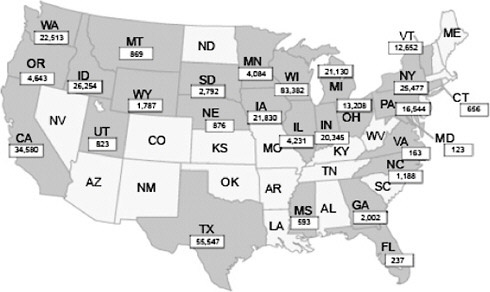
FIGURE 3-6 Number of operating manure digesters across the United States in 2009 and the amount of energy produced from the biogas generated. Numbers represent total annual energy production in MWh equivalent.
SOURCE: EPA (2009).
Impacts of pesticide on biodiversity are clear for some organisms but are typically compounded with loss of habitat, increased disturbance, and other attributes of intensive farming systems. This convergence of factors makes it difficult to determine the extent of direct impacts from pesticide use alone. One of the best-documented examples relates to the dramatic loss of native bees, representing the loss of a major ecological service (pollination) that is thought to increase size, quality, or stability of yields for 70 percent of the major crops produced globally (Ricketts et al., 2008) and is of paramount importance to the food supply (Allen-Wardell et al., 1998). Although difficult to pinpoint, the cause of pollinator decline is thought to be in part due to pesticide exposure, habitat loss, expansion of intensive agriculture, diseases, and parasites (Allen-Wardell et al., 1998; NRC, 2007; Rundlof et al., 2008; Black et al., 2009).
Continued reductions in pesticide use can reduce the potential of spray drift or leaching into ground water and potentially enhance biodiversity. In many situations, pesticide reduction could also result in decreased energy consumption (from reductions in production and transportation); however, any savings need to be balanced against any increases in tillage or decreases in productivity to determine overall energy use per unit of food or fiber produced.
To effectively manage the weed–disease–pest complex with reductions in, or elimination of, chemical use requires a suite of strategies (Shennan, 2008) that includes: breeding of crops that are pest and disease resistant and that are better able to compete with weeds in a given environment; use of different soil and crop management strategies; and diversification of crop rotations and noncrop vegetation.
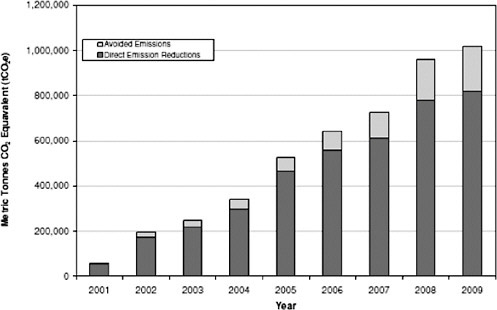
FIGURE 3-7 Reductions in greenhouse-gas emissions in 2009 as a result of the 140 operating manure digesters.
SOURCE: EPA (2009).
Managing the Crop–Weed–Disease–Pest Complex
For many decades the fields of weed, disease, and pest management focused primarily on chemical pest control materials targeted for the particular types of organisms in question, with little integration across the disciplines. Efforts to reduce chemical usage and develop more ecologically based approaches has called into question the value of this single disciplinary approach, as evidence of important interrelationships among each component of the crop–weed–disease–pest complex has emerged. Multitrophic interactions are known to occur in natural systems with important consequences, so it is not unexpected that they could play important roles in agroecosystems as well (Shennan, 2008). For example, foliar herbivory in grasslands has major consequences for the functioning of soil food webs (Wardle, 2006), and similarly, changes in soil food webs and nutrient dynamics also affect plant quality and attractiveness to herbivores (Awmack and Leather, 2002; Beanland et al., 2003). As a result, farm practices such as tillage, crop rotation, fertility inputs, and pesticides not only have direct effects on weed populations, disease incidence, and pest populations individually, but also important indirect effects mediated by other elements of the crop–weed–disease–pest complex. For example, changes in weed populations can provide new hosts for pests or pathogens increasing their severity; alternatively, they can provide refugia for beneficial arthropods and enhance soil suppressiveness to soil-borne pathogens, thus aiding biological control (Norris, 2005; Thomas et al., 2005; Wisler and Norris, 2005). Further, as in nature, crop plants are subjected to attack by more than one organism such that below-ground attack can influence responses to above-ground attack and
vice versa, because of systemic induction of defense metabolism (Bruce et al., 2007). Finally, similar management techniques can be used to control more than one kind of pest, again arguing for interdisciplinary collaborations. Use of organic amendments to enhance soil suppressiveness is advocated to help manage fungal, bacterial, and nematode pest species (Alabouvette et al., 2006). Similarly, biofumigation through the incorporation of residues that are high in biocidal compounds, such as Brassica species, has the potential to control a range of soil pests (for example, nematodes) and pathogens (Matthiessen and Kirkegaard, 2006). The nature and outcomes of management interventions on the weed–disease–pest complex will be site- and organism-specific, making their study complex and challenging in terms of research design and statistical analysis (Kranz, 2005). Because the bulk of the literature is disciplinary studies, significant advances in each component of the complex are discussed, followed by a more holistic view of the impacts of different farming practices and systems.
The Evolution of Integrated Pest Management
Recently, the Food and Agriculture Organization (FAO) further revised its definition of integrated pest management (IPM) to reflect a continuing shift toward greater emphasis on ecologically based management, with application of pesticides seen as a last resort (W. Settle, presentation to the committee on January 14, 2009). However, others continue to use a narrower definition that implies a more primary role for improved pesticide use. The spectrum of definition is also reflected on the ground according to surveys of IPM practices among different farms in the United States and elsewhere. For some farmers, IPM means simply scheduling pesticide applications based on monitoring and established economic thresholds; others use more integrated IPM that combines a mix of cultural and biological control practices with or without pesticide use as a last resort (Shennan et al., 2001). The latter is sometimes referred to as ecological pest management (Shennan, et al., 2008) to distinguish it from improved management of pesticides. While IPM is most commonly associated with above-ground arthropod pest management, terms such as “integrated weed and disease management” are becoming more common, reflecting a similar increased attention to a diversified set of management approaches for these organisms. However, there are unique challenges for integrated management of soil pests and pathogens, and concepts of monitoring and use of thresholds are difficult to apply (Matthiessen and Kirkegaard, 2006).
While pesticides remain the primary method of pest control currently, increasing public and regulatory pressures for additional pesticide reductions are shifting the focus of research to development and implementation of nonchemical alternatives. The following section highlights promising new developments toward this goal.
Use of Disease and Insect Resistant Cultivars in IPM
Plant breeding has a crucial role in protecting crops against diseases and insect pests. For example, wheat cultivars are now grown with resistance to one or more of the following: stem rust, leaf rust, stripe rust, powdery mildew, soilborne mosaic, pseudocercosporella foot rot, Hessian fly, and greenbug (Cook, 2000). The transgenic Rainbow variety of papaya was engineered to resist papaya ringspot virus, which devastated the papaya industry in Hawai’i in the 1990s (Gonsalves et al., 2007). The use of resistant varieties is an important component of any IPM program. Development of resistant varieties depends on the availability of useful genes and the methods of selection, as discussed in the earlier
section on Plant Breeding and the Genetic Modification of Crops. Yet, relying completely on resistant varieties to manage diseases and insect pests is usually inadequate because resistance can break down, new pest and diseases can emerge, or previously minor pests can become major pests under favorable environments and selection pressure.
Arthropod Pest Management
A sustainability goal for arthropod pest management is to reduce pesticide use. Achieving that goal requires a suite of approaches, including cultural control techniques (not discussed here), use of resistant varieties, and biological control. This section focuses on biological control. Three types of biological control of arthropods are recognized: classical, which refers to the release of exotic organisms to control pests that are not effectively controlled by native natural enemies; augmentative, the periodic release of natural enemies to augment native populations; and conservation biological control, where habitat diversification is used to provide the resources necessary to support higher populations of natural enemies.
Classical biological control has a long history, and numerous reviews of the successes and failures of classical biological control efforts can be found (Bale et al., 2008, and references therein). In general the technique has been most successful with perennial crops where lack of disturbance allows for populations of the introduced natural enemy to become established. A recent success of classical biological control has been the introduction of a parasitoid (Epidinocarsis lopezi) to control a mealy bug (Phenacoccus manihoti) that attacks cassava in Africa. First introduced into Nigeria in 1981, E. lopezi has now spread to neighboring countries resulting in major economic benefits (Neuenschwander et al., 2003).
In contrast, augmentative biological control is better suited for highly disturbed annual cropping systems where populations are less likely to become established and multiple releases are often required for adequate control (Bale et al., 2008). Yet given the expense involved with multiple releases of commercially produced organisms, they are only used primarily on high-value crops such as fruits and vegetables. In 1995 augmentative releases were used on 19 percent of fruit and nut and 7 percent of vegetable acreage (U.S. Congress, Office of Technology Assessment, 1995); in California, however, predatory mites are released on 50 to 70 percent of the strawberry acreage to control the two-spotted spider mite (Hoffman et al., 1998). Effectiveness of augmentative releases is highly variable, and they are often less effective and more expensive than pesticides, limiting their widespread use. It is estimated that in only 15 percent of cases studied did natural enemy populations reach desired levels, and they failed to provide control in 64 percent of the cases due to some combination of problems such as poor environmental conditions, mortality, inadequate dispersion, or predation of the released organisms (Collier and Van Steenwyk, 2004).
There is also increasing concern about the effect of biological control releases on non-target species, as discussed in Wajnberg et al. (2001). Conservation biological control, in contrast, avoids these problems by enhancing indigenous populations of natural enemies by provision of desirable habitat and resources. Desirable habitat can be created at multiple scales; within the field, as in the case of trap cropping and insectary plantings, or along field margins as for hedgerows, and by the presence of different habitat patches within the wider landscape (Shennan, 2008). Within-field examples include planting rows of sweet alyssum (Lobularia maritima) as insectaries in lettuce fields. This led to consistently higher natural enemy-to-pest ratios and significant biological control of aphids (Chaney, 1998; Collins et al., 2002). Planting strips of alfalfa as a trap crop in strawberry fields effectively attracted
large numbers of lygus bugs, such that vacuuming only the alfalfa rows achieved equivalent control to either vacuuming the entire field or applying recommended pesticides with greatly reduced energy and labor costs (Swezey et al., 2007).
Intercropping is also a method of diversification within the field and has been shown in many cases to reduce herbivore levels. For example, intercropping alfalfa with forage grasses has been shown to reduce damage to alfalfa by alfalfa weevils compared to alfalfa monocrops (Roda et al., 1996). Another meta-analysis of intercrop studies found that on average 52 percent of herbivore species studied had lower population levels in intercrops versus monocrops, whereas 21 percent had variable responses. Ten percent showed no response, and the remaining 18 percent had higher herbivore levels in intercrops than in monocrops. The variable outcome of intercropping illustrates that the effect is species-specific and system-specific (Andow, 1991).
Alternatively, habitat can be created along field margins by planting hedgerows or by conserving fragments of native habitat in the agricultural landscape. Considerable evidence has shown the ability of managed hedgerows to increase populations of natural enemies (Letourneau, 1998; Nicholls et al., 2001; Letourneau and Bothwell, 2008). In some studies, dispersal of natural enemies from the hedgerow into the field was monitored, showing that dispersal distances differed greatly among various types of natural enemies, but the distances can be large for highly mobile species. Less well documented, however, is whether the presence of the hedgerows actually results in significant levels of biological control within the crop field (English-Loeb et al., 2003; Letourneau and Bothwell, 2008). Also the method of biological control differs among pests, with some controlled by increases in generalist natural enemies, while others require development of desirable habitat for specific antagonists (Bugg et al., 1991; Wang et al., 2003).
Studying cucurbit crops (Cucurbita spp.) with buckwheat refuges, Platt et al. (1999) found numbers of insect predators and parasitoids caught on sticky traps increased by 2 to 19 times as one moved toward buckwheat refuges from 20 to 35 m away. However, striped cucumber beetle (Acalymma vittatum F.) populations increased beyond the economic threshold at distances 10 m from buckwheat refuges and when buckwheat stopped flowering. Such spatially and temporally explicit information regarding the effects of vegetation management on both pest and beneficial arthropods remains rare, especially for field-scale studies that also quantify economic crop yields and have control treatments with standard chemical pest suppression. Indeed, the combination of field margin hedgerows and in-field insectaries may improve natural enemy movement and biocontrol because of greater habitat connectivity, especially for species that do not disperse long distances from perennial field margins into fields (Nicholls et al., 2001).
Other studies have investigated whether greater landscape diversity surrounding farm fields leads to higher levels of biological control. Structurally complex landscapes have been found to lead to higher levels of parasitism and lower crop damage (Thies and Tscharntke, 1999; Pullaro et al., 2006), but this is not always the case if parasitism or predation rates depend upon the presence of particular species or plant communities (Menalled et al., 1999; Landis et al., 2005). It is well known that the size of habitat patches in the landscape, the degree of connectivity between patches, and the structure of the “matrix” between the habitat patches greatly affect the survival and mobility of natural enemies (Donald and Evans, 2006). In a recent review of the effects of landscape diversity on conservation biological control, Tscharntke et al. (2008) concluded that “Complex landscapes characterized by highly connected crop-noncrop mosaics may be best for long-term conservation biological control and sustainable crop production, but experimental evidence for detailed recommendations to design the composition and configuration of agricultural landscapes that maintain a diversity of generalist and specialist natural enemies is still needed.”
Finally, there is renewed interest in better understanding the roles of insectivorous birds on biological control of arthropod pests and how to provide nesting habitat to enhance their populations. The most extensive work has been done in the tropics, notably in shade coffee systems (Perfecto et al., 2004). However, some investigations are being undertaken in Mediterranean and temperate agricultural systems. For example, Great Tits are able to reduce caterpillar damage in some apple orchards (Mols and Visser, 2002). In Australia, native bird species commonly found in shelter belts were found to prey on common pests of crops and pastures, although direct suppression of pest populations was not measured (Gamez-Virues et al., 2007).
Thus, there are many compelling reasons for promoting habitat diversification if, on balance, it leads to more effective pest management and is economically feasible. Not only does habitat diversification avoid the need to release control agents and hence eliminate concerns about nontarget effects, but also it can provide other important ecological services to meet sustainability goals such as conservation of native biodiversity, reduced erosion, reduced runoff, and protection of vulnerable fresh water habitats, as well as enhanced quality of life and aesthetic value.
Pathogen Management
Nonchemical approaches to disease management are built around a combination of use of resistant varieties (discussed earlier), and cultural and biological control practices. Cultural approaches include soil organic matter management, irrigation, fertility management, microclimate modification via planting arrangements, choice of irrigation methods and scheduling, crop rotation, and biofumigation methods (Shennan, 2008). Considerable advances have been made in understanding the mechanisms that underlie many of these practices, some of which enhance intrinsic biological control of pathogens and can obviate the need for applications of fungicides or external biological control agents.
The ability to manage soil-borne pathogens has advanced considerably with improved understanding of what gives certain soils the capacity to suppress disease development. Two forms of suppressiveness are found: general and specific. The former is because of competition for resources by the overall microbial community (Schneider, 1982), and hence is associated with high levels of microbial activity. The latter is because of characteristics of specific organisms, or groups of organisms that suppress a specific pathogen (Weller et al., 2002). An example of general suppression is the suppression of corky root of tomato in organic fields caused by a combination of high microbial activity and low soil nitrate levels (Workneh et al., 1993). Take-all disease caused by Gaeumannomyces graminis var. tritici was suppressed in organic soils relative to conventional soils in wheat and barley production because of a combination of both general and specific suppression (Hiddink et al., 2005).
Examples of specific suppression include the ability of nonpathogenic strains of disease-causing fungi and arbuscular mycorrhizal (AM) fungi to act as biocontrol agents. Nonpathogenic strains of Fusarium oxysporum can reduce the incidence of Fusarium wilt due to a combination of increased competition for resources, competition for infection sites, and the ability of the nonpathogenic strains to induce plant resistance (Bao et al., 2004). Further, colonization of strawberry plant roots by AM fungi can induce resistance to Phytophthora fragariae in strawberry, but the effect is variety specific. AM fungi have also been found to suppress Phytophthora nicotianae var. parasitica (Cordier et al., 1996) and to reduce root rot in woody perennials (Traquair, 1995).
Advances have been made in the identification of the soil microorganisms responsible for specific types of suppressiveness, aided by the development of molecular genetic isolation and fingerprinting techniques (Benitez et al., 2007). For example, in the case of take-all
disease, suppression is caused by a build up of antagonistic fluorescent Pseudomonas spp. in the wheat root rhizosphere that produces antibiotic compounds and induces plant resistance (Weller et al., 2002). However, other organisms may be involved in addition, since take-all suppression was not affected by the presence of fluorescent Pseudomonas spp. in one study (Hiddink et al., 2005).
Induced resistance, a rapidly growing research focus, refers to the phenomenon whereby attack by one organism stimulates plant defense mechanisms conferring some degree of resistance to other pests and diseases. For example, infection of black mustard plants (Brassica nigra) by a root-feeding nematode (Pratylenchus penetrans) led to reduced growth and pupae production of the butterfly Pieris rapae (Bruce and Pickett, 2007). Interestingly, nonpathogenic soil microorganisms have also been found to induce plant resistance responses to foliar pathogens and represent a promising avenue for nonchemical management of these diseases, for which few other alternatives currently exist. For example, specific strains of Bacillus spp. have been found to induce resistance in 11 different host plants and cause reductions in a spectrum of diseases (foliar, stem, and soil-borne fungal diseases), viruses, and root-knot nematodes, as well as reducing populations of three insect vectors of viral diseases (Kloepper et al., 2004). A commercial formulation of these bacteria has been produced for controlling diseases of soybean (Kloepper et al., 2004). It should be noted, however, that use of such formulations is currently limited in part due to variability in effectiveness and cost. Variable results in the field could be because of application problems (physiological state of the bacteria, timing, and dosage) or differences in microclimate, crop genotypes, weed communities, and soil ecology (Fravel, 1999; Sabaratnam and Traquair, 2002). Problems related to poor establishment in soils may be circumvented if ways are found to manipulate levels of specific endophytic (that is, live within the plant tissue) microorganisms that can induce resistance (Sturz et al., 2000). Recent reviews describe the rapid advances being made in the field of induced resistance, both in terms of an improved understanding of different signaling metabolic pathways leading to resistance elicitors such as jasmonic and salicylic acids, and the potential applications of this knowledge in field management (Bruce et al., 2007; Karban and Chen, 2007).
An emerging focus of plant breeding is to breed plants with enhanced capacity for induced resistance. Understanding of the physiology and biochemistry underlying this phenomenon has increased greatly in recent years, and many of the genes responsible have been mapped for some major crops, notably rice (Karban and Chen, 2007). Efforts are now underway to develop techniques for incorporating these genes into cultivated rice varieties (Karban and Chen, 2007) and in other crops (Vallad and Goodman, 2004). Some organisms involved in induced resistance are microorganisms found in the rhizosphere, where a complex of different bacteria and fungi (such as AM species) are found that also contribute to the ability of soils to suppress diseases, as discussed above. Selecting for an increased ability to support beneficial rhizosphere microorganisms, as well as beneficial endophytic and phylloplane (leaf surface) microorganisms, is an emerging area of plant improvement (Karban and Chen, 2007).
Biofumigation, Organic Amendments, and Anaerobic Disinfestation Techniques
Biofumigation refers to incorporation of plant residues that contain biocidal com pounds, some of which are toxic to soil pathogens, and others that are allelopathic to weeds. Brassica species in particular have been widely studied for use as disease-suppressive cover crops (Snapp et al., 2005; Matthiessen and Kirkegaard, 2006) that can also help control plant parasitic nematodes (Zasada and Ferris, 2004). While in some cases biofumigation
with Brassica species can provide effective control of diseases, it is not always effective (Hartz et al., 2005) and this lack of consistency is seen as a barrier to widespread adoption (Matthiessen and Kirkegaard, 2006). There are many possible explanations for such inconsistency: different growing conditions, varietal differences in isothiocyanate levels, variation in release of isothiocyanates into the soil, differential sensitivity of the target pathogens, and variation in the ability of soil microorganisms to rapidly break down the active biocidal compounds. The latter (referred to as enhanced microbial biodegradation) is of particular concern, because it seems that once soil has developed a high capacity for degrading specific biocidal compounds (a desirable feature when more persistent pesticides are used, but not for biofumigation), it is apparently difficult to reverse (Matthiessen and Kirkegaard, 2006). It is clearly also important to know the levels of biocidal compounds in the residue being incorporated and their activity in the soil environment to select appropriate species and varieties to use. Some have found consistent results for biofumigation with Brassicas when appropriately selected varieties are used (Zasada and Ferris, 2004). Some species that provide biofumigation benefits against pathogens can also suppress plant parasitic nematodes and suppress weed germination and growth, as discussed below.
Compost additions and cover crop residues have been found to reduce fungal, bacterial, and nematode pathogens in a number of systems, although the effect can be highly variable depending on the specific crop–pathogen–amendment combination (Abawi and Widmer, 2000). For example, compost reduced certain fruit diseases of tomato but not others, increased foliar disease levels, and had differential effects depending on the tomato cultivar and whether the plants were grown organically or not (Abbasi et al., 2002). In a recent review of 250 papers, the authors found that compost application effectively controlled root diseases in more than 50 percent of the studies and was conducive to disease in only 12 percent of cases. Crop residues, however, had more variable effects, showing suppression in 45 percent of the cases but an increase in plant disease in 28 percent of the cases. Suppression also varied greatly with different pathogens; for example, Verticillium, Fusarium, and Phytophthora were suppressed in more than 50 percent of the cases as opposed to only 26 percent for Rhizoctonia solani (Bonanomi et al., 2007). The authors called for more research on mechanisms of suppression under different conditions to enable better prediction of the effects of organic amendments.
Finally, anaerobic residue decomposition techniques have been developed independently in Japan and the Netherlands to control a range of soil pathogens that attack a variety of crops ranging from vegetables to trees (Blok et al., 2000; Messiha et al., 2007). This involves adding some kind of carbon source and water to saturate the soil, then covering the soil with an oxygen-impermeable tarp to stimulate anaerobic decomposition of organic carbon sources. It is thought that products of anaerobic decomposition (possibly organic acids) combined with low oxygen levels might be responsible for the reductions in disease, but the exact mechanisms are not understood (Blok et al., 2000; Momma, 2008). This technique offers promise as an alternative to use of the fumigants such as methyl bromide, chloropicrin, and others for high-value vegetable and strawberry production and a variant of the approach. It is already used extensively in greenhouse production in Japan (Momma, 2008).
Advances in Nematode Management
Biologically based nematode management can be achieved through a number of approaches; many utilize the same mechanisms as described for soil-borne disease management. Again, both general and specific types of soil suppressiveness to plant parasitic
nematodes have been observed (Westphal, 2005). For example, combinations of plant-growth-promoting rhizobacteria, organic amendments, and phytochemicals can suppress root-knot nematodes in tomato transplants (Kokalis-Burelle et al., 2002). In addition, certain soil fungi are known to attack nematodes and can be effective biological control agents (Wang et al., 2001).
Nematode communities are known to shift in response to organic matter level and quality, with species diversity increasing with organic matter inputs (Mikola and Sulkava, 2001; Wardle, 2006). Changes in organic matter level and quality can result in higher populations of predatory nematodes that attack other nematodes and suppress populations of plant parasitic nematode species. However, shifts in nematode community composition can occur over relatively short time frames. For example, the effects of long-term reduced tillage on nematode species, other than plant feeders, disappeared within one year of disruptive soil management (Berkelmans et al., 2003).
As noted previously, biofumigation and the use of certain cover crop species can also be used to control some nematode species (Cherr et al., 2006), yet it is clear that variety, site, and crop-specific testing is needed to determine efficacy. In one location, a cowpea variety effectively suppressed root-knot nematode, but in another location, cowpea increased rootknot nematode populations (variety not noted). Similarly the effectiveness of buckwheat and mustard species for nematode suppression varies with location (Cherr et al., 2006).
Crop rotations can be an effective nematode management tool when built around use of nematode-suppressive cover crops and residues, nonhost crops, or varieties, as well as appropriate tillage and organic matter to stimulate desired changes in soil communities (Caamal-Maldonado et al., 2001; Vargas-Ayala and Rodriguez-Kabana, 2001; Pyrowolakis et al., 2002; Zasada and Ferris, 2004; Snapp et al., 2005; Westphal, 2005). Crop rotation in combination with the use of an annual cover crop of sorghum-sudangrass effectively controlled southern root-knot nematodes and lesion nematodes in another study (Kratochvil et al., 2004). Interestingly, the species composition of fallows in shifting cultivation and bush-fallow systems can be manipulated to suppress key plant parasitic nematodes (Adediran et al., 2005).
Advances in Weed Management
The basis of ecological weed management is to employ an integrated suite of techniques to shift the competitive balance in favor of the crop plant over weedy species (Shennan, 2008). Crop competitiveness can be increased by use of more competitive varieties (see below) and optimizing conditions for crop growth (fertility and water management, planting arrangements, tillage, and so on), and weed growth and reproductive success of weedy species can be reduced. The latter can be achieved by a combination of mechanical weeding; use of physical barriers such as plastic, plant residue, or living, mulches; incorporation of allelopathic residues or release of allelopathic chemicals from the crop itself; and managing soil ecology to increase rates of predation and infection by pathogens on weed seeds in the soil seed bank. When designing an integrated approach to weed management, it is important to employ both immediate and long-term strategies in order to reduce both the annual input of new seeds and preexisting seed bank numbers.
One aspect of plant breeding that has grown in recent years is the development of crop cultivars that can better compete against weeds. Given the widespread use of herbicides and the priority for improved weed management in organic production, this is an important research area. Current efforts focus primarily on selection for phenological and growth
rate characteristics associated with increased competitiveness, such as rapid early canopy growth (Gibson et al., 2003) and development of crops containing increased levels of allelopathic compounds (Bhowmik and Inderjit, 2003).
Until recently, little work had been done to select for phenological and growth rate characteristics—partly because of the challenge of conducting large screenings in the presence or absence of weed competition. There also is the perception that negative tradeoffs will occur between resource allocation to growth traits that confer competitiveness and resource allocation to seed or fruit production. However, a number of studies show that this tradeoff does not always occur. The ability of rice cultivars to suppress watergrass (Echinochloa oryzoides) was not inversely related to yields even though some cultivars were able to reduce watergrass biomass by as much as 40 to 80 percent (Gibson et al., 2003). Traits correlated with higher competitiveness related to early season vigor as measured by height growth rates, tiller production, and specific leaf area (Caton et al., 1999; Gibson et al., 2003). Similar relationships between early vigor (plant height, tiller number, and light interception) and competitiveness against weeds have been identified in wheat by comparing taller, near identical isolines with various semi-dwarf cultivars (Zerner et al., 2008). Selecting for early vigor can thus be used to screen large numbers of varieties such that only the most promising would need to be tested in the presence or absence of weeds.
To date, most of the work identifying germplasm for increased production of allelopathic compounds has been done with rice. Cultivars that combine high allelopathic potential without yield loss have been identified (Ni and Zhang, 2005; Labrada, 2008). The application of biotechnology to the development of weed-suppressive crops is in its infancy and is thought to have considerable potential (Rector, 2008; Weih et al., 2008). However, the allelopathic compounds would have to be evaluated for their nontarget effects.
A well-adapted crop variety for ecologically based production systems needs to exhibit a combination of complex characteristics that are each based on multiple mechanisms to provide improved competitiveness against weeds, disease, and pest resistance and to enhance nutrient uptake ability. Some argue for the use of cultivar mixtures as one mechanism for improving overall crop performance (Sarandon and Sarandon, 1995) and disease management (Mundt, 2002). There is evidence that relative cultivar performance differs when cultivars are grown in organically managed soils as opposed to chemically fertilized soils (Murphy et al., 2007; Wolfe et al., 2008), and a number of research groups are now selecting for competitiveness specifically for organic systems (Mason and Spaner, 2006; Hoad et al., 2008). Further, characteristics other than early vigor may be important for competitiveness in low-fertility conditions as found in the developing world. Results from India suggest improving lentil root systems to increase nutrient uptake ability in low-fertility soils improved competitiveness against weeds (Gahoonia et al., 2005, 2006). Selecting for such a complex mix of characteristics is challenging and involves large numbers of individual genes, so approaches such as building diverse composite cross-populations that are then subjected to natural and artificial selections in varied environments (Phillips and Wolfe, 2005) are being used.
Allelopathic chemicals released by specific cash crop or green manure species has been shown to inhibit weed growth, although the effect is known to be highly specific to species and variety and is dependent upon the combination of microclimate, residue management, soil conditions, and target organism (Blackshaw et al., 2001; Caamal-Maldonado et al., 2001; Inderjit et al., 2001). Notably, small-seeded weeds tend to be particularly susceptible to growth-reducing stresses following the incorporation of residues. Growth reduction could be a result of the release of chemicals, increased susceptibility to soil-borne pathogens, and
nutritional stress because of delay in the release of nitrogen from decomposing organic matter. In contrast, larger seeded crops have an early season growth advantage (Dyck et al., 1995; Davis and Leibman, 2001; Petersen et al., 2001).
Mulches control weed growth by providing a physical barrier and (in the case of dark plastics, residue mulches, and living mulches) reducing light transmission. If clear plastics are used, solarization occurs where ambient temperatures are sufficiently high to raise soil temperatures under the plastic to levels lethal to weed seeds. For environmental (to eliminate the need for plastics) and soil health reasons, interest in use of residue mulches and living mulches has increased over the past 20 years. There are numerous examples of suppressive residue mulches effectively controlling weeds. In cherry orchards, a suppressive mulch inhibited weed growth and increased fruit yield by 20 percent (Landis et al., 2002), and use of clover residue in wheat effectively controlled ragweed (Mutch et al., 2003). The use of living mulches can be effective in some systems, but the effects are highly variable (Hartwig and Ammon, 2002) and competition from the mulch can cause significant yield reductions (Chase and Mbuya, 2008). However, use of legumes, particularly velvetleaf (Mucuna deeringiana (Bort) Merr) as a living mulch in corn fields in Mexico effectively suppressed weed growth and increased corn yields (Caamal-Maldonado et al., 2001). Specific practices, such as the timing of sowing the living mulch (Vanek et al., 2005) and mowing timing and frequency, can greatly affect the outcome of mulch crop competition (Hartwig and Ammon, 2002). Further, the use of residues for mulches that also have allelopathic properties can be effective at weed suppression, but there is debate as to whether they can be as effective as herbicides currently in use (Bhowmik and Inderjit, 2003; Khanh et al., 2005). For example, use of black oats or rye mulch in cotton could effectively replace the postemergence herbicide used, but not the preemergence application (Reeves et al., 2005).
The use of intercropping also has the potential to suppress weeds, although most studies have been of short duration and long-term impacts on weed populations are not well understood (Shennan, 2008). Nonetheless, some studies have shown effective weed suppression in intercrops as compared to the equivalent monocrops. In India, a chickpea–wheat intercrop provided sufficient weed suppression that, when combined with some hand weeding, led to a higher net income for the farmers relative to growing the two crops separately (Banik et al., 2006). In a barley–pea intercrop, weeds were greatly suppressed relative to the pea monocrop, but populations were similar, but more stable, compared to the barley monocrop (Poggio, 2005). Studies in Europe have also found that pea–barley (Hauggaard-Nielsen et al., 2001) and leek–celery (Baumann et al., 2000) intercrops can reduce weeds. Other intercrops do not suppress weeds effectively (for example, vetch–cabbage; Brainard and Bellinder, 2004) or benefit from addition of some herbicides (Szumigalski and Van Acker, 2005). With the development of ecophysiological models for many crops, both mechanistic and descriptive models are now being used to design intercrops for yield, crop quality, and weed suppression (Baumann et al., 2002).
Other cultural practices can also affect crop competitiveness and weed suppression; they include crop rotation, nitrogen fertility management, planting density, and planting arrangements. Manipulation of crop rotations and inclusion of cover crops at key points can suppress weeds, and lifecycle models for weeds can be used to design appropriate sequences (Anderson, 2004). Nitrogen fertility affects the competitive balance between weeds and crops in a very crop-specific manner (Liebman and Davis, 2000), with increasing nitrogen benefiting highly nitrogen-responsive crops such as corn (Evans, 2003). Planting density and arrangement affect weed suppression in spring wheat, with a grid arrangement being the most effective (Baumann et al., 2001); however, the more easily achieved random arrangement was almost as effective (Olsen et al., 2005b). While random planting is not
an option for many row crops due to tillage and harvest requirements, it has potential for small grains and cover crops.
Weed seed bank dynamics are affected by tillage, residue management, and crop rotation, by reductions in annual seed input by weed suppression during the crop cycle, and by increasing seed predation in the soil (Menalled et al., 2001; Murphy et al., 2006). Reduced tillage and crop rotation were found to increase seed diversity, but reduce seed density in the soil by 80 percent over a six-year period (Murphy et al., 2006). Seed density also declined significantly in organic and reduced input systems relative to conventional and no-till systems in another study (Menalled et al., 2001), yet reductions in seed density do not always lead to reduced weed pressure during the crop cycle (Liebman and Davis, 2000).
Considerable progress has been made in understanding different mechanisms of weed suppression, and the ability to control weeds and reduce herbicide use will continue to improve as better combinations of approaches are developed and more competitive crop varieties become available. Linking weed and crop lifecycle models with models of seed bank dynamics could help design weed-suppressive rotations and management practices.
Designing Systems for Holistic Management of the Crop–Weed–Disease–Pest Complex
The preceding discussion lays out the elements necessary for effective management of the crop–weed–disease–pest complex. At the heart of any preventive management system is the maintenance of soil conditions that support the desired microbial, fungal, and nematode community assemblages that will suppress pathogenic fungi and nematodes, induce crop resistance responses, and reduce viable weed seed populations. Soil fertility needs to be managed for good crop growth, while at the same time ensuring that nutrient levels in the soil and plant tissue are not high enough to increase susceptibility to pathogens or attract higher levels of herbivory. In addition to good soil management, other key elements are the use of competitive and disease- or pest-resistant varieties, diversification of crop rotations to break pest cycles, and the inclusion of noncrop vegetation to provide habitat for natural enemies. Taken together, these strategies enable ecological interactions to occur that can greatly decrease the severity of pest, weed, and disease impacts, and potentially increase resilience of the production system to fluctuating conditions (Shennan, 2008).
The tools available to farmers to prevent outbreaks of pests, weeds, and disease are: varietal selection, crop rotation, tillage, fertility inputs, organic amendments, water management, and the provision of habitat diversity. Sufficient knowledge is now available to begin designing integrated management systems tailored to specific production systems using thoughtful combination of the practices discussed above.
Several factors and practices and their interactions are relevant to managing the weed–disease–pest complex. For example, crop rotation and organic matter management can enhance the populations of beneficial rhizobacteria and thus increase soil suppressiveness to diseases and nematodes (Welbaum et al., 2004). The effectiveness, however, can vary with soil types (Messiha et al., 2007). The effects of biological amendments (for example, biocontrol agents, microbial inoculants, mycorrhizae, and an aerobic compost tea) on disease suppressiveness appear to vary with crop rotations. It is possible that some crop rotations are better able than others to support populations of added beneficial organisms from amendments and enable more effective biological control (Larkin, 2008). Crop rotations can also be designed for improved weed control by using models of weed life cycles (Anderson, 2004) and can address other pest problems as highlighted by the following examples. Introduction of such tropical crops as American jointvetch (Aeschynomene americana) or castor (Ricinus communis) into the rotation with peanut and soybean was found to provide nema-
tode control and increased peanut and soybean yields in Alabama (Rodríguez-kábana and Canullo, 1992). When corn is rotated with soybeans, it can reduce the need for insecticide by reducing the number of western corn rootworm larvae in the soil. The effectiveness of this management practice, however, has diminished over time because of a shift in the ovipositional behavior of the western corn rootworm (O’Neal et al., 1999; Schroeder et al., 2005).
Use of cover crops in rotations can similarly have multiple effects, and the choice of crop depends on which functions are seen as primary. For example, in addition to providing soil cover and cycling nutrients, cover crops can also suppress weed populations if appropriate species are chosen that shade and outcompete weeds or are allelopathic (Teasdale, 1998); provide habitats for beneficial insects and pests (Costello and Daane, 1998); or suppress certain diseases (Griffin et al., 2009).
Changing management practices, such as planting density and nitrogen fertility, can similarly have multiple effects. For example, the incidence of powdery mildew in no-till wheat depends upon a complex combination of nitrogen application rates, row spacing and seeding rates, and crop phenology (Tompkins et al., 1992). However, nitrogen fertility level and crop spacing also affect weed suppression (Liebman and Davis, 2000; Evans, 2003; Olsen et al., 2005a,b), and high nitrogen fertility can reduce soil suppressiveness to disease (Workneh et al., 1993) and increase crop palatability to arthropod herbivores (Staley et al., 2009).
Although information and management tools that can contribute to integrated management of specific pests or the whole weed–disease–pest complex are available, the challenge is determining which combination of tools to use to create the synergies necessary for effective control and to minimize negative interactions. Each system will need to be carefully tailored to the specifics of the location and context. Negative interactions might occur in some circumstances and need to be taken into account. For example, a cover crop that is desirable for one purpose, such as nitrogen fixation, may result in increased disease problems if the species is susceptible to key diseases in the area. Similarly, reduced tillage may have multiple benefits but still increase specific problems. Effects of reduced tillage on soil biota are somewhat predictable, favoring fungal food webs that are readily disrupted with soil disturbance, as well as higher AM fungal populations and increased seed predation (Shennan, 2008). This can be beneficial for disease suppressiveness and reductions in weed seed banks through increased seed predation and disease. Reduced tillage, however, also can reduce crop growth through poorer seed bed structure, cooler soil temperatures, and other factors (Triplett and Dick, 2008).
The complexity and unpredictability of the biotic interactions described above further reinforce the need to test ecological pest management tactics in systems-level field contexts (Shennan, 2008), as has been argued for biological control tactics for plant diseases (Alabouvette et al., 2006; Matthiessen and Kirkegaard, 2006) and use of green manures (Cherr et al., 2006). Further, monitoring outcomes when farmers adapt techniques for their individual contexts could provide important information on systems-level interactions. Putting a greater emphasis on participatory research approaches would combine farmer knowledge and experience with a generation of research information for subsequent meta-analysis and could increase the ability to predict when synergies or negative interactions are likely to occur in the field and adjust management accordingly.
Evaluation of Adoption, Effectiveness, and Future Challenges of IPM and Ecological Pest Management
While considerable research has been done to investigate more ecological approaches to pest management, little information is available on levels of adoption and effectiveness,
even for arthropod IPM, which has a relatively long history. Indeed, few assessments are available. Comments range from the assertion that IPM has enjoyed significant success in the developed world (Way and van Emden, 2000) to a commentary (Devine and Furlong, 2007, p. 295) on its perceived failure: “It is worth noting that, despite the popularity of the IPM concept (reviewed by Kogan, 1998) there has been no decrease in overall insecticide usage, even in areas where that concept is very favorably viewed (for example, in the United Kingdom and California). If the success of the IPM concept is judged by reductions in the area of land sprayed by insecticides, then it has clearly failed.”
It appears that inadequate datasets and lack of agreement on how to evaluate success explains such disparate views. Reductions in amounts used or acreage where pesticides are applied will be difficult to discern if highly aggregated data are used (for example, by country or region, across all types of pesticides, or across all crop types), because these data obscure any changes in pesticide use for a particular crop and pesticide combination for which an IPM system has been developed. Further, trends in application rates are also complicated by shifts in individual pesticides used, with replacement compounds often requiring lower application rates. In the absence of more nuanced analysis and adequate long-term data, it is inappropriate to draw broad conclusions about the impacts of IPM programs in the United States.
High levels of IPM use have clearly been documented for certain systems in the United States where growers are part of a network or organization that promotes sustainability as a goal (Warner, 2008). Likewise, there is evidence for use of IPM leading to reduction in pesticide use in developing countries, particularly where emphasis has been placed on farmer education through the Farmer Field School programs of organizations like the FAO. In their review, Van Den Berg and Jiggins (2007) looked at 14 studies that showed significant reductions of pesticide use (35 to 95 percent) in 13 of the studies and no effect in 1 study (although the design of the latter has been questioned). Many of the studies only measured immediate effects, however, and more long-term studies are needed.
Considerable progress has been made in development and commercialization of different kinds of augmentative biological control agents, yet sales of biocontrol products only account for 1 percent of total agricultural chemical sales (Fravel, 2005). A major barrier to use of biocontrol organisms is a lack of consistent and predictable levels of control under field situations. For example, in the case of antagonistic soil bacteria, variable results can be due to application problems (physiological state of the bacteria, timing, and dosage), or microclimate variation, differences in soil ecology, crop genotype, or weed community (Fravel, 1999, 2005; Sabaratnam and Traquair, 2002). Product registration can be a barrier, as in the case of AM fungal biocontrol agents (Whipps, 2004), and costs of formulating and producing mixtures may still be too high relative to chemical control options (Fravel, 2005). In addition, concerns about nontarget effects and ecological risks of microbial and other biocontrol agents are increasingly being voiced, particularly for those that are genetically modified (Wajnberg et al., 2001; Timms-Wilson et al., 2004). However, some argue that there is remarkable little evidence of negative side effects of biocontrol organisms, but this might be because of the lack of effort made to assess nontarget effects (Wajnberg et al., 2001).
Future Role of Pesticides in IPM
The future role for pesticides as part of integrated management of the pest complex was discussed in detail in the report The Future Role of Pesticides in U.S. Agriculture (NRC, 2000a). It is widely agreed that pesticides will continue to play an important role in many production systems, with continued attention to reducing nontarget effects by development of improved chemicals that have greater specificity, break down rapidly in the envi-
ronment, and are less toxic to humans and other animals. That report (NRC, 2000a, p. 254) concluded that “the most promising opportunity for increasing benefits and reducing risks is to invest time, money, and effort into developing a diverse toolbox of pest-management strategies that include safe products and practices that integrate chemical approaches into an overall, ecologically based framework to optimize sustainable production, environmental quality, and human health.” Pesticide use as part of an IPM system that combines cultural, physical, and biological strategies likely will continue, but there could be a shift to reduced pesticide use or using it as a last resort.
A number of priorities for future work emerge from the preceding discussion if a truly integrated pest, disease, and weed management system is to be developed. These involve more coordinated monitoring and data collection on the effectiveness and adoption of different strategies, as well as a shift to more integrated systems research on the crop–weed–disease–pest complex. Some suggested actions are:
-
A coordinated effort to evaluate on-farm adoption and effectiveness of IPM and ecological pest management strategies, and track corresponding changes in pesticide use for specific cropping systems.
-
Collection of field-based data to better understand the causes of variability in effectiveness of biocontrol organisms under different conditions; without this, adoption is unlikely to increase significantly.
-
On-farm work to assess the ability of different kinds of vegetation diversification to increase indigenous biological control. If biological control advantages are well documented, growers will be more likely to diversify habitats within and around the farm, which will also provide other important ecological benefits.
-
Field-based interdisciplinary work to increase the understanding of the effects of management practices and systems on dynamics among the whole weed–disease–pest complex.
Taken together those efforts will improve the ability to determine the adaptability and resilience of ecologically based management of the pest complex as compared to pesticide-based management.
MANAGING EFFICIENCY OF ANIMAL PRODUCTION SYSTEMS
Improvements in animal genetics, herd or flock management, and nutrition have resulted in increased conversion of animal feed to human-edible food and fiber of animal origin (Bull et al., 2008). Animals require nutrients for maintenance, growth, production, and reproduction. When nutrient intake is insufficient, the body prioritizes how nutrients are used with maintenance needs met first, followed by the other three categories in differing orders based on specific metabolic conditions. As an example, a female of reproductive age must meet maintenance requirements for regular estrus cycles, ovulation, and conception. Once pregnancy is established, the female requires additional nutrients for the developing fetus. After parturition, further nutritional needs exist to provide nutrients for the female to maintain herself, as well as sufficient nutrients to produce milk for her offspring. Improvements in genetics, management, and nutrition that allow for more closely targeted nutrient flow (inputs) to meet animal metabolic requirements will improve efficiency of feed conversion to animal product.
Feed conversion is the amount of feed required to produce one unit of product, where product can be eggs, meat, wool, or milk. As feed conversion efficiency improves, less
feed is required per unit output, translating into a reduced need for farmland to grow feed inputs as well as reduced nutrient excretion (manure). Three key opportunities exist on livestock and poultry farms to improve feed conversion: genetics, nutrition, and management. This section discusses genetics and nutrition as approaches to improving efficiency of animal production systems.
Animal Breeding
Efforts in animal breeding have focused on traits that influence output, such as weight gain, feed efficiency, reproductive efficiency (Grosshans et al., 1994; Kelm et al., 2000), or meat quality (Bishop and Woolliams, 2004). Genetic improvement can contribute to improving sustainability by increasing feed utilization efficiency (Ward, 1999), by selecting traits to improve animal health and welfare (Star et al., 2008), and by reducing livestock’s carriage of food-borne pathogens (Doyle and Erickson, 2006).
Quantitative genetics has been used in animal breeding for decades to select animals displaying desirable production traits. Broilers are used as an example in this section to discuss improvements associated with genetic versus nutrition alterations over time. Poultry breeders have developed broiler lines that exhibit increased growth rate and improved feed conversion efficiency, thereby reducing the time necessary for animals to reach market weight (with less feed inputs and less manure outputs). The challenge for scientists was to determine what fraction of the improvement resulted from improved genetics versus improved diet formulation. The Athens-Canadian random bred control (ACRBC) was established in 1957 by scientists at Agriculture Canada. That broiler line has been maintained genetically at the Southern Regional Poultry Breeding Laboratory (University of Georgia Department of Poultry Science, Athens, Georgia). The production traits of the ACRBC strain were evaluated in 1991 and found to have similar feed conversion as in 1957, which allowed comparison between old genetic lines (1957) and new genetic lines (2001) to evaluate feed conversion and growth weight (Havenstein et al., 2003a), carcass composition and yield (Havenstein et al., 2003b), and immune response (Cheema et al., 2003). Male or female birds were assigned from “old” (ACRBD) or “new” (Ross 208 broiler) genetic lines and on “old” (1957) or “new” (2001) feeding regimen. The Ross 308 broiler on the 2001 feed was estimated to have reached a body weight of 1,815 grams at 32 days of age with a feed conversion of 1.47, whereas the ACRBC on the 1957 feed would not have reached that body weight until 101 days of age with a feed conversion of 4.42. The shorter age to market as a result of improved feed conversion would require far less feed input (and associated land to grow the feed) to achieve similar product and have markedly less manure output. Comparisons of carcass weights of the Ross 308 on the 2001 diet versus the ACRBC on the 1957 diet showed they were 6.0, 5.9, 5.2, and 4.6 times heavier than the ACRBC at 43, 57, 71, and 85 days of age, respectively. Yields of hot carcass without giblets (fat pad included) were 12.3, 13.6, 12.2, and 11.1 percentage points higher for the Ross 308 than for the ACRBC at those ages. The yields of total breast meat and yields of saddle and legs for the Ross 308 were higher than for the ACRBC. The Ross 308 averaged more whole carcass fat than the ACRBC. Genetic selection for improved broiler performance has resulted in a decrease in the adaptive arm of the immune response but an increase in the cell-mediated and inflammatory responses (Cheema et al., 2003). The authors attributed 85 percent of the improvement in feed conversion and growth to genetics and 15 percent to nutrition.
Other tools in genetic improvement of livestock include genomics and transgenics. The development of the chicken, swine, and bovine genomic toolboxes provide “the needed platforms for developing whole-genome selection programs based on linkage disequilib-
rium for a wide spectrum of traits” (Green, 2009, p. 793). “Transgenic technology allows for the stable introduction of exogenous genetic information into livestock genomes” (Laible, 2009). USDA researchers have developed a transgenic dairy cattle that resist Staphylococcus aureus, a major mastitis pathogen (Donovan et al., 2005). The ability to identify genes that influence livestock production traits from genomic information complemented with transgenic technology could transform genetic improvement of livestock. Transgenic technology has not been applied in agricultural practices in the United States. As with genetic modification of crops, the use of transgenic livestock is a controversial topic and the potential risks, consumer acceptance, and the value of the product could be barriers to its development (Blasco, 2008; Laible, 2009).
As in the case with crops, the maintenance and use of genetic diversity in livestock will help manage the risks of animal production and improve resilience of animal production systems (Bishop and Woolliams, 2004). USDA established the National Animal Germplasm Program in 1999 to conserve livestock genetic resources (Blackburn, 2009), which is critical to future animal breeding efforts in the United States.
Disadvantages of Animal Breeding
Breeding animals for a specific trait could have unintended effects on animal health and welfare. Rauw et al. (1998) reviewed the undesirable behavioral, physiological, and immunological effects correlated to selection for high production efficiency in broilers, pigs, and dairy cattle. Star et al. (2008) suggested the concept of robustness in animal breeding, which emphasizes selection for individual traits of an animal that are relevant for health and welfare.
Animal Nutrition
To produce 1 lb of consumable meat takes about 4–18 lbs of meat (Rasby, 2007; Wulf, 2010). Research has increased efficiencies of converting food inputs to animal products. Incorporating research findings associated with basic chemistry and biochemistry has resulted in reduced needs for inputs and reduced nutrient excretion per unit animal product produced. The National Research Council has been releasing and updating reports on nutritional requirements of dairy cattle (NRC, 2001), beef cattle (NRC, 2000b), swine (NRC, 1998), poultry (NRC, 1994), and other animals since 1917. With improved understanding of nutrient requirements, animal diets can be managed to ensure that animals are provided adequate nutrients to meet the needs of maintenance, growth, reproduction, and lactation.
Animal and poultry science literature is rich in detailed studies conducted to improve production with less emphasis on determining output per unit product produced (meat animals) or per productive life of the animal (in the case of milk). Diets are often formulated with least-cost formulations where minimum constraints represent the NRC recommendations and maximum constraints identified (for select nutrients) identify caps for biochemical, palatability, or toxicity reasons. Those formulation programs typically do not include constraints associated with local environmental issues. As such, inclusion of byproduct feeds in diets to achieve least-cost formulation can be done and can reduce land requirements below those of grazing animals (Vandehaar and St. Pierre, 2006). However, the use of the byproducts might well exceed nutrient concentrations for sensitive nutrients. A recent review (CAST, 2002) identified advances through dietary modification to reduce excretion of nitrogen and phosphorus in food-producing animals. Formulation of diets to specific amino acid requirements (poultry and swine), inclusion of additives to improve bioavail-
ability of nutrients (particularly phosphorus), and chemical modifications can result in no-loss in production or production gains, while reducing total amounts of specific nutrients excreted by animals per given unit of product produced. (See the earlier section on dietary modification for adjusting manure composition in this chapter.)
Impact of Nutritional Strategies
The improvements in feed conversion through genetics, nutrition, and management have significantly reduced manure and nutrient excretion per unit animal product produced and reduced land required for production. For example, the improvements in dairy cattle feed conversion is summarized by Bull et al. (2008). Broiler research identified that the time to reach market weight for a broiler in 1957 was 101 days with a feed requirement of 8.0 kg per broiler (Havenstein et al., 2003a; Havenstein, 2006). With improved genetics and feed, the same market weight was achieved in 2001 in 32 days with 2.68 kg of feed. In 2007, dairy cattle waste solids production was estimated to be less than half of the amount produced in 1950 (123 million lbs/day in 2000 versus 250 million lbs/day in 1950). Vandehaar and St. Pierre (2006) compared three types of dairy cattle (grazing, confined with no by-products, confined with byproducts) producing 5,000 kg/cow per year. Required land was 0.54, 0.66, and 0.30 ha/cow per year. Efficiency of land use improved within animal type (for example, confined and fed byproducts 76, 88, and 93 percent) as animal production increased (5,000; 10,000; 15,000 kg/herd per year). This efficiency was calculated as protein and energy yield per ha from dairy farming relative to the protein and energy yield from soybean and corn grown for direct human consumption. The comparative value for the grazing type cattle (5,000 kg/herd per year milk yield) was 43 percent.
Disadvantages of Nutritional Strategies
Improved genetics can be accomplished through incorporation of genetically improved lines (either through purchases or artificial insemination). Operations maintaining closed herds (that do not import live animals) rely on selection processes that might require longer time intervals for genetic improvement. Improvements in management can require costly infrastructure improvements or retraining of operators to achieve greater genetic potential. One great challenge associated with management and infrastructure improvements is the difficult nature of conducting controlled experiments to identify cost-effective alternatives to existing practices.
Nutritional strategies focus on more closely matching feed nutrient inputs to requirements of animals. The use of supplemental amino acids in poultry is based primarily on simple production economics (for example, least-cost, most-profitable production of meat and eggs) and is not specifically intended to decrease nitrogen excretion (reduce environmental costs). Least-cost diet formulation does not usually include decreasing nitrogen excretion because there has been little or no economic incentive to do so (CAST, 2002). In dairy cattle, the economic risk of underfeeding protein is greater than the risk of overfeeding protein (Vandehaar and St. Pierre, 2006) when environmental costs are not reviewed. As such, analysis of protein efficiency has not become an industry standard.
Adoption of Nutritional Strategies
The adoption of mitigation practices varies by species and herd or flock size. Animal operators often produce a product for a specific market. Often, broilers, turkeys, and swine are contracted out to meet a specified range of weights in a specified number of days. This
provides the purchaser with a relatively uniform product for slaughter and further processing and delivers a more uniform and consistent product to the consumer. In some cases, specified diets are prescribed for specific production stages from the purchaser of the animal product. Adoption of nutritional strategies often results in a cost-savings or break-even situation (Powers and Angel, 2008). Most of the poultry industry routinely adds methionine and, in some cases, lysine to the diet so that lower concentrations of total protein and amino acids can be fed. Most of the industry also implements phase-feeding, but the number of diet changes may be less than optimal. A substantial part of the industry uses ideal protein to estimate more closely the amino acids requirements of older birds (CAST, 2002).
Increased attention and scrutiny on whole farm nutrient balance would provide additional opportunities for livestock and poultry nutrition consultants to focus on reducing nutrient excretion and potential sequestration of nutrients within facilities. For dairy animals, the key contributing factor responsible for excessive phosphorus supplementation is the prevailing belief that addition of phosphorus to diets will improve reproductive performance. Aggressive marketing of phosphorus supplements has contributed to unrealistic margins of safety in diet formulation programs. The emphasis in feeding is on maximizing animal production and profits, rather than on minimizing excretion of nutrients. Once animal producers understand the ramifications of nutrient accumulation (especially beyond regulatory thresholds), attention to dietary modification will increase. Nutritional strategies have achieved success in providing a partial solution for several of the prominent environmental issues (nitrogen, phosphorus, sulfur). Nutritional strategies can play an important role in reducing the environmental impact of animal production.
ANIMAL WELFARE
A recent report (Mench, 2008) summarized the scientific and social issues surrounding animal welfare. Research activities include areas of behavior (for example, natural behaviors, abnormal behaviors, and animal preferences, such as by Wemelsfeder and Farish, 2004; Smulders et al., 2006); physiology (for example, hormonal changes characteristic of stress, such as by Mormede et al., 2007); health (for example, pain, injury, and disease, such as by Webster and Cardina, 2004): and productivity (for example, growth rates and reproduction). Each of those measures has strengths and limitations, and it is generally agreed that there is no single indicator of good welfare and that multiple measures should therefore be evaluated. Animal-based outcome measures such as lameness, animal body condition score, sickness, and death losses are increasingly used to assess animal welfare (Grandin, 2010). The interpretation of the importance of those measures, however, is ultimately based on values and attitudes toward animals rather than on science. This section has a different format than the others in this chapter because animal welfare research is relatively new compared to research discussed earlier. Moreover, the impact of different practices aimed to improve animal welfare depends on the criteria used to measure welfare. Therefore, this section provides a brief overview of animal welfare, a few examples of research activities on animal welfare, and discussion of some of the controversies or tradeoffs. In a landmark report commissioned in the United Kingdom, the Brambell Committee (1965) identified five tenets of animal welfare:
-
Freedom from hunger and thirst.
-
Freedom from discomfort.
-
Freedom from pain, injury, or disease.
-
Freedom to express normal behavior.
-
Freedom from fear and distress.
The Brambell report encouraged an entirely new area of science to address the evaluation of the physical and mental well-being of animals. The Brambell Committee stressed the need to include scientific evidence when evaluations of welfare are conducted. However, the measurement of animal welfare, both quantitative and qualitative, remains controversial because animal welfare research involves consideration of bodies (health, growth, reproduction, mortality; Gonyou, 1994), natures (behavior, evolution; Mench et al., 1998), and minds (fear, frustration, pain, boredom, and contentment; Duncan, 1981; Duncan and Dawkins, 1983). As society’s attitudes toward animal care and treatment have changed considerably over time, careful analyses of animal welfare are needed. A thorough analysis of the welfare of a single animal or group of animals requires a multidisciplinary approach that acknowledges the effects of human treatment of animals (for example, provision of housing, feed and water, and handling) on animal welfare. Housing, handling, diet and health issues are specific to animal species. Cattle, sheep, dairy animals, swine and poultry have different needs, and the requirements and options for meeting their needs differ markedly. Nonetheless, all production options benefit from enhanced genetics, and improved knowledge of diet, of diseases and pests, and of options for controlling them.
Achieving the five freedoms requires balancing priorities and understanding tradeoffs. Examples of practices aimed at improving animal health or welfare are discussed in the sections below.
Housing
The average number of animals at livestock and poultry operations has increased while the number of operations has decreased in the United States for the past many decades (McBride, 1997; MacDonald and McBride, 2009). Farms have become more specialized, resulting in increased productivity. Most livestock in the United States, except for beef cattle, are kept in confinement (NRC, 2003). Animal housing has contributed to improved biosecurity and reduced predation. Delivering feed to confined animals provides the advantages of the ability to control the animals’ diet and to reduce the energy that animals exert in foraging. Housing restrictions, however, might minimize or prohibit animals from expressing all normal behaviors depending on the housing design. Housing design could have a positive or negative effect on the welfare of animals (Keeling, 2005). Improving animal health and welfare is an objective of the sustainability goal of enhancing environmental quality and the resource base (see Box 2-5 in Chapter 2). Many production systems have both advantages and disadvantages for animal welfare. Of more potential importance is to understand how well a particular system is operated than to judge the welfare merely by the presence or absence of a system (Mench, 2008).
Numerous scientific studies examine animal welfare issues in poultry. During the 1950s, commercial egg layer operators began the separation of animals from their feces to reduce or prevent spread of soil-borne parasites and reduce pathogen impact. Over time, the battery cage was developed and husbandry practices were implemented to provide sufficient animal health conditions to lead to production improvements (reduced sickness and mortality; increased production of eggs). Some 50 years later, the European Union and Australia established practices that require birds be reared in noncaged systems (on the premise of improved animal welfare) by 2012. The concerns are that cage systems lack suitable nest sites for birds and opportunities for birds to forage and scratch in litter. Two basic approaches to redesign housing are underway. One approach was to identify the normal
behavioral practices prevented by the current housing and change the physical housing environment to allow those needs to be met. Another approach was to study the welfare of the laying hens and quantify what the hens must do to adjust to their environment (for example, monitor physiology, behavior, and immunology) to meet their behavioral needs.
Two basic alternative systems exist to battery cages: barns or free range. Barn structures house animals in relatively large populations where animals have access to ground and nesting boxes. Free range is a method of husbandry that allows the animals to roam within an area. A detailed comparison of the benefits and detriments of each housing system is available (SCARM, 2000). The unstable social group (anomaly of the population size) in barn housing situations can result in pecking and cannibalism. Knowledge of genetic strain, rearing management, and layer house design and management can be used to minimize these animal welfare problems associated with barn housing. However, approaches to improving animal welfare have to consider the animals’ overall welfare (Millet et al., 2005), and not just address one concern at a time because of possible tradeoffs. It has been documented that when animals of genetic strains selected for cage-rearing systems are relocated outdoors, there is a greater incidence of health problems, such as parasites, debilitating foot problems, and increased mortality.
A recent Swedish study (Fossum et al., 2009) reported on changes in animal health associated with the implementation of the 1988 Swedish Animal Welfare Act, which mandated use of alternative housing systems in lieu of conventional battery cages. The study identified increases in submissions of animals for necropsy between 2001 and 2004 from litter-based systems and free-range production, compared to hens in cages. The study showed increased occurrence of bacterial and parasitic diseases and cannibalism from animals in the noncaged systems and an elevated occurrence of viral diseases in indoor litter-based housing systems when compared with animals in cages. The time period covered by the report was consistent with the peak change from conventional to alternative housing. Litter-based and outdoor-housing systems result in direct contact of animals with soil (soil-harboring diseases) and provide a social structure conducive to cannibalism. The authors indicated that knowledge and experience of keeping large flocks of hens in those systems was limited.
Alternative housing for pigs aims to improve their welfare by providing such things as an outdoor environment, increased floor space allowance to allow them to turn around, and bedding (Millet et al., 2005). Pigs that are kept outdoors in paddocks or pasture can engage in extended locomotion. However, they might be subject to higher risks of contracting ectoparasites and endoparasites, which could be counteracted with good management practices (Millet et al., 2005). Pigs tend to make fewer and longer visits to an automated feeder as space allowance decreases so that they can avoid the crowded situation (Hyun et al., 1998). Pigs in deep-litter, large-group housing spent more time (P < 0.05) standing, walking around, and interacting with their environment and exhibited more exploratory behavior than their conventionally housed counterparts (Morrison et al., 2007). A low-confinement hog system is discussed in further detail in Chapter 5.
Qualitative Diet Restriction
Animals tend to consume excess energy when they are exposed to unlimited amounts of high-quality feed (D’Eath et al., 2009). Consumption of excess energy can result in reproductive disorders and other health problems in some farm animals (West and York, 1998; D’Eath et al., 2009). Therefore, livestock operations might restrict the quantity of food provided to the animals (also known as quantitative feed restriction) to prevent excessive
body weight gain and reproductive disorders (Sandilands et al., 2005; Renema et al., 2007). However, quantitative feed restriction can result in hunger, which in turn leads to physiological stress and abnormal behavior of the animals (Mench, 2002). Qualitative diet restriction, in which feed is reduced in quality but animals are given ad libitum access, has been proposed as an alternative approach that would result in animals’ freedom from hunger. Whether qualitative diet restriction improves animal welfare compared to quantitative diet restriction remains controversial. Some argue qualitative restriction results in more normal feeding behavior and promotes satiety, while others argue that the alternative diet does not meet nutrient or metabolic needs. In their review, D’Eath et al. (2009) explained that the controversy is a result of the diverse and indirect indicators used to evaluate the animal’s underlying subjective state. As with animal housing, the effect of dietary restriction on animal welfare requires further research to understand its impact on the animal’s overall welfare.
Environmental Enrichment
Environmental enrichment is a term used to describe efforts to improve the living conditions of captive animals, including farm animals. Environmental enrichment might include providing toys or bedding, or improving human-animal interactions. Producers have been providing toys to pigs to prevent boredom and aggressive behavior. Providing pigs with an additional stimulus also makes them calmer and less excitable (Livestock Conservation Institute, 1988). A study shows that providing broilers with a cereal-based environmental enrichment device, known as Peckablock, reduces the proportion of observation time spent in feather-pecking (Guy, 2001).
Providing cover panels to broiler breeders has been shown to improve their reproductive performance. Leone and Estevez (2008) assessed the potential benefits of cover panels as environmental enrichment to broiler breeders in five commercial farms and found broiler breeders with access to cover panels produced more eggs and maintained better hatchability and fertility throughout the breeding cycle than birds without access to cover panels. The birds in the enriched environment produced 4.5 more chicks per female than their counterparts in the unenriched environment. Providing environmental enrichment in the form of cover panels most likely increased opportunities for males to mate and reduced stress in females.
Some types of interactions between animal caretakers and livestock that induce fear in livestock can affect their productivity and welfare, and identification of aversive handling is important to improve animal welfare (Hemsworth, 2003). A pilot study showed that positive treatment by humans, such as brushing and stroking, is rewarding to heifers and constitutes environmental enrichment (Bertenshaw and Rowlinson, 2008). Therefore, if rewarding elements of human-animal interactions are identified, they can be used to alleviate the stress to the animals incurred by the aversive interactions that are sometimes necessary in livestock operations (Hemsworth, 2003).
Research Needs
Because the assessment of animal welfare requires human interpretation of animals’ emotional and behavioral states and observational changes in behavior and physiology, there is not a set of agreed-upon measures. Despite the general consensus that animals feel pain, experience fear and distress, have emotions, and that animals’ appearance and behavior can be used by farmers to recognize both the “normality” and deviations from
normality of their animals, those variables are difficult to measure or define (Barnett, 2007). Challenges in animal welfare research include defining and assessing hunger in animals (D’Eath et al., 2009), defining and recognizing pain and distress in animals (Underwood, 2002), and defining normal behavior. Studies on assessment methodologies and indicators of animal welfare are important research priorities that can provide the scientific underpinning for future welfare standards (Barnett, 2007).
ANIMAL HEALTH
Successful management of farm animal health has to address prevention and treatment of internal and external parasites, and infectious diseases (transferred within species, between species, and to humans, including foreign animal diseases). It also has to minimize damage by flies, lameness, predators, and inadvertent importation of disease. Multiple approaches—for example, age-segregation, all-in all-out management, sanitation, vaccinations, biosecurity (for example, closed herd, sanitation for visitors, access of animals in particular sequence), pest control (such as flies, rodents), and use of antibiotics—are used to prevent and control infectious diseases (McEwen, 2006). Livestock producers have established and implemented programs that incorporate many of these practices. This section focuses on alternatives to subtherapeutic antibiotics and animal identification and discusses their effects on animal health.
Alternatives to Subtherapeutic Antibiotics
As mentioned in Chapter 2, overuse of antibiotics, in particular the use of different classes of antibiotics in animal feed has raised concerns. However, eliminating on-farm antibiotic use entirely will be unlikely because of its effectiveness for treating diseases. For example, prohibition of antibiotic use in meat and dairy animals that are certified organic has negatively affected animal health and hence welfare in some cases, particularly in pig production. A study on 84 organic pig farms in Austria reported endoparasites found in 75 percent of the herds. Milk spots were observed in 50 percent and pneumonic lesions were observed in 24 percent of slaughter pigs (Baumgartner et al., 2003). In dairy cows, several studies did not find significant differences in herd health between conventionally and organically raised animals (Sato et al., 2005; Fall et al., 2008a,b). Proper herd management promotes animal health irrespective of whether the animals are conventionally or organically raised. To ensure their health and welfare, organically raised animals could be treated with antibiotics if homeopathy or phytotherapy prove ineffective and the animal would be removed from the organic herd. (See Radiance Dairy in Chapter 7 for an example.) The judicious use of antibiotics is critical to maximizing therapeutic efficacy while minimizing the development of antibiotic resistance in microorganisms (McEwen, 2006).
This section focuses on a practice that has raised long-term health concerns for animals and humans—subtherapeutic use of antibiotics as growth promoters—and discusses alternatives to in-feed antibiotics. Yang et al. (2009) reviewed alternatives to in-feed antibiotics that have growth-promoting effects. They include the following:
-
Fiber-degrading enzymes2. Exogenous enzymes can be included in the diets of nonruminant animals to improve digestibility of such feed components as fiber,
-
phytate, and protein (Yang et al., 2009). Fiber-degrading enzymes break down nonstarch polysaccharides, such as cellulose, to sugars.
-
Prebiotics. A prebiotic is a nondigestible food ingredient that beneficially affects the host by selectively stimulating the growth or activity of one or a limited number of bacteria in the gut (Gibson and Roberfroid, 1995). Prebiotics include fructo-oligosaccharides, mannan-oligosaccarhides, gluco-oligosaccharides, malto-oligosaccharides, stachyose, and oligochitosan. They can inhibit the growth of pathogens, promote digestion, and enhance immune response (Huang et al., 2007; Yang et al., 2009).
-
Probiotics. A probiotic is “a preparation of or a product containing viable, defined microorganisms in sufficient numbers, which alter the microflora (by implantation or colonization) in a compartment of the host and by that exert beneficial health effects in this host” (Schrezenmeir and de Vrese, 2001, p. 362S). Probiotics maintain a beneficial population of microflora by competition exclusion—competing for substrate and attachment sites and producing antimicrobial metabolites to inhibit pathogens—and immune modulation. Microorganisms that have been used as probiotics include bacterial species, such as Bacillus, Bifidobacterium, Enterococcus, Escherichia, Lactobacillus, Lactococcus, and Streptococcus, yeast species, and mixed cultures (Yang et al., 2009).
-
Immune modulators. Immune modulators are compounds that affect the working of the immune system and enhance resistance to disease. Those compounds include cytokines and unidentified components of spray-dried plasma.
-
Organic acids. Organic acids have been widely used as food additives and preservatives for preventing food spoilage and prolonging shelf-life of perishable foods (Ricke, 2003). Organic acids have been suggested as a growth-promoter for livestock, but the mechanisms through which organic acids promote growth are not clear (Ricke, 2003). One potential mechanism is that organic acids reduce gastric pH and thus improve nutrient digestion (Doyle, 2001). The antimicrobial effects of the organic acids lead to beneficial effects, possibly by controlling bacterial populations in the intestinal tract of livestock (Doyle, 2001).
The search for antibiotic replacement has gained attention, likely because some countries banned the use of antibiotics in feed (Dibner and Richards, 2005). Data on adoption of those alternatives are not available to the committee’s knowledge. None of the alternatives seem to be able to replace all the potential benefits of in-feed antibiotics and certainly cannot provide the same benefits as therapeutic antibiotics (Pettigrew, 2006).
Impact of Alternatives to Antibiotics
The alternatives to antibiotics discussed above have been shown to promote growth in livestock. Dietary enzymes can improve feed conversion and increase weight gain in pigs (Doyle, 2001). Supplementation of exogenous enzymes can improve growth rate in poultry by 2 to 3 percent, reduce incidence of sticky excreta, and improve litter conditions (Broz and Beardsworth, 2002; Yang et al., 2009).
Increased growth was observed in broilers treated with either an antibiotic growth promoter or a prebiotic compared to those that did not receive any supplement (Catala-Gregori et al., 2008). Yang et al. (2009) summarized the effects of different prebiotics on growth performance of broilers and they reported weight change ranging from –3 percent to 8 percent. The effect of prebiotics on feed conversion ratio of broilers ranges from –1
percent response to 6 percent. Some prebiotics resulted in growth-promoting effects similar to those of antibiotics (Huang et al., 2007; Li et al., 2008).
Probiotics added to feed for piglets protect them from intestinal pathogens and enhance nutrient uptake in their guts (Doyle, 2001). Doyle (2001) summarized research on the positive effects of probiotics, which include increased weight gain, reduced mortality, and improved feed efficiency in pigs, and improved growth and decreased incidence of diarrhea in piglets. In broilers, probiotics have been shown to reduce Salmonella colonization in broilers by 9 to 60 percent and enhance growth and reduce mortality (Yang et al., 2009).
Spray-dried porcine plasma protein could reduce mortality and diarrhea in piglets (Doyle, 2001). Another meta-analysis (van Dijk et al., 2001; Pettigrew, 2006) and a review of literature reported more than a 20 percent mean increase in growth rate of young pigs. In chickens, some cytokines can act as growth promoters by stimulating the immune system to ward off pathogens (Lowenthal et al., 2001). Cytokines can potentially be used as therapeutics and vaccine adjuvants (Hilton et al., 2002).
Organic acids have been shown to improve performance of weaned piglets, but the magnitude of performance depends on the acid used (Patanen and Mroz, 1999). Lactic acid seems to reduce gastric pH and coliforms in pigs consistently (Jensen, 1998). Other researchers showed evidence that organic acids improve the digestibility of proteins, minerals, and other nutrients (Doyle, 2001).
Disadvantages of Alternatives to Antibiotics
The response of poultry to alternatives to in-feed antibiotics depends on multiple factors including quality and quantity of feed, microbial status in the animal’s gut, and the animal’s age (Bedford, 2001; Doyle, 2001; Yang et al., 2009), so that improvements in feed efficiency and growth are not always observed. The benefits of prebiotics and probiotics also depend on the hygienic conditions of the farm, with benefits more readily observed under poor hygienic conditions (Doyle, 2001). The optimal dosage of prebiotics and probiotics could be difficult to determine because it depends on multiple factors including diet, species, age, stage of production of the animals, and hygiene status of the farm (Verdonk et al., 2005; Yang et al., 2009). Dosages that are too high could have negative effects on the gut flora and slow growth of the birds (Yang et al., 2009). Bacteria can develop acid resistance over time, similar to antibiotic resistance (Ricke, 2003), so that the benefits of in-feed organic acids likely will decrease over time.
Animal Identification
Most livestock on farm have some form of individual identification (USDA-APHIS, 2007, 2009). Livestock owners have different motives for establishing an identification system for their animals including evaluating product quality and genetic improvements, protecting their livestocks from loss or theft, and evaluating animal health and tracing back diseases (Golan et al., 2004; USDA-APHIS, 2007). Methods of identification include branding, tattooing, retina scanning, iris imaging, and tagging. Tags might have simple printed numbers, imbedded microchips, or machine-readable codes such as radio frequency identification. Increasingly, the animals are given individual identification that is linked to documentation of an individual’s vaccination records, health history, breeding characteristics, and other process attributes. Some operations implement an animal identification system that allows traceability (Golan et al., 2004). Identification and recordkeeping systems used in the United States are summarized by Disney et al. (2001).
An animal identification system helps owners evaluate animal health, track disease in their own herds, and evaluate genetic improvements (USDA-APHIS, 2007). Beyond the farm scale, an animal identification and traceability system can help ensure that unhealthy animals will not contaminate healthy herds, and hence could prevent spread of animal diseases. An animal identification and traceability system would be useful for the control and eradication of animal products (Disney et al., 2001). For example, animal identification was an important element of the brucellosis eradication program in the United States (Golan et al., 2004).
SUMMARY
Chapter 3 summarizes how specific agricultural management practices and approaches can contribute to crop and livestock productivity and reduce some of the detrimental impacts on the environment. Because the practices are components of “agricultural systems,” their interconnectivity and interactions are complex; a practice that by itself might improve sustainability in one aspect could have a negative effect in another. Hence, advantages and disadvantages of certain practices are discussed.
Soil Management
Proper soil management is a key component of sustainable agricultural production practices because it produces crops that are healthier and less susceptible to pests and diseases, and important ecosystem services, such as reduced nitrogen runoff and better water-holding capacity. Soil quality is a basic and critical starting point for robustness (including productivity) and resilience of all of agriculture. It is influenced by many factors, with one of the most critical being mechanical management and tillage.
-
Conservation (reduced) tillage practices have been adopted on millions of acres of U.S. farmland during the past two decades, covering more than half of the acreage of corn, soybean, and cotton, with use in a wide range of agronomic and horticultural crops. Significant increases in soil quality have been nearly universal, and environmental loading has been markedly reduced. Research is needed to broaden crop coverage, solve problems in low-moisture areas, and increase the diversity of herbicides used while focusing on developing conservation tillage systems that would work with low-or-zero herbicide use, such as in organic agriculture.
-
Cover crop use has seen a resurgence of interest and use in the past two decades, adding to landscape-level diversity, more effective nutrient containment, and improved soil quality, often in combination with conservation tillage. Enhanced research efforts are needed to identify improved varieties and to identify species for application in a wide range of crop production (both horticultural and agronomic) and biophysical conditions. Improved understanding of site specificity of cover crop performance is also needed, as noted by farmers in this report’s case studies (see Chapter 7).
Crop and Vegetation Diversity Management
Biodiversity of both crops and animals at field, farm, and landscape scales is critical to soil quality, ecosystem function, pest and disease management, efficient nutrient flow at high rates with farm-and-field containment, and for farm and landscape-level productivity, robustness, and resilience. The following issues impact that diversity:
-
Noncrop vegetation (including grassed waterways, buffer strips, and riparian vegetation) for protection of waterways and other environmentally sensitive areas, and for wildlife habitat is highly beneficial to ecosystem functioning.
-
Ongoing genetic improvement of crop varieties through conventional and molecular-assisted technologies is critical for sustainability.
Water Use and Quality Management
Agricultural irrigation is the dominant form of water use; therefore, practices and applications that improve water application efficiency and minimize water loss are the most effective in conserving water and energy. Significant increases in population, expansion of housing, and a wide range of competing demands for water and land resources demand that agriculture responds to those pressures. Increasing efficiency and reducing major areas of hypoxia and other adverse environmental impacts are ways in which agriculture is meeting those challenges:
-
Water-use efficiency has been increasing, driven both by increasing water scarcity and costs, through the use of farmer-assist models, and careful metering and low-pressure application technologies. Such savings are not nearly as widespread as they could be.
-
Water reuse has been increasing, but with significant concern for maintaining quality. There will be a growing demand for recycling of tile drain water, both for water savings, but most importantly for reduction of loss of soluble nutrients and crop and animal residues.
-
Small-scale dams and mini-watershed management approaches have considerable scope for improvement in some areas.
-
Several regional and increasingly national-scale hypoxic zones could be more adequately addressed through reduction in nutrient and pesticide loading via more widespread and effective application of many of the technologies and practices mentioned in this chapter. Improved wetland management will be critical.
Nutrient Management
Nutrient loading at landscape and regional scales is increasingly critical as cropping intensity and animal densities increase at the same time that agriculture’s share of environmental loading is reduced through social and regulatory pressures.
-
Mass balances of nutrient flow at farm and landscape levels are highly relevant, particularly to large animal operations and regions of high animal census, regardless of the management systems used. Well-designed nutrient management plans would be useful for all production systems.
-
Use of manure and of all nutrient inputs can enhance nutrient recycling on farms, but their use would have to be monitored carefully to ensure high nutrient uptake by plants and minimal nutrient loss to the environment. Compost use can have an important role in the recycling of plant and animal wastes and residues. Anaerobic digestion with biogas recovery can play a more important role in sensitive locations with many animal operations of various scales. Precision agriculture is another tool for nutrient management.
Weed, Pest, and Disease Management in Crops
Weed, pest, and disease management in crops has undergone significant improvement in the last two decades. Nowadays, information is available to better inform the use of ecological approaches that can bring about less environmental loading from pesticides. Most of the ecological approaches are based on use of multiple integrated practices that directly and indirectly affect pest population shifts and management, rather than enabling complete “control” of a particular organism. Because of the complex interactions among different components, holistic management of the crop–weed–disease–pest complex is needed. Although knowledge of interactions between soil and crop management and their effects on the crop–weed–disease–pest complex is improving, field-based research to address the applicability of manipulating those interactions in operating farming systems is sparse, but needed.
-
The paucity of information in the United States on adoption of IPM practices and effects on pesticide use by crops has made it difficult to determine how effective IPM methods are in the fields, and by how much those methods can reduce pesticide use. Increased efforts are also needed to better understand how biodiversity in the farm landscape can enhance biological control.
-
A number of promising avenues for pest and pathogen management are being pursued. They include the ongoing development of pest-resistant varieties, efforts to manipulate induced resistance responses, develop disease and pest-suppressive soils, and biofumigate through the use of plant residues to manage pathogens and nematodes. Those approaches deserve additional research attention with an emphasis on field testing under different conditions. Weed management requires a suite of approaches to reduce annual seed production and the preexisting seed bank. Methods such as crop rotations, soil tillage, and organic matter management; use of cover crops and other crops with allelopathic properties; plant spacing; and water management all can affect weed populations. The use of weed and crop lifecycle models in conjunction with seed bank models would inform the design of weed-suppressive cropping systems.
Animal Housing, Nutrition, Health, and Breeding
Most livestock in the United States, with the exception of beef cattle, are raised in large confinement facilities. There is major controversy over several aspects of those animal systems as the demands for animal products grow and the environmental and social dimensions of animal production come under increasing scrutiny.
-
Animal housing and space allocation is one of the critical elements. Requirements and options differ widely with animal species. The issues are especially critical around pigs, cattle, and dairy animals where research on alternative housing and management systems highlight the interactions among space, animal health, environmental impacts, labor requirements, and worker safety. Research that characterizes and quantifies those interactions within the context of the increasing demands for air and water quality in animal-raising landscapes and changing global economies could be expanded.
-
Interactions of the environmental variability and feed sources on the nutrition
-
of animals in mixed crop–animal and other alternative systems are not well understood.
-
Animal health, diet, housing, and exercise interactions with animal immune levels and robustness leave significant areas for further research. Studies on how to reduce or eliminate routine use of antibiotics to maintain health without compromising productivity would be useful.
-
If animals are to be raised with more rather than less space, greater exposure to environmental fluctuations, and fewer medications for disease and parasite control, then the breeding and selection criteria would change for many systems. Hence, continuous research on animal breeding is critical to improving agricultural sustainability.
REFERENCES
Abawi, G.S., and T.L. Widmer. 2000. Impact of soil health management practices on soilborne pathogens, nematodes and root diseases of vegetable crops. Applied Soil Ecology 15(1):37–47.
Abbasi, P.A., J. Al-Dahmani, F. Sahin, H.A.J. Hoitink, and S.A. Miller. 2002. Effect of compost amendments on disease severity and yield of tomato in conventional and organic production systems. Plant Disease 86(2): 156–161.
Abid, M., and R. Lal. 2008. Tillage and drainage impact on soil quality. I. Aggregate stability, carbon and nitrogen pools. Soil & Tillage Research 100(1–2):89–98.
Acosta-Martinez, V., and R.D. Harmel. 2006. Soil microbial communities and enzyme activities under various poultry litter application rates. Journal of Environmental Quality 35(4):1309–1318.
Adediran, J.A., A.A. Adegbite, T.A. Akinlosotu, G.O. Agbaje, L.B. Taiwo, O.F. Owolade, and G.A. Oluwatosin. 2005. Evaluation of fallow and cover crops for nematode suppression in three agroecologies of south western Nigeria. African Journal of Biotechnology 4(10):1034–1039
ADMS (Agricultural Drainage Management Systems). 2003. Agricultural Drainage Management Systems task force-charter. Available at http://extension.osu.edu/~usdasdru/ADMS/charter.htm. Accessed on May 5, 2009.
Ahloowalia, B.S., M. Maluszynski, and K. Nichterlein. 2004. Global impact of mutation-derived varieties. Euphytica 135(2):187–204.
Alabouvette, C., C. Olivain, and C. Steinberg. 2006. Biological control of plant diseases: the European situation. European Journal of Plant Pathology 114(3):329–341.
Allen-Wardell, G., P. Bernhardt, R. Bitner, A. Burquez, S. Buchmann, J. Cane, P.A. Cox, V. Dalton, P. Feinsinger, M. Ingram, D. Inouye, C.E. Jones, K. Kennedy, P. Kevan, H. Koopowitz, R. Medellin, S. Medellin-Morales, G.P. Nabhan, B. Pavlik, V. Tepedino, P. Torchio, and S. Walker. 1998. The potential consequences of pollinator declines on the conservation of biodiversity and stability of food crop yields. Conservation Biology 12(1):8–17.
Altieri, A. 1990. Why study traditional agriculture? Pp. 551–564 in Agroecology, Carroll, C.R., J.H. Vandermeer, and P. Rosset, eds. New York: McGraw-Hill Publishing Company.
Altieri, A., and C.I. Nicholls. 1999. Biodiversity, ecosystem function, and insect pest management in agricultural systems. In Biodiversity in Agroecosystems, W.W. Collins and C.O. Qualset, eds. Boca Raton, Fla.: CRC Press.
Anderson, R.L. 2004. A planning tool for integrating crop choices with weed management in the Northern Great Plains. Renewable Agriculture and Food Systems 19(1):23–29.
Andow, D.A. 1991. Vegetational diversity and arthropod population response. Annual Review of Entomology 36:561–586.
Andrews, D.J., and A.H. Kassam. 1976. The importance of multiple cropping in increasing world food supplies. In Multiple Cropping, R.I. Papendick, A. Sanchez, and G.B. Triplett, eds. Madison, Wisc.: American Society of Agronomy.
Arshad, M.A., A.J. Franzluebbers, and R.H. Azooza. 1999. Components of surface soil structure under conventional and no-tillage in northwestern Canada. Soil & Tillage Research 53(1):41–47.
Awmack, C.S., and S.R. Leather. 2002. Host plant quality and fecundity in herbivorous insects. Annual Review of Entomology 47:817–844.
Bach, S.J., T.A. McAllister, D.M. Veira, V.P.J. Gannon, and R.A. Holley. 2002. Transmission and control of Escherichia coli O157:H7—a review. Canadian Journal of Animal Science 82(4):475–490.
Baker, J.M., T. Ochsner, and T.J. Griffis. 2007. Impact of a cover crop on carbon and water balance of corn/soybean systems. In The Fourth USDA Greenhouse Gas Conference, Baltimore, Md.
Bale, J.S., J.C. van Lenteren, and F. Bigler. 2008. Biological control and sustainable food production. Philosophical Transactions of the Royal Society B-Biological Sciences 363(1492):761–776.
Balsam, J. 2006. Anaerobic digestion of animal wastes: factors to consider. Available at http://www.attra.ncat.org/attra-pub/PDF/anaerobic.pdf. Accessed on September 7, 2009.
Banik, P., A. Midya, B.K. Sarkar, and S.S. Ghose. 2006. Wheat and chickpea intercropping systems in an additive series experiment: advantages and weed smothering. European Journal of Agronomy 24(4):325–332.
Banin, A. 1999. Recycling and reuse of wastewater for irrigation in the Mediterranean region: approaches, precautions and potentials. Annali di Chimica 89(7–8):479–488.
Bao, J., D. Fravel, G. Lazarovits, D. Chellemi, P. van Berkum, and N. O’Neill. 2004. Biocontrol genotypes of Fusarium oxysporum from tomato fields in Florida. Phytoparasitica 32(1):9–20.
Barnett, J.L. 2007. Effects of confinement and research needs to underpin welfare standards. Journal of Veterinary Behavior–Clinical Applications and Research 2(6):213–218.
Baumann, D.T., M.J. Kropff, and L. Bastiaans. 2000. Intercropping leeks to suppress weeds. Weed Research 40(4): 359–374.
Baumann, D.T., L. Bastiaans, and M.J. Kropff. 2001. Competition and crop performance in a leek-celery intercropping system. Crop Science 41(3):764–774.
Baumann, D.T., L. Bastiaans, J. Goudriaan, H.H. van Laar, and M.J. Kropff. 2002. Analysing crop yield and plant quality in an intercropping system using an eco-physiological model for interplant competition. Agricultural Systems 73(2):173–203.
Baumgartner, J., T. Leeb, T. Gruber, and R. Tiefenbacher. 2003. Husbandry and animal health on organic pig farms in Austria. Animal Welfare 12(4):631–635.
Beanland, L., P.L. Phelan, and S. Salminen. 2003. Micronutrient interactions on soybean growth and the developmental performance of three insect herbivores. Environmental Entomology 32(3):641–651.
Bedford, M.R. 2001. The role of carbohydrases in feedstuff digestion. Pp. 319–336 in Poultry Feedstuffs: Supply, Composition, and Nutritive Value, J. McNab and K.N. Boorman, eds. Edinburgh, UK: CAB International.
Benes, S.E., P.H. Robinson, S.R. Grattan, D. Goorahoo, and V. Cervinka. 2004. Saline drainage water re-use systems for the Westside San Joaquin Valley of California: candidate forages, halophytes, and soil management. Paper read at Frontis Biosaline Agriculture workshop, June 27–30, 2004, at Wageningen University, the Netherlands.
Benitez, M.S., F.B. Tustas, D. Rotenberg, M.D. Kleinhenz, J. Cardina, D. Stinner, S.A. Miller, and B.B.M. Gardener. 2007. Multiple statistical approaches of community fingerprint data reveal bacterial populations associated with general disease suppression arising from the application of different organic field management strategies. Soil Biology & Biochemistry 39(9):2289–2301.
Beretti, M., and D. Stuart. 2008. Food safety and environmental quality impose conflicting demands on Central Coast growers. California Agriculture 62(2):68–73.
Berkelmans, R., H. Ferris, M. Tenuta, and A.H.C. van Bruggen. 2003. Effects of long-term crop management on nematode trophic levels other than plant feeders disappear after 1 year of disruptive soil management. Applied Soil Ecology 23(3):223–235.
Bertenshaw, C.E., and P. Rowlinson. 2008. Exploring heifers’ perception of “positive” treatment through their motivation to pursue a retreated human. Animal Welfare 17(3):313–319.
Bhowmik, P.C., and Inderjit. 2003. Challenges and opportunities in implementing allelopathy for natural weed management. Crop Protection 22(4):661–671.
Biermacher, J.T., B.W. Brorsen, F.M. Epplin, J.B. Solie, and W.R. Raun. 2009. The economic potential of precision nitrogen application with wheat based on plant sensing. Agricultural Economics 40(4):397–407.
Bishop, S.C., and J.A. Woolliams. 2004. Genetic approaches and technologies for improving the sustainability of livestock productions. Journal of the Science of Food and Agriculture 84(9):911–919.
Black, S.H., M. Shepherd, M. Vaughan, C. LaBar, and N. Hodges. 2009. Yolo Natural Heritage Program pollinator conservation strategy. Available at http://www.xerces.org/wp-content/uploads/2010/01/yolo-nhp_pollinator-strategy_xerces.pdf. Accessed on February 28, 2010.
Blackburn, H.D. 2009. Genebank development for the conservation of livestock genetic resources in the United States of America. Livestock Science 120(3):196–203.
Blackshaw, R.E., J.R. Moyer, R.C. Doram, and A.L. Boswell. 2001. Yellow sweetclover, green manure, and its residues effectively suppress weeds during fallow. Weed Science 49(3):406–413.
Blanco-Canqui, H., and R. Lal. 2008. No-tillage and soil-profile carbon sequestration: an on-farm assessment. Soil Science Society of America Journal 72:693–701.
Blankenberg, A.G.B., B. Braskerud, and K. Haarstad. 2006. Pesticide retention in two small constructed wetlands: treating non-point source pollution from agriculture runoff. International Journal of Environmental Analytical Chemistry 86(3–4):225–231.
Blasco, A. 2008. The role of genetic engineering in livestock production. Livestock Science 113(2–3):191–201.
Blevins, R.L., W.W. Frye, P.L. Baldwin, and S.D. Robertson. 1990. Tillage effects on sediment and soluble nutrient losses from a maury silt loam soil. Journal of Environmental Quality 19(4):683–686.
Blok, W.J., J.G. Lamers, A.J. Termorshuizen, and G.J. Bollen. 2000. Control of soilborne plant pathogens by incorporating fresh organic amendments followed by tarping. Phytopathology 90(3):253–259.
Bonanomi, G., V. Antignani, C. Pane, and E. Scala. 2007. Suppression of soilborne fungal diseases with organic amendments. Journal of Plant Pathology 89(3):311–324.
Bordovsky, J.P., W.M. Lyle, and J.W. Keeling. 1994. Crop-rotation and tillage effects on soil-water and cotton yield. Agronomy Journal 86(1):1–6.
Bowden, R., J. Shroyer, K. Roozeboom, M. Claassen, P. Evans, B. Gordon, B. Heer, K. Janssen, J. Long, J. Martin, A. Schlegel, R. Sears, and M. Witt. 2001. Performance of wheat variety blends in Kansas. Available at http://www.oznet.ksu.edu/library/crpsl2/SRL128.pdf. Accessed on February 27, 2010.
Bowden, W.B. 1987. The biogeochemistry of nitrogen in freshwater wetlands. Biogeochemistry 4:313–348.
Boyle, M., W.T. Frankenberger, Jr., and L.H. Stolzy. 1989. The influence of organic matter on soil aggregation and water infiltration. Journal of Production Agriculture 2:290–299.
Brady, N.C., and R.R. Weil. 2008. The Nature and Properties of Soils, 14th edition. Upper Saddle River, N.J.: Prentice Hall.
Brainard, D.C., and R.R. Bellinder. 2004. Weed suppression in a broccoli-winter rye intercropping system. Weed Science 52(2):281–290.
Brambell, F.W.R. 1965. Report of the Technical Committee to Enquire into the Welfare of Animals Kept Under Intensive Livestock Husbandry Systems. London: Her Majesty’s Stationery Office, London.
Braskerud, B.C., K.S. Tonderski, B. Wedding, R. Bakke, G.B. Blankenberg, B. Ulen, and J. Koshiaho. 2005. Can constructed wetlands reduce diffuse phosphorus loads to eutrophic water in cold temperature regions? Journal of Environmental Quality 34:2145–2155.
Breve, M.A., R.W. Skaggs, J.E. Parsons, and J.W. Gilliam. 1997. DRAINMOD-N: a nitrogen model for artificially drained soils. Transactions of the ASABE 40(4):1067–1075.
Brinton, W.F., P. Storms, and T.C. Blewett. 2009. Occurrence and levels of fecal indicators and pathogenic bacteria in market-ready recycled organic matter composts. Journal of Food Protection 72(2):332–339.
Broz, J., and P. Beardsworth. 2002. Recent trends and future developments in the use of feed enzymes in poultry nutrition. Pp. 345–362 in Poultry Feedstuffs: Supply, Composition and Nutrition Value, J.M. MacNab and K.N. Boorman, eds. Wallingford, Oxfordshire, UK: CABI.
Bruce, T.J., and J.A. Pickett. 2007. Plant defence signalling induced by biotic attacks. Current Opinion in Plant Biology 10(4):387–392.
Bruce, T.J.A., M.C. Matthes, J.A. Napier, and J.A. Pickett. 2007. Stressful “memories” of plants: evidence and possible mechanisms. Plant Science 173(6):603–608.
Bruland, G.L., and C.J. Richardson. 2006. An assessment of the phosphorus retention capacity of wetlands in the Painter Creek Watershed, Minnesota, USA. Water Air and Soil Pollution 171(1–4):169–184.
Buckler IV, E.S., and J.M. Thornberry. 2002. Plant molecular diversity and applications to genomics. Current Opinion in Plant Biology 5:107–111.
Bugg, R.L., and C. Waddington. 1994. Using cover crops to manage arthropod pests of orchards—a review. Agriculture, Ecosystems & Environment 50(1):11–28.
Bugg, R.L., F.L. Wackers, K.E. Brunson, J.D. Dutcher, and S.C. Phatak. 1991. Cool-season cover crops relay inter-cropped with cantaloupe—influence on a generalist predator, Geocorpis-punctipes (hemiptera, lygaeidae). Journal of Economic Entomology 84(2):408–416.
Bull, L.S., D. Meyer, J.M. Rice, O. D. Simmons, III. 2008. Recent changes in food animal production and impacts on animal waste management. Available at http://www.ncifap.org/bin/u/v/PCIFAP_FW_FINAL1.pdf. Accessed on April 13, 2010.
Burchell II, M.R., R.W. Skaggs, J.E. Parsons, J.W. Gilliam, and L.A. Arnold. 2005. Shallow subsurface drains to reduce nitrate losses from drained agricultural lands. Transactions of the ASABE 48(3):1079–1089.
Burger, H., M. Schloen, W. Schmidt, and H.H. Geiger. 2008. Quantitative genetic studies on breeding maize for adaptation to organic farming. Euphytica 163:501–510.
Caamal-Maldonado, J.A., J.J. Jimenez-Osornio, A. Torres-Barragan, and A.L. Anaya. 2001. The use of allelopathic legume cover and mulch species for weed control in cropping systems. Agronomy Journal 93(1):27–36.
California Energy Commission. 2008. Energy in agriculture program on-farm irrigation. Available at http://www.energy.ca.gov/process/agriculture/farm_irrigation.html. Accessed on May 8, 2009.
California Integrated Waste Management Board. 2009. Compost quality: performance requirements. Available at http://www.ciwmb.ca.gov/organics/products/Quality/Needs.htm. Accessed on September 3, 2009.
Callaway, T.R., R.O. Elder, J.E. Keen, R.C. Anderson, and D.J. Nisbet. 2003. Forage feeding to reduce preharvest escherichia coli populations in cattle, a review. Journal of Dairy Science 86:852–860.
Carr, P.M., R.D. Horsley, and W.W. Poland. 2004. Barley, oat, and cereal-pea mixtures as dryland forages in the Northern Great Plains. Agronomy Journal 96(3):677–684.
Carr, P.M., G.B. Martin, and R.D. Horsley. 2006. Impact of tillage and crop rotation on spring wheat yield: II. Rotation effect. Available at http://www.plantmanagementnetwork.org/pub/cm/research/2006/wheat2/. Accessed on June 26, 2009.
CAST (Council on Animal Technology). 2002. Animal Diet Modification to Decrease the Potential for Nitrogen and Phosphorus Pollution. Washington, D.C.: Author.
Catala-Gregori, P., S. Mallet, A. Travel, J. Orengo, and M. Lessire. 2008. Efficiency of a prebiotic and a plant extract alone or in combination on broiler performance and intestinal physiology. Canadian Journal of Animal Science 88(4):623–629.
Caton, B.P., T.C. Foin, and J.E. Hill. 1999. A plant growth model for integrated weed management in direct-seeded rice. III. Interspecific competition for light. Field Crops Research 63(1):47–61.
Cavigelli, M.A., J.R. Teasdale, and A.E. Conklin. 2008. Long-term agronomic performance of organic and conventional field crops in the Mid-Atlantic region. Agronomy Journal 100:785–794.
Ceccarelli, S., and S. Grando. 1991. Environment of selection and type of germplasm in barley breeding for low-yielding conditions. Euphytica 57(3):207–219.
Ceotto, E. 2005. The issues of energy and carbon cycle: new perspectives for assessing the environmental impact of animal waste utilization. Bioresource Technology 96(2)191–196.
Chable, V., M. Conseil, E. Serpolay, and F. Le Lagadec. 2008. Organic varieties for cauliflowers and cabbages in Brittany: from genetic resources to participatory plant breeding. Euphytica 164(2):521–529.
Chaney, W.E. 1998. Biological control of aphids in lettuce using in-field insectaries. Pp. 73–83 in Enhancing Biological Control: Habitat Management to Promote Natural Enemies of Agricultural Pests. Berkeley, Calif.: University of California Press.
Chase C.A., and O.S. Mbuya. 2008. Greater interference from living mulches than weeds in organic broccoli production. Weed Technology 22:280–285.
Cheema, M.A., M.A. Qureshi, and G.B. Havenstein. 2003. A comparison of the immune response of a 2001 commercial broiler with a 1957 randombred broiler strain when fed representative 1957 and 2001 broiler diets. Poultry Science 82(10):1519–1529.
Cherr, C.M., J.M.S. Scholberg, and R. McSorley. 2006. Green manure as nitrogen source for sweet corn in a warm-temperate environment. Agronomy Journal 98(5):1173–1180.
Cherry, K.A., M. Shepherd, P.J.A. Withers, and S.J. Mooney. 2008. Assessing the effectiveness of actions to mitigate nutrient loss from agriculture: a review of methods. Science of the Total Environment 406:1–23.
Chichester, F.W., and C.W. Richardson. 1992. Sediment and nutrient loss from clay soils as affected by tillage. Journal of Environmental Quality 21(4):587–590.
Chien, S.H., L.I. Prochnow, and H. Cantarella. 2009. Recent developments of fertilizer production and use to improve nutrient efficiency and minimize environmental impacts. Advances in Agronomy 102:267–322.
Christopher, S.F., and R. Lal. 2007. Nitrogen management affects carbon sequestration in North American cropland soils. Critical Reviews in Plant Sciences 26(1):45–64.
Christopher, S.F., R. Lal, and U. Mishra. 2009. Regional study of no-till effects on carbon sequestration in the Midwestern United States. Soil Science Society of America Journal 73:207–216.
Ciecko, Z., M. Wyszkowski, W. Krajewski, and J. Zabielska. 2001. Effect of organic matter and liming on the reduction of cadmium uptake from soil by triticale and spring oilseed rape. Science of the Total Environment 281(1–3):37–45.
Clark, M.S., H. Ferris, K. Klonsky, W.T. Lanini, A.H.C. van Bruggen, and F.G. Zalom. 1998. Agronomic, economic, and environmental comparison of pest management in conventional and alternative tomato and corn systems in northern California. Agriculture, Ecosystems and Environment 68:51–71.
Clawson, K.L., and B.L. Blad. 1982. Infrared thermometry for scheduling irrigation of corn. Agronomy Journal 74:311–316.
Coates, R.W., M.J. Delwiche, and P.H. Brown. 2006. Design of a system for individual microsprinkler control. Transactions of the ASABE 49(6):1963–1970.
Collier, T., and R. Van Steenwyk. 2004. A critical evaluation of augmentative biological control. Biological Control 31(2):245–256.
Collins, H.P., P.E. Rasmussen, and C.L. Douglas. 1992. Crop-rotation and residue management effects in soil carbon and microbial dynamics. Soil Science Society of America Journal 56(3):783–788.
Collins, K.L., N.D. Boatman, A. Wilcox, J.M. Holland, and K. Chaney. 2002. Influence of beetle banks on cereal, aphid predation in winter wheat. Agriculture Ecosystems & Environment 93(1–3):337–350.
Connell, J.H., and P.M. Vossen. 2007. Organic olive orchard nutrition. In Organic Olive Production Manual, P.M. Vossen, ed. University of California, Agriculture and Natural Resources.
Cook, R.J. 2000. Advances in plant health management in the twentieth century. Annual Review of Phytopathology 38:95–116.
———. 2006. Toward cropping systems that enhance productivity and sustainability. Proceedings of the National Academy of Sciences USA 103(49):18389–18394.
Cooke, R.A., G.R. Sands, and L.C. Brown. 2008. Drainage water management: a practice for reducing nitrate loads from subsurface drainage systems. In Final Report: Gulf Hypoxia and Local Water Quality Concerns Workshop. St. Joseph, Mich.: American Society of Agricultural and Biological Engineers.
Cooley, H., J. Christian-Smith, and P. Gleick. 2009. Sustaining California Agriculture in an Uncertain Future. Oakland, Calif.: Pacific Institute.
Cooper, R.L., N.R. Fausey, and J. G. Streeter. 1991. Yield potential of soybeans grown under a subirrigation/drainage water management system. Agronomy Journal 83(5):884–887.
Copeland, P.J., R.R. Allmaras, R.K. Crookston, and W.W. Nelson. 1993. Corn soybean rotation effects on soil-water depletion. Agronomy Journal 85(2):203–210.
Cordier, C., S. Gianinazzi, and V. Gianinazzi-Pearson. 1996. Colonisation patterns of root tissues by Phytophthora nicotianae var parasitica related to reduced disease in mycorrhizal tomato. Plant and Soil 185(2):223–232.
Cornell University, U.S. Department of Agriculture Agricultural Research Service, and The University of Vermont. 2009. Nitrogen management on dairy farms. Available at http://www.dairyn.cornell.edu/. Accessed on September 3, 2009.
Costa, J.M., M.F. Ortuno, and M.M. Chaves. 2007. Deficit irrigation as a strategy to save water: physiology and potential application to horticulture. Journal of Integrative Plant Biology 49(10):1421–1434.
Costa, R.D., C.R.G. Tavares, and E.S. Cossich. 2007. Stabilization of swine wastes by anaerobic digestion. Environmental Technology 28(10):1145–1151.
Costello, M.J., and K.M. Daane. 1998. Influence of ground cover on spider populations in a table grape vineyard. Ecological Entomology 23(1):33–40.
Cowger, C., and R. Weisz. 2008. Winter wheat blends (mixtures) produce a yield advantage in North Carolina. Agronomy Journal 100(1):169–177.
Crews, T.E., and M.B. Peoples. 2005. Can the synchrony of nitrogen supply and crop demand be improved in legume and fertilizer-based agroecosystems? A review. Nutrient Cycling in Agroecosystems 72(2):101–120.
Crumpton, W.G. 2005. Water Quality Benefits of Wetland Restoration: A Performance-Based Approach. Washington, D.C.: U.S. Geological Survey.
Crumpton, W.G., and L.G. Goldsborough. 1998. Nitrogen transformation and fate in prairie wetlands. Great Plains Research 8:57–72.
Crumpton, W.G., D.A. Kovacic, D.L. Hey, and J.A. Kostel. 2008. Potential of Restored and Constructed Wetlands to Reduce Nutrient Export from Agricultural Watersheds in the Corn Belt. St. Joseph, Mich.: American Society of Agricultural and Biological Engineers.
CTIC (Conservation Technology Information Center). 2004. Conservation tillage and other tillage types in the United States—1990–2004. Available at http://www2.ctic.purdue.edu/ctic/CRM2004/1990–2004data.pdf. Accessed on September 2, 2009.
———. 2007. An Introduction to Nutrient Management. West Lafayette, Ind.: Author.
D’Eath, R.B., B.J. Tolkamp, I. Kyriazakis, and A.B. Lawrence. 2009. “Freedom from hunger” and preventing obesity: the animal welfare implications of reducing food quantity or quality. Animal Behaviour 77(2):275–288.
Dabney, S.M. 1998. Cover crop impacts on watershed hydrology. Journal of Soil & Water Conservation 53:207–213.
Dabney, S.M., J.A. Delgado, and D.W. Reeves. 2001. Using winter cover crops to improve soil and water quality. Communications in Soil Science and Plant Analysis 32:1221–1250.
Darymple, D. 1986. Development and Spread of High Yielding Varieties in Developing Countries. Washington, D.C.: U.S. Agency for International Development.
Daverede, I.C., A.N. Kravchenko, R.G. Hoeft, E.D. Nafziger, D.G. Bullock, J.J. Warren, and L.C. Gonzini. 2003. Phosphorus runoff: effect of tillage and soil phosphorus levels. Journal of Environmental Quality 32(4):1436–1444.
Davis, A.S., and M. Leibman. 2001. Nitrogen source influences wild mustard growth and competitive effect on sweet corn. Weed Science 49(4):558–566.
Davros, N.M., D.M. Debinski, K.F. Reeder, and W.L. Hohman. 2006. Butterflies and continuous conservation reserve program filter strips: landscape considerations. Wildlife Society Bulletin 34(4):936–943.
Dawson, J., K. Murphy, and S. Jones. 2006. Evolutionary participatory wheat breeding in Washington State, USA. Paper read at Participatory Plant Breeding: Relevance for Organic Agriculture?, at La Besse, France.
De Cauwer, B., D. Reheul, I. Nijs, and A. Milbau. 2006. Effect of margin strips on soil mineral nitrogen and plant biodiversity. Agronomy for Sustainable Development 26(2):117–126.
———. 2008. Management of newly established field margins on nutrient-rich soil to reduce weed spread and seed rain into adjacent crops. Weed Research 48(2):102–112.
Dechert, G., E. Veldkamp, and R. Brumme. 2005. Are partial nutrient balances suitable to evaluate nutrient sustainability of land use systems? Results from a case study in Central Sulawesi, Indonesia. Nutrient Cycling in Agroecosystems 72(3):201–212.
Delate, K., C. Cambardella, and A. McKern. 2008. Effects of organic fertilization and cover crops on an organic pepper system. HortTechnology 18(2):215–226.
Delgado, J., S. Essah, M. Dillon, R. Ingham, D. Manter, A. Stuebe, and R. Sparks. 2008. Sustainable cover crop rotations with potential to improve yields, crop quality, and nutrient and water use efficiencies. Paper read at the annual meeting of the Soil and Water Conservation Society at Tucson, Ariz.
Delgado, J.A., and W.C. Bausch. 2005. Potential use of precision conservation techniques to reduce nitrate leaching in irrigated crops. Journal of Soil and Water Conservation 60(6):379–387.
Dell, C.J., P.R. Salon, C.D. Franks, E.C. Benham, and Y. Plowden. 2008. No-till and cover crop impacts on soil carbon and associated properties on Pennsylvania dairy farms. Journal of Soil and Water Conservation 63(3): 136–142.
DeLuca, T.H., and D.K. DeLuca. 1997. Composting for feedlot manure management and soil quality. Journal of Production Agriculture 10(2):235–241.
Derksen, D.A., R.L. Anderson, R.E. Blackshaw, and B. Maxwell. 2002. Weed dynamics and management strategies for cropping systems in the northern Great Plains. Agronomy Journal 94(2):174–185
Desneux, N., A. Decourtye, and J.M. Delpuech. 2007. The sublethal effects of pesticides on beneficial arthropods. Annual Review of Entomology 52:81–106.
Devine, G.J., and M.J. Furlong. 2007. Insecticide use: contexts and ecological consequences. Agriculture and Human Values 24(3):281–306.
Dibner, J.J., and J.D. Richards. 2005. Antibiotic growth promoters in agriculture: history and mode of action. Poultry Science 84(4):634–643.
Dinnes, D.L., D.L. Karlen, D.B. Jaynes, T.C. Kaspar, J.L. Hatfield, T.S. Colvin, and C.A. Cambardella. 2002. Nitrogen management strategies to reduce nitrate leaching in tile-drained Midwestern soils. Agronomy Journal 94(1):153–171.
Disney, W.T., J.W. Green, K.W. Forsythe, J.F. Wiemers, and S. Weber. 2001. Benefit-cost analysis of animal identification for disease prevention and control. Revue Scientifique et Technique de L’Office International Des Epizooties 20(2):385–405.
Donald, P.F., and A.D. Evans. 2006. Habitat connectivity and matrix restoration: the wider implications of agri-environment schemes. Journal of Applied Ecology 43:209–218.
Donovan, D.M., D.E. Kerr, and R.J. Wall. 2005. Engineering disease resistant cattle. Transgenic Research 14(5): 563–567.
Doty, C.W., J.E. Parsons, A.W. Badr, A. Nassehzadeh-Tabrizi, and R.W. Skaggs. 1985. Water table control for water resource projects on sandy soils. Journal of Soil and Water Conservation 40(4):360–364.
Dourmad, J.Y., and C. Jondreville. 2007. Impact of nutrition on nitrogen, phosphorus, Cu and Zn in pig manure, and on emissions of ammonia and odours. Livestock Science 112(3):192–196.
Doyle, M.E. 2001. Alternatives to antibiotic use for growth promotion in animal husbandry. Available at http://fri.wisc.edu/briefs/antibiot.pdf. Accessed on July 14, 2009.
Doyle, M.P., and M.C. Erickson. 2006. Reducing the carriage of foodborne pathogens in livestock and poultry. Poultry Science 85:960–973.
Drinkwater, L.E. 2002. Cropping systems research: reconsidering agricultural experimental approaches. HortTechnology 12(3):355–361.
Drinkwater, L.E., P. Wagoner, and M. Sarrantonio. 1998. Legume-based cropping systems have reduced carbon and nitrogen losses. Nature 396(19):262–265.
Drinkwater, L.E., M. Schipanski, S. Snapp, and L.E. Jackson. 2008. Ecologically-based nutrient management. Pp. 161–209 in Agricultural Systems: Agroecology and Rural Innovation for Development, S. Snapp, and B. Pound, eds. San Diego, Calif.: Academic Press.
Dukes, M.D., R.O. Evans, J.W. Gilliam, and S.H. Kunickis. 2002. Effect of riparian buffer width and vegetation type on shallow groundwater quality in the Middle Coastal Plain of North Carolina. Transactions of the ASABE 45(2):327–336.
Duncan, I.J.H. 1981. Animal rights animal-welfare: a scientist’s assessment. Poultry Science 60(3):489–499.
Duncan, I.J.H., and M.S. Dawkins. 1983. The problem of assessing well-being and suffering in farm animals. Pp. 13–24 in Indicators Relevant to Farm Animal Welfare, D. Schmidt, ed. The Hague, Netherlands: Springer.
Dusenbury, M.P., R.E. Engel, P.R. Miller, R.I. Lemke, and R. Wallender. 2008. Nitrous oxide emissions from a northern great plains soil as influenced by nitrogen management and cropping systems. Journal of Environmental Quality 37:542–550.
Dyck, E., M. Liebman, and M.S. Erich. 1995. Crop-weed interference as influenced by a leguminous or synthetic fertilizer nitrogen source: 1. Doublecropping experiments with crimson clover, sweet corn, and lambsquarters. Agriculture Ecosystems & Environment 56(2):93–108.
Easter, M., K. Paustian, K. Killian, S. Williams, T. Feng, R. al-Adamat, N.H. Batjes, M. Bernoux, T. Bhattacharyya, C.C. Cerri, C.E.P. Cerri, K. Coleman, P. Falloon, C. Feller, P. Gicheru, P. Kamoni, E. Milne, D.K. Pal, D.S. Powlson, Z. Rawajfih, M. Sessay, and S. Wokabi. 2007. The GEFSOC soil carbon modeling system: a tool for conducting regional-scale soil carbon inventories and assessing the impacts of land use change on soil carbon. Agriculture, Ecosystems & Environment 122(1):13–25.
Edwards, L., and J. Burney. 2008. Effect of preceding crop management on crop yield and soil properties assessed using standard erosion plots. Canadian Journal of Soil Science 88(4):553–558.
Eghball, B. 2002. Soil properties as influenced by phosphorus- and nitrogen-based manure and compost applications. Agronomy Journal 94:128–135.
Eghball, B., B.J. Wienhold, J.E. Gilley, and R.A. Eigenberg. 2002. Mineralization of manure nutrients. Journal of Soil and Water Conservation 57(6):470–473.
Ekholm, P., E. Turtola, J. Gronroos, P. Seuri, and K. Ylivainio. 2005. Phosphorus loss from different farming systems estimated from soil surface phosphorus balance. Agriculture Ecosystems & Environment 110(3–4):266–278.
English-Loeb, G., M. Rhainds, T. Martinson, and T. Ugine. 2003. Influence of flowering cover crops on Anagrus parasitoids (Hymenoptera : Mymaridae) and Erythroneura leafhoppers (Homoptera : Cicadellidae) in New York vineyards. Agricultural and Forest Entomology 5(2):173–181.
EPA (U.S. Environmental Protection Agency). 2002. Managing manure with biogas recovery systems: improved performance at competitive costs. Available at http://www.epa.gov/agstar/pdf/manage.pdf. Accessed on January 6, 2009.
———. 2009. The AgSTAR Program. The accomplishments. Available at http://www.epa.gov/agstar/accomplish.html. Accessed on January 29, 2010.
Evans, R., J.W. Gilliam, and W. Skaggs. 1996. Controlled Drainage Management Guidelines for Improving Drainage Water Quality. Raleigh: North Carolina Cooperative Extension Service.
Evans, R.D. 2003. Mechanisms controlling plant nitrogen isotope composition. Trends in Plant Sciences 6: 121–126.
Evans, R.O., and R.W. Skaggs. 1989. Design guidelines for water table management systems. Applied Engineering in Agriculture 5(4):539–548.
Evans, R.O., J.W. Gilliam, and R.W. Skaggs. 1990. Controlled Drainage Management Guidelines for Improving Water Quality. Raleigh: North Carolina Cooperative Extension Service.
Evans, R.O., J. Paul Lilley, R.W. Skaggs, and J.W. Gilliam. 2000. Rural Land Use, Water Movement, Coastal Water Quality. Raleigh: North Carolina Cooperative Extension Service.
Evanylo, G., C. Sherony, J. Spargo, D. Starner, M. Brosius, and K. Haering. 2008. Soil and water environmental effects of fertilizer-, manure-, and compost-based fertility practices in an organic vegetable cropping system. Agriculture Ecosystems & Environment 127(1–2):50–58.
Fageria, N.K., and V.C. Baligar. 2005. Enhancing nitrogen use efficiency in crop plants. Advances in Agronomy 88:97–185.
Falconer, I.R., H.F. Chapman, M.R. Moore, and G. Ranmuthugala. 2006. Endocrine-disrupting compounds: a review of their challenge to sustainable and safe water supply and water reuse. Environmental Toxicology 21(2):181–191.
Fall, N., U. Emanuelson, K. Martinsson, and S. Jonsson. 2008a. Udder health at a Swedish research farm with both organic and conventional dairy cow management. Preventive Veterinary Medicine 83(2):186–195.
Fall, N., K. Forslund, and U. Emanuelson. 2008b. Reproductive performance, general health, and longevity of dairy cows at a Swedish research farm with both organic and conventional production. Livestock Science 118(1–2):11–19.
FAO (Food and Agriculture Organization). 1996. Global Plan of Action for the Conservation and Sustainable Utilization of Plant Genetic Resources for Food and Agriculture. Rome: Author.
———. 1999. Sustaining agricultural biodiversity and agro-ecosystem functions. Available at http://www.fao.org/sd/epdirect/EPre0080.htm. Accessed on January 29, 2010.
———. 2003. Soil biodiversity. Available at http://www.fao.org/ag/agl/agll/soilbiod/soilbtxt.stm. Accessed on August 12, 2009.
Faurés, J.M., M. Svendsen, and H. Turral. 2007. Reinventing irrigation. In Water for Food, Water for Life: A Comprehensive Assessment of Water Management in Agriculture, D. Molden, ed. London and Colombo: Earthscan and IWMI.
Fernandez-Cornejo, J., and M. Caswell. 2006. The First Decade of Genetically Engineered Crops in the United States. Washington, D.C.: U.S. Department of Agriculture Economic Research Service.
Fortuna, A., R. Harwood, G. Robertson, J. Fisk, and E. Paul. 2003. Seasonal changes in nitrification potential associated with application of N fertilizer and compost in maize systems of southwest Michigan. Agriculture, Ecosystems & Environment 97:285–293.
Fossum, O., D.S. Jansson, P.E. Etterlin, and I. Vagsholm. 2009. Causes of mortality in laying hens in different housing systems in 2001 to 2004. Acta Veterinaria Scandinavica 51:3.
Fravel, D. 1999. Hurdles and bottlenecks on the road to biocontrol of plant pathogens. Australasian Plant Pathology 28(1):53–56.
Fravel, D.R. 2005. Commercialization and implementation of biocontrol. Annual Review of Phytopathology 43: 337–359.
Freemark, K.E., and D.A. Kirk. 2001. Birds on organic and conventional farms in Ontario: partitioning effects of habitat and practices on species composition and abundance. Biological Conservation 101(3):337–350.
Frydman, E., F. Carrari, Y.S. Liu, A.R. Fernie, and D. Zamir. 2004. Zooming in on a quantitative trait for tomato yield using interspecific introgressions. Science 305:1786–1789.
Gahoonia, T.S., O. Ali, A. Sarker, M.M. Rahman, and W. Erskine. 2005. Root traits, nutrient uptake, multi-location grain yield and benefit-cost ratio of two lentil (Lens culinaris, Medikus.) varieties. Plant and Soil 272(1–2): 153–161.
Gahoonia, T.S., O. Ali, A. Sarker, N.E. Nielsen, and M.M. Rahman. 2006. Genetic variation in root traits and nutrient acquisition of lentil genotypes. Journal of Plant Nutrition 29(4):643–655.
Gamez-Virues, S., R.S. Bonifacio, G.M. Gurr, C. Kinross, A. Raman, and H.I. Nicol. 2007. Arthropod prey of shelterbelt-associated birds: linking faecal samples with biological control of agricultural pests. Australian Journal of Entomology 46:325–331.
García, J.P., C.S. Wortmann, M. Mamo, R.A. Drijber, J.A. Quincke, and D. Tarkalson. 2007. One-time tillage of no-till: effects on nutrients, mycorrhizae, and phosphorus uptake. Agronomy Journal 99:1093–1103.
Gaskell, M., and R. Smith. 2007. Nitrogen sources for organic vegetable crops. HortTechnology 17(4):431–441.
Gebhardt, M.R., T.C. Daniel, E.E. Schweizer, and R.R. Allmaras. 1985. Conservation tillage. Science 230(4726): 625–629.
Ghaouti, L., W. Vogt-Kaute, and W. Link. 2008. Development of locally-adapted faba bean cultivars for organic conditions in Germany through a participatory breeding approach. Euphytica 162(2):257–268.
Ghebremichael, L.T., P.E. Cerosaletti, T.L. Veith, C.A. Rotz, J.M. Hamlett, and W.J. Gburek. 2007. Economic and phosphorus-related effects of precision feeding and forage management at a farm scale. Journal of Dairy Science 90(8):3700–3715.
Ghebremichael, L.T., T.L. Veith, J.M. Hamlett, and W.J. Gburek. 2008. Precision feeding and forage management effects on phosphorus loss modeled at a watershed scale. Journal of Soil and Water Conservation 63(5):280–291.
Ghosh, P.K., M.C. Manna, K.K. Bandyopadhyay, Ajay, A.K. Tripathi, R.H. Wanjari, K.M. Hati, A.K. Misra, C.L. Acharya, and A.S. Rao. 2006. Interspecific interaction and nutrient use in soybean/sorghum intercropping system. Agronomy Journal 98(4):1097–1108.
Gibson, G.R., and M.B. Roberfroid. 1995. Dietary modulation of the human colonic microbiota—introducing the concept of prebiotics. Journal of Nutrition 125(6):1401–1412.
Gibson, K.D., A.J. Fischer, T.C. Foin, and J.E. Hill. 2003. Crop traits related to weed suppression in water-seeded rice (Oryza sativa L.). Weed Science 51(1):87–93.
Gil, M.V., M.T. Carballo, and L.F. Calvo. 2008. Fertilization of maize with compost from cattle manure supplemented with additional mineral nutrients. Waste Management 28(8):1432–1440.
Gilbert, R.A., N. Tomkins, J. Padmanabha, J.M. Gough, D.O. Krause, and C.S. McSweeney. 2005. Effect of finishing diets on Escherichia coli populations and prevalence of enterohaemorrhagic E-coli virulence genes in cattle faeces. Journal of Applied Microbiology 99(4):885–894.
Giller, K.E., M.H. Beare, P. Lavelle, A.M.N. Izac, and M.J. Swift. 1997. Agricultural intensification, soil biodiversity and agroecosystem function. Applied Soil Ecology 6(1):3–16.
Gilley, J.E., B. Eghball, and D.B. Marx. 2007. Nitrogen and phosphorus concentrations of runoff as affected by moldboard plowing. Transactions of the ASABE 50(5):1543–1548.
Gilliam, J.W., and R.W. Skaggs. 1986. Controlled agricultural drainage to maintain water quality. Journal of Irrigation and Drainage Engineering 112(3):254–263.
Gilliam, J.W., R.W. Skaggs, and S.B. Weed. 1978. An evaluation of the potential from using drainage control to reduce nitrate loss from agricultural fields to surface waters. Raleigh: North Carolina State University, Water Resource Research Institute.
———. 1979. Drainage control to diminish nitrate loss from agricultural fields. Journal of Environmental Quality 8(1):137–142.
Gilliam, J.W., D.L. Osmond, and R.O. Evans. 1997. Selected Agricultural Best Management Practices to Control Nitrogen in the Neuse River Basin, North Carolina. Raleigh: North Carolina State University.
Gilliom, R.J., J.E. Barbash, C.G. Crawford, P.A. Hamilton, J.D. Martin, N. Nakagaki, L.H. Nowell, J.C. Scott, P.E. Stackelberg, G.P. Thelin, and D.M. Wolock. 2006. The Quality of Our Nation’s Waters: Pesticides in the Nation’s Streams and Ground Water, 1992–2001. Reston, Va.: U.S. Geological Survey.
Golan, E., B. Krissoff, F. Kuchler, L. Calvin, K. Nelson, and G. Price. 2004. Traceability in the U.S. Food Supply: Economic Theory and Industry Studies. Washington, D.C.: U.S. Department of Agriculture Economic Research Service.
Goldhamer, D.A., and R.H. Beede. 2004. Regulated deficit irrigation effects on yield, nut quality and water-use efficiency of mature pistachio trees. Journal of Horticultural Science & Biotechnology 79(4):538–545.
Gollehon, N., and M. Caswell. 2000. Confined animal production poses manure management problems. Agricultural Outlook Sept: 12–18.
Gonsalves, C., D.R. Lee, and D. Gonsalves. 2007. The adoption of genetically modified papaya in Hawaii and its implications for developing countries. Journal of Development Studies 43(1):177–191.
Gonyou, H.W. 1994. Why the study of animal behavior is associated with the animal-welfare issue. Journal of Animal Science 72(8):2171–2177.
Goodlass, G., N. Halberg, and G. Verschuur. 2003. Input output accounting systems in the European community—an appraisal of their usefulness in raising awareness of environmental problems. European Journal of Agronomy 20:17–24.
Government of Manitoba. 2009. Soil management guide. Available at http://www.gov.mb.ca/agriculture/soilwater/soilmgmt/fsm01s07.html. Accessed on August 12, 2009.
Grandin, T. 2010. Improving Animal Welfare: A Practical Approach. Wallingford, UK: CAB International.
Green, R.D. 2009. ASAS Centennial Paper: future needs in animal breeding and genetics. Journal of Animal Science 87(2):793–800.
Griffin, T.S., R.P. Larkin, and C.W. Honeycutt. 2009. Delayed tillage and cover crop effects in potato systems. American Journal of Potato Research 86(2):79–87.
Grosshans, T., O. Distl, G. Seeland, and J. Wolf. 1994. Estimation of individual cross-breeding effects on milk-production traits of the German-black-pied dairy-cattle using different genetic models. Journal of Animal Breeding and Genetics-Zeitschrift Fur Tierzuchtung Und Zuchtungsbiologie 111(5–6):472–492.
Guimarães, E.P., J. Ruane, B.D. Scherf, A. Sonnino, and J.D. Dargie. 2007. Marker-Assisted Selection, Current Status, and Future Perspectives in Crops, Livestock, Forestry, and Fish. Rome: FAO.
Guy, J. 2001. Environmental enrichment for broilers—will it prevent feather pecking? World Poultry 17(3).
Haas, G., C. Deittert, and U. Kopke. 2007. Farm-gate nutrient balance assessment of organic dairy farms at different intensity levels in Germany. Renewable Agriculture and Food Systems 22(3):223–232.
Hajjar, R., D.I. Jarvis, and B. Gemmill-Herren. 2008. The utility of crop genetic diversity in maintaining ecosystem services. Agriculture Ecosystems & Environment 123(4):261–270.
Halberg, N., H.M.G. van der Werf, C. Basset-Mens, R. Dalgaard, and I.J.M. de Boer. 2005. Environmental assessment tools for the evaluation and improvement of European livestock production systems. Livestock Production Science 96:33–50.
Hanna, R., F.G. Zalom, and W.J. Roltsch. 2003. Relative impact of spider predation and cover crop on population dynamics of Erythroneura variabilis in a raisin grape vineyard. Entomologia Experimentalis Et Applicata 107(3):177–191.
Hanson, G.J., L. Caldwell, M. Lobrecht, D. McCook, S. L. Hunt, and D. Temple. 2007. A look at the engineering challenges of the USDA small watershed program. Transactions of the ASABE 50(5):1677–1682.
Hargreaves, J., M.S. Adl, P.R. Warman, and H.P.V. Rupasinghe. 2008. The effects of organic amendments on mineral element uptake and fruit quality of raspberries. Plant and Soil 308(1–2):213–226.
Harnly, M., R. McLaughlin, A. Bradman, M. Anderson, and R. Gunier. 2005. Correlating agricultural use of or-ganophosphates with outdoor air concentrations: a particular concern for children. Environmental Health Perspectives 113(9):1184–1189.
Harris, G.H., O.B. Hesterman, E.A. Paul, S.E. Peters, and R.R. Janke. 1994. Fate of legume and fertilizer N-15 in a long-term cropping systems experiment. Agronomy Journal 86(5):910–915.
Hartwig, N.L., and H.U. Ammon. 2002. 50th anniversary invited article: cover crops and living mulches. Weed Science 50(6):688–699.
Hartz, T.K., P.R. Johnstone, E.M. Miyao, and R.M. Davis. 2005. Mustard cover crops are ineffective in suppressing soilborne disease or improving processing tomato yield. HortScience 40(7):2016–2019.
Haruvy, N. 1997. Agricultural reuse of wastewater: nation-wide cost-benefit analysis. Agriculture Ecosystems & Environment 66(2):113–119.
Hauggaard-Nielsen, H., P. Ambus, and E.S. Jensen. 2001. Interspecific competition, N use and interference with weeds in pea-barley intercropping. Field Crops Research 70(2):101–109.
Hauggaard-Nielsen, H., S. Mundus, and E.S. Jensen. 2009. Nitrogen dynamics following grain legumes and subsequent catch crops and the effects on succeeding cereal crops. Nutrient Cycling in Agroecosystems 84(3): 281–291.
Havenstein, G.B. 2006. Performance changes in poultry and livestock following 50 years of genetic selection. Lohmann Information 41:30–37.
Havenstein, G.B., P.R. Ferket, and M.A. Qureshi. 2003a. Growth, livability, and feed conversion of 1957 versus 2001 broilers when fed representative 1957 and 2001 broiler diets. Poultry Science 82(10):1500–1508.
———. 2003b. Carcass composition and yield of 1957 versus 2001 broilers when fed representative 1957 and 2001 broiler diets. Poultry Science 82(10):1509–1518.
Havlin, J.L., D.E. Kissel, L.D. Maddux, M.M. Claassen, and J.H. Long. 1990. Crop rotation and tillage effects on soil organic carbon and nitrogen. Soil Science Society American Journal 54:448–452.
Heffner, E.L., M.E. Sorrells, and J.L. Jannink. 2009. Genomic selection for crop improvement. Crop Science 49(1): 1–12.
Heichel, G.H. 1987. Legumes as a source of nitrogen in conservation tillage systems. Pp. 29–35 in The Role of Legumes in Conservation Tillage Systems, J.F. Power, ed. Ankeny, Iowa: Soil Conservation Society of America.
Heinonen-Tanski, H., M. Mohaibes, P. Karinen, and J. Koivunen. 2006. Methods to reduce pathogen microorganisms in manure. Livestock Science 102(3):248–255.
Heller, M., and G. Keoleian. 2000. Life-Cycle Based Sustainability Indicators for Assessment of the U.S. Food System. Ann Arbor: University of Michigan Center for Sustainable Systems.
Hemsworth, P.H. 2003. Human-animal interactions in livestock production. Applied Animal Behaviour Science 81(3):185–198.
Henderson, I.G., J. Cooper, R.J. Fuller, and J. Vickery. 2000. The relative abundance of birds on set-aside and neighbouring fields in summer. Journal of Applied Ecology 37(2):335–347.
Henggeler, J.C., J.M. Enciso, W.L. Multer and B.L. Unruh. 2002. Deficit subsurface drip irrigation of cotton. In Deficit Irrigation Practices. Rome: Food and Agriculture Organization of the United Nations.
Hepperly, P., D. Lotter, C.Z. Ulsh, R. Seidel, and C. Reider. 2009. Compost, manure and synthetic fertilizer influences crop yields, soil properties, nitrate leaching and crop nutrient content. Compost Science & Utilization 17(2):117–126.
Herring, J.P., R.C. Schultz, and T.M. Isenhart. 2006. Watershed scale inventory of existing riparian buffers in northeast Missouri using GIS. Journal of the American Water Resources Association 42(1):145–155.
Hesterman, O.B., T.S. Griffin, P.T. Williams, G.H. Harris, and D.R. Christenson. 1992. Forage-legume small-grain intercrops–nitrogen–nitrogen-production and response of subsequent corn. Journal of Production Agriculture 5(3):340–348.
Hey, D.L., D.L. Montgomery, L.S. Urban, T. Prato, R. Zarwell, A. Forbes, M. Martell, J. Pollack, and Y. Steele. 2004. Flood Damage Reduction in the Upper Mississippi River Basin: An Ecological Means. Chicago, Ill.: The Wetlands Initiative.
Hickey, M.B.C., and B. Doran. 2004. A review of the efficiency of buffer strips for the maintenance and enhancement of riparian ecosystems. Water Quality Research Journal of Canada 39(3):311–317.
Hiddink, G.A., A.H.C. van Bruggen, A.J. Termorshuizen, J.M. Raaijmakers, and A.V. Semenov. 2005. Effect of organic management of soils on suppressiveness to Gaeumannomyces graminis var. tritici and its antagonist, Pseudomonas fluorescens. European Journal of Plant Pathology 113(4):417–435.
Hilton, L.S., A.G.D. Bean, and J.W. Lowenthal. 2002. The emerging role of avian cytokines as immunotherapeutics and vaccine adjuvants. Veterinary Immunology and Immunopathology 85(3–4):119–128.
Hoad, S., C. Topp, and K. Davies. 2008. Selection of cereals for weed suppression in organic agriculture: a method based on cultivar sensitivity to weed growth. Euphytica 163(3):355–366.
Hoffman, M.P., R.L. Ridgeway, E.D. Show, and J. Matteoni. 1998. Practical application of mass-reared natural enemies: selected case histories. Pp. 268–293 in Mass-Reared Natural Enemies: Application, Regulation, and Needs, R.L. Ridgeway, M.P. Hoffmann, M.N. Inscoe and C.S. Glenister, eds. Lanham, Md.: Entomology Society of America.
Hooks, C.R.R., and M.W. Johnson. 2004. Using undersown clovers as living mulches: effects on yields, lepidopterous pest infestations, and spider densities in a Hawaiian broccoli agroecosystem. International Journal of Pest Management 50(2):115–120.
Hooper, D.U., F.S. Chapin, J.J. Ewel, A. Hector, P. Inchausti, S. Lavorel, J.H. Lawton, D.M. Lodge, M. Loreau, S. Naeem, B. Schmid, H. Setala, A.J. Symstad, J. Vandermeer, and D.A. Wardle. 2005. Effects of biodiversity on ecosystem functioning: A consensus of current knowledge. Ecological Monographs 75(1):3–35.
Howard-Williams, C. 1985. Cycling and retention of nitrogen and phosphorus in wetlands: a theoretical and applied perspective. Freshwater Biology 15:391–431.
Hoyt, G.D. 1999. Tillage and cover residue affects on vegetable yields. HortTechnology 9:351–358.
Hoyt, G.D., and T.R. Konsler. 1988. Soil Water and Temperature Regimes Under Tillage and Cover Crop Management for Vegetable Culture. Paper read at 11th International Conference, ISTRO, at Edinburgh, Scotland.
Huang, R.L., Z.Y. Deng, C.B. Yang, Y.L. Yin, M.Y. Xie, G.Y. Wu, T.J. Li, L.L. Li, Z.R. Tang, P. Kang, Z.P. Hou, D. Deng, H. Xiang, X.F. Kong, and Y.M. Guo. 2007. Dietary oligochitosan supplementation enhances immune status of broilers. Journal of the Science of Food and Agriculture 87(1):153–159.
Huggins, D.R., and J.P. Reganold. 2008. No-till: the quiet revolution. Scientific American 299:70–77.
Hunt, S., D. Reep, K.C. Kadavy. 2008. RCC stepped spillways for Renwick Dam—a partnership in research and design. Dam Safety Journal 6(2):32–40.
Hyun, Y., M. Ellis, and R.W. Johnson. 1998. Effects of feeder type, space allowance, and mixing on the growth performance and feed intake pattern of growing pigs. Journal of Animal Science 76(11):2771–2778.
Inderjit, M. Kaur, and C.L. Foy. 2001. On the significance of field studies in allelopathy. Weed Technology 15: 792–797.
IPCC (Intergovernmental Panel on Climate Change). 2006. IPCC Guidelines for National Greenhouse Gas inventories: Agriculture, Forestry and Other Land Uses. Vol. 4. Geneva: Author.
———. 1996. Revised 1996 IPCC Guidelines for National Greenhouse Gas Inventories. Geneva: Intergovernmental Panel on Climate Change.
Isensee, A.R., and A.M. Sadeghi. 1996. Effect of tillage reversal on herbicide leaching to groundwater. Soil Science 161:382–389.
Jagadamma, S., R. Lal, and B.K. Rimal. 2009. Effects of topsoil depth and soil amendments on corn yield and properties of two Alfisols in central Ohio. Journal of Soil and Water Conservation 64(1):70–80.
Jay, M.T., M. Cooley, D. Carychao, G.W. Wiscomb, R.A. Sweitzer, L. Crawford-Miksza, J.A. Farrar, D.K. Lau, J. O’Connell, A. Millington, R.V. Asmundson, E.R. Atwill, and R.E. Mandrell. 2007. Escherichia coli O157:H7 in feral swine near spinach fields and cattle, central California coast. Emerging Infectious Diseases 13(12): 1908–1911.
Jaynes, D.B., T.S. Calvin, D.L. Karlen, C.A. Cambardella, and D.W. Meek. 2001. Nitrate losses in subsurface drainage as affected by nitrogen fertilizer rate. Journal of Environmental Quality 30:1305–1314.
Jemison, J.M., J.D. Jabro, and R.H. Fox. 1994. Evaluation of LEACHM: 1. Simulation of drainage, bromide leaching, and corn bromide uptake. Agronomy Journal 86(5):843–851.
Jensen. 1998. The impact of feed additives on the microbial ecology of the gut in young pigs. Journal of Animal and Feed Sciences 7:45–64.
Jensen, E., D.C.N. Robb, and C.E. Franzoy. 1970. Scheduling irrigations using climate-crop-soil data. Journal of the Irrigation and Drainage Division 96(1):25–38.
Jezierska-Tys, S., and M. Frac. 2008. Microbiological indices of soil quality fertilized with dairy sewage sludge. International Agrophysics 22(3):215–219.
———. 2009. Impact of dairy sewage sludge on enzymatic activity and inorganic nitrogen concentrations in the soils. International Agrophysics 23(1):31–37.
Johnson, N.C., P.J. Copeland, B.K. Crookston, and F.L. Pfleger. 1992. Mycorrhizae: possible explanation of yield decline with continuous corn and soybeans. Agronomy Journal 84:387–390.
Johnson, S.R., S. Strom, and K. Grillo. 2008. Quantification of the impacts on US agriculture of biotechnology-derived crops planted in 2006. Washington, D.C.: National Center for Food and Agricultural Policy.
Jordan, D.L., J.S. Barnes, T. Corbett, C.R. Bogle, P.D. Johnson, B.B. Shew, S.R. Koenning, W.M. Ye, and R.L. Brandenburg. 2008. Crop response to rotation and tillage in peanut-based cropping systems. Agronomy Journal 100(6):1580–1586.
Joseph, T., and M. Morrison. 2006. Nanotechnology in agriculture and food. Available at http://files.nanobio-raise.org/Downloads/nfnaf.pdf. Accessed on April 5, 2010.
Joyce, B.A., W.W. Wallender, J.P. Mitchell, L.M. Huyck, S.R. Temple, P.N. Brostrom, and T.C. Hsiao. 2002. Infiltration and soil water storage under winter cover cropping in California’s Sacramento Valley. Transactions of the ASAE 45(2):315–326.
Kach, B., and R. Khosla, 2003. The role of precision agriculture in cropping systems. In Cropping Systems: Trends and Advances, A. Shrestha, ed. Binghamton, N.Y.: Food Products Press.
Kadlec, R.H., and R.L. Knight. 1996. Treatment Wetlands. Boca Raton, Fla.: Lewis Publishers.
Kalita, P.K., and R.S. Kanwar. 1993. Effect of water table management practices on the transport of nitrate-N to shallow groundwater. Transactions of the ASABE 36(2):413–422.
Kallestad, J.C., J.G. Mexal, T.W. Sammis, and R. Heerema. 2008. Development of a simple irrigation scheduling calendar for Mesilla Valley pecan growers. HortTechnology 18(4):714–725.
Kanwar, R.S., R.M. Cruse, M. Ghaffarzadeh, A. Bakhsh, D.L. Karlen, and T.B. Bailey. 2005. Corn-soybean and alternative cropping systems effects on NO3-N leaching losses in subsurface drainage water. Applied Engineering in Agriculture 21(2):181–188.
Karban, R., and Y. Chen. 2007. Induced resistance in rice against insects. Bulletin of Entomological Research 97(4): 327–335.
Karlen, D.L., N.C. Wollenhaupt, D.C. Erbach, E.C. Berry, J.B. Swan, N.S. Eash, and J.L. Jordahl. 1994. Long-term tillage effects on soil quality. Soil & Tillage Research 32(4):313–327.
Karlen, D.L., M.D. Duffy, and T.S. Colvin. 1995. Nutrient, labor, energy, and economic evaluations of two farming systems in Iowa. Journal of Production Agriculture 8(4):540–546.
Karlen, D.L., A. Kumar, R.S. Kanwar, C.A. Cambardella, and T.S. Colvin. 1998. Tillage system effects on 15-year carbon-based and simulated N budgets in a tile drained Iowa field. Soil & Tillage Research 48:155–165.
Karlen, D.L., E.G. Hurley, S.S. Andrews, C.A. Cambardella, D.W. Meek, M.D. Duffy, and A.P. Mallarino. 2006. Crop rotation effects on soil quality at three northern corn/soybean belt locations. Agronomy Journal 98(3): 484–495.
Kasper, T.C., E.J. Kladivko, J.W. Singer, S. Morse, and D.R. Mutch. 2008. Potential and limitations of cover crops, living mulches, and perennials to reduce nutrient losses to water sources from agricultural fields in the Upper Mississippi River Basin. In Gulf Hypoxia and Local Water Quality Concerns Workshop. St. Joseph, Mich.: American Society of Agricultural and Biological Engineers.
Keeling, L.J. 2005. Healthy and happy: animal welfare as an integral part of sustainable agriculture. Ambio 34(4–5): 316–319.
Kelm, S.C., A.E. Freeman, and N.C.T. Comm. 2000. Direct and correlated responses to selection for milk yield: results and conclusions of regional project NC-2, “Improvement of dairy cattle through breeding, with emphasis on selection.” Journal of Dairy Science 83(12):2721–2732.
Khanh, T.D., M.I. Chung, T.D. Xuan, and S. Tawata. 2005. The exploitation of crop allelopathy in sustainable agricultural production. Journal of Agronomy and Crop Science 191(3):172–184.
Kim, C.S., G.D. Schaible, and S.G. Daberkow. 2000. An efficient cost-sharing program to reduce nonpoint-source contamination: theory and an application to groundwater contamination. Environmental Geology 39(6): 649–659.
Kirchmann, H., and M.P. Bernal. 1997. Organic waste treatment and C stabilization efficiency. Soil Biology & Biochemistry 29(11–12):1747–1753.
Kirda, C. 2002. Deficit irrigation scheduling based on plant growth stages showing water stress tolerance. In Deficit Irrigation Practices. Rome: Food and Agriculture Organization of the United Nations.
Kloepper, J.W., C.M. Ryu, and S.A. Zhang. 2004. Induced systemic resistance and promotion of plant growth by Bacillus spp. Phytopathology 94(11):1259–1266.
Knowlton, K.F., M.S. Taylor, S.R. Hill, C. Cobb, and K.F. Wilson. 2007. Manure nutrient excretion by lactating cows fed exogenous phytase and cellulase. Journal of Dairy Science 90(9):4356–4360.
Kogan, M. 1998. Integrated pest management: historical perspectives and contemporary developments. Annual Review of Entomology 43: 243–270.
Kokalis-Burelle, N., N. Martinez-Ochoa, R. Rodriguez-Kabana, and J.W. Kloepper. 2002. Development of multi-component transplant mixes for suppression of Meloidogyne incognita on tomato (Lycopersicon esculentum). Journal of Nematology 34(4):362–369.
Kovacic, D.A., M.B. David, L.E. Gentry, K.M. Starks, and R.A. Cooke. 2000. Effectiveness of constructed wetlands in reducing nitrogen and phosphorus export from agricultural tile drainage. Journal of Environmental Quality 29:1262–1274.
Kramer, A.W., T.A. Doane, W.R. Horwath, and C. van Kessel. 2002. Combining fertilizer and organic inputs to synchronize N supply in alternative cropping systems in California. Agriculture Ecosystems & Environment 91(1–3):233–243.
Kranz, J. 2005. Interactions in pest complexes and their effects on yield. Zeitschrift Fur Pflanzenkrankheiten Und Pflanzenschutz—Journal of Plant Diseases and Protection 112(4):366–385.
Kranz, W.L., D.E. Eisenhauer, and M.T. Retka. 1992. Water and energy-conservation using irrigation scheduling with center-pivot irrigation systems. Agricultural Water Management 22(4):325–334.
Kratochvil, R.J., S. Sardanelli, K. Everts, and E. Gallagher. 2004. Evaluation of crop rotation and other cultural practices for management of root-knot and lesion nematodes. Agronomy Journal 96(5):1419–1428.
Kuepper, G. 2001. Pursuing Conservation Tillage Systems for Organic Crop Production. Fayetteville, Ariz.: National Center for Appropriate Technology.
Labrada, R. 2008. Allelopathy as a tool for weed management. Allelopathy Journal 22(2):283–287.
Laible, G. 2009. Enhancing livestock through genetic engineering—Recent advances and future prospects. Comparative Immunology Microbiology and Infectious Diseases 32(2):123–137.
Lal, R. 1991. Tillage and agricultural sustainability. Soil & Tillage Research 20(2–4):133–146.
———. 2004a. Carbon emission from farm operations. Environmental International 30:981–990.
———. 2004b. Soil carbon sequestration impacts on global climate change and food security. Science 304(5677): 1623–1627.
Landis, D.A., F.D. Menalled, A.C. Costamagna, and T.K. Wilkinson. 2005. Manipulating plant resources to enhance beneficial arthropods in agricultural landscapes. Weed Science 53:902–508.
Landis, J.N., J.E. Sanches, G.W. Bird, C.E. Edson, R. Isaacs, R.H. Lehnert, A.M.C. Schilder, and S.M. Swinton, eds. 2002 Fruit Crop Ecology and Management. Extension Bulletin E-2759. East Lansing: Michigan State University.
Langdale, G.W., R. L. Blevins, D.L. Karlen, D.K. McCool, M.A. Nearing, E.L. Skidmore, A.W. Thomas, D.D. Tyler, and J.R. Williams. 1991. Cover crop effects on soil erosion by wind and water. In Cover Crops for Clean Water, W.L. Hargrove, ed. Ankeny, Iowa: Soil and Water Conservation Society.
Larkin, R.P. 2008. Relative effects of biological amendments and crop rotations on soil microbial communities and soilborne diseases of potato. Soil Biology and Biochemistry 40:1341–1351.
Larkin, R.P., C.W. Honeycutt, and T.S. Griffin. 2006. Effect of swine and dairy manure amendments on microbial communities in three soils as influenced by environmental conditions. Biology and Fertility of Soils 43(1):51–61.
Larney, F.J., and X.Y. Hao. 2007. A review of composting as a management alternative for beef cattle feedlot manure in southern Alberta, Canada. Bioresource Technology 98(17):3221–3227.
Lauer, J.A. 2007. A retrospective on crop rotation research during the last century—what have we learned? In ASA-CSSA-SSSA International Annual Meeting, New Orleans, La.
Lee, K.H., T.M. Isenhart, and R.C. Schultz. 2003. Sediment and nutrient removal in an established multi-species riparian buffer. Journal of Soil and Water Conservation 58:1–7.
Leib, B.G., M. Hattendorf, T. Elliott, and G. Matthews. 2002. Adoption and adaptation of scientific irrigation scheduling: trends from Washington, USA as of 1998. Agricultural Water Management 55(2):105–120.
Lemaux, P.G. 2008. Genetically engineered plants and foods—a scientist’s analysis of the issues (Part I). Annual Review of Plant Biology 59:771–812.
———. 2009. Genetically engineered plants and foods—a scientist’s analysis of the issues (Part II). Annual Review of Plant Biology 60:511–559.
Leone, E.H., and I. Estevez. 2008. Economic and welfare benefits of environmental enrichment for broiler breeders. Poultry Science 87(1):14–21.
Lesoing, G.W., and C.A. Francis. 1999. Strip intercropping effects on yield and yield components of corn, grain sorghum, and soybean. Agronomy Journal 91(5):807–813.
Letourneau, D.K. 1998. Conserving biology, lessons for conserving natural enemies. In Conservation Biological Control, P. Barbosa, ed. San Diego, Calif.: Academic Press.
Letourneau, D.K., and S.G. Bothwell. 2008. Comparison of organic and conventional farms: challenging ecologists to make biodiversity functional. Frontiers in Ecology and the Environment 6(8):430–438.
Li, X.Q., L. Qiang, and C.L. Xu. 2008. Effects of supplementation of fructooligosaccharide and/or Bacillus subtilis to diets on performance and on intestinal microflora in broilers. Archiv Fur Tierzucht—Archives of Animal Breeding 51(1):64–70.
Li, Y.C., P.J. Stoffella, and H.H. Bryan. 2000. Management of organic amendments in vegetable crop production systems in Florida. Soil and Crop Science Society of Florida Proceedings 59:17–21.
Liaghat, A., and S.O. Prasher. 1997. Role of soil and grass strips in reducing nitrate-N pollution in subsurface-drained farmlands: Lysimeter results. Canadian Water Resources Journal 22(3):117–127.
Liebman, M., and A.S. Davis. 2000. Integration of soil, crop and weed management in low-external-input farming systems. Weed Research 40(1):27–47.
Lindstrom, M.J. 2006. Tillage erosion: description and process. In Encyclopedia of Soil Science, R. Lal, ed. New York: Taylor & Francis.
Livestock Conservation Institute. 1988. Environmental enrichment for confinement pigs. Paper read at Livestock Conservation Institute 1998 Annual Meeting, Kansas City, Mo.
Locascio, S.J. 2005. Management of irrigation for vegetables: past, present, and future. HortTechnology 15(3): 482–485.
Lou, W.R., R.W. Skaggs, and G.M. Chescheir. 2000. DRAINMOD modifications for cold conditions. Transactions of the ASABE 43(6):1569–1582.
Lowenthal, J.W. 2001. Therapeutic applications of cytokines—what can the chicken teach us? Pp. 1–7 in Current Progress on Avian Immunology Research, K.A. Schat, ed. Kennett Square, Pa: American Association of Avian Pathologists.
Lowrance, R., L.S. Altier, R.G. Williams, S.P. Inamdar, J.M. Sheridan, D.D. Bosch, R.K. Hubbard, D.L. Thomas. 2000. REMM: The riparian ecosystem management model. Journal of Soil and Water Conservation 55:27–34.
Lowrance R., T.M. Isenhart, W.J. Gburek, F.D. Shields, Jr., P.J. Wigington, Jr., and S.M. Dabney. 2006. Landscape Management Practices. Pp. 269–317 in Environmental Benefits of Conservation on Cropland: The Status of Knowledge, M. Schnepf and C. Cox, eds. Ankeny, Iowa: Soil and Water Conservation Society.
Lu, Y.C., K.B. Watkins, J.R. Teasdale, and A.A. Abdul-Baki. 2000. Cover crops in sustainable food production. Food Reviews International 16(2):121–157.
Luna, J. 1998. Multiple impacts of cover crops in farming systems. Available at http://ifs.orst.edu/pubs/multiple _impacts_cover_cro.html. Accessed on June 25, 2009.
Lyberg, K., H.K. Andersson, J.S. Sands, and J.E. Lindberg. 2008. Influence of phytase and xylanase supplementation of a wheat-based diet on digestibility and performance in growing pigs. Acta Agriculturae Scandinavica Section a-Animal Science 58(3):146–151.
Lyle, W., and J. Bordovsky. 1981. Low Energy Precision Application (LEPA) irrigation system. Transactions of the ASABE 24(5):1241–1245.
Lyons, J., S.W. Trimble, and L.K. Paine. 2000. Grass versus trees: managing riparian areas to benefit streams of central North America. Journal of the American Water Resources Association 36(4):919–930.
MacDonald, J.M., and W.D. McBride. 2009. The Transformation of U.S. Livestock Agriculture: Scale, Efficiency, and Risks. Washington, D.C.: U.S. Department of Agriculture Economic Research Service.
MacDonald, J.M., M.O. Ribaudo, M.J. Livingston, J. Beckman, and W. Huang. 2009. Manure Use for Fertilizer and for Energy Report to Congress. Washington, D.C.: U.S. Department of Agriculture Economic Research Service.
Macias-Corral, M.A., Z.A. Samani, A.T. Hanson, R. DelaVega, and P.A. Funk. 2005. Producing energy and soil amendment from dairy manure and cotton gin waste. Transactions of the ASABE 48(4):1521–1526.
Madden, N.M., R.J. Southard, and J.P. Mitchell. 2008. Conservation tillage reduces PM10 emissions in dairy forage rotations. Atmospheric Environment 42(16):3795–3808.
Marshall, E.J.R., and A.C. Moonen. 2002. Field margins in northern Europe: their functions and interactions with agriculture. Agriculture, Ecosystems & Environment 89(1–2):5–12.
Martin, D.L., E.C. Stegman, and E. Fereres. 1990. Irrigation scheduling principles. In Management of Farm Irrigation Systems. St. Joseph, Mich.: American Society of Agricultural Engineers.
Martin, J., and D. Beegle. 2009. Manure sampling for nutrient management planning. University Park: The Pennsylvania State University. Available at http://cropsoil.psu.edu/extension/facts/agfact69.pdf. Accessed on February 9, 2010.
Marvier, M., C. McCreedy, J. Regetz, and P. Kareiva. 2007. A meta-analysis of effects of Bt cotton and maize on nontarget invertebrates. Science 316:1475–1477.
Mason, H.E., and D. Spaner. 2006. Competitive ability of wheat in conventional and organic management systems: a review of the literature. Canadian Journal of Plant Science 86(2):333–343.
Matson, P.A., W.J. Parton, A.G. Power, and M.J. Swift. 1997. Agricultural intensification and ecosystem properties. Science 277(5325):504–509.
Matthiessen, J.N., and J.A. Kirkegaard. 2006. Biofumigation and enhanced biodegradation: opportunity and challenge in soilborne pest and disease management. Critical Reviews in Plant Sciences 25(3):235–265.
McBride, W.D. 1997. Change in U.S. Livestock Production, 1969–92. Washington, D.C.: U.S. Department of Agriculture Economic Research Service.
McCarthy, J.R., D.L. Pfost, and H.D. Currence. 1993. Conservation Tillage and Residue Management to Reduce Soil Erosion. University of Missouri Extension Publication G1650. Columbia: University of Missouri.
McCouch, S. 2004. Diversifying selection in plant breeding. Plos Biology 2(10):1507–1512.
McCouch, S., Y.X. L. Teytelman, K.B. Lobos, K. Clare, M. Walton, B. Fu, R. Maghirang, Z. Li, Y. Xing, Q. Zhang, M.Y. I. Kono, R. Fjellstrom, G. DeClerck, D. Schneider, S. Cartinhour, D. Ware, and L. Stein. 2002. Development and mapping of 2240 new SSR markers for rice (Oryza sativa L.). DNA Research 9:199–207.
McCracken, D.V., M.S. Smith, J.H. Grove, C.T. Mackown, and R.L. Blevins. 1994. Nitrate leaching as influenced by cover cropping and nitrogen source. Soil Science Society of America Journal 58(5):1476–1483.
McDowell, R.W., and L.M. Condron. 2004. Estimating phosphorus loss from New Zealand grassland soils. New Zealand Journal of Agricultural Research 47(2):137–145.
McDowell, R.W., and A.N. Sharpley. 2004. Variation of phosphorus leached from Pennsylvanian soils amended with manures, composts or inorganic fertilizer. Agriculture Ecosystems & Environment 102(1):17–27.
McEwen, S.A. 2006. Antibiotic use in animal agriculture: what have we learned and where are we going? Animal Biotechnology 7(2):239–250.
McIsaac, G.F., J.K. Mitchell, and M.C. Hirschi. 1995. Dissolved phosphorus concentrations in runoff from simulated rainfall on corn and soybean tillage systems. Journal of Soil and Water Conservation 50(4):383–388.
McIsaac, G.F., and X. Hu. 2004. Net N input and riverine N export from Illinois agricultural watersheds with and without extensive tile drainage. Biogeochemistry 70:251–271.
Menalled, F.D., K.L. Gross, and M. Hammond. 2001. Weed aboveground and seedbank community responses to agricultural management systems. Ecological Applications 11(6):1586–1601.
Menalled, F.D., P.C. Marino, S.H. Gage, and D.A. Landis. 1999. Does agricultural landscape structure affect parasitism and parasitoid diversity? Ecological Applications 9(2):634–641.
Mench, J.A. 2002. Broiler breeders: feed restriction and welfare. Worlds Poultry Science Journal 58(1):23–29.
———. 2008. Farm animal welfare in the USA: farming practices, research, education, regulation, and assurance programs. Applied Animal Behaviour Science 113(4):298–312.
Mench, J.A., J. Morrow-Tesch, and L.R. Chu. 1998. Environmental enrichment for farm animals. Lab Animal 27(3):32–36.
Messiha, N.A.S., A.H.C. van Bruggen, A.D. van Diepeningen, O.J. de Vos, A.J. Termorshuizen, N.N.A. Tjou-Tam-Sin, and J.D. Janse. 2007. Potato brown rot incidence and severity under different management and amendment regimes in different soil types. European Journal of Plant Pathology 119(4):367–381.
Meyer-Aurich, A., A. Weersink, K. Janovicek, and B. Deen. 2006. Cost efficient rotation and tillage options to sequester carbon and mitigate GHG emissions from agriculture in Eastern Canada. Agriculture Ecosystems & Environment 117(2–3):119–127.
Mikola, J., and P. Sulkava. 2001. Responses of microbial-feeding nematodes to organic matter distribution and predation in experimental soil habitat. Soil Biology & Biochemistry 33(6):811–817.
Millet, S., C.P.H. Moons, M.J. Van Oeckel, and G.P.J. Janssens. 2005. Welfare, performance and meat quality of fattening pigs in alternative housing and management systems: a review. Journal of the Science of Food and Agriculture 85(5):709–719.
Mitchell, J., C. Summers, T. Prather, J. Stapleton, and L. Roche. 2000. Potential allelopathy of sorghum-sudan mulch. HortScience 35:442.
Mitsch, W.J., J.W. Day Jr., J.W. Gilliam, P.M. Groffman, D.L. Hey, G.W. Randall, and N. Wang. 2001. Reducing nitrogen loading to the Gulf of Mexico from the Mississippi River Basin: strategies to counter a persistent ecological problem. BioScience 51:373–388.
Mitsch W.J., J.W. Day, L. Zhang, and R.R. Lane. 2005. Nitrate-nitrogen retention in wetlands in the Mississippi river basin. Ecological Engineering 24(4):267–278.
Mohammad, F.S., and A.I. Al-Amoud. 1993. Water conservation through irrigation scheduling under arid climatic conditions. Agricultural Water Management 24:251–264.
Molden, D.J., R. Sakthivadivel, C.J. Perry, C.J. de Fraiture, and W.H. Kloezen. 1998. Indicators for Comparing Performance of Irrigated Agricultural Systems. Colombo, Sri Lanka: International Irrigation Management Institute.
Moller, K., W. Stinner, and G. Leithold. 2008. Growth, composition, biological N-2 fixation and nutrient uptake of a leguminous cover crop mixture and the effect of their removal on field nitrogen balances and nitrate leaching risk. Nutrient Cycling in Agroecosystems 82(3):233–249.
Mols, C.M.M., and M.E. Visser. 2002. Great tits can reduce caterpillar damage in apple orchards. Journal of Applied Ecology 39(6):888–899.
Momma, N. 2008. Biological soil disinfestation (BSD) of soilborne pathogens and its possible mechanisms. Japan Agricultural Research Quarterly 42(1):7–12.
Montemurro, F., and M. Maiorana. 2007. Nitrogen utilization, yield, quality and soil properties in a sugarbeet crop amended with municipal solid waste compost. Compost Science & Utilization 15(2):84–92.
Montemurro, F., M. Maiorana, D. Ferri, and G. Convertini. 2006. Nitrogen indicators, uptake and utilization efficiency in a maize and barley rotation cropped at different levels and sources of N fertilization. Field Crops Research 99(2–3):114–124.
Montgomery, D.R. 2007. Soil erosion and agricultural sustainability. Proceedings of the National Academy of Sciences USA 104:13268–13272.
Moonen, A.C., and P. Barberi. 2008. Functional biodiversity: an agroecosystem approach. Agriculture Ecosystems & Environment 127(1–2):7–21.
Moore, J.M., S. Klose, and M.A. Tabatabai. 2000. Soil microbial biomass carbon and nitrogen as affected by cropping systems. Biology and Fertility of Soils 31(3–4):200–210.
Moore, M.T., C.M. Cooper, S. Smith, R.F. Cullum, S.S. Knight, M.A. Locke, and E.R. Bennett. 2007. Diazinon mitigation in constructed wetlands: influence of vegetation. Water Air and Soil Pollution 184(1–4):313–321.
Mormede, P., S. Andanson, B. Auperin, B. Beerda, D. Guemene, J. Malnikvist, X. Manteca, G. Manteuffel, P. Prunet, C.G. van Reenen, S. Richard, and I. Veissier. 2007. Exploration of the hypothalamic-pituitary-adrenal function as a tool to evaluate animal welfare. Physiology & Behavior 92:317–339.
Morrison, R.S., L.J. Johnston, and A.M. Hilbrands. 2007. The behaviour, welfare, growth performance and meat quality of pigs housed in a deep-litter, large group housing system compared to a conventional confinement system. Applied Animal Behaviour Science 103(1–2):12–24.
Morse, D., J.C. Guthrie, and R. Mutters. 1996. Anaerobic digester survey of California dairy producers. Journal of Dairy Science 79:149–153.
Motta, A.C.V., D.W. Reeves, C. Burmester, and Y. Feng. 2007. Conservation tillage, rotations, and cover crop affecting soil quality in the Tennessee valley: particulate organic matter, organic matter, and microbial biomass. Communications in Soil Science and Plant Analysis 38(19–20):2831–2847.
Mullen, M.D., C.G. Melhorn, D.D. Tyler, and B.N. Duck. 1998. Biological and biochemical soil properties in no-till corn with different cover crops. Journal of Soil and Water Conservation 53(3):219–224.
Mundt, C.C. 2002. Use of multiline cultivars and cultivar mixtures for disease management. Annual Review of Phytopathology 40:381–410.
Munoz, A.R., M. Trevisan, and E. Capri. 2009. Sorption and photodegradation of chlorpyrifos on riparian and aquatic macrophytes. Journal of Environmental Science and Health Part B–Pesticides Food Contaminants and Agricultural Wastes 44(1):7–12.
Murphy, D.V., E.A. Stockdale, P.R. Poulton, T.W. Willison, and K.W.T. Goulding. 2007. Seasonal dynamics of carbon and nitrogen pools and fluxes under continuous arable and ley-arable rotations in a temperate environment. European Journal of Soil Science 58(6):1410–1424.
Murphy, K., D. Lammer, S. Lyon, B. Carter, and S.S. Jones. 2005. Breeding for organic and low-input farming systems: An evolutionary-participatory breeding method for inbred cereal grains. Renewable Agriculture and Food Systems 20(1):48–55.
Murphy, S.D., D.R. Clements, S. Belaoussoff, P.G. Kevan, and C.J. Swanton. 2006. Promotion of weed species diversity and reduction of weed seedbanks with conservation tillage and crop rotation. Weed Science 54(1):69–77.
Mustafa, A., M. Scholz, R. Harrington, and P. Carroll. 2009. Long-term performance of a representative integrated constructed wetland treating farmyard runoff. Ecological Engineering 35(5):779–790.
Mutch, D.R., T.E. Martin, and K.R. Kosola. 2003. Red clover (Trifolium pratense) suppression of common ragweed (Ambrosia artemisiifolia) in winter wheat (Triticum aestivum). Weed Technology 17(1):181–185.
Nahm, K.H. 2000. A strategy to solve environmental concerns caused by poultry production. Worlds Poultry Science Journal 56(4):379–388.
Narwal, S.S. 2005. Allelopathy in sustainable agriculture. In Allelopathy: A Physiological Process with Ecological Implications, M.J. Reigosa, N. Pedrol, and L. Gonzalez, eds. Dordrecht, the Netherlands: Springer.
National Sustainable Agriculture Information Service (ATTRA). 2006. Anaerobic digestion of animal wastes: factors to consider. Available at http://www.attra.ncat.org. Accessed on April 7, 2010.
Neuenschwander, P., C. Borgemeister, and J. Langewald, eds. 2003. Biological Control in IPM Systems in Africa. Wallingford, UK: CAB International.
Ngouajio, M., M.E. McGiffen, and C.M. Hutchinson. 2003. Effect of cover crop and management system on weed populations in lettuce. Crop Protection 22(1):57–64.
Ni, H.W., and C.X. Zhang. 2005. Use of allelopathy for weed management in China—a review. Allelopathy Journal 15:3–12.
Nicholls, C.I., M. Parrella, and M.A. Altieri. 2001. The effects of a vegetational corridor on the abundance and dispersal of insect biodiversity within a northern California organic vineyard. Landscape Ecology 16(2):133–146.
Nixon, S.W., and V. Lee. 1986. Wetlands and Water Quality: A Regional Review of Recent Research in the United States on the Role of Freshwater and Saltwater Wetlands as Sources, Sinks, and Transformers of Nitrogen, Phosphorus, and Various Heavy Metals. Vicksburg, Miss.: Army Corps of Engineers, Waterways Experiment Station.
Noble, R., A. Dobrovin-Pennington, C. Wright, P.J. Hobbs, and J. Williams. 2009. Aerating recycled water on mushroom composting sites affects its chemical analysis and the characteristics of odor emissions. Journal of Environmental Quality 38(4):1493–1500.
Norris, R.E. 2005. Ecological bases of interactions between weeds and organisms in other pest categories. Weed Science 53(6):909–913.
Noss, R. 1990. Indicators for monitoring biodiversity—a hierarchial approach. Conservation Biology 4(4):355–364.
Novak, J.M., P.G. Hunt, K.C. Stone, D.W. Watts, and M.H. Johnson. 2002. Riparian zone impact on phosphorus movement to a Coastal Plain black water stream. Journal of Soil and Water Conservation 57(3):127–133.
NRC (National Research Council). 1980. Mineral Tolerance of Domestic Animals. Washington, D.C.: National Academy Press.
———. 1989. Alternative Agriculture. Washington, D.C.: National Academy Press.
———. 1992. Conserving Biodiversity—A Research Agenda for Developing Agencies. Washington, D.C.: National Academy Press.
———. 1993. Soil and Water Quality. Washington, D.C.: National Academy Press.
———. 1994. Nutrient Requirements of Poultry: Ninth revised edition. Washington, D.C.: National Academy Press.
———. 1995. Wetlands: Characteristics and Boundaries. Washington, D.C. National Academy Press.
———. 1997. Precision Agriculture in the 21st Century: Geospatial and Information Technologies in Crop Management. Washington, D.C.: National Academy Press.
———. 1998. Nutrient Requirements of Swine: 10th revised edition. Washington, D.C.: National Academy Press.
———. 2000a. The Future Role of Pesticides in U.S. Agriculture. Washington, D.C.: National Academy Press.
———. 2000b. Nutrient Requirements of Beef Cattle: Seventh revised edition. Washington, D.C.: National Academy Press.
———. 2001. Nutrient Requirements of Dairy Cattle: Seventh revised edition. Washington, D.C.: National Academy Press.
———. 2003. Air Emissions from Animal Feeding Operations: Current Knowledge, Future Needs. Washington, D.C.: National Academies Press.
———. 2007. Status of Pollinators in North America. Washington, D.C.: National Academies Press.
———. 2008a. Emerging Technologies to Benefit Farmers in Sub-Saharan Africa and South Asia. Washington, D.C.: National Academies Press.
———. 2008b. Prospects for Managed Underground Storage of Recoverable Water. Washington, D.C.: National Academies Press.
NRI (Natural Resources Institute). 2003. National Resources Inventory, 2003 Annual NRI Soil Erosion. Washington, D.C.: USDA National Resources Conservation Service.
O’Callaghan, M., T.R. Glare, E.P.J. Burgess, and L.A. Malone. 2005. Effects of plants genetically modified for insect resistance on nontarget organisms. Annual Review of Entomology 50:271–292.
O’Neal, M.E., M.E. Gray, and C.A. Smyth. 1999. Population characteristics of a western corn rootworm (Coleop-tera : Chrysomelidae) strain in east-central Illinois corn and soybean fields. Journal of Economic Entomology 92(6):1301–1310.
Oenema, O., H. Kros, and W. de Vries. 2003. Approaches and uncertainties in nutrient budgets: implications for nutrient management and environmental policies. European Journal of Agronomy 20(1–2):3–16.
Olfs, H.W., K. Blankenau, F. Brentrup, J. Jasper, A. Link, and J. Lammel. 2005. Soil- and plant-based nitrogen-fertilizer recommendations in arable farming. Journal of Plant Nutrition and Soil Science—Zeitschrift Fur Pflanzenernahrung Und Bodenkunde 168(4):414–431.
Olsen, J., L. Kristensen, and J. Weiner. 2005a. Effects of density and spatial pattern of winter wheat on suppression of different weed species. Weed Science 53(5):690–694.
Olsen, J., L. Kristensen, J. Weiner, and H.W. Griepentrog. 2005b. Increased density and spatial uniformity increase weed suppression by spring wheat. Weed Research 45(4):316–321.
Ondersteijn, C.J.M., A.C.G. Beldman, C.H.G. Daatselaar, G.W.J. Giesen, and R.B.M. Huirne. 2002. The Dutch mineral accounting system and the European nitrate directive: implications for N and P management and farm performance. Agriculture Ecosystems & Environment 92(2–3):283–296.
Osborne, L.L., and D.A. Kovacic. 1993. Riparian vegetated buffer strips in water-quality restoration and stream management. Freshwater Biology 29(2):243–258.
Osborne, S.L. 2007. Utilization of existing technology to evaluate spring wheat growth and nitrogen nutrition in South Dakota. Communications in Soil Science and Plant Analysis 38(7–8):949–958.
Padgitt, M., D. Newton, R. Penn, and C. Sandretto. 2000. Production Practices for Major Crops in U.S. Agriculture, 1990–97. Washington, D.C.: U.S. Department of Agriculture Economic Research Service.
Painter, K. 1991. Does sustainable farming pay: a case study. Journal of Sustainable Agriculture 1:37–48.
Pala, M., J. Ryan, H. Zhang, M. Singh, and H.C. Harris. 2007. Water-use efficiency of wheat-based rotation systems in a Mediterranean environment. Agricultural Water Management 93(3):136–144.
Patanen, K.H., and Z. Mroz. 1999. Organic acids for performance enhancement in pig diets. Nutrition Research Reviews 12:117–145.
Peet, M. 2008. Conservation tillage methods. Available at http://www.ncsu.edu/sustainable/tillage/cons_til. html. Accessed on August 12, 2009.
Peigne, J., and P. Girardin. 2004. Environmental impacts of farm-scale composting practices. Water Air and Soil Pollution 153(1–4):45–68.
Peigne, J., B.C. Ball, J. Roger-Estrade, and C. David. 2007. Is conservation tillage suitable for organic farming? A review. Soil Use and Management 23(2):129–144.
Perez-de-Luque, A., and D. Rubiales. 2009. Nanotechnology for parasitic plant control. Pest Management Science 65(5):540–545.
Perfecto, I., J.H. Vandermeer, G.L. Bautista, G.I. Nunez, R. Greenberg, P. Bichier, and S. Langridge. 2004. Greater predation in shaded coffee farms: the role of resident neotropical birds. Ecology 85(10):2677–2681.
Pesant, A.R., J. L. Dionne, and J. Genest. 1987. Soil and nutrient losses in surface runoff from conventional and no-till corn systems. Canadian Journal of Soil Science 67:835–843.
Petersen, J., R. Belz, F. Walker, and K. Hurle. 2001. Weed suppression by release of isothiocyanates from turnip-rape mulch. Agronomy Journal 93:37–43.
Petersen, S.O., S.G. Sommer, F. Beline, C. Burton, J. Dach, J.Y. Dourmad, A. Leip, T. Misselbrook, F. Nicholson, H.D. Poulsen, G. Provolo, P. Sorensen, B. Vinneras, A. Weiske, M.P. Bernal, R. Bohm, C. Juhasz, and R. Mihelic. 2007. Recycling of livestock manure in a whole-farm perspective. Livestock Science 112(3):180–191.
Petrolia, D.R., and P.H. Gowda. 2006. Missing the boat: Midwest farm drainage and Gulf of Mexico hypoxia. Review of Agricultural Economics 28 (2):240–253.
Pettigrew, J.E. 2006. Reduced use of antibiotic growth promoters in diets fed to weanling pigs: dietary tools, part 1. Animal Biotechnology 17(2): 207–215.
Phillips, S.L., and M.S. Wolfe. 2005. Evolutionary plant breeding for low input systems. Journal of Agricultural Science 143:245–254.
Pilson, D., and H.R. Prendeville. 2004. Ecological effects of transgenic crops and the escape of transgenes into wild populations. Annual Review of Ecology Evolution and Systematics 35:149–174.
Plaster, E.J. 2009. Soil Science and Management. 5th edition. Clifton Park, N.Y.: Delmar.
Platt, J.O., J.S. Caldwell, and L.T. Kok. 1999. Effect of buckwheat as a flowering border on populations of cucumber beetles and their natural enemies in cucumber and squash. Crop Protection 18(5):305–313.
Plumstead, P.W., H. Romero-Sanchez, R.O. Maguire, A.G. Gernat, and J. Brake. 2007. Effects of phosphorus level and phytase in broiler breeder rearing and laying diets on live performance and phosphorus excretion. Poultry Science 86(2):225–231.
Poggio, S.L. 2005. Structure of weed communities occurring in monoculture and intercropping of field pea and barley. Agriculture Ecosystems & Environment 109(1–2):48–58.
Pope, R.O., and D.E. Stoltenberg. 1991. A Review of Literature Related to Vegetative Filter Strips. Ames: Iowa State University Press.
Porter, P.M., D.R. Huggins, C.A. Perillo, S.R. Quiring, and R.K. Crookston. 2003. Organic and other management strategies with two- and four-year crop rotations in Minnesota. Agronomy Journal 95(2):233–244.
Power, A.G. 1987. Plant community diversity, herbivore movement, and an insect-transmitted disease of maize. Ecology 68:1658–1669.
Power, A.G. 1990. Cropping systems, insect movement, and the spread of insect-transmitted diseases in crops. In Agroecology: Researching the Ecological Basis for Sustainable Agriculture, S.R. Gliessman, ed. New York: Springer-Verlag.
Powers, W., and R. Angel. 2008. A review of the capacity for nutritional strategies to address environmental challenges in poultry production. Poultry Science 87(10):1929–1938.
Pridham, J.C., and M.H. Entz. 2008. Intercropping spring wheat with cereal grains, legumes, and oilseeds fails to improve productivity under organic management. Agronomy Journal 100(5):1436–1442.
Pridham, J.C., M.H. Entz, R.C. Martin, and R.J. Hucl. 2007. Weed, disease and grain yield effects of cultivar mixtures in organically managed spring wheat. Canadian Journal of Plant Science 87(4):855–859.
Pullaro, T.C., P.C. Marino, D.M. Jackson, H.F. Harrison, and A.P. Keinath. 2006. Effects of killed cover crop mulch on weeds, weed seeds, and herbivores. Agriculture Ecosystems & Environment 115(1–4):97–104.
Pyrowolakis, A., A. Westphal, R.A. Sikora, and J.O. Becker. 2002. Identification of root-knot nematode suppressive soils. Applied Soil Ecology 19(1):51–56.
Pywell, R.F., K.L. James, I. Herbert, W.R. Meek, C. Carvell, D. Bell, and T.H. Sparks. 2005. Determinants of over-wintering habitat quality for beetles and spiders on arable farmland. Biological Conservation 123(1):79–90.
Quincke, J.A., C.S. Wortmann, M. Mamo, T. Franti, R.A. Drijber, and J.P. García. 2007. One-time tillage of no-till systems: soil physical properties, phosphorus runoff, and crop yield. Agronomy Journal 99:1104–1110.
Rasby, R. 2007. Beef cattle production—frequently asked questions. Available at http://beef.unl.edu/FAQ/2007 07291.shtml. Accessed on February 2, 2010.
Rauw, W.M., E. Kanis, E.N. Noordhuizen-Stassen, and F.J. Grommers. 1998. Undesirable side effects of selection for high production efficiency in farm animals: a review. Livestock Production Science 56(1):15–33.
Rector, B.G. 2008. Molecular biology approaches to control of intractable weeds: new strategies and complements to existing biological practices. Plant Science 175(4):437–448.
Reddy, K.R., and D.A. Graetz. 1988. Carbon and nitrogen dynamics in wetland soils. In The Ecology and Management of Wetlands, D.D. Hook, ed. Portland, Ore.: Timber Press.
Reddy, K.R., R.H. Kadlec, E. Flag, and P.M. Gale. 1999. Phosphorus retention in streams and wetlands: a review. Critical Reviews in Environmental Science and Technology 29:83–146.
Reddy, K.R., R.G. Wetzel, and R.H. Kadlec. 2005. Biogeochemistry of phosphorus in wetlands. In Phosphorous: Agriculture and the Environment. Madison, Wis.: American Society of Agronomy, Crop Science Society of America, and Soil Science Society of America.
Reeves, D.W., A.J. Price, and M.G. Patterson. 2005. Evaluation of three winter cereals for weed control in conservation-tillage nontransgenic cotton. Weed Technology 19(3):731–736.
Reganold, J.P., L.F. Elliott, and Y.L. Unger. 1987. Long-term effects of organic and conventional farming on soil erosion. Nature 330:370–372.
Reich, P.B., D. Tilman, J. Craine, D. Ellsworth, M.G. Tjoelker, J. Knops, D. Wedin, S. Naeem, D. Bahauddin, J. Goth, W. Bengtson, and T.D. Lee. 2001. Do species and functional groups differ in acquisition and use of C, N and water under varying atmospheric CO2 and N availability regimes? A field test with 16 grassland species. New Phytologist 150(2):435–448.
Reichenberger, S., M. Bach, A. Skitschak, and H.G. Frede. 2007. Mitigation strategies to reduce pesticide inputs into ground- and surface water and their effectiveness; a review. Science of the Total Environment 384(1–3):1–35.
Renema, R.A., M.E. Rustad, and F.E. Robinson. 2007. Implications of changes to commercial broiler and broiler breeder body weight targets over the past 30 years. Worlds Poultry Science Journal 63(3):457–472.
Rhoades, R.E., and V. Nazarea. 1999. Local management of biodiversity in traditional agroecosystems. In Biodiversity in Agroecosystems, W.W. Collins and C.O. Qualset, eds. New York: CRC Press.
Richardson, C.J. 1999. The role of wetlands in storage, release, and cycling of phosphorus on the landscape: a 25-year retrospective. In Phosphorus Biogeochemistry in Sub-Tropical Ecosystems, K.R. Reddy, ed. Boca Raton, Fla.: CRC Press/Lewis Publishers.
Ricke, S.C. 2003. Perspectives on the use of organic acids and short chain fatty acids as antimicrobials. Poultry Science 82:632–639.
Ricketts, T.H., J. Regetz, I. Steffan-Dewenter, S.A. Cunningham, C. Kremen, A. Bogdanski, B. Gemmill-Herren, S.S. Greenleaf, A.M. Klein, M.M. Mayfield, L.A. Morandin, A. Ochieng, and B.F. Viana. 2008. Landscape effects on crop pollination services: are there general patterns? Ecology Letters 11(5):499–515.
Riedell, W.E., J.L. Pikul, A.A. Jaradat, and T.E. Schumacher. 2009. Crop rotation and nitrogen input effects on soil fertility, maize mineral nutrition, yield, and seed composition. Agronomy Journal 101(4):870–879.
Roberson, E.B., S. Sarig, C. Shennan, and M.K. Firestone. 1995. Nutritional management of microbial polysaccharide production and aggregation in an agricultural soil. Soil Science Society of America Journal 59(6): 1587–1594.
Robert, P.C. 2002. Precision agriculture: a challenge for crop nutrition management. Plant and Soil 247(1): 143–149.
Robertson, G.P., E.A. Paul, and R.R. Harwood. 2000. Greenhouse gases in intensive agriculture: contributions of individual gases to the radiative forcing of the atmosphere. Science 289(5486):1922–1925.
Roda, A.L., D.A. Landis, M.L. Coggins, E. Spandl, and O.B. Hesterman. 1996. Forage grasses decrease alfalfa weevil (Coleoptera: Curculionidae) damage and larval numbers in alfalfa-grass intercrops. Journal of Economic Entomology 89(3):743–750.
Rodríguez-kábana, R. and G.H. Canullo. 1992. Cropping systems for the management of phytonematodes. Phytoparasitica 20(3):211–224.
Rothrock, C.S., T.L. Kirkpatrick, R.E. Frans, and H.D. Scott. 1995. The influence of winter legume cover crops on soilborne plant-pathogens and cotton seedling diseases. Plant Disease 79(2):167–171.
Rundlof, M., H. Nilsson, and H.G. Smith. 2008. Interacting effects of farming practice and landscape context on bumblebees. Biological Conservation 141(2):417–426.
Sabaratnam, S., and J.A. Traquair. 2002. Formulation of a Streptomyces biocontrol agent for the suppression of Rhizoctonia damping-off in tomato transplants. Biological Control 23(3):245–253.
Salmon, S., L. Frizzera, and S. Camaret. 2008. Linking forest dynamics to richness and assemblage of soil zoological groups and to soil mineralization processes. Forest Ecology and Management 256(9):1612–1623.
Sandilands, V., B.J. Tolkamp, and I. Kyriazakis. 2005. Behaviour of food restricted broilers during rearing and lay—effects of an alternative feeding method. Physiology & Behavior 85(2):115–123.
Sandretto, C., and J. Payne. 2006. Chapter 4.2. Soil Management and Conservation. In Agricultural Resources and Environmental Indicators, 2006 Edition. Washington, D.C.: U.S. Department of Agriculture Economic Research Service.
Sarandon, S.J., and R. Sarandon. 1995. Mixture of cultivars: pilot field trial of an ecological alternative to improve production or quality of wheat (Triticum-aestivum). Journal of Applied Ecology 32(2):288–294.
Sato, K., P.C. Bartlett, R.J. Erskine, and J.B. Kaneene. 2005. A comparison of production and management between Wisconsin organic and conventional dairy herds. Livestock Production Science 93(2):105–115.
SCARM (Standing Committee of Agricultural and Resource Management Working Group). 2000. Review of layer hen housing and labelling of eggs in Australia. Available at http://www.daff.gov.au/__data/assets/pdf_file/0009/146709/synopsis.pdf. Accessed on September 3, 2009.
Schaible, G., and M. Aillery. 2006. Irrigation water management. In Agricultural Resources and Environmental Indicators, 2006 Edition/EIB-16. Washington, D.C.: U.S. Department of Agriculture Economic Research Service.
Schillinger, W.F., A.C. Kennedy, and D.L. Young. 2007. Eight years of annual no-till cropping in Washington’s winter wheat-summer fallow region. Agriculture Ecosystems & Environment 120(2–4):345–358.
Schneider, R.W., ed. 1982. Suppressive Soils and Plant Disease. St. Paul, Minn.: The American Phytopathological Society.
Schonbeck, M. 2009. What is “organic no-till,” and is it practical? Available at http://www.extension.org/ article/18526. Accessed on August 12, 2009.
Schrezenmeir, J., and M. de Vrese. 2001. Probiotics, prebiotics, and synbiotics—approaching a definition. American Journal of Clinical Nutrition 73(2)361S–364S.
Schroder, J.J., J.J. Neeteson, O. Oenema, and P.C. Struik. 2000. Does the crop or the soil indicate how to save nitrogen in maize production? Reviewing the state of the art. Field Crops Research 66(2):151–164.
Schroeder, J.B., S.T. Ratcliffe, and M.E. Gray. 2005. Effect of four cropping systems on variant western corn root-worm (Coleoptera : Chrysomelidae) adult and egg densities and subsequent larval injury in rotated maize. Journal of Economic Entomology 98(5):1587–1593.
Schultz, R.C., T.M. Isenhart, W.W. Simpkins, and J.P. Colletti. 2004. Riparian forest buffers in agroecosystems—lessons learned from the Bear Creek Watershed, Central Iowa, USA. Agroforestry Systems 61(1):35–50.
Seitzinger, S.P. 1988. Denitrification in freshwater and coastal marine systems: ecological and geochemical significance. Limnology and Oceanography 33:702–724.
SERA-17. 2008. SERA-17: Organization to minimize phosphorus losses from agriculture. Available at http://www.sera17.ext.vt.edu/index.htm. Accessed on September 2, 2009.
Sharifi, M., B.J. Zebarth, G.A. Porter, D.L. Burton, and C.A. Grant. 2009. Soil mineralizable nitrogen and soil nitrogen supply under two-year potato rotations. Plant and Soil 320(1–2):267–279.
Sharpley, A.N., and S.J. Smith. 1991. Effects of cover crops on surface water quality. In Cover Crops for Clean Water: Proceedings from International Conference, W.L. Hargrove, ed. Ankeny, Iowa: Soil and Water Conservation Society of America.
Sharratt, B.S., and D. Lauer. 2006. Particulate matter concentration and air quality affected by windblown dust in the Columbia plateau. Journal of Environmental Quality 35:2011–2016.
Shennan, C. 2008. Biotic interactions, ecological knowledge and agriculture. Philosophical Transactions of the Royal Society B: Biological Sciences 363:717–739.
Shennan, C., C.L. Cecchettini, G.B. Goldman, and F.G. Zalom. 2001. Profiles of California farmers by degree of IPM use as indicated by self-descriptions in a phone survey. Agriculture, Ecosystems and Environment 84:267–275.
Shennan, C., S.R. Grattan, D.M. May, C.J. Hillhouse, D.P. Schachtman, M. Wander, B. Roberts, R.G. Burau, C. McNeish, L. Zelinski, and S. Tafoya. 1995. Feasibility of cyclic reuse of saline drainage in a tomato-cotton rotation. Journal Environmental Quality 24:476–486.
Shipitalo, M.J., W.A. Dick, and W.M. Edwards. 2000. Conservation tillage and macropore factors that affect water movement and the fate of chemicals. Soil & Tillage Research 53(3–4):167–183.
Shock, C.C., and E.B.G. Feibert. 2002. Deficit irrigation of potato. In Deficit Irrigation Practices. Rome: Food and Agriculture Organization of the United Nations.
Sibley, K.J., T. Astatkie, G. Brewster, P.C. Struik, J.F. Adsett, and K. Pruski. 2009. Field-scale validation of an automated soil nitrate extraction and measurement system. Precision Agriculture 10(2):162–174.
Singer, R.S., L.A. Cox, J.S. Dickson, H.S. Hurd, I. Phillips, and G.Y. Miller. 2007. Modeling the relationship between food animal health and human foodborne illness. Preventive Veterinary Medicine 79(2–4):186–203.
Sitthaphanit, S., V. Limpinuntana, B. Toomsan, S. Panchaban, and R.W. Bell. 2009. Fertiliser strategies for improved nutrient use efficiency on sandy soils in high rainfall regimes. Nutrient Cycling in Agroecosystems 85(2):123–139.
Skaggs, R.W., and G.M. Chescheir. 2003. Effects of subsurface drain depth on nitrogen losses from drained lands. Transactions of the ASABE 46(2):237–244.
Skaggs, R.W., and J.W. Gilliam. 1981. Effects of drainage system design and operation on nitrate transport. Transactions of the ASABE 24(1):934–940.
Smith, D. 2008. GPS sparks big changes. Available at http://www.allbusiness.com/agriculture-forestry/ agriculture-crop-production-oilseed/10597000-1.html. Accessed on April 7, 2010.
Smith, D.R., P.A. Moore, B.E. Haggard, C.V. Maxwell, T.C. Daniel, K. VanDevander, and M.E. Davis. 2004. Effect of aluminum chloride and dietary phytase on relative ammonia losses from swine manure. Journal of Animal Science 82(2):605–611.
Smith, M.D., P.J. Barbour, L.W. Burger, and S.J. Dinsmore. 2005. Density and diversity of overwintering birds in managed field borders in Mississippi. Wilson Bulletin 117(3):258–269.
Smith, P., D. Martino, Z. Cai, D. Gwary, H. Janzen, P. Kumar, B. McCarl, S. Ogle, F. O’Mara, C. Rice, B. Scholes, O. Sirotenko, M. Howden, T. McAllister, G. Pan, V. Romanenkov, U. Schneider, S. Towprayoon, M. Wattenbach, and J. Smith. 2008. Greenhouse gas mitigation in agriculture. Philosophical Transactions of the Royal Society B-Biological Sciences 363(1492):789–813.
Smith, R.G., K.L. Gross, and G.P. Robertson. 2008. Effects of crop diversity on agroecosystem function: crop yield response. Ecosystems 11(3):355–366.
Smithson, J.B., and J.M. Lenne. 1996. Varietal mixtures: a viable strategy for sustainable productivity in subsistence agriculture. Annals of Applied Biology 128(1):127–158.
Smulders, D., G. Verbeke, P. Mormede, and R. Geers. 2006. Validation of a behavioral observation tool to assess pig welfare. Physiology & Behavior 89(3):438–447.
Snapp, S.S., S.M. Swinton, R. Labarta, D. Mutch, J.R. Black, R. Leep, J. Nyiraneza, and K. O’Neil. 2005. Evaluating cover crops for benefits, costs and performance within cropping system niches. Agronomy Journal 97(1):322–332.
Snyder, N.J., S. Mostaghimi, D.F. Berry, R.B. Reneau, S. Hong, P.W. McClellan, and E.P. Smith. 1998. Impact of riparian forest buffers on agricultural nonpoint source pollution. Journal of the American Water Resources Association 34(2):385–395.
Soliman, K.M., and R.W. Allard. 1991. Grain-yield of composite cross populations of barley—effects of natural selection. Crop Science 31(3):705–708.
Solley, W.B., R.R. Pierce, and H.A. Perlman. 1998. Estimated use of water in the United States in 1995: U.S. Geological Survey Circular 1200. Available at http://water.usgs.gov/watuse/pdf1995/pdf/circular1200.pdf. Accessed on January 30, 2010.
Sommerfeldt, T.G., C. Change, and T. Entz. 1988. Long-term annual manure applications increase soil organic matter and nitrogen, and decrease carbon to nitrogen ratio. Soil Science Society of America Journal 52:1668–1672.
Sonmez, O., G.M. Pierzynski, L. Frees, B. Davis, D. Leikam, D.W. Sweeney, and K.A. Janssen. 2009. A field-based assessment tool for phosphorus losses in runoff in Kansas. Journal of Soil and Water Conservation 64(3):212–222.
Spalding, R.F., and M.E. Exner. 1993. Occurrence of nitrate in groundwater—a review. Journal of Environmental Quality 22:392–402.
Staley, J.T., A. Stewart-Jones, G.M. Poppy, S.R. Leather, and D.J. Wright. 2009. Fertilizer affects the behaviour and performance of Plutella xylostella on brassicas. Agricultural and Forest Entomology 11(3):275–282.
Stanger, T.F., and J.G. Lauer. 2008. Corn grain yield response to crop rotation and nitrogen over 35 years. Agronomy Journal 100(3):643–650.
Stanger, T.F., J.G. Lauer, and J.P. Chavas. 2008. The profitability and risk of long-term cropping systems featuring different rotations and nitrogen rates. Agronomy Journal 100(1):105–113
Star, L., E.D. Ellen, K. Uitdehaag, and F.W.A. Brom. 2008. A plea to implement robustness into a breeding goal: Poultry as an example. Journal of Agricultural & Environmental Ethics 21(2):109–125.
State of California. 2008. California Irrigation Management Information System (CIMIS). Available at http://www.cimis.water.ca.gov/cimis/welcome.jsp. Accessed on August 12, 2009.
Steenwerth, K., and K.M. Belina. 2008. Cover crops enhance soil organic matter, carbon dynamics and microbiological function in a vineyard agroecosystem. Applied Soil Ecology 40(2):359–369.
Steinhilber, P., and J. Salak. 2006. Nutrient management—sampling manure for nutrient content. College Park: Maryland Cooperative Extension. Available at http://anmp.umd.edu/Pubs/NM-6.pdf. Accessed on February 9, 2010.
Stoddard, C.S., J.H. Grove, M.S. Coyne, and W.O. Thom. 2005. Fertilizer, tillage, and dairy manure contributions to nitrate and herbicide leaching. Journal of Environmental Quality 34(4):1354–1362.
Strock, J.S., P.M. Porter, and M.P. Russelle. 2004. Cover cropping to reduce nitrate loss through subsurface drainage in the northern U.S. Corn Belt. Journal of Environmental Quality 33:1010–1016.
Stroppiana, D., M. Boschetti, P.A. Brivio, and S. Bocchi. 2009. Plant nitrogen concentration in paddy rice from field canopy hyperspectral radiometry. Field Crops Research 111(1–2):119–129.
Sturz, A.V., B.R. Christie, and J. Nowak. 2000. Bacterial endophytes: potential role in developing sustainable systems of crop production. Critical Reviews in Plant Sciences 19(1):1–30.
Stute, J.K., and J.L. Posner. 1993. Legume cover crop options for grain rotations in Wisconsin. Agronomy Journal 85(6):1128–1132.
Sullivan, P. 2003. Overview of cover crops and green manures. Available at http://attra.ncat.org/attra-pub/PDF/covercrop.pdf. Accessed on June 24, 2009.
———. 2004. ATTRA, National Sustainable Agriculture Information Service. Available at http://www.attra.ncat.org/attra-pub/PDF/soilmgmt.pdf. Accessed on September 16, 2008.
Sullivan, T.J., J.A. Moore, D.R. Thomas, E. Mallery, K.U. Snyder, M. Wustenberg, J. Wustenberg, S.D. Mackey, and D.L. Moore. 2007. Efficacy of vegetated buffers in preventing transport of fecal coliform bacteria from pasturelands. Environmental Management 40(6):958–965.
Sweeney, D.W., and J.L. Moyer. 1994. Legume green manures and conservation tillage for grain–sorghum production on prairie soil. Soil Science Society of America Journal 58(5):1518–1524.
Swezey, S.L., D.J. Nieto, and J.A. Bryer. 2007. Control of western tarnished plant bug Lygus hesperus knight (Hemiptera : Miridae) in California organic strawberries using alfalfa trap crops and tractor-mounted vacuums. Environmental Entomology 36(6):1457–1465.
Swift, M., A.M. Izac, and M. Noordwijk. 2004. Biodiversity and ecosystem services in agricultural landscapes—are we asking the right questions? Agriculture Ecosystems and Environment 104:113–134.
Swink, S.N., Q.M. Ketterings, L.E. Chase, K.J. Czymmek, and J.C. Mekken. 2009. Past and future phosphorus balances for agricultural cropland in New York State. Journal of Soil and Water Conservation 64(2):120–133.
Szumigalski, A., and R. Van Acker. 2005. Weed suppression and crop production in annual intercrops. Weed Science 53(6):813–825.
Teasdale, J.R. 1998. Cover crops, smother plants, and weed management. In Integrated Weed and Soil Management, J.L. Hatfield, D.D. Buhler, and B.A. Stewart, eds. Chelsea, Mich.: Ann Arbor Press.
The Great Lakes Regional Water Program. 2009. The Great Lakes Regional Water Program. Available at http://www.uwex.edu/ces/regionalwaterquality/. Accessed on September 3, 2009.
Thies, C., and T. Tscharntke. 1999. Landscape structure and biological control in agroecosystems. Science 285(5429): 893–895.
Thomas, S.H., J. Schroeder, and L.W. Murray. 2005. The role of weeds in nematode management. Weed Science 53:923–928.
Thorp, K.R., and L.F. Tian. 2004. Performance study of variable-rate herbicide applications based on remote sensing imagery. Biosystems Engineering 88(1):35–47.
Thrupp, L.A. 1997. Linking Biodiversity and Agriculture: Challenges and Opportunities for Sustainable Food Security. Washington, D.C.: World Resources Institute.
———. 1998. Cultivating Diversity: Agrobiodiversity and Food Security. Washington, D.C.: World Resources Institute.
Tilman, D., J. Hill, and C. Lehman. 2006. Carbon-negative biofuels from low-input high-diversity grassland biomass. Science 314:1598–1600.
Timms-Wilson, T.M., K. Kilshaw, and M.J. Bailey. 2004. Risk assessment for engineered bacteria used in biocontrol of fungal disease in agricultural crops. Plant and Soil 266(1–2):57–67.
Tompkins, D.K., A.T. Wright, and D.B. Fowler. 1992. Foliar disease development in no-till winter wheat: influence of agronomic practices on powdery mildew development. Canadian Journal of Plant Science 72(3):965–972.
Tonitto, C., M.B. David, and L.E. Drinkwater. 2006. Replacing bare fallows with cover crops in fertilizer-intensive cropping systems: a meta-analysis of crop yield and N dynamics. Agriculture Ecosystems & Environment 112(1):58–72.
Torsvik, V., J. Goksøyr, F. L. Daae, R. Sørheim, J. Michalsen, and K. Salte. 1994. Use of DNA analysis to determine the diversity of microbial communities. Pp. 39–48 in Beyond the Biomass, K. Ritz, J. Dighton, and K. E. Giller, eds. London, UK: Wiley-Sayce Publications.
Traquair, J.A. 1995. Fungal biocontrol of root diseases—endomycorrhizal suppression of cylindrocarpon root-rot. Canadian Journal of Botany 73(S1):89–95.
Triplett, G.B., and W.A. Dick. 2008. No-tillage crop production: a revolution in agriculture! Agronomy Journal 100(3):S153–S165.
Troeh, F.R., and L.M. Thompson. 2005. Soils and Soil Fertility. Sixth edition. Ames, Iowa: Blackwell Publishing.
Tscharntke, T., R. Bommarco, Y. Clough, T.O. Crist, D. Kleijn, T.A. Rand, J.M. Tylianakis, S. van Nouhuys, and S. Vidal. 2008. Conservation biological control and enemy diversity on a landscape scale (Reprinted from Biological Control 43:294–309, 2007). Biological Control 45(2):238–253.
Tucker, M., S.R. Whaley, and J.S. Sharp. 2006. Consumer perceptions of food-related risks. International Journal of Food Science and Technology 41(2):135–146.
Underwood, W.J. 2002. Pain and distress in agricultural animals. Journal of the American Veterinary Medical Association 221(2):208–211.
UNDP (United Nations Development Program). 1995. Agroecology: Creating the Synergism for a Sustainable Agriculture. New York: Author.
Unger, P.W., and M.F. Vigil. 1998. Cover crop effects on soil water relationships. Journal of Soil and Water Conservation 53(3):200–207.
U.S. Congress, Office of Technology Assessment. 1995. Biologically Based Technologies for Pest Control. Washington, D.C., U.S. Government Printing Office.
USDA-APHIS (U.S. Department of Agriculture Animal and Plant Health Inspection Service). 2007. Dairy cattle identification practices in the United States, 2007. Available at http://nahms.aphis.usda.gov/dairy/dairy07/Dairy07_ID.pdf. Accessed on February 15, 2010.
———. 2009. Cattle identification practices on U.S. beef cow-calf operations. Available at http://www.aphis.usda.gov/vs/ceah/ncahs/nahms/beefcowcalf/beef0708/Beef0708_cattleID_infosheet.pdf. Accessed on February 15, 2010.
USDA-ARS (U.S. Department of Agriculture Agricultural Research Service). 2009. U.S. dairy forage research center. Available at http://ars.usda.gov/mwa/madison/dfrc. Accessed on September 3, 2009.
USDA-ERS (U.S. Department of Agriculture Economic Research Service). 1987. Farm Drainage in the United States: History, Status, and Prospects. Washington, D.C.: Author.
———. 2005. Agricultural chemicals and production technology—soil management. Available at http://www.ers.usda.gov/briefing/agchemicals/soilmangement.htm. Accessed on February 27, 2010.
———. 2008. U.S. consumption of nitrogen, phosphate, and potash, 1960–2007. Available at http://www.ers.usda.gov/Data/FertilizerUse/Tables/Table1.xls. Accessed on February 10, 2010.
———. 2009. Adoption of genetically engineered crops in the U.S.: extent of adoption. Available at http://www.ers.usda.gov/Data/BiotechCrops/adoption.htm. Accessed on August 6, 2009.
USDA-NASS (U.S. Department of Agriculture National Agricultural Statistics Service). 2010. Farm and Ranch Irrigation Survey (2008). Washington, D.C.: Author.
USDA-NIFA (U.S. Department of Agriculture National Institute of Food and Agriculture). 2009. Precision, geospatial, and sensor technologies—adoption of precision agriculture. Available at http://www.csrees.usda.gov/nea/ag_systems/in_focus/precision_if_adoption.html. Accessed on February 28, 2010.
USDA-NRCS (U.S. Department of Agriculture National Resource Conservation Service). 1997. National Irrigation Guide. East Lansing, Mich.: Author.
———. 2000. A report to congress on aging watershed infrastructure: an analysis and strategy for addressing the nation’s aging flood control dams. Available at http://www.nrcs.usda.gov/Programs/WSRehab/wsr_ main/AgingDams.pdf. Accessed on April 5, 2010.
———. 2006. Conservation resource brief: energy management. Available at http://www.nrcs.usda.gov/feature/ outlook/Energy.pdf. Accessed on April 5, 2010.
———. 2008a. Energy consumption awareness tool: tillage. Estimator. Available at http://ecat.sc.egov.usda.gov/. Accessed on April 5, 2010.
———. 2008b. Energy consumption awareness tool—irrigation. Estimator. Available at http://ipat.sc.egov.usda. gov/. Accessed on April 5, 2010.
———. 2008c. Watershed projects authorized by the Watershed Protection and Flood Protection Act (PL 83-566): helping communities solve natural resource issues. Available at http://www.watershedcoalition.org/Watershed%20Benefits%203%2008.pdf. Accessed on April 5, 2010.
———. 2009. National conservation practice standards—NHCP. Available at http://www.nrcs.usda.gov/ technical/Standards/nhcp.html. Accessed on February 8, 2009.
USGS (U.S. Geological Survey). 2009a. National Water-Quality Assessment Program. Available at http://water. usgs.gov/nawqa/. Accessed on August 6, 2009.
———. 2009b. Some irrigation methods. Available at http://ga.water.usgs.gov/edu/irquicklook.html. Accessed on July 17, 2009.
Vallad, G.E., and R.M. Goodman. 2004. Systemic acquired resistance and induced systemic resistance in conventional agriculture. Crop Science 44(6):1920–1934.
Van Den Berg, H. and J. Jiggins. 2007. Investing in farmers—the impacts of farmer field schools in relation to integrated pest management. World Development 35:663–686.
Van Bueren, E.T.L., P.C. Struik, and E. Jacobsen. 2002. Ecological concepts in organic farming and their consequences for an organic crop ideotype. Netherlands Journal of Agricultural Science 50(1):1–26.
Vandehaar, M.J., and N. St. Pierre. 2006. Major advances in nutrition: relevance to the sustainability of the dairy industry. Journal of Dairy Science 89:1280–1291.
Vandermeer, J. 1995. The ecological basis of alternative agriculture. Annual Review of Ecology and Systematics 26:201–224.
van Dijk, A.J., H. Everts, M.J.A. Nabuurs, R. Margry, and A.C. Beynen. 2001. Growth performance of weanling pigs fed spray-dried animal plasma—a review. Livestock Production Science 68(2–3):263–274.
Vanek, S., H.C. Wien, and A. Rangarajan. 2005. Time of interseeding of lana vetch and winter rye cover strips determines competitive impact on pumpkins grown using organic practices. HortScience 40(6):1716–1722.
Vargas-Ayala, R., and R. Rodriguez-Kabana. 2001. Bioremediative management of soybean nematode population densities in crop rotations with velvetbean, cowpea, and winter crops. Nematropica 31(1):37–46.
Varvel, G.E. 1994. Rotation and nitrogen-fertilization effects on changes in soil carbon and nitrogen. Agronomy Journal 86(2):319–325.
Verdonk, J., S.B. Shim, P. van Leeuwen, and M.W.A. Verstegen. 2005. Application of inulin-type fructans in animal feed and pet food. British Journal of Nutrition 93:S125–S138.
Viau, E., and J. Peccia. 2009. Survey of wastewater indicators and human pathogen genomes in biosolids produced by class A and class B stabilization treatments. Applied and Environmental Microbiology 75(1):164–174.
Vigil, M.F., B. Eghball, M.L. Cabrera, B.R. Jakubowski, and J.G. Davis. 2002. Accounting for seasonal nitrogen mineralization: an overview. Journal of Soil and Water Conservation 57(6):464–469.
Wajnberg, E., J.K. Scott, and P.C. Quimby, eds. 2001. Evaluating Indirect Ecological Effects of Biological Control. Wallingford, UK: CAB International Publishing.
Walton, J.C., D.M. Lambert, R.K. Roberts, J.A. Larson, B.C. English, S.L. Larkin, S.W. Martin, M.C. Marra, K.W. Paxton, and J.M. Reeves. 2008. Adoption and abandonment of precision soil sampling in cotton production. Journal of Agricultural and Resource Economics 33(3):428–448.
Wang, Q.R., Y.C. Li, and W. Klassen. 2006. Summer cover crops and soil amendments to improve growth and nutrient uptake of okra. HortTechnology 16(2):328–338.
Wang, Y., R.L. Crocker, L.T. Wilson, G. Smart, X. Wei, W.T. Nailon, and P.P. Cobb. 2001. Effect of nematode and fungal treatments on nontarget turfgrass-inhabiting arthropod and nematode populations. Environmental Entomology 30(2):196–203.
Wang, Z.C., Q.S. Li, X.J. Li, C.C. Song, and G.X. Zhang. 2003. Sustainable agriculture development in saline-alkali soil area of Songnen Plain, Northeast China. Chinese Geographical Science 13(2):171–174.
Ward, K.A. 1999. Altering nutrient utilization in animals through transgenesis. Nutrition Research Reviews 12(1): 179–199.
Ward, M.H., J. Lubin, J. Giglierano, J.S. Colt, C. Wolter, N. Bekiroglu, D. Camann, P. Hartge, and J.R. Nuckols. 2006. Proximity to crops and residential exposure to agricultural herbicides in Iowa. Environmental Health Perspectives 114(6):893–897.
Wardle, D.A. 2006. The influence of biotic interactions on soil biodiversity. Ecology Letters 9(7):870–886.
Warner, K.D. 2008. Agroecology as participatory science: emerging alternatives to technology transfer extension practice. Science Technology Human Values 33(6):754–777.
Watts, D.B., and H.A. Torbert. 2009. Impact of gypsum applied to grass buffer strips on reducing soluble P in surface water runoff. Journal of Environmental Quality 38(4):1511–1517.
Way, M.J., and H.F. van Emden. 2000. Integrated pest management in practice—pathways towards successful application. Crop Protection 19(2):81–103.
Webb, J., S. Ellis, R. Harrison, and R. Thorman. 2004. Measurement of N fluxes and soil N in two arable soils in the U.K. Plant and Soil 260:253–270.
Webster, T.M., and J. Cardina. 2004. A review of the biology and ecology of Florida beggarweed (Desmodium tortuosum). Weed Science 52(2):185–200.
Weih, M., U.M.E. Didon, A.C. Ronnberg-Wastljung, and C. Bjorkman. 2008. Integrated agricultural research and crop breeding: allelopathic weed control in cereals and long-term productivity in perennial biomass crops. Agricultural Systems 97(3):99–107.
Welbaum, G.E., A.V. Sturz, Z.M. Dong, and J. Nowak. 2004. Managing soil microorganisms to improve productivity of agro-ecosystems. Critical Reviews in Plant Sciences 23(2):175–193.
Weller, D.M., J.M. Raaijmakers, B.B.M. Gardener, and L.S. Thomashow. 2002. Microbial populations responsible for specific soil suppressiveness to plant pathogens. Annual Review of Phytopathology 40:309–348.
Wemelsfeder, F., and M. Farish. 2004. Qualitative categories for the interpretation of sheep welfare: a review. Animal Welfare 13:261–268.
West, D.B., and B. York. 1998. Dietary fat, genetic predisposition, and obesity: lessons from animal models. American Journal of Clinical Nutrition 67:505S–512S.
West, T.D., and D.R. Griffith. 1992. Effect of strip-intercropping corn and soybean on yield and profit. Journal of Production Agriculture 5(1):107–110.
West, T.O., and G. Marland. 2002. Net carbon flux from agricultural ecosystems: methodology for full carbon cycle analyses. Environmental Pollution 116(3):439–444.
Westphal, A. 2005. Detection and description of soils with specific nematode suppressiveness. Journal of Nematology 37(1):121–130.
Whipker, L.D, and J.T. Akridge. 2007. Precision agricultural services dealership survey results. Working Paper #07-13. Available at http://www.agriculture.purdue.edu/SSMC/publications/2007_Presicion_Ag.pdf. Accessed on February 28, 2010.
Whipps, J.M. 2004. Prospects and limitations for mycorrhizas in biocontrol of root pathogens. Canadian Journal of Botany—Revue Canadienne de Botanique 82(8):1198–1227.
Williams, S.M., and R.R. Weil. 2004. Crop cover root channels may alleviate soil compaction effects on soybean crop. Soil Science Society of America 68(4):1403–1409.
Wisler, G.C., and R.E. Norris. 2005. Interactions between weeds and cultivated plants as related to management of plant pathogens. Weed Science 53:914–917.
Wolfe, M.S., J.P. Baresel, D. Desclaux, I. Goldringer, S. Hoad, G. Kovacs, F. Loschenberger, T. Miedaner, H. Ostergard, and E.T.L. van Bueren. 2008. Developments in breeding cereals for organic agriculture. Euphytica 163:323–346.
Woltemade, C.J., and J. Woodward. 2008. Nitrate removal in a restored spring-fed wetland, Pennsylvania, USA. Journal of the American Water Resources Association 44(1):222–234.
Workneh, F., A.H.C. Vanbruggen, L.E. Drinkwater, and C. Shennan. 1993. Variables associated with corky root and phytophthora root-rot of tomatoes in organic and conventional farms. Phytopathology 83(5):581–589.
Wulf, D.M. 2010. Did the locker plant steal some of my meat? Available at http://ars.sdstate.edu/MeatSci/ May99-1.htm. Accessed on February 2, 2010.
Wyland, L.J., L.E. Jackson, W.E. Chaney, K. Klonsky, S.T. Koike, and B. Kimple. 1996. Winter cover crops in a vegetable cropping system: impacts on nitrate leaching, soil water, crop yield, pests and management costs. Agriculture Ecosystems & Environment 59(1–2):1–17.
Xu, Y., and J.H. Crouch. 2008. Marker-assisted selection in plant breeding: from publications to practice. Crop Science 48(2):391–407.
Yang, Y., P.A. Iji, and M. Choct. 2009. Dietary modulation of gut microflora in broiler chickens: a review of the role of six kinds of alternatives to in-feed antibiotics. Worlds Poultry Science Journal 65(1):97–114.
Yoo, K.H., J.T. Touchton, and R.H. Walker. 1988. Runoff, sediment, and nutrient losses from various tillage systems of cotton. Soil & Tillage Research 12:14–24.
Youssef, M.A., R.W. Skaggs, G.M. Chescheir, and J.W. Gilliam. 2004. Field testing of nitrogen model DRAINMODN II for North Carolina soils. Paper read at Proceedings of the 8th International Drainage Symposium, St. Joseph, Mich.
———. 2005. The nitrogen simulation model DRAINMOD-N II. Transactions of the ASABE 48(2):611–626.
Zasada, I.A., and H. Ferris. 2004. Nematode suppression with brassicaceous amendments: application based upon glucosinolate profiles. Soil Biology & Biochemistry 36(7):1017–1024.
Zebarth, B.J., C.F. Drury, N. Tremblay, and A.N. Cambouris. 2009. Opportunities for improved fertilizer nitrogen management in production of arable crops in eastern Canada: a review. Canadian Journal of Soil Science 89(2):113–132.
Zerner, M.C., G.S. Gill, and R.K. Vandeleur. 2008. Effect of height on the competitive ability of wheat with oats. Agronomy Journal 100(6):1729–1734.
Zhang, N.Q., M.H. Wang, and N. Wang. 2002. Precision agriculture—a worldwide overview. Computers and Electronics in Agriculture 36(2–3):113–132.
Zicheng, F., M.D. Robbins, and J.E. Staub. 2006. Population development by phenotypic selection with subsequent marker-assisted selection for line extraction in cucumber (Cucumis sativus L.). Journal of Theoretical and Applied Genetics 112:843–855.