Suggested Citation:
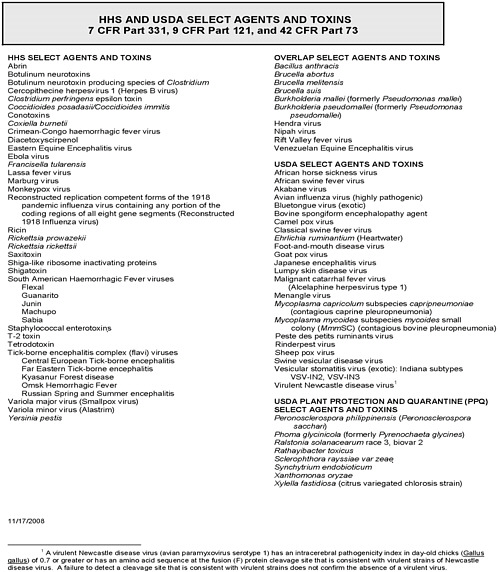
"Appendix C: HHS and USDA Select Agents and Toxins." National Research Council. 2010. Sequence-Based Classification of Select Agents: A Brighter Line. Washington, DC: The National Academies Press.
doi: 10.17226/12970.
Suggested Citation:
"Appendix C: HHS and USDA Select Agents and Toxins." National Research Council. 2010. Sequence-Based Classification of Select Agents: A Brighter Line. Washington, DC: The National Academies Press.
doi: 10.17226/12970.
Suggested Citation:
"Appendix C: HHS and USDA Select Agents and Toxins." National Research Council. 2010. Sequence-Based Classification of Select Agents: A Brighter Line. Washington, DC: The National Academies Press.
doi: 10.17226/12970.
Suggested Citation:
"Appendix C: HHS and USDA Select Agents and Toxins." National Research Council. 2010. Sequence-Based Classification of Select Agents: A Brighter Line. Washington, DC: The National Academies Press.
doi: 10.17226/12970.
Select Agents are defined in regulations through a list of names of particularly dangerous known bacteria, viruses, toxins, and fungi. However, natural variation and intentional genetic modification blur the boundaries of any discrete Select Agent list based on names. Access to technologies that can generate or 'synthesize' any DNA sequence is expanding, making it easier and less expensive for researchers, industry scientists, and amateur users to create organisms without needing to obtain samples of existing stocks or cultures. This has led to growing concerns that these DNA synthesis technologies might be used to synthesize Select Agents, modify such agents by introducing small changes to the genetic sequence, or create entirely new pathogens. Amid these concerns, the National Institutes of Health requested that the Research Council investigate the science and technology needed to replace the current Select Agent list with an oversight system that predicts if a DNA sequence could be used to produce an organism that should be regulated as a Select Agent.
A DNA sequence-based system to better define when a pathogen or toxin is subject to Select Agent regulations could be developed. This could be coupled with a 'yellow flag' system that would recognize requests to synthesize suspicious sequences and serve as a reference to anyone with relevant questions, allowing for appropriate follow-up.
Sequence-Based Classification of Select Agents finds that replacing the current list of Select Agents with a system that could predict if fragments of DNA sequences could be used to produce novel pathogens with Select Agent characteristics is not feasible. However, it emphasized that for the foreseeable future, any threat from synthetic biology and synthetic genomics is far more likely to come from assembling known Select Agents, or modifications of them, rather than construction of previously unknown agents. Therefore, the book recommends modernizing the regulations to define Select Agents in terms of their gene sequences, not by their names, and called this 'sequence-based classification.'
Sign in to access your saved publications, downloads, and email
preferences.
Former MyNAP users: You'll need to reset your password on your first
login to MyAcademies. Click "Forgot password" below to receive a reset
link via email. Having trouble?
Visit our FAQ page
to contact support.
Members of the National Academy of Sciences, National Academy of
Engineering, or National Academy of Medicine should log in through their
respective Academy portals.
Register
Register
Thank You
Thank You
Thank you for creating a MyAcademies account!
Enjoy free access to thousands of National Academies' publications, a
10% discount off every purchase, and build your personal library.
Forgot Password
Forgot Password
Enter the email address for your MyAcademies (formerly MyNAP) account to
receive password reset instructions.
Reset Requested
Reset Requested
We sent password reset instructions to
your email
. Follow the link in that email to create a new password. Didn't receive
it? Check your spam folder or
contact us
for assistance.
We sent a verification link to your email. Please check your inbox (and
spam folder) and follow the link to verify your email address. If you
did not receive the email, you can request a new verification link below