Industrial Methods for the Effective Development and Testing of Defense Systems (2012)
Chapter: Appendix B: Overview of the Defense Milestone System
Overview of the Defense
Milestone System
This appendix presents a brief overview of the defense acquisition process.1 The diagram below from the U.S. Department of Defense (2008:12 enclosure 2) depicts the development of defense systems as they proceed through the defense acquisition milestone system:
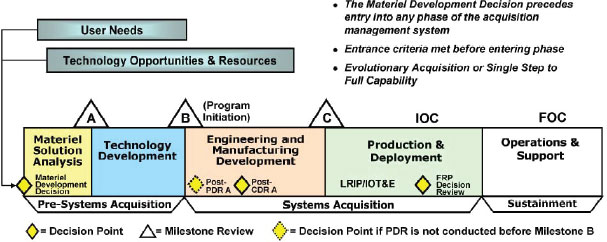
For the purposes of this report, it is generally sufficient to know the following rough outline of the process. Defense systems have to be justified as satisfying a specific military need. This occurs during the

1Some of this discussion relies on Schwartz (2010). For more details, see U.S. Department of Defense Instruction (DODI) 5000.02, Operation of the Defense Acquisition System. Available: http://www.dtic.mil/whs/directives/corres/pdf/500002p.pdf [November 2011].
first stage—materiel solution analysis. After that has been established, specific requirements are produced, a request for proposals is generated, a contract is awarded, work on a specific system begins, and the system passes Milestone A.
At this stage, each acquisition program is usually managed by an acquisition program office with an assigned program manager (PM). The PM is usually supported by a staff that can include engineers, logisticians, contracting officers, and various system specialists.
Milestone A is followed by technology development in which the necessary technologies for the system are identified and, if not sufficiently mature, are further developed. This phase is also when the reliability, availability, and maintainability strategy is developed. The technology development stage culminates in Milestone B.
This stage of development is complete, passing Milestone B, only when an affordable system is identified that is sufficiently mature in the relevant environment, and it has also been shown that the needed manufacturing processes are ready to produce prototypes at a reasonable cost. Passing Milestone B, a system enters into engineering and manufacturing development. In this stage, the components and subsystems are fully integrated into a complete system, and manufacturing processes are finalized. This phase is when a majority of the developmental testing takes place. Systems pass Milestone C when they have passed developmental testing and operational assessment, when they have shown interoperability and operational supportability, and when they have been shown to be affordably manufactured.
The next stage is production and deployment, which works with a small number of system prototypes, produced as part of low-rate initial production, and includes the most operationally relevant form of testing—operational testing. Systems that pass operational testing enter into full-rate production. The final stage of acquisition is operations and support, which oversees the continued use and improvement of the system through its lifetime of use.

