Memorial Tributes: Volume 16 (2012)
Chapter: NICHOLAS ROTT
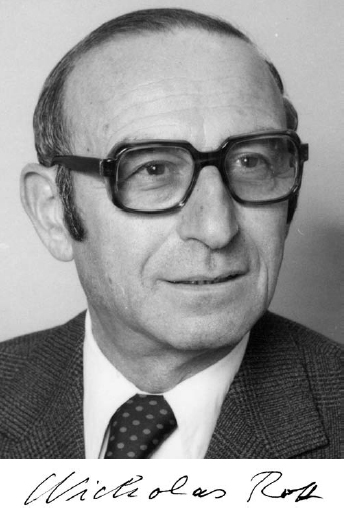
1917–2006
Elected in 1993
“For teaching and research leading to fundamental advances in
aerodynamics, acoustics, and fluid mechanics.”
BY BRIAN J. CANTWELL AND GEORGE S. SPRINGER
NICHOLAS ROTT, professor emeritus of fluid dynamics at the Swiss Federal Institute of Technology in Zurich, whose teaching and research led to fundamental advances in aerodynamics, acoustics, and fluid mechanics, died on August 10, 2006, at the age of 88.
He was elected to membership in the National Academy of Engineering in 1993.
Nicholas Rott was born on October 6, 1917, in Budapest, Hungary. He pursued his studies in aeronautical engineering, which became the foundation of his life’s work, at the Zurich Institute of Technology. It was also in Switzerland that he met his wife, Rosanna. By 1951, Nicholas and his family, which included two children, immigrated to the United States. Nicholas taught at Cornell University, the first of three teaching positions. In 1959 he began teaching at the University of California at Los Angeles, and in 1967 he returned to Switzerland to become head of the Department of Aeronautical Engineering at the Federal Institute of Technology in Zurich. He retired in 1983 as professor of fluid dynamics from the Federal Institute of Technology. Nicholas and Rosanna moved to Palo Alto, California, in 1984 to be close to their children, Dainuri Rott and Katherine P. Roselli. After retirement he became a consulting professor in the Department of Aeronautics and
Astronautics at Stanford University, where he continued his research. At Stanford he collaborated with Brian Cantwell in theoretical modeling of vortex pairs and vortex rings and helped advise students in fluid mechanics and experimental methods.
As his National Academy of Engineering biography reads: “Rott and his colleagues in Zurich developed a theoretical foundation for thermoacoustics, which has applications in refrigeration and ventilation, especially in space capsules, where thermo-oscillation is used to replace the natural convection that occurs in gravity environments.”
Nicholas was also interested in nonlinear dynamics. Starting with mathematical theory, he used a double pendulum to illustrate this theory and, in the process, created a unique system that demonstrates regular and chaotic motion. His pendulum, developed as an exhibit in conjunction with Ned Kahn on the staff of the Exploratorium in San Francisco, is on display at the Exploratorium. For many years it has been the first exhibit that greets visitors when they enter the museum.
With respect to Prandtl’s formulation of boundary layer equations in 1904, Nicholas made “fundamental contributions to the solution of many boundary layer problems, such as laminar boundary layer calculations on yawed wings, compressible, time-dependent and acoustic boundary layers as well as boundary layers in rotating flows.”
Nicholas wrote a landmark paper, published in 1956, in the first volume of the Journal of Fluid Mechanics. In this paper Nicholas proposed to parameterize vortex sheet spirals by their circulation and showed that this led to a particularly useful description of their motion. An analogous theory was given by Birkhoff in 1962 for the case of infinite vortex sheets. The resulting Birkhoff-Rott equation has influenced research to the present and can be used to provide a unified view of various approximations for the calculation of vortex sheet motion.
Nicholas collaborated with Harvey Lam of Princeton University on the theory of time-dependent boundary layers. Their results, in the form of the Lam-Rott solutions,
have recently become a crucial ingredient in the analysis of boundary layer receptivity.
His daughter wrote:
Nicholas played the cello and had a lifelong love for classical music. One of his grandsons became coprincipal cellist at the State Opera Orchestra of Hanover, Germany.
He translated the poetry of Rainer Maria Rilke as he felt the official translations did not do his favorite poet justice. He loved history and gave his children a world context for unfolding news.
In his later years Nicholas took to riding a motorized tricycle around town, appreciating the mobility it gave him when he could no longer drive. Dainuri created a foundation in his father’s name to promote hybrid tricycles for elders called Good Life Trikes, which has now developed into Good Life Mobility.
Nicholas Rott is survived by his daughter, Kathy Roselli of Ashland, Oregon; a son, Dainuri Rott of Palo Alto; five grandchildren; and seven great-grandchildren. He is fondly remembered by his family as “The Popster.”


