Effective Tracking of Building Energy Use: Improving the Commercial Buildings and Residential Energy Consumption Surveys (2012)
Chapter: Appendix E: Composite Estimation
Appendix E
Composite Estimation
This appendix briefly presents the simplest composite estimator for a rotating panel design. There is an extensive literature on composite estimation to which the reader can turn for descriptions of more elaborate approaches.
This discussion assumes an annual data collection. Let  denote a parameter to be estimated in year t, and let
  denote the “usual unbiased estimate” of
  based only on data from time t. Note that it is also possible to compute an estimate
  based only on the overlapping (or “matched”) sample, i.e., using only the sample that is being interviewed for the second time (or more). Since values exist from the previous year for the matched sample, it is possible to compute
  and so
  is an estimate of the change between year t and year t–1 based on the same sample units. By adding this estimate of change to last year’s estimate of
  a second estimate of , namely,
 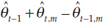 is obtained. (In words, the estimate for this year is equal to the estimate for last year plus the estimated year-to-year change.) Since there are now two estimates of the same quantity , it is natural to combine them to obtain an improved estimate. Thus the so-called composite estimate of is
  a weighted average of two estimates (assuming α is between 0 and 1). Because
  is a better estimate than
  then in practice, the following composite estimate is used:
  .
.
The value of α is chosen to minimize the variance of  .
.

