Discovering the Brain (1992)
Chapter: Front Matter

National Academy Press
2101 Constitution Avenue, N.W.Washington, D.C.20418
This publication is based on presentations at a July 1990 symposium organized by the Institute of Medicine and held in Washington, D.C., to initiate the Decade of the Brain.
The Institute of Medicine was chartered in 1970 by the National Academy of Sciences to enlist distinguished members of appropriate professions in the examination of policy matters pertaining to the health of the public. In this, the Institute acts both under the Academy's 1863 congressional charter responsibility to be an adviser to the federal government and its own initiative in identifying issues of medical care, research, and education.
This project was supported by the National Institute of Mental Health under contract number 278-90-0006(OD).
This book is printed with soy ink on acid-free recycled stock.
Library of Congress Cataloging-in-Publication Data
Discovering the brain / Sandra Ackerman for the Institute of Medicine
p. cm.
“Based on presentations at a July 1990 symposium organized by the Institute of Medicine and held in Washington, D.C.”—T.p. verso.
“This project was supported by the National Institute of Mental Health under contract number 278-90-0006 (OD)”—T.p. verso.
Includes bibliographical references and index.
ISBN 0-309-04529-0
1. Brain. 2. Neurology. 3. Neurobiology. 4. United States. Joint Resolution to Designate the Decade Beginning January 1, 1990, as the “Decade of the Brain”—Congresses. I. Institute of Medicine (U.S.) II. National Institute of Mental Health (U.S.) III. Title.
[DNLM: 1. Brain. WL 300 A182d 1990]
QP376.A23 1992
612.8'2—dc20
DNLM/DLC
for Library of Congress
92-1231
CIP
Copyright © 1992 by the National Academy of Sciences
No part of this book may be reproduced by any mechanical, photographic, or electronic procedure, or in the form of a phonographic recording, nor may it be stored in a retrieval system, transmitted, or otherwise copied for public or private use, without written permission from the publisher, except for the purpose of official use by the United States government.
Printed in the United States of America
The serpent has been a symbol of long life, healing, and knowledge among almost all cultures and religions since the beginning of recorded history. The image adopted as a logotype by the Institute of Medicine is based on a relief carving from ancient Greece, now held by the Staatlichemuseen in Berlin.
Cover: Paul Klee. Senecio (Baldgreis). 1922. Oil on canvas. Collection Öffentliche Kunstsammlung, Basel, Switzerland.
First Printing, March 1992 Second Printing, November 1993
Foreword
The brain is the last and grandest biological frontier, the most complex thing we have yet discovered in our universe. It contains hundreds of billions of cells interlinked through trillions of connections. The brain boggles the mind.
The diseases that disrupt brain function are among the most painful and destructive we know—Alzheimer's disease, schizophrenia, Huntington's disease, and others. They invade the mind, tearing at the fabric of family life and shattering the attributes that make us most human. These diseases are the enemy; neuroscientists are fighters on the front lines. Their weapons are new ideas, tested by experimentation. The revolution in modern biology has supplied science with a formidable armamentarium, well stocked with purchases made using federal dollars.
The health of neuroscience today rests firmly on this foundation of public investment. Since World War II, our nation has consistently supported biomedical research, creating the most robust research enterprise the world has ever seen. That success, evidenced by the prizes and international recognition accorded American scientists, has depended on champions within government.
Silvio Conte was one such champion, a true friend of science. He passionately believed biomedical research could stop the ravages of incurable disease. Year after year, he supported such research in Congress. One of his last legislative acts was to shepherd a congressional resolution declaring the 1990s the “Decade of the Brain” through the congressional process, resulting in the official proclamation by President Bush in July 1989.
This book arose out of a July 1990 symposium organized by the Institute of Medicine to initiate the Decade of the Brain, the first installment in what will certainly develop into many decades of fruitful research. Rep. Conte attended the IOM symposium near the end of his public career. He died in office later that year. He will be sorely missed, especially by those who commit their lives to science. This book is dedicated to him.
The symposium was a political event with a scientific purpose. Scientists reviewed the state of their knowledge in the presence of policymakers, covering topics that ranged from the molecular events underlying transmission of nerve impulses to the biology of perception and consciousness. Sandra Ackerman is to be congratulated on her clear distillation of themes from the symposium into this book, which introduces neuroscience to those who may be approaching it for the first time. It serves as a clear overview of neuroscience in the early 1990s, as the molecular tools developed over the past three decades are becoming sufficiently powerful to allow us to navigate through an intellectual terrain as vast as the human brain.
James D. Watson
Director, Cold Spring Harbor Laboratory, and
Director, National Center for Human Genome Research
National Institutes of Health
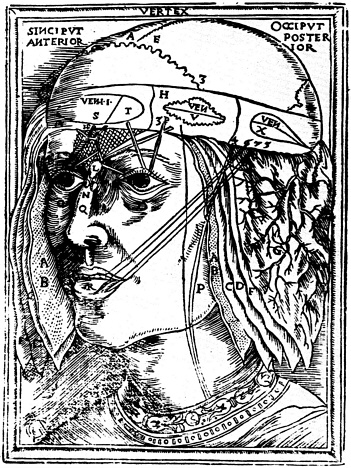
FIGURE 1.1. The earliest efforts to explore the brain arose from the same deep curiosity that draws researchers into neuroscience today. This Dutch woodcut from J. Dryander's Anatomie (1537) shows that the brain was already understood at this time as a structure composed of diverse parts. The woodcut identifies divisions between a frontal (“sinciput, anterior”) and rear (“occipital, posterior”) portion of the brain, and between lobes at the sides; these divisions still serve as landmarks for students of neuroanatomy. At the right, the letters A, B, C, D, F, and G distinguish the six layers of the cerebral cortex; in this century, observations down to the level of single cells make it possible to sort out the distinct functions of each of these layers. Source: The National Library of Medicine.


