Acute Exposure Guideline Levels for Selected Airborne Chemicals: Volume 18 (2014)
Chapter: 4 Oxygen Difluoride
4
Oxygen Difluoride1
Acute Exposure Guideline Levels
PREFACE
Under the authority of the Federal Advisory Committee Act (FACA) P.L. 92-463 of 1972, the National Advisory Committee for Acute Exposure Guideline Levels for Hazardous Substances (NAC/AEGL Committee) has been established to identify, review, and interpret relevant toxicologic and other scientific data and develop AEGLs for high-priority, acutely toxic chemicals.
AEGLs represent threshold exposure limits for the general public and are applicable to emergency exposure periods ranging from 10 minutes (min) to 8 hours (h). Three levels—AEGL-1, AEGL-2, and AEGL-3—are developed for each of five exposure periods (10 and 30 min and 1, 4, and 8 h) and are distinguished by varying degrees of severity of toxic effects. The three AEGLs are defined as follows:
AEGL-1 is the airborne concentration (expressed as parts per million or milligrams per cubic meter [ppm or mg/m3]) of a substance above which it is predicted that the general population, including susceptible individuals, could experience notable discomfort, irritation, or certain asymptomatic, nonsensory
____________________
1This document was prepared by the AEGL Development Team composed of Robert Young (Oak Ridge National Laboratory), Gary Diamond (SRC, Inc.), Julie Klotzbach (SRC, Inc.), Chemical Manager Iris Camacho (National Advisory Committee [NAC] on Acute Exposure Guideline Levels for Hazardous Substances), and Ernest V. Falke (U.S. Environmental Protection Agency). The NAC reviewed and revised the document and AEGLs as deemed necessary. Both the document and the AEGL values were then reviewed by the National Research Council (NRC) Committee on Acute Exposure Guideline Levels. The NRC committee has concluded that the AEGLs developed in this document are scientifically valid conclusions based on the data reviewed by the NRC and are consistent with the NRC guidelines reports (NRC 1993, 2001).
effects. However, the effects are not disabling and are transient and reversible upon cessation of exposure.
AEGL-2 is the airborne concentration (expressed as ppm or mg/m3) of a substance above which it is predicted that the general population, including susceptible individuals, could experience irreversible or other serious, long-lasting adverse health effects or an impaired ability to escape.
AEGL-3 is the airborne concentration (expressed as ppm or mg/m3) of a substance above which it is predicted that the general population, including susceptible individuals, could experience life-threatening health effects or death.
Airborne concentrations below the AEGL-1 represent exposure concentrations that could produce mild and progressively increasing but transient and nondisabling odor, taste, and sensory irritation or certain asymptomatic, nonsensory effects. With increasing airborne concentrations above each AEGL, there is a progressive increase in the likelihood of occurrence and the severity of effects described for each corresponding AEGL. Although the AEGL values represent threshold concentrations for the general public, including susceptible subpopulations, such as infants, children, the elderly, persons with asthma, and those with other illnesses, it is recognized that individuals, subject to idiosyncratic responses, could experience the effects described at concentrations below the corresponding AEGL.
SUMMARY
Oxygen difluoride is an irritating, colorless gas that has been used as an oxidizing propellant for missiles (Darmer et al. 1972). Because of its powerful oxidizing potential, contact with reducing agents should be avoided. Oxygen difluoride reacts slowly with water to form hydrofluoric acid and may be explosive when mixed with hydrocarbons. The odor of oxygen difluoride has been described as “not displeasing”, peculiar, or foul. The concentration at which an odor is detected has been reported to be 0.1 ppm, with an obvious odor at 0.5 ppm. Rapid accommodation to the odor has been reported. No data were available from which to calculate a level of odor awareness.
No information on lethality in humans after exposure to oxygen difluoride was available, but inhalation exposure reportedly produces effects similar to those caused by ozone (respiratory tract irritation and pulmonary edema and hemorrhage). Intractable headaches were associated with oxygen difluoride vapors at concentrations in the parts per billion. Quantitative exposure-response information on oxygen difluoride in humans was not found.
Although acute lethality data are available for monkeys, dogs, rats, and mice, the overall exposure-response relationship for oxygen difluoride is not well defined. Analysis lethality data revealed that 1-h LC50 (lethal concentration, 50% lethality) values varied about 17-fold between the least sensitive species (monkeys) and the most sensitive (mice), with larger species appearing to be
less sensitive (1-h LC50 values were 1.5, 2.6, 16, and 26.0 ppm, respectively, for mice, rats, dogs, and monkeys). Although pulmonary damage was apparent in exposed animals, the chemical does not appear to damage bronchial mucosal surfaces as do other fluorine compounds. For all species tested, delayed death (hours to days) was a typical response pattern.
Exposure-response data for AEGL-1 severity effects were unavailable. Studies in laboratory species focused on lethality. Where nonlethal responses were reported, the severity of the effects were either not described or likely involved effects that are more severe (e.g., pulmonary damage) than those relevant to AEGL-1 values. Therefore, AEGL-1 values are not recommended for oxygen difluoride because of insufficient data.
Information regarding AEGL-2 severity effects is limited to that obtained from two studies focusing on lethality (Lester and Adams 1965; Davis 1970). Neither study identified a no-effect level for AEGL-2 effects. The lowest concentrations tested (per exposure duration) in monkeys, dogs, and rats were the no-effect levels for lethality. Therefore, the data are not suitable as the basis for AEGL-2 values. Lethality data on oxygen difluoride in monkeys, dogs, rats, and mice indicate that the exposure-response curve is steep. Therefore, in accordance with the standing operating procedures for deriving AEGL values (NRC 2001), AEGL-2 values were determined by dividing the AEGL-3 values by 3.
For AEGL-3 values, a lethality threshold for oxygen difluoride was estimated from the study of rhesus monkeys by Davis (1970). Analysis of the 1-h exposure data resulted in a BMC05 (benchmark concentration, 5% response) of 17.2 ppm, a BMCL05 (benchmark concentration, 95% lower confidence limit with 5% response) of 7.48 ppm, and a BMC01 (benchmark concentration, 1% response) of 14.4. The BMCL05 was used as the point-of-departure because it accounts for the variability due to the small number of animals tested (four per group) and is typically used as the point-of-departure for deriving AEGL-3 values (NRC 2001). It is also lower than the LC5 determined by the method of Litchfield and Wilcoxon (1949). Time scaling was performed using the equation Cn × t = k. An empirical value of 1.1 for the exponent n was determined using the data of Lester and Adams (1965) and Davis (1970) and the software package of ten Berge.
A total uncertainty factor of 10 was applied. Davis (1970) evaluated acute inhalation toxicity of oxygen difluoride in monkeys, dogs, rats and mice. Results indicate that larger species (dogs and monkeys) are less sensitive to the lethal effects of oxygen difluoride than smaller species (rats and mice). However, the study was conducted using a small number of animals (two males and two females per group), so a factor of 3 was applied to account for species differences. Although asthmatics and individuals with compromised pulmonary function may be considered to be more susceptible to the effects of oxygen difluoride vapor, necropsy findings in multiple animal species indicate that the primary target of oxygen difluoride toxicity is the lungs rather than the airways. For this reason, an intraspecies uncertainty factor of 3 was considered sufficient to account for individual variability in the toxic response to inhaled oxygen difluo-
ride. A factor of 3 is also consistent with the uncertainty factor used for other direct-acting fluorinated compounds (chlorine pentafluoride, chlorine trifluoride, and hydrogen fluoride).
The AEGL values for oxygen difluoride are presented in Table 4-1.
1. INTRODUCTION
Oxygen difluoride is an irritating, colorless gas that has been used as an oxidizing propellant for missiles (Darmer et al. 1972). Because of its powerful oxidizing potential, contact with reducing agents should be avoided. It may be explosive when mixed with hydrocarbons (HSDB 2005). The chemical and physical properties of oxygen difluoride are presented in Table 4-2.
TABLE 4-1 AEGL Values for Oxygen Difluoride
| Classification | 10 min | 30 min | 1 h | 4 h | 8 h | End Point (Reference) |
| AEGL-1 (nondisabling) | NRa | NRa | NRa | NRa | NRa | Insufficient data. |
| AEGL-2 (disabling) |
0.43 ppm (0.95 mg/m3) |
0.16 ppm (0.35 mg/m3) |
0.083 ppm (0.18 mg/m3) |
0.024 ppm (0.053 mg/m3) |
0.013 ppm (0.029 mg/m3) |
One-third of AEGL-3 values. |
| AEGL-3 (lethal) |
1.3 ppm (2.9 mg/m3) |
0.47 ppm (1.0 mg/m3) |
0.25 ppm (0.55 mg/m3) |
0.071 ppm (0.16 mg/m3) |
0.038 ppm (0.084 mg/m3) |
1-h BMCL05 of 7.48 ppm for rhesus monkeys (Davis 1970) |
aNot recommended. Absence of AEGL-1 values does not imply that exposures at concentrations below the AEGL-2 values are without adverse effects.
TABLE 4-2 Chemical and Physical Data for Oxygen Difluoride
|
|
||
| Parameter | Value | Reference |
|
|
||
| Synonyms | Difluorine monoxide;fluorine oxide; oxydifluoride; oxygen fluoride | HSDB 2005 |
| CAS registry no. | 7783-41-7 | HSDB 2005 |
| Chemical formula | OF2 | NIOSH 2013 |
| Molecular weight | 54.00 | HSDB 2005 |
| Physical state | Colorless gas; yellowish-brown liquid | HSDB 2005 |
| Melting point | -223.8°C | HSDB 2005 |
| Boiling point | -144.75°C | HSDB 2005 |
| Solubility in water | 6.8 mL/100 mL at 0°C | HSDB 2005 |
| Density/Specific gravity | 1.9 at -223.8°C (liquid) |
HSDB 2005 |
| Relative vapor density | 1.86 | ACGIH 2001 |
| Vapor pressure | >760 mm Hg | ACGIH 2001 |
| Conversion factors in air | 1 ppm = 2.2 mg/m3 1 mg/m3 = 0.45 ppm |
NIOSH 2011 |
|
|
||
2. HUMAN TOXICITY DATA
2.1. Acute Lethality
No data were available regarding lethality in humans following inhalation exposure to oxygen difluoride.
2.2. Nonlethal Toxicity
In a review chapter, Deichmann and Gerarde (1969) noted that inhalation of oxygen difluoride produced effects similar to those caused by ozone. Respiratory tract irritation and pulmonary edema and hemorrhage were observed following exposure at 0.5 ppm for a few hours (duration was not further defined). However, no additional information was reported and a primary reference for this information was not provided. Exposure to oxygen difluoride at concentrations in the parts per billion reportedly caused intractable headaches in workers conducting animal exposure studies (LaBelle et al. 1945). Sullivan et al. (1995) included oxygen difluoride among the compounds considered by the Occupational Safety and Health Administration as potentially causing respiratory effects in construction industry workers, but no exposure-response information was provided. Lester and Adams (1965) reported that oxygen difluoride has a “not displeasing” odor that is detectable at 0.1 ppm and obvious at 0. 5 ppm. However, NIOSH (2011) reported that oxygen difluoride has a peculiar foul odor. Rapid accommodation to the odor has been reported. No additional information was available; therefore, a level of odor awareness could not be calculated.
2.3. Developmental and Reproductive Effects
No human developmental or reproductive toxicity data were available for oxygen difluoride.
2.4. Genotoxicity
No human genotoxicity data on oxygen difluoride were available.
2.5. Carcinogenicity
No data regarding the carcinogenic potential of oxygen difluoride in humans were found.
2.6. Summary
No exposure-response data for inhalation exposure of humans to oxygen difluoride were available. The chemical reportedly is very irritating and has caused severe headaches at concentrations in the parts per billion, and severe irritation and pulmonary edema and hemorrhage following a few hours exposure at 0.5 ppm.
3. ANIMAL TOXICITY DATA
3.1. Acute Lethality
3.1.1. Monkeys
In a multispecies acute inhalation toxicity study, Davis (1970) exposed rhesus monkeys (two males and two females) to oxygen difluoride (commercial grade, 98% purity) for 15 min or 1 h. The oxygen difluoride was diluted with dry nitrogen before the animals were placed in the Longley exposure chambers. An MSA BillionAire was used for concentration monitoring (the BillionAire analyzer functions by exposing an air-gas sample with a suitable reagent and passing it through a radioactive source within the chamber. The ions that are formed create a current which is a function of the concentration of vapor present and which is measured by an electrometer). The animals were observed during the exposure and for 14 days after exposure. Monkeys exhibited dyspnea for several days following exposure, gagging, salivation, lacrimation, vomiting, tetany, and muscular weakness. Necropsies revealed massive pulmonary edema and hemorrhage and also congestion of the liver, spleen, and kidneys. No sign of skin irritation was observed even at lethal concentrations. The lethality data are presented in Table 4-3. Time-to-death was not specified. The reported LC50 values were 108 ppm and 26.0 ppm, respectively, for the 15-min and 60-min exposures. On the basis of the concentration-time (C × t) product, the investigator noted a near linear response for the time range tested (1,620 ppm-min vs. 1,560 ppm-min for the 15-min and 60-min exposures, respectively).
A 1-h LC50 of 16 ppm for rhesus monkeys (assumed to be a combined value from two males and two females per group) was reported by Darmer et al. (1972). That concentration, cited from Davis (1970), is likely a reporting error and should be 26 ppm which is the value reported in the Davis study.
3.1.2. Dogs
Davis (1970) also studied lethality in beagle dogs exposed to oxygen difluoride for 15 or 60 min. Experimental procedures were the same as those described for the experiments with monkeys (see Section 3.1.1). The dogs ex-
hibited responses similar to those of the monkeys. LC50 values of 90 ppm and 26.0 ppm were reported for the 15-min and 60-min exposures, respectively. Similar to the findings in monkeys, the response was near-linear; 1,350 ppm-min and 1,560 ppm-min, respectively, for the 15-min and 1-h exposures. Results of the experiment are summarized in Table 4-4.
Darmer et al. (1972) reported a 1-h LC50 of 26.0 ppm for groups of four male and female beagle dogs (assumed to be a combined value with two males and two females per group). Experimental details are described in Section 3.1.1.
3.1.3. Rats
The acute inhalation toxicity of oxygen difluoride in rats was studied by Lester and Adams (1965). Groups of 10 Sprague-Dawley rats (150-175 g; assumed to be five males and five females per group) were exposed to oxygen difluoride (>97% purity) at concentrations of 10, 20, 30, or 40 ppm for 5 min, or
TABLE 4-3 Mortality in Rhesus Monkeys Exposed to Oxygen Difluoride Vapor
|
|
||
| No. exposed | Concentration (ppm) | Mortality ratio |
|
|
||
| 15-min exposure | ||
| 4 | 60 | 0/4 |
| 4 | 100 | 2/4 |
| 4 | 120 | 2/4 |
| 4 | 140 | 4/4 |
| 60-min exposure | ||
| 4 | 16.0 | 0/4 |
| 4 | 21.0 | 1/4 |
| 4 | 32.0 | 3/4 |
|
|
||
Source: Adapted from Davis 1970.
TABLE 4-4 Mortality in Dogs Exposed to Oxygen Difluoride
|
|
||
| No. exposed | Concentration (ppm) | Mortality ratio |
|
|
||
| 15-min exposure | ||
| 4 | 60 | 0/4 |
| 4 | 80 | 1/4 |
| 4 | 100 | 3/4 |
| 60-min exposure | ||
| 4 | 8.2 | 0/4 |
| 4 | 16.0 | 2/4 |
| 4 | 21.0 | 1/4 |
| 4 | 32.0 | 4/4 |
|
|
||
Source: Adapted from Davis 1970.
As described for monkeys (Section 3.1.1), Darmer et al, (1972) also reported a 1-h LC50 value of 2.6 ppm for male (n = 10) Sprague-Dawley rats. This is likely the same1-h LC50 value of 2.6 ppm (2.5-2.7) reported by Vernot et al. (1977) for male rats and originally reported by Davis (1970).
TABLE 4-5 Mortality in Rats Exposed to Oxygen Difluoride
| Exposure Duration (min) | Concentration (ppm) a | Mortality | Time-to-death (h)b |
| 5 | 10 (9.7) | 0/10 | – |
| 5 | 20 (19.5) | 7/10 | 27, 27, 27, 42, 42, 42, 66 |
| 5 | 30 (29.2) | 9/10 | 10, 10, 17, 17, 17, 27, 29, 31, 39 |
| 5 | 40 (39.0) | 10/10 | 10, 10, 10, 10, 19, 19, 19, 19, 25, 25 |
| 15 | 5 (4.9) | 0/10 | – |
| 15 | 10 (9.7) | 7/10 | 9, 17, 17, 20, 28, 41, 49 |
| 15 | 15 (14.6) | 7/10 | 15, 24, 30, 30, 30, 41, 55 |
aValues in parentheses are corrected for the reported 97.4% OF2 assay efficiency.
bNumber of hours after exposure.
Source: Lester and Adams 1965. Reprinted with permission; copyright 1965, Journal of Occupational and Environmental Hygiene.
Groups of 10-15 male Wistar rats were exposed to oxygen difluoride for 15 or 60 min and observed for 14 days (Davis 1970) (see Section 3.1.1. for experimental details). The rats exhibited somewhat different signs during exposure than did the monkeys and dogs, which involved tachypnea and muscular weakness only. The mortality data for rats is summarized in Table 4-6. LC50 values of 12.7 ppm and 2.6 ppm for 15- and 60-min exposures, respectively, were reported.
In a study designed to evaluate ultrastructural changes in respiratory tissue, groups of four white rats (sex not specified) were exposed to oxygen difluoride at 4.5 ppm (mean measured concentrations) for 30 or 60 min (Harrison and Mackenzie 1973). All animals exposed for 60 min died within 3 days of exposure. All rats exposed for 30 min survived exposure but showed signs of respiratory distress (details not reported) which resolved after 2 days.
3.1.4. Mice
Both Darmer et al. (1972) and Vernot et .al. (1977) reported a 1-h LC50 of 1.5 ppm for groups of 10 male ICR mice, which originates with the work of Davis (1970).
Groups of 15 male ICR mice were exposed to oxygen difluoride for 15 or 60 min and observed for 14 days in the Davis (1970) study (see Section 3.1.1. for experimental details). The mice exhibited somewhat different signs during exposure than did the monkeys and dogs, which involved tachypnea and muscular weakness only. The mortality data for mice is summarized in Table 4-7. LC50 values of 7.5 ppm and 1.5 ppm for the 15- and 60-min exposures, respectively, were reported.
TABLE 4-6 Mortality in Rats Exposed to Oxygen Difluoride Vapor
|
|
||
| No. exposed | Concentration (ppm) | Mortality ratio |
|
|
||
| 15-min exposure | ||
| 10 | 9.5 | 0/10 |
| 10 | 10.4 | 1/10 |
| 10 | 11.0 | 3/10 |
| 10 | 11.9 | 1/10 |
| 10 | 13.8 | 9/10 |
| 10 | 15.2 | 8/10 |
| 10 | 16.5 | 9/10 |
| 60-min exposure | ||
| 10 | 2.2 | 0/10 |
| 10 | 2.7 | 7/10 |
| 15 | 3.0 | 14/15 |
| 10 | 4.0 | 10/10 |
|
|
||
Source: Adapted from Davis 1970.
3.1.5. Summary of Animal Lethality Data
Lethality data for laboratory species exposed to oxygen difluoride are summarized in Table 4-8. Comparing 1-h LC50 values reveals about a 17-fold difference between the least sensitive and most sensitive of the four species tested, with larger species appearing to be less sensitive. On the basis of experimental results from monkeys, dogs, rats, and mice, Davis (1970) summarized that the primary target of oxygen difluoride toxicity is the lungs and that there is a considerable difference in susceptibility among the species tested. Specifically, rats and mice were much more susceptible to the effects of oxygen difluoride than were monkeys or dogs. For all species tested, delayed death (hours to days) was a typical response pattern.
TABLE 4-7 Mortality in Mice Exposed to Oxygen Difluoride Vapor
|
|
||
| No. exposed | Concentration (ppm) | Mortality ratio |
|
|
||
| 15-min exposure | ||
| 15 | 4.5 | 8/15 |
| 15 | 5.8 | 1/15 |
| 15 | 7.5 | 8/15 |
| 15 | 8.5 | 4/15 |
| 15 | 9.5 | 12/15 |
| 15 | 11.0 | 8/15 |
| 15 | 11.9 | 15/15 |
| 15 | 15.2 | 12/15 |
| 15 | 16.5 | 14/15 |
| 60-min exposure | ||
| 15 | 1.0 | 5/15 |
| 15 | 2.2 | 8/15 |
| 15 | 4.2 | 15/15 |
|
|
||
Source: Adapted from Davis 1970.
TABLE 4-8 Lethality of Oxygen Difluoride in Laboratory Animals
| Species | Exposure Duration | Response | Reference |
| Monkey | 1 h | LC = 26 m | Davis 1970 |
| 15 min | LC50 = 108 ppm | Davis 1970 | |
| Dog | 1 h | LC50 = 26.0 ppm | Davis 1970 |
| 15 min | LC50 = 90 ppm | Davis 1970 | |
| Rat | 5 min | LC50 = 17.6 ppm | Lester and Adams 1965 |
| 15 min | LC50 = 8 ppma | Lester and Adams 1965 | |
| 15 min | LC50 = 12.7 ppm | Davis 1970 | |
| 30 min | No lethalit | Harrison and Mackenzie 1973 | |
| 1 h | . LC50 = 2.6 ppm | Davis 1970 | |
| 1 h | 100% lethality = 4.5 ppm | Harrison and Mackenzie 1973 | |
| Mouse | 1 h | LC50 = 1.5 ppm | Davis 1970 |
| 15 min | LC50 = 7.5 ppm | Davis 1970 | |
aEstimated.
3.2. Nonlethal Toxicity
3.2.1. Monkeys
Exposure of four rhesus monkeys (two males and two females) to oxygen difluoride at 16 ppm for 1 h or at 60 ppm for 15 min was not lethal (Davis 1970). The monkeys exhibited gagging, lacrimation, salivation, muscular weakness, dyspnea, vomiting, and tetany. Neither the severity of the effects nor the number of subjects affected was specified. Dyspnea reportedly persisted for several days after exposure. Hematologic and clinical chemistry evaluations conducted immediately after exposure and at various (unspecified) times during the 14-day observation period revealed no significant findings in measurements of hematologic parameters, uric acid, creatinine, serum alkaline phosphatase, glutamic oxaloacetic transaminase, blood glucose, or extracellular electrolyte composition. Pathologic examination showed slight to moderate pulmonary congestion and edema.
3.2.2. Dogs
Exposure of male and female beagle dogs (two per sex) to oxygen difluoride at concentrations of 60 ppm for 15 min or 8.2 ppm for 60 min was without lethality over a 14-day observation period (Davis 1970). Signs of exposure were similar to those described for monkeys with dyspnea reportedly persisting for several days after the exposure. Clinical findings were similar to those reported for monkeys.
3.2.3. Rats
In the lethality study by Lester and Adams (1965), no deaths occurred in rats exposed to oxygen difluoride at 10 ppm for 5 min or at 5 ppm for 15 min. The severity of pulmonary damage (if any) for these animals was not reported. The investigators reported that pulmonary damage increased with time and that if damage did not attain sufficient severity to cause death within 9 h of exposure, then repair of the pulmonary tissue would ensue after 3 days. This contention was based on examination of rats exposed to oxygen difluoride at 20 ppm for 5 min and then killed 0.09, 0.17, 0.58, 0.75, 1, 2, 3.5, 5, 6, 7, 14, 22.5, and 29 h after exposure. Microscopic findings in pulmonary tissue were characterized as slight congestion, focal atelectasis, hemorrhage, polymorphonuclear leukocyte infiltration, edema, and acute pneumonia. Gross examination of rats surviving for 14 days revealed varying degrees of pulmonary damage (slight to moderate hemorrhage, edema, and consolidation of whole lung lobes), some to the extent of questionable survival.
There was no lethality over a 14-day observation period in groups of 10 male Wistar rats exposed to oxygen difluoride at a concentration of 9.5 ppm for
15 min or 2.2 ppm for 60 min (Davis 1970). During exposure, the rats exhibited tachypnea and muscular weakness although the severity and the number of animals affected were not specified. Dyspnea reportedly persisted for several days after the exposure. No hematologic or clinical chemistry data were reported.
Harrison and Mackenzie (1973) conducted a study designed to evaluate ultrastructural changes in respiratory tissue following 30- or 60-min exposures to oxygen difluoride at 4.5 ppm (mean measured concentrations). Groups of six white rats (sex not reported) were tested. The rats exposed for 30 min were killed immediately after exposure, and the rats exposed for 60 min were killed either immediately after exposure or after 1 or 2 h. Gross pathologic examination of rats exposed for 60 min and killed 1 or 2 h after exposure revealed patchy areas of edema and “possibly” edema; no gross findings were observed in rats killed immediately after exposure. No findings in any group were observed under light microscopy. Electron microscopy revealed several alterations, including blebbing of endothelial cells and epithelial layers for the alveolo-capillary wall and loss of matrix structure and density of lamellar bodies of Type II cells. Effects became more widespread and extensive with the length of the observation-exposure period. Additional groups of four rats were exposed under that same conditions and observed for lethality. All rats exposed for 30 min survived exposure but showed signs of respiratory distress (details not reported), which resolved after 2 days. All animals exposed for 60 min died within 3 days of exposure.
3.2.4. Mice
There were no nonlethal exposures reported by Davis (1970) for groups of 15 male ICR mice exposed to oxygen difluoride. The lowest concentrations tested (4.5 ppm for 15 min or 1.0 ppm for 60 min) resulted in lethality.
3.2.5. Summary of Nonlethal Toxicity in Animals
Exposures of rats to oxygen difluoride at 10 ppm for 5 min, at 5-9.5 ppm for 15 min, or at 2.2 ppm for 60 min were not lethal (assessed after a 14-day observation period). Nonlethal concentrations in rhesus monkeys were 16 ppm for 1 h or 60 ppm for 15 min. As observed with data on lethality, smaller species (rats and mice) appear to be more sensitive than larger species (monkeys and dogs) to the nonlethal effects of oxygen difluoride. Pathologic examinations of animals exposed to oxygen difluoride confirm pulmonary involvement (congestion, edema, focal atelectasis, and hemorrhage).
3.3. Developmental and Reproductive Effects
Data regarding the developmental and reproductive toxicity of oxygen difluoride following inhalation exposure were not available.
3.4. Genotoxicity
No information regarding the genotoxicity of oxygen difluoride was available.
3.5. Carcinogenicity
There were no data with which to evaluate the carcinogenic potential of inhaled oxygen difluoride.
3.6. Summary
On the basis of lethality data in several species, oxygen difluoride appears to be a potent pulmonary toxicant. Gross and microscopic examinations of rats exposed to oxygen difluoride at 20 ppm for 5 min revealed pulmonary damage (swelling, acute pneumonia, consolidation of lung lobes, focal atelectasis, polymorphonuclear leukocyte infiltration, and pulmonary hemorrhage and edema) that progressed with time following cessation of exposure and which did not appear to affect bronchial regions. Larger species (dogs and monkeys) appeared to be notably less sensitive than rodents (mice and rats) to the lethal effects of oxygen difluoride. The overall toxicity data for oxygen difluoride is compromised by an absence of exposure-response data for nonlethal effects.
4. SPECIAL CONSIDERATIONS
4.1. Metabolism and Disposition
No data regarding the metabolism and disposition of oxygen difluoride were available.
4.2. Mechanism of Toxicity
Data on the mechanism of action of oxygen difluoride are not available. Its oxidizing potential implies an ability to cause direct-contact tissue damage. Necropsy findings in rats (focal atelectasis, hemorrhage, polymorphonuclear leukocyte infiltration, edema, and acute pneumonia) showed that the primary target is the lungs rather than the airways. Necropsy findings in monkeys included massive pulmonary edema and hemorrhage and congestion of the liver, spleen, and kidneys.
4.3. Structure-Activity Relationships
Because chemical-specific data were available, structure-activity relationships were not used for development of AEGL-3 values for oxygen difluoride.
Both fluorine and hydrogen fluoride are present in the reaction mixture producing oxygen difluoride but are less toxic than oxygen difluoride (Lester and Adams 1965). Other fluorinated compounds (hydrogen fluoride, chlorine pentafluoride, and chlorine trifluoride) also act as direct-contact irritants. Relative lethality data from Davis (1970) and Darmer et al. (1972) for a 1-h exposure to several fluorinated compounds are summarized in Table 4-9. Generally, the potency of the compounds is greatest for oxygen difluoride, followed by chlorine pentafluoride, chlorine trifluoride, and then hydrogen fluoride.
4.4. Species Variability
As shown by the data from Davis, (1970), there is considerable variability in the lethal response to inhaled oxygen difluoride among the species tested (monkeys, dogs, rats, and mice). Specifically, comparison of 1-h LC50 values reveals about a 17-fold difference between the least sensitive and most sensitive species, with larger species appearing to be less sensitive. Additionally, the monkey appears to exhibit the least variability in lethal response to other fluorinated compounds.
4.5. Concurrent Exposure Issues
Concurrent exposure to other chemicals affecting the respiratory tract will be of concern but cannot be readily quantified.
4.6. Susceptible Populations
No information on the relative susceptibility of individuals with preexisting pulmonary diseases was identified. Individuals with pre-existing lung disease might be at increased risk from acute exposure to oxygen difluoride. In addition, asthmatics may respond to irritants with increased bronchial responsiveness. The very old and those who are ill may also have increased susceptibility to irritants such as oxygen difluoride.
TABLE 4-9 Relative Lethality of Oxygen Difluoride to Other Fluorinated Compoundsa
| Species | Oxygen Difluoride | Chlorine Pentafluoride | Chlorine Trifluoride | Hydrogen Fluoride |
| Rat | 2.6/2.6 = 1 | 122/2.6 = 47 | 299/2.6 = 115 | 1,276/2.6 = 491 |
| Mouse | 1.5/1.5 = 1 | 57/1.5 = 38 | 178/1.5 = 119 | 501/1.5 = 334 |
| Dog | 26/26 = 1 | 122/26 = 5 | – | – |
| Monkey | 26/26 = 1 | 173/26 = 6.7 | 230/26 = 8.8 | 1,774/26 = 68 |
a1-h LC50 values expressed in ppm (Davis 1970; Darmer et al. 1972).
5. DATA ANALYSIS FOR AEGL-1
5.1. Human Data Relevant to AEGL-1
No quantitative data regarding AEGL-1 type effects in humans exposed to oxygen difluoride are available.
5.2. Animal Data Relevant to AEGL-1
No data regarding AEGL-1 type effects in animals exposed to oxygen difluoride are available.
5.3. Derivation of AEGL-1 Values
Exposure-response data for AEGL-1 severity effects was unavailable for oxygen difluoride. Studies in animals primarily focused on lethality. Where nonlethal responses were reported, the severity of the effects was not described or likely involved effects more severe (e.g., pulmonary damage) than those relevant to AEGL-1 values. Therefore, AEGL-1 values are not recommended for oxygen difluoride because of insufficient data.
6. DATA ANALYSIS FOR AEGL-2
6.1. Human Data Relevant to AEGL-2
In a review chapter, Diechmann and Gerarde (1969) stated that exposure of humans to oxygen difluoride at 0.5 ppm for “a few hours” produced respiratory-tract irritation and pulmonary edema and hemorrhage; however, no additional information was reported and a primary citation for the findings was not reported. Similar respiratory tract effects have been reported in laboratory animals. No additional information regarding AEGL-2 level effects in humans was identified.
6.2. Animal Data Relevant to AEGL-2
Information regarding AEGL-2 severity effects from oxygen difluoride is limited to that obtained from studies focusing on lethality (Lester and Adams 1965; Davis 1970; Harrison and Mackenzie 1973). The lowest concentrations tested (per exposure duration) in monkeys, dogs, and rats were the no-effect levels for lethality (see Tables 4-3 to 4-6). In addition, at the lowest concentrations tested, AEGL-2 level effects were observed, as summarized below. Therefore, the data are not suitable as the basis for deriving AEGL-2 values.
Davis (1970) reported the oxygen difluoride was nonlethal for a 1-h exposure at 16 ppm in monkeys, at 8.2 ppm in dogs 8.2 ppm, and at 2.2 ppm in rats;
for a 15-min exposure it was nonlethal at 60 ppm in monkeys and dogs and at 9.5 ppm in rats. Nonlethal exposures produced effects which could impair escape (AEGL-2 level effects), including gagging (monkeys and dogs), lacrimation (monkeys and dogs), muscular weakness (monkeys, dogs, and rats), dyspnea (monkeys and dogs), vomiting (monkeys and dogs), tetany (rats), and tachypnea (rats). In addition, slight-to-moderate pulmonary congestion and edema were observed at sublethal exposures; however, the study report did not report provide any additional details of these findings.
No lethality was observed in rats exposed to oxygen difluoride at 10 ppm for 5 min or at 5 ppm for 15 min (Lester and Adams 1965). In rats exposed at 20 ppm for 5 min, gross and microscopic examinations showed significant pulmonary damage, including swelling, acute pneumonia, consolidation of lung lobes, focal atelectasis, polymorphonuclear leukocyte infiltration, and pulmonary hemorrhage and edema; however, the study report did not provide adequate information to determine the severity of pulmonary damage.
At a nonlethal exposure to oxygen difluoride at 4.5 ppm for 30 min, respiratory distress was observed (Harrison and McKenzie, 1973). However, only one concentration was evaluated and, therefore, a no-effect level for AEGL-2 level effects was not identified in this study.
6.3. Derivation of AEGL-2 Values
Available studies on oxygen difluoride did not identify a no-effect level for AEGL-2 effects. Lethality data for oxygen difluoride in monkeys, dogs, rats, and mice indicate that the exposure-response curve for lethality is steep (data reported in Tables 4-3 to 4-7). Therefore, AEGL-2 values were derived by dividing the AEGL-3 values by 3, in accordance with the standing operating procedures for deriving AEGL values (NRC 2001).
The AEGL-2 values for oxygen difluoride are presented in Table 4-10. As noted in Section 6.1, Diechmann and Gerarde (1969) stated that humans exposed to oxygen difluoride at 0.5 ppm for “a few hours” developed respiratory-tract irritation and pulmonary edema and hemorrhage. However, that information cannot be verified or reviewed, as a primary reference to support the statement was not provided. Davis (1970) reported that sublethal exposures of monkeys (16 ppm for 1 h), dogs (8.2 ppm for 1 h), and rats (2.2 ppm for 1 h) produced slight to moderate pulmonary congestion and edema. AEGL-2 values for durations of 30 min or longer are below the effect-level report by Diechmann and Gerarde (1969), with the 4- and 8-h AEGL-2 values more than 10-fold lower. Thus, the AEGL-2 values are protective for AEGL-2 level effects.
TABLE 4-10 AEGL-2 Values for Oxygen Difluoride
| 10 min | 30 min | 1 h | 4 h | 8 h |
| 0.43 ppm | 0.16 ppm | 0.083 ppm | 0.024 ppm | 0.013 ppm |
| (0.95 mg/m3) | (0.35 mg/m3) | (0.18 mg/m3) | (0.053 mg/m3) | (0.029 mg/m3) |
7. DATA ANALYSIS FOR AEGL-3
7.1. Human Data Relevant to AEGL-3
No data on lethality in humans from inhalation exposure to oxygen difluoride were available.
7.2. Animal Data Relevant to AEGL-3
Acute lethality data for several animal species are available (Lester and Adams 1965; Davis, 1970). One-hour LC50 values ranged from 1.5 to 26.0 ppm, with larger species (dogs and monkeys) being less sensitive than smaller species (rats and mice) (see Table 4-8). Gross and microscopic examinations of the lungs of rats serially killed over 29 h after a single 5-min exposure to oxygen difluoride at 20 ppm (Lester and Adams 1965) indicated that lethality was contingent on the relationship between pulmonary damage (the primary target of oxygen difluoride) and tissue repair. Three days appeared to define a critical period for determining a lethal versus nonlethal response. Necropsy of rats, mice, dogs, and monkeys exposed at sublethal concentrations of oxygen difluoride revealed minor or moderate pulmonary edema and congestion for up to 14 days after exposure (Davis 1970).
7.3. Derivation of AEGL-3 Values
Lethality data from studies of rhesus monkeys exposed to oxygen difluoride (Davis 1970) were used as the basis for AEGL-3 values, because monkeys are a more relevant test species for humans than rodents and because hematology, clinical chemistry, and gross pathology data were available for 14 days after exposure. Benchmark dose analysis of the 1-h exposure data for monkeys resulted in a BMC05 of 17.2 ppm, a BMCL05 of 7.48 ppm, and a BMC01 of 14.4 ppm (EPA 2003; see Appendix D). Analysis of the same data by the method of Litchfield and Wilcoxon (1949) resulted in an LC1 value of about 13 ppm and an LC5 value of about 17 ppm (see Appendix D). The BMCL05 (7.48 ppm) accounts for the variability due to the small number of animals tested (four per group); although it is lower than the LC5 determined by the method of Litchfield and Wilcoxon (1949), the BMCL05 is typically used as the point-of-departure for deriving AEGL-3 values (NRC 2001). Time scaling was performed using the equation Cn × t = k. An empirical value of 1.1 for the exponent n was determined using the data of Lester and Adams (1965) and Davis (1970) and the software package of ten Berge. Regression analysis of the 5-, 15- and 60-min LC50 values of Lester and Adams (1965) and Davis (1970) resulted in a similar n value of 1.27.
A total uncertainty factor of 10 was applied. Davis (1970) evaluated the acute inhalation toxicity of oxygen difluoride in monkeys, dogs, rats, and mice.
Larger species (dogs and monkeys) appeared to be less sensitive to the lethal effects of inhaled oxygen difluoride than smaller species (rats and mice), with up to a 17-fold difference between the rhesus monkey and the mouse. However, the study was conducted using a small number of animals (two males and two females per group). Therefore, an interspecies uncertainty factor of 3 was applied. Although asthmatics and individuals with compromised pulmonary function may be considered more susceptible to the effects of oxygen difluoride than healthy individuals, necropsy findings in multiple animal species indicate that the primary target of oxygen difluoride toxicity is the lungs rather than airways. For this reason an intraspecies uncertainty factor of 3 was considered sufficient to account for individual variability in the toxic response to inhaled oxygen difluoride. A factor of 3 is also consistent with the uncertainty factor used to derive AEGL values for other direct-acting fluorinated compounds (chlorine pentafluoride, chlorine trifluoride, and hydrogen fluoride). A modifying factor of 3 was also applied to account the sparse data set on oxygen difluoride.
The AEGL-3 values for oxygen difluoride are presented in Table 4-11, and the calculations are shown in Appendix A.
8. SUMMARY OF AEGLS
8.1. AEGL Values and Toxicity End Points
Table 4-12 presents the AEGL values for oxygen difluoride. Data on oxygen difluoride were insufficient for deriving AEGL-1 values. Lethality tests in several laboratory species suggest that inhalation exposure to oxygen difluoride results in latent pulmonary damage. Data with which to derive AEGL-2 value were unavailable. Because lethality data indicate that oxygen difluoride has a steep concentration-response curve, AEGL-2 values were derived by dividing AEGL-3 values by 3. AEGL-3 values for oxygen difluoride were derived from an estimated lethality threshold (1-h BMCL05 of 7.48 ppm in rhesus monkeys).
8.2. Comparisons with Other Standards and Guidelines
Standards and guidance levels established for oxygen difluoride for workplace and community exposures are presented in Table 4-13. The primary distinction that explains the differences between the values established by the American Conference of Governmental Industrial Hygienists, the National Institute for Occupational Safety and Health, and the Occupational Safety and Health Administration is that those values apply to working populations and are intended to prevent adverse health effects from exposures over a working lifetime whereas AEGL values apply to the general population, including susceptible subpopulations, and are intended to protect against adverse health effects from a single exposure occurring only once in a lifetime.
TABLE 4-11 AEGL-3 Values for Oxygen Difluoride
| 10 min | 30 min | 1 h | 4 h | 8 h |
| 1.3 ppm | 0.47 ppm | 0.25 ppm | 0.071 ppm | 0.038 ppm |
| (2.9 mg/m3) | (1.0 mg/m3) | (0.55 mg/m3) | (0.16 mg/m3) | (0.084 mg/m3) |
TABLE 4-12 AEGL Values for Oxygen Difluoride
| Classification | 10 min | 30 min | 1 h | 4 h | 8 h |
| AEGL-1 (nondisabling) | NRa | NRa | NRa | NRa | NRa |
| AEGL-2 (disabling) |
0.43 ppm (0.95 mg/m3) |
0.16 ppm (0.35 mg/m3) |
0.083 ppm (0.18 mg/m3) |
0.024 ppm (0.053 mg/m3) |
0.013 ppm (0.029 mg/m3) |
| AEGL-3 (lethal) |
1.3 ppm (2.9 mg/m3) |
0.47 ppm (1.0 mg/m3) |
0.25 ppm (0.55 mg/m3) |
0.071 ppm (0.16 mg/m3) |
0.038 ppm (0.084 mg/m3) |
aNot recommended. Absence of AEGL-1 values does not imply that exposures at concentrations below the AEGL-2 values are without adverse effects.
TABLE 4-13 Other Standards and Guidelines for Oxygen Difluoride
| Guideline | Exposure Duration | ||||
| 10 min 30 min | 1 h | 4 h | 8 h | ||
| AEGL-1 | NR NR | NR | NR | NR | |
| AEGL-2 | 0.43 ppm 0.16 ppm | 0.083 ppm | 0.024 ppm | 0.013 ppm | |
| AEGL-3 | 1.3 ppm 0.47 ppm | 0.25 ppm | 0.071 ppm | 0.038 ppm | |
| IDLH (NIOSH)a | – 0.5 ppm | – | – | - | |
| TLV-C (ACGIH)b | 0.05 ppm 0.05 ppm | 0.05 ppm | 0.05 ppm | 0.05 ppm | |
| REL-C (NIOSH)c | 0.05 ppm 0.05 ppm | 0.05 ppm | 0.05 ppm | 0.05 ppm | |
| PEL-TWA (OSHA)d | – – | – | – | 0.05 ppm | |
aIDLH (immediately dangerous to life or health, National Institute for Occupational Safety and Health)(NIOSH 1994) represents the maximum concentration from which one could escape within 30 min without any escape-impairing symptoms, or any irreversible health effects.
bTLV-C (threshold limit value – ceiling, American Conference of Governmental Industrial Hygienists)(ACGIH 2012) is a concentration that must not be exceeded during any part of the workday.
cREL-C (recommended exposure limit – ceiling, National Institute for Occupational Safety and Health)(NIOSH 2011) is defined analogous to the ACGIH TLV-C.
dPEL-TWA(permissible exposure limit – time-weighted average, Occupational Safety and Health Administration)(29CFR 1910[2013]) is the average airborne concentration that should not be exceeded in any 8-h work shift of a 40-h work week.
8.3. Data Adequacy and Research Needs
Data on human exposure to oxygen difluoride were not available. Results of animal studies in several species were sufficient for identifying lethal concen-
trations of oxygen difluoride vapor, demonstrating latency in the lethal response, deep pulmonary damage as the probable cause of death, and that smaller species exhibited greater sensitivity to the lethal effects of oxygen difluoride than larger species. The AEGL-2 and AEGL-3 values are based on data from a study in rhesus monkeys. Lethal response data 14-days after exposure, hematologic and clinical chemistry measurements, and gross pathology findings were used to define critical effects. Although lethality data are available to derive AEGL-3 effects, a modifying factor was applied to account for a sparse database. Data from which to definitively assess the exposure response-exposure duration relationship for nonlethal effects of oxygen difluoride were lacking.
9. REFERENCES
ACGIH (American Conference of Governmental Industrial Hygienists). 2001. Oxygen Difluoride (CAS Reg. No. 7783-41-7). Documentation of the Threshold Limit Values and Biological Exposure Indices. ACGIH, Cincinnati, OH.
ACGIH (American Conference of Governmental Industrial Hygienists). 2012. TLVs and BEIs Based on the Documentation of the Threshold Limit Values for Chemical Substances and Physical Agents and Biological Exposure Indices: Oxygen Difluoride. ACGIH, Cincinnati, OH.
Darmer, K.I., C.C. Haun, and J.D. MacEwen. 1972. The acute inhalation toxicology of chlorine pentafluoride. Am. Ind. Hygiene Assoc. J. 33(10):661-668.
Davis, H.V. 1970. Acute Toxicity of Oxygen Difluoride. AMRL-TR-70-102. Aerospace Medical Research Laboratory, Wright-Patterson Air Force Base, OH [online]. Available: http://www.dtic.mil/dtic/tr/fulltext/u2/727525.pdf [accessed July 16, 2014].
Deichmann, W.B., and H.W. Gerarde. 1969. Oxygen fluoride. P. 444 in Toxicology of Drugs and Chemicals. New York: Academic Press.
EPA (U.S. Environmental Protection Agency). 2003. Benchmark Dose Software, Version 1.3.2. National Center for Environmental Assessment, Office of Research and Development, U.S. Environmental Protection Agency, Washington, DC.
Haber, F.R. 1924. On the history of the gas war. Pp. 76-92 in Five lectures from the years 1920-1923 [in German]. Berlin, Germany: Verlag von Julius Springer.
Harrison, G., and W. Mackenzie. 1973. Ultrastructural Pathogenesis of Lesions Produced by Exposure to Oxygen Difluoride with Correlative Light Microscopy. AMRLTR-72-107. Aerospace Medical Research Laboratory, Wright-Patterson Air Force Base, OH [online]. Available: http://www.dtic.mil/dtic/tr/fulltext/u2/770292.pdf [accessed August 26, 2013].
HSDB (Hazardous Substances Data Bank). 2005. Fluorine Monoxide (CAS Reg. No. 7783-41-7). TOXNET, Specialized Information Services, U.S. National Library of Medicine, Bethesda, MD [online]. Available: http://toxnet.nlm.nih.gov/cgibin/sis/htmlgen?HSDB [accessed August 20, 2013].
LaBelle, C.W., R.G. Metcalf, G.M. Suter, and F.A. Smith. 1945. Studies of the Toxicity of Oxygen Fluoride at Levels of Exposure from 10 to 0.1 ppm by Volume. Pharmacology Report No. 478, Manhattan Project Contract W-7401-eng-49. University of Rochester, New York (as cited in ACGIH 2001).
Lester, D., and W.R. Adams. 1965. The inhalation toxicity of oxygen difluoride. Am. Ind. Hyg. Assoc. J. 26:562-567.
Litchfield, J.T., and F. Wilcoxon. 1949. Simplified method of evaluating dose-effect experiments. J. Pharmacol. Exp. Ther. 96(2):99-113.
NIOSH (National Institute for Occupational Safety and Health). 1994. Documentation for Immediately Dangerous to Life or Health Concentrations (IDLHs): Oxygen difluoride [online]. Available: http://www.cdc.gov/niosh/idlh/7783417.html [accessed August 2013].
NIOSH (National Institute for Occupational Safety and Health). 2011. NIOSH Pocket Guide to Chemical Hazards: Oxygen Difluoride [online]. Available: http://www.cdc.gov/niosh/npg/npgd0475.html [accessed August 2013].
NRC (National Research Council). 1993. Guidelines for Developing Community Emergency Exposure Levels for Hazardous Substances. Washington, DC: National Academy Press.
NRC (National Research Council). 2001. Standing Operating Procedures for Developing Acute Exposure Guideline Levels for Hazardous Chemicals. Washington, DC: National Academy Press.
Rinehart, W.E., and T. Hatch. 1964. Concentration-time product (CT) as an expression of dose in sublethal exposures to phosgene. Am. Ind. Hyg. Assoc. J. 25(6):545-553.
Smyth, H.F., Jr. 1966. Military and space short-term inhalation standards. AMA Arch. Environ. Health 12(4):488-490.
Sullivan, P.A., K.M. Bang, F.J. Hearl, and G.R. Wagner. 1995. Respiratory disease risks in the construction industry. Occup. Med. 10(2):313-334.
ten Berge, W.F., A. Zwart, and L.M. Appelman. 1986. Concentration-time mortality response relationship of irritant and systemically acting vapours and gases. J. Hazard Mater. 13(3):301-309.
Vernot, E.H., J.D. MacEwen, C.C. Haun, and E.R. Kinkead. 1977. Acute toxicity and skin corrosion data for some organic and inorganic compounds and aqueous solutions. Toxicol. Appl. Pharmacol. 42(2):417-423.
APPENDIX A
DERIVATION OF AEGL VALUES FOR OXYGEN DIFLUORIDE
Derivation of AEGL-1 Values
AEGL-1 values for oxygen difluoride are not recommended because of insufficient data. The absence of AEGL-1 values does not imply that exposures at concentrations below the AEGL-2 values are without adverse effects.
Derivation of AEGL-2 Values
No data were available on oxygen difluoride from which to define a point-of-departure for deriving AEGL-2 values. Lethality data from studies in monkeys, dogs, rats, and mice show that the exposure-response curve for oxygen difluoride is steep (Lester and Adams 1965; Davis 1970). Therefore, in accordance with the standing operating procedures for deriving AEGL values (NRC 2001), the AEGL-2 values were estimated by dividing the AEGL-3 values by 3.
Calculations:
|
10-min AEGL-2 |
1.3 ppm ÷ 3 = 0.43 ppm |
|
30-min AEGL-2 |
0.47 ppm ÷ 3 = 0.16 ppm |
|
1-h AEGL-2 |
0.25 ppm ÷ 3 = 0.083 ppm |
|
4-h AEGL-2 |
0.071 ppm ÷ 3 = 0.024 ppm |
|
8-h AEGL-2 |
0.038 ppm ÷ 3 = 0.013 ppm |
Derivation of AEGL-3 Values
|
Key study: |
Davis, H.V. 1970. Acute Toxicity of Oxygen Difluoride. AMRL-TR-70-102 Aerospace Medical Research Laboratory, Wright-Patterson Air Force Base, OH. |
|
Critical effect: |
Lethality in rhesus monkeys, 1-h BMCL05 of 7.48 ppm. The BMCL05 accounts for the variability due to the small number of test animals (four per group) and is typically used as the point-of-departure for deriving AEGL-3 values. The BMCL05 is below the 1-h nonlethal concentration of 16 ppm reported by Davis (1970) for rhesus monkeys and beagle dogs. It is also about one-third of the 1-h LC50 of 26 ppm determined by the |
|
method of Litchfield and Wilcoxon (1949), but is more conservative than the 1-h LC5 of 17 ppm calculated by that method. |
|
|
Time scaling: |
Cn × t = k; an empirical value for the exponent n of 1.1 was determined using the software of ten Berge and data from the studies by Lester and Adams (1965) and Davis (1979) (see Appendix B). Regression analysis of the 1-h LC50 data from those studies resulted in a similar value for n of 1.27. |
|
Uncertainty factors: |
Total uncertainty factor: 10 |
|
Modifying factor: |
3, for sparse data set |
|
Calculations: |
|
|
10-min AEGL-3: |
C1.1 × 0.1667 h = 9.15 ppm-h |
|
30-min AEGL-3: |
C1.1 × 0.5 h = 9.15 ppm-h |
|
1-h AEGL-3: |
C1.1 × 1 h = 9.15 ppm-h |
|
4-h AEGL-3: |
C1.1 × 4 h = 9.15 ppm-h |
|
8-h AEGL-3: |
C1.1 × 8 h = 9.15 ppm-h |
APPENDIX B
TIME SCALING CALCULATIONS FOR OXYGEN DIFLUORIDE
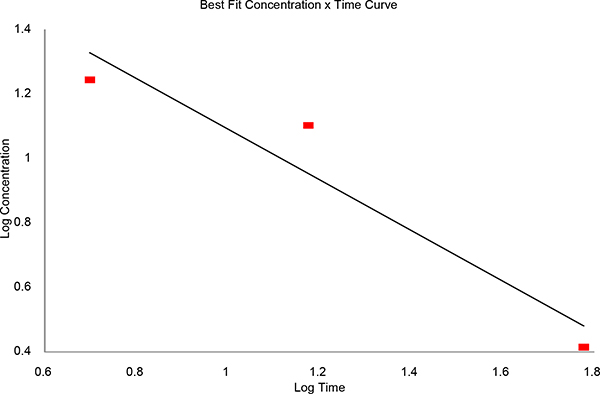
The relationship between dose and time for any given chemical is a function of the physical and chemical properties of the substance and the unique toxicologic and pharmacologic properties of the individual substance. Historically, the relationship according to Haber (1924), commonly called Haber’s Law or Haber’s Rule (C × t = k, where C = exposure concentration, t = exposure duration, and k = a constant) has been used to relate exposure concentration and duration to effect (Rinehart and Hatch 1964). The concept states that exposure concentration and exposure duration may be reciprocally adjusted to maintain a cumulative exposure constant (k) and that the cumulative exposure constant will always reflect a specific quantitative and qualitative response. The inverse relationship of concentration and time may be valid when the toxic response to a chemical is equally dependent on the concentration and the exposure duration. However, an assessment of LC50 data for certain chemicals by ten Berge et al. (1986) revealed chemical-specific relationships between exposure concentration and exposure duration that were often exponential. That relationship can be expressed by the equation Cn × t = k, where n represents a chemical-specific, and even a toxic end-point specific, exponent. The relationship described by the equation is basically the form of a linear regression analysis of the log-log transformation of a plot of C vs. t. ten Berge et al. (1986) examined the airborne concentration (C) and short-term exposure duration (t) relationship relative to death for approximately 20 chemicals and found that the empirically derived value of n ranged from 0.8 to 3.5 among the chemicals. Hence, the value of the exponent (n) in the equation Cn × t = k quantitatively defines the relationship between exposure concentration and exposure duration for a given chemical and for a specific health effect end point. Haber’s Rule is the special case where n = 1. As the value of n increases, the plot of concentration vs. time yields a progressive decrease in the slope of the curve.
TABLE B-1 Oxygen Difluoride Lethality in Rats
| Time | Conc. | Log Time | Log Conc. | Regression Output: | |
| 5 | 17.6 | 0.6990 | 1.2455 | Intercept | 1.8782 |
| 15 | 12.7 | 1.1761 | 1.1038 | Slope | -0.7857 |
| 60 | 2.6 | 1.7782 | 0.4150 | R Squared | 0.9145 |
| Correlation | -0.9563 | ||||
| Degrees of Freedom | 1 | ||||
| Observations | 3 | ||||
| n = | 1.27 | ||||
| k = | 245.78 | ||||
Source: Lester and Adams 1965; Davis 1970.
Analysis of data from Davis (1970) and Lester and Adams (1965) using the software of ten Berge resulted in a value for n of 1.1. Regression analysis of lethality data for rats (LC50 values for 5 min, 15 min, and 1 h) also showed a near linear relationship (n = 1.27), similar to that of the ten Berge software. The n value of 1.1 was used for deriving the AEGL values for oxygen difluoride.
LogProbit_Oxygen difluoride_rat AEGL
LogProbit_Oxygen difluoride_rat AEGL
Filename: Oxygen difluoride_rat AEGL for Log Probit Model
Date: 09 February 2007 Time: 12:15:08
| Seq. Nr Responded | Conc ppm | Minutes | Exposed | |
| 1 | 10 | 5 | 10 | 0 |
| 2 | 20 | 5 | 10 | 7 |
| 3 | 30 | 5 | 10 | 9 |
| 4 | 40 | 5 | 10 | 10 |
| 5 | 5 | 15 | 10 | 0 |
| 6 | 10 | 15 | 10 | 7 |
| 7 | 15 | 15 | 10 | 7 |
| 8 | 10 | 15 | 10 | 0 |
| 9 | 10 | 15 | 10 | 1 |
| 10 | 11 | 15 | 10 | 3 |
| 11 | 12 | 15 | 10 | 1 |
| 12 | 14 | 15 | 10 | 9 |
| 13 | 15 | 15 | 10 | 8 |
| 14 | 17 | 15 | 10 | 9 |
| 15 | 2 | 60 | 10 | 0 |
| 16 | 3 | 60 | 10 | 7 |
| 17 | 3 | 60 | 15 | 14 |
| 18 | 4 | 60 | 10 | 10 |
Filename: Oxygen difluoride_rat AEGL for Log Probit Model
Date: 09 February 2007 Time: 12:18:17
| Seq. Nr Responded | Conc ppm | Minutes | Exposed | |
| 1 | 10 | 5 | 10 | 0 |
| 2 | 20 | 5 | 10 | 7 |
| 3 | 30 | 5 | 10 | 9 |
| 4 | 40 | 5 | 10 | 10 |
| 5 | 5 | 15 | 10 | 0 |
| 6 | 10 | 15 | 10 | 7 |
| 7 | 15 | 15 | 10 | 7 |
| 8 | 10 | 15 | 10 | 0 |
| 9 | 10 | 15 | 10 | 1 |
| 10 | 11 | 15 | 10 | 3 |
| 11 | 12 | 15 | 10 | 1 |
| 12 | 14 | 15 | 10 | 9 |
| 13 | 15 | 15 | 10 | 8 |
| 14 | 17 | 15 | 10 | 9 |
| 15 | 2 | 60 | 10 | 0 |
| 16 | 3 | 60 | 10 | 7 |
| 17 | 3 | 60 | 15 | 14 |
| 18 | 4 | 60 | 10 | 10 |
Observations 1 through 18 considered!
| Seq. Nr Responded | Conc ppm | Minutes | Exposed | |
| 1 | 10 | 5 | 10 | 0 |
| 2 | 20 | 5 | 10 | 7 |
| 3 | 30 | 5 | 10 | 9 |
| 4 | 40 | 5 | 10 | 10 |
| 5 | 5 | 15 | 10 | 0 |
| 6 | 10 | 15 | 10 | 7 |
| 7 | 15 | 15 | 10 | 7 |
| 8 | 10 | 15 | 10 | 0 |
| 9 | 10 | 15 | 10 | 1 |
| 10 | 11 | 15 | 10 | 3 |
| 11 | 12 | 15 | 10 | 1 |
| 12 | 14 | 15 | 10 | 9 |
| 13 | 15 | 15 | 10 | 8 |
| 14 | 17 | 15 | 10 | 9 |
| 15 | 2 | 60 | 10 | 0 |
| 16 | 3 | 60 | 10 | 7 |
| 17 | 3 | 60 | 15 | 14 |
| 18 | 4 | 60 | 10 | 10 |
Used Probit Equation Y = B0 + B1*×1 + B2*×2
X1 = Conc ppm, ln-transformed
X2 = Minutes, ln-transformed
Chi Square = 74.27
Degrees of freedom = 15
Probability model = 7.66E-10
Ln (likelihood) = -56.25
B 0 = -6.6734E+00 Student t = -1.5079
B 1 = 2.4596E+00 Student t = 2.7662
B 2 = 2.2229E+00 Student t = 2.5684
variance B 00 = 1.9587E+01
covariance B 01 = -3.8663E+00
covariance B 02 = -3.7876E+00
variance B 11 = 7.9059E-01
covariance B12 = 7.3043E-01
variance B 22 = 7.4905E-01
Estimation ratio between regression coefficients of ln(conc) and ln(minutes)
Point estimate = 1.106
Lower limit (95% CL) = 0.817
Upper limit (95% CI) = 1.396
Filename: Oxygen difluoride_rat AEGL for Log Probit Model
Date: 09 February 2007 Time: 12:41:36
| Seq. Nr Responded | Conc ppm | Minutes | Exposed | |
| 1 | 10 | 5 | 10 | 0 |
| 2 | 20 | 5 | 10 | 7 |
| 3 | 30 | 5 | 10 | 9 |
| 4 | 40 | 5 | 10 | 10 |
| 5 | 5 | 15 | 10 | 0 |
| 6 | 10 | 15 | 10 | 7 |
| 7 | 15 | 15 | 10 | 7 |
| 8 | 10 | 15 | 10 | 0 |
| 9 | 10 | 15 | 10 | 1 |
| 10 | 11 | 15 | 10 | 3 |
| 11 | 12 | 15 | 10 | 1 |
| 12 | 14 | 15 | 10 | 9 |
| 13 | 15 | 15 | 10 | 8 |
| 14 | 17 | 15 | 10 | 9 |
| 15 | 2 | 60 | 10 | 0 |
| 16 | 3 | 60 | 10 | 7 |
| 17 | 3 | 60 | 15 | 14 |
| 18 | 4 | 60 | 10 | 10 |
APPENDIX C
ACUTE EXPOSURE GUIDELINE LEVELS FOR OXYGEN DIFLUORIDE
Derivation Summary
AEGL-1 VALUES
AEGL-1 values for oxygen difluoride are not recommended because of insufficient data. The absence of AEGL-1 values does not imply that exposures at concentrations below the AEGL-2 values are without adverse effects.
AEGL-2 VALUES
|
|
||||
| 10 min | 30 min | 1 h | 4 h | 8 h |
|
|
||||
| 0.43 ppm | 0.16 ppm | 0.083 ppm | 0.024 ppm | 0.013 ppm |
| (0.95 mg/m3) | (0.35 mg/m3) | (0.18 mg/m3) | (0.053 mg/m3) | (0.029 mg/m3) |
|
|
||||
| Data adequacy: Data were not available from which to define a point-of-departure for AEGL-2 values for oxygen difluoride. Lethality data from studies in monkeys, dogs, rats, and mice show that the exposure-response curve for oxygen difluoride is steep (Lester and Adams 1965; Davis 1970). Therefore, in accordance with the standing operating procedures for deriving AEGL values (NRC 2001), the AEGL-2 values were estimated by dividing the AEGL-3 values by 3. | ||||
AEGL-3 VALUES
|
|
||||
| 10 min | 30 min | 1 h | 4 h | 8 h |
|
|
||||
| 1.3 ppm (2.9 mg/m3) |
0.47 ppm (1.0 mg/m3) |
0.25 ppm (0.55 mg/m3) |
0.071 ppm (0.16 mg/m3) |
0.038 ppm (0.084 mg/m3) |
|
|
||||
| Reference: Davis, H.V. 1970. Acute Toxicity of Oxygen Difluoride. AMRL-TR-70-102. Aerospace Medical Research Laboratory, Wright-Patterson AFB, OH. | ||||
|
|
||||
| Test species/Strain/Sex/Number: Monkey; rhesus; 2/sex/group | ||||
|
|
||||
| Exposure route/Concentrations/Durations: Inhalation; 60, 100, 120, or 140 ppm for 15 min or 16, 21, or 32 ppm for 1 h. | ||||
|
|
||||
| Effects: | ||||
|
|
||||
| 15 min | 1 h | ||
|
|
|||
| Conc. (ppm) | Mortality ratio | Conc. (ppm) | Mortality ratio |
|
|
|||
| 60 | 0/4 | 16 | 0/4 |
| 100 | 2/4 | 21 | 1/4 |
| 120 | 2/4 | 32 | 3/4 |
| 140 | 4/4 | ||
|
|
||||
| End point/Concentration/Rationale: BMCL05 of 7.48 ppm; accounts for the variability due to the small number of test animals (four per group) and is typically used as the point-of-departure for AEGL-3 values. The BMCL05 is below the 1-h nonlethal | ||||
|
|
|
|
||||
| concentration of 16 ppm reported by Davis (1970) for rhesus monkeys and beagle dogs. It is also about one-third of the 1-h LC50 of 26 ppm determined by the method of Litchfield and Wilcoxon (1949), but more conservative than the 1-h LC5 of 17 ppm calculated by that method. | ||||
|
|
||||
| Uncertainty factors/Rationale: Total uncertainty factor: 10 Interspecies: 3, Davis (1970) evaluated the acute inhalation toxicity of oxygen difluoride in monkeys, dogs, rats, and mice. Larger species (dogs and monkeys) appeared to be less sensitive to the lethal effects of oxygen difluoride than smaller species (rats and mice). However, the study was conducted using a small number of animals (two males and two females per group). Therefore an interspecies uncertainty factor of 3 was applied. Intraspecies: 3, consistent with the uncertainty factor application for other direct-acting fluorinated compounds (chlorine pentafluoride, chlorine trifluoride, and hydrogen fluoride, which all appear to cause tissue irritation by direct-contact mechanisms). Data in animals indicate that the primary target is the deep lung rather than the airways. Therefore, an intraspecies uncertainty factor of 3 was considered sufficient to account for individual variability in the toxic response to oxygen difluoride. |
||||
|
|
||||
| Modifying factor: 3 to account for the sparse data set on oxygen difluoride | ||||
|
|
||||
| Animal-to-human dosimetric adjustment: Not applicable | ||||
|
|
||||
| Time scaling: Cn × t = k; an empirical value of 1.1 for the exponent n was derived using the software of ten Berge and the data from the studies by Lester and Adams (1965) and Davis (1970). Regression analysis of 1-h LC50 data from those studies resulted in a similar n value of 1.27. | ||||
|
|
||||
| Data adequacy: Lethality data are available for four species (monkeys, dogs, rats, and mice) and are sufficient for deriving AEGL-3 values. However, due to the sparse data set, a modifying factor of 3 was applied. Results of experiments indicate that larger species are less susceptible to oxygen difluoride than smaller species. | ||||
|
|
||||
APPENDIX D
LETHALITY THRESHOLD AND BENCHMARK DOSE ANALYSIS FOR OXYGEN DIFLUORIDE
Davis (1970): Rhesus monkeys (4/group; 2 males, 2 females), 1-h exposure BMCL05
Probit Model $Revision: 2.1 $ $Date: 2000/02/26 03:38:53 $
Input Data File: C:\BMDS\UNSAVED1.(d)
Gnuplot Plotting File: C:\BMDS\UNSAVED1.plt
Tue Jan 30 08:44:51 2007
BMDS MODEL RUN
The form of the probability function is:
P[response] = Background + (1-Background) * Cum-
Norm(Intercept+Slope*Log(Dose)),
where CumNorm(.) is the cumulative normal distribution function
Dependent variable = COLUMN3
Independent variable = COLUMN1
Slope parameter is not restricted
Total number of observations = 4
Total number of records with missing values = 0
Maximum number of iterations = 250
Relative Function Convergence has been set to: 1e-008
Parameter Convergence has been set to: 1e-008
User has chosen the log transformed model
Default Initial (and Specified) Parameter Values
background = 0
intercept = -9.26036
slope = 2.85468
Asymptotic Correlation Matrix of Parameter Estimates
The model parameter(s) - background have been estimated at a boundary point, or have been specified by the user, and do not appear in the correlation matrix
| intercept | slope | |
| intercept | 1 | -1 |
| slope | -1 | 1 |
Parameter Estimates
|
|
||
| Variable | Estimate | Std. Err. |
|
|
||
| background | 0 | NA |
| intercept | -12.6489 | 5.97666 |
| slope | 3.8667 | 1.85849 |
|
|
||
NA indicates that this parameter has hit a bound implied by some inequality constraint and thus has no standard error.
Analysis of Deviance Table
|
|
||||
| Model | Log (likelihood) | Deviance | Test DF | P-value |
|
|
||||
| Full model | -4.49868 | |||
| Fitted model | -4.65729 | 0.317211 | 2 | 0.8533 |
| Reduced model | -8.99736 | 8.99736 | 3 | 0.02933 |
|
|
||||
AIC: 13.3146
Goodness of Fit Scaled
|
|
|||||
| Dose | Est. Prob. | Expected | Observed | Size | Residual |
|
|
|||||
| 0.0000 | 0.0000 | 0.000 | 0 | 4 | 0 |
| 16.0000 | 0.0269 | 0.108 | 0 | 4 | -0.3327 |
| 21.0000 | 0.1903 | 0.761 | 1 | 4 | 0.3039 |
| 32.0000 | 0.7740 | 3.096 | 3 | 4 | -0.1148 |
|
|
|||||
Chi-square = 0.22 DF = 2 P-value = 0.8975
Benchmark Dose Computation
Specified effect = 0.05
Risk Type = Extra risk
Confidence level = 0.95
BMC = 17.216
BMCL = 7.48236
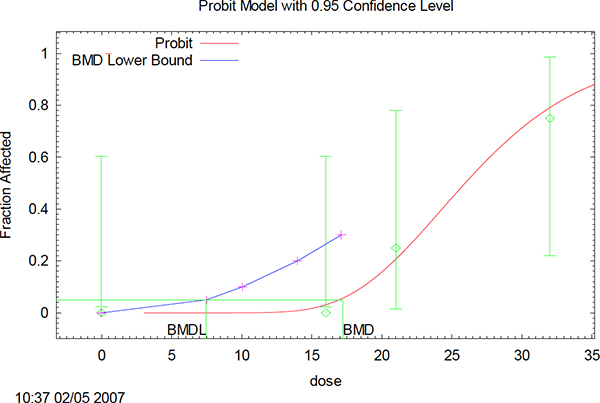
FIGURE D-1 Probit model BMCL05.
Davis (1970): Rhesus monkeys (4/group; 2 males, 2 females), 1-h exposure BMC01
Probit Model $Revision: 2.1 $ $Date: 2000/02/26 03:38:53 $
Input Data File: C:\BMDS\UNSAVED1.(d)
Gnuplot Plotting File: C:\BMDS\UNSAVED1.plt
Wed Jan 31 10:38:01 2007
BMDS MODEL RUN
The form of the probability function is: P[response] = Background + (1-Background) *CumNorm(Intercept+Slope*Log(Dose)), where CumNorm(.) is the cumulative normal distribution function
Dependent variable = COLUMN3
Independent variable = COLUMN1
Slope parameter is not restricted
Total number of observations = 3
Total number of records with missing values = 0
Maximum number of iterations = 250
Relative Function Convergence has been set to: 1e-008
Parameter Convergence has been set to: 1e-008
User has chosen the log transformed model
Default Initial (and Specified) Parameter Values
background = 0
intercept = -9.26036
slope = 2.85468
Asymptotic Correlation Matrix of Parameter Estimates
The model parameter(s) - background have been estimated at a boundary point, or have been specified by the user, and do not appear in the correlation matrix )
| intercept | slope | |
| intercept | 1 | -1 |
| slope | -1 | 1 |
Parameter Estimates
|
|
||
| Variable | Estimate | Std. Err. |
|
|
||
| background | 0 | NA |
| intercept | -12.6489 | 5.97666 |
| slope | 3.8667 | 1.85849 |
|
|
||
NA indicates that this parameter has hit a bound implied by some inequality constraint and thus has no standard error.
Analysis of Deviance Table
| Model | Log (likelihood) | Deviance | Test DF | P-value |
| Full model | -4.49868 | |||
| Fitted model | -4.65729 | 0.317211 | 1 | 0.5733 |
| Reduced model | -7.63817 | 6.27898 | 2 | 0.0433 |
AIC: 13.3146
Goodness of Fit Scaled
| Dose | Est. Prob. | Expected | Observed | Size | Residual |
| 16.0000 | 0.0269 | 0.108 | 0 | 4 | -0.3327 |
| 21.0000 | 0.1903 | 0.761 | 1 | 4 | 0.3039 |
| 32.0000 | 0.7740 | 3.096 | 3 | 4 | -0.1148 |
Chi-square = 0.22 DF = 1 P-value = 0.6420
Benchmark Dose Computation
Specified effect = 0.01
Risk Type = Extra risk
Confidence level = 0.95
BMC = 14.4341
BMCL = 4.22764
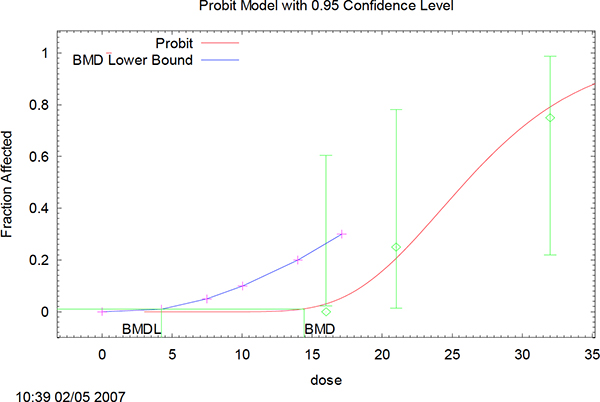
FIGURE D-2 Probit model BMC01.
LC50 and Lethality Threshold - Litchfield-Wilcoxon
Davis (1970): Rhesus monkeys, 1-h exposure to oxygen difluoride
| Mortality | Observed % | Expected % | Observed-Expected | Chi-Square | |
| 16.000 | 0/4 | 0 (2.30) | 3.37 | -1.07 | 0.0035 |
| 21.000 | 1/4 | 25.00 | 18.45 | 6.55 | 0.0285 |
| 32.000 | 3/4 | 75.00 | 80.38 | -5.38 | 0.0183 |
Values in parentheses are corrected for 0 or 100 percent Total = 0.0503
LC50 = 26.067(20.584 - 33.010)*
Slope = 1.27(1.02 - 1.58)*
*These values are 95 percent confidence limits
Total animals = 12Total doses = 3 Animals/dose = 4.00
Chi-square = total chi-square X animals/dose = 0.2013
Table value for Chi-square with 1 Degrees of Freedom = 3.8400
| LC84 = 33.175 | LC16 = 20.481 | FED = 1.27 | FS = 1.24 | A = 1.10 |
Expected Lethal Dose Values
|
|
|||
| LC0.1 | 9.545 | ||
| LC1.0 | 13.360 | ||
| LC5.0 | 16.986 | ||
| LC10 | 18.936 | ||
| LC25 | 22.217 | ||
| LC50 | 26.067 | ||
| LC75 | 30.583 | ||
| LC90 | 35.882 | ||
| LC99 | 50.857 | ||
|
|
|||
APPENDIX E
CATEGORY PLOT FOR OXYGEN DIFLUORIDE

FIGURE E-1 Category plot of toxicity data and AEGL values for oxygen difluoride.
TABLE E-1 Data Used in Category Plot for Oxygen Difluoride
| Source | Species | Sex | No. Exposures | ppm | Minutes | Category | Comments |
| AEGL-1 | NR | 10 | AEGL | ||||
| AEGL-1 | NR | 30 | AEGL | ||||
| AEGL-1 | NR | 60 | AEGL | ||||
| AEGL-1 | NR | 240 | AEGL | ||||
| AEGL-1 | NR | 480 | AEGL | ||||
| AEGL-2 | 0.43 | 10 | AEGL | ||||
| AEGL-2 | 0.16 | 30 | AEGL | ||||
| AEGL-2 | 0.083 | 60 | AEGL | ||||
| AEGL-2 | 0.024 | 240 | AEGL | ||||
| AEGL-2 | 0.013 | 480 | AEGL | ||||
| AEGL-3 | 1.3 | 10 | AEGL | ||||
| AEGL-3 | 0.47 | 30 | AEGL | ||||
| AEGL-3 | 0.25 | 60 | AEGL | ||||
| AEGL-3 | 0.071 | 240 | AEGL | ||||
| AEGL-3 | 0.038 | 480 | AEGL | ||||
| Darmer et al. 1972 | Rat | M | 1 | 2.6 | 60 | SL | LC50 |
| Davis 1970 | Dog | B | 1 | 60 | 15 | 1 | Mortality: 0/4 |
| Davis 1970 | Dog | B | 1 | 100 | 15 | SL | Mortality: 3/4 |
| Davis 1970 | Dog | B | 1 | 8.2 | 60 | 1 | Mortality: 0/4 |
| Davis 1970 | Dog | B | 1 | 16 | 60 | SL | Mortality: 2/4 |
| Davis 1970 | Dog | B | 1 | 21 | 60 | SL | Mortality: 1/4 |
| Davis 1970 | Dog | B | 1 | 32 | 60 | 3 | Mortality: 4/4 |
| Davis 1970 | Monkey | B | 1 | 60 | 15 | 1 | Mortality: 0/4 |
| Davis 1970 | Monkey | B | 1 | 100 | 15 | SL | Mortality: 2/4 |
| Davis 1970 | Monkey | B | 1 | 120 | 15 | SL | Mortality: 2/4 |
| Davis 1970 | Monkey | B | 1 | 140 | 15 | 3 | Mortality: 4/4 |
| Davis 1970 | Monkey | B | 1 | 16 | 60 | 1 | Mortality: 0/4 |
| Davis 1970 | Monkey | B | 1 | 21 | 60 | SL | Mortality: 1/4 |
| Davis 1970 | Monkey | B | 1 | 32 | 60 | SL | Mortality: 3/4 |
| Davis 1970 | Mouse | M | 1 | 7.5 | 15 | SL | LC50 |
| Davis 1970 | Mouse | 7.5 | 15 | SL | LC50 | ||
| Davis 1970 | Mouse | M | 1 | 9.5 | 15 | SL | Mortality: 12/15 |
| Davis 1970 | Mouse | M | 1 | 11.0 | 15 | SL | Mortality: 8/15 |
| Davis 1970 | Mouse | M | 1 | 11.9 | 15 | 3 | Mortality: 15/15 |
| Davis 1970 | Mouse | M | 1 | 15.2 | 15 | SL | Mortality: 12/15 |
| Davis 1970 | Mouse | M | 1 | 16.5 | 15 | SL | Mortality: 14/15 |
| Davis 1970 | Mouse | M | 1 | 1.0 | 60 | SL | Mortality: 5/15 |
| Davis 1970 | Mouse | M | 1 | 2.2 | 60 | SL | Mortality: 8/15 |
| Davis 1970 | Mouse | M | 1 | 2.2 | 60 | SL | Mortality: 8/15 |
| Davis 1970 | Mouse | M | 1 | 4.2 | 60 | 3 | Mortality: 15/15 |
| Davis 1970 | Rat | M | 1 | 9.5 | 15 | 1 | Mortality: 0/10 |
| Davis 1970 | Rat | M | 1 | 10.4 | 15 | SL | Mortality: 1/10 |
| Davis 1970 | Rat | M | 1 | 11.0 | 15 | SL | Mortality: 3/10 |
| Davis 1970 | Rat | M | 1 | 11.9 | 15 | SL | Mortality: 1/10 |
| Davis 1970 | Rat | M | 1 | 12.7 | 15 | SL | LC50 |
| Davis 1970 | Rat | M | 1 | 13.8 | 15 | SL | Mortality: 9/10 |
| Davis 1970 | Rat | M | 1 | 15.2 | 15 | SL | Mortality: 8/10 |
| Source | Species | Sex | No. Exposures | ppm | Minutes | Category | Comments |
| Davis 1970 | Rat | M | 1 | 16.5 | 15 | SL | Mortality: 9/10 |
| Davis 1970 | Rat | M | 1 | 2.2 | 60 | 1 | Mortality: 0/10 |
| Davis 1970 | Rat | M | 1 | 2.2 | 60 | 1 | Mortality: 0/10 |
| Davis 1970 | Rat | 2.6 | 60 | SL | LC50 | ||
| Davis 1970 | Rat | M | 1 | 2.7 | 60 | SL | Mortality: 7/10 |
| Davis 1970 | Rat | M | 1 | 3.0 | 60 | SL | Mortality: 14/15 |
| Davis 1970 | Rat | M | 1 | 4.0 | 60 | 3 | Mortality: 10/10 |
| Harrison and Mackenzie 1973 | Rat | M | 1 | 4.5 | 30 | 1 | Respiratory distress |
| Harrison and Mackenzie 1973 | Rat | M | 1 | 4.5 | 60 | 3 | Mortality: 4/4 |
| Harrison and Mackenzie 1973 | Rat | 4.5 | 60 | 3 | 100% mortality | ||
| Lester and Adams 1965 | Rat | B | 1 | 17.6 | 5 | SL | LC50 |
| Lester and Adams 1965 | Rat | B | 1 | 2.3 | 15 | SL | BMCL05 |
| Lester and Adams 1965 | Rat | B | 1 | 3.6 | 15 | SL | BMC01 |
| Lester and Adams 1965 | Rat | B | 1 | 8.0 | 15 | SL | LC50 |
| Lester and Adams 1965 | Rat | B | 1 | 9.7 | 15 | SL | Mortality: 7/10 |
| Lester and Adams 1965 | Rat | B | 1 | 14.6 | 15 | SL | Mortality: 7/10 |
| Vernot et al. 1977 | Rat | M | 1 | 2.6 | 60 | SL | LC50 |
For category: 0 = no effect, 1 = discomfort, 2 = disabling, SL = some lethality, 3 = lethality.


