Previous Chapter: 5 APPLICATION OF THE *GUIDE TO DEVELOPING STANDARD OPERATING PROCEDURES*
Suggested Citation: "6 FORMS." National Academies of Sciences, Engineering, and Medicine. 2016. Chemical Laboratory Safety and Security: A Guide to Developing Standard Operating Procedures. Washington, DC: The National Academies Press. doi: 10.17226/21918.

images

Suggested Citation: "6 FORMS." National Academies of Sciences, Engineering, and Medicine. 2016. Chemical Laboratory Safety and Security: A Guide to Developing Standard Operating Procedures. Washington, DC: The National Academies Press. doi: 10.17226/21918.

This page intentionally left blank.

Suggested Citation: "6 FORMS." National Academies of Sciences, Engineering, and Medicine. 2016. Chemical Laboratory Safety and Security: A Guide to Developing Standard Operating Procedures. Washington, DC: The National Academies Press. doi: 10.17226/21918.

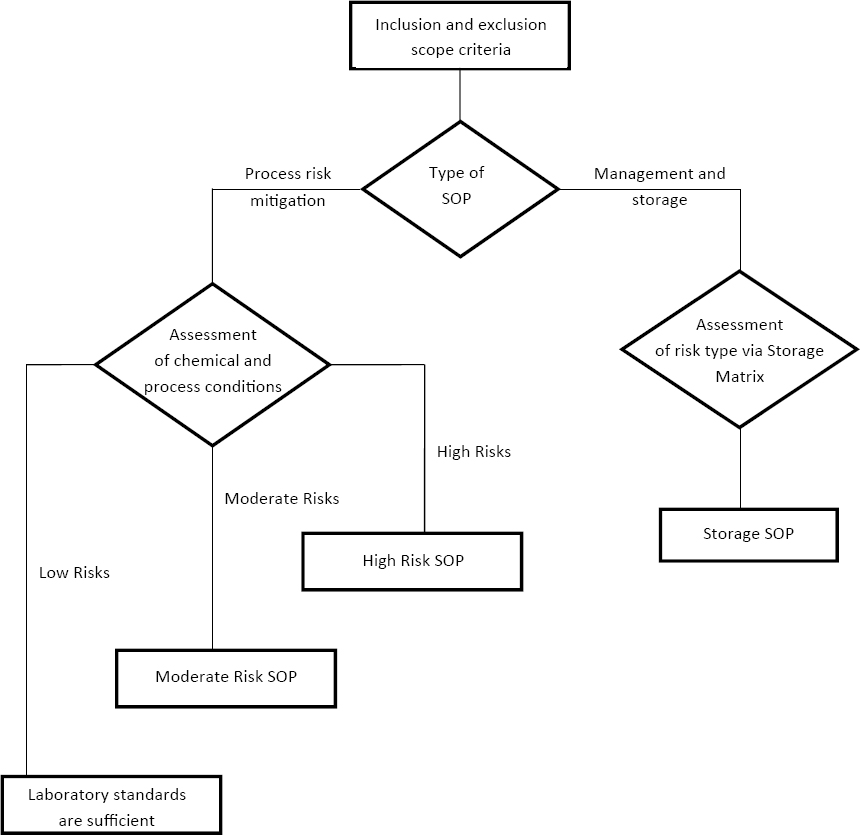
RISK ASSESSMENT FLOWCHART

The Risk Assessment Flowchart is intended for use by laboratory personnel with a B.S. degree in chemistry or equivalent. The flowchart is divided into Process Risk Mitigation and Management and Storage of Chemicals. Users will answer a series of questions that lead to one of four potential outcomes: (1) Laboratory Standards Are Sufficient, (2) Moderate Risk Standard Operating Procedure Is Required, (3) High Risk Standard Operating Procedure Is Required, and (4) Storage Matrix Standard Operating Procedure Is Required.
Image

Suggested Citation: "6 FORMS." National Academies of Sciences, Engineering, and Medicine. 2016. Chemical Laboratory Safety and Security: A Guide to Developing Standard Operating Procedures. Washington, DC: The National Academies Press. doi: 10.17226/21918.

This page intentionally left blank.

Suggested Citation: "6 FORMS." National Academies of Sciences, Engineering, and Medicine. 2016. Chemical Laboratory Safety and Security: A Guide to Developing Standard Operating Procedures. Washington, DC: The National Academies Press. doi: 10.17226/21918.

This page intentionally left blank.

Suggested Citation: "6 FORMS." National Academies of Sciences, Engineering, and Medicine. 2016. Chemical Laboratory Safety and Security: A Guide to Developing Standard Operating Procedures. Washington, DC: The National Academies Press. doi: 10.17226/21918.

MODERATE RISK STANDARD OPERATING PROCEDURE FORM

Implementation of the Moderate Risk Standard Operating Procedure is suggested for processes, experiments, or manipulations that pose moderate risks and that call for protective steps beyond those dictated by accepted laboratory standards. They are intended to limit the potential for injury, equipment damage, or environmental impact.

1. TITLE AND DESCRIPTION OF EXPERIMENT OR PROCESS:

2. PREPARER(S):

3. LOCATION:

4. AUTHORIZED PERSONNEL (WITH CONTACT INFORMATION)

a. PRINCIPAL INVESTIGATOR (PI)/SUPERVISOR:

b. STUDENT(S)/TECHNICIAN(S)/OPERATOR(S):

c. OTHERS TO BE NOTIFIED (e.g., other workers in the same laboratory, or other members of the research group):

5. POTENTIAL HAZARDS:

6. DESCRIBE ALL SPECIAL REQUIREMENTS FOR SPECIFIC ITEMS THAT REQUIRE A GREATER LEVEL OF SAFETY

Planned chemicals involved

Personal protective equipment

Engineering and environmental controls

Operational ranges and conditions

Special handling and storage requirements

Spill and accident procedure as needed

Waste handling and disposal

Suggested Citation: "6 FORMS." National Academies of Sciences, Engineering, and Medicine. 2016. Chemical Laboratory Safety and Security: A Guide to Developing Standard Operating Procedures. Washington, DC: The National Academies Press. doi: 10.17226/21918.

7. IDENTIFY ANY TRAINING NEEDS

Specific training required

Users requiring training

Date completed

8. VERIFICATION AND REVIEW

By signing below, you acknowledge that you have read, understand, and approve the SOP.

PI name (please print)
Pl signature
Safety staff name (please print)
Safety staff signature
Current date
Date of SOP expiration (e.g., 1 year)

9. LIST OF REFERENCES (include Safety Data Sheets, Globally Harmonized System, any outside personnel consulted in preparation of document, peer reviewers, etc.)
images

Suggested Citation: "6 FORMS." National Academies of Sciences, Engineering, and Medicine. 2016. Chemical Laboratory Safety and Security: A Guide to Developing Standard Operating Procedures. Washington, DC: The National Academies Press. doi: 10.17226/21918.

MODERATE RISK STANDARD OPERATING PROCEDURE REVIEW AND MODIFICATIONS LOG

Were modifications made to current SOP? Yes images No images
If no, then list date of approval
Last reviewed by (please print)
If yes, then list and describe modifications


Were modifications made to current SOP? Yes images No images
If no, then list date of approval
Last reviewed by (please print)
If yes, then list and described modifications


Were modifications made to current SOP? Yes images No images
If no, then list date of approval
Last reviewed by (please print)
If yes, then list and describe modifications


Suggested Citation: "6 FORMS." National Academies of Sciences, Engineering, and Medicine. 2016. Chemical Laboratory Safety and Security: A Guide to Developing Standard Operating Procedures. Washington, DC: The National Academies Press. doi: 10.17226/21918.

This page intentionally left blank.

Suggested Citation: "6 FORMS." National Academies of Sciences, Engineering, and Medicine. 2016. Chemical Laboratory Safety and Security: A Guide to Developing Standard Operating Procedures. Washington, DC: The National Academies Press. doi: 10.17226/21918.

HIGH RISK STANDARD OPERATING PROCEDURE FORM

Implementation of the High Risk Standard Operating Procedure Form is suggested for processes, experiments, or manipulations that pose high risks and that call for protective steps beyond those dictated by accepted laboratory standards. They are intended to limit the potential for injury, equipment damage, or environmental impact.

1. TITLE AND DESCRIPTION OF EXPERIMENT OR PROCESS:

2. PREPARER(S):

3. LOCATION:

4. AUTHORIZED PERSONNEL (WITH CONTACT INFORMATION)

a. PRINCIPAL INVESTIGATOR (PI)/SUPERVISOR:

b. STUDENT(S)/TECHNICIAN(S)/OPERATOR(S):

c. OTHERS TO BE NOTIFIED (e.g., other workers in the same laboratory, or other members of the research group):

5. IDENTIFY ANY TRAINING NEEDS

Experimental techniques

Specific training required

Users requiring training

Date completed
Suggested Citation: "6 FORMS." National Academies of Sciences, Engineering, and Medicine. 2016. Chemical Laboratory Safety and Security: A Guide to Developing Standard Operating Procedures. Washington, DC: The National Academies Press. doi: 10.17226/21918.

6. DETAILED PROCESS DESCRIPTION

List ranges for variables Temperature:
Pressure:
Viscosity:
Flammability:
Other:
List of operational ranges and
conditions
Materials to be used Chemicals:


Equipment:


DETAILED PROCEDURE:

Column A: Process Steps provide step-by-step normal operating procedures, including the transfer of chemicals between or across laboratories, production of gases, workup of products, and preparation of wastes.

Column B: Safety Notes describe how the risk can be mitigated (i.e., minimize clutter, control flammables, secure gas cylinders, ensure good condition of pump belts).

Column A: Process Steps Column B: Safety Notes
1.0 e.g., specific personal protective equipment requirements


1.1


1.2


Suggested Citation: "6 FORMS." National Academies of Sciences, Engineering, and Medicine. 2016. Chemical Laboratory Safety and Security: A Guide to Developing Standard Operating Procedures. Washington, DC: The National Academies Press. doi: 10.17226/21918.
2.0


2.1


2.2


3.0


3.1


3.2


4.0


4.1


4.2


Suggested Citation: "6 FORMS." National Academies of Sciences, Engineering, and Medicine. 2016. Chemical Laboratory Safety and Security: A Guide to Developing Standard Operating Procedures. Washington, DC: The National Academies Press. doi: 10.17226/21918.

7. ENGINEERING CONTROLS (check all that apply and provide a detailed description)

Engineering Controls Check box if applicable Description
Ex. Glove box images Use inert air (N2 or Ar)

Fume hood or glove box

images

Special ventilation images
HEPA-filtered vacuum lines images
Non-reactive containers images
Pressure relief devices images
Temperature control images
Bench paper, pads, plastic-backed paper images
Special signage images
Safe sharp devices images
Other safety devices used: images

8. PERSONAL PROTECTIVE EQUIPMENT (check all that apply)

Personal Protective Equipment Check box if applicable Description
Gloves images
Lab coats images
Suits images
Aprons images
Long pants images
Close-toed shoes images
Long sleeves images
Safety glasses images
Goggles images
Face shields images
Respirators (include cartridge type and cartridge change-out schedule) images
Hearing protection (include level of protection needed) images
Special equipment (i.e., blast shields, special enclosures) images
Other PPE images
Suggested Citation: "6 FORMS." National Academies of Sciences, Engineering, and Medicine. 2016. Chemical Laboratory Safety and Security: A Guide to Developing Standard Operating Procedures. Washington, DC: The National Academies Press. doi: 10.17226/21918.

9. WORK PRACTICE CONTROLS

Controls Description
Designated areas


Procedures for requesting emergency assistance


Emergency phone numbers


Locations of fire alarms, fire extinguishers, fire blankets, eye washes, showers, etc.


Emergency responders


Workers on shifts


Training on all experimental techniques and experiments


Restricting access; locks


Housekeeping


Lockout/tagouta procedure plan


After-hour procedures


Preventive maintenance


a Lockout/tagout refers to specific procedures to safeguard researchers from an unexpected startup of machinery and equipment, or a release of hazardous energy during service or maintenance activities.

Suggested Citation: "6 FORMS." National Academies of Sciences, Engineering, and Medicine. 2016. Chemical Laboratory Safety and Security: A Guide to Developing Standard Operating Procedures. Washington, DC: The National Academies Press. doi: 10.17226/21918.

10. MONITORING

Monitoring Description
Personnel exposure monitoring


e.g., wearable sensors for toxics, radiation badges
Leak checking


Gas and spill release monitoring


Temperature and pressure


Alarms


11. SPILL AND ACCIDENT PROCEDURES

Description and Location
Secondary containment


Spill kits


Emergency shutdown procedures


Process shutdown


Persons to inform


12. WASTE DISPOSAL PROCEDURES (include segregation of acids, bases, halogenated compounds, PPE, collection and transport procedures, proper documentation, regulations, etc.)

Suggested Citation: "6 FORMS." National Academies of Sciences, Engineering, and Medicine. 2016. Chemical Laboratory Safety and Security: A Guide to Developing Standard Operating Procedures. Washington, DC: The National Academies Press. doi: 10.17226/21918.

13. STORAGE (check all that apply)

Ventilated enclosures images

Refrigeration images

Gas cabinet images

Compliance with regulations images

Expiration date:

Inventory:

Other:

14. TRANSPORTATION PROCEDURES:

(e.g., secondary container for transporting between and across laboratories; secondary containment for experimental apparatus)


15. PEER REVIEW

Name (please print)
Signature
Date
Notes


Name (please print)
Signature
Date
Notes


Suggested Citation: "6 FORMS." National Academies of Sciences, Engineering, and Medicine. 2016. Chemical Laboratory Safety and Security: A Guide to Developing Standard Operating Procedures. Washington, DC: The National Academies Press. doi: 10.17226/21918.

16. VERIFICATION AND REVIEW

By signing below, you acknowledge that you have read, understand, and approve the SOP.

PI name (please print)
PI signature
Safety staff name (please print)
Safety staff signature
Current Date
Date of SOP expiration (e.g., 1 year)

17. LIST OF REFERENCES (include Safety Data Sheets, Globally Harmonized System, any outside personnel consulted in preparation of document, peer reviewers, etc.)

images

Suggested Citation: "6 FORMS." National Academies of Sciences, Engineering, and Medicine. 2016. Chemical Laboratory Safety and Security: A Guide to Developing Standard Operating Procedures. Washington, DC: The National Academies Press. doi: 10.17226/21918.

HIGH RISK STANDARD OPERATING PROCEDURE REVIEW AND MODIFICATIONS LOG

Were modifications made to current SOP? Yes images No images
If no, then list date of approval
Last reviewed by (please print)
If yes, then list and describe modifications


Were modifications made to current SOP? Yes images No images
If no, list date of approval
Last reviewed by (please print)
If yes, list and describe modifications


Were modifications made to current SOP? Yes images No images
If no, list date of approval
Last reviewed by (please print)
If yes, list and describe modifications


Suggested Citation: "6 FORMS." National Academies of Sciences, Engineering, and Medicine. 2016. Chemical Laboratory Safety and Security: A Guide to Developing Standard Operating Procedures. Washington, DC: The National Academies Press. doi: 10.17226/21918.

This page intentionally left blank.

Suggested Citation: "6 FORMS." National Academies of Sciences, Engineering, and Medicine. 2016. Chemical Laboratory Safety and Security: A Guide to Developing Standard Operating Procedures. Washington, DC: The National Academies Press. doi: 10.17226/21918.
Page 69
Suggested Citation: "6 FORMS." National Academies of Sciences, Engineering, and Medicine. 2016. Chemical Laboratory Safety and Security: A Guide to Developing Standard Operating Procedures. Washington, DC: The National Academies Press. doi: 10.17226/21918.
Page 70
Suggested Citation: "6 FORMS." National Academies of Sciences, Engineering, and Medicine. 2016. Chemical Laboratory Safety and Security: A Guide to Developing Standard Operating Procedures. Washington, DC: The National Academies Press. doi: 10.17226/21918.
Page 71
Suggested Citation: "6 FORMS." National Academies of Sciences, Engineering, and Medicine. 2016. Chemical Laboratory Safety and Security: A Guide to Developing Standard Operating Procedures. Washington, DC: The National Academies Press. doi: 10.17226/21918.
Page 72
Suggested Citation: "6 FORMS." National Academies of Sciences, Engineering, and Medicine. 2016. Chemical Laboratory Safety and Security: A Guide to Developing Standard Operating Procedures. Washington, DC: The National Academies Press. doi: 10.17226/21918.
Page 73
Suggested Citation: "6 FORMS." National Academies of Sciences, Engineering, and Medicine. 2016. Chemical Laboratory Safety and Security: A Guide to Developing Standard Operating Procedures. Washington, DC: The National Academies Press. doi: 10.17226/21918.
Page 74
Suggested Citation: "6 FORMS." National Academies of Sciences, Engineering, and Medicine. 2016. Chemical Laboratory Safety and Security: A Guide to Developing Standard Operating Procedures. Washington, DC: The National Academies Press. doi: 10.17226/21918.
Page 75
Suggested Citation: "6 FORMS." National Academies of Sciences, Engineering, and Medicine. 2016. Chemical Laboratory Safety and Security: A Guide to Developing Standard Operating Procedures. Washington, DC: The National Academies Press. doi: 10.17226/21918.
Page 76
Suggested Citation: "6 FORMS." National Academies of Sciences, Engineering, and Medicine. 2016. Chemical Laboratory Safety and Security: A Guide to Developing Standard Operating Procedures. Washington, DC: The National Academies Press. doi: 10.17226/21918.
Page 77
Suggested Citation: "6 FORMS." National Academies of Sciences, Engineering, and Medicine. 2016. Chemical Laboratory Safety and Security: A Guide to Developing Standard Operating Procedures. Washington, DC: The National Academies Press. doi: 10.17226/21918.
Page 78
Suggested Citation: "6 FORMS." National Academies of Sciences, Engineering, and Medicine. 2016. Chemical Laboratory Safety and Security: A Guide to Developing Standard Operating Procedures. Washington, DC: The National Academies Press. doi: 10.17226/21918.
Page 79
Suggested Citation: "6 FORMS." National Academies of Sciences, Engineering, and Medicine. 2016. Chemical Laboratory Safety and Security: A Guide to Developing Standard Operating Procedures. Washington, DC: The National Academies Press. doi: 10.17226/21918.
Page 80
Suggested Citation: "6 FORMS." National Academies of Sciences, Engineering, and Medicine. 2016. Chemical Laboratory Safety and Security: A Guide to Developing Standard Operating Procedures. Washington, DC: The National Academies Press. doi: 10.17226/21918.
Page 81
Suggested Citation: "6 FORMS." National Academies of Sciences, Engineering, and Medicine. 2016. Chemical Laboratory Safety and Security: A Guide to Developing Standard Operating Procedures. Washington, DC: The National Academies Press. doi: 10.17226/21918.
Page 82
Suggested Citation: "6 FORMS." National Academies of Sciences, Engineering, and Medicine. 2016. Chemical Laboratory Safety and Security: A Guide to Developing Standard Operating Procedures. Washington, DC: The National Academies Press. doi: 10.17226/21918.
Page 83
Suggested Citation: "6 FORMS." National Academies of Sciences, Engineering, and Medicine. 2016. Chemical Laboratory Safety and Security: A Guide to Developing Standard Operating Procedures. Washington, DC: The National Academies Press. doi: 10.17226/21918.
Page 84
Suggested Citation: "6 FORMS." National Academies of Sciences, Engineering, and Medicine. 2016. Chemical Laboratory Safety and Security: A Guide to Developing Standard Operating Procedures. Washington, DC: The National Academies Press. doi: 10.17226/21918.
Page 85
Suggested Citation: "6 FORMS." National Academies of Sciences, Engineering, and Medicine. 2016. Chemical Laboratory Safety and Security: A Guide to Developing Standard Operating Procedures. Washington, DC: The National Academies Press. doi: 10.17226/21918.
Page 86
Suggested Citation: "6 FORMS." National Academies of Sciences, Engineering, and Medicine. 2016. Chemical Laboratory Safety and Security: A Guide to Developing Standard Operating Procedures. Washington, DC: The National Academies Press. doi: 10.17226/21918.
Page 87
Suggested Citation: "6 FORMS." National Academies of Sciences, Engineering, and Medicine. 2016. Chemical Laboratory Safety and Security: A Guide to Developing Standard Operating Procedures. Washington, DC: The National Academies Press. doi: 10.17226/21918.
Page 88
Next Chapter: APPENDIXES
Subscribe to Email from the National Academies
Keep up with all of the activities, publications, and events by subscribing to free updates by email.