Memorial Tributes: Volume 20 (2016)
Chapter: CHARLES C. LADD
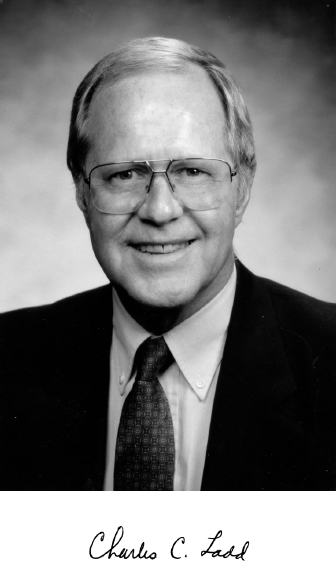
1932–2014
Elected in 1983
“For developing unifying principles governing clay behavior and innovative design procedures related to soft ground construction.”
BY W. ALLEN MARR
Civil engineering lost an icon and Geo-Legend with the passing of CHARLES CUSHING LADD III, age 81 (born November 23, 1932), at his home on August 4, 2014. Professor Ladd was renowned as a gifted teacher (with a style emulated by many former students who became faculty members) and innovative researcher on advanced technical topics in geotechnical engineering, particularly the engineering properties of soft clays. He was internationally sought after to consult on complex and difficult civil projects involving soft ground.
Among his numerous professional achievements, Professor Ladd was elected to the National Academy of Engineering in 1983. He was the recipient of many research awards from the American Society of Civil Engineers (ASCE), including the Walter L. Huber Civil Engineering Research Prize (1969), the J. James R. Croes Medal (1973), the Thomas A. Middlebrooks Award (2002), the Norman Medal (1976), and the Karl Terzaghi Award (1999). In 1995 he was elected to distinguished member of ASCE. In 2013 he was awarded the ASCE Outstanding Project and Leaders (OPAL) Leadership Award for his contributions to engineering education, an accomplishment of which he was most proud. He also contributed his time and expertise to a number of ASCE committees, among them the Committee on Curricula and Accreditation, the Geotechnical
Engineering Division’s publications committee, the Awards Committee, and a committee dealing with soil properties. He also served as a member of the Geo-Institute’s Board of Governors. He also received the C.A. Hogentogler Award (1990) from the American Society for Testing and Materials.
Professor Ladd was an inspiring, committed teacher, legendary for his attention to detail, focused thinking, and integrity. His lectures in soil mechanics and soil behavior were meticulously prepared, accompanied by his handwritten notes bearing his initials and revision dates in the upper right-hand corner of each sheet. Chuck challenged his students to rise to high levels of performance and determination.
One of his most important contributions was the development of SHANSEP, an acronym for stress history and normalized soil engineering properties, which is widely used for evaluating the undrained stability of construction on and in soft clays. This work grew out of a consulting project in Japan in 1960 involving oil storage tanks constructed on deep soft soils and evolved into 50 years of research and practice with major contributions on the effects of anisotropy, sample disturbance, and strain rate on stress-strain-strength behavior of clay soils.
Chuck received a bachelor of arts (cum laude) in mathematics and physics from Bowdoin College in 1955, and a bachelor of science in building engineering and construction from MIT the same year. He continued on at MIT to earn a master of science in civil engineering in 1957 and doctor of science in soil engineering in 1961. He joined the MIT faculty in 1961 and served continuously until he retired in 2001 as the Edmund K. Turner Professor of Civil and Environmental Engineering. He served as instructor, assistant professor, associate professor, full professor, acting head of the Geotechnical Division, chair of the Civil and Environmental Engineering Department’s Committee on Graduate Studies, director of the Center for Scientific Excellence in Offshore Engineering, and graduate admissions officer.
Chuck was the patriarch of a large, tightly knit family. He and his late wife, Carol, enjoyed taking their family on winter
cruises and treating their extended family to yearly summer vacations. He and Carol were famous for hosting Christmas parties where he would serve his signature “punch” concoction. He loved his students and colleagues, often inviting them to attend family functions, celebrations, and holidays. Up until his hospitalization on August 1, he had been spending much of his time happily working on a book on soil behavior and a challenging soft clay embankment stability problem for a proposed new airport in Mexico City.
He was a devoted husband of 55 years to the late Carol Ballou Ladd, who died in 2009. He is survived by children Melissa Northrup of Boxborough, MA; Charles C. Ladd IV and his wife Marcia of Mountain Top, Pennsylvania; Ruth McGraw and her husband James of Essex, MA; Matthew Ladd and his wife Annette of Little Compton, Rhode Island; nine grandchildren; and three great-grandchildren. He also left his fiancée, Elaine Burkley of Sudbury, Massachusetts, and his brother and sister-in-law, Richard and Linda Ladd of Albuquerque.


