Emergency Alert and Warning Systems: Current Knowledge and Future Research Directions (2018)
Chapter: 2 Building an Integrated Alert and Warning Ecosystem
2
Building an Integrated Alert and Warning Ecosystem
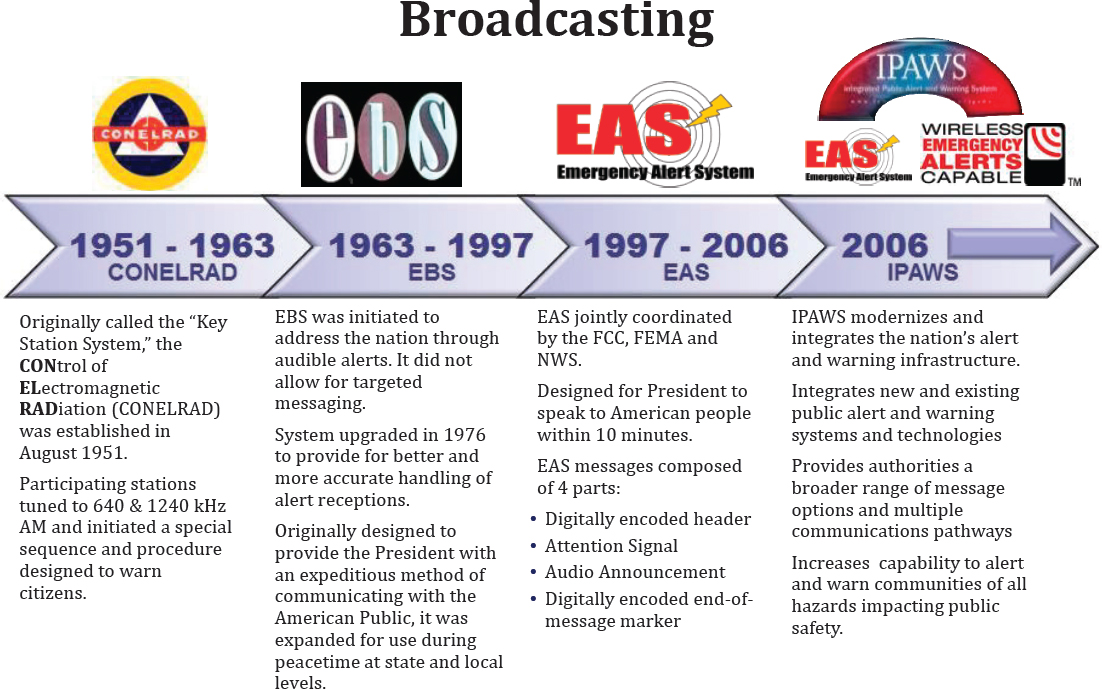
Alert and warning systems have evolved over time to reflect new types of hazards or technologies, moving from various television and radio broadcast technologies to now include cell broadcast. (See Figure 2.1 for the evolution of emergency broadcasting and Appendix A for a longer history of alert and warning systems.). However, this evolution has occurred very slowly and has often stemmed from a major hazards event. Furthermore, alert and warning systems have not kept up with new technologies. For example, the 2006 Warning, Alert, and Response Network (WARN) Act prompted the first significant changes to national alerting systems since the mid-1990s.
In combination with Executive Order 13407,1 the WARN Act created the Integrated Public Alert and Warning System (IPAWS) and Wireless Emergency Alerts (WEA) (then known as the Commercial Mobile Alert System). IPAWS unified the Emergency Alert System (EAS), the national warning system (NAWAS), the newly created WEA, and National Oceanic and Atmospheric Administration (NOAA) Weather Radio All Hazards into a one modern network. Additionally, IPAWS allows for alerts to be originated by various government organizations and officials at the federal, state, local, and tribal level, and allows a single message to be transmitted to the various alert platforms. An XML-based data format, the Common Alerting Protocol (CAP), standardizes alert data across threats, jurisdictions, and warning systems. The CAP data structure was defined
___________________
1 Executive Order. No. 13407, 2006, pp. 1226–1228.
so as to be backward compatible with existing alert formats while providing new capabilities, such as those needed for WEA, flexible geotargeting that can more narrowly target areas using GIS data,2 multilingual and multiaudience messaging; phased and delayed effective times and expirations, enhanced message update and cancellation features, template support, digital encryption and signature capabilities, and facilities for digital images, audio, and video.
Mobile devices have become an integral part of people’s lives, with 97 percent of American adults owning one and 90 percent of those owners “frequently” carrying their phones with them and “never” or “rarely” power off the devices completely.3 Furthermore, almost 43 percent of adults live in homes without a landline. Further limiting the ways in which homes can be reached, one in five households no longer have cable television subscriptions,4 potentially limiting the reach of live, local news. Not only can cell phones reach a large swathe of the population, for some it may be the only or best way to reach them during emergencies given declines in listening to or viewing live broadcasts, a drop in cable subscription rates, and a dramatic falloff in households with landline telephones. The National Weather Service, in a talk in early 2015,5 provided the following several examples where WEA was credited by the media and members of the public for saving lives:
- Rose Hill, MS, tornado on July 24, 2014,
- Cape Charles, VA, severe weather on July 24, 2013,
- Illinois tornadoes on November 17, 2013,
- East Windsor, CT, tornado on July 1, 2013, and
- Elmira, NY, tornado on July 26, 2012.
WEA, which added alerts delivered to phones to IPAWS, added important capabilities to the national alerting system but does not take full advantage of the ability of mobile devices to process and make decisions about which messages to present based on user needs or contextual information the device has about the user and the environment. Nor does
___________________
2 Older alert systems relied on Federal Information Processing Standard codes that were assigned by county and a few larger cities, making the finest grain of geotargeting alerts countywide.
3 Pew Research Center American Trends Panel Survey, May 30-June 30, 2014; L. Rainie and K. Zickuhr, “Americans’ Views on Mobile Etiquette,” release date August 26, 2015, http://www.pewinternet.org/2015/08/26/americans-views-on-mobile-etiquette/.
4 A. Pressman, 2016, More than one in five households has dumped the cable goliath, Fortune, http://fortune.com/2016/04/05/household-cable-cord-cutters/.
5 National Oceanic and Atmospheric Administration, “Wireless Emergency Alerts,” last update February 5, 2015, http://www.crh.noaa.gov/images/lbf/wxsafety/WEA/WEA_Update%2002052015.pdf.
it leverage Internet-based technologies such as social media platforms that could be used to deliver alerts. Furthermore, both private and public organizations have begun to take advantage of the large amounts of data they possess about users to detect events and provide alerts and warnings and other hazard-related information to their users.
NEED FOR AN INTEGRATED ALERT AND WARNING ECOSYSTEM
Currently, emergency alerting takes place across an information ecosystem that includes emergency responders and their alerting platforms as well as diverse channels of message delivery, distributed sensing devices, and feedback mechanisms. Emergency alerts are distributed directly to users over landline phones and, more recently, over mobile phones (through WEA). They are also broadcast through traditional channels, such as radio and television, and increasingly through social media. Emergency alerts and additional contextual information about events can be accessed online through the websites of response agencies, mainstream media outlets, and other websites. Individuals also receive alerts via various mobile applications and other digital tools. In the near future, emergency alerts could also be delivered through other Internet-connected devices, such as Amazon Alexa or Google Home.
The information ecosystem for alerting the public encompasses more than IPAWS. For example, a person who receives a WEA message may post information from that alert on social media, or a community radio station may broadcast information it found in a Facebook post or another online source. The information ecosystem also includes “incoming” information. Information gathered from social media and distributed sensing devices can be utilized to inform situational awareness and generate emergency alerts—and (potentially) feedback mechanisms about what information is reaching whom, when, and how individuals are responding. Private organizations are also developing platforms to use during a crisis. Examples include Facebook Safety Check as a feedback channel and Google Alerts. The public also uses various commercial smartphone applications to provide weather alerting and follows local weather forecasters’ social media feeds.
In addition to the technical changes, our understanding of how the public responds to systems has advanced. For example, while we have known for some time what information is needed to elicit public action, we also now know that the 90-character message length afforded by the
current WEA system is not sufficient to yield a quick public response.6 This ecosystem is continuing to evolve as new technologies are introduced and new practices and protocols emerge around information sharing during emergency events
The committee acknowledges the work done to develop and deploy current WEA capabilities and is encouraged by recent Federal Communications Commission (FCC) changes to WEA rules that expand the message length to 360 characters—changes made, at least in part, due to work funded by the Department of Homeland Security (DHS).7 In view of the availability of new tools, and the emergence of Internet of Things (IoT) technologies, any methodology that relies on broadcasts to a singular device is no longer sufficient to serve as the primary alert and warning system for an increasingly connected population using diversified communication mediums and preferences.
FINDING: Alert and warning systems exist within a larger communication and technical ecosystem, and government-designed and maintained systems must fit within this larger ecosystem.
FINDING: A more cohesive and all-encompassing alert and warning system is needed that will integrate public and private communications mechanisms and sources of information, and continue to provide the necessary information for the purpose of preserving the health and safety of people, while being technologically agnostic—such that new technologies for alerts and warnings can be adopted quickly.
FINDING: The nation’s alerting capabilities, such as WEA and IPAWS, will need to evolve and progress as the capabilities of smartphones and other mobile broadband devices improve and newer technologies become available. This evolution will need to be informed by both technical research and social and behavioral science research.
PROPERTIES OF AN INTEGRATED ALERT AND WARNING SYSTEM
The purpose of alerts and warnings is to provide the necessary information to warn the public and effect the necessary actions that will lead
___________________
6 H. Bean, B.F. Liu, S. Madden, J. Sutton, M.M. Wood, and D.S. Mileti, 2016, Disaster warnings in your pocket: How audiences interpret mobile alerts for an unfamiliar hazard, Journal of Contingencies and Crisis Management 24(3):136-147.
7 While the work done on public response to message length was completed through a DHS research project, the Communications Security, Reliability and Interoperability Council V (CSRIC V) reviewed the technical feasibility of increasing the message length.
to their safety, and to deliver the messages to populations at risk of imminent threats with the goal of maximizing the probability that people take protective actions and minimizing the delay in their taking those actions. Given the extensive body of knowledge built on six decades of research, we have an extensive understanding of key properties of effective alert and warning systems.
This body of knowledge tells us that an effective alert and warning system will be capable of the following:
- Only target and reach people (or their devices)—and people who care about the people and property—at risk from the hazard. Fine-grained geotargeting is important to ensure that those who are not at risk do not receive alerts that do not apply to them. However, others who may not be in the at-risk area may want or need to know about the hazard; the hazard may impact a location of interest. For example, a parent might want to know about hazards that would impact their child’s school.
- Communicate impact and recommend protective actions that people can understand and can reasonably take with the guidance provided and tailored to the circumstances of each alert recipient. For example, recommending to shelter in place may not be actionable for mobile home residents; advance recommendations to evacuate or shelter elsewhere would be more helpful.
- Be respected and trusted by the public, emergency managers, other public officials, and the media. Alert originators need to trust that the system will in fact deliver an alert sent in a timely manner and to all planned recipients and the public needs to know that the delivered message is in fact accurate and is from a trusted source. This property will rely on key technical capabilities and system properties of dependability, reliability, resilience, and security.
- Be suitable for all hazards and effective in reaching all at-risk populations. The population impacted by hazards is incredibly diverse in numerous ways, including differences in languages, abilities, and technology access. An alert and warning system needs to support this diversity and communicate to each impacted subpopulation effectively.
- Work well alongside other government and private information sources. As noted above numerous public and private organizations either collect information during a disaster, provide information, or both. Therefore, alert and warning systems must work alongside these services; alerts will need to be easily repurposed for other media or delivery methods).
- Allow for collecting feedback from the alerted population to determine the effectiveness of an alert and give emergency managers better situational awareness during an event. Feedback is needed during a crisis
- to immediately understand how the public is responding to the event but is also needed for post hoc analysis so that systems can be improved.
EVOLUTION OF AN INTEGRATED ALERT AND WARNING ECOSYSTEM
The committee envisions an alert and warning system that continually takes advantage of new technologies and reflects the results that emerge from research. In the near term, this will mean increasing adoption of WEA and other existing alert and warning systems, incorporation of current knowledge about public response to craft more effective alert messages, and research focusing on verifying technology capabilities. Existing technologies, such as newer delivery and geotargeting technologies, will need to be adapted for use in alert and warning systems. Long-term, this will involve exploring new technologies, gaining a better understanding of existing technologies, and continued technical, social, and behavioral research to inform the design and operation of future alerting capabilities. These near- and long-term visions for an alerting system underpin the research agenda described in the next section.
Near-Term: Use Current Alert and Warning Technologies and Tools
Near-term goals for an integrated alerting system are twofold: fully adopt and understand current alerting tool and adopt newer technologies for use within that system.
Fully Adopt and Understand Current Alerting Tools
As of August 8, 2016, less than a third of U.S. counties have registered to use the Integrated Public Alert and Warning System8 gateway, the system that allows message originators to send WEA messages. Only 387 wireless emergency alerts have been originated by state or local governments since WEA came online; by comparison the National Weather Service has sent approximately two million alerts.9 An increased use of WEA by emergency officials could mean reaching additional populations, and increased use would also improve familiarity with the systems, which could improve public response times.
___________________
8 IPAWS was created under Executive Order 13407 to integrate various alerting systems—Emergency Alert System, National Warning System, Wireless Emergency Alerts, and NOAA Weather Radio All Hazards—into one modern network. IPAWS takes advantage of the Common Alerting Protocol, an XML-based data format for exchanging alerts and warnings.
9 M. Lucero, FEMA IPAWS Division, “IPAWS Evolution,” presentation to the committee on August 9, 2016.
Research is also needed to understand the implications of new FCC rules for WEA, which expands the message length to 360 characters and allows the use of Web links (URLs) in messages. Although the new rules will provide new opportunities for emergency managers who have struggled to provide useful information in 90 characters, research is needed to determine what information to include and how to best display additional information, in the WEA message itself and on any media it links to. Furthermore, research is needed to better understand what message lengths are technically feasible and what message length elicits the best public response.
Adopt Newer Technologies for Use Within That System
WEA was developed prior to the wide use of smartphones and newer cellular network technologies. Incorporation of newer technologies could address many shortcomings of WEA, including a host of accessibility, functionality, and other concerns. These advances include the following:
- Modernize delivery technologies. The immediate opportunity to modernize is to switch from 2nd/3rd generation short message service-based (cell broadcast) to (4th generation) long-term evolution (LTE) broadcast as the primary bearer.10
- Diversify communications technologies in handsets to help distribute alert messages when cellular network congestion or failure occurs. Short-range communications technology such as Bluetooth and WiFi could be used to forward messages locally while FM radio provides an alternate long-range technology.
- Support the use of location information stored on the handset to improve the precision of geotargeting by determining if a device is located within the targeted area and whether an alert should be displayed. Smart phones, using GPS and other technologies, are very capable of not only knowing where a phone is but also where it has been (and potentially where it is likely to be in the future).
- Adopting a more “app”-like approach to WEA, as opposed to the current simple text like approach. Such an approach would allow for the incorporation of more flexibility so that alert and warning capabilities can be upgraded more easily as understanding of public response and technology capabilities change. For example, the software on smartphones that supports WEA alerts could be moved from the operating system (which on some phones may not be frequently updated) to a more easily updated app distributed through the normal application distribution channels.
___________________
10 LTE Broadcast (or multicast) provides faster delivery and supports a larger content size.
- Provide mechanisms for performance monitoring and user feedback to facilitate studies related to perceived relevance (by seeking user feedback and/or inferring action taken), coverage (how many users did and did not receive a message), and message delivery latency.
Long-Term: Incentivize the Building of an Integrated Alert and Warning Ecosystem
The increasing number of connected devices, sensor networks, and mobile phone capabilities provide significant opportunity to detect events, deliver well-vetted alerts over numerous channels, and gather feedback on how these alerts are perceived. As a result, the overall ecosystem will be both rich and complex. A framework can be developed that allows for gathering alerts from multiple sources and making those available for other third-party applications and incentives participation by those third parties. Such a framework could leverage the increasingly advanced capabilities of connected personal devices to support applications that will factor in user preferences and the dynamic context and relationships they find themselves in to present the information in effective ways. The emergence of frameworks like Apple’s Homekit and Google Home demonstrate the feasibility of such an approach. A framework could track the relevance, fidelity, veracity, and uncertainty of the data, contributing to building a better system, and provide mechanisms to enable revision of stale or incorrect information. Such a framework could also be designed to decouple the content of messages and data from the channels through which the content is delivered, eliminating the need to create separate stovepiped systems and use all available modes of communication, ranging from managed cellular systems to opportunistic peer-to-peer systems.
While short-term evolution focuses on improvements on or extension of WEA, the committee also foresees a wider capability for IPAWS as a central tool to an integrated alert and warning ecosystem that draws on a wide variety of data sources for better understanding emergencies and the public response and that encompasses a wide range of potential technologies and devices for delivering messages. Box 2.1 explores example scenarios of how advances in technology might be used in an alert and warning ecosystem.
Envisioning such an advanced system requires exploring questions around technical feasibility and implementation and an understanding of how these tools will impact public response. However, social and behavioral research already informs us of properties an ecosystem should have, including the following:
- Using technologies that are privacy preserving. For example, location and other contextual information can be stored locally on a smartphone, and applications can use this information to decide when and how to display messages.
- Assuring end-to-end service availability and the integrity of valid messages, preventing spoofed messages and spoofed alerts, and assuring system availability from alert origination to message receipt.
- Giving users as much control as possible over what kinds of messages they receive, and alerting control should not be limited to simply on or off.
- Including metadata in alerting systems that can be used in combination with user preference to determine when and how to present alerts.
- Integrating messages across communication channels, given the wide number of available technologies. For example, IPAWS messages could be made available as a data stream for private industry to use freely in weather applications, navigation systems, social media streams, and the like.
- Making alerting systems devices agnostic and able to support more than one modality of information presentation. For example, both text and voice alerts can be provided on mobile devices.
- Reflecting a better understanding of the information needs of emergency managers to quickly analyze data generated via social media.
- Using IoT devices and other embedded sensors to detect, analyze, and categorize potential events, send alerts, and potentially automate certain protective actions for minimizing potential damages.
- Incorporating available communications technologies, such as mesh networking and FM broadcast signals,11 to increase the ability to deliver information in the event that primary communication networks fail.
- Adapting message content and format to the context and needs of the end-user, for example, considering location of device, known home location of device owner, language of device owner, disability status, and other context (as selected or entered by the user).
___________________
11 Many smartphones have FM radio receiver hardware built into them. There is potential for these to be used to provide information if a cellular network is not functioning or data access is limited for other reasons; however, enabling this function requires the consideration of a number of technical and business issues.


