Alternatives for the Demilitarization of Conventional Munitions (2019)
Chapter: 3 Review of Conventional Open Burning/Open Detonation Technologies
3
Review of Conventional Open Burning/Open Detonation Technologies
This chapter describes the processes used at the seven stockpile depots for performing munitions demilitarization using open burning (OB) and open detonation (OD) and provides background information on the procedures, hazards, and environmental impacts of OB/OD.
OB/OD has historically been the standard method for disposal of excess, unserviceable, or obsolete military munitions because it is a technically simple method of disposal that is frequently the least expensive and easiest to perform. OB and OD have, however, come under increasing scrutiny and criticism from environmental regulators and public interest groups and local residents for their potential human health and environmental impacts.
COMPONENTS OF ENVIRONMENTAL AND PUBLIC HEALTH CONCERN
An acceptable demilitarization technology would destroy munitions components while producing emissions or effluents that are within regulatory risk ranges. Because complete destruction of energetics or other chemicals of concern is generally not achievable with any technology, trace amounts of substances of potential public health and environmental concern may be released. This is particularly true of OB/OD, where residues such as smoke, soot, and various gases are released directly to the environment. The possibility that human or environmental exposures to those substances might occur has been a source of concern for the Army, the U.S. Environmental Protection Agency (EPA), states, and communities in the vicinity of demilitarization facilities for some time (see Appendix D).
Several classes of substances associated with munitions demilitarization may be of public health or environmental concern. Those include nitramine explosives (RDX, HMX); other nitrosated explosives (e.g., nitroglycerine, TNT); elemental metals (e.g., aluminum, arsenic, cadmium, chromium, copper, cobalt, iron, lead, magnesium, mercury, silver, zinc); volatile and semi-volatile organics (e.g., 2,4-dinitrotoluene, 1,3-butadiene, benzene, methylene chloride, phthalates); polycyclic aromatic hydrocarbons (products of incomplete combustion, e.g., benzo[a]pyrene, benzo[a]anthracene); chlorinated dioxins and furans; and perchlorate (a component of some propellants). Those substances may be released during OB/OD to the air, groundwater, surface water, and soil. Contained systems generally have back-end pollution abatement systems that treat offgases prior to being released, with liquid and solid residues being captured and treated according to the Resource Conservation and Recovery Act (RCRA) permits. Hence, while some of the same contaminants may be generated following treatment with alternative technologies, contained technologies are typically designed to mitigate releases to the environment as prescribed in the facility’s RCRA or Clean Air Act (CAA) permits.
A recent study characterized air emissions in the downwind plume following OB/OD activities involving a number of different propellants and munitions (Gullett et al., 2016). Analytes included particulate matter, carbon dioxide, carbon monoxide, methane, volatile organic compounds, chlorine species (HCl, chloride, chlorate, perchlorate), polychlorinated dibenzodioxins and polychlorinated dibenzofurans, and particulate-based metals. Combustion was sometimes incomplete, depending on the munitions treated. That study used an aerostat-lofted instrument package to analyze emissions following actual OB/OD activities at a munitions depot. That study, as well as a following study that sampled OB plumes using sensors mounted on an unmanned aerial vehicle (Aurell and Gullett, 2017), yielded results that were consistent with an earlier study (the “Bang Box” study), which also characterized air emissions from OB/OD of various similar munitions, but did so using instruments inside a confined chamber and small volumes of explosives and propellants (Wilcox et al., 1996).
Substances generated by munitions demilitarization become potential threats to human or environmental health only if exposure occurs, and only if that exposure occurs in a manner likely to produce adverse health effects. The mag-
nitude and character of health effects that a particular demilitarization site or activity poses to installation personnel or the public can be characterized by performing human and environmental health risk assessments, often a requirement of RCRA permitting for OB/OD units. Risk assessments evaluate exposures that might occur directly—via groundwater, surface water, soil, and air—as well as indirectly—such as by consuming contaminated wildlife—and estimate the likelihood that the exposures will result in adverse consequences. The extent to which risk assessment plays a role in establishing permit conditions for OB/OD operations and alternative technologies is discussed in Chapter 6.
OVERVIEW OF OPEN BURNING AND OPEN DETONATION
During both OB and OD the munitions to be demilitarized are destroyed by either burning or detonation, resulting in destruction of the energetics, demilitarization of the munitions, and release of energy in the form of heat, light, and shock. Residues of OB/OD include atmospheric emissions and fragments of the munitions components that are not consumed during the burning or detonation, and result in contaminated soil and sometimes groundwater as well. The munitions may require varying amounts of preparation, including disassembly to separate energetic components or removal of environmentally hazardous components that may not be disposed of by burning or detonation.
Both OB and OD at the Army stockpile depots are performed under RCRA permits issued by EPA or EPA-authorized state agencies. These permits impose a number of restrictions intended to enhance safety and limit impacts to human health and the environment. The following are typical permit restrictions governing the performance of OB and OD:
- Net explosive weight (NEW) limits. The NEW limits can be any combination of (1) the maximum amounts of energetics per burn pan or disposal pit, (2) the total of all burn pans or disposal pits in one burn operation or detonation event, or (3) allowable totals per day or per year. Each RCRA permit has specific NEW restrictions.
- Limits on the number of burns or detonations per day.
- Meteorological limits (e.g., average wind speeds between 3-20 miles per hour, wind direction away from publicly accessible areas, and less than 50 percent chance of precipitation).
More information on permitting is provided in Chapter 6.
Although handling and using energetics and high and low explosives is inherently hazardous, as discussed in Chapter 2, the Office of the Product Director for Demilitarization (PD Demil) has a good safety record for performing OB/OD. According to information provided by the PD Demil1 there have only been two accidental detonations resulting in two minor injuries and one serious injury during OD operations since 2004.
The following descriptions of OB/OD were developed by reviewing nine Army depot standard operating procedures (SOPs). Note that one SOP for static firing of rocket motors was reviewed,2 and the committee categorizes static firing of rocket and missile motors as OB because the rocket or missile motor propellant is burned and the products of combustion are directly emitted to the atmosphere.
The SOPs reviewed by the committee are:
- Blue Grass Army Depot (BGAD) SOPs for OB/OD (BGAD, 1996),
- Crane Army Ammunition Activity (CAAA) SOPs for OB/OD (CAAA, 2017a and 2017b),
- Letterkenny Army Depot (LEAD) SOP for OD (Letterkenny Army Depot, 2017),
- McAlester Army Ammunition Plant (MCAAP) SOP for OB (McAlester Army Ammunition Plant, 2017), and
- Tooele Army Depot (TEAD) SOPs for OB, OD, and static firing (Tooele Army Depot, 2017a, 2017b, 2017c).
The operations and procedures summarized in the following sections are not intended to be detailed or all encompassing. Instead, these summaries are intended to provide the reader of this report with (1) a basic understanding of how OB/OD is performed at the depots to help the reader evaluate the challenges and impacts of implementing alternatives to OB/OD at these facilities, addressed in later chapters, and (2) an understanding of variations in the procedures used and in the type and quantity of materials handled and disposed of by OB/OD at the seven Army depots that are the focus of this study.
The committee notes that the SOPs vary significantly in their style and level of detail. For example, the OB SOP for BGAD is 38 pages in length versus 204 pages for the CAAA OB SOP. This is because (1) the type and volume of material being disposed of at the two depots are significantly different, and (2) the depots are authorized to develop and implement their own local procedures in order to comply with their specific RCRA permits and other local requirements as long as they also comply with all DoD and Army technical requirements such as DoD 6055.9-M3 and Army technical
___________________
1 OB/OD Accident Info, document provided to the committee via e-mail on October 6, 2017, by John McFassel, product director for demilitarization, PEO AMMO.
2 Static firing of rocket and missile motors is the process of mounting the rocket or missile motor in a fixed position on a special stand and initiating it to allow the propellant to burn while the motor is held in place.
3 DoD Manuals (6055.9-M, DoD Ammunition and Explosives Safety Standards (Volumes 1–8)), https://www.wbdg.org/ffc/dod/manuals.
manuals (DA, 1982). The committee believes that the SOPs provided for review by the Army are typical of those used at the other Army stockpile depots and represent the range of types and volume of OB/OD performed.
Open Burning
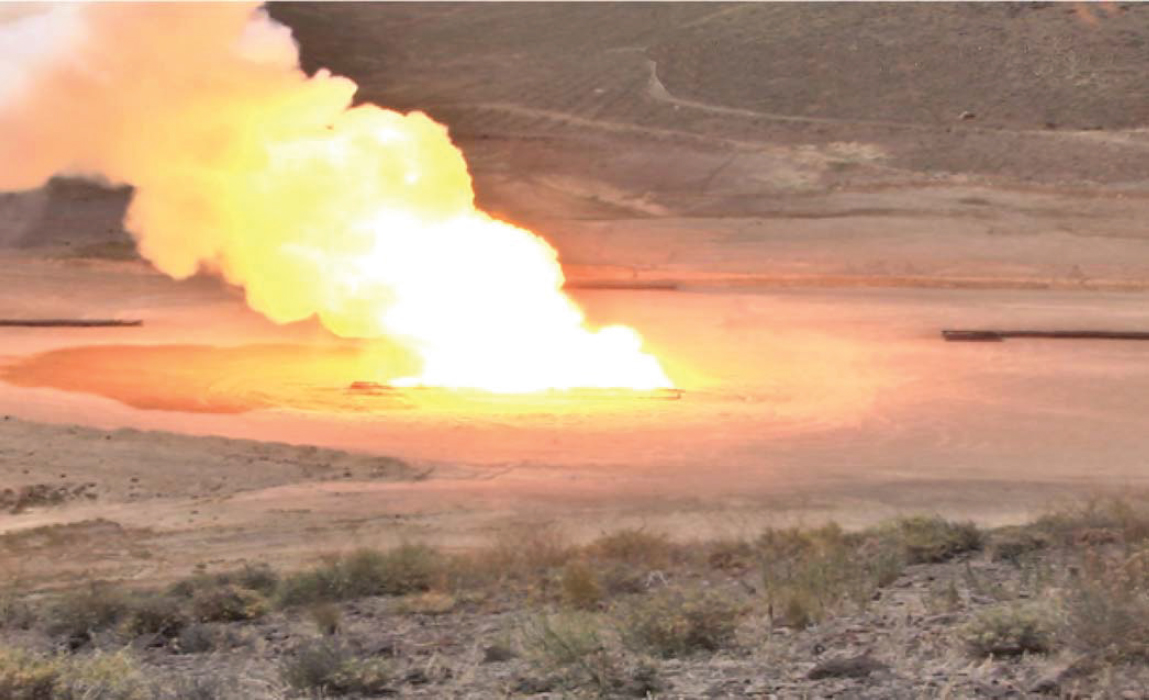
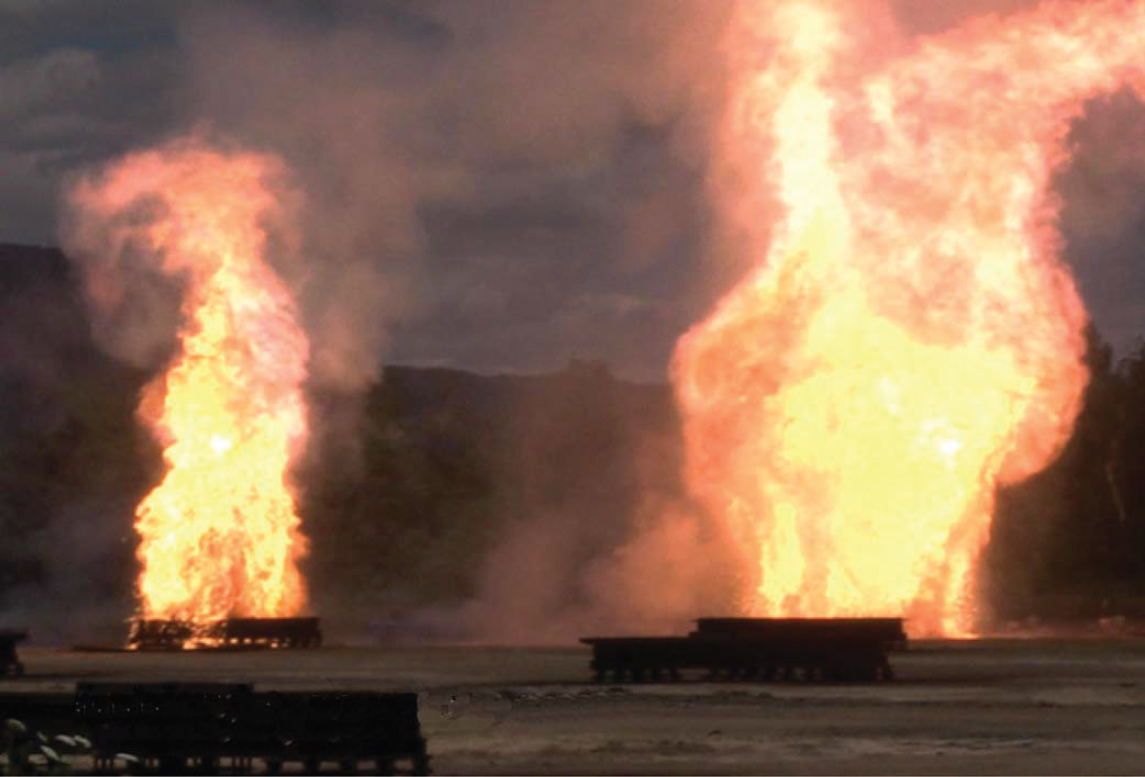
“Open Burn” is defined in DoD Manual 6055.9-M, Volume 8, as, “An open-air combustion process by which excess, unserviceable, or obsolete munitions are destroyed to eliminate their inherent explosive hazards” (DoD, 2012). Figures 3.1 and 3.2 show examples of OB operations.
OB is technically appropriate for the disposal of munitions, bulk energetics, and other waste materials that are unlikely to detonate and are more prone to burning when ignited. Examples of such munitions, bulk energetics, and waste materials include the following:
- Small arms ammunition (SAA): The only energetics in SAA are a small, smokeless powder propellant charge, a small primer, and a tracer in some SAA cartridges. These ignite or “cook off” when adequately heated, demilitarizing the SAA. OB of SAA is frequently performed in a containment cage or “popping furnace” or, in the case of CAAA, in “pipe pits.” As with all OB, the resulting air emissions are released directly to the atmosphere, and residues, consisting of melted projectiles and brass cases from the burned SAA, are left in the furnace to be periodically removed.
- Bulk propellants and other nondetonating energetics: Propellants removed from SAA and larger projectiles, rockets, and missile systems, and bulk propellant from propelling charges are appropriate for OB. They are either removed from the weapons system, spread out on a “burn pan,” and remotely ignited or (in the case of rocket and missile motors) can be static fired (Figure 3.3 shows a static fire operation). In both cases, there is very little physical residue from the energetics remaining at the OB site, as most of the energetics is consumed by the burning process. Only small amounts of ash remain after the burn, but, as with all OB, all of the airborne emissions are released directly without treatment to the atmosphere. The ash is removed following each OB event for subsequent disposal, typically as hazardous waste.
- Bulk explosives: Some bulk explosives are suitable for disposal by OB because they tend to burn efficiently and not detonate unless they are confined and the detonation is initiated by an adequate explosive initiator, such as a blasting cap. The process for burning bulk explosives is similar to that for OB
- of bulk propellants. The possibility of a high-order detonation during burning exists, so adequate separation distance between the OB site and personnel and structures is required.
- Waste contaminated with propellant, energetics, and other contaminants: Some of the depot RCRA permits authorize them to dispose of flammable contaminated material by burning, usually on a bed of scrap such as contaminated wood or other flammable material. In this case the burn is often started and sustained with added fuel oil.
The following general information and description of procedures for OB is based on the OB SOPs reviewed.
The range of material authorized for disposal by burning under the SOPs varies from being limited to only bulk propellant and propelling charges (e.g., at BGAD and TEAD) to the materials that may be burned at CAAA. CAAA is authorized to burn Composition B sludge; Explosive D and Explosive D contaminated material; rocket motors; white phosphorous; scrap red phosphorus and red phosphorus sludge; flare, smoke, and ignition compositions; contaminated waste solids (soaked in fuel oil to enable combustion); and contaminated liquids that are “positively identified as pyrotechnic, explosive, or propellant (PEP) contaminated.” These contaminated liquids “include, but are not limited to, acetone, toluene, hexane, fuel oil, minor amounts of 1,1,1 trichloroethane, cyclohexanone, denatured alcohol, dimethylfloroamide, and methylene chloride,” and other “contaminated solvents and sludges.”
The size and volumes of OB operations range from two burn pans that can be used a maximum of three times each 24-hour period (BGAD), with an estimated daily production rate at BGAD of 15,000 lb of explosives and propellants, to the OB operation at CAAA, which is authorized to burn the range of hazardous material as described above with the maximum per-pan burn limit based on the type of material being burned. The NEW limits at CAAA vary from a low of 25 lb for black powder, pentolite, and PETN to 1,000 lb of Composition B explosive and 1,500 lb wet weight for certain propellants that are shipped wet, such as “large web smokeless powder.”4 The CAAA SOP includes procedures for performing OB in
___________________
4 The CAAA SOP has different NEW limits and procedures for “small web smokeless powder” (defined as propellant used in 3-in. and smaller projectiles) and “large web smokeless powder” (defined as propellant used in projectiles larger than 3-in.).

- Eighteen steel pans.
- Three steel “sludge burn pans.”
- “Incinerator pits” with concrete containment floors and walls with the floor covered with a minimum of 6 in. of sand or a sand and clay mixture.
- Two “pipe pits,” which are wood dunnage-fueled systems with a munitions feed system using forced air “fire boxes” for burning small arms, cartridges, primers, tracers, detonators, blasting caps, and other munitions with relatively low NEW.
- An “incendiary cage,” which consists of the wood dunnage-fueled burn cage and a conveyor feed system that is used for burning larger flares, pyrotechnic signals, munitions candles, simulators, mortar primers, fuzes, small rocket motors, propellant charges, and other munitions with a greater NEW than is allowed in the “pipe pit.” This facility has a sand-covered concrete floor, and the burning can take place directly on the sand-covered concrete floor or in steel boxes placed atop the sand-covered concrete floor, depending on the method of feeding munitions into the system. Burning directly on the sand-covered concrete pad is performed to dispose of material that includes, “but should not be limited to: wood, cardboard, fiberboard, metal parts, plastics, ordnance hardware; projectile bodies, cartridge cases, mine/bomb skins, propellant containers/cans, that have been partially decontaminated by other methods, that is, physically emptied, burned, steam melted, water/chemically desensitized, or that have been visually inspected by qualified personnel, to assure that only minimal explosives are present.” Fuel-soaked wooden dunnage is used to fuel burns on the concrete pad.
- A “flashing pad complex” consisting of steel pans or boxes placed inside pits that are used to burn explosives, projectiles, and warheads that have been vented so that the explosives are unconfined.
All of the SOPs limit burning operations to periods of daylight when specific meteorological conditions are met including wind direction and speed, cloud cover, visibility, humidity, and ensuring that conditions are not conducive for lightning strikes.
The SOPs frequently have other restrictions prohibiting burning certain compounds, including hexachloroethane and other riot control agents, white phosphorus, plasticized white phosphorous, and red phosphorous (examples of depots with these restrictions are BGAD and LEAD). Not more than 55
gallons of solvents are specifically authorized for burning per day at MCAA.
The Army depots have consistent procedures for initiating the burns, and two methods of ignition, electric and nonelectric, are authorized for use. Some of the depots specify one type of ignition and others allow both types. Nonelectric ignition consists of a mechanical pull igniter and safety fuse (also known as “time fuse”) attached to an ignition charge burn initiator (locally prepared bags of smokeless powder). Electric ignition uses electrically fired “squibs” that are placed in the burn initiator bags and functioned to initiate each burn. In both cases the time fuse or the squibs are placed in locally prepared bags of smokeless powder, which are, in turn, placed and ignited in the burn pan or other apparatus to ignite the material to be burned. Most of the SOPs allow wood dunnage soaked with fuel oil be included in the burn to help ensure ignition.
Most of the SOPs have oversight and quality inspection requirements by “surveillance personnel” or the depot’s Quality Assurance Department, but these requirements vary.
The SOPs all employ the following general OB procedures:
- Technicians don the required personal protective equipment for each operation.
- A specified cooling time of approximately 2 hours must be observed following a previous burn. Some SOPs require taking temperature readings in the pans, while others allow water to be sprayed on the pans as a cooling technique.
- Usually the burn pans are cleaned of residue from the previous burn with subsequent containerization and disposal.
- Inspections are made to ensure proper bonding (grounding) of the burn pans.
- Required local notifications are made to the depot environmental and range managers and approval to initiate the burn is received.
The following procedures are implemented for each burn:
- The material to be burned is transported to the site and placed or poured into the pan(s). This is sometimes required to be a specific depth (a 3 in. deep layer at BGAD and McAlester Army Ammunition Plant), while other depots specify various depths of material and NEW depending on the type of material being disposed of (CAAA).
- Most personnel depart, while a minimum number of technicians remain at the burn pans to install the ignition systems in each burn pan.
- Depending on the type of ignition system used (electric or nonelectric), either the mechanical pull igniters are initiated and the technicians depart the area in a prepositioned safety vehicle to the designated observation point or the technicians depart to the firing point and initiate the electric squib ignitors.
The following procedures are implemented following the burn:
- Serviceable propellant containers are placed in storage for reuse. Unserviceable propellant containers are inspected, crushed, and removed as scrap.
- The required wait time is observed following the burn, and water wet-down of the pans may be performed if authorized.
- After the wait and cooling time the technicians perform an inspection. If there is unburned and “kicked-out”5 propellant, it is collected for addition to the next burn.
- Residue from the burn is removed from the pans and placed in drums for disposal as hazardous waste by the depot’s environmental division.
- Various methods for documenting the burns is completed. This varies from completing detailed forms to maintaining a range log book.
Open Detonation
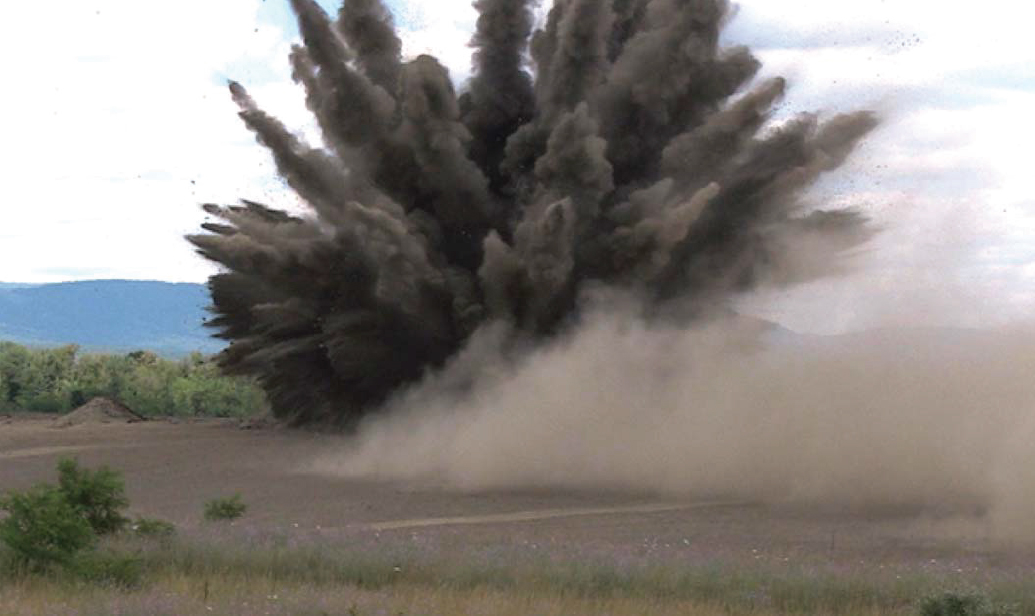
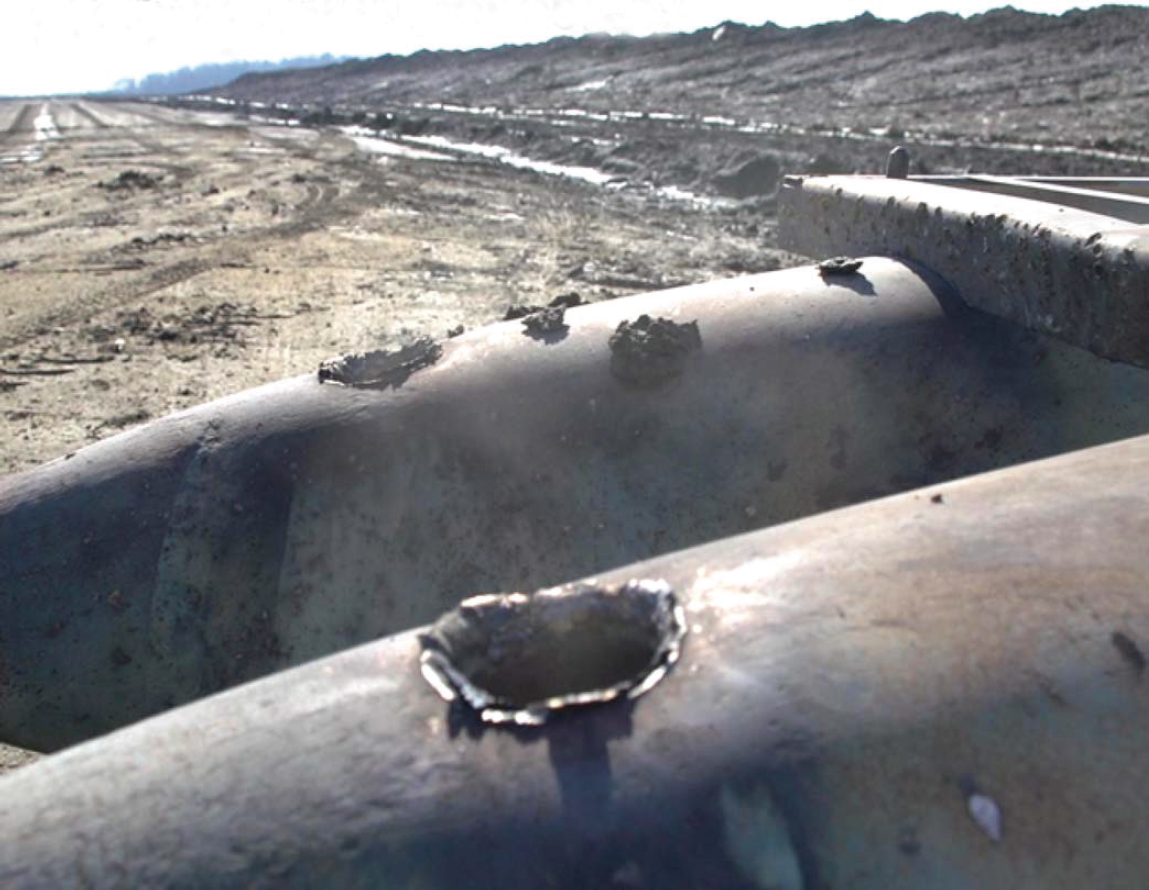
“Open Detonation” is defined in DoD Manual 6055.9-M as, “An open-air process used for the treatment of excess, unserviceable, or obsolete munitions whereby an explosive donor charge initiates the munitions being treated.” Figure 3.4 shows an OD operation. Figure 3.5 shows munitions being prepared for venting, which is explosively punching holes in the munitions casing, to expose the filler material and is considered to be OD because it is possible that the venting may cause a high-order detonation. Figure 3.6 shows the results of a venting operation.
Munitions and explosives that are likely to reliably detonate when initiated are technically appropriate for OD. OD is commonly performed by placing the munitions to be demilitarized into a prepared trench or pit, placing donor charges in contact with the munitions, placing prepared detonation initiators on the donor explosives, covering the prepared OD “shot” with soil removed from the trench (a process known as “tamping” designed to decrease the noise, shock, and debris ejected from the detonation), and then initiating the disposal detonation from a distant and protected location. The detonating donor explosives initiate almost immediate “sympathetic detonations” in the munitions, causing the munitions to also detonate, resulting in their demilitarization.
OD generally results in a greater amount of solid residue remaining at the site because there is usually a greater volume of inert components (such as bomb and projectile
___________________
5 The term “kick-out” is not defined in DoD Manual 6055.9-M. However, it is a term commonly used to describe whole or partial munitions or still-active energetics that are ejected from the site of a disposal burn or detonation and that represent a potential explosive or reactive hazard.

cases) input into the OD process compared to OB. Although the components and heavy steel cases of the munitions are demilitarized, they are not “consumed” by the detonation and are not actually “destroyed.” The inert components are shattered into fragments of varying sizes by the detonation, and the fragmented metal components, dispersed by the detonation, remain in the disposal trench and the surrounding area as defined by the fragmentation distance of the detonation. This makes the cleanup of solid residues from OD more time-consuming and costly than cleanup of residues from OB, which are most often confined to a burn pan.
Examples of munitions that are appropriate for OD demilitarization are munitions that are filled with high explosives and are designed to detonate such as projectiles, bombs, grenades, and rocket and missile warheads.
The following description of typical procedures implemented during OD operations is based on the SOPs provided by PD Demil for review. The various Army depot OD SOPs are more similar than those for OB, and the committee believes that the SOPs reviewed are representative of the procedures performed at the seven stockpile depots. The OD SOPs are typically approximately 80 pages in length.
The range maximum NEW limits are described in the SOPs, but they vary based on the size of the detonation facilities and the mission of the depot. For BGAD, OD is limited to doing disposals in 30 disposal pits with a 100 lb NEW for each pit (a maximum total of 3,000 lb per disposal detonation event). There are 6 primary demolition pits at CAAA, and the NEW limit for each pit is 500 lb, with a 70,000 lb NEW maximum allowed on the range. The CAAA range also has one pit designated for the disposal of rocket motors and a secondary range with a maximum NEW limit of 1,000 lb. TEAD has 19 detonation pits on the “TN Range” and 25 on the “TS Range,” with up to 3,000 lb NEW authorized for detonation in each pit.
Many of the SOPs contain prohibitions on the detonation of some types of munitions. Disposal by detonation of hexachloroethane and other riot control agents, colored smoke, white phosphorous, red phosphorus, and depleted uranium is specifically prohibited in the BGAD SOP. No prohibited
munition types are specified in the CAAA SOP. The LEAD SOP prohibits detonation of “dye filled rocket warheads and Navy armor piercing rounds.”
The OD SOPs contain specific weather and environmental conditions that are similar to the restrictions for OB that must exist before initiating a disposal operation. At BGAD each disposal detonation must be approved by a “planning team” that prepares a “daily authorization” for OD operations, and “surveillance personnel” must perform and document safety inspections of OD operations at least daily. The CAAA SOP has less rigid “notification requirements” to be implemented before OD is performed, and there are no specific surveillance or quality requirements, although it is possible that surveillance and quality requirements are contained in a different SOP belonging to those departments.
The type of initiation (electric or nonelectric) varies among the Army depots with some authorized to use both. The various depots also use different donor charges, most likely based on local availability. For example, at TEAD, TNT, Composition B, Composition C, and Bangalore Torpedoes6 are authorized for use as donor charges. In all cases the donor charges are initiated by detonation cord connected to initiator explosives (usually blocks of Composition 4 or TNT) that, in turn, are placed on the donor explosives.
The SOPs contain the following general procedures that are performed for each detonation shot:
- Checking continuity in the firing wire and the resistance of the blasting caps (electric initiation) or receiving the nonelectric initiation system components (for nonelectric initiation).
- Receiving the munitions for OD and the donor charges.
- Preparing the detonation pits by digging them at least 6 ft. deep using a bulldozer. Some of the SOPs specify different depths of excavation.
- Placing the munitions for disposal in the prepared pits as specified in detailed SOP requirements.
- Loading donor explosives on top of and around the disposal munitions.
- Preparing the electric or nonelectric detonation system. Normally two independent systems for each detonation are used to help avoid misfires and ensure high-order detonations.
- Placing the prepared initiation charge on the donor charge.
- Covering the prepared detonation shot with soil using a bulldozer while ensuring that the detonation cord is undamaged and protrudes from the ground. The minimum amount of soil to tamp the shot varies in the SOPs. Above-ground shots are authorized at LEAD, but they are limited to 50 lb NEW and are performed only when the demolition supervisors have determined that above-ground OD is necessary, typically for safety reasons. BGAD specifies covering each shot with at least 6 ft. of soil. An earth cover 15 ft. deep is required at TEAD for shots larger than 50 lb.
- Connecting the electric or nonelectric blasting caps to the detonating cord leading into each pit.
- Electric initiation of the detonations from the designated safe area after ensuring that the area is clear of personnel and approval for the detonation has been received. For nonelectric initiation the time fuse igniters are actuated at the disposal pits and the technicians then depart to the safe area.
- Procedures to be followed in the event of a misfire are included in the SOPs.
- Upon completion of the detonations the technicians inspect the demolition area and collect large debris and kick-outs. Large debris that does not contain explosives is collected for range maintenance and recycling. That with explosives is added to the next detonation event to achieve disposal.
- Reporting requirements vary among the SOPs with some requiring formal reports and others using log book entries.
REFERENCES
Aurell J., and B. Gullett. 2017. Characterization of Air Emissions from Open Burning at the Radford Army Ammunition Plant. https://www.deq.virginia.gov/Portals/0/DEQ/Land/Radford/Radford_Final_Report.pdf?ver=2017-09-27-151820-227.
BGAD (Blue Grass Army Depot). 1996. Standard Operating Procedure BG-0000-H-007 (Revision 9, Change 3), Demilitarization by Open Burning and Standard Operating Procedure BG-0000-G-163 (Revision 10, Change 1), Demilitarization by Detonation. Richmond, Ky.: Blue Grass Army Depot.
CAAA (Crane Army Ammunition Activity). 2017a. Standard Operating Procedure CN-0000-H-003 (Revision 5, Change 1). Destruction by Burning by Various Methods at the Ammunition Burning Grounds or the Demolition Range Explosives Burning/Flashing Pad Complex.
CAAA. 2017b. Standard Operating Procedure CN-0000-G-241 (Revision 6, Change 2), Disposal of Ammunition, Explosives and Other Dangerous Articles (AEDA) By Detonation.
DA (Department of the Army). 1982. TM 9-1300-277. General Instructions for Demilitarization/Disposal of Conventional Munitions. Washington, D.C.: Headquarters, Department of the Army.
DoD (U.S. Department of Defense). 2012. Manual Number 6055.09-M, Volume 8. DoD Ammunition and Explosives Safety Standards: Glossary. https://www.wbdg.org/FFC/DOD/DODMAN/605509-M-V8.pdf.
Gullett, B.K., J. Aurell, and R. Williams. 2016. Characterization of Air Emissions from Open Burning and Open Detonation of Gun Propellants and Ammunition. https://cfpub.epa.gov/si/si_public_record_report.cfm?dirEntryId=337030.
___________________
6 A Bangalore torpedo is a high-explosive-filled steel tube designed for use by soldiers for cutting trenches and clearing minefields.
Letterkenny Army Depot. 2017. Standard Operating Procedure LE-0000-G-014 Revision 8, Change 0. Detonation of Conventional Ammunition, Missile Items and Components at Demolition Ground #2. Chambersburg, Pa.: Letterkenny Army Depot.
McAlester Army Ammunition Plant. 2017. Standard Operating Procedure MC-0000-H-003 Revision 15, Change 2. Burning of Miscellaneous Ammunition of Explosives. McAlester, Okla.: McAlester Army Ammunition Plant.
Tooele Army Depot. 2017a. Standard Operating Procedure TE-0000-H-012 Revision 8. Destruction of Bulk Propellant and Propellant Charges by Burning. Tooele, Utah.: Tooele Army Depot.
Tooele Army Depot. 2017b. Standard Operating Procedure TE-0000-G-010 Revision 14. Detonation of High Explosive (HE) Munitions and Explosive Components. Tooele, Utah.: Tooele Army Depot.
Tooele Army Depot. 2017c. Standard Operating Procedure TE-0000-J-168 Revision 2, Change 1. Static Firing of Rocket Motors and JATOS, all DODICs. Tooele, Utah: Tooele Army Depot.
Wilcox, J.L., B. Entezam, M.J. Molenaar, and T.R. Shreve. 1996. DPG-TR-96-015. Characterization of Emissions Produced by Open Burning/Open Detonation of Complex Munitions. http://www.dtic.mil/dtic/tr/fulltext/u2/a349149.pdf.


