Memorial Tributes: Volume 22 (2019)
Chapter: ALEXANDER H. FLAX
This page intentionally left blank.
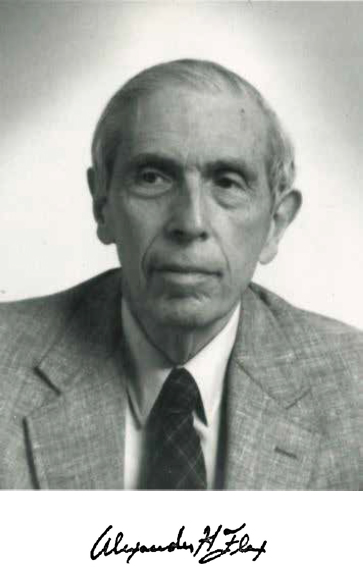
ALEXANDER H. FLAX
1921–2014
Elected in 1967
“Solid and fluid mechanics and aerodynamics.”
ALEXANDER HENRY FLAX passed away June 30, 2014, at age 93 after a long and distinguished career as an engineer and scientist, a leader in government and industry, and a valued advisor. He was NAE home secretary from 1984 to 1992.
Al was born to David and Etta Flax on January 18, 1921, in Brooklyn, New York. A high school teacher inspired his interest in mathematics and, after he graduated at age 16, he went on to receive his BS in aeronautical engineering from New York University and PhD in physics from the University of Buffalo.
His career was largely in the world of aerospace, aviation, and defense, beginning with employment at Curtiss-Wright Corporation, Piasecki Helicopter Corporation (later acquired by Boeing), and Cornell Aeronautical Laboratory (now Calspan Corporation).
At Curtiss-Wright (1940–44) he introduced analytical methods for developing and using ground and flight instrumentation in aircraft design, development, and flight testing, applying these methods to problems in vibration, flutter, and structural leads for flight dynamics. He spearheaded the development and adoption of electric strain gauges in aeronautical instrumentation and provided insights to address “the compressibility effect” (excessive vibration) in aircraft at high speeds.
In his work at Piasecki (1944–46) he headed a group of engineers who developed twin-rotor tandem helicopters, which are still in use (the Boeing CH-47 Chinook). He also led the technical effort that yielded aerodynamic structures testing and weight control, including the development of methods of design analysis and testing.
At Cornell Aeronautical Laboratory (1946–59 and 1961–63) his analytical and flight test correlations contributed to flight stability and helicopter blade design. He led research in supersonic aerodynamics, flight control, and ram-jet propulsion, and significantly enhanced wind tunnel capacity for supersonic and hypersonic testing.
He served as chief scientist of the Air Force (1959–61) and then assistant secretary of the Air Force for Research and Development (1963–69) under Presidents John Kennedy and Lyndon Johnson. He was the third director of the National Reconnaissance Office (NRO) at a time when the second generation of imaging systems became operational and important in US intelligence during the Cold War. He advocated major growth in NRO funding and personnel, oversaw the production of signals intelligence collectors from space, and promoted the development of an electro-optical imaging system for US reconnaissance satellites. From there he became president of the Institute for Defense Analyses (IDA; 1969–83).
In addition, he was a long-time consultant to the Defense Science Board (DSB; 1974–87) and President’s Foreign Intelligence Advisory Board (1982–87).
He was a member of numerous government and university advisory boards, committees, and panels. He served on the Air Force Scientific Advisory Board, DSB, and Federal Emergency Management Agency advisory board, and chaired the Defense Intelligence Agency (DIA) advisory committee.
He was also active in the work of the NAE and National Research Council, as a member of the Panel on the Impact of National Security Controls on International Technology Transfer (1985–87), Committee on a Commercially Developed Space Facility (1988–89), and Committee on NASA Scientific and Technological Program Reviews (1981–93), among others.


