Memorial Tributes: Volume 22 (2019)
Chapter: GREGORY S. VASSELL
This page intentionally left blank.
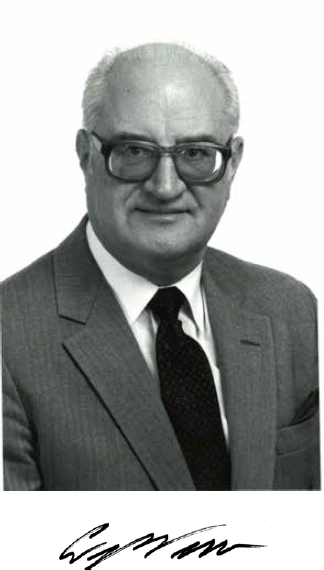
GREGORY S. VASSELL
1921–2016
Elected in 1980
“Contributions in the field of electric energy supply, both as to its technical features and its societal implications.”
GREGORY S. VASSELL, who promoted the development of AEP’s extra-high-voltage transmission system, including the 765KV network, now the nation’s largest, died November 3, 2016, at the age of 94 in Dublin, Ohio.
He was born December 24, 1921, in Moscow. In 1930 he and his parents escaped the Soviet Union, and in 1951 he earned an advanced degree in electrical engineering from the Technical University of Berlin-Charlottenburg, Germany. Shortly thereafter, he emigrated to the United States, where he began his career as an assistant engineer at the American Electric Power Service Corporation (AEP) in New York City. He earned an MBA from New York University in 1954 and became a US citizen in 1957.
At AEP Greg advanced through the engineering levels in the 1950s and 1960s to become assistant vice president in 1968, vice president of system planning in 1973, and senior vice president in 1976, eventually relocating to Ohio. He also served on the AEP board of directors (1973–87). He retired from AEP at the end of 1987 but continued to work as an independent consultant, arbitrator, and mediator until 2001, when he retired a second time, at age 81.
During his career he was responsible for formulating plans for the construction of thousands of miles of high-voltage and
extra-high-voltage transmission lines as well as the location of many major power plants throughout the Midwestern United States. For his substantial contributions in transmission engineering, AEP named a 765/345/138 kilovolt (KV) “super” station in Sunbury, Ohio, after him.
He published many technical papers and articles in professional journals in the United States and abroad. He also delivered a number of talks and lectures on various aspects of power system planning and operation in general, and on extra-high-voltage transmission planning, generating capacity reserve planning, pumped-storage hydro planning, electric bulk power supply reliability, power plant siting, load forecasting, generating capacity efficiency and reliability, and the structure of the electric utility industry.
In addition, he testified before congressional committees and state legislatures and appeared on innumerable occasions as an expert witness before the Federal Energy Regulatory Commission (FERC; and its predecessor, the Federal Power Commission), the Securities and Exchange Commission, and state regulatory commissions.
Greg was active in national and international efforts concerning power generation and transmission. His analysis of the cause of the 1965 blackout1 led to his participation in the founding of the East Central Area Reliability Coordination Agreement. He served on the Federal Power Commission Technical Advisory Committee on Transmission (1970); National Power Survey (chair, System Aspects Subcommittee) (1968–70); US delegations to the Soviet Union to study extra-high-voltage transmission facilities (1972) and to study the design, construction, and operation of large electric generating plants (1973), both under the US-USSR Exchange Agreement; FERC Task Force on Power Pooling (1980–81); and Atlantic
___________________
1 Late in the afternoon of November 9, 1965, a design failure in a protective setting at a single power station triggered a cascade effect that disrupted the electricity supply for more than 30 million people over 80,000 square miles in Ontario, Connecticut, Massachusetts, New Hampshire, New Jersey, New York, Rhode Island, Pennsylvania, and Vermont. The outage lasted 13 hours in some places.


