Leading Health Indicators 2030: Advancing Health, Equity, and Well-Being (2020)
Chapter: Summary
Summary
Beginning in 1979 and in each subsequent decade, the Department of Health and Human Services (HHS) has overseen the Healthy People initiative to set national goals and objectives for health promotion and disease prevention. Like its predecessors, Healthy People 2030 (HP2030) includes a conceptual framework, a large set of objectives organized by topics, and a smaller set of high-level priority measures called Leading Health Indicators (LHIs). The committee that authored this report was asked to contribute two components to inform the HHS process illustrated in Figure S-1.
The HHS Office of the Assistant Secretary for Health has charged the National Academies of Sciences, Engineering, and Medicine committee to assist in the development of the LHIs for HP2030. The committee will develop (1) recommendations regarding the criteria for selecting LHIs and (2) a slate of LHIs that will serve as options for the Healthy People Federal Interagency Workgroup to consider as they develop the final criteria and set of LHIs for HP2030. The committee may identify gaps and may recommend new objectives for LHI consideration that meet the core objective criteria.
The committee’s first report, Criteria for Selecting the Leading Health Indicators for Healthy People 2030 (NASEM, 2019c), was released in August 2019 and responded to the first part of the charge. The present report responds to the second part of the charge—putting forward a slate
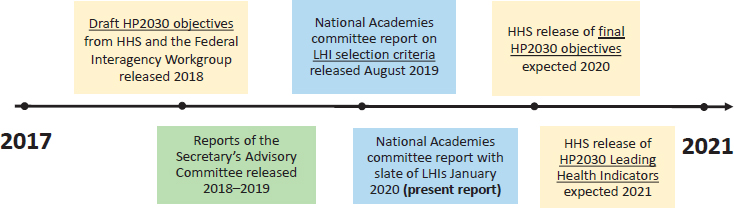
NOTES: National Academies reports are denoted in blue. HHS = Department of Health and Human Services; HP2030 = Healthy People 2030; LHI = leading health indicator.
SOURCE: NASEM, 2019c.
of LHIs based on its review of draft core objectives for HP20301 as well as identifying any gaps in the objectives and recommending additions.
The committee reviewed past and current Healthy People materials, both those developed by HHS and the current Secretary’s Advisory Committee on National Health Promotion and Disease Prevention Objectives for 2030 (SAC), and prior National Academies reports.
FINDINGS AND RECOMMENDATIONS
In this report, the committee recommends a set of 34 LHIs organized by the 12 themes from the HP2030 Framework (see Table S-1).2 The committee took three steps to assemble the most appropriate slate of LHIs:
- It applied the criteria for LHI selection developed by the current SAC, along with the committee’s own guidance about using alignment with the HP2030 Framework as a criterion.
- In cases where a draft HP2030 objective was not available, it added a new objective if it met the SAC-described objective selection criteria.
- It applied the SAC’s criteria for the set of LHIs to the 34 LHIs collectively.
___________________
1 According to HHS, the LHIs are to be selected from the HP2030 objectives, which had not been finalized at the time this report was prepared.
2 The committee did not comment on targets for the LHIs or their associated objectives as that was not part of its charge.
The committee also made the following four findings regarding important topics that call for an LHI, but where the state of the field does not currently provide adequate support for such an indicator.
How the Proposed LHIs Differ from Past Sets
The Healthy People objectives and the Healthy People LHIs are used by agencies at all levels of government and in the private sector to guide various population health improvement agendas. The following examples illustrate the reach of the Healthy People effort in states and localities, such as Healthy Alaskans 2020, Healthy New Jersey, and Healthy Sonoma (California). HHS has been conducting a periodic series of webinars about the HP2020 LHIs, called “Who’s Leading the Leading Health Indicators” featuring state, local, and private-sector (e.g., health system) initiatives and activities on specific LHIs.3 The organization Grantmakers in Health
___________________
3 See, for example, https://health.gov/news/events/2019/08/webinar-whos-leading-the-leading-health-indicators-nutrition-physical-activity-and-obesity-3 (accessed December 31, 2019).
developed a resource portfolio on the LHIs for HP2010.4 The National Indian Health Board selected HP2020 LHIs that addressed the American Indian/Alaska Native population.5
The LHIs recommended in this report (see Table S-1) differ from past sets in several important ways. First, they are substantially reflective of the HP2030 Framework, which has health, equity, and well-being at its center. The LHI set recommended includes measures of well-being and health-related quality of life (these types of measures had been included in HP2020, but not among the draft core objectives for HP2030), and measures of equity that go beyond merely disaggregating data by race, ethnicity, sex, or geography and examine segregation and discrimination (see NASEM, 2017) for a discussion of poverty, racism, and discrimination as the root causes of health inequities.
Second, the LHIs include fewer health conditions; the need for parsimony and alignment with the HP2030 Framework required more measures of upstream factors that shape health (i.e., the causes of causes of poor health [Wilkinson and Marmot, 2003]). To keep the number close to 30 (the committee’s original aim), members carefully considered the tradeoffs for each LHI selected. However, many important measures of health conditions (e.g., diabetes, chronic kidney disease, specific types of cancer) are included in the draft objectives for HP2030, and they will be monitored by different agencies at different levels of government in the course of HP2030 implementation even if they may not be included among the small number of final LHIs.6
Third, the recommended LHIs are to a lesser extent than ever before linked with the health care delivery system’s capabilities and its metrics. Rather, many of the LHIs are indicators of how people live their lives in the United States—shaped by the broad context of policies, systems,
___________________
4 See https://www.gih.org/publication/the-nations-leading-health-indicators-measuring-progress-taking-action (accessed December 18, 2019).
5 See https://www.nihb.org/public_health/healthy_people_2020.php (accessed December 18, 2019).
6 In winnowing the objectives to select LHIs the committee resolved to have certain indicators stand for a series of objectives that were of a similar nature. For example, hypertension was selected because for the prevalence to decrease many things need to happen: salt in the food supply and in people’s diets needs to decrease; people need to have access to medical care, the medical care needs to be of good quality, people need to be able to afford the medications and/or change their behavior to achieve hypertension control (see, for example, CDC, 2011). Also, hypertension is a greater risk factor than cholesterol for cardiovascular disease (WHO, 2017). For many of the other clinical preventive services (colon, breast, and prostate cancers), although there is evidence of environmental risks (with tobacco being among the best understood), many of them and potential interventions are not as well elucidated or understood as for hypertension, perhaps making related measures less likely to meet the LHI criterion “actionable” (AACR, 2019).
TABLE S-1 Recommended Leading Health Indicators
| No. | LHI Candidate | Measure (new objective, unless HP2030 draft core objective is listed, denoted by XX-2030-XX*) | HP2030 Framework Concepts (see Figure 1-1) |
|---|---|---|---|
| 1 | Life expectancy | Increase life expectancy (at birth) | Closing gaps: Health Equity |
| 2 | Child health | MICH-2030-02 Reduce the rate of all infant deaths | Health and Well-Being Across the Lifespan: Physical Health |
| 3 | Child health and well-being | Reduce the prevalence of one or more adverse childhood experiences (ACEs) from birth to age 17 | Health and Well-Being Across the Lifespan: Mental Health |
| 4 | Self-rated health | Increase the mean healthy days (CDC HRQOL–14 Healthy Days) | Health and Well-Being Across the Lifespan: Physical Health |
| 5 | Well-being | Increase proportion thriving on Cantril’s Self-Anchored Striving Scale | Health and Well-Being Across the Lifespan: Physical Health |
| 6 | Disability | Reduce the percentage of adults aged 65 years and over with limitations in daily activities | Health and Well-Being Across the Lifespan: Physical Health |
| 7 | Mental disability | Reduce the rate of mental disability | Health and Well-Being Across the Lifespan: Mental Health |
| 8 | Substance use | SU-2030-03 Reduce drug overdose deaths | Health and Well-Being Across the Lifespan: Physical Health |
| 9 | Unintentional injury deaths | IVP-2030-03 Reduce unintentional injury deaths | Increasing Knowledge and Action: Physical Health |
| 10 | All cancer deaths | C-2030-01 Reduce the overall cancer death rate | Health and Well-Being Across the Lifespan: Physical Health |
| 11 | Suicide | MHMD-2030-01 Reduce the suicide rate | Health and Well-Being Across the Lifespan: Mental Health |
| 12 | Firearm-related mortality | IVP-2030-12 Reduce firearm-related deaths | Health and Well-Being Across the Lifespan: Physical Health |
| 13 | Maternal mortality rate | MICH-2030-04 Reduce maternal deaths | Closing Gaps: Health Equity |
TABLE S-1 Continued
| No. | LHI Candidate | Measure (new objective, unless HP2030 draft core objective is listed, denoted by XX-2030-XX*) | HP2030 Framework Concepts (see Figure 1-1) |
|---|---|---|---|
| 14 | Mental health | Reduce percentage of adults who reported their mental health was not good on 14 or more days in the past 30 days (i.e., frequent mental distress) | Health and Well-Being Across the Lifespan: Mental Health |
| 15 | Oral health access | OH-2030-08 Increase the proportion of children, adolescents, and adults who use the oral health care system | Health and Well-Being Across the Lifespan: Physical Health |
| 16 | Reproductive health care services | FP-2030-07 Increase the proportion of sexually active adolescents aged 15 to 19 years who use any method of contraception at first intercourse | Health and Well-Being Across the Lifespan: Access to Quality Public Health and Clinical Care Systems |
| 17 | HIV incidence | HIV-2030-03 Reduce the number of new HIV diagnoses among persons of all ages | Health and Well-Being Across the Lifespan: Physical Health |
| 18 | Tobacco | TU-2030-13 Reduce the use of any tobacco products by adolescents | Increasing knowledge and action: Evidence-based laws, policies, and practices |
| 19 | Obesity | NWS-2030-03 Reduce the proportion of children and adolescents aged 2 to 19 years who have obesity | Health and Well-Being Across the Lifespan: Physical Health |
| 20 | Alcohol use | SU-2030-13 Reduce the proportion of people with alcohol use disorder in the past year | Health and Well-Being Across the Lifespan: Physical Health |
| 21 | Immunization | Increase the proportion of 19–35-month-old children up to date on DTaP, MMR, polio, Hib, HepB; varicella, and pneumococcal conjugate vaccines | Increasing knowledge and action: Evidence-based laws, policies, and practices (also public health successes) |
| 22 | Hypertension rate | HDS-2030-04 Reduce the proportion of adults with hypertension | Health and Well-Being Across the Lifespan: Physical Health |
TABLE S-1 Continued
| No. | LHI Candidate | Measure (new objective, unless HP2030 draft core objective is listed, denoted by XX-2030-XX*) | HP2030 Framework Concepts (see Figure 1-1) |
|---|---|---|---|
| 23 | Ambulatory care-sensitive conditions/avoidable hospitalization | Reduce discharges for ambulatory care-sensitive conditions per 1,000 Medicare enrollees (CMS-2) | Health and Well-Being Across the Lifespan: Access to Quality Public Health and Clinical Care Systems |
| 24 | Medical insurance coverage | AHS-2030-01 Increase the proportion of persons with medical insurance | Health and Well-Being Across the Lifespan: Access to Quality Public Health and Clinical Care Systems |
| 25 | Affordable housing | SDOH-2030-04 Reduce the proportion of all households that spend more than 30 percent of income on housing | Cultivating Healthier Environments: Social Environment |
| 26 | Environment | Improve the Environmental Quality Index | Cultivating Healthier Environments: Physical Environment |
| 27 | Environment | Lower the Heat Vulnerability Index | Cultivating Healthier Environments: Physical Health |
| 28 | Education | AH-2030-04 Improve the fourth grade reading level | Cultivating Healthier Environments: Social Environment |
| 29 | Poverty | SDOH-2030-03 Reduce the proportion of persons living in poverty | Cultivating Healthier Environments: Economic Environment |
| 30 | Food security | NWS-2030-01 Reduce household food insecurity | Cultivating Healthier Environments: Social Environment |
| 31 | Civic engagement | Increase the proportion of voting eligible population that votes | Cultivating Healthier Environments: Social Environment |
| 32 | Social environment | Lower the Neighborhood Disinvestment Index | Closing Gaps: Health Equity |
| 33 | Social environment | Reduce the level of residential segregation captured by the Index of Dissimilarity | Closing Gaps: Health Equity |
TABLE S-1 Continued
| No. | LHI Candidate | Measure (new objective, unless HP2030 draft core objective is listed, denoted by XX-2030-XX*) | HP2030 Framework Concepts (see Figure 1-1) |
|---|---|---|---|
| 34 | Social environment | Reduce the level of residential segregation captured by the Isolation Index | Closing Gaps: Health Equity |
NOTE: CHR = County Health Rankings; CMS-2 = a chronic conditions composite measure developed by Centers for Medicare & Medicaid Services; DTaP = diphtheria; Hep B = hepatitis B; Hib = Haemophilus influenzae type B; HIV = human immunodeficiency virus; MMR = measles, mumps, rubella.
* Items that include an acronym or abbreviation that represents the topic and the draft objective number, such as, “SU-2030-03: Reduce drug overdose deaths,” are draft HP2030 objectives, which are listed in Appendix E. All others are new objectives.
social structures, and economic forces. This is true of many of the LHIs, including firearms-related mortality, deaths by suicide and drug overdose, maternal mortality, voting as a measure of civic engagement, and the health effects of climate change. Finally, the recommended LHIs are intended to balance those that operate and are measured at the individual level with those that operate and are measured at the environmental level (biological, physical, chemical, social).


