Governance and Management of the Nuclear Security Enterprise (2020)
Chapter: 2 National and Departmental Leadership and Coordination
2
National and Departmental Leadership and Coordination
IMPORTANCE OF NATIONAL LEADERSHIP
The Augustine-Mies report expressed concern that the nuclear security enterprise was at risk of eroding because it was no longer receiving the attention and leadership needed from the President and Congress. The introduction summarized the problem then (in 2014) as follows:
At the root of the challenges faced by the nuclear enterprise is the loss of focus on the nuclear mission across the nation and within U.S. leadership as a whole since the end of the Cold War. Every aspect of the enterprise is colored by the fact that, bluntly stated, nuclear weapons have become orphans in both the Executive and Legislative branches. This has been reflected by the lack of an urgent and clear mission and lack of follow-through in assuring adequate performance to modernize the nuclear stockpile on schedule and on budget.1
That report explained that many of those working in the national security enterprise felt that they were in a declining career field and that the results produced by the enterprise were frequently unacceptable. The report assigned much of the blame for that situation to the lack of urgency and clarity of their mission, concluding that the only way the situation would improve was with “[s]ustained and focused national commitment.”2
This study’s panel has found that the situation has improved compared to that described by Augustine-Mies. The 2018 Nuclear Posture Review (NPR) emphasizes the need for a strong nuclear deterrent
___________________
1 Congressional Advisory Panel on the Governance of the Nuclear Security Enterprise, 2014, A New Foundation for the Nuclear Enterprise: Report of the Congressional Advisory Panel on the Governance of the Nuclear Security Enterprise, http://cdn.knoxblogs.com/atomiccity/wp-content/uploads/sites/11/2014/12/Governance.pdf, p. xi.
2 Congressional Advisory Panel on the Governance of the Nuclear Security Enterprise, 2014, p. xi.
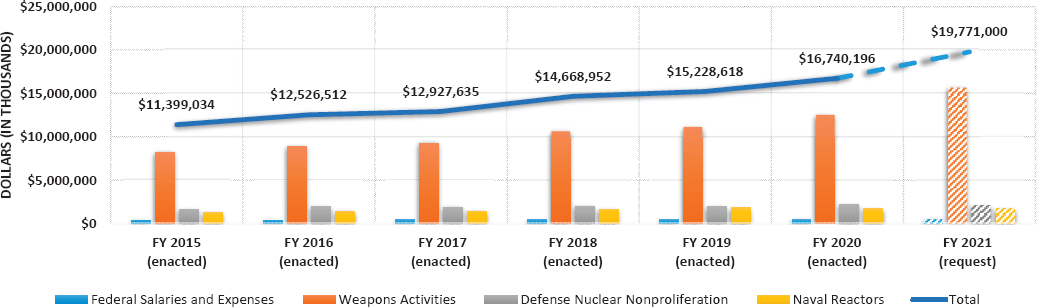
and supports the development of new delivery platforms and continued upgrades and life extensions for nuclear weapons. Both the National Nuclear Security Administration (NNSA) Administrator and the Department of Defense (DoD) Secretary have stated that modernization of the strategic nuclear triad is the President’s number-one priority.3 While the nuclear triad is often thought of in terms of bombers, land-based missiles, and submarines, the warheads are an integral part. The President and Congress clearly recognized this in requesting a FY 2021 budget for NNSA with an increase of 25 percent over the FY 2020 budget, which itself had seen a significant increase from earlier years (see Figure 2.1).
In Congress, six different committees interact with the nuclear security enterprise—two authorizing committees in the Senate and two in the House, plus the Appropriations Committees in the Senate and the House.4 The variation in interests across these committees has the potential to lead to differing guidance and directions.
Moreover, some in Congress and the public have advocated substantially different positions in terms of what the national policy should be to maintain the nuclear deterrent and how much funding should be provided for it. Under these circumstances, budget levels and mission requirements might not be stable from year to year, enactment of relevant legislation may be delayed, and mismatches might arise between mandated activities and funding levels and between schedules for weapons and delivery platforms. Under such uncertainty, strong governance and management is all the more important to ongoing operations and the transparency that helps to enable course corrections. For example, limited or unstable budgets can exacerbate tensions between NNSA and DoD or among components of NNSA and its operating partners, which reliable and transparent management practices can help mitigate. Likewise, in the face of uncertain budgetary resources, strong strategic and operational planning are all the more essential
___________________
3 In recent congressional testimony, Administrator Gordon-Hagerty stated that “modernization of the nuclear triad is the President’s number one priority” (House Energy Appropriations hearing, March 3, 2020). Likewise, Defense Secretary Esper recently stated, “The president was very clear to me, to the Pentagon, to the Hill, that modernization of our strategic nuclear forces is priority number one. So, we made it priority number one in our budget. And the numbers should show that” (February 19, 2020), https://www.defense.gov/Newsroom/Transcripts/Transcript/Article/2088918/secretary-of-defense-dr-mark-t-esper-media-availability-at-minot-afb/.
4 Legislative authorization and congressional oversight are conducted by the House and the Senate Armed Services Committees and by the House Committee on Energy and Water Development and by the Senate Committee on Energy and Natural Resources. The Energy and Water Subcommittees of the House and Senate Appropriations Committees develop and legislate appropriations.
for anticipating and planning how to maintain critical physical infrastructure, human capital, and other aspects of the enterprise’s capabilities. In such circumstances, active communication and outreach to all parties with timely and complete information can be particularly important to enable effective planning.
THE DEPARTMENT OF ENERGY’S ROLE WITH REGARD TO THE NUCLEAR SECURITY ENTERPRISE
The Augustine-Mies report found that, because of the way in which NNSA’s statutory position within the Department of Energy (DOE) was then implemented, the ownership and accountability for NNSA’s mission were blurred and the resulting arrangement “did not achieve the intended degree of clarity in enterprise roles and mission ownership. NNSA was not provided the line management authority necessary to execute NNSA’s missions; nor was an effective policy implementation framework established.”5
An aspect of the relationship between DOE and NNSA that the Augustine-Mies report found to be particularly concerning was the overlap of DOE’s and NNSA’s functional offices. The report explained that the NNSA Act had established NNSA as a “separately organized” component of DOE and provided the NNSA Administrator with headquarters functional staffs independent from those in DOE; yet, “[d]espite the creation of NNSA’s parallel staff structure,” DOE had established “management processes requiring that major NNSA decisions and initiatives would remain subject to myriad DOE headquarters staffing processes.”6 This confusion in roles and responsibilities of DOE’s and NNSA’s headquarters offices led to two damaging dynamics for the enterprise:
- It was exceedingly difficult for personnel responsible for operations to get clear direction and decisions—there were “no clear lines of appeal or decision making and no integrated place for the cost benefit analysis to be done” (quoting a field representative at the time).7
- Some DOE mission support organizations saw their role as a mission in itself, rather than as a support function. As Augustine-Mies described it, “some organizations responsible for mission support functions often operate[d] independently of line management.”8
The consequence of this DOE-NNSA interaction was a “tendency to skew incentives toward delay and excessively conservative approaches at the DOE headquarters level.”9
The Augustine-Mies panel considered whether there was a better organizational model for NNSA, specifically considering the options of it being either an independent agency or an element of DoD. Ultimately, they reached the unanimous conclusion that remaining within DOE, with some adjustments, was the best course. Their report recommended that the DOE Secretary be expected to take a more substantial role in leadership and in setting policy for the nuclear security enterprise, which represents more than half of DOE’s budget. This change was intended both to provide Cabinet-level commitment to the mission and to evoke the Secretary’s leadership in keeping the department’s functional offices mission-focused when dealing with nuclear security matters. Some of the specific recommendations
___________________
5 Congressional Advisory Panel on the Governance of the Nuclear Security Enterprise, 2014, p. 21.
6 Congressional Advisory Panel on the Governance of the Nuclear Security Enterprise, 2014, p. 22.
7 Congressional Advisory Panel on the Governance of the Nuclear Security Enterprise, 2014, p. 23.
8 Congressional Advisory Panel on the Governance of the Nuclear Security Enterprise, 2014, p. 23.
9 Congressional Advisory Panel on the Governance of the Nuclear Security Enterprise, 2014, p. 23.
made by the Augustine-Mies panel would have required legislative revisions to the NNSA Act, which have not been taken up.10
Whereas the legislative steps recommended by Augustine-Mies to address overlapping staffs and blurred accountability have not been enacted, DOE and NNSA have worked together in other ways since 2014 to address the concerns that Augustine-Mies raised. For example,
- Steps have been taken to establish better working relations and coordination between offices within DOE and NNSA that are responsible for overlapping functional responsibilities, such as for financial management, environment, health, safety, and security.
- Certain organizations in NNSA have been assigned responsibilities to monitor how DOE’s functional offices affect the nuclear security enterprise and to advocate on behalf of the enterprise. Specifically, NNSA’s Office of Audits and Internal Affairs serves as the “front door” for coordinating, and sometimes negotiating with, external auditors, and NNSA’s Operations and Efficiencies Board leads or participates in departmental Regulatory Reform Task Force working groups that review burdensome regulations.
- Line managers’ ownership of mission, and functional offices’ roles in support of the mission, have been clarified.
The Augustine-Mies report stated that, at the time of its study, “NNSA was not provided the line-management authority necessary to integrate safety, security, and environmental concerns into the decision making for executing NNSA’s missions.”11 The Secretary’s new policy on roles and responsibilities in 2016 changed that and specifically made line managers responsible for making integrated risk decisions on behalf of the department.12 NNSA continues to pursue clarification and reinforcement that line managers within NNSA make integrated risk decisions and that functional offices serve in support of line managers’ mission authority.
During its many interviews and discussion groups, the panel heard nothing to indicate that the current dynamic with DOE deprives the Administrator or others within NNSA of line-management authority as codified in formal documents.
On the other hand, the panel has heard from NNSA and management and operating (M&O) personnel about some interactions with DOE’s functional offices that they found concerning. In the area of financial management, some NNSA officials and others have stated that reprogramming requests, which must go through the DOE Chief Financial Officer (CFO) on their way to the Office of Management and Budget (OMB), have been delayed or disapproved without clear rationale, and the DOE CFO was cited as a source of delay in some other cases. On the other hand, some DOE and NNSA officials defended these sorts of restrictions as representing the DOE CFO doing the necessary job of the office. In the area of nuclear safety, an NNSA official said that DOE auditors reviewing the handling of Special Nuclear Materials sometimes are not sufficiently knowledgeable or are unduly rigid—for example, they may
___________________
10 To establish the Secretary’s leadership role, the Augustine-Mies report recommended enactment of legislation to make the Secretary “the lead authority responsible and accountable to the President and the Congress for the Department’s nuclear security mission” and to terminate the NNSA’s status as a “separately organized agency,” making it instead an “Office” in the department. The Director of the new office would execute the mission “consistent with the Secretary’s policy.” To avoid duplication of staffs and to establish the authority of the Director, the proposed legislation would require the Director to rely on matrix staff from the department’s mission-support organizations to the extent practicable, and the Director would select, supervise, and evaluate the performance of those matrix staff (Augustine-Mies recommendation 3 and pp. xii, 113, 119, and 121).
11 Congressional Advisory Panel on the Governance of the Nuclear Security Enterprise, 2014, p. xii.
12 DOE Policy P112.1, http://www.directives.doe.gov/directives-documents/100-series/0112.1-APolicy.
focus unduly on a process compliance issue, even if safety is not obviously compromised. The panel did hear, however, of at least one case in which NNSA’s NA-70 office was able to get a particular DOE safety requirement adjusted to be more appropriate.
Notwithstanding those relatively limited concerns, the impression the panel received from NNSA’s functional staffs is that their interactions with DOE generally work well and have, in important ways, improved over the past several years. What the panel has seen does not suggest the need for a disruptive change to the structural relationship between NNSA and DOE. The panel agrees with the Augustine-Mies report that there is no clear benefit to recasting NNSA as an independent agency or as an element of DoD. Moreover, the panel does not believe that the remaining challenges in governance and management at NNSA arise from being part of DOE or require a structural change.
Consistent with that view, both DOE Secretary Brouillette and NNSA Administrator Gordon-Hagerty were asked in hearings early in 2020 whether they favored NNSA staying in DOE, moving to DoD, or becoming an independent agency. Both replied that they favored NNSA remaining in DOE.13 The panel agrees with the Augustine-Mies report that it is very important for the DOE Secretary to be responsible and accountable for success of the NNSA missions, and that both the Secretary and the Administrator continue to clarify, enforce, and institutionalize appropriate roles and responsibilities throughout their respective organizations.
Recommendation 2.1: The statutory relationship between the Department of Energy (DOE) and the National Nuclear Security Administration (NNSA) should not be restructured. The Secretary of Energy’s ownership of DOE’s nuclear deterrence mission should be reemphasized through the Senate confirmation process and annual administration and congressional reporting and oversight activities. Both DOE and NNSA should diligently enforce assigned roles and responsibilities throughout both organizations in order to maintain a healthy and effective enterprise.
STRENGTHENING DOD-NNSA RELATIONSHIPS AND COLLABORATION
The Augustine-Mies report discussed the need to adopt new mechanisms to improve consistency among the budgets, priorities, and program expectations of DOE-NNSA and other agencies, especially DoD. That report concluded that there was insufficient collaboration between DoD and NNSA. Given that DoD provides the delivery platforms for nuclear weapons and operates them, and that NNSA provides the science and builds and maintains (with DoD) the nuclear warheads, collaboration between the two agencies is essential for the United States to maintain effective nuclear security. At the time of the Augustine-Mies report, the inability of DoD and NNSA to agree on a viable plan for modernizing nuclear weapons and facilities strained their relationship. The reported perception was that NNSA could not be counted on for reliable planning and cost estimates, and that NNSA was not transparent in providing information. Further, NNSA’s budget shortfalls and continued requests for added funding reportedly frustrated DoD leaders. Steps NNSA has taken to address these budget issues and improve credibility are discussed in Chapter 3.
After reviewing events since 2014 that influenced the DoD-NNSA relationship and conducting a series of interviews with DoD and NNSA leaders, the panel found significant improvements in the relationship in recent years. When DoD and NNSA interviewees characterized the overall DoD-NNSA
___________________
13 Both hearings were before the House Committee on Appropriations, Subcommittee on Energy and Water Development. The Secretary’s testimony was on February 27 and the Administrator’s on March 4.
relationship, most called it “good” or even used more positive terms, and they were optimistic about the future of the DoD-NNSA relationship. However, the panel found that some issues remain, and some interviewees expressed caution that the DoD-NNSA relationship has not been seriously tested with major issues.
Several events have positively influenced these relationships since publication of the Augustine-Mies report:
- Notably, in February 2018, the Administration released a new NPR. Mandated by the President and signed by the Secretary of Defense, the review established goals for both DoD and NNSA and so provided an agreed-to plan for modernizing nuclear weapons and facilities.
- NNSA leaders have emphasized the importance of a strong relationship with the DoD. General Frank Klotz, the NNSA Administrator at the time the Augustine-Mies report was released, spoke of the close working relationship with DoD while testifying before Congress in 2017. In response to questions submitted prior to her confirmation hearing in 2018, Lisa Gordon-Hagerty—NNSA’s current Administrator—indicated that she understood that the DoD-NNSA relationship could be improved and went on to state her intention to ensure that. Gordon-Hagerty reiterated that commitment during discussions with the panel.
- Administrator Gordon-Hagerty also emphasized the importance of improved communications with DoD. The Nuclear Weapons Council (NWC) is a key forum for communications and coordination between senior leaders in DoD and NNSA. The NWC meets monthly and addresses substantive issues. The panel has been told that, to stay coordinated, NNSA’s Administrator and DoD’s Undersecretary for Acquisition and Sustainment participate in NWC sessions and talk weekly.
While interviewees agreed that the relationship is better, some also noted that there is additional room for improvement.
- Interviewees noted that “transparency” remains an issue. For example, one DoD manager felt that there was a delay in informing DoD about the capacitor failure issue on the B61-12 Life Extension Program when it occurred in 2019.
- DoD interviewees also felt that budget alignment could improve. They said that because DoD and NNSA work toward common objectives, budget alignment is critical so that programs do not delay each other’s work. To this end, the panel was told that DoD has begun issuing annual planning guidance to inform NNSA about its requirements and timing for nuclear weapons, which is a helpful step.
- NNSA personnel noted that budget “size” and organizational complexity differences between DoD and NNSA can complicate relationships. For example, a single NNSA person serving as a liaison to DoD for a particular portfolio or issue might have to interface with numerous DoD counterparts.
- Last, “cultural” differences were cited as sometimes posing problems, such as differences in the two organizations’ approaches to using contractors. DoD generally uses contractors to provide support services and expects them to seek and accept direction on tasks. NNSA’s relations with its M&O partners, especially the federally funded research and development center (FFRDC) national laboratories, includes the expectation that they will play active roles in helping to shape
the programs for NNSA to achieve its mission; these partners may thus have a role beyond the normal contractual relationship14 with which many DoD staff are familiar.
The panel values the central role of the NWC in coordinating plans, resources, and activities across DOE and DoD and the importance of it meeting regularly to discuss and address substantive issues affecting the nation’s nuclear defense, and to inform NNSA about DoD’s requirements and priorities. It endorses—and encourages expansion of—collaboration between NNSA and DoD that has led to joint appearances at congressional hearings and at meetings with congressional staff. In addition to its potential to improve congressional relations, collaboration provides opportunities for personnel to increase their knowledge and understanding of each other’s organizations as they prepare for such meetings.
Both external and internal factors—such as changes in congressional priorities, unexpected crises like the coronavirus pandemic, and shifts in perspective and funding that often accompany changes in Administration—can create new challenges for DoD-NNSA collaboration. Therefore, the panel encourages NNSA leadership to institutionalize channels for collaboration, communication, and coordination, particularly the working relationships with the NWC.
Recommendation 2.2: The National Nuclear Security Administration (NNSA) Administrator, in collaboration with the Undersecretary of Defense (Acquisition and Sustainment), should continue to implement and institutionalize practices that promote the transparent exchange of information and a strong, collaborative working relationship between the Department of Defense (DoD) and NNSA. The Administrator and Undersecretary should particularly emphasize coordination of the agencies’ budgets for the stockpile and weapons delivery systems.
TERMS OF OFFICE FOR NNSA SENIOR LEADERS
Continuing the reform of governance and management—not to mention accomplishing NNSA’s mission—requires senior leaders with skill and experience. Those leaders also must hold office long enough to carry out reforms, which often take multiple years. Figure 2.2 identifies the four positions in NNSA that are presidentially appointed and subject to Senate confirmation (PAS).
Administrator’s Position
The Augustine-Mies report recommended that the Administrator remain as a PAS position but that the law be changed to provide the Administrator with a fixed term, with a minimum tenure of at least 6 years.15 Since creation of the Administrator position in 2000, there have been four gaps when there was no confirmed Administrator leading NNSA. Those gaps averaged 247 days between the vacancy and Senate confirmation of the next Administrator (see Table 2.1). The gaps would have been even longer if those Administrators had not continued into the following Administrations, adding an average of 1.6 years to each of their tenures.
___________________
14 Federal Acquisition Regulations, section 35.017: “An FFRDC, in order to discharge its responsibilities to the sponsoring agency, has access, beyond that which is common to the normal contractual relationship, to Government and supplier data, including sensitive and proprietary data, and to employees and installations, equipment and real property.”
15 Congressional Advisory Panel on the Governance of the Nuclear Security Enterprise, 2014.
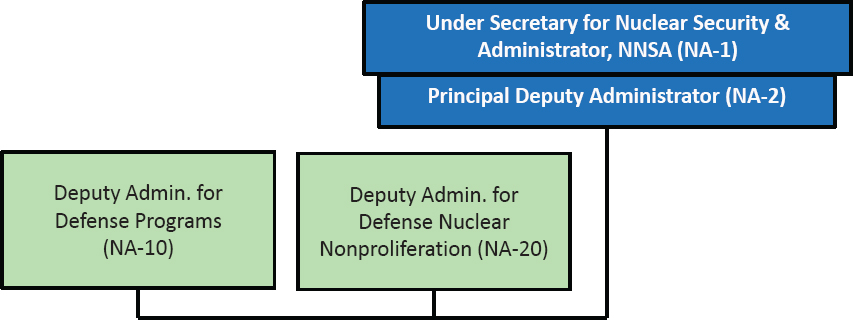
TABLE 2.1 Length of Time Between Senate-Approved Administrators at NNSA
| Gaps Between Administrators | Dates Without a Senate-Confirmed Administrator (Position Was Unfilled or Filled by Someone in an Acting Capacity) | Days Elapsed (approximate) |
|---|---|---|
| Gordon to Brooks | 7/8/2002–5/16/2003 | 313 |
| Brooks to D’Agostino | 1/19/2007–8/13/2007 | 208 |
| D’Agostino to Klotz | 1/16/2013–4/8/2014 | 445 |
| Klotz to Gordon-Hagerty | 1/20/2018–2/15/2018 | 23 |
| Average gap duration | 247 | |
SOURCE: Data from http://www.energy.gov/sites/prod/files/2020/06/f76/20200630%20-%20NNSA%20HQ%20Org%20Chart.pdf.
To prepare for a potential transition after the 2016 presidential election and before a new Administrator would be confirmed and in place, former Administrator Klotz appointed a senior NNSA civil servant to serve as acting Administrator during any gap periods, and ensured that that individual was fully informed and able to carry on leadership, if needed. The current Administrator has followed this practice, to be prepared if there is a transition and until a new Administrator can be confirmed, by identifying a member of the Senior Executive Service (SES) to serve in a similar role if needed. However, based on the experience of panel members, “acting” officials feel significantly less empowered to provide strong leadership and bring about significant change. An acting leader typically is also trying to fill his or her own job as well as the functions of the acting position, giving them less time.16
A fixed-term appointment may help to address these problems, and there is precedent elsewhere in government for fixed-term PAS appointments. The panel documented 12 examples of PAS appointees
___________________
16 The panel also notes that over the past 20 years, the tenure of NNSA Administrators has averaged 3.7 years, which does not allow enough time for making major changes such as reform of governance and management.
with fixed terms in its fourth interim report.17 Typically, these fixed-term PAS appointees manage organizations requiring technical knowledge and objectivity, such as the Internal Revenue Service or the Bureau of the Census. Ten of these 12 appointees had terms of 5 or 6 years.
After considering these data and talking with former NNSA leaders, and taking into account the Augustine-Mies proposal, the panel reiterates a recommendation made in its fourth interim report.
Recommendation 2.3: Congress should amend the National Nuclear Security Act to modify the position of National Nuclear Security Administration (NNSA) Administrator so that it has a fixed term but is still filled by presidential appointment subject to Senate confirmation. To eliminate leadership gaps, the Administrator should be authorized to stay in office until a replacement is confirmed by the Senate, even beyond the formal completion of his or her term.
NNSA’s Other PAS Positions
The three other PAS positions in NNSA—the Principal Deputy Administrator, Deputy Administrator for Defense Programs, and Deputy Administrator for Defense Nonproliferation—have also experienced substantial periods when there was no confirmed incumbent. Not having a senior leadership team in place affects the Administrator’s effectiveness and ability to carry out mission objectives. Average gaps for these positions have been longer than for the Administrator position, ranging from 386 days to 495 days. For reasons similar to those discussed above with respect to the Administrator position, acting officials filling these deputy positions will generally be less able to effectively exercise the functions of their office than confirmed officials.
The Augustine-Mies report recommended that these three positions be converted to Senior Executive Service or Excepted Civil Service, a shift that would surely reduce the gap periods substantially. However, during panel interviews, two former NNSA leaders felt that these positions require the stature associated with being a political appointee. This stature helps, for example, in their interactions with senior officials in DoD and also with international leaders. Panel members, based on their own experience in government and PAS positions, agree with this. However, steps are needed to reduce the long gap periods associated with these positions, which have been serious. Some options include expediting the process of nomination and confirmation, careful use of deputy positions, or conversion of the positions to other types of appointments such as “PA” positions, which are presidential appointees that do not require Senate confirmation. Any or all of these steps can be helpful, but the last option offers the most assured benefit.
Recommendation 2.4: To reduce gaps in other key leadership positions, the requirement for Senate confirmation of the Principal Deputy Administrator, Deputy Administrator for Defense Programs, and Deputy Administrator for Defense Nonproliferation should be removed. These positions should continue to be filled with political appointees to provide appropriate stature.
___________________
17 National Academies of Sciences, Engineering, and Medicine and the National Academy of Public Administration, 2020, Report 4 on Tracking and Assessing Governance and Management Reform in the Nuclear Security Enterprise, The National Academies Press, Washington, D.C.


