Leveraging Advances in Modern Science to Revitalize Low-Dose Radiation Research in the United States (2022)
Chapter: Appendix D: Projects Designated by the Department of Energy as "Low-Dose Radiation Projects" Carried Out at National Laboratories (20162021)
| DOE Laboratory | Funding Year | Amount | Source |
|---|---|---|---|
| ANL | 2020a | $2,200,000 | BER |
| ANL | 2021a | $2,528,000 | BER |
| BNL | 2020a | $1,400,000 | BER |
| BNL | 2021a | $1,000,000 | BER |
| LANL | 2017–2021 | $1,950,000 | DOE-NNSA |
| LANL | 2020–2022 | $245,000 | DTRA |
| LANL | 2021–2023 | $5,100,000 | LDRD |
| LBNL | 2006–2017 | $500,000 in 2016b | DOE-BER |
| LBNL | 2011–2016 | N/A (JGI user facility provided at no cost to users) | DOE JGI |
| LBNL | 2011–2016 | $3,600,531 | NASA |
| LBNL | 2012–2016 | $1,654,643 | NASA |
| LBNL | 2012–2017 | $990,770 | NASA |
| LBNL | 2012–2017 | $2,025,709 | NIH |
| LBNL | 2013–2016 | $70,195 | NASA |
| LBNL | 2013–2017 | $1,154,600 | NASA |
| LBNL | 2014–2017 | $421,707 | NASA (prime sponsor); Oregon Health & Science University (direct sponsor) |
| LBNL | 2014–2019 | $1,583,882 | NASA |
| LBNL | 2015–2016 | $199,929 | NASA |
| LBNL | 2015–2017 | $200,474 | NASA |
| LBNL | 2015–2019 | $297,416 | NASA (prime sponsor); Medical College of Wisconsin (direct sponsor) |
| LBNL | 2016–2019 | $1,741,387 | NASA |
| LBNL | 2016–2019 | $492,041 | NASA |
| LBNL | 2016–2021 | $3,959,623 | NASA |
| LBNL | 2019–2022 | $215,999 | NASA |
| LBNL | 2019–2021 | $504,391 | NASA |
| LBNL | 2019–2022 | $216,118 | NASA |
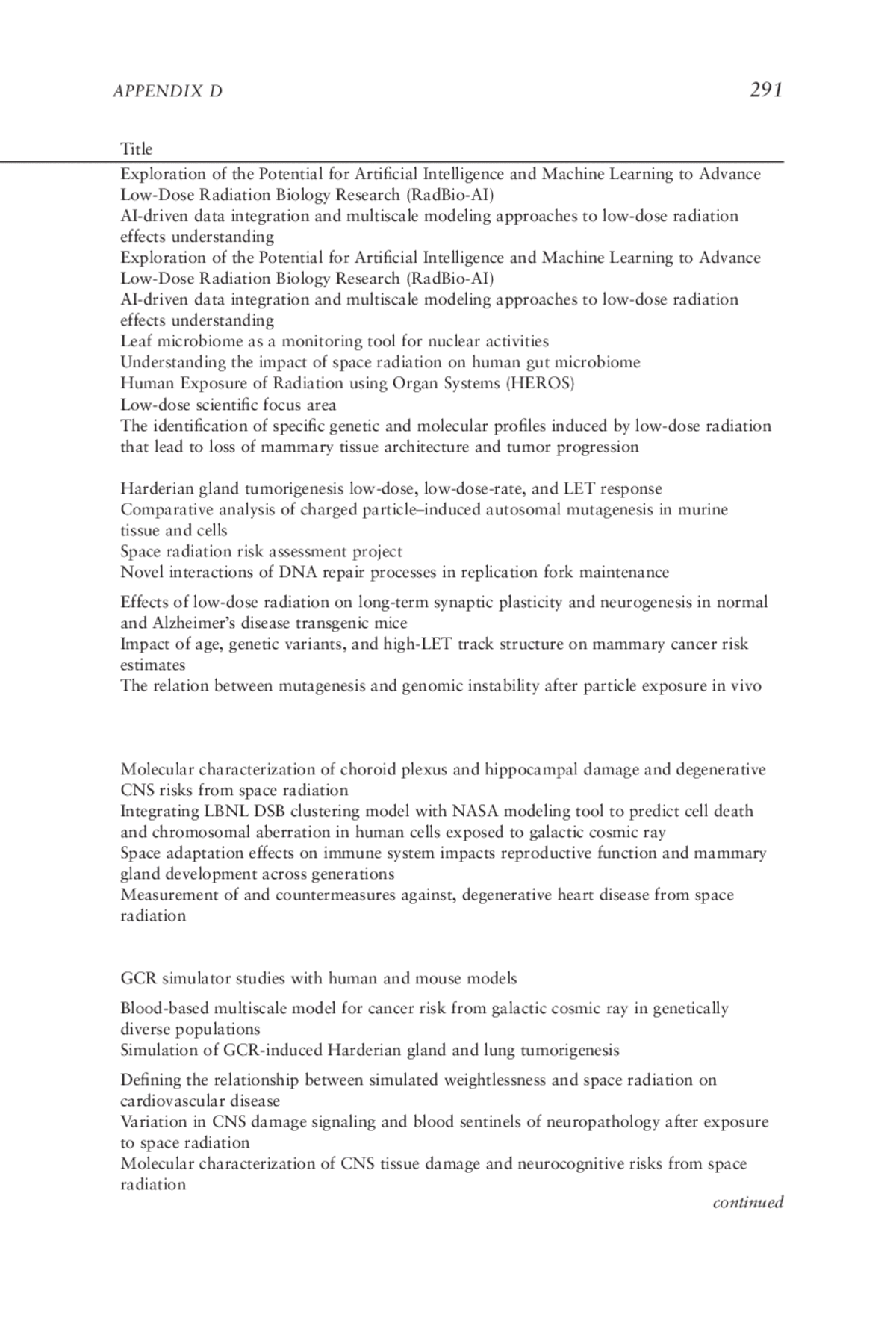
| Title |
|---|
| Exploration of the Potential for Artificial Intelligence and Machine Learning to Advance Low-Dose Radiation Biology Research (RadBio-AI) |
| AI-driven data integration and multiscale modeling approaches to low-dose radiation effects understanding |
| Exploration of the Potential for Artificial Intelligence and Machine Learning to Advance Low-Dose Radiation Biology Research (RadBio-AI) |
| AI-driven data integration and multiscale modeling approaches to low-dose radiation effects understanding |
| Leaf microbiome as a monitoring tool for nuclear activities |
| Understanding the impact of space radiation on human gut microbiome |
| Human Exposure of Radiation using Organ Systems (HEROS) |
| Low-dose scientific focus area |
| The identification of specific genetic and molecular profiles induced by low-dose radiation that lead to loss of mammary tissue architecture and tumor progression |
| Harderian gland tumorigenesis low-dose, low-dose-rate, and LET response |
| Comparative analysis of charged particle–induced autosomal mutagenesis in murine tissue and cells |
| Space radiation risk assessment project |
| Novel interactions of DNA repair processes in replication fork maintenance |
| Effects of low-dose radiation on long-term synaptic plasticity and neurogenesis in normal and Alzheimer’s disease transgenic mice |
| Impact of age, genetic variants, and high-LET track structure on mammary cancer risk estimates |
| The relation between mutagenesis and genomic instability after particle exposure in vivo |
| Molecular characterization of choroid plexus and hippocampal damage and degenerative CNS risks from space radiation |
| Integrating LBNL DSB clustering model with NASA modeling tool to predict cell death and chromosomal aberration in human cells exposed to galactic cosmic ray |
| Space adaptation effects on immune system impacts reproductive function and mammary gland development across generations |
| Measurement of and countermeasures against, degenerative heart disease from space radiation |
| GCR simulator studies with human and mouse models |
| Blood-based multiscale model for cancer risk from galactic cosmic ray in genetically diverse populations |
| Simulation of GCR-induced Harderian gland and lung tumorigenesis |
| Defining the relationship between simulated weightlessness and space radiation on cardiovascular disease |
| Variation in CNS damage signaling and blood sentinels of neuropathology after exposure to space radiation |
| Molecular characterization of CNS tissue damage and neurocognitive risks from space radiation |
| DOE Laboratory | Funding Year | Amount | Source |
|---|---|---|---|
| LBNL | 2019–2025 | $1,138,838 | NIH (prime sponsor sponsor); Albert Einstein College of Medicine (direct sponsor) |
| LBNL | 2020–2025 | $1,200,000 | NASA |
| LBNL | 2020–2022 | $497,795 | NIH |
| LBNL | 2021–2022 | $784,812 | NASA |
| LLNL | 2011–2017 | $1,925,000 | NIH/NCI |
| LLNL | 2013–2018 | $1,650,000 | NIH/NCI |
| LLNL | 2016–2018 | $200,000 | NIH (prime); Columbia University (direct sponsor) |
| LLNL | 2017–2021 | $3,000,000 | NASA (prime sponsor); Wake Forest University (direct sponsor) |
| LLNL | 2017–2019 | $700,000 | LDRD |
| LLNL | 2017–2022 | $1,784,000 | NIH/NCI (prime sponsor); UC Davis (direct sponsor) |
| LLNL | 2018–2021 | $6,000,000 | LDRD |
| LLNL | 2018–2023 | $1,620,000 | NIH/NCI (prime sponsor); Dana Farber Cancer Institute (direct sponsor) |
| LLNL | 2020–2023 | $2,250,000 | LDRD |
| ORNL | 2018 | $180,000 | LDRD |
| ORNL | 2019 | $1,000,000 | LDRD |
| ORNL | 2020 | $130,000 | Work for Others |
| ORNL | 2020 | $180,000 | BER |
| ORNL | 2020a | $1,400,000 | BER |
| ORNL | 2021a | $1,000,000 | BER |
| ORNL | 2021 | N/A | Equipment |
| PNNL | 2008–2016 | $500,000 in 2016b | BER |
| PNNL | 2020–2021 | $330,000 | NASA |
| PNNL | 2020–2022 | $485,000 | NASA |
a Appropriated by Congress to DOE as part of the new low-dose program.
b The last year of the previous low-dose radiation program.
NOTE: ANL = Argonne National Laboratory; BER = DOE-Biological and Environmental Research; BNL = Brookhaven National Laboratory; CNS = central nervous system; DOE = Department of Energy; DSB = double strand break; DTRA = Defense Threat Reduction Agency; GCR = galactic cosmic ray; JGI = Joint Genome Institute; LANL = Los Alamos National Laboratory; LBNL = Lawrence Berkeley National Laboratory; LDRD = Laboratory Directed
| Title |
|---|
| DNA repair, mutations, and cellular aging |
| Dose-rate effects and galactic cosmic ray simulation in cancer-relevant systems |
| Genetic determinants of radiation-induced hematologic toxicity |
| Simulation of GCR-induced Harderian gland and lung tumorigenesis |
| Characterization of HER2 family of proteins |
| Optimizing 131I-MIBG therapy for children with advanced neuroblastoma |
| Biodosimetry of exposure to internalized 131Iodine in human relapsed or refractory cancer patients |
| Novel microfluidic biomarker detection platforms to monitor in vivo effects of solar particle events and galactic cosmic rays radiation, using mice with human hematopoietic systems |
| Diagnostic devices for detection in harsh environments |
| Mitochondrial bioenergetics in aggressive breast cancer growth |
| Instrumented tumor |
| Tumor and host markers of clinical outcomes after MIBG therapy in neuroblastoma |
| High-throughput protein biomanufacturing and in-situ assessment platform to enable rapid response capability |
| A microfluidic platform for identifying radiation/nuclear countermeasures for emergency situations |
| Next-generation radiotherapeutics and bioassessment platforms |
| Synthesis and evaluation of Z-glutamine analogs |
| Targeted delivery of radionuclides and chemotherapy to therapy-resistant cancer stem cells |
| Exploration of the Potential for Artificial Intelligence and Machine Learning to Advance Low-Dose Radiation Biology Research (RadBio-AI) |
| AI-driven data integration and multiscale modeling approaches to low-dose radiation effects understanding |
| Equipment to analyze trace materials |
| Linear and nonlinear tissue signaling mechanisms in response to low-dose and low-dose-rate radiation |
| C4 Photosynthesis in Space (C4Space) |
| Dynamics of Microbiomes in Space (DynaMoS) |
Research and Development; LET = linear energy transfer; LLNL = Lawrence Livermore National Laboratory; MIPG = metaiodobenzylguanidine; NASA = National Aeronautics and Space Administration; NCI = National Cancer Institute; NIH = National Institutes of Health; NNSA = National Nuclear Security Administration; ORNL = Oak Ridge National Laboratory; PPNL = Pacific Northwest National Laboratory; UC = University of California.
This page intentionally left blank.