Innovation, Global Value Chains, and Globalization Measurement: Proceedings of a Workshop (2022)
Chapter: 9 Creation and Diffusion of Knowledge in the Global Firm
9
Creation and Diffusion of Knowledge in the Global Firm
Paper Authors: Çağatay Bircan (European Bank for Reconstruction and Development [EBRD]), Beata Javorcik (EBRD, University of Oxford, and Centre for Economic Policy Research), and Stefan Pauly (Sciences Po)
Presenter: Çağatay Bircan (EBRD)
Moderator: Andreas Moxnes (University of Oslo)
The workshop paper by Çağatay Bircan, Beata Javorcik, and Stefan Pauly investigates the diffusion of innovation in multinational firms, which is important for understanding the growth of countries.
Çağatay Bircan, senior research economist at the Office of the Chief Economist at the European Bank for Reconstruction and Development (EBRD), introduced the workshop paper by motivating its importance. The main pillars of modern growth theory are the creation and diffusion of knowledge. Multinational enterprises (MNEs) account for most of private research and development (R&D) expenditures and subsequent innovation activity. The authors used patent data to capture the patterns of creation and diffusion of knowledge in MNEs, focusing primarily on understanding the collaborative process across international borders. In ongoing work, the authors extend their analysis to understanding the role of inventor teams and how inventor characteristics, such as gender, influence the innovation process.
Bircan previewed some of the stylized facts and main findings:
- First, the authors found that knowledge creation is increasingly globally collaborative (defining globally collaborative innovation as patents involving inventors from at least three countries). Further, patents that result from global collaboration are higher in quality, and a large share of MNE patents are invented in a foreign-affiliate firm.
- Second, the authors found that differences in time zones are a major barrier to knowledge diffusion. Barriers due to time zones are larger than direct distance-effect barriers, which are also present and are a
- major contributing factor. Time-zone differences also affect patterns of collaboration and citations within an MNE.
- Third, the authors found that diffusion occurs in MNEs through inventor mobility. An overlap in business hours eases barriers to mobility, while distance does not appear to affect mobility. The authors found that, within MNEs, women have less mobility than their male counterparts.
DATA
Bircan explained that he and his coauthors used patent data from two sources: the European Patent Office’s (EPO’s) PATSTAT database and the U.S. Patent and Trademark Office (USPTO), with coverage from 1980 to 2010. The authors focused on patents granted by the EPO, USPTO, and the Japanese Patent Office (JPO), known as triadic patent families. In the regression analysis, only patents from 2000 to 2010 are included to increase matching quality. The patent data were merged with information about inventor location by geocode and gender. Further, the dataset was merged with Bureau van Dijk’s Orbis and Orbis Intellectual Property (IP) databases, allowing the authors to match patent and applicant names using Global Ultimate Owner (GUO). Firms are defined as an MNE if they have affiliates in at least two countries. These firms are the focus of the paper.
STYLIZED FACTS
Bircan presented four stylized facts in detail:
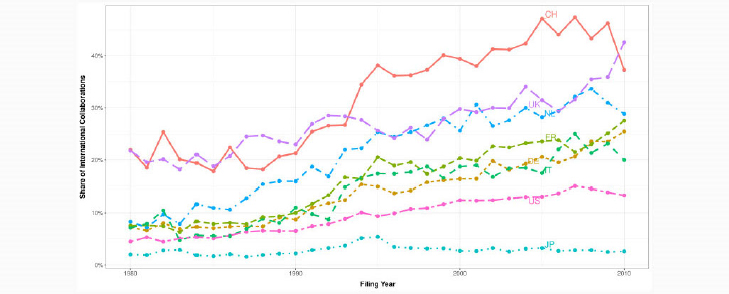
- First, there has been a rise in global collaboration in innovation; however, large variation exists across countries. Japan collaborates the least and its trend appears relatively flat across the sample, with the exception of a small rise around 1995. The United States collaborates at lower rates than Italy, Germany, France, the Netherlands, or the United Kingdom (in order from least to most collaborative in 2010), but these countries generally show a rise in collaboration over the sample, with some decreases. China is the most collaborative country in the sample, peaking at a collaborative share of patents of more than 45 percent, although China’s collaboration appears to have flattened in the last third of the sample, and may be falling (see Figure 9-1).
- Second, global collaboration in innovation activity results in higher-quality patents. Across various specifications this result remains positive and significant but varies in magnitude. Patent quality also increases as the number of inventors on the team also increases (see Figure 9-2).
SOURCE: Presentation by Çağatay Bircan.
NOTE: HQ = headquarters.
SOURCE: Presentation by Çağatay Bircan.
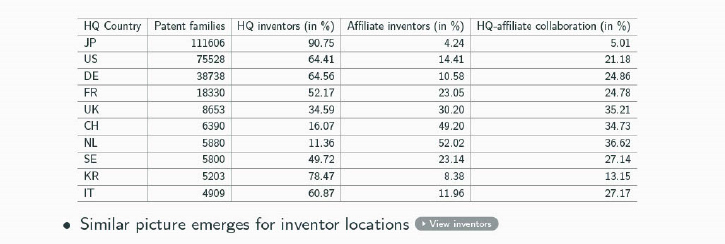
- Third, a large share of innovative activity takes place in foreign-affiliate firms. There is a large amount of variation in this share across the sample. European MNEs are innovating especially outside of the headquarter (HQ) country, as are Chinese MNEs. Japanese MNEs have the highest share of solely HQ inventors in the sample.
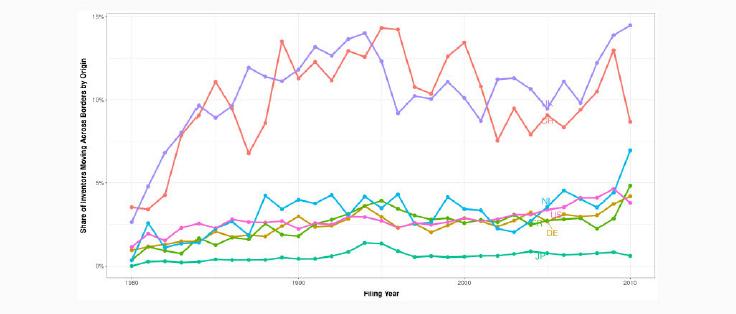
- Fourth, inventors are more mobile across borders. Similar trends occur with the United Kingdom and China as the highest share of mobile inventors by origin, with Japan having the lowest share. The rest of Europe and the United States appear roughly equal and have a small overall rise in their share of inventors moving by origin. (See Figure 9-3.)
SOURCE: Presentation by Çağatay Bircan.
EMPIRICAL FINDINGS ON KNOWLEDGE DIFFUSION
Bircan explained that his and his coauthors’ empirical findings on knowledge diffusion are split into four categories: global collaboration, citations, inventor mobility, and ongoing work on the role of the inventor’s gender. Two empirical approaches are used to understand the first two categories: analysis at the patent-inventor level and analysis at the establishment, or country time-zone, level. The third outcome category uses only the second approach. The first approach double counts patents with multiple inventors, leading to the implementation of the second approach. The sample for the first two regressions contains all patents with at least one inventor outside of the HQ country from 2000 to 2010.
All regressions have the general form
Y = αOverlap + βDistance + Fixed Effects + ε.
Overlap is a measure of the business-hour overlap for an inventor in an affiliate-country time zone with respect to the HQ time zone; this measure is specific to the approach used. Distance is a measure of the distance between the inventor country and the HQ country and is specific to the approach used.
Bircan moved to the results in the first category, global collaboration, measured either as an indicator of collaboration in the first approach or as the share of collaborative patents in the second approach. In the first approach, the authors found that both the business-hour overlap and physical distance are significant. The coefficients on business-hour overlap are positive, indicating that an increase in overlap increases cross-border collaboration. Distance has negative coefficients, indicating that the greater the distance between the inventors, the less collaboration occurs among them. To understand the results in a real-world context, Bircan gave an example of a German MNE with affiliate firms in Poland
and Japan. The coefficients overlap implies that the Polish firm would have 33 percent higher probability of collaborating with the HQ, due to the 7-hour overlap in business hours, relative to inventors based in Japan. Likewise, Japanese firms have around a 70 percent lower probability of collaborating with a German HQ than Polish inventors, due to the physical distance between them. These results are robust in the second approach; however, the implied probabilities change when affiliates that do not collaborate are purged from the dataset.
Bircan explained that the second category, citations, studies how foreign affiliates cite patents registered with the MNE HQ. The outcome variable of interest, within-firm citations, indicates whether a patent filed at a foreign affiliate cites at least one patent filed by inventors from the MNE HQ. This means the authors did not examine whether the Polish affiliate cites any German patent, but solely patents from within the MNE. The authors excluded the interfirm patenting activity from the sample, as this may introduce endogeneity concerns between patents. The first approach indicates that business-hour overlap does not play a significant role, but that physical distance contributes a negative and significant coefficient. However, the second approach indicates that business-hour overlap does play a significant role, as does distance.
Third, Bircan and his coauthors examined inventor mobility by studying how inventors move within a firm. The sample is amended from the first two regressions to contain all inventors located outside of the HQ country. The outcome variable of interest is an indicator for whether at least one inventor has moved from an affiliate firm to the MNE HQ, or vice versa. Using only the second regression approach, the authors split their results based on movement from affiliate to HQ, or from HQ to affiliate. In both cases, the business-hour overlap is a very strong predictor of inventor mobility. Distance is not a significant predictor of mobility in either direction.
The authors then considered robustness exercises across the outcome variables of interest.
- First, they included affiliate–HQ-pair fixed effects to explore whether unobserved bilateral variables drive the results, and their results did not meaningfully change.
- Second, to explore whether the results are driven by certain countries, the authors took three approaches:
- dropping GUOs from the United States or dropping inventors located in the United States,
- dropping GUOs with multiple home establishments, and
- clustering at several levels.
Bircan transitioned to discussing the ongoing work that studies how gender influences the results. Prior literature indicates that women may have
different commuting preferences and, for various reasons, may have less mobility. To explore this hypothesis, the authors ran a regression with the main outcome variable as a measure of mobility, and an indicator for gender and a measure of tenure, along with fixed effects. The results indicate that female inventors have much less mobility than male inventors with respect to within-firm cross-border movement. Personal preference and within-firm gender norms are offered as possible explanations for these findings.
To explore the role of within-firm gender norms, Bircan explained, the authors ran a regression with the outcome variable of interest as the share of female inventors employed at the foreign-affiliate firm, along with three explanatory variables: the gender gap between the host and HQ countries using the World Economic Forum inequality index, the gap between girls’ and boys’ mathematics scores on the PISA (Programme for International Student Assessment) for the host and HQ countries, and the share of female inventors observed at the HQ. The authors found that affiliates in countries with a larger gender gap employ more women, supporting the idea that MNEs can overcome local norms. Further, more female inventors are found in countries in which girls perform better than boys on mathematics exams. Lastly, there is a positive correlation between the share of women employed at the firm HQ and the share employed at the affiliate.
SUMMARY
Bircan and his coauthors presented cross-country evidence on where and how MNEs innovate. They presented several stylized facts that document barriers to the ability of MNEs to diffuse knowledge across borders. They indicated that a major barrier to this diffusion is the overlap, or lack thereof, in business hours between affiliate firms and the HQ, a result that implies that communication costs, monitoring, and repeated interactions are important for innovative collaboration across borders. The authors also presented early-stage work about the role of inventor teams, focusing on heterogeneity of results due to gender and country-level gender norms.
DISCUSSION
Discussant: Heiwai Tang (Hong Kong Business School)
Heiwai Tang, professor of economics at the Hong Kong Business School (on leave from The Johns Hopkins University) and associate director of the Asia Global Institute, began by summarizing the workshop paper’s empirical strategy. The main explanatory variables across specifications are business-hour overlap and physical distance. The authors used different measures from the patent data to infer patterns about knowledge creation and diffusion within MNEs.
Tang summarized four main results from the paper:
- First, innovation activity is increasingly global, which leads to higher-quality patents and an increasing share of MNE patents coming from the foreign affiliates.
- Second, time-zone differences and physical distance are barriers to collaborative innovation.
- Third, inventor within-firm mobility is decreasing in time-zone difference and the physical distance between affiliates and HQ.
- Lastly, the mobility results are heterogeneous with respect to the gender of the inventors, where female inventors have less mobility than their male counterparts.
Tang then gave a brief overall assessment of the paper, which, he said, needs little motivation due to the importance of how innovation is created and transferred across MNE networks. The authors presented interesting and important stylized facts about MNE innovative activity. The paper contributes to various literatures on how MNEs divide labor and organize innovative activities within their network, spillovers due to foreign direct investment (FDI), and communication barriers.
Moving to broad comments on the work, Tang pointed out three interesting projects that could come out of the presented work:
- The creation of stylized facts about innovative activity and collaboration by MNEs.
- Further understanding firms’ global innovation strategies by going deeper than explanatory variables on distance and business-hours overlap and exploring other country-dependent variables, such as institutions, market size, and knowledge stock.
- The work on inventor mobility and the analysis of heterogeneous outcomes due to gender could be its own work. Currently, it feels like an add-on to an already high-quality paper.
Tang offered five specific comments in addition to the broad comments above:
- Are the results on international collaboration driven by European HQ activities? According to Figure 9-1, Japan plays a nearly meaningless role in global collaboration, and the United States also plays a small role. The results withstand many robustness checks, but the phenomenon itself seems to be European in nature.
- The mechanical results may be driven by the empirical strategy. Patents are only considered if they are filed across all three patent offices, but Japanese MNEs mainly only file with the JPO; as a
- result, much of this activity is dropped from the sample. This bias may also be true for U.S. MNEs. Each patent office has different standards for successful applicants, although the USPTO may be considered more global, as the most productive firms choose to patent there in addition to their home office. Tang suggested that the authors may only capture the tip of the iceberg in knowledge diffusion because of this high-productivity bias.
- The authors use an unconventional strategy for identifying affiliate firms. The Orbis database does not identify affiliate firms, but the authors used a creative solution, identifying an establishment as an affiliate when the foreign applicant for a patent is identified. A concern is that affiliate firms that do not file a patent are not recorded, which may alter the interpretation and bias the results.
- The authors see business-hour overlaps as a benefit that eases communication. Tang offered an alternative interpretation, suggesting that these results may be driven by a strategic acquisition motive. An HQ firm may acquire a firm that is innovating in the same space as itself. This may introduce reverse causality concerns, especially for the regressions on citations and similarity, as an affiliate patent that cites an HQ may indicate strategic acquisition. To work around these issues, Tang suggested reintroducing the temporal dimension and identifying an exogenous event, such as the Schengen Agreement in 1995.
- As the authors focus on the communications costs, there should be more insight on heterogeneous effects. For example, different technologies may innovate at different levels—basic, product, or process—and collaboration may be different across these types of innovation. Some technologies require more communication, and these may be more sensitive than others to the business-hour overlap and physical distance. Further, is the innovation groundbreaking or more incremental? Keller and Yeaple (2013) present the idea of “gravity of knowledge,” alleging that industries that are R&D intensive have a lower share of routine tasks, which may suggest that they are more reliant on communication. As a final note, Tang suggested that the results are mostly driven by horizontal FDI and wonders if there is a systematic difference between that and vertical FDI.
Tang concluded by stating that the authors presented several new stylized facts that are important for various literatures. The authors may be able to split the work into two or three papers and build a structural model. Beyond that which has already been completed, more work is needed to prove that the mechanism in the business-hour overlap benefit is communication. Lastly, some
work is needed on how an MNE will decide where to file patents, in order to better understand countries outside of Europe.
Bircan responded that Tang is correct about the missing foreign affiliates because of affiliates that have no patenting behavior. The authors focused on triadic patents to have a certain level of quality. They can investigate what occurs when they exclude Japan, as it is an outlier in terms of patenting activity. The strategic acquisition motive is interesting, and the authors are currently exploring it. They are compiling a dataset that contains the transfer of patents across firms and are aware of the acquisition motive of MNEs.
Beata Javorcik, chief economist at the European Bank for Reconstruction and Development, professor of economics at the University of Oxford, affiliate of the Centre for Economic Policy Research, and a coauthor of the presented work, responded to Tang’s concern that the results were driven by European MNEs, stating that the authors did run their regressions on U.S. MNEs, and their results were robust.
During the presentation, one audience member asked about the use of subsidiary information from the Orbis database. Bircan responded that the authors are not currently using the subsidiary information from Orbis, but they are hoping to do so. Another asked about data on inventor location. An inventor may not be employed by the affiliate but could be employed at arm’s length. Bircan responded that, while the authors are not able to certify the absolute location of innovation, they argue that to a first-order approximation, this is a reasonable measure. Bircan noted that the use of the subsidiary information from Orbis may help alleviate some of these concerns. Another audience member mentioned the nonlinearity of the globe. As one moves westward in Europe, one encounters more water; can the authors show their time-zone results on a subregion that is landlocked? Bircan responded that this is a rich area that the authors want to further clarify in their next draft.
This page intentionally left blank.


