The Role of Net Metering in the Evolving Electricity System (2023)
Chapter: Appendix B: Net Metering and Net Metering Reform Status in U.S. Jurisdictions
APPENDIX B
Net Metering and Net Metering Reform Status in U.S. Jurisdictions
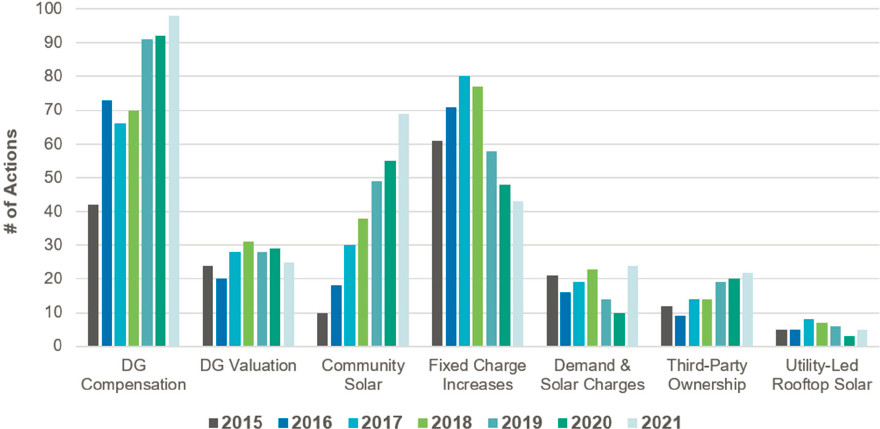
This appendix includes details about the status of net metering and related policies in the United States. The source for these data, unless otherwise specified, is the North Carolina Clean Energy Technology Center (NC-CETC) “50 States of Solar” series of reports.1 Additional details and links to each jurisdiction’s foundational documents are available at the NC-CETC website and on the NC-CETC Database of State Incentives for Renewables and Efficiency (DSIRE).2 Figure B-1 shows the numbers of actions taken by state legislatures and utility regulators, from 2015 to 2022, depicting seven major categories of net metering reforms.3
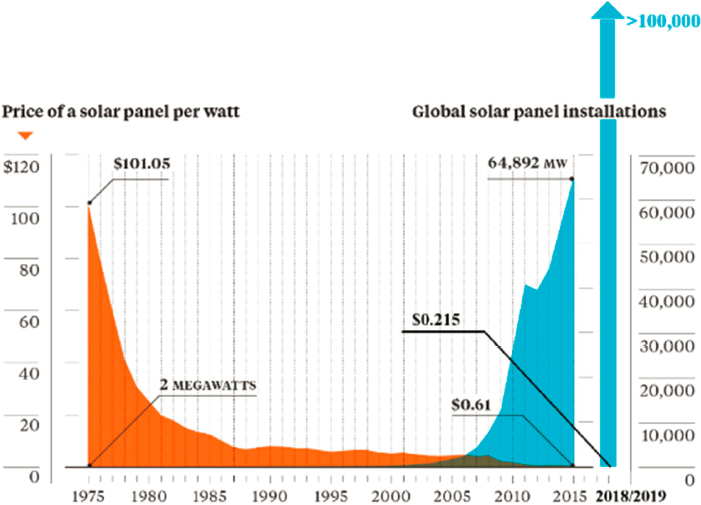
Figure B-2 shows trends in the global price of solar panels and in global solar panel installations by year, from 1975 through 2019. The International Energy Agency (IEA) estimates that global installations nearly doubled again between 2019 and 2021 (totaling nearly 175 GW) and projected another 275 GW would be installed by year end 2022.4 IEA shows installations over the past decade averaging about 60 percent in utility scale centralized photovoltaic (PV) power plants with 40 percent grid-connected distributed generation, and only small single-digit percentages of off-grid solar. IEA does report a major decline in solar PV installed as a result of feed-in tariffs, declining from 85 percent of all PV installations in 2010 to 60 percent in 2015 and 28 percent in 2021. Feed-in tariff auctions and purchase power agreements (PPAs) (20 percent), direct subsidies and tax breaks (16 percent), and net metering and similar incentives for self-consumption (10 percent) were also reported for almost half of global 2021 PV installations, with non-incentivized installations accounting for nearly 25 percent of 2021 system additions.5
___________________
1 North Carolina Clean Energy Technology Center (NC-CETC). 2021 and 2022. “The 50 States of Solar Reports.” Raleigh: North Carolina State University. https://nccleantech.ncsu.edu/the-50-states-reports.
2 See https://nccleantech.ncsu.edu/our-work/energy-policy-markets/ and NC-CETA. 2022a. “Database of State Incentives for Renewables and Efficiency® (DSIRE).” https://www.dsireusa.org.
3 Legislation is counted if it has been introduced and has passed at least one house of a state legislature. Regulatory Commission actions are counted.
4 For additional information see https://www.iea.org/reports/solar-pv.
5 International Energy Agency. 2022. “Trends in Photovoltaic Applications 2022.” Photovoltaic Power Systems Program. Report No. IEA PVPS T1-43:2022. https://iea-pvps.org/trends_reports/trends-2022.
SOURCE: North Carolina Clean Energy Technology Center, 2022b, “50 States of Solar Q4 2021 and Annual Report for 2021.”
Table B-1 summarizes jurisdiction decisions about net metering reforms, from 2015 to 2022. Table B-2 summarizes decisions about net metering reforms that were made by some of the larger public power authorities in the United States, from 2012 through 2021.6 Table B-3 provides a summary of decisions that have added specific fees for customers with distributed generation. Those decisions were made between 2017 and the time of data gathering in 2022. They are listed by state, including some that apply to only some utility companies. As noted in the “Year of Decision” column, of the 11 decisions adding charges specifically to customers with DG, or in some cases only to customers with on-site PV, five of the decisions were later overturned by state legislators, state courts, or state regulatory commissions. Table B-4 shows the different major categories of benefits and costs that have been included in over 30 value of solar (VOS) and value of distributed energy resources (VDER) studies. Table B-4 also shows that several of the benefit categories are included in nearly every study, while other benefit categories and the two cost categories were not included in many of the studies. Environmental benefits were included in all by six of the studies.
___________________
6 NC-CETC has not compiled the details of net metering policies and changes for all municipal and publicly owned utilities in the United States but does collect and report information about the larger ones, with more than 100,000 customers.
NOTE: Graph adapted from CleanTechnica83 with data from Bloomberg, Earth Policy Institute, GTM, and Energy Trend.
SOURCE: L. Grafman and J.M. Pearce, 2021, To Catch the Sun, Arcata, CA: Humboldt State University Press, https://digitalcommons.humboldt.edu/textbooks/8. CC BY-SA 4.0.
TABLE B-1 Summary of State Net Metering Reform Decisions
| State | Year of Decision | Initiated by | Applicability | Netting Interval | Excess Generation Credit Rate | Additional Fees |
|---|---|---|---|---|---|---|
| Arkansas* | 2020 | Act 827 of 2015, Act 464 of 2019 | All | Annual (Net Metering) | Retail rate | Grid Access Fee for larger customers (set at zero initially); struck down by court in 2022 |
| Arizona | 2016; Implemented in utility rate cases | Utility proposal (2013) and ACC (2014) | APS: Residential solar TEP/UNS: Residential and small commercial solar or wind |
Instantaneous (Net Billing) | Phasing down to avoided cost rate by 10% per year | APS: Grid Access Fee ($0.93/kW DG capacity (removed by ACC in 2021), OR On-Peak Demand Charge. TEP/UNS: Monthly Meter Charge of $2.23 (residential) and $0.90 (non-residential) |
| California* | 2016 | A.B. 327 of 2013 | All | Annual by TOU period (Net Metering) | Retail TOU rates | Per-kWh non-bypassable charges, upfront interconnection fee |
| Connecticut | 2021 | S.B. 9 of 2018, H.B. 5002 of 2019 | All | Annual (Net Metering) | Retail rate | Per-kWh non-bypassable charges to be implemented |
| All | Buy-All/Sell-All | Sell-all rate determined annually (2022: 29.43 cents/kWh for residential, 20.097 cents/kWh for nonresidential); low-income adder of 2.5 cents/kWh and distressed municipality adder of 1.25 cents/kWh | None |
| State | Year of Decision | Initiated by | Applicability | Netting Interval | Excess Generation Credit Rate | Additional Fees |
|---|---|---|---|---|---|---|
| Hawaii* | 2015 (CGS) (closed) | HI PUC (2014) | All | Instantaneous (Net Billing) | Avoided cost rate | None |
| 2015 (CSS) | HI PUC (2014) | All | None | N/A (self-consumption only) | None | |
| 2017 (CGS+) | HI PUC (2016) | All | Instantaneous (Net Billing) | Avoided cost rate (12-mo. avg. on-peak avoided cost) | None | |
| 2017 (Smart Export) | HI PUC (2016) | All paired with battery storage | Instantaneous (Net Billing) | For 4 pm–9 am only: average marginal cost for this time period | None | |
| Iowa | To be implemented after July 1, 2027 | S.F. 583 of 2019 | All | 15-Minute (Net Billing) | Value of solar rate | None |
| Illinois | To be implemented January 1, 2025 | S.B. 2814 of 2016, S.B. 2408 of 2021 | Customers not on hourly pricing | Instantaneous (Net Billing) | Energy, capacity, transmission, and purchased energy adjustment components of retail rates (plus upfront rebate) | None |
| Indiana* | 2021/2022 | S.B. 309 of 2017 | All | Instantaneous (Net Billing); 2022 court decision changed to monthly for Vectren | 1.25 × avoided cost rate | None |
| Kansas | 2018; struck down by court in 2020 (closed) | Utility proposal (2018) preceded by KCC investigation (2016) | Residential | Monthly (Net Metering) (Note residential DG rate features reduced retail rate) | Reduced retail rate (residential DG schedule includes lower rate of 4.584 cents/kWh) | NCP Demand Charge: $3.00/kW (Oct.–May), $9.00/kW (June–Sept.) for 60-min. demand |
| Kentucky | 2021 | S.B. 100 of 2019 | All | Monthly (Net Metering) | KY Power: 9.746 cents/kWh (residential), 9.657 cents/kWh (non-residential) KY Utilities: 7.366 cents/kWh LG&E: 6.924 cents/kWh |
None |
| Louisiana | 2019 | LA PSC (2015) – cap triggered | All | Instantaneous (Net Billing) | Avoided cost rate | None |
| Massachusetts | 2018; Fees overridden by legislation in 2018 | Acts of 2016 Chapter 75, Acts of 2018 Chapter 227 | All | Monthly (Net Metering) | ≤60 kW: Retail rate Other: 60% of retail rate | Eversource: Fixed charge and demand charge (amount varies by customer rate) |
| 2018 | Acts of 2016 Chapter 75 | Solar only | Monthly (Net Metering) | Alternative option to net metering: Basic service rate | None |
| State | Year of Decision | Initiated by | Applicability | Netting Interval | Excess Generation Credit Rate | Additional Fees |
|---|---|---|---|---|---|---|
| Maine* | 2017 (closed) | ME PUC (2016) – cap triggered | All | Buy-All/Sell-All | Reducing production able to be netted against T&D charges by 10% per year | None |
| 2019 | L.D. 91 of 2019 | All | Annual (Net Metering) | Granted to utility after 12 months | None | |
| Commercial and industrial | Buy-All/Sell-All | Rate established annually by PUC (based on standard offer service rate plus 75% T&D rate) | None | |||
| Michigan* | 2018; Implemented in utility rate cases | Act 341 of 2016 | All | Instantaneous (Net Billing) | Power supply rate (excluding transmission component for Consumers Energy, DTE) | None |
| Mississippi | 2015 (MS’s first DG tariff, not a “successor”) | MS PSC (2011) | All | Instantaneous (Net Billing) | Avoided cost rate plus non-quantifiable expected benefits adder (2.5 cents/kWh) and low-income adder (2 cents/kWh) | None |
| New Hampshire* | 2016 | H.B. 1116 of 2016 | All | Monthly (Net Metering) | ≤100 kW: 100% of energy and transmission charges plus 25% of distribution charge >100 kW: Energy charge |
None |
| Nevada | 2015 (closed) | S.B. 374 of 2015 | All | Hourly (Net Billing) | Avoided cost rate | None |
| 2017 | A.B. 405 of 2017 | All | Monthly (Net Metering) | 75% of retail rate | None | |
| New York* | 2017 (VDER) | NY PSC (2015) | All; required for large commercial and community DG | Hourly (Net Billing) | Value of DER rate (includes LMP and value for capacity, environment, demand reduction, locational system relief) | 50% Customer Benefit Contribution (CBC) for residential, 70% CBC for small commercial opting in to VDER; others: none |
| 2020 (Mass Market) | Residential and small commercial | Annual (Net Metering) | Retail rate | CBC: $0.69–$1.09/kW DG capacity | ||
| South Carolina | 2021 (Dominion) | H.B. 3659 of 2019 | All | Monthly by TOU period (Net Metering) | Avoided cost rate | Residential Minimum Bill: $13.50 |
| 2021 (Duke Energy) | Residential | Monthly by TOU period (Net Metering) | Avoided cost rate | Minimum Bill: $30.00 Non-Bypassable Charge: $0.42/kW DG capacity (DEC) or $0.49/kW DG capacity (DEP) Grid Access Fee: $5.86/kW (DEC) or $3.95/kW (DEP) of DG capacity >15 kW |
||
| Texas | 2017 (El Paso Electric) | Utility proposal (2017) | Residential | Monthly (Net Metering) | Avoided cost rate | Minimum Bill: $30.00 (standard), $26.50 (TOU) OR NCP Demand Charge: $3.16/kW for 60-min. demand |
| State | Year of Decision | Initiated by | Applicability | Netting Interval | Excess Generation Credit Rate | Additional Fees |
|---|---|---|---|---|---|---|
| Utah | 2017 | Utility proposal (2014) and UT PSC (2014) | All | Instantaneous (Net Billing) | Transitional credit: 3.4–9.2 cents/kWh, depending on customer type | None |
| 2020 | All | Instantaneous (Net Billing) | Rate including value for avoided energy and avoided generation, transmission, and distribution capacity | None | ||
| June–Sept.: 5.160 cents/kWh Oct.–May: 4.462 cents/kWh | ||||||
| Vermont | 2017 | H.B. 702 of 2014 | All | Monthly (Net Metering) | Blended residential retail rate; credit adjusters based on REC ownership; system size, and siting applied to gross production | None |
NOTE: Asterisks denote jurisdictions that are currently considering or have announced plans to consider additional net metering reforms.
SOURCE: North Carolina Clean Energy Technology Center, 2021 and 2022, “The 50 States of Solar Reports,” https://nccleantech.ncsu.edu/the-50-states-reports.
TABLE B-2 Notable Public Power Net Metering Reform Decisions
| State | Utility | Year of Decision | Netting Interval | Excess Generation Credit Rate | Additional Fees |
|---|---|---|---|---|---|
| Arizona | Salt River Project | 2014 | |||
| California | Sacramento Municipal Utility District | 2021 | Instantaneous | 7.4 cents/kWh | None |
| Florida | JEA | 2018 | Instantaneous | Fuel rate (varies monthly; May 2022: 4.025 cents/kWh) | None |
| Florida | Lakeland Electric | 2015 | Monthly (Note solar price plan features reduced retail rate) | Reduced retail rate (solar price plan includes lower rate of 2.427 cents/kWh) | Demand Charge: $5.27/kW during peak hours |
| Texas | Austin Energy | 2012 | Buy-All/Sell-All | Value of solar rate (residential/commercial non-demand: 9.7 cents/kWh; commercial demand (solar <1 MW): 6.7 cents/kWh; commercial demand (solar ≤1 MW: 4.7 cents/kWh) | None |
| Texas | Pedernales Electric Cooperative | 2021 | Instantaneous | Value of solar rate (5.377 cents/kWh) | None |
SOURCE: Data from North Carolina Clean Energy Technology Center, 2021 and 2022, “The 50 States of Solar Reports,” https://nccleantech.ncsu.edu/the-50-states-reports.
TABLE B-3 State and Investor-Owned Utility Additional Fees for DG Customers
| State | Utility | Year of Decision | Type | Amount |
|---|---|---|---|---|
| Alabama | Alabama Power | DG Capacity Charge (for Non-Demand Rate Customers) | $5.41/kW | |
| Arkansas | IOUs, Co-ops | 2020; struck down by Court in 2022 | DG Capacity Charge | $0.00 |
| Arizona | Arizona Public Servic | e 2017; removed by ACC in 2021 | DG Capacity Charge (for Non-Demand Rate Customers) | $0.93/kW |
| Arizona | Tucson Electric Powe UNS Electric | , 2017 | Fixed Charge | $2.23 (residential) or $0.90 (non-residential) |
| Kansas | Evergy | 2018; struck down by Court in 2020 | Demand Charge | $3.00/kW (Oct.–May), $9.00/kW (June–Sept.) for 60-min. NCP demand |
| Massachusetts | Eversource | 2018; overridden by legislation in 2018 | Demand Charge, Fixed Charge | |
| New Mexico | Xcel Energy | Removed by NM PRC in 2018 | Production Charge | $0.0367/kWh |
| New York | IOUs | 2020 | DG Capacity Charge | $0.69–$1.09/kW |
| South Carolina | Dominion Energy South Carolina | 2021 | Minimum Bill | $13.50 |
| State | Utility | Year of Decision | Type | Amount |
|---|---|---|---|---|
| South Carolina | Duke Energy Carolinas (DEC), Duke Energy Progress (DEP) | 2021 | DG Capacity Charges, Minimum Bill | Minimum Bill: $30.00 Non-Bypassable Charge: $0.42/kW DG capacity (DEC) or $0.49/kW DG capacity (DEP) Grid Access Fee: $5.86/kW (DEC) or $3.95/kW (DEP) of DG capacity >15 kW |
| Texas | El Paso Electric* | 2017 | Minimum Bill or Demand Charge | Minimum Bill: $30.00 (standard), $26.50 (TOU) or Demand Charge: $3.16/kW for 60-min. NCP demand |
NOTE: * El Paso Electric is a municipal utility, regulated by a municipal board.
SOURCE: North Carolina Clean Energy Technology Center, 2021 and 2022, “The 50 States of Solar Reports,” https://nccleantech.ncsu.edu/the-50-states-reports.
TABLE B-4 Types of Benefits and Costs Included in State Value of Solar Studies (by Year)
| Year | Study | Costs | Benefits | ||||||||||
|---|---|---|---|---|---|---|---|---|---|---|---|---|---|
| Integration Cost | Admin. Cost | Avoided Energy | Avoided Gen. Capacity | Avoided Transmission | Avoided Distribution | System/Line Losses | Ancillary Services | Risk/Price Hedging | Market Price Suppression | Env. Benefits | Other | ||
| 2006 | Austin Energy (CPR) | ||||||||||||
| 2009 | Arizona Public Service (R.W. Beck) | ||||||||||||
| 2012 | Michigan (NREL) | ||||||||||||
| 2012 | New Jersey/Pennsylvania (CPR) | ||||||||||||
| 2013 | CPS Energy | ||||||||||||
| 2013 | Arizona Public Service (SAIC) | ||||||||||||
| 2013 | Xcel Energy – CO (CPR) | ||||||||||||
| 2013 | Arizona Public Service (Crossborder) | ||||||||||||
| 2013 | North Carolina (Crossborder) | ||||||||||||
| 2013 | Austin Energy (CPR) | ||||||||||||
| 2014 | Utah (CPR) | ||||||||||||
| 2014 | Xcel Energy – MN (CPR) | ||||||||||||
| 2014 | Nevada (E3) | ||||||||||||
| 2014 | Mississippi (Synapse) | ||||||||||||
| 2014 | Vermont (Public Service Dept.) | ||||||||||||
| 2015 | Maine (CPR) | ||||||||||||
| 2015 | Massachusetts (Acadia Center) | ||||||||||||
| 2015 | Louisiana (Acadian Consulting) | ||||||||||||
| 2015 | Tennessee Valley Authority (EPRI) | ||||||||||||
| 2015 | South Carolina (E3) | ||||||||||||
| 2016 | Arizona Public Service (Crossborder) | ||||||||||||
| 2016 | Nevada (SolarCity) | ||||||||||||
| 2016 | Nevada (E3) | ||||||||||||
| 2017 | Georgia Power (Georgia Power) | ||||||||||||
| 2017 | District of Columbia (Synapse) | ||||||||||||
| 2017 | Oregon (PUC) | ||||||||||||
| 2017 | Entergy Arkansas (Crossborder) | ||||||||||||
| 2018 | NorthWestern Energy – MT (Navigant) | ||||||||||||
| 2018 | Maryland (Daymark) | ||||||||||||
| 2019 | Mississippi (Acadian Consulting) | ||||||||||||
| 2020 | Connecticut (PURA) | ||||||||||||
| 2021 | Pedernales Electric Cooperative | ||||||||||||
SOURCE: North Carolina Clean Energy Technology Center, 2022b, “The 50 States of Solar: 2021 Policy Review and Q4 2021 Quarterly Report,” January 2022, https://nccleantech.ncsu.edu/the-50-states-reports.


