4
The Talent Pool
Development of the advanced materials workforce has been central to the Materials Genome Initiative (MGI) from its inception to the most recent strategic plan (2021). The National Science Foundation (NSF) places considerable emphasis across its programs on education and outreach, and Designing Materials to Revolutionize and Engineer Our Future (DMREF) projects play a key role in education at all levels and in engaging a broader talent pool through outreach programs. Key contributions of the DMREF program were included in the Minerals, Metals & Materials Society’s 2019 report Creating the Next-Generation Materials Genome Initiative Workforce.1 Indeed, DMREF has been an important force in the development of a new culture in advanced materials, integrating computation and experiment and engaging disciplines such as computer science and data science. In this section, the committee discusses the progress of this culture change and highlights needs and opportunities for the future.
INFORMATION ABOUT WORKFORCE DEVELOPMENT
The committee obtained its information about various aspects of workforce development in an anecdotal framework, through interviews and a sampling of project outcome reports and research highlights. Quantitative information about the participants and their demographics as well as the subsequent career paths of
___________________
1 Minerals, Metals & Materials Society (TMS), 2019, Creating the Next-Generation Materials Genome Initiative Workforce, Pittsburgh, PA: TMS, pp. 24–25.
students and other junior researchers in DMREF projects are not readily available. There is no central collection of information about courses developed in DMREF projects, training schools, or outreach activities that could be a resource for others planning or undertaking such activities. However, Figure 4-1 shows the cumulative (until 2021) geographic distribution of DMREF principal investigator (PI) grant locations. It is also worth noting that some DMREF grants are co-sponsored by the Established Program to Stimulate Competitive Research.2 The DMREF website3 could potentially gather and disseminate this information, but it is still in a very preliminary stage.
COURSE AND CURRICULUM DEVELOPMENT
Several DMREF project outcome reports describe the incorporation of DMREF research results into courses at the undergraduate and graduate levels. For example, in Project 1231586,4 team members at the State University of New York at Stony Brook incorporated results into the following courses: Impact of Materials on Environment, a new introductory undergraduate course, and Introduction to Environmental Materials Engineering. In Project 1234320, Engineering Organic Glasses, research was incorporated into a continuing-education course offered each spring through the University of Wisconsin (UW)–Madison’s Extension Service to a total of 100 industrial scientists.
Specialized schools and training programs also play an important role. Some of this was discussed in Chapter 2.
JUNIOR PARTICIPANT RESEARCH EXPERIENCES IN DMREF
An important contribution of the DMREF program is the early exposure it provides to students and postdoctoral researchers. In the committee’s process of finding students and postdoctoral researchers, including those that have moved to industry and academia, it contacted more than 500 former PIs of the DMREF program via email and asked if they were willing to connect the committee with graduate students and postdocs that benefited from their DMREF grant. Out of the 500, approximately 60 PIs responded, and 30 helped the committee make connections with the panelists. By no means does this represent a statistical set, but it does give information from those that have participated and are participating in DMREF
___________________
2 The Established Program to Stimulate Competitive Research website is https://beta.nsf.gov/funding/initiatives/epscor, accessed September 30, 2022.
3 The website for DMREF is dmref.org, accessed September 30, 2022.
4 You can search on the grant at https://dmref.org/projects and learn more about the specifics of the project.
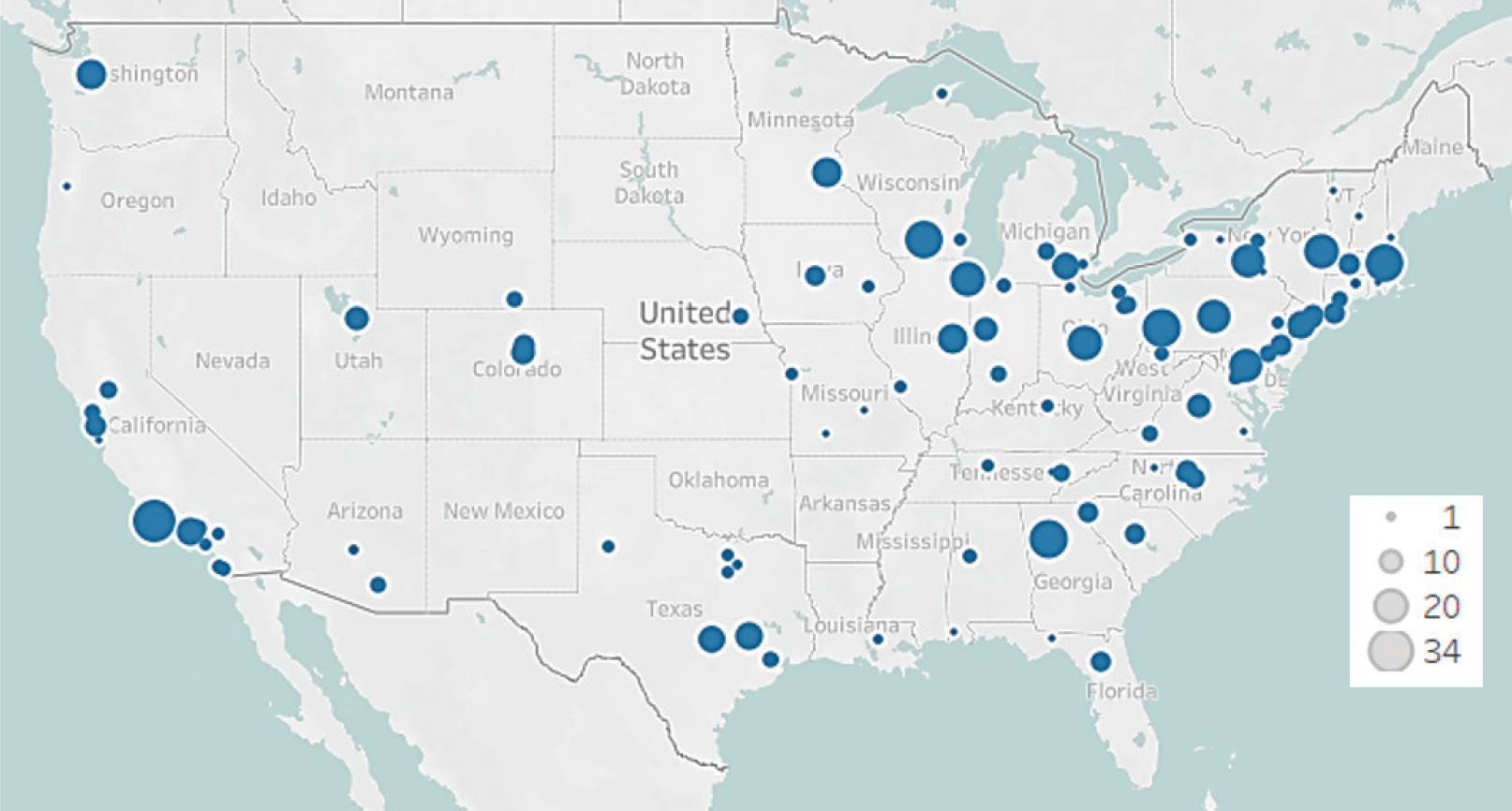
SOURCE: Courtesy of P.M. Anderson and K.D. Wilson, National Science Foundation staff.
activities. Figure 4-2 shows the number of junior participants in the program since the effort started as a Dear Colleague Letter in 2012; DMREF was launched as an official program in 2015, at which point there was a significant increase in the number of participants. In 2021, nine divisions across three directorates were participating in the DMREF program. The overall data reflect a multiyear trend of increased numbers of students/postdocs supported by DMREF; the modest downturn in 2021 is somewhat unclear, although it could be a consequence of COVID-19 and/or a result of the switch from annual to biennial competitions after 2017.5
The committee conducted interviews with panels of current students, current postdoctoral researchers, and former students and postdoctoral researchers contacted through the process described above. Below are some of the key takeaways from that discussion.
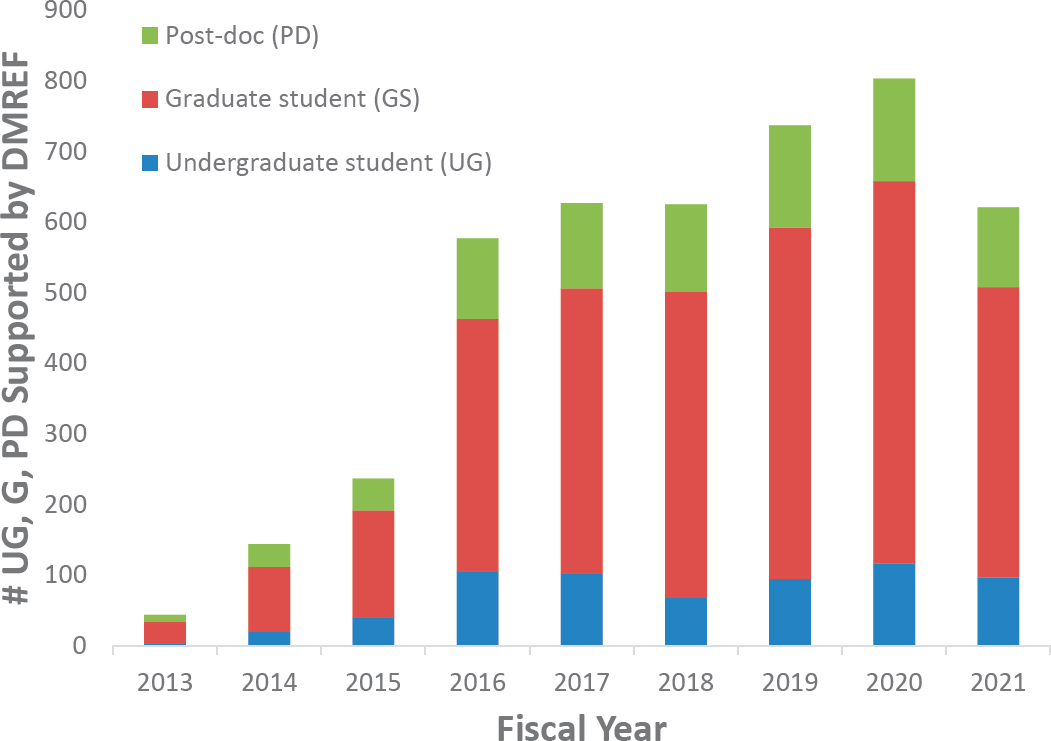
NOTES: Support varies from partial to full-time equivalent of a student/postdoc. Undergraduate = blue, graduate = red, postdoc = green.
SOURCE: Courtesy of P.M. Anderson, National Science Foundation staff, with data from the Division of Materials Research, using annual reports for the DMREF projects.
___________________
5 There were no competitions in 2018 and 2020.
- Current students.6 The committee met with six students from five research-intensive institutions, with a variety of backgrounds that included experimentation and modeling. Most of these students were not aware of the MGI, although they were generally informed and aware of NSF funding that was permitting them to collaborate and connect across disciplines. They recognized this as a benefit that provided them additional visibility in interdisciplinary fields, for future job prospects, and for industry internships during their time as students. In particular, one student mentioned that his industry internship would not have been possible without the DMREF funding.
The interdisciplinarity of the projects that these students were participating in was also recognized as an opportunity to acquire insights into how other groups function and how vocabulary is used in the different fields. However, this recognition was not as effective as it could be. Students felt unprepared to understand the other side of the effort (e.g., an experimentalist not quite grasping the terminology used by modelers and vice versa). One student recommended extended exchanges of one semester or one or two summers to truly experience the other side, while a second student recommended smaller satellite meetings of all DMREF programs to increase exchanges beyond the annual PI meeting.
While it is not necessary for student researchers to become experts in all domains of knowledge and skill areas involved in a DMREF effort, it is important for them to be aware of the fundamental concepts, thus better promoting creativity and innovation. Being conversant across the spectrum of data science, computation, and experiment is the best mechanism to promote true interdisciplinarity. In this regard, a DMREF student award that rewards exemplary collaboration across skill areas could promote a better branding and understanding of the bigger concepts by students in this program.
- Postdoctoral researchers.7 The committee also met with six postdoctoral researchers from one national laboratory and three diverse research-intensive universities. An important finding from the discussions with these postdoctoral researchers involved the need for a repository. The group described how “not all experimental data are procured, curated, and stored in the same way—sometimes essential information (fitting ranges,
___________________
6 Six panelists from The Pennsylvania State University; Cornell University; University of Nebraska–Lincoln; Georgia Institute of Technology; Michigan Technological University; and The University of Vermont.
7 Six panelists from Los Alamos National Laboratory; University of Kentucky; Northwestern University; and Columbia University.
- etc.) is not retained, and comparisons between trends are obfuscated.” They said, “We still do not have a database for all the data, and therefore the interface for sharing the knowledge in a streamlined way is not yet there.” Furthermore, “the challenge may be in the structural, standardized curation of these databases. Standardization here includes not only data extraction but data storage and categorization in intelligent ways and then dissemination and use of these databases—that is, populating and refining them further rather than spending time, effort, and money on new non-communicating databases.” In addition, the postdoctoral researchers agreed that failed experiments are still experiments that should be stored and curated in databases.
- Former graduate students.8 The committee then met with six professionals who participated in DMREF as students. Their places of employment included three companies, one research-intensive university, and two national laboratories. One professional described that DMREF shaped her career tremendously, collaborating with five different groups and becoming a generalist, which now allows her to connect with many people as head of customer education in her company. The value was precisely the cross-collaboration. A desire to connect with students from the different funded projects was also described, mirroring comments from current students that proposed the need for extended exchanges of one semester or one to two summers to truly experience the other side.
A previous analysis of coursework related to MGI concepts was completed in 2019, showing that although there has been success in incorporating computational materials science concepts into materials science and engineering curricula, this success does not include data science concepts. Perhaps this explains the comments from the postdoctoral researchers, who recognize the need for data science and data management but are not leveraging them in their research. A specific insight on this issue was provided by one postdoctoral researcher who “lost [his/her] database designer, [which] highlights the fragility of the DMREF way of working together.” If databases and repositories were centralized, this problem may be minimized.
Comments were also made regarding the role of the DMREF program in outreach. There was a mixed understanding of the role that DMREF is required to play in outreach. Some did not participate at all in any broader impact efforts, whereas others were enthusiastic about their involvement in activities to encourage women and underrepresented minorities to enter the field.
___________________
8 Six panelists from SAP; The University of Alabama; Cornell University; Qorvo; 3M Corporate Research Analytical Lab; and University of Connecticut.
One of the professionals noted the lack of women and underrepresented minorities working in these areas. In this regard, the study committee felt that there was no mechanism for determining any relevant demographics of the students or postdoctoral researchers who have participated in DMREF. Thus, a more comprehensive analysis of the successes and failures of DMREF for promoting inclusivity is not possible.
While the sample size from which the findings in this section of the report are drawn is small, the committee recognizes the important insights these discussions provide into the perceptions of the DMREF program over the past 10 years. From these and committee members’ broader experiences, the committee proposes the following findings and recommendations.
KEY FINDING 4.1: The degree to which students are educated about the broader context and goals of the MGI and the degree of integration and interdisciplinarity of their training are very uneven among different DMREF projects.
FINDING 4.2: Within a project team, students find that data sharing and data interpretation strategies are not sufficiently accessible or emphasized in their training, but they are eager to have ways that will enable them to learn more about the overall work being done and how to use the data to draw conclusions about the work.
FINDING 4.3: There is a lack of student training with respect to courses that create awareness of the field from various angles, and many students felt unprepared to understand the other side of the effort (e.g., an experimentalist not understanding the terminology used by modelers and vice versa) and thus less able to contribute deeply and broadly to the project.
FINDING 4.4: Culture and training are effective with respect to being focused within a specific discipline in which a student is enrolled but uneven with respect to the amount of foundational knowledge that a student requires to be able to contribute deeply and broadly to the discipline, while on the project and beyond.
KEY RECOMMENDATION 4.1: Students, postdoctoral associates, and other junior scientists associated with DMREF projects should develop substantial understanding of all aspects of the project, beyond those aspects that are the primary focus of their work. DMREF should encourage and help principal investigators to develop and implement the interdisciplinary training that this entails.
RECOMMENDATION 4.2: Faculty leading DMREF projects, or involved in DMREF, should consider course offerings for students that provide them with the breadth of training needed to gain the foundational knowledge required. NSF should consider providing funding opportunities for design of new types of courses or new ways of educating students in such interdisciplinary projects where they can receive the foundational knowledge that is needed.
RECOMMENDATION 4.3: A DMREF student team award should be established by DMREF leadership to reward the skills development espoused by the program.
Student and junior researchers need more exposure to industrial research and development through extended visits or internships. This should include smaller companies. Additional opportunities to enhance preparation for and participation of junior researchers in DMREF-sponsored research are discussed in Chapter 6 (see Finding 6.16 and Recommendations 6.19 and 6.20).
OUTREACH
Targeted outreach efforts can expand the reach of DMREF and broaden awareness of materials research opportunities.
In Project 1234320, the PIs and their students were part of UW–Madison’s PEOPLE program, designed to increase the enrollment of minority and low-income students in colleges. Between 2013 and 2016, this group taught a 3-week course each summer for a total of ~60 high school students.
Outreach programs for K–12 teachers can also help to engage a broader talent pool. In Project 1234096, to seed the next generation of materials research, secondary school teachers from schools in Puerto Rico were invited for a workshop on communicating important ideas in materials physics to high school students. Teachers learned about aspects of materials design, visited a materials analysis company, and developed several classroom activities that they implemented in their own and other schools.
FINDING 4.5: It was difficult to determine how much broadening participation efforts resulted in increasing diversity of students in the DMREF groups. The National Science Board Vision 2030 has shown how large the gap is with regard to the number of women and underrepresented minorities in the workforce. It states that the number of women will need to double while the number of underrepresented minorities will need to more than double in order for the science, technology, engineering, and mathematics workforce to resemble that of U.S. demographics.
RECOMMENDATION 4.4: Information on demographics of student and postdoctoral researcher teams needs to be made available to the materials community. This should include statistics on gender, underrepresented minority status, disability status, and geographic distribution, among several others, and if possible, subsequent career paths of students and other junior researchers.
RECOMMENDATION 4.5: To broaden the participation of women and underrepresented minorities in DMREF programs, principal investigators are encouraged to engage minority-serving institutions (including Hispanic-Serving Institutions and Historically Black Colleges and Universities) in meaningful and productive collaborations that are mutually engaging and scientifically beneficial.


