Lifecycle BIM for Infrastructure: A Business Case for Project Delivery and Asset Management (2023)
Chapter: Chapter 5 - BIM for Asset Data Management

CHAPTER 5
BIM for Asset Data Management
5.1 Summary
In Part 1 of ISO 19650, BIM is defined as the “use of a shared digital representation of a built asset to facilitate design, construction, and operation processes to form a reliable basis for decisions” (ISO 2018a). BIM has shown significant benefits across many industry sectors. The adoption of BIM for highway and bridge assets will allow for workflow efficiency gains, detailed construction costs, and reduction of construction errors in a time when the transportation sector needs to effectively address the improvement and management of deficient infrastructure. The adoption of BIM requires the development of an intentional transition strategy to alter the methods for producing and organizing information related to two broad phases of a project: delivery and operations. It also requires organizations to evaluate their approach to handling assets, which frequently includes identifying the need to move from a siloed, primarily phase-based perspective to a lifecycle perspective.
This chapter provides a structure to help highway agencies develop their BIM asset data management strategy. Following the introduction, this chapter presents a four-part approach to develop the BIM strategy; define the asset information data requirements; leverage BIM during the delivery phase for improved delivery performance, along with the production of asset information for operations; and use an AIM to support operations.
The broad adoption of BIM throughout a transportation agency is a journey and will require significant planning. This guide was developed to initiate and direct this planning, while also pointing to some of the most valuable external resources for detailed implementation.
5.2 Introduction
To achieve the benefits of leveraging asset data from BIM throughout asset management and future infrastructure projects, an agency must focus on developing a structured lifecycle information management approach. This introduction provides the foundation for this approach.
Information Management Process
The development of clear BIM asset data requirements necessitates a structured information management process. In 2018 and 2020, ISO released a series of new standards (ISO 19650, Parts 1, 2, and 3) that document a framework and structured process for adopting BIM strategies to define asset information requirements (AIR) for an organization. These asset information needs can be interpreted into specific project information requirements (PIR) from team members, enabling an owner to receive valuable asset data at the conclusion of the project delivery phase.
The information management process, as it relates to the built highway and road infrastructure, has two broad phases, as defined within asset information management standards (ISO 2018a). These phases of the asset information management lifecycle include 1) development of asset information in the project delivery phase, and 2) the use and updating of asset information in the operational phase. One challenge faced by transportation agencies is how to implement requirements on the activities within the delivery phase to obtain valuable information that can be used during the operational phase of the assets (roads, bridges, signs, etc.). To do this, an intentional process must be performed—first to define the overall goal of leveraging asset data to support lifecycle asset O&M, then to identify and define the information that can be developed or procured during the delivery phase (design and construction) to support the overall operational process.
To align with the two primary phases of delivery and operation (or asset management), there are two categories of models: 1) the PIM, developed by project team members (e.g., designers, constructors, and inspectors, either in-house or contracted parties); and 2) the AIM, maintained by the transportation agency. It is important to note that the term “model” frequently refers to a federated model (composed of multiple, integrated data sources), and the model is an information model, not necessarily requiring 3D information for all its components. To successfully develop these information models, the information requirements need to be clearly defined, both at a project level and at an asset management level.
There are multiple approaches to documenting these requirements, including 1) the development of well-defined information exchanges, 2) the creation of detailed asset data requirements, and 3) requiring that elements within a 3D modeling application be modeled to a specific LOD and level of information (LOI). LOD generally relates to the reliability and detail of graphical content of models, while LOI relates to the non-graphical content of models.
Within the information management lifecycle, there are important information exchange points or events when information is shared. The information exchange points or events include the start of a project delivery phase, where information is shared from the operational phase of the AIM, as well as from the new project to represent the existing conditions (especially important for renovation or repair projects). At the end of the project delivery phase (or throughout the delivery), information is shared from the PIM to the AIM. These fundamental information exchanges—from AIM to PIM, and from PIM to AIM—must be clearly defined and closely managed.
In the context of a highway project, the information exchanges can be documented as clear BIM requirements. An example of requirements can be found in projects such as the NYSDOT Kew Gardens Project (described in the case studies chapter). Within this project, existing condition information was captured and shared with the design team. Then the project team continuously built upon the existing information by creating a design model. This design model content was required to be used as the foundation for construction model content. At the conclusion of the delivery, the contractor was required to provide as-built model content to NYSDOT, including updated underground utilities. The as-built model data will be used to populate the AIM for use during the operational phase to support asset management and asset inventories. It is important to note that an AIM is not one single model, but a collection of individual models that are harvested into their authoritative asset inventories by asset class.
Recommendations for Planning for BIM for Asset Management
Initially and clearly defining the information that will benefit the agency within the asset operations and inventory processes is critical to the success of leveraging BIM data and models created during the design and construction phases in support of asset management. Information

Figure 5-1. Representation of information requirement hierarchy.
needs can be viewed as a hierarchy of information (as seen in Figure 5-1), moving from overall agency information needs to specific information per asset (e.g., bridges, roads, and other assets) and information that can be gained from the delivery (design and construction) phase.
To develop the AIR, there are a series of steps that an agency can perform (defined in Section 2 of this chapter). In general, the agency will need to prioritize the specific information needs for assets documented as the AIR (e.g., bridge condition information, accurate utility location information) and confirm that clear PIR are defined to ensure that the necessary information can be collected from various project team members (e.g., designers, constructors, and inspectors). The actual information is collected in a series of information exchanges, which are defined as exchange information requirements (EIRs). Once the series of exchange requirements is defined, the requirements can be added to the project agreements to ensure that team members deliver the information as required.
5.3 Section 1: BIM for Asset Data Management Strategic Plan
To be successful in developing a comprehensive strategy for managing lifecycle asset data across multiple projects, it is important to develop a strategic plan for collecting, storing, retrieving, and using the data. A transportation infrastructure owner should develop an asset data management plan to clearly define the important asset information that will be managed throughout the lifecycle, along with the various use cases for leveraging this information. This section defines the elements that are foundational to developing the asset data management strategy. The strategy can be developed by 1) creating a BIM and asset data steering committee to guide the process; 2) developing the asset data management strategy; and 3) assessing and updating the existing portfolio of BIM and asset data throughout the organization.
Create a BIM and Asset Data Steering Committee
A BIM and Asset Data Steering Committee should be assembled to include individuals who have background knowledge and experience with BIM and its processes and should represent a diverse group of members from across the organization (Messner et al. 2019). As with any
organizational change, the Steering Committee should be a multidisciplinary group that includes all stakeholders who will feel the impact of the changes, as well as those with deep knowledge of the organization’s asset data and data storage capacities. Their role is to develop the strategic plans, make key decisions, and guide the implementation of the plan. The Steering Committee may report to a separate executive group, depending upon the structure of the agency or the level of executive involvement in the Steering Committee. If the agency does not have previous BIM experience, it may be advantageous to seek assistance from third-party BIM implementers.
The Steering Committee should include the following types of representatives:
- BIM champion. A technically skilled and motivated person to guide the development and implementation of the asset data strategy, or BIM champion, should be included. The champion could be from areas such as asset management, design, or construction, depending on the strengths and experience of the person and departments within the agency. A champion should have the ability to direct funds and staffing as necessary to support the BIM efforts. The importance of a dedicated BIM champion cannot be overemphasized. The champion will need to be devoted, have the authority to make key decisions, and sometimes face challenges when people resist change within the delivery process.
- Executive representation. The Steering Committee should have appropriate representation from an executive level to ensure that it has access to the necessary resources to plan and implement the recommendations that are developed. Examples of possible job titles for individuals in this role within a transportation agency include deputy or assistant deputy director, chief or assistant engineer/director, division administrator/engineer, director of project development, director of operations, and director of information technology, or people who directly report to them.
- Middle management representation. Mid-level managers should be involved in the core plan development to ensure appropriate process adoption throughout various departments. Typical job titles for individuals in this role within a transportation agency include state design engineer, state right-of-way director, state planning director, state construction/materials engineer, state structures engineer, state maintenance engineer, and state traffic engineer, or people who report directly to them.
- Technical representation. Individuals with technical expertise in various workflows and BIM tools will benefit the Steering Committee since their involvement can help foster acceptance of the new processes and provide insight into the challenges involved in modifying processes. Typical job titles for individuals in this role within a transportation agency include standards and methods engineer, CADD services manager, automation engineer, construction management systems manager, GIS manager, and asset management systems manager, or people who report directly to them.
When assembling the BIM Steering Committee, consideration should be given to involving personnel with specific responsibilities and capabilities, including
- One or more individuals who can champion the planning throughout the organization;
- Decision-makers who have authority to grant access to resources required by the team (e.g., time, funding, personnel, and infrastructure);
- Individuals who might be directly affected by the adoption or change;
- Motivated individuals who can contribute to the process and support improving the process through change;
- Implementers of the BIM process; and
- Individuals who will be able to monitor progress and manage the process change (Messner et al. 2019).
In addition to the Steering Committee, there can be disciplinary or topic-focused subcommittees or subgroups that work on individual technical initiatives to execute directives provided through the strategic planning process.
Assess and Update BIM and Asset Data Management Technical Portfolio
Transportation infrastructure owners typically have multiple databases as well as digital or paper documents that contain information about existing assets. Once a BIM and asset data management strategy is developed, it will be important to review the portfolio of existing asset data information platforms available and develop strategies for managing these platforms. There are several relatively simple core concepts for governing these data sources, but achieving these objectives may require detailed planning. Part 1 of the ISO 19650 information management standards (ISO 2018a) defines a CDE as an “agreed source of information for any given project or asset, for collecting, managing, and disseminating each information container through a managed process.” In more common language, the CDE is a defined, common location for an organization to store all information related to projects and assets within a structure that allows for one source of truth for the information required for a task. The CDE may be composed of multiple interconnected data sources, but there should be a clear definition for the location within the CDE that contains the single source of truth for each type of asset information. Ideally, there would be procedures in place to ensure data consistency and quality throughout the CDE.
The CDE at a project level encompasses the information needed to manage the project using PIM data. The CDE is typically implemented via a collaborative project management system that enables file sharing and communication about design and construction information (design models, specifications, RFIs, submittals, and change requests). This collection of design, construction, and initial AIMs makes up the PIM. The agency manages the assets by referencing a series of other information sources that make up the AIM.
Every highway agency will have a significant amount of data from previous and existing projects and asset databases that may not be consistent with the developed strategy. An evaluation of the data environment and existing data sources will need to be conducted. When practical, it is necessary to develop strategies for collecting and updating information throughout the existing data environment to work toward a cohesive, comprehensive, and secure CDE. The existing data environment; the as-constructed, as-found existing asset inventory; and existing data sources make up the AIM within the authoritative asset management system. Ideally, the various data sources are related and make up a comprehensive CDE for the asset information.
Determine a BIM and Asset Data Management Strategy
The Steering Committee will focus on the development of a BIM and asset data management strategy. The development of this strategy can be performed through a series of steps. There are several resources to help guide this process, such as structured process documents like the information management standards developed with ISO 19650, along with more practice-oriented guidelines such as BIM Planning Guide for Facility Owners. The documents have common elements that are important to successfully developing a strategy for an asset owner:
- Assessment: Identify the current status of the organization’s information management processes related to asset information management.
- Alignment: Define the desired future state (at a point in time) for the organization’s asset information management.
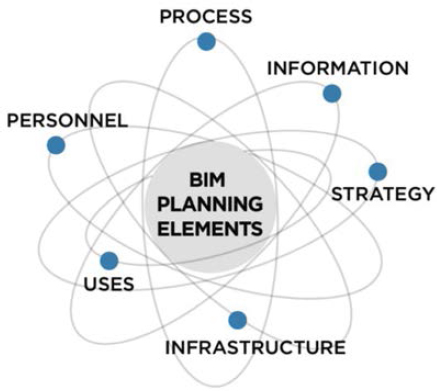
Figure 5-2. BIM planning elements.
- Advancement: Develop an implementation plan to transition the organization from the current state to a future state with improved asset information management.
This process requires time and a commitment to analyzing the organization’s current practices and information management approaches. Information and data management processes within the organization are frequently structured around legacy processes and practices, which may not be the best approach when transitioning to digitalization with an increasing LOI.
When developing the strategy, it is important to consider a number of factors. These factors were defined within BIM Planning Guide for Facility Owners as 1) strategy, 2) information, 3) process, 4) personnel, 5) uses, and 6) infrastructure (Figure 5-2). A CMM can be used to evaluate the agency’s maturity in these areas.
This report will not delve into the details of this process since it has been defined within BIM Planning Guide for Facility Owners, but a maturity model that was originally published in the planning guide has been modified to focus on transportation agencies and is included in Appendix E. The Steering Committee should review the process defined within this guide to gain insights into the planning process and leverage the resources provided to create a strategy.
5.4 Section 2: Information Exchange Requirements for BIM Asset Data
This section defines the steps involved for an agency to develop asset data requirements for core asset data and models. The core need to clearly define owner asset data requirements has been highlighted in multiple initiatives, including the emphasis on “beginning with the end in mind” (with the “end” being operations) highlighted in BIM Project Execution Planning Guide (Messner et al. 2021) and the initial step in the ISO 19650 information process of assessment of needs by the owner. While this process is included in the strategic planning process in Section 1 at a high level, it is important to consider the detailed steps involved in developing these exchange requirements.
The following seven steps can be followed to develop these AIR, which can be translated into individual requirements as part of an agreement.
- Identify lifecycle asset management use cases. Within the strategic planning process (Section 1), agencies should identify the BIM use cases that align with their core objectives and
- Identify core data models needed to support use cases (e.g., roadway geometry model, bridge model, road network model).
- Define BIM data entities (e.g., shoulders, lanes, medians). Figure 5-4 shows an example of the various potential building blocks for a data model. For example, the roadway geometry data model should include the shoulders, lanes, medians, vertical alignment, horizontal alignment, and routes as objects within the data model, including their geometry.
- Identify data properties that can be collected from the delivery phase. The agency can define specific data properties for each primary object category. The Minnesota Department of Transportation’s as-built deliverables website is an example of the clear definition of asset data submissions required from a project. This website provides a series of spreadsheet templates for various road and bridge project asset categories, including bridge, drainage, and facility (Figure 5-5).
- Assign responsible party for data collection. All information should be collected from one source of truth. For some information (e.g., the design information), the responsible party will be the design engineer, and more specifically, the model information that the engineer develops. For other information, such as utility locations, the surveyor may be the responsible party. These responsible parties should be clearly documented.
goals for implementing BIM. While BIM Planning Guide for Facility Owners does not include specific details regarding BIM uses for highways and roads, Figure 5-3 includes a specific set of BIM uses, organized within two categories of essential and enhanced, that agencies should consider implementing. The details of these BIM uses are defined in Section 3 for plan, design, and construct phases and Section 4 for the operate phase. These use cases are divided into four categories: project delivery core, asset management core, project delivery extensions, and asset management extensions.
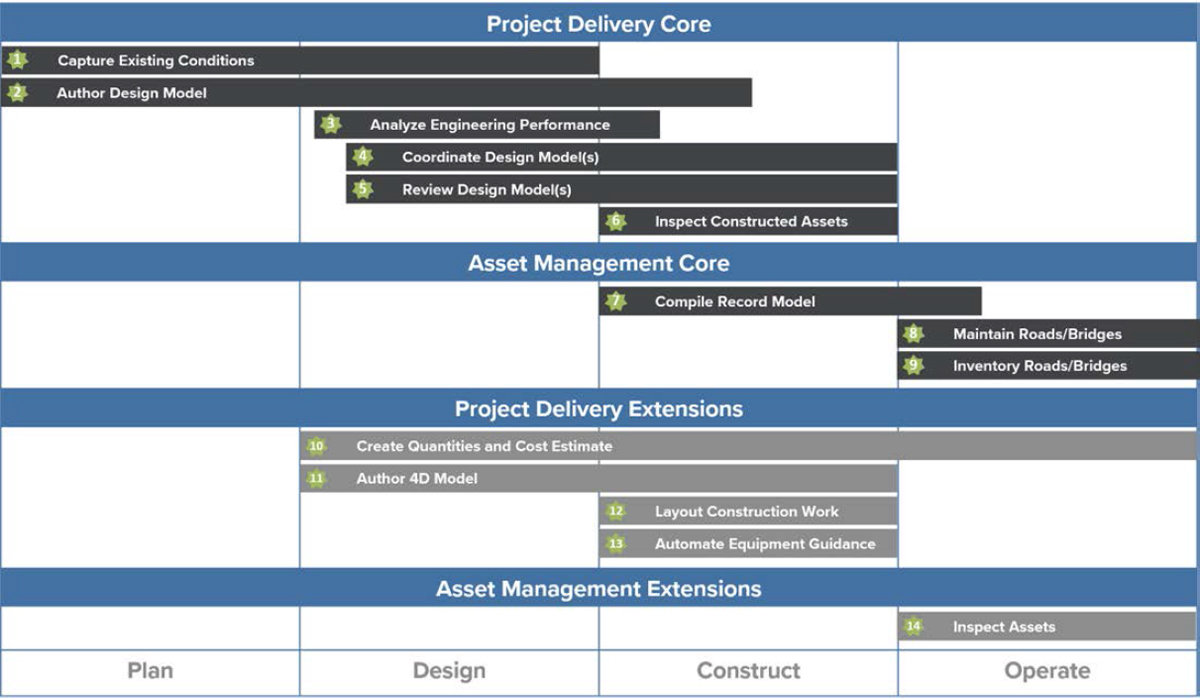

Figure 5-4. Data entities (or object types) as building blocks for data model.

Figure 5-5. Sample drainage asset class sheet from Minnesota Department of Transportation.
-
Determine ideal data exchange format to enable easy consumption of data. For asset data exchanges, the data should be structured so that they can be easily translated into the core asset management systems (or using ISO terminology, the AIM). This may include a requirement that information be documented in templated data tables, or it could involve defining a standard data schema, such as Construction-Operations Building information exchange (COBie).
There are also ongoing efforts to clearly define openBIM information exchanges that will make this process easier. One initiative that is advancing in the international community, with support from DOTs in the United States, is the BIM for Bridges and Structures Transportation Pooled Fund. This project aims to identify specific information objects, attributes, and relationships for a series of information exchange standards that can or should occur within the design and construction phases of a bridge project. The information exchanges will be very detailed, along with software to transact the information using the IFC data schema managed by buildingSMART International. This schema has been adopted by AASHTO as the data schema for openBIM data exchange. Several other efforts are underway through buildingSMART International Infrastructure Room projects. When complete, this will allow for agencies to simply specify a desired exchange instead of having to create unique information requirements for each exchange. (More information and the current status of this initiative can be found within the buildingSMART International Infrastructure Room at https://www.buildingsmart.org/standards/rooms/infrastructure/.) Agencies can leverage these open information exchanges once documented. It would be valuable for BIM champions to make sure they are aware of the resources available in these standards projects.
- Create data exchange requirements. Finalize the exchange requirements in a format that can be clearly referenced within design and construction contracts or leveraged for internal use when required. The requirements should leverage openBIM standards as much as possible.
5.5 Section 3: BIM in the Delivery Phase
The delivery phase is composed of the planning, design, and construction of the asset. BIM can be used throughout the delivery phase to improve overall project performance, including reducing overall delivery costs, improving schedule reliability, and helping to ensure a high-quality design and constructed asset. There are many ways that BIM can be used to support the delivery process. A core subset of these BIM uses is presented in Figure 5-3, and a brief definition is provided in the following sections.
BIM in the Planning Process
The core BIM uses performed within the planning process can be used to develop an existing conditions model to represent current conditions and the initial phases of authoring the early scoping and design schemas. The following are concise definitions of these planning uses:
- Capture Existing Conditions: using 3D information-capture approaches and BIM authoring software to develop a 3D model of the existing conditions for a site, roads/bridges on a site, or a specific area within a road or bridge (Messner et al. 2021).
- Author Design Model: using BIM authoring software to develop a model with 3D and additional attribute information for a road/bridge design, leveraging a library of parametric design elements (Messner et al. 2021).
When viewing the specific data management tasks associated with these BIM uses, the agency should prepare to support the development of the planning model through the following steps:
- Organize existing AIMs and data provided from asset management databases.
- Identify existing or newly classified assets within project work area and associated work type.
- If work is programmed, information can be updated in the authoritative system with project information as pending status.
- Collect preliminary data from authoritative asset inventory databases or management systems and attach to PIMs as required by the project information exchange requirements.
- Contextualize the project area using conceptual visualization products to help get input from stakeholders and collaborate with external agencies.
- Provide these conceptual visualization models and preliminary data resources to designers as a point of beginning. It may be helpful to involve the design team during the contextualization of the project area.
BIM in the Design Process
The core BIM uses performed within the design process include the development of a design model along with analysis for performance, coordination, and review. The following are concise definitions of these design uses:
- Author Design Model: using BIM authoring software to develop a model with 3D and additional attribute information for a road/bridge design, leveraging a library of parametric design elements (Messner et al. 2021).
- Analyze Engineering Performance: a process in which intelligent modeling software uses the BIM model to determine the most effective engineering method based on design specifications (Messner et al. 2021).
- Coordinate Design Models: using 3D coordination software to compile a federated model of design models for performing automated 3D collision detection to identify potential coordination issues and a visual analysis to identify potential spatial design issues (Messner et al. 2021).
- Review Design Models: reviewing a building information model with project stakeholders to gain their feedback and to validate the design, construction, or operational aspects of a project (Messner et al. 2021).
In addition to these essential uses, there are potential enhanced uses that are focused on cost and schedule management. One such use is Create Quantities and Cost Estimate, a process in which BIM can be used to assist in the generation of accurate QTOs and cost estimates throughout the lifecycle of a project (Messner et al. 2021).
Key asset data tasks for setting up a process to develop BIM in design include:
- Uploading any model content created in the design phase to the CDE to share with the design team;
- Generating 3D models with distinct elements for classified assets;
- Populating classified assets with data specified in data exchange requirements; and
- Providing models and data deliverables from the design process to the contractor.
BIM in the Construction Process
The core BIM uses performed within the construction process include the development of a record construction model, the use of the design model released for construction and inspection of constructed assets, authoring 4D models, laying out construction work, and use in automated machine equipment. The following are concise definitions for these construction uses:
- Inspect Constructed Assets: using 3D models to verify location, elevation, and quantities of installed assets against contract requirements.
- Compile Record Model/Digital As-Built Model: a process for obtaining information about the elements, surrounding conditions, and assets of a road or bridge (adapted from Messner et al. 2021). This includes the review and acceptance of digital as-built models, including asset objects and appropriate asset information and status. For example, part of the information requirements may include an asset property to indicate if the asset was newly installed, replaced, repaired, or removed/decommissioned.
Also, it is important to recognize that asset objects do not always require a 3D model. It is anticipated that items like striping, for example, are asset objects whose data is important to collect at the end of installation. This information can then be harvested by the authoritative database or system. Thus, compiling a record model or digital as-built of the built environment can be done for all types of projects when the owner agency has established clear requirements guided by data governance policies.
In addition to these essential uses, there are potential enhanced uses focused on the automation of laying out work in the field and guiding equipment, including the following:
- Author 4D Model: a process in which a 4D model (3D model with the added dimension of time) is utilized to effectively plan staged work or to show the construction sequence of various activities (Messner et al. 2021). This BIM use is primarily a construction risk management tool for complex projects or for the benefit of contractors as part of their means and methods. Nevertheless, it is an option for certain types of projects.
- Layout Construction Work: using model information to lay out road/bridge assemblies or automate control of automated equipment on a construction project (adapted from Messner et al. 2021).
- Automate Equipment Guidance: using information from a model to guide or control excavation for road and bridge construction equipment on the jobsite.
A core aspect of many of these use cases is the need to create highly detailed models with accurate geometric data, which have been defined within the BIM Forum LOD specification as LOD 400 elements. These detailed asset models will either use the design model as the base reference or, in some instances, transition the design model components into a more detailed construction model representation. This process also includes the compilation of the final record model, documenting an accurate representation with varying potential levels of geospatial detail, and the final constructed product. Specific items that are important within the construction process include
- Creating or transitioning the design models to an appropriate LOD to support construction;
- Using design models, newly developed construction models, and data deliverables for construction use cases;
- Collecting data as required by the EIRs;
- Updating location and attributes of 3D elements in the model as appropriate to capture as-built locations and actual constructed element information; and
- Providing the final BIM and data deliverables to the owner.
5.6 Section 4: BIM for Operations Phase
Once the digital as-built model, including the asset information exchange, has been handed off by the construction team, the information from the PIM relevant to the operations phase is used to populate or update the AIM, which is continuously maintained during the operations phase. The following are concise definitions of these BIM uses during operations:
- Maintain Roads/Bridges: using information from AIMs to monitor status and schedule maintenance activities for a road or bridge (adapted from Messner et al. 2021). It is assumed that this use will be enabled by defining information delivery requirements for all areas that contribute to the development of the AIM. It is important to recognize that the AIM is not static, but rather a model that is constantly being upgraded by the information being collected during O&M activities.
- Inventory Roads/Bridges: using information extracted from AIMs to document and track conditions and quantities assets. It is expected that the digital as-built will augment the information housed in authoritative databases or systems.
In addition to these essential uses, there are potential enhanced uses that are focused on the periodic inspection of assets. For example, Inspect Assets involves using the AIM to inform the inspection of bridges and roads during the operational phase of the assets.
Several core items to consider in this phase include
- Use PIMs and data deliverables to populate Asset Management databases;
- Merge PIMs with AIM;
- Collect data and update AIMs as required by the data exchange requirements;
- Generate reports necessary for O&M; and
- Generate the PIMs from AIMs as necessary to begin a new project.
5.7 Conclusions and Observations
The development of a comprehensive asset management plan using BIM across the scope of assets managed by a transportation agency will require detailed planning over multiple years. It will also require a mindset throughout the agency that places a high value on lifecycle information management. This guide aims to outline a high-level approach to this asset management plan development. There are many resources available to support the development with different solutions.
Some lessons learned from previous initiatives and case studies include
- Seek out empowered BIM champions.
- Start with pilot implementations and grow initiatives after prototyping.
- Begin with the end in mind, that is, understand which data have high value and focus on them from the beginning.
- Focus on targeted improvements, and continue to expand.
- Leverage lessons and resources from others whenever possible, including the ongoing standards work at buildingSMART International, U.S. National BIM Standard activities, and requirements from other agencies.
There are ongoing efforts to support the development and adoption of national and international standards for BIM implementation that will continue to make adoption easier and more consistent. For example, the IFC Bridge and IFC Road projects within buildingSMART International are focused on defining consistent, open information exchanges for bridge and road assets. Agencies can leverage these information exchanges to define information needs and support software vendors in implementing the tools needed to develop the exchanges. The NIBS BIM Council is also leading efforts to develop consistent and detailed processes for defining BIM planning and requirements through national standards. In addition, there are efforts to develop standard, common object-type libraries and minimum information requirements for objects within the library to support common information exchanges. There are many additional initiatives, supported by FHWA, AASHTO, and national standards organizations, to develop more comprehensive and valuable resources for BIM adoption.


