2022 Assessment of the National Institute of Standards and Technology's Communications Technology Laboratory (2023)
Chapter: 2 Overview of the Communications Technology Laboratory
2
Overview of the Communications Technology Laboratory
The Communications Technology Laboratory (CTL) is one of the six laboratories operated by the National Institute of Standards and Technology (NIST).1 It was established in 2014 to bring NIST’s distributed work on wireless communication under the unified leadership of one laboratory. CTL
Serves as an independent, unbiased arbiter of trusted measurements and standards to government and industry. We focus on developing precision instrumentation and creating test protocols, models and simulation tools to enable a range of emerging wireless technologies.2
COMMUNICATIONS TECHNOLOGY LABORATORY REORGANIZATION
In 2021, CTL underwent a reorganization, expanding to include the following five divisions:
- Core Network Technologies (lead: Abdella Battou, Smart Connected Systems Division chief), comprising
- Emerging Network Technologies Program,
- Information-Centric Networks,
- 5G/6G Core Networks, and
- Quantum Optical Networking, including metrology, network architectures, and protocols;
- Trustworthy Networks Research Program,
- Robust Inter-Domain Routing,
- Trustworthy Intelligent Networks,
- Software Defined and Virtualized Networks,
- Trustworthy Network of Things,
- Emerging Network Technologies Program,
___________________
1 The other National Institute of Standards and Technology (NIST) laboratories are the Engineering Laboratory, Information Technology Laboratory, Material Measurement Laboratory, NIST Center for Neutron Research, and Physical Measurement Laboratory.
2 NIST, 2022, “About CTL,” updated May 5, https://www.nist.gov/ctl/about-ctl.
-
-
- High Assurance Domains, and
- U.S. Government IPv6 Program;
-
- Fundamental Electromagnetic Technologies and Standards (lead: Paul Hale, Radio Frequency Technologies Division chief), comprising
- Electromagnetic Traceability,
- Microwave Measurements for Materials and Electronics,
- Over-the-Air Testing, and
- Quantum Traceability for Communications;
- Next-Generation Wireless Systems (lead: Nada Golmie, former Wireless Networks Division chief and current NIST fellow), comprising
- Antenna measurements,
- Channel sounding and modeling,
- Signal models,
- Spectrum sharing and metrology, and
- Worldwide NextG;
- Public Safety Communications (lead: Dereck Orr, Public Safety Communications Research Division chief), comprising
- Mission Critical Voice,
- Location-Based Services, and
- User Interface/User Experience;
- Smart Infrastructure and Manufacturing (lead: David Wollman, Smart Connected Systems Division deputy chief), comprising
- Smart Connected Manufacturing,
- Smart Grid,
- Internet of Things and Infrastructure,
- Smart Cities and Communities; and
- Spectrum Sharing and Sensing (lead: Melissa Midzor, Spectrum Technology and Research Division chief), comprising
- Spectrum Sharing, and
- Spectrum Sensing.
As part of the reorganization process, CTL undertook an extensive strategic planning exercise. The CTL Strategic Plan3 describes the planning process, results, and an action plan. The following six research focus areas were identified:
- Core Network Technologies,
- Fundamental Electromagnetic Technologies and Standards,
- Next-Generation Wireless Systems,
- Public Safety Communications,
- Smart Infrastructure and Manufacturing, and
- Spectrum Sharing and Sensing.
The mapping of these focus areas to divisions is shown in Table 2.1. The reorganized CTL leverages existing strengths in research and development, metrology, and standards coordination with an expanded scope, including “wired and wireless communications, spectrum sharing, photonics and quantum communications, as well as other next generation communications
___________________
3 NIST, “CTL Strategic Plan, 2021-2025,” https://drive.google.com/file/d/1OcslPrGwdk1l-F8HrqxfdBBFJNw3iBMZ/view, accessed September 21, 2022.
TABLE 2.1 Mapping of the Communications Technology Laboratory (CTL) Research Focus Areas to Its Divisions
| Core Network Technologies | Fundamental Electromagnetic Technologies and Standards | Next-Generation Wireless Systems | Public Safety Communications | Smart Infrastructure and Manufacturing | Spectrum Sharing and Sensing | |
|---|---|---|---|---|---|---|
| Public Safety Communications Research Division | X | X | X | |||
| Radio Frequency Technologies Division | X | X | X | X | X | |
| Smart Connected Systems Division | X | X | ||||
| Spectrum Technology and Research Division | X | X | X | |||
| Wireless Networks Division | X | X | X | X | X | X |
SOURCE: National Institute of Standards and Technology Communications Technology Laboratory, 2022, “2022 NASEM Review Materials,” Boulder, CO.
modalities, such as Internet of Things (IoT) and smart grid technologies, industrial networking and communications.”4
For the work in each research focus area CTL draws on multi-disciplinary teams of researchers from across the laboratory, bringing to bear the most relevant expertise to provide standards, tools, and commercialization resources to U.S. industry. This structure is similar to that in NIST’s five laboratories performing research to further NIST’s six critical and emerging technology areas.
The leaders in each research focus area are responsible for collaborating with their peers and the laboratory office to guide the research direction for the focus area. Project plans are crafted each year to further the capabilities in each focus area or address an industry need. Project plans have defined milestones, staff, and budget and are crafted in collaboration between the division chiefs and research focus area leads. Project Plans are approved by the CTL director. Division chiefs manage staff development, staff hiring, safety, operations, budget, and project implementation.
Given the recent nature of the CTL reorganization, this assessment reflects the fact that there has been limited time for the projects and organizations to make the connections envisioned in the reorganization. The panel believes that as CTL finds new ways to connect various efforts within the organization, opportunities and impact will grow.
Table 2.1 maps CTL’s divisions to the six research focus areas. While the table shows that the Radio Frequency Technologies Division and the Wireless Networks Division perform work in the Public Safety Communications research focus area, this is a case of their normal work having public safety communications applications. They are not doing significant work funded by the Public Safety Trust Fund and its expiration is not expected to affect them.
BUDGET
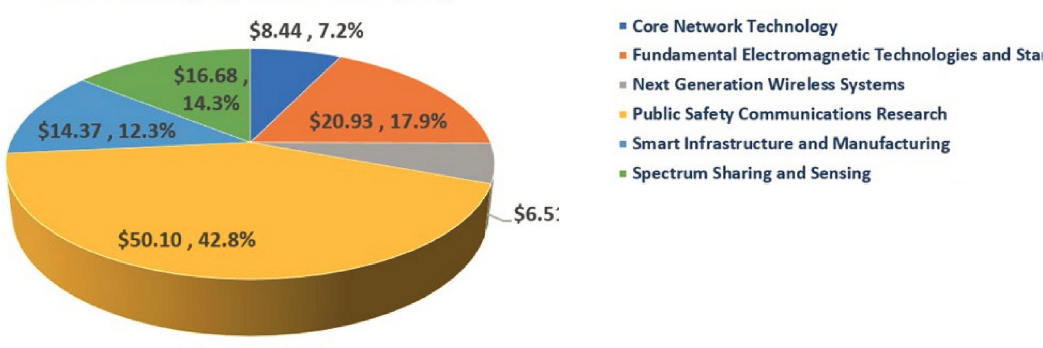
The CTL budget for fiscal year (FY) 2022 is approximately $117 million. The dollar amounts and percentages of the total budget for each focus area are shown in Figure 2.1. The funding trends for each focus area since 2019 are shown in Figure 2.2. Note that prior to the reorganization in 2021, CTL had four research focus areas—Public Safety, Spectrum Testing, Fundamental Metrology, and Next Generation Wireless.
___________________
4 NIST Communications Technology Laboratory (CTL), 2022, “2022 NASEM Review Materials,” Boulder, CO.
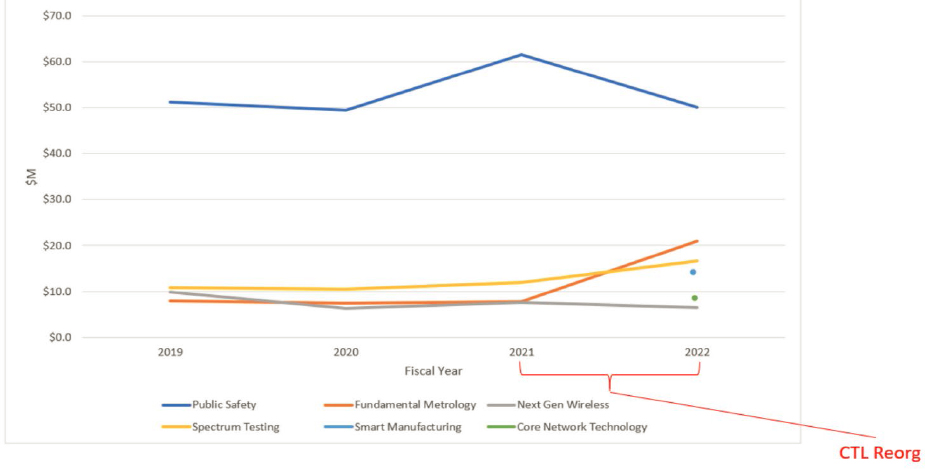
TABLE 2.2 Sources of Funding for Fiscal Year 2022 Communications Technology Laboratory (CTL) Budget (in Thousands of Dollars)
| Scientific and Technical Research and Services Base | Non-Base to Date | Other Agencies to Date | Expected Calibrations and Other | Public Safety Communications Research (PSCR) | Total | |
|---|---|---|---|---|---|---|
| Current CTL Funding | $23,466.2 | $8,594.2 | $4,466.4 | $300.0 | — | $36,826.8 |
| Additions from Reorganization | $26,500.8 | $2,030.3 | $1,012.5 | $561.4 | — | $30,105.0 |
| PSCR | $3,250.0 | — | — | — | $46,850.7 | $50,100.7 |
SOURCE: National Institute of Standards and Technology Communications Technology Laboratory, 2022, “2022 NASEM Review Materials,” Boulder, CO.
CTL funding comes from—largest to smallest— the Public Safety Trust Fund, congressional appropriations, contracted work from other agencies, and calibrations. The amounts of funding from various sources for FY 2022 are shown in Table 2.2. Note that the reorganization more than doubled the amount of the CTL budget coming from congressional appropriations.
Expiration of the Public Safety Trust Fund
FY 2022 is the final year of PSCR funding from the Public Safety Trust Fund. This will result in approximately $50 million less in PSCR spending per year. This fund was always temporary, and the expiration was known all along. As discussed in Chapter 6, the PSCR Division has planned for this and is already working on how to adjust its activities in light of the expiration. It should be noted that most of
these funds were not spent internally on CTL research but were directed to outside activities like prize challenges and research grants and contracts. While the change in funding appears to be dramatic, the panel does not believe that it affects any of the non-PSCR parts of CTL.
IMPACTS OF THE CHIPS AND SCIENCE ACT OF 2022
The Creating Helpful Incentives to Produce Semiconductors (CHIPS) and Science Act of 2022 (P.L. 117-167), was signed into law during the preparation of this report. Although this development is too recent for this panel to be able to assess its impact and CTL’s response, CTL reports that it has several programs that are well positioned to support the goals of this act. CTL staff have been involved in high-level planning activities to ensure that their project plans are aligned with industry and administration goals. CTL sees the following opportunities in its research focus areas:
- Fundamental Electromagnetic Metrology and Standards. This research focus area includes research, development, testing, and evaluation of materials, devices, and circuit design. It also includes the validation and verification work that will support the growth of the U.S. semiconductor value chain. CTL is leveraging partnerships with the International Electronics Manufacturing Initiative (iNEMI), Semiconductor Research Corporation (SRC), and test equipment manufacturers to help with prioritizing research programs in this space.
- Next Generation Wireless. Semiconductors are at the core of the wireless communications industry. Understanding complex antenna designs and wireless propagation are key to both the design and testing of wireless chips. CTL will leverage its partnerships through the NextG Channel Model Alliance and the National Science Foundation’s Resilient and Intelligent NextG Systems program to provide data, models, and measurement methods to support the design and testing of wireless chips.
- Smart Infrastructure and Manufacturing. CTL programs in smart manufacturing, hardware security, and operational technologies support the advanced manufacturing goals of the CHIPS and Science Act of 2022.5
STAFF
CTL operates from the NIST campuses in Boulder, Colorado, and Gaithersburg, Maryland. As of May 2022, there are 345 CTL staff. Table 2.3 shows the distribution of the staff type in each division.
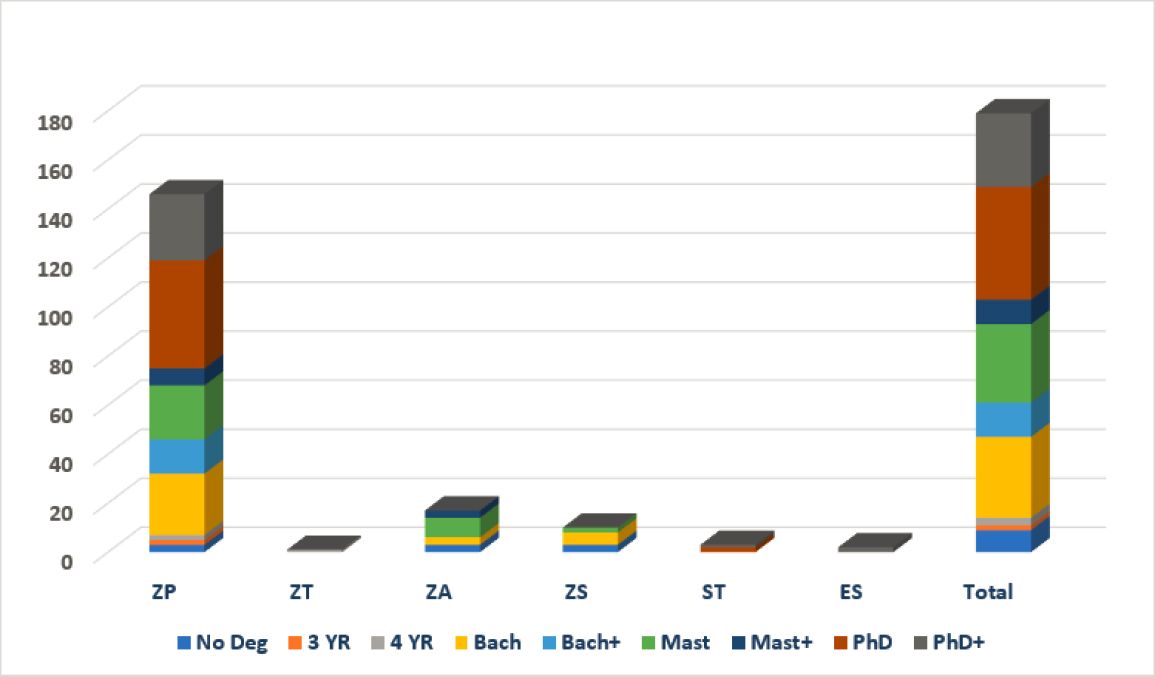
Figure 2.3 shows the academic credentials held by CTL federal staff in various career paths. The career paths are defined in the figure caption.
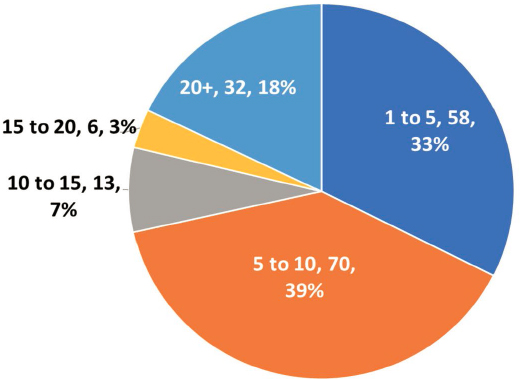
Figure 2.4 shows the distribution of years of service for CTL federal staff, showing that CTL has been successful in hiring and retaining federal staff. Sixty-seven percent of the staff has been at CTL for at least 5 years, and 28 percent has been there for at least 10 years.
___________________
5 Email correspondence between Marla Dowell, director, CTL, and Jim Myska, study director, August 10, 2022.
TABLE 2.3 Communications Technology Laboratory Staff Type in Each Division
| Division | Federal Employees | NIST Associatesa | ||||
|---|---|---|---|---|---|---|
| Permanent | Term-Limited | Intermittent | Domestic | Foreign | Total | |
| Headquarters | 16 | 1 | 0 | 2 | 1 | 20 |
| PSCR | 15 | 19 | 0 | 19 | 0 | 53 |
| Radio Frequency Technology | 27 | 15 | 0 | 39 | 11 | 92 |
| Wireless Networks | 24 | 2 | 2 | 2 | 20 | 50 |
| Smart Connected Systems | 30 | 0 | 5 | 9 | 29 | 73 |
| Spectrum Technology and Research | 17 | 6 | 0 | 26 | 8 | 57 |
| Total | 129 | 43 | 7 | 97 | 69 | |
| Grand Totals | 179 | 166 | 345 | |||
a NIST associates include guest researchers, research associates, contractors, and other non-NIST employees that require access to the NIST campuses or NIST resources.
SOURCE: National Institute of Standards and Technology Communications Technology Laboratory, 2022, “2022 NASEM Review Materials,” Boulder, CO.