Valuing America's Health: Aligning Financing to Reward Better Health and Well-Being (2024)
Chapter: Appendix C: Illustrative Models of Implementing Whole Person, Whole Population Health Priority Actions
Appendix C
ILLUSTRATIVE MODELS OF IMPLEMENTING WHOLE PERSON, WHOLE POPULATION HEALTH PRIORITY ACTIONS
This appendix was drafted by the Steering Committee to exemplify how an activated citizenry could begin leveraging the political process, pushing leaders in the federal government to act, and holding them accountable for progress as raised in Chapter 4. Through the examples of ending housing instability and food insecurity, this section outlines how action by the federal government can spur action in other sectors.
DISRUPTIVE ACTION TO ADDRESS HOUSING INSTABILITY
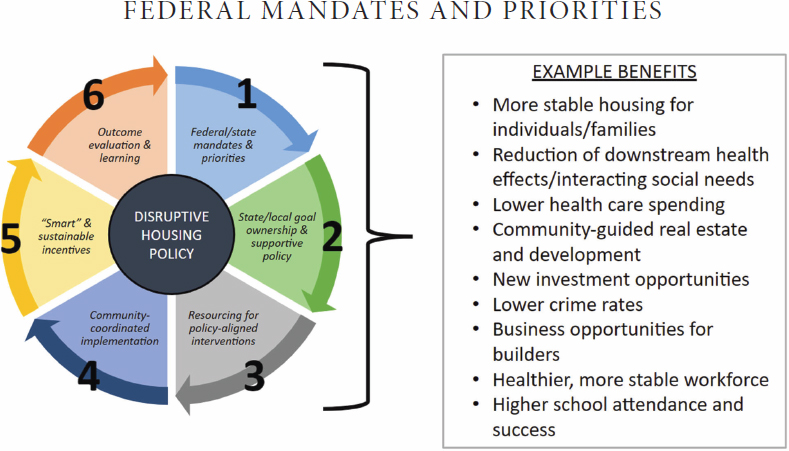
In response to national advocacy demanding whole person, whole population health interventions, federal government leaders could first set bold goals and corresponding policy changes to drive demand for solutions to these seemingly intractable problems. For example, the federal government could set the following bold national goals related to housing:
- Eliminate childhood homelessness nationally;
- Reduce adult homelessness by 75 percent; and
- Ensure no one must spend more than 30 percent of their income on housing costs.
Existing federal policies would then be changed either legislatively or through regulation to align with these goals. For example, the tax code or Medicare and Medicaid policy could be harnessed to create strong incentives and disincentives that align with these goals (see Box 4).
Assessing progress toward initial goals will help to inform federal and state priorities moving forward. Starting points could include the following:
- Monitor chronic homelessness and other forms of housing insecurity with an approach like the U.S. Department of Housing and Urban Development’s (HUD’s) point-in-time estimates.
- Track housing affordability through well-established survey methods. The Census Bureau could conduct this data collection and analysis every 2-3 years.
- Track waiting times for people eligible for housing assistance.
STATE AND LOCAL GOVERNMENT ALIGNMENT
With incentives and penalties in place at the federal level, state and local government leaders should begin to experience pressure from businesses, Medicare and Medicaid providers, real estate developers, and others to conform to state and local policies that align with federal housing priorities. Local governments may then begin to:
- Change zoning laws to support higher density and more affordable developments;
- Remove regulatory barriers to multifamily housing units; and
- Place caps on growth in land prices.
PUBLIC AND PRIVATE FINANCING OF SOLUTIONS
In response to new financial incentives put in place by the federal government, public and private financing should also begin to shift in support of affordable housing. For example, one might begin to see:
- Real Estate Investment Trusts (REITs) diversify to invest in the development of affordable housing;
- Institutional investors link portfolio decisions to homelessness and housing affordability;
- Venture investors prioritize Medicare Advantage and Medicaid health plans that have housing solutions and companies that build affordable prefabricated homes;
- Local health systems repurpose their underused real estate to lease to low-income patients and others at risk for homelessness;
- New real estate developers specialize in working with community stakeholders and building affordable housing as in-fills or in new areas;
- New partnerships between health systems and real estate developers emerge; and
- Healthy neighborhood equity funds move quickly to identify high-value land and make upstream investments to create more value for existing residents versus new residents.
INVESTMENTS DIRECTED BY EMPOWERED COMMUNITY STAKEHOLDERS
In addition to public and private financing shifting to support more affordable housing, community stakeholders should also drive investment decisions and capital allocation. Governing bodies of key community stakeholders should be established locally to help guide important investment decisions. For example:
- Working with local government planners, community stakeholders could identify geographic areas to prioritize for housing investments and types of housing or development.
- Investors should be able to easily access such maps to make commitments.
- Discounted auctions should be created for community-based trusts to purchase critical real estate and thus make decisions surrounding allocations, scale, use, and development.
SUSTAINABLE SOLUTIONS
To ensure the sustainability of the interventions, thoughtfully designed incentive structures should be created and implemented. These should be flexible enough to reward different outcomes over time and effectively designed so they visibly sustain activities that produce favored outcomes. The solutions should pay for themselves if effective land and development costs, inclusive of claimed tax burdens and deductions, are low enough to generate reasonable profit based on purchases limited to 30 percent of income. It is reasonable to expect that as homelessness and housing instability decrease, overall behavioral health outcomes will improve, even though substantial wraparound behavioral health care services are required nationally.
The same activism around food insecurity could also lead to improved whole health.
FEDERAL MANDATES AND PRIORITIES
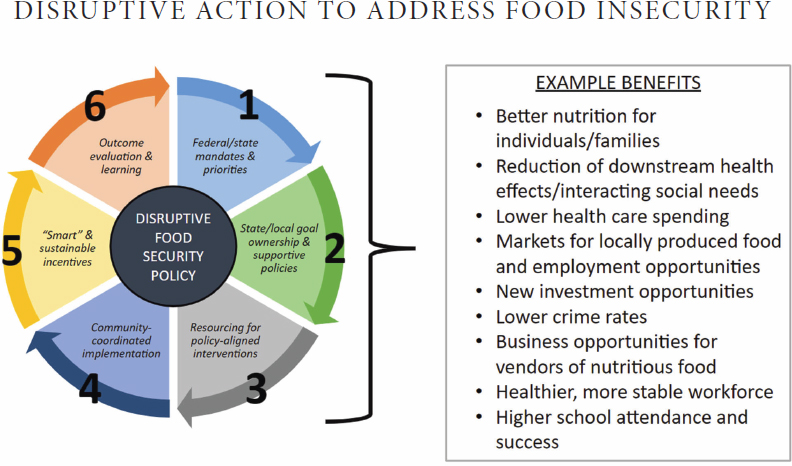
To advance whole person, whole population health, leaders in the federal government could begin a transformation in this area by setting the following bold national goals related to food insecurity:
- Eliminate childhood food insecurity;
- Reduce adult individual and household food insecurity by 90 percent; and
- Ensure no household must spend more than 30 percent of its income on food, and all households have access to adequate nutrition to thrive.
Existing federal policies would then be changed either legislatively or through regulation to align with these goals (see Box 5).
STATE AND LOCAL GOVERNMENT ALIGNMENT
With the incentives and penalties in place at the federal level, state and local government leaders would likely begin to experience pressure from individual taxpayers, business owners, and Medicare and Medicaid providers. This pressure would likely lead them to conform to state and local policies aligned with federal housing priorities. Local governments and neighborhood food councils could then begin to take ownership of food insecurity goals.
For example, local governments could:
- Create Offices of Food Security that would have the mandate of completely eradicating food insecurity. These offices would make publicly available dashboards charting progress and coordinate collaborations with local community organizations and businesses.
- Create neighborhood councils for food security that help educate policy makers about local needs and local situations.
- Ensure coordination among economic empowerment offices, mental and behavioral health providers, schools, employers, and food access mechanisms to tailor solutions for the families with the greatest need.
- Dedicate local tax revenue to reducing food insecurity by supplementing federal food programs (e.g., increasing SNAP allotments, extending support to immigrant children, and contributing to local food banks).
- Remove regulatory barriers and increase financial incentives (tax or subsidies) to low-cost farmers markets in areas with high food insecurity.
CREATING AND PAYING FOR SUSTAINABLE SOLUTIONS
Federal and state tax policies can be applied to incentivize the desired end state of universal food security. One approach might be to identify all likely downstream beneficiaries of better food security (e.g., health organizations, schools, employers, local government units such as law enforcement and family services, local philanthropies, food producers, grocery stores, restaurants) and attempt to quantify the value of achieving universal food security for the community as a whole and where possible, for beneficiaries experiencing or at risk of food insecurity. This approach would allow for the prioritization of state and federal subsidies to address food insecurity. If more local funds are necessary to achieve universal food security, then voluntary or regulatory payment approaches could be developed that are proportional to local beneficiaries’ benefits (this could be via Social Impact Bond mechanisms or CAPGI [Collaborative Approach to Public Good Investments], or
new taxes or expected contributions through philanthropy). Communities that have achieved universal food security should have lower health and social service costs over time. Successful community models should be disseminated.
OUTCOME EVALUATION AND LEARNING
Program and policy outcomes and outputs must be accurately and routinely evaluated to promote the continuous improvement of interventions and policies relative to community needs. There are currently multiple ways to measure food insecurity locally; one standard measure must be agreed on. Because poverty and structural economic conditions are highly correlated with food insecurity, progress must also be rewarded. Approaching universal food security will require broad-based investments to address the intersectional drivers impacting food insecurity, which include high health care costs, structural racism, and a lack of affordable housing (Hunger and Health, n.d.). Therefore, the comprehensiveness of local plans should be a key element of targeted federal subsidies and interventions. The good news is that substantial progress is possible, as recent research has shown (Rouse and Restrepo, 2021).
REFERENCES
Hunger and Health. n.d. Understand Food Insecurity. Available at: https://hungerandhealth.feedingamerica.org/understand-food-insecurity (accessed July 13, 2022).
Rouse, C., and B. Restrepo. 2021. Federal Income Support Helps Boost Food Security Rates. Available at: https://www.whitehouse.gov/cea/written-materials/2021/07/01/federal-income-support-helps-boost-food-security-rates (accessed July 13, 2022).


