Homelessness: A Guide for Public Transportation (2024)
Chapter: Chapter 7 - Land, Facilities, and Public Spaces
CHAPTER 7
Land, Facilities, and Public Spaces
Transit agencies have struggled to manage the impacts of homelessness on their facilities, vehicles, land, and other assets. A prime example is encampments. Without housing solutions, including shelters and supportive services, people will look for safe places to sleep and stay. Encampments can form in varying sizes, at different locations on the system, and with various levels of permanence (U.S. Department of Housing and Urban Development 2019). Encampments can create both real and perceived challenges and issues of safety, public health, maintenance, trash, and sanitation. Managing encampments and public spaces can cause transit agencies to expend significant resources to maintain transit assets and public spaces so that they are clean and safe for all users.
Homelessness needs to be addressed wholistically, but societal changes, especially building affordable housing, can often take years. People sleeping in transit vehicles or encampments on transit agency land are outcomes of broader and systemic issues. Transit agencies can assist in broader community efforts to aid people in need in connecting to shelter and service support. In the meantime, many transit agencies must deal with the hard task of mitigating the impacts of homelessness on their vehicles, facilities, and land. A common approach has been to remove individuals from the transit system and conduct sweeps of encampments. These actions can be effective in the immediate term but do not address the issue of homelessness and lack a human-centered approach. Of course, in some situations, it may be necessary to remove people, possessions or property, or camps because of safety concerns or operational needs.
This chapter discusses programs and policies adopted by transit agencies to support people experiencing homelessness who are using transit agencies’ land, facilities, and public spaces while they are also seeking to reduce the negative effects of homelessness on transit riders and on infrastructure.
7.1 Facilities and Assets
Public transportation facilities may already be serving people experiencing homelessness. Bathrooms, stations, and transit vehicles may be used as intended or in other ways. Transit agencies can use these existing facilities to better support people experiencing homelessness while also mitigating the negative effects of homelessness on infrastructure and housed riders.
7.1.1 Public Places
Travelers of all kinds regularly use transit stops and stations as places to rest, sleep, eat, and conduct business. Many cities and agencies with open public property are faced with decisions related to how to manage and design spaces for inclusive public use. Transit agencies can and do employ inclusive design principles to welcome all riders and users of transit systems, including
complying with Americans with Disabilities Act (ADA) standards for accessible design. Inclusive design principles involve looking for solutions that fit all riders’ needs.
Most of the issues regarding the impacts of homelessness on transit agency facilities and assets raised in the case studies and in the literature focus on individuals using transit locations and spaces to sleep or rest or for hygiene purposes. Transit agencies struggle with people using facilities for urination or defecation, which presents issues of public decency, public nuisance, smell, health, and hygiene. Oahu Transit Services, like other transit agencies, struggles with people using bus stops and shelters for sleeping, which has created safety and sanitation concerns for other riders. There are about 3,800 bus stops on Oahu, and no city ordinance makes it illegal to sleep at them. Often these activities are in locations not specifically intended or wanted for these purposes. Because these are public spaces, there is a balance between what is allowable and what are unacceptable activities, such as using the space for normal activities versus loitering, civil disturbance, illegal activities, and abusive behavior toward others (American Civil Liberties Union of Oregon 2017; Frankel et al. 2016; National Law Center on Homelessness & Poverty 2015; Municipal Research and Services Center of Washington n.d.). Often, these activities will be defined in local ordinances or regulations.
There is a balance between the use of defensive or hostile architecture and the use of inclusive design principles. Defensive or hostile architecture or design is often associated with making sleeping or resting uncomfortable and impractical on furnishings (Hu 2019; Suleiman 2022). Examples are sloped windowsills to stop people from sitting on them and benches with armrests positioned to stop people from lying on them. Often the decisions to use defensive design principles and concepts are place-based and context-based, but agencies need to weigh factors related to rider comfort, maintenance and custodial impacts, and customer satisfaction.
Transit agencies should be strategic about where to welcome and where to discourage people from resting. For instance, limiting seating where trains on- and off-board may be necessary for pedestrian circulation and security. However, it may be possible to identify other places within a transit station where, for example, social service agencies can offer people experiencing homelessness a place to rest and receive support. In 2018, SEPTA worked with the City of Philadelphia to provide a large space in central downtown near the Suburban Station Concourse to a nonprofit working with people experiencing homelessness. The group created a drop-in center offering temporary shelter and access to medical services and housing assistance (Ionescu 2022). Using available commercial space in or near public transportation stations to connect people to assistance and provide comfortable places to relax can help support homelessness services while also reducing the negative impacts of homelessness on housed riders.
7.1.2 Encampments
A major concern of transit agencies is unauthorized permanent or semipermanent camping (encampments) on transit property such as stations, facilities, bus stops, undeveloped property, and parking garages. “Unauthorized encampment” refers to people living in tents or self-made structures or sleeping on concrete in areas where camping is not allowed (U.S. Department of Housing and Urban Development 2019). There may be one tent or a few sites spread out; in other places there may be multiple structures near one another where people interact or even run their own community governance. Camps are often located on public transportation property, including in underground tunnels and small pocket parks, as well as on land adjacent to transit property.
Transit agencies may approach unauthorized camping by clearing people or sites or may secure areas of concern with fencing or other barriers. These actions may often be necessary for specific reasons, but they take additional resources, provide only temporary fixes, and ultimately are not effective in addressing the overall problem of homelessness (U.S. Department of Housing and Urban Development 2019).
Cities and transit agencies are somewhat constrained regarding how they can approach encampments or just people sleeping or camping on transit property. In 2018, the 9th Circuit Court of Appeals found in favor of the plaintiffs in Martin v. Boise that cities cannot enforce camping bans by citing or arresting individuals when there are not sufficient shelter beds for people experiencing homelessness. The Supreme Court of the United States let the ruling stand in 2019 (National Homelessness Law Center 2019). As discussed in other areas of the report, helping individuals get into supportive services and more permanent housing options provides more long-term positive outcomes.
Removing encampments without providing supportive services does not solve the underlying issues and could harm people experiencing homelessness (U.S. Department of Housing and Urban Development 2020b). These actions erode trust between people experiencing homelessness, social service providers, advocates, and government partners. Removal of property can result in the loss of personal identification needed to access services as well as the loss of other personally meaningful items. Two court cases protect the personal property of people experiencing homelessness:
- In Lavan v. City of Los Angeles (2012), the Ninth Circuit Court of Appeals determined that property could not be considered abandoned if its owner was temporarily separated from it (e.g., using a bathroom). The court also required that “meaningful notice” be provided before property is seized.
- In Ellis v. Clark County Department of Corrections (2016), the Washington Western District Court ruled that property seized during a forced relocation could not be immediately destroyed except in specific circumstances.
Both courts ruled that violating a no-camping ordinance did not justify taking someone’s property.
Public transportation agencies with encampments can work with local agencies, homeless service providers, mutual aid groups, and advocates to help develop the relationships needed to move people to shelters or authorized locations. Where there are threats to the safety of people experiencing homelessness, transit agency staff should work with partners to help relocate the camp or help place people in shelter. Pragmatically, removing encampments simply pushes people into someone else’s neighborhood or jurisdiction. Being an active community partner means being conscious and deliberate when an encampment must be removed and working with other local agencies and advocates to help the people being moved access transitional or permanent housing when possible. The City of Chicago, along with other cities like Houston, Tacoma, and San Jose, has adopted a strategy of clearance and closure with support for responding to encampments. In this approach, clearance (removing structures and personal belongings) and closure (securing location) are paired with resource-intensive outreach to help connect encampment residents with needed services to try to ensure that they have somewhere to go after the encampment closure (U.S. Department of Housing and Urban Development 2020b). For locations such as along the Chicago “L” Red Line, the CTA is a member of the city task force and participates in the Level 1 encampment response (U.S. Department of Housing and Urban Development 2020c; Chicago Transit Authority 2022).
7.2 Hygiene and Public Restrooms
As stated previously, there are significant challenges and impacts from the increase in homelessness in communities. Some of the most visible are the increase in trash and the need for sanitation due to public urination or defecation. These impacts have caused transit agencies to spend additional resources cleaning vehicles and facilities. For example, to address cleanliness
issues, SEPTA will allocate $14.8 million for maintenance custodians in its budget for the fiscal year 2023—nearly triple the amount in previous years. The smell of urine and issues of cleanliness have been identified as highly problematic for the transit rider experience and have been reported to reduce ridership by several transit agencies (Liederman 2022; Lindblom 2023; Pan 2022). BART, CTA, and the San Francisco Municipal Transportation Agency have increased budgets over the years to address cleanliness in stations and to staff elevators with attendants (Liederman 2022; Rodriguez 2018; Golden Gate Media 2021). In October 2022, New York MTA started to reopen some of the 69 subway system station bathrooms and has hired more cleaning staff and security personnel to monitor them (Ley 2022).
A significant concern raised by transit system users and agency staff is the impact public urination and defecation have on infrastructure as well as system user and worker health and experiences. These negative impacts are experienced by unhoused people, housed riders, and staff members alike. For the unhoused person, relieving oneself in a place not designed for bathroom usage can be dehumanizing as well as prevent effective hygiene practices and create unhygienic living spaces. Urination or defecation in elevators may make them unusable until they are cleaned and may damage them long term.
Restroom access at transit stations varies by transit agency and within agencies. A TCRP study surveyed transit agencies to assess restroom access for its vehicle operators (Gillespie and Sarles 2020). Seventy-four percent of respondents reported that specific routes had problematic bathroom access. This study considered private and public restroom access, including access along bus and rail lines. The report stated that “inadequate restroom access is most common at designated locations along the bus routes (47% of bus operators do not have access at designated points, 34% of fixed-guideway operators, and 44% of paratransit operators) and at layover points (37%, 28%, and 23%, respectively)” (Gillespie and Sarles 2020).
For the public, accessing bathrooms is difficult. There is no comprehensive list of which transit agencies provide publicly accessible restrooms on rail lines or bus terminals, and restrooms are also not always located at every station. MBTA has restrooms at almost all 69 “T” stations and underground trolley stops; however, only 22 are designated as open to the public. Some communities require that restroom facilities be installed at transit facilities. The City of Kent, WA, requires restrooms for its new light-rail stations (Fesler 2019).
Some transit agencies closed their public restrooms after September 11, 2001, in the wake of safety concerns following the terrorist attack on the United States. In 2022, San Francisco’s BART began reopening underground bathrooms that were closed after the attacks (Bay Area Rapid Transit n.d.b.). The remodeled units lack entrance doors and feature hand-washing stations outside of the bathroom area. These design modifications are meant to enhance safety and limit congregating in the facilities. The reopening of these restrooms is a response to the needs of a range of transit system users, including paying customers. As part of the BART restroom reopening, a pilot attendant program was launched. All underground restrooms have restroom attendants who are on duty during all hours the stations are opened; their duties include greeting riders and discouraging unwanted behavior. BART contracted with District Works LLC to provide attendant staffing but has a long-term goal of using BART staff members. For the 2022–2023 fiscal year, District Works LLC was awarded $2,000,000 to provide the attendants.
Recently, the LA Metro board approved a proposal to add mobile shower stations to some transit stops, install public restrooms at all new rail stations, and add features like hand sanitizer to buses and trains. The agency is also studying whether metro facilities, like bus yards, could be used for temporary housing.
When transit agencies do provide public restrooms, transit riders have described challenges in knowing which stations have them, locating them, and, in some cases, accessing them. In response
to these issues, some riders have created maps or have visited restrooms and reported on their locations, ease of access, and conditions. These maps may include nearby public and private restrooms as well as restrooms on transit property (Goldchain 2017; Taylor 2019).
WMATA’s public restroom history and perception demonstrate the degree of confusion about the presence of, location of, and access to public restrooms (Office of the Auditor General 2006; Powers 2016). In 2018, WMATA released a planning guide for Metrobus restrooms. The guide lays out its plans for “adequate restroom facilities at all terminals” (Washington Metropolitan Area Transit Authority 2018). While all 91 Metro stations have employee restrooms, they are located in secure ancillary areas that require an employee to be an escort and open doors if a member of the public requests access. Six of these are not accessible to the public for security reasons (Pentagon, Anacostia, Rhode Island Avenue, Congress Heights, U Street, and Addison Road). The five newest stations on the current Silver Line extension include public restrooms.
Responding to the hygiene needs of transit staff members, housed riders, and people experiencing homelessness may be done through temporary toilet installations. WMATA has installed portable restrooms in some locations to address sanitation issues. BART distributes a handout with maps showing where the city’s Pit Stop toilets are in relation to station stops. The Pit Stop program:
. . . utilizes both portable toilets, which are trucked to and from the sites daily after overnight servicing at a remote location, and the semi-permanent, self-cleaning toilets. All the Pit Stop facilities are staffed by attendants who help ensure that the toilets are well maintained and used for their intended purpose. (San Francisco Pit Stop. n.d.)
Reports of feces declined in neighborhoods that had pit toilets, including in neighborhoods where people were experiencing homelessness (Amato et al. 2022).
Signs in restrooms can help connect individuals with support. Outreach workers might be invited to work in the facilities and directly help people experiencing homelessness. Transit agencies can support homelessness services not only by ensuring access to clean and safe public bathrooms, but by using these facilities as opportunities for communicating with people experiencing homelessness.
The American Restroom Association advocates for the inclusion of bathrooms in public places. It has worked with transit agencies specifically and provides a list of restrooms as well as apps, maps, and locations of sites (American Restroom Association n.d.). It cautions that many of these resources include bathrooms that are in businesses. Transit agencies may find these resources helpful if they design their own maps to help people locate nearby restrooms. The Urban Design Forum has created The Need for Public Bathrooms, a resource of the best practices, design typologies, and guidelines for building public restrooms (Chou et al. 2020).
7.3 Public Transportation Vehicles
Public transportation vehicles are expected to serve their operational function for all riders and be comfortable, clean, and safe places. If they are not, some riders may choose not to use the transit system. These issues were brought to the forefront during the COVID-19 pandemic. Transit agencies struggled to develop practices to mitigate riders’ concerns and keep operators and riders safe through operational controls, engineering redesigns, and increased cleanings. Similar issues and concerns exist in relation to general cleanliness (Loukaitou-Sideris et al. 2020). Portland Streetcar recently replaced cloth seat covers with nonporous, easy-to-sanitize vinyl to make them easier to clean and to reduce complaints from riders (Portland Streetcar 2022).
Public transportation vehicles, bus stops, and station platforms are often places where general riders come into contact with people experiencing homelessness. Not only are these individuals using the transit system, but they are often using these places as locations of refuge. As described elsewhere in the report, these are locations for appropriate professionals to meet the individuals experiencing homelessness to provide interaction and support. Outreach workers and other social service providers can display posters or provide brochures in buses and trains advertising supportive services. Transit agency staff can also ride transit and connect directly with people in need. When staff meet someone on the transit system, they can help direct them to locations of shelter and support. Transit agencies, including those in Madison, WI, Phoenix, AZ, Portland, OR, and Washington, DC, offer free rides to shelters.
For people experiencing unsheltered homelessness, public transportation vehicles can provide a place of refuge, especially during times of extreme weather. Allowing people experiencing homelessness to ride for free and as long as needed to escape excessive hot or cold temperatures or poor air quality caused by wildfire smoke can be lifesaving. Providing free rides to warming, cooling, or clean-air shelters during these times can also be lifesaving. WMATA has partnered with DC’s Homeland Security and Emergency Management Agency to provide designated warming buses around the city when the temperature drops below 20 degrees, with food and water available and portable restrooms nearby (Otto 2014). Other cities, including St. Louis and Kansas City, MO, have also incorporated warming buses into their emergency weather plans to support people experiencing homelessness (StLouis-MO.gov n.d.; Spoerre 2022).
7.4 Alternative Shelter or Housing Development
Public transportation agencies often own accessible public property, particularly undeveloped or vacant land that could be used for the provision of services to people experiencing homelessness, including those seeking shelter in or on transit facilities. Some of this land may be well located for housing and other types of development. Some of this housing development can serve people with low incomes or who are experiencing homelessness. Examples of transit agencies that made properties available to respond to homelessness are provided in the following.
7.4.1 Alternative Shelters
Vacant land can provide alternative emergency shelter. Some property-owning government entities loan or lease vacant or underutilized properties to assist with homelessness response. These temporary places—sometimes referred to as safe sleep sites, pod villages, or rest areas—can provide private and safe places to sleep. Bathrooms and other amenities can also be provided on-site. Some alternative shelters are run by government entities, usually in partnership with nonprofit organizations. Others are created and run by people experiencing homelessness.
Pod Villages
A comprehensive study of pod villages in Portland, OR, identified strategies for creating villages with high resident, manager, and housed-neighbor satisfaction. The study found that neighbors’ concerns about the villages diminished over time. These and other findings are shared in a how-to guide (Ferry et al. 2022). The land for one of the six villages in the study—which serves women escaping domestic violence—was provided by Portland’s Bureau of Environmental Services. There are some examples of transit agencies that have provided land to create pod villages. In 2021, the City of Seattle asked Seattle’s Sound Transit to allow a property previously used to stage development of the University District light-rail stop to be used as part of the city’s homelessness response program. Sound Transit agreed and leased the property to the City of Seattle
to create Rosie’s Tiny Home Village. The initial lease on the property was for 1 year and could be renewed for up to 3 years. Sound Transit (2021) offered the lease at no cost to the city. As stated by the agency’s CEO:
This innovative use of property first used for construction staging when building our new University District station is helping us tackle the most critical need burdening our region. We are grateful to the elected leaders of Seattle in partnering with us on this effort and look forward to the groundbreaking later this fall.
The village is managed by an area nonprofit organization, and, as of the end of 2021, served 27 people. There are communal facilities and services for residents. The final capacity of the site is expected to be up to 65 people living in up to 36 pods. The funding for the structures, other property improvements, and staffing are included in the city’s budget. Long term, the property will be converted into TOD.
Adequately staffed pod villages are an effective route to housing. In 2018, 42% of residents served by pod villages across Seattle obtained permanent or transitional housing, compared to 4% to 20% of those served in other types of shelters (Lee 2019).
Safe Parking Sites
Safe parking sites provide places for people living in vehicles to stay overnight. Some are open for set periods of time; others are open 24 hours a day. These programs are primarily concentrated on the West Coast, and the locations, usually parking lots, are provided and managed by a range of organizations (McElwain et al. 2021; Municipal Research and Services Center of Washington n.d.). Public transportation agencies can make land, such as existing parking lots or unused assets, available for safe parking places that allow people living in vehicles to congregate legally and safely and have access to transit.
In 2021, LTD in Oregon leased a five-acre property to the City of Eugene to create one of five planned Safe Sleep sites (Figure 8). These sites are part of the city’s shelter program, which is funded and overseen by the city and operated by local social service providers, and are where people can safely and legally stay with basic infrastructure, hygiene stations, and access to support services. The lease agreement for this property provides it at no cost to the city for the first 2 years. The site reached its capacity of 55 vehicles used for shelter (with additional space for commuting vehicles) within 2 weeks and carries a waiting list in the hundreds. LTD staff provided GIS skills to analyze and identify property to be used for alternative shelter. LTD has also worked with the City of Eugene and Lane County to provide programmatic input on siting and accessibility to transit.
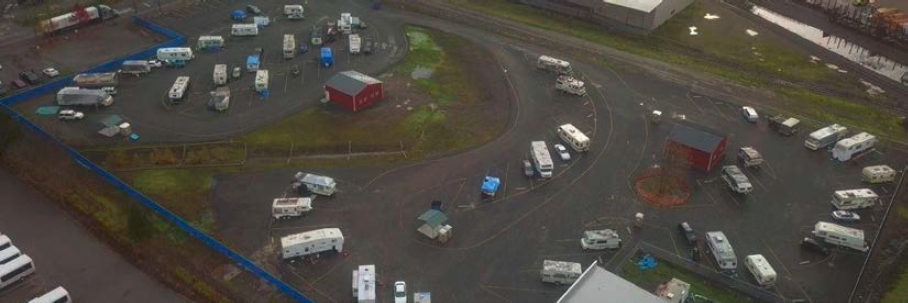
Figure 8. Aerial view of 310 Garfield Safe Sleep site operated by St. Vincent de Paul Society of Lane County and located on property owned and leased by LTD, November 15, 2021.
Public transportation agencies can help set expectations for the sites. For example, the Vancouver City Council and C-TRAN (Vancouver, WA) created a code of conduct for the Evergreen Transit Center’s temporary Safe Parking Zone (City of Vancouver 2022). Done poorly, villages and safe parking sites do not meet the expectations of residents and erode trust between government agencies, social service providers, and people experiencing homelessness (Weare 2018; Berton 2020). Done well, these alternative models of shelter can provide safer and more dignified places where people can live while waiting for housing. The effective sites are managed by social service providers that are responsible for compliance with rules and community agreements, monitor who is allowed to be on-site, coordinate ongoing site infrastructure needs, are accessible and responsive to neighbor concerns, and coordinate with the city and other partners.
7.4.2 Housing Development
Transit agencies can also propose and support TOD and higher-density housing with affordability set-asides near transit services. Transit agencies provide essential services, such as buses, trains, and streetcars, which allow residents of affordable housing to easily commute to their workplaces, schools, health care facilities, and other essential services. By ensuring that reliable and affordable transportation options exist, transit agencies make it possible for low-income individuals and families to access employment opportunities and essential services while reducing transportation costs and increasing mobility.
Transit agencies often have a significant influence on land use planning decisions, particularly in TOD projects. TODs are designed to maximize access to public transportation by integrating affordable housing with transit infrastructure. Transit agencies can work closely with housing developers, local governments, and community stakeholders to identify suitable sites for affordable housing near transit hubs, ensuring that housing options are available to a wide range of income groups.
Transit agencies can also help gain access to funding sources that can be leveraged to support affordable housing development. They can collaborate with housing developers and local governments to secure grants, subsidies, or loans specifically earmarked for affordable housing projects. By pooling resources and coordinating efforts, transit agencies can help increase the financial viability of affordable housing developments, making them more feasible and sustainable.
Focusing on the intersection of affordable housing and transit can allow public transportation agencies to support the resolution of homelessness while also meeting climate goals (Great Communities Collaborative n.d.). Some examples of transit agencies supporting affordable housing development are:
- Brownsville Transit Village in Miami. Affordability and transit goals were united in the development of the Brownsville Transit Village (MiamiDade.gov 2015). This affordable housing development was constructed on an underused parking lot and adjacent busway owned by the Miami-Dade Transit Authority (HSQ Group Inc. n.d.). Built over five phases, the village provides 467 affordable apartments, community facilities and services, and commercial space.
- The Madison/Boylston housing development in downtown Seattle. This development is another example of transit-supported affordable housing. The 350-unit development is the first affordable high-rise complex built in Seattle in more than 50 years. When it opens in 2023 it will serve, in part, formerly homeless seniors making less than 30% of the median household income. Sound Transit purchased the property in 2001 in anticipation of a light-rail expansion that did not occur. It transferred ownership of the property to two nonprofit housing developers for no cost. According to Sound Transit CEO Peter Rogoff:
Sound Transit is proud to have donated a half-acre of surplus property for this innovative project, which will provide over 350 affordable homes for low-income individuals in the heart of Seattle. . . . The First Hill
project is our largest accomplishment to date in advancing our equitable transit-oriented development policy to provide affordable housing in thriving neighborhoods with ready access to transit, jobs, and medical care. These new affordable homes will be a vibrant addition to this welcoming neighborhood. (Plymouth Housing n.d.)
- In addition to seniors, the development will provide housing to families and adults earning up to 60% of median household income. Supportive services will be available to all residents.
- RTC Washoe in Reno is supportive of affordable housing near transit because it improves mobility for everyone and boosts transit ridership. The RTC undertook an affordable housing study to explore ways to encourage developers to build affordable housing near existing transit routes (Wood Rodgers 2020). The study identified locations near transit that would be ideal for affordable housing. The RTC will work with its regional partners and the development community to potentially develop a pathway to encourage affordable housing at these locations.
Although these efforts are often led by real estate developers or public agencies, transit agencies are important partners in the development of affordable housing because they provide accessible transportation options, influence land use planning, offer funding opportunities, and assist in community engagement. Collaboration between transit agencies, housing developers, local governments, and the community is crucial to creating affordable housing options that are well connected to transportation networks.
7.5 Summary
The activities within each response category are summarized in the following subsections in three ways—first by stakeholders, then by staff implementers, and then by how difficult an activity would be to implement.
7.5.1 Addressing Stakeholder Needs and Concerns
Core stakeholder groups affected by implementation strategies include people experiencing homelessness, housed transit riders, and transit agency staff. Each group has needs related to and concerns about homelessness, and each group may benefit from different responses. In Table 14, the activities are identified as responding to the needs and concerns of the stakeholder groups.
Table 14. Addresses stakeholder needs and concerns by response category.
| Addresses Stakeholder Needs and Concerns | ||||
|---|---|---|---|---|
| Stakeholders | ||||
| Response Category | Activity | People Experiencing Homelessness | Housed Riders | Transit Agency Staff |
| Land, facilities, and public space | Facilities and assets | X | X | X |
| Hygiene and public restrooms | X | X | X | |
| Public transportation vehicles | X | X | X | |
| Alternative shelter or housing | X | |||
Table 15. Key implementing staff by response activities.
| Key Implementing Staff | |||||
|---|---|---|---|---|---|
| Response Category | Activity | Implementing Staff | |||
| Frontline Staff | Transit Police | Specialized Staff | Leadership | ||
| Land, facilities, and public space | Facilities and assets | X | X | X | |
| Hygiene and public restrooms | X | X | X | ||
| Public transportation vehicles | X | X | |||
| Alternative shelter or housing | X | X | |||
Table 16. Ease of implementation by response activity.
| Ease of Implementation | ||||
|---|---|---|---|---|
| Response Category | Activity | Easy | Medium | Difficult |
| Land, facilities, and public space | Facilities and assets | X | ||
| Hygiene and public restrooms | X | X | X | |
| Public transportation vehicles | X | |||
| Alternative shelter or housing | X | |||
7.5.2 Key Implementing Staff
Effective implementation depends on identifying the right staff members to make the activities work. Table 15 identifies the staff type that would be best positioned to implement the given activities.
7.5.3 Ease of Implementation
Policies, programs, and strategies have varying levels of ease of implementation. Table 16 shows approximate levels of difficulty of implementing activities, from easy to difficult.


