Homelessness: A Guide for Public Transportation (2024)
Chapter: Appendix C - Program Descriptions

WHO TO CALL FACT SHEET
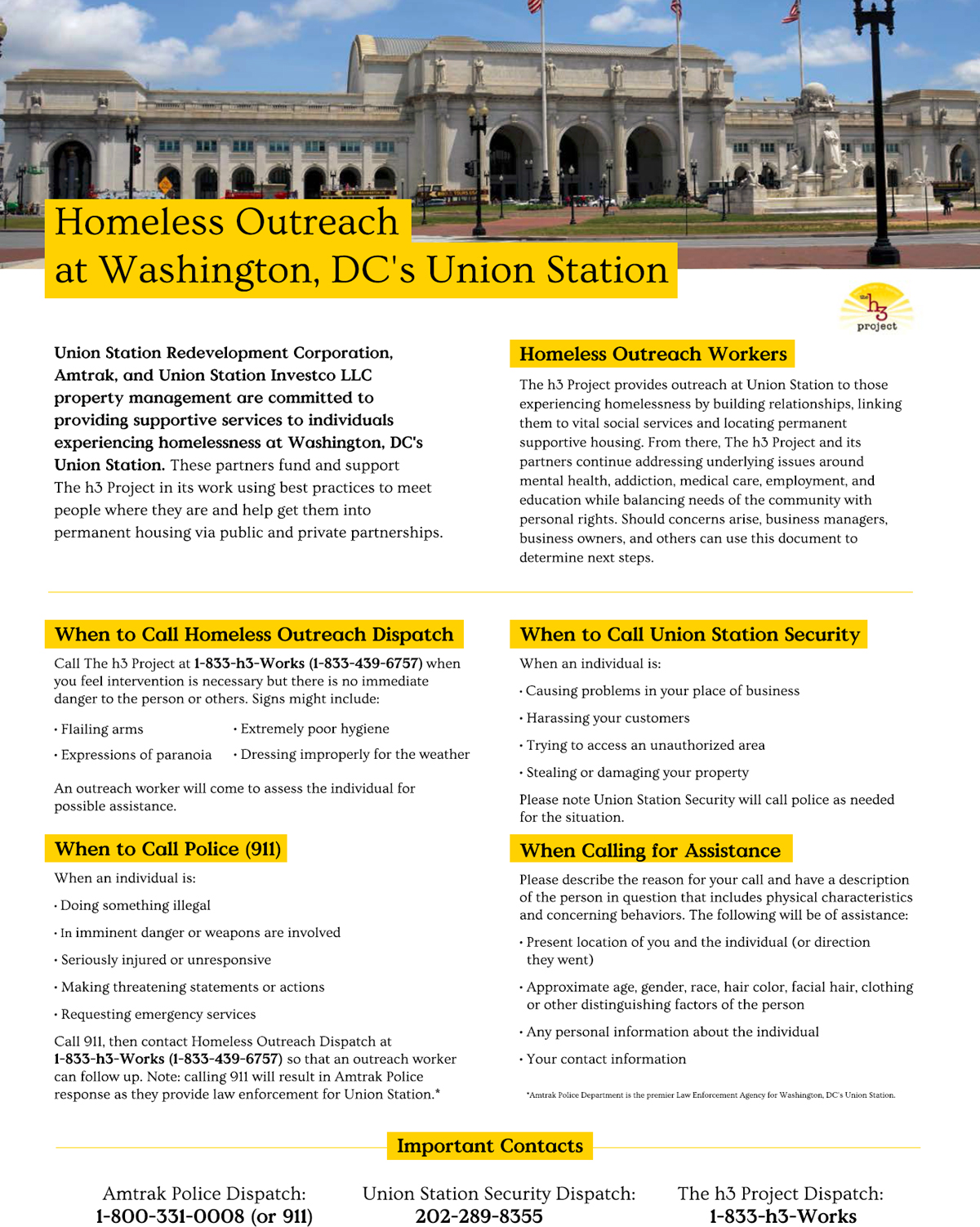
OVERVIEW
Mount Vernon Triangle Community Improvement District (MVT CID) is committed to providing meaningful supportive services to individuals experiencing homelessness in the Mount Vernon Triangle neighborhood. MVT CID and its rate paying stakeholders fund and support The h3 Project in its work in Mount Vernon Triangle. This model follows best practices by meeting people where they are and helping them attain permanent housing. Through partnerships with government agencies and private organizations, we all work diligently to acknowledge and address the issues of homelessness and human trafficking.
HOMELESS OUTREACH WORKERS
The h3 Project provides outreach in and around MVT to those who are experiencing homelessness. The h3 Project outreach workers build relationships with homeless neighbors and link them to vital social services and permanent supportive housing. Once housed, The h3 Project and its partners continue addressing underlying issues around mental health, addiction, medical care, employment, and education.
The h3 Project outreach workers balance the needs of the community while respecting personal rights and providing significant support to those in need. When concerns arise, property and business owners and managers and others can use this document to determine the next steps.
When to Call Homeless Outreach Dispatch
Call The h3 Project at (833) 439-6757 (833-h3-Works) when you feel that intervention is necessary, but there is no immediate danger to the person or others. An outreach worker will come to assess the individual for possible assistance. Some of the signs you see might include:
- Flailing arms
- Expressions of paranoia
- Extremely poor hygiene
- Dressing improperly for the weather
- Verbally requesting assistance
For general assistance or questions about homelessness and what you can do to help, you can email The h3 Project at info@h3projectdc.org
WHEN TO CALL POLICE (911)
- Someone is doing something illegal
- Someone is in imminent danger or when there are weapons involved
- Someone is seriously injured or unresponsive
- Someone is making threatening statements or actions
- Someone requests emergency services
- Someone is causing problems in your place of business
- Someone is harassing your residents or customers
- Someone is trying to access an unauthorized area
- There is damage or theft to your property
WHEN TO CALL MVT CID DISPATCH
- There are overflowing public trash cans
- There is broken glass or other debris on the sidewalk
WHEN CALLING FOR ASSISTANCE
Please describe the reason for your call and have a description of the person in question. This includes physical characteristics, as well as a description of the behavior that caused your concern. The following will be of assistance:
- Where are you and the individual each located? If the individual left the area, which way did he or she go?
- The approximate age, gender, race, hair color, facial hair, description of clothing, or other distinguishing factors of the person.
- Do you know any personal information about the individual?
- Your contact information.
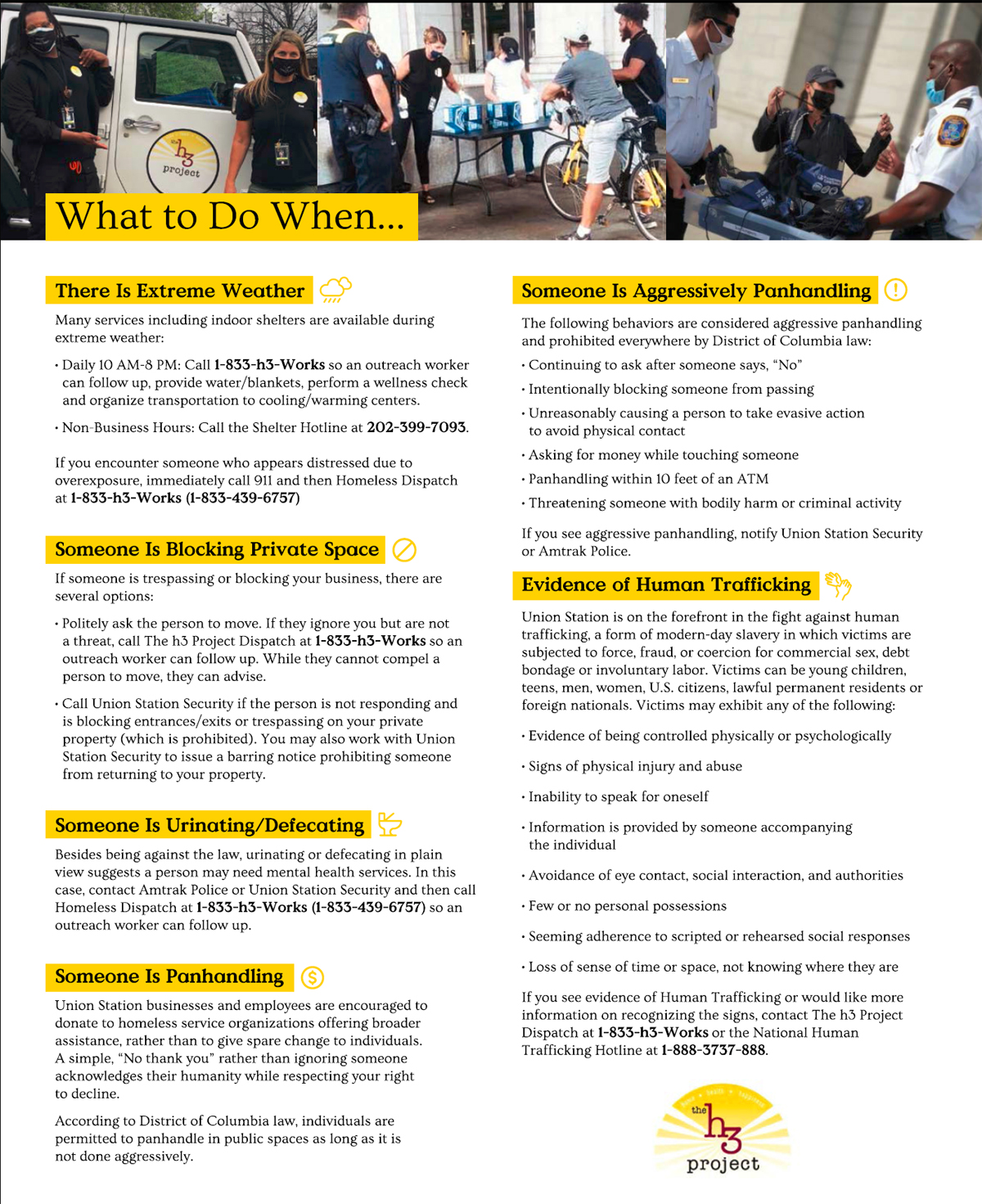
WHAT TO DO WHEN…
There Is Extreme Weather
Many services, including indoor shelters, are available during extremely cold or hot weather. If you are concerned about someone or they are interested in going inside, please contact:
- M-Sat, 10:00am-6:00pm: Call (833) 439-6757 (833-h3-Works) so that an outreach worker can follow up and coordinate water or blankets, perform a wellness check, and organize transportation to cooling/warming centers.
- Non-Business Hours: Call the Shelter Hotline at (202) 399-7093 or the Community Response Team at (202) 673-6495.
If you encounter someone who appears to be in physical distress due to overexposure, immediately call 911 and then call The H3 Project Dispatch at (833) 439-6757 (833-h3-Works) so that an outreach worker can follow up.
Someone Is Blocking Private Space If someone is trespassing or blocking space around your business, there are several options, depending on the situation:
- Politely ask the person to move. If the person ignores you and is not a threat, call The h3 Project Dispatch at (833) 439-6757 (833-h3-Works) so that an outreach worker can follow up. While outreach workers cannot compel a person to move, they can advise the person of his or her options.
- Call MPD if the person is not responsive to moving and is currently blocking entrances/exits or trespassing on your private property. Blocking access to your property is prohibited. You may also work with MPD to issue a barring notice to prohibit someone from remaining on or returning to your property.
Someone Is Urinating/Defecating
Urinating or defecating in plain view suggests that the person may need mental health services. It is also against the law. In this case, contact Metropolitan Police Department and then call The h3 Project Dispatch at (833) 439-6757 (833-h3-Works so that an outreach worker can follow up with the individual if they are experiencing homelessness.
Someone Is Panhandling
Each of us must decide what to do when approached by someone asking for money, but MVT CID businesses and employees are encouraged to give to homeless service organizations that provide assistance on a broader scale, rather than give spare change to individuals. A simple “no thank you” rather than ignoring someone will acknowledge the person’s humanity while respecting your right to say no. According to District of Columbia law, individuals are permitted to panhandle in public spaces if it is not done in an aggressive manner.
Someone Is Aggressively Panhandling
The following behaviors are considered aggressive panhandling and are prohibited by District of Columbia law no matter where they occur:
- Continuing to ask for money after someone says “no”
- Intentionally blocking someone from passing
- Unreasonably causing a person to take evasive action to avoid physical contact
- Asking for money while touching someone
- Panhandling within 10 feet of an ATM
- Threatening someone with bodily harm or criminal activity
If you see aggressive panhandling, notify the Metropolitan Police Department.
There is Evidence of Human Trafficking
Washington, DC is on the forefront in the fight against human trafficking. Human trafficking is a form of modern-day slavery in which victims are subjected to force, fraud, or coercion for the purpose of commercial sex, debt bondage, or involuntary labor. Victims of human trafficking can be young children, teenagers, men, and women. They can be U.S. citizens, lawful permanent residents, or foreign nationals. Victims of Human Trafficking may exhibit any of the following:
- Evidence of being controlled, either physically or psychologically
- Signs of physical injuries and abuse
- Inability to speak for oneself or share one’s own information
- Information is provided by someone accompanying the individual
- Avoidance of eye contact, social interaction, and authority figures/law enforcement
- Few or no personal possessions
- Seeming adherence to scripted or rehearsed responses in social interaction
- Loss of sense of time or space, not knowing where they are or what city or state they are in.
If you see evidence of Human Trafficking or would like more information on identifying the signs, contact the National Human Trafficking Hotline at 1-888-3737-888. You can also contact h3 Project Dispatch at (833) 439-6757 (833-h3-Works). You may also contact MPD’s Human Traffickling Unit at (202) 299-3903.
 |
June 2019 |
| Core Elements of Effective Street Outreach to People Experiencing Homelessness |
Coordinated street outreach that identifies and engages people living in unsheltered locations, such as in cars, parks, abandoned buildings, encampments, and on the streets, plays critical roles within systems for ending homelessness. Effective street outreach reaches people who might not otherwise seek assistance or come to the attention of the homelessness service system and ensures that people’s basic needs are met while supporting them along pathways toward housing stability.
Most street outreach in communities is currently funded through a patchwork of government programs and private resources, with varying mandates, requirements, and performance measures. It is also not funded at levels that would allow for implementation of the full range of activities and approaches described here in most communities. Communities should, however, be striving to strengthen the roles their street outreach programs play within effective systems for helping people who are living unsheltered return to stable community living in safe and affordable housing.
This document, which was developed collaboratively with our partners at Department of Housing and Urban Development (HUD), Department of Veterans Affairs (VA), Department of Health and Human Services (HHS), and the National Alliance to End Homelessness (NAEH), is not intended to replace the mandates or metrics of individual programs. Rather, it is intended to identify core elements of effective street outreach that can be implemented under various funding streams, and which are broadly applicable to a variety of communities, geographic contexts, and sub-populations.
It is important to acknowledge that the implementation of such efficient systems requires access to housing affordable to people who are exiting homelessness. Strategies to expand the supply of such housing can be implemented by all levels of government and across the public and private sectors, including removing local policy barriers that limit housing development in the private market, prioritizing people experiencing homelessness for available housing resources, and expanding affordable housing opportunities through actions across all levels of government.
Core Elements of Effective Street Outreach
It is our hope that communities will use this list of core elements of effective street outreach to assess their current outreach efforts, at both the program- and system-level, and to identify opportunities to build upon and strengthen those efforts within their systemic approaches to ending homelessness, particularly unsheltered homelessness.
Street Outreach Efforts are Systematic, Coordinated, and Comprehensive.
- Street outreach is conducted on behalf of the community rather than one agency, requiring collaboration among multiple stakeholders. Knowledge of and engagement with all partners implementing street outreach efforts leads to more strategic use of resources and more comprehensive coverage and identification of all people experiencing unsheltered homelessness.
- Street outreach is coordinated among various providers engaged in ending homelessness and across different entities such as Federal, State, local government, and non-profits. These entities may utilize multiple funding sources to conduct street outreach.i
- Street outreach efforts are also coordinated with the broader network of programs, services, or staff who are likely to encounter individuals experiencing unsheltered homelessness, but whose regular focus is broader than homelessness. This might include law enforcement and other first responders, hospitals, health and behavioral healthcare providers, child welfare agencies, homeless education liaisons, workforce systems, faith-based organizations, and other community-based providers.
- Street outreach efforts are connected to coordinated entry processes. People sleeping in unsheltered locations are assessed and prioritized for assistance in the same manner as any other person assessed through the coordinated entry process.
- All street outreach contacts and housing placements are documented in HMIS or another local data system, such as an active or by-name list. Outreach workers have access to data systems to be able to input data, look up previous contacts with the person experiencing homelessness, and access information on available resources.
Where street outreach providers or coordinated-entry processes have established data-sharing agreements and protocols, outreach providers can access data that helps them more effectively focus on supporting housing outcomes. Data on frequent use of shelter, emergency health services, and jails, when reviewed alongside HMIS or by-name list data, can lead to more comprehensive identification of high-need individuals.
Street Outreach Efforts Are Housing Focused.
- The goal of street outreach is to make connections to stable housing with tailored services and supports of their choice, such as health and behavioral health care, transportation, access to benefits, and more.
Street outreach does not require individuals to enter emergency shelter or transitional housing as an ‘interim step’ or prerequisite to accessing stable housing. However, street outreach does make immediate connections to emergency shelter or temporary housing to provide safe options while individuals and families are on a pathway toward stability.
- To the extent possible, street outreach utilizes Housing First approaches that do not impose preconditions to make referrals to permanent housing, shelter, or other temporary housing, such as sobriety, minimum income requirements, absence of a criminal record, completion of treatment, participation in services, or other unnecessary conditions. Some housing options in the homelessness system may not be available due to specific eligibility criteria.
Street Outreach Efforts Are Person-Centered, Trauma-Informed, and Culturally Responsive.
- Street outreach utilizes a person-centered approach, focused on the individual’s strengths and resources, and never makes assumptions about what a person might need or want.
i Funding sources may include HUD’s CoC and ESG programs, SAMHSA’s Projects for Assistance in Transition from Homelessness (PATH), Grants for the Benefit of Homeless Individuals (GBHI), Treatment for Individuals Experiencing Homelessness (TIEH), and Cooperative Agreements to Benefit Homeless Individuals (CABHI), HRSA’s Healthcare for the Homeless (HCH), ACF’s grantees of the Runaway and Homeless Youth Act Street Outreach Program (SOP), and VA’s outreach including Supportive Services for Veteran Families (SSVF) and Health Care for Homeless Veterans (HCHV).
- Street outreach workers provide people experiencing homelessness with multiple opportunities to say ‘no’ and make repeated offers of assistance as necessary throughout the engagement process.
- Street outreach staff receive regular training in evidence-based practices, including trauma-informed care, and are proficient in utilizing such practices.
- Street outreach providers employ outreach staff with lived experience and offer commensurate compensation to all outreach staff.
- Street outreach workers provide warm handoffs to coordinated entry or to shelter, housing, and service providers (e.g. outreach staff may offer to physically accompany the individual to appointments to provide support).
- Street outreach efforts are respectful and responsive to the beliefs and practices, sexual orientations, disability statuses, age, gender identities, cultural preferences, and linguistic needs of all individuals.
- Street outreach efforts analyze local data regarding racial inequities and disparities among people experiencing homelessness and tailor and customize their efforts to ensure that equity is being achieved within their outreach activities and outcomes. This might include diversifying staff and leadership, assuring appropriate geographic coverage, training all staff in issues of equity and cultural competency, and regularly analyzing performance and outcomes with a focus on racial equity.
- Street outreach workers utilize problem-solving techniques to identify strengths and existing support networks, explore possible safe housing options outside the homelessness service system, such as reunification with family, and connect the individual to community supports and services.
Street Efforts Emphasize Safety and Reduce Harm.
- Street outreach providers have protocols in place to ensure the safety of all individuals seeking assistance. These protocols help ensure that people fleeing domestic violence, as well as dating violence, sexual assault, trafficking, or stalking, have safe and confidential access to the coordinated entry process and domestic violence services.
- Street outreach efforts utilize harm reduction principles, including non-judgmental, non-coercive provision of services and resources.
- Street outreach efforts accept that some individuals may not initially accept offers of emergency shelter or housing assistance. While maintaining a focus on creating connections to permanent housing, outreach workers establish rapport and reduce harm by providing critical, life-saving resources such as food, water, clothing, blankets, and other necessities.
This page intentionally left blank.