Transportation for People with Disabilities and Older Adults During COVID-19: Lessons for Emergency Response (2024)
Chapter: Chapter 8 - Emergency Management--Strategies and Approaches

CHAPTER 8
Emergency Management—Strategies and Approaches
This chapter provides a set of strategies and approaches for transportation organizations to consider in their transportation service delivery and administration during an emergency event. The strategies and approaches outlined are based on examples and findings from transportation organizations during the COVID-19 pandemic; some of these strategies and approaches are specific to service for people with disabilities and older adults, while many others apply to all transportation services and the well-being of the organization.
The rest of this chapter is organized into broad topic areas in emergency management for transportation. Each topic area section is introduced with a brief overview, followed by a set of highlights particularly relevant for providing service to people with disabilities and older adults, and then followed by subsections of key strategy areas within that topic. The strategy subsections contain a list of brief bulleted descriptions of approaches that transportation organizations can consider for their own emergency planning purposes.
The topic area sections also include text boxes with specific case examples from several transportation organizations on their strategies during the COVID-19 pandemic as discovered during the research. While many approaches were used by several transportation organizations around the United States, the examples showcased in the text boxes are intended to highlight unique or particularly relevant practices that were used to address service challenges during the pandemic. As with the summary bullet points, these callouts are intended to merely provide examples for consideration.
The topic area sections contained within the remainder of this chapter are as follows:
- Planning
- Continuity of Services
- New and Temporary Services
- Safety Procedures
- Equity of Service Changes
- Relationships and Partnerships
- Communications and Engagement
- Financial Sustainability
Planning
Planning effectively for pandemics and other emergencies can help transit agencies prepare for all highly infectious diseases and other types of disasters. Having a plan that sets forth roles, responsibilities, and policies for staffing, safety, and communications will help ensure that transportation organizations are resilient and able to make good decisions in evolving emergency
events. During the COVID-19 pandemic, a small number of transportation organizations had existing pandemic plans, which provided a starting point for each agency’s response.
Pandemic plans are a variation of existing plans such as continuity of operations plans (COOPs), emergency response plans, and operational plans that establish what departments and/or staff members do. Along with vulnerability assessments and a comprehensive emergency plan, the pandemic plan should include an activation section that provides leadership with guidance on when to activate specific actions and make operational decisions. Pandemics are dynamic events that change with subsequent waves of the disease; handling these changes successfully during the COVID-19 pandemic involved taking a measured and tiered approach to planning. Activation of different levels of response should be coordinated with local emergency management, public health, and other local/regional/state transportation agencies.
Key Points on Service for People with Disabilities and Older Adults
Existing plans and procedures for providing transportation for people who are immunocompromised and people with communicable diseases can be useful during different types of health-related emergencies.
Identifying existing community-based groups and programs for people with disabilities and older adults can help planners know where populations are located, their main destinations, and their specific service needs.
Utilizing Existing Planning Processes
- Use existing plans as a starting point even though existing plans may be outdated or based on assumptions that do not apply to the current emergency (Mader, 2021). Organizations that typically transport people who are immunocompromised and people with communicable diseases found that existing plans and procedures were valuable during the pandemic.
- Recognize that plans for certain types of emergencies may involve relationships or processes that could be used in a different type of emergency. Hazard emergency plans, COOP plans, and even cybersecurity plans were found to be useful in responding to the COVID-19 pandemic. There may be some aspects in other plans that can apply during an emergency such as integrated state/city or county response or coordinated messaging among agencies to avoid confusion.
- Be prepared to make some adaptations to the plans; for example, COVID-19 required adjustments to existing plans for social distancing and its impact on vehicle drivers and passengers, evacuations, and sheltering.
- Take advantage of existing processes and resources to have meetings and talk to colleagues. Join industry response groups such as APTA to learn what others are doing and borrow examples to use.
- Monitor ridership and the impacts of service changes to modify plans and determine options going forward.
Establishing Plans with Other Organizations
Planning for emergencies requires coordination and collaboration because effective response and recovery involves many agencies and community
organizations and usually more than one jurisdiction. Strategic, innovative relationships can lead to smoother, better-coordinated responses to disasters and improve recovery.
- Utilize preexisting relationships to help with planning and coordinating organization efforts during an emergency. Understanding each entity’s capabilities and available resources can increase responsiveness and efficiency and help eliminate duplication of effort.
- Build on existing relationships. Existing partnerships and collaborations with various departments enabled prompt responses to community needs and helped resolve issues during the pandemic. Organizations built on existing relationships with other agencies during the pandemic to establish new ways of serving the public.
- Identify existing working groups for state and regional planning. Participate in planning initiatives with the state, metropolitan planning organization, and local disaster emergency management organization to coordinate actions and build relationships.
- Engage members of the community to encourage feedback and glean insights that might otherwise be missed. During the COVID-19 pandemic, local community groups were helpful in communicating with their local transit agency and local government on community members’ transportation needs, including getting to vaccination sites without access to a personal vehicle.
- Identify existing community-based groups and programs for people with disabilities and older adults. These groups can help planners know where populations of people with disabilities and older adults are located, what their main destinations are (e.g., aging and disability resource centers or medical facilities), and what their specific service needs are. Collaboration with groups/programs that have these established relationships, networks, and communication channels can support effective services during an emergency event. Organizations should involve people with disabilities and older adults throughout the planning process.
Defining Roles and Responsibilities Within the Agency
- Identify roles and tasks to address the emergency while allocating resources to accomplish those tasks. Effective plans tell those with operational responsibilities what to do and why to do it, and these plans instruct those outside the jurisdiction on how to provide/receive support and what to expect. A dedicated budget or list of potential financial resources that could be deployed to support the roles and tasks outlined in the plan establishes early agency buy-in and can help avoid delays in execution at critical times during the emergency event.
- Recognize that roles and responsibilities for staff members change during emergency events. During the pandemic, transportation organizations had to address the procurement of PPE, policies to ensure the safety of their workforce and passengers, service planning, and operations. Maintenance and service planning staff took on major roles in planning the agency response. Maintenance staff, with their extensive knowledge of the facilities and vehicles, often drove the response with the goal of improving safety within vehicles and at agency facilities.
- Realize that new roles may be necessary to address emergencies, especially health-related emergencies. Some organizations identified the need for an industrial hygienist or other medical professional to provide guidance and credibility to the agency’s mitigation and response effort. This type of role is not commonly available at transit agencies. If there was no one at an agency who could fill this type of role or the agency could not recruit someone, it had to work with other state and local agencies to find resources that could fill those roles.
Planning for Pandemic Waves and Recovery
- Be prepared to take a phased approach to providing services and returning to “normal,” with the recognition that there may be a “new normal” after each pandemic wave that requires changes and modifications of operations.
- Ensure that agency recovery plans contain indicators and decision criteria for each phase along with milestones to be reached, such as a sustained decrease in the number of COVID-19 cases in the service area, to indicate the service level to provide at a particular phase. A phased approach provides flexibility, allowing an organization to test the safety and effectiveness of the approach and modify it as necessary.
- As the pandemic progresses, track changes in ridership characteristics, including trip purposes, client demographics, geographic distribution of trips, and reasons for such changes. This will allow transportation organizations to better coordinate with institutions such as vaccination sites and aging and disability resource centers and anticipate service needs such as capacity.
- Recognize the key considerations for service recovery. For paratransit service providers in particular during the COVID-19 pandemic, developing guidelines for future emergency events, examining alternative delivery methods, planning scenarios during the recovery period, and establishing partnerships with other transportation providers to increase resilience were found to be critical.
Continuity of Services
Emergency situations will disrupt transportation service continuity for at least a short-term period in response to the circumstances encountered by transportation organizations. In the immediate anticipation and aftermath of an emergency, some routes and services may need to be temporarily suspended in order to keep riders and employees safe as well as to use available resources (e.g., staffing and safety protections) on the most critical services. If emergencies extend for a longer period of time, as they did during the COVID-19 pandemic, it is important for transportation organizations to preserve accessible transportation service and the distribution of goods and services for customers with a higher level of need (including people with disabilities and older adults). Strategies to minimize the impact of emergencies on transportation for people with disabilities and older adults can be incorporated into planning and mitigation efforts ahead of an emergency.
Key Points on Service for People with Disabilities and Older Adults
Organizations can proactively determine services affecting customers with the highest level of need as part of emergency mitigation planning; these services could include providing transportation to places like dialysis centers, adult day care centers, and local community centers.
Because paratransit is a critical service for riders that use it, reductions in fixed-route service hours should not be the sole rationale for reducing paratransit service during an emergency. Reserving service capacity for transportation customers with health risks (potentially through single isolated trips) may be a needed solution.
Organizations can explore methods for conducting eligibility assessments remotely or granting temporary eligibility status for new paratransit applicants over a certain period of months as alternatives to the regular eligibility determination process.
Preserving Existing Services for Customers with the Highest Level of Need
- Determine which services affect customers with the highest level of need as part of emergency mitigation planning. Plan to continue to provide scheduled transit or other transportation services to dialysis centers, adult day care centers, and local community centers that are critical for these population groups.
- Maintain critical services first. If it is determined that there is a need to suspend overall service, first attempt to maintain routes and access to locations that serve customers with a high level of need (such as aging and disability resource centers or medical facilities).
- Use a core route network as a fallback. For transit agencies with fixed-route service, identify a core route network ahead of an emergency as a fallback option for maintaining service for customers with a high level of need. Make sure that the access points of populations with a high level of need are used in determining the core route network (rather than only considering ridership and frequency levels).
- Maintain service for customer groups with the highest level of need since these populations often have fewer transportation alternatives. Customer groups to consider include people with disabilities, older adults, riders with medical needs, and riders with low incomes.
- Maintain existing paratransit service hours and coverage. Paratransit is a critical service for the people with disabilities who use it. Avoid using reductions in fixed-route service hours as a rationale for reducing paratransit service as well.
- Consider including more customer groups for temporary service eligibility. If additional capacity is available and people with disabilities will not be negatively impacted, consider using vehicles to pick up older adults for trips to critical locations (e.g., grocery stores and pharmacies).
- Connect services and assistance to people with disabilities. During an emergency, when people with disabilities may be unable to leave their homes for safety purposes, transporting friends, family, and care to the paratransit customer is a reasonable accommodation. For example, agencies could transport personal care attendants on paratransit vehicles to and from their clients’ homes for care purposes.
- Consider additional service when appropriate. Even in instances when service coverage and hours are reduced, additional service on maintained fixed routes could be appropriate for maintaining safe access to transportation. For example, double-busing to put more vehicles and drivers on the same route can help improve social distancing while riding.
- Consider additional access for reserving trips. During an emergency, accepting same-day reservations on demand-response service if capacity allows rather than only allowing reservations in advance can provide additional access for riders.
- Reserve capacity for safely transporting customers with health risks. Service requests cannot be denied just because a customer appears symptomatic. Consider instead performing single trips (with no other passengers) using demand-response vehicles for riders who need to be isolated for travel.
- Be flexible in vehicle uses. During service disruptions, it may be feasible and appropriate to use vehicles that are a different size than those normally used for a given service. For example, cutaway buses or other smaller vehicles may provide additional capacity to maintain fixed routes.
- Do not prioritize some ADA paratransit trip purposes over others. During COVID-19, many agencies identified essential trip purposes (such as medical appointments and grocery trips) for demand-response service requests. However, all trip requests should be treated equally.
- Utilize temporary eligibility as a tool if normal processes are disrupted. This option can include exploring methods to conduct eligibility assessments remotely or granting temporary eligibility status for new paratransit applicants over a certain period of months. FTA states that transit systems can suspend eligibility assessments so long as presumptive eligibility processes for ADA paratransit service are still in place (complete suspension without temporary eligibility is not permitted).
- Coordinate and refer rides to neighboring transportation organizations if your service capacity is nearly full. Coordinate with transportation services available in the region as well.
- Consider temporary bus-supportive infrastructure and policies. Changed traffic conditions during an emergency can provide an opportunity for improved service, such as creating bus-exclusive lanes or adjusting service times to provide access for more transit-reliant communities.
Reducing Services While Minimizing Impacts
- Anticipate customer perceptions of transit service reductions. Even if services are not nominally reduced, driver shortages and lower on-time performance are felt by customers. Minimize the impacts of reduced service by ensuring continued service delivery in transit operations. Provide clear, consistent communications so customers are aware of the services being provided.
- Review changes for regulatory compliance. Any proposed changes such as service reductions, shutdowns, fare changes, policy changes, and other similar changes should be proactively reviewed for regulatory compliance while also keeping in mind future audits.
- Recognize differences in riders’ travel behavior. During an emergency, travel patterns such as commuting may be lessened generally, but it may be important to continue providing service for the commuters who remain, such as workers who cannot stay at home (called essential workers during COVID-19). Beware of cutting needed service for transit-dependent riders based on overall trends.
- Ensure compliance with regulations throughout the emergency response period. Federal regulations such as ADA requirements are not implicitly waived during emergencies, meaning transit agencies are not permitted to restrict trip purpose or eligibility for ADA complementary paratransit service. Implementing training on these requirements for staff members involved in operations and service provision is important for compliance.
- Be careful in the messaging provided to customers. Encouraging customers to consider taking scheduled rides only for essential trips or based on possible virus symptoms is allowable, but trip requests for ADA paratransit service cannot be denied based on customers’ responses.
- Maintain service coverages when temporary measures are taken. For ADA paratransit customers, it is important that service remains available for their coverage area even if the fixed route enabling paratransit availability is not temporarily running during the emergency.
- Consider temporary changes to fare collection for some riders during emergencies. Suspension of fare collection on at least a temporary basis can help increase safety on vehicles for riders and employees during certain types of emergencies. FTA states that transit agencies changing their fare media policies (such as not accepting cash fares) must consider mitigating measures to ensure the change does not result in disparate impacts on riders.
- Do not let seating capacity reductions translate into reduced service. Monitor ridership on routes and services with reduced capacity and make sure all riders wanting to use the service (including passengers using wheelchairs) can board vehicles, and that the agency is meeting
- Set aside standby capacity to meet demand. Operating extra standby buses on heavily used routes can help with controlling capacity maximums on vehicles.
- Consider longer-term emergencies in phases rather than as one event demanding a single type of operational response.
- Respond to service cuts with other services. During COVID-19, some large transit agencies provided taxi services or other on-demand services for people with disabilities and older adults for essential trips to areas where fixed-route services were cut back.
- Make sure that service alternatives are viable and available. Service options like TNCs and taxicabs as alternative service providers can be useful for transit agencies in helping to connect customers to needed trips and services, but drivers of these services must be available and on the road during the emergency in order for the service to work effectively.
- Do not use service alternatives as a substitute for service requirements. Paratransit customers requesting a trip cannot be denied just because a service alternative is available; this is true during both emergency and non-emergency periods.
- Adjust demand-response vehicle runs based on safety. Exclusive rides to and from a destination can help keep drivers and riders safer during a health-related emergency. During COVID-19, some organizations adjusted paratransit service to be a round trip in one vehicle (similar to a VDP model).
- Avoid further service limitations on non-peak period times such as nights, evenings, and weekends; riders using public or volunteer transportation at these times typically do not have other reliable transportation options.
- Restart services as conditions improve. Once safer conditions are in place, restore service levels based on capacity available and demand from riders with higher levels of need.
any additional demand with additional vehicles. For paratransit, this may mean exclusive rides for some customers.
Allocating Staff and Vehicle Resources Effectively
- Utilize temporary staff roles for employee retention. During COVID-19, food delivery programs enabled service activity for transit agencies and thus allowed them to continue employing vehicle operators as demand for normal trips decreased dramatically.
- Use available partner organizations and opportunities to supplement capacity. For example, transportation vouchers supported by Section 5310 funding could help fulfill trips to appointments by specialized transportation providers.
- Consider temporary drivers (such as school bus drivers out of work) to fill gaps in staffing of vehicle operators during the emergency.
- Reduce barriers to employment and compensation. Actions like expanding access to sick leave, reducing red tape in employee rules, and compensating workers for time spent during quarantine periods can help with workforce retention and well-being.
- Retain staff as much as possible during periods of low demand in an emergency. Because hiring and training is a struggle, retaining current employees through an emergency can be preferable to laying off staff. This retention through ridership downturns could be done in conjunction with cuts in hours and moving to telework (for some positions).
- Pay attention to contractor structures and limitations. If needed, work with a contractor to adjust the agreement payment structure during an emergency to account for the costs associated with additional standby drivers, safety requirements (such as vehicle cleaning), guaranteed pay rates for service, and revised service expectations (e.g., the number of passengers per revenue hour).
Strong Communication as a Continuity Tool
- Use clear, consistent communication about service changes at the organization during an emergency to help employees and alleviate any fears. Communication with employees is a full-time job.
- Recognize coordination as a tool to help address service demand. Transportation organizations need to work with their contractors and other partner organizations to coordinate communication efforts, creating one source of information (instead of multiple sources) to maintain consistency and avoid the problems of different information from different sources.
- Be transparent with the public with consistent information updates to let the public know what service changes are happening and the policies that will impact them during the emergency. This transparency is just as important as the strong communication needed with employees.
- Recognize the connection between drivers and customers and use this relationship to make sure customers are getting what they need in terms of services and information. For example, drivers can provide information sheets to paratransit customers during an emergency to let them know what to expect.
New and Temporary Services
During the response phase of emergency management, new or temporary services can fill a service gap or community need, enabling the use of vehicles and drivers not needed for regularly scheduled service. These services, sometimes termed “incidental uses,” may be particularly aimed at providing assistance for people with disabilities and older adults or helping the general public. Types of incidental use instituted by a transportation organization (or in partnership with other organizations) may differ depending on the nature and length of the emergency (e.g., a short-term weather event versus a long-term pandemic).
During COVID-19, new incidental uses were common at large and small transportation organizations throughout the United States. One of the most common was meal and grocery delivery (as well as delivery of other essential items) to fill a community need for access to food and daily supplies. These services often target older adults and paratransit customers. Other common incidental uses were shuttle rides to access testing or vaccinations or trips to emergency medical care or isolation. Numerous transportation organizations and their community partners developed these services through demand-response or private automobile-based services while identifying resources at each partner that could be relevant to service delivery.
Key Points on Service for People with Disabilities and Older Adults
Adjust incidental use services as new community needs are discovered based on customer feedback, including adding eligibility for different delivery items or access to additional destinations. This can be particularly relevant for communities with longer travel distances such as exurban or rural communities.
Separate vehicles should be used for passenger trips and goods delivery in order to keep the rider prioritized under the circumstances of the emergency. It may also be necessary to permit trips with one passenger per vehicle if the passenger needs to be isolated for medical
reasons. At the same time, it is important to be flexible in allowing vehicles to be used for multiple emergency needs.
Developing Incidental Uses
- Utilize community partners in developing incidental use services. Public health departments, health and human service organizations, aging and disability resource centers, senior living facilities, and area agencies on aging can be instrumental in developing services that will assist people with disabilities and older adults. For food delivery services, organizations like local food pantries and community gardens, and grocery stores are great partners to work with. Non-profit foundations and advocacy organizations are other kinds of potential partners.
- Think outside the box with available resources. Transportation organization vehicles and facilities can be used for more than just transporting customers, and incidental uses can provide the community with public health access and shelter (such as mobile vaccination buses or centers). Let partners and community organizations know what capabilities and resources beyond transportation services are available at your organization.
- Consider private transportation services for service capacity needs. These could include taxicab, TNCs, and local specialized transportation providers that could provide direct transportation for incidental use services; any private transportation service used to meet capacity needs should include additional wheelchair-accessible vehicles in the service fleet. Be open-minded to working with new types of partners.
- Utilize trip subsidies for travel on other services. Free rides for customers on another private provider service can enable customer choice and direct transportation to a community access point.
- Consider providing single trips (with no other passengers) on demand-response vehicles if it is deemed an appropriate transportation response for riders with immediate medical needs or needing isolation from other passengers.
- Ensure that protocols necessary for customers to access and use new or temporary services are clear and available to customers through multiple communication channels.
- Enable access to incidental uses for those without technology access. Setting up a special hotline or calling customers on the phone can help people learn about the service and sign up for trips/appointments.
- Determine special transportation needs based on the service. For some incidental uses, additional care/assistance for the customer may be needed beyond dropping them off at a location. Some customers may need a driver to ensure their well-being before departing (i.e., vaccination appointments) or even to provide roundtrip service.
- Adjust service parameters and procedures for delivery uses. From a scheduling and dispatching perspective, food and goods delivery in transportation vehicles works very differently from passenger trip operations. Challenges can include floor capacity and logistical arrangements with partners for goods handoff.
- Implement policies in delivery services to set limits on the availability of cold/frozen food delivery and/or on the amount of cold/frozen food that can be delivered. Likewise, policies should limit the number of bags customers can order. These policies would help ensure the delivery of items in suitable condition and protect employee well-being by limiting excessive lifting of items.
- Host pickup or drive-through events as an additional option to delivery/transportation. Hosting distribution events or vaccination sites at your facility could be more useful for some customers and their caregivers or family/friends.
- Utilize publicly available tools or resources from partners for the administration of programs. Resources like request forms/platforms, staff capacity, and call centers can help field requests for incidental uses less focused on transportation.
- Coordinate with other organizations in developing incidental uses to determine how your transportation organization can best assist with transportation service or facility use while coordinating resources together.
- Leverage technology already in place for existing public and private transportation options. Fare payment and trip reservation technologies for existing paratransit or specialized transportation programs can be key in enabling a new incidental use program that is accessible to the targeted customer base.
- Make adjustments to existing agreements with contractors as needed. Transportation organizations can often work within existing agreements and make adjustments to tailor the service in coordination with their partners.
- Develop standing agreements or procedures for incidental uses, particularly during the mitigation and preparation stages of emergency management. This strategy could be particularly useful for deploying anticipated incidental use services during future emergencies. Informal agreements and ad-hoc procedures are suitable during an emergency state, particularly during new types of emergencies or circumstances.
- Recognize capacity limits in the incidental use design. It may be necessary to limit the number of trips or deliveries per month for ongoing incidental use services; these limits could act as a safeguard (e.g., preventing staff burnout or customer disappointment) while allowing for special requests from customers and exemptions.
Meeting Community Needs
- Determine what types of incidental use transportation or other services the organization could provide that would be the most helpful for the community. Community needs will be identified through communication with local stakeholders, community organizations, and customers knowledgeable about the issues for people with disabilities and older adults.
- Conduct or facilitate wellness checks for customers. This practice is helpful for learning how customers are doing and connecting them to care and resources they may not have access to themselves during an emergency. Wellness checks can involve drivers, reservationists, and even personnel from other local departments (e.g., police officers).
- Adjust incidental use services as new community needs are discovered based on customer feedback. This feedback could include requests for additional items to be made eligible for delivery (e.g., prescriptions, adult diapers, packages, and mail) or requests for access to additional destinations. This issue may be particularly relevant for communities with longer travel distances such as exurban or rural communities.
- Facilitate access to other transportation providers or carriers if needed. Subsidized trips using other local transportation may be a better option for some customers than waiting for available transportation from your organization.
- Be proactive in reaching out to customers to minimize potential cases of social isolation. Emergency situations can be particularly harmful in cutting off people with disabilities and older adults from their family and friends, medical care, and food or other goods; make it a priority to reach out to these customer groups.
- Participate regularly in interagency and community group meetings. These conversations can help identify community needs and help transportation organizations learn about actions happening elsewhere to which different organizations can contribute.
- Use impactful communication methods to provide information about incidental uses. For people with disabilities and older adults, direct information delivery through phone calls, emails, and letters can be more effective than other methods; for word-of-mouth communications, communication through relevant community partners and leaders is best.
- Work with federal and state authorities to allow new or temporary services to meet community needs. Typically, incidental uses such as shuttle and delivery services are not eligible for public transportation activities, so ensure that these activities are given the green light temporarily.
Responsiveness to the Emergency Event
- Be open-minded and flexible during an emergency. Thinking outside of the box and being ready to embrace technology can help in determining the use of resources to serve people with disabilities and older adults.
- Look at emergencies as opportunities to leverage expertise and resources. Transportation organizations and other community partners can bring new groups to the conversation and make something new from what has been tried before to address customer needs.
- Be prepared to respond rapidly. Incidental delivery uses, evacuations, or shuttle services may be needed suddenly and evolve in real-time as community needs and emergency impacts change. Transportation organizations need to work to create ideal solutions in response to the situation and community needs.
- Utilize additional vehicles, drivers, and facilities as needed based on the incidental use volume and timing.
- Have protective safety gear and measures available and ready to opera-tionalize. Depending on the type of emergency, the distribution of PPE to customers may be a great resource for both riders and individuals remaining at home.
- Use technology and the capabilities of partners for emergency situations. Technology platforms may be able to determine the eligibility of some customers based on their status and trip locations (e.g., travel to work or vaccination locations).
- Separate fleet uses for different incidental use types. Separate vehicles should be used for passenger trips and goods delivery in order to keep the rider prioritized under the circumstances of the emergency. It may also be necessary to permit trips with one passenger per vehicle if the passenger needs to be isolated for medical reasons. At the same time, it is important to be flexible in allowing vehicles to be used for multiple emergency needs.
Safety Procedures
In all emergencies, transportation organizations need to protect employees and customers while ensuring continuity of operations and the resilience of the transportation system. Employee and passenger health and safety are especially critical in a pandemic. Employee availability is essential for the provision of agency services but can become limited due to illness, exposure, need to quarantine, or family concerns such as vulnerable members, illness, or disruption of school or day care. During the COVID-19 pandemic, transportation organizations prioritized driver safety and worked to make it clear to employees that this was important. Because a pandemic is “invisible” relative to other types of emergencies, riders may not feel safe, even though precautions are in place to ensure their safety.
During the COVID-19 pandemic, all transportation organizations put in place safety measures and procedures in response to the pandemic, doing what was being recommended at the time by local and state public health officials and the CDC. Research conducted during the pandemic found that if employees and the public believe that a transportation organization is concerned for their welfare and is trying to meet their needs and if safety measures are highly visible or recognizable, they will feel safe. A multilayered approach to safety that includes protective measures, policies, communication, and education was found to be effective by some transportation organizations.
Key Points on Service for People with Disabilities and Older Adults
Be aware that social distancing or other safety requirements during an emergency can create challenges for individuals who need assistance with boarding, wheelchair securement, or assistance to the front door.
Recognize that practices effective in fixed-route services may not be possible in paratransit and other services for people with disabilities and older adults. For example, it is not possible to safely leave a wheelchair unsecured in a vehicle. Transportation organizations may also need to limit trips to one or two passengers in some emergencies.
Look out for unintended consequences of safety procedures or for protective measures that exacerbate existing problems. Limiting contact with passengers as a safety precaution can result in problems with assistance for wheelchair securement and challenge riders with hearing difficulties.
Impact on People with Disabilities and Older Adults
- Recognize any additional needs of people with disabilities and older adults due to existing conditions, weakened immune systems, and other factors. These riders must weigh the risk of exposure and getting sick while traveling against the benefits of making the trip.
- Address the particular safety needs of customers requiring direct physical interactions. During a pandemic emergency, some passengers still need assistance with boarding, wheelchair securement, or getting to the door of their destination.
- Understand the new safety concerns of people with disabilities and older adults during pandemics and other emergencies. For example, passengers with visual disabilities may not be able to assess the level of social distance in the vehicle, cleanliness of the vehicle, or level of mask-wearing compliance by other riders. Additionally, riders may lack information on those who had been in the vehicle prior to them (such as their health status).
Protective Measures
- Take a multilayered approach to safety that includes protective measures, policies, communication, and education.
- Implement protective actions, both mandatory and voluntary, as needed to ensure the safety of employees and passengers. Especially during pandemics, transportation organizations should apply general public health principles to protect everyone.
- Be aware that there may be different types of protective actions necessary for different types of employees based on different work requirements, levels of physical presence, and levels of interaction between agency staff and passengers.
Personal Protective Equipment
For respiratory-based pandemics, public health guidelines are likely to recommend that all employees and travelers wear masks and/or gloves to protect themselves and others, in addition to following regular handwashing and sanitation measures. Based on these guidelines, transportation organizations can
- Encourage or require face mask usage for employees and passengers.
- Provide masks and other PPE to all paratransit passengers.
- Utilize partners and local/state services (e.g., health centers, emergency management teams, local businesses, and others) to acquire masks and other PPE, especially if there are shortages or other procurement challenges.
Cleaning
- Start additional cleaning, disinfection, and ventilation of vehicles and facilities as quickly as possible once transmission mechanisms are suspected or identified.
- Clean and disinfect high-touch surfaces and common areas regularly. The frequency of cleaning will vary depending on health guidance, organization policy, operations schedules, and use. Cleaning protocols may change over time. APTA’s Health and Safety Commitments Program, developed early in the pandemic, identified cleaning and disinfecting transit vehicles frequently as one of the four key areas that transit systems needed to address to earn riders’ confidence.
- Conduct high-visibility cleaning. Clearly identify how and when the system will be cleaned and what cleaning agents will be used to help reassure passengers and employees that the transit system and vehicles are safe. During the COVID-19 pandemic, some transit agencies had their cleaning staff wear distinctive vests or uniforms so they could be easily noticed and
- Modify existing ventilation systems to improve air circulation and fresh air replenishment, if necessary.
identified. Agencies also used scented cleaners and other sensory clues to make their cleaning efforts more obvious.
Social Distancing
- Create physical distance between passengers and drivers by seating van passengers in the furthest row from the driver, installing physical barriers to separate the driver from the passenger compartment, reducing the number of passengers per vehicle, and eliminating shared rides in vehicles. During the COVID-19 pandemic, rear-door boarding was implemented by many fixed-route transit providers.
- Separate and segregate agency employees, if possible, (e.g., creating A and B operating groups or separating employees by shift) to isolate groups of employees from one another and limit employee interactions. Those employees who work in administrative and other departments where remote work is possible can work from remote locations and/or use technology to telework.
Transporting COVID-19 Positive Passengers
- Work with public health officials to determine how to safely transport passengers who have a confirmed infection or who test positive.
- Dedicate vehicles and drivers to providing service for infected passengers or those who test positive.
- Assign volunteer drivers who have full knowledge of the passenger’s status.
- Provide full PPE (e.g., gowns, masks, and goggles) to drivers and train them in proper PPE use. If possible, have drivers trained by public health, medical, and/or emergency response officials.
Addressing Riders Who Need Assistance
- Be aware that social distancing requirements can create challenges for individuals who need assistance with boarding, wheelchair securement, or assistance to the front door.
- Follow recommended procedures such as installing a safety strap or other temporary barrier to prevent the use of front seats by passengers other than those using a wheelchair, walker, or other similar mobility device.
- Establish a safety protocol for assisting passengers who use wheelchairs. During the COVID-19 pandemic, some transit agencies had passengers who use wheelchairs turn their heads away while drivers secured their wheelchairs to avoid any sudden sneezes or coughs that could expose a rider or driver to aerosolized droplets.
- Recognize that practices effective in fixed-route services may not be possible in paratransit and other services for people with disabilities and older adults. For example, it is not possible to safely leave a wheelchair unsecured in a vehicle. Transportation organizations may also need to limit trips to one or two passengers in some emergencies.
Health Monitoring and Vaccination
- Modify existing organization processes or create new processes to support health monitoring of employees. Many transportation organizations instituted health monitoring (e.g., temperature checks) and regular COVID-19 testing for employees during the pandemic. Some transit
- Establish passenger screening processes, if recommended by public health. Some agencies implemented temperature checks for passengers before allowing them to board the vehicle during the COVID-19 pandemic.
- Work with public health officials to understand vaccine availability and ensure that employees are prioritized. Once the COVID-19 vaccine was available, some agencies required drivers and other employees to be vaccinated. Transportation organizations can work with public health officials to prioritize vaccinations for frontline transit workers.
agencies conducted contact tracing for employees who became ill or were exposed to an active infection during the pandemic.
Policies
- Put in place policies and procedures on PPE, supplies/equipment, and personnel, including health-tracking plans and policies on how vehicle operators interact with passengers.
- Establish policies in advance. During a pandemic and other emergencies, delays can jeopardize safety. Be consistent with state, federal, and local public health regulations.
- Provide consistent, clear, and uniform guidance about safety protocols and procedures to employees and passengers based on general health principles and a current understanding of what types of guidance are available prior to the onset of the event.
- Ensure employees understand guidelines regarding compliance, exceptions, and enforcement to avoid difficult customer interactions.
- Recognize that the situation and guidance may change over time. Staying alert as public health guidance changes or new safety-related techniques or technologies are developed will help ensure that employees and passengers are as safe as possible. Figure 9 shows an example of safety measures communicated to passengers.
Adherence to Safety Protocols and Impact of Safety Measures
- Be aware that long-term emergencies, such as pandemics, may require increased focus on compliance and proper use of safety and protective measures as time goes on. Complacency and weariness among employees and passengers can arise over time, likely as a result of overall pandemic/emergency fatigue.
- Anticipate passengers and employees becoming less careful about the precautions they are taking. People will get more comfortable and start to lapse in safety precautions. Figure 10 shows an example of safety guidelines posted by a transit agency.
- Look out for unintended consequences of safety procedures or for protective measures that exacerbate existing problems. For example, during the COVID-19 pandemic, passenger complaints increased after rear-door boarding signs were installed, and agencies had to reinforce with drivers that passengers could board in front when needed. Drivers’ desire for limited contact with passengers as a safety precaution could result in problems with assistance for wheelchair securement and challenged riders with hearing difficulties.
- Consider performing a hazard risk analysis and assessment of any temporary or permanent additions or modifications to transportation facilities, vehicles, or procedures during times of emergency to ensure new hazards are not inadvertently introduced as a result of implementing a mitigation approach. For example, installing temporary barriers or blocking seats may introduce a new hazard for drivers or riders.
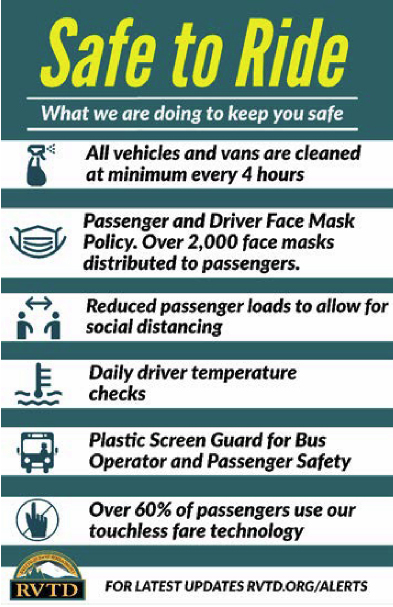
Figure 9. Example of transit safety measures information.
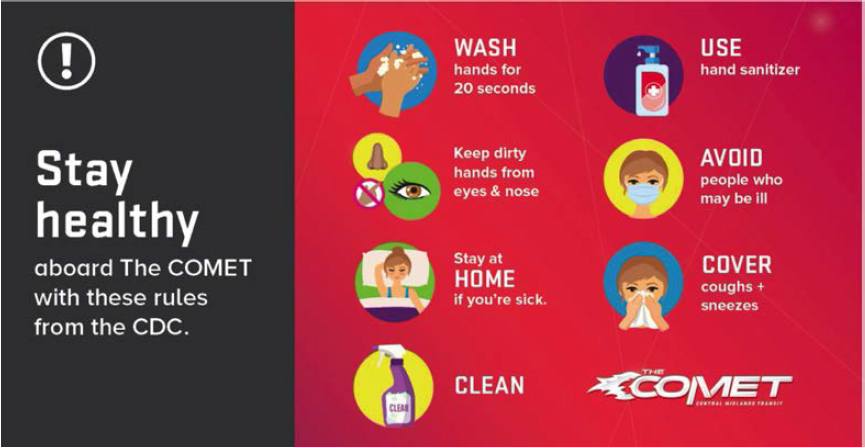
Figure 10. Poster on safety guidelines.
Right-Sizing Safety Procedures to the Event
Pandemics and other extended emergencies emphasize a transportation organization’s need to balance safety with service, a challenge that agencies wrestle with every day. The following principles can help better match safety and protective measures for an agency to a particular emergency:
-
Apply a hierarchy of controls:
- Protect workers/customers (PPE)
- Change the way people work (administrative controls)
- Isolate people from hazards (e.g., limiting number of people in vehicles, instituting social distancing, using larger vehicles)
-
Establish appropriate policies:
- Implement compliance requirements/standards regarding the use of PPE and vaccinations
- Work with public health officials to understand and facilitate transmission mitigation, testing, and vaccinations, and be alert for improvements as public health guidance changes or new opportunities are presented
- Work with community and accessibility organizations regarding the particular needs of the community
-
Work with employees and employee unions to establish safe work processes and procedures:
- Establish different work requirements and levels of physical presence and interaction—there may be different types of protective actions necessary for different types of employees
- Explore options for modifications or adaptations to work situations to better protect employees
-
Monitor employee and public responses and adjust policies and procedures to address issues that may arise:
- Ensure that there are channels available to obtain employee and public feedback
- Recognize potential sources of information such as agency partners and community organizations
Equity of Service Changes
During emergency situations, transit agencies and other transportation-providing organizations may make temporary service changes due to limited resources and capacity along with environmental conditions that may hinder the safe operation of service. Under normal operating conditions, to implement a major service change or fare change, transportation providers that receive federal funding and “operate 50 or more fixed-route vehicles in peak service and are located in [an urbanized area] of [at least] 200,000” would be required to conduct a full Title VI equity analysis to ensure the changes do not result in disparate impacts or disproportionate burdens for Title VI protected populations. FTA states that temporary service changes in response to an emergency do not require a service equity analysis so long as the change does not last longer than 12 months; the same is true for fare changes within a 6-month period. Additionally, FTA states that transit agencies are expected to take reasonable measures to ensure that any temporary service or fare changes are implemented equitably to prevent any unintentional discrimination.
As FTA indicates, regardless of mandate, transportation organizations still have a responsibility to ensure that temporary service changes during an emergency, as well as any incidental use programs that are launched in response to the emergency, are implemented equitably within its service area and that these services address the needs of the people who rely on their service the most. Disparate impacts from service changes on people with disabilities and older adults need to be mitigated and avoided as much as possible during the planning and coordination phases of the service change rather than discovered after the implementation. Likewise, transportation organizations should be open and responsive to input and feedback from customers (particularly those with accommodation needs) in order to adjust service to meet their needs and maintain accessibility to transportation.
Key Points on Service for People with Disabilities and Older Adults
Ensure that there is no prioritization of ADA paratransit trip requests based on trip purpose since it is not an allowable qualification for agencies to use in screening trip requests. Customer travel needs should be respected in all cases, especially for paratransit users.
Proactively designate services used by riders with high need as part of core route networks and services used as the default during emergency situations, helping to prevent inequitable service reductions.
Prioritize access to incidental use services for customers with high need in collaboration with local partner organizations to understand and address the needs of people with disabilities and older adults for these services.
Temporary Eligibility Changes
- Consider roundtrip service or shuttle service for demand-response services that are temporarily limited by vehicle seating capacity during an emergency. Adjusting the service delivery design can fulfill the requested trip while still accommodating any necessary safety procedures.
- Ensure that there is no prioritization of ADA paratransit trip requests based on trip purpose or essential work. Trip purpose is not an allowable qualification for agencies to use in screening trip requests, and customer travel needs (particularly for paratransit) should be respected in all cases.
- Reconsider service suspension policies during emergencies. During an emergency period, issuing service suspensions to riders for no-shows and late cancellations may appear overly punitive to customers in need of service access. Transportation organizations should consider removing pending or existing service suspensions in these cases.
- Adjust components of eligibility assessments to meet safety concerns. Hybrid assessments using phone/video conferencing tools may be helpful for continuing assessments during an emergency. Phone and virtual web interviews could be used to conduct assessments with social distance.
- Consider temporary eligibility for new paratransit customers and recertifications. If safety is a concern for in-person eligibility assessments, granting temporary eligibility is suitable until environmental conditions allow for assessments to resume. Granting temporary eligibility is an appreciated method to enable access to service and averts risks of non-compliance from service denial.
- Consider going directly to the customer for eligibility assistance. Customers who are unable to leave their homes during an emergency could be visited by staff in person for registration and application assistance. This strategy also presents an opportunity to assign new tasks to employees who would otherwise not have responsibilities and be at risk of furloughs or layoffs.
- Stagger temporary eligibility term durations for new customers if there is a concern that service capacity could be overwhelmed by too many customers. This practice could also help stagger the subsequent workload of eligibility assessments for staff once resumed.
- Do not entirely suspend the eligibility process associated with paratransit service during an emergency. Presumptive eligibility, temporary eligibility, or full eligibility must be available for paratransit service at all times according to the ADA.
Considerations with Limited Service Provision
- Maintain service days and hours for paratransit and other mobility options specifically serving people with disabilities and older adults where possible. Reducing paratransit coverage should not automatically result in temporary reductions to fixed-route service.
- Be mindful of regulations governing temporary service changes. A temporary change cannot last longer than 12 months, while a temporary fare change cannot last longer than 6 months. Otherwise, both will require a Title VI equity analysis to be completed (for agencies that meet the minimum size requirements listed in FTA Circular 4702.1B).
- Implement temporary service changes equitably. Even if a Title VI analysis is not required, transit agencies are obligated to be mindful of and prevent potential discrimination from any temporary service changes.
- Include high levels of need for travel along with service demand as factors in decisions about service. If service must be reduced, transportation organizations should consider customers with high levels of need for travel as well as trip demand levels. The same is true for the decision-making process that occurs when restoring service during the recovery phase.
- Build services used by riders with high levels of need (such as people with disabilities, older adults, and people with low incomes) into core route networks and services, particularly if core service networks are used as a default service setting during emergency situations. Proactively building equity considerations into service design during normal operations will help prevent inequitable service reductions during an emergency.
- Consider challenges for unbanked and underbanked riders if temporary fare collection changes are made. For example, suspending the collection of cash fares for safety reasons may result in diminished access for some riders.
- Consider access to key services, care, and commercial destinations during core service planning. Access at all times to destinations such as dialysis centers and other sites of non-emergency medical care is critical for people with disabilities and older adults.
- Provide or facilitate alternatives if fixed-route service is reduced. Supplemental service through private providers (such as taxicabs and TNCs) could help fill the service gap created by fixed-route reductions. These supplemental options should be supported through trip subsidies by transportation agencies and ensure access to wheelchair-accessible vehicles.
New Incidental Uses and Equity
- Prioritize access to incidental use services for customers with high levels of need, particularly shuttle trips and access to care and services such as grocery delivery. Collaborate with local partner organizations to understand and address the needs of people with disabilities and older adults for incidental use services.
- Reach out to paratransit customers and older adults to offer registration for incidental uses. Helpful resources for this outreach could include agency records or relevant service provider contacts. Likewise, leverage relationships with local non-profit and social service organizations working with these community members to help raise awareness about new incidental use services as they are introduced.
Relationships and Partnerships
Relationships between public and private organizations are essential in the coordination of resources and leveraging strengths together. Within the context of emergency management, relationships are key to success in all four phases that occur around the emergency. Along with
communication and coordination, informal or sometimes formal partnerships can help further develop services and address community needs in more defined roles for each participant. To serve people with disabilities and older adults effectively during an emergency, relationships with other community organizations and stakeholders who are knowledgeable about the needs of these individuals are critical.
During the COVID-19 pandemic, many transportation organizations developed new coordination efforts with other government entities and local assistance organizations. This coordination was useful in communicating service changes and safety procedures, discovering community needs, and other organizations’ efforts, and developing incidental use services. Partnerships with these organizations and private transportation providers, sometimes through existing agreements, were used to adjust service terms and procedures to fit the conditions of the pandemic so that service and deliveries could be provided safely. Having preexisting relationships and emergency planning in place helped with coordinating transportation efforts during the pandemic. Existing partnerships and collaborations with various departments enabled prompt responses to community needs and helped resolve issues during and after the pandemic.
Key Points on Service for People with Disabilities and Older Adults
Identify partnerships for responding to emergencies with appropriate and available resources. Transportation provision in concert with other organization efforts may be the most appropriate in some instances (meal delivery), while facility and in-kind asset use may be better in other situations (mobile vaccination buses).
Use partnerships for coordination and communication of special emergency efforts. Partner resources and relationships can extend the broadcast range to areas and community groups beyond those a transportation organization already reaches.
Utilizing Existing Relationships and Partners
- Work with local law enforcement to support emergency needs. Local law enforcement can help with determining where service needs to be provided during an emergency and how people with disabilities and older adults have been affected. Law enforcement can also help with providing wellness checks and supporting operations for incidental uses.
- Communicate with partner organizations to identify community needs and to find rides for customers, particularly in cases when service capacity or safety protocols prevent the provision of transportation to an individual.
- Include information about local partner organization efforts in each other’s resources, such as newsletters, website posts, emails, and social media.
- Coordinate with partners on safety resources to overcome procurement and supply challenges. Organizations like health centers and local
- Utilize resources and expertise within your own organization. If you are part of a large government organization or larger agency, reaching out to other departments within the organization may be the best first step in developing helpful partnerships for emergency management.
businesses can help with discovering available resources and allocating them (e.g., cleaning products, PPE) to other organizations in need.
Forming and Managing New Partnerships
- Identify new partners based on service adjustments and incidental uses. For example, food banks are instrumental partners for meal service delivery, while grocers and other retailers can determine the needed logistics of order deliveries.
- Identify partnerships to respond to an emergency with appropriate and available resources. Transportation provision in concert with other organization efforts may be the most appropriate in some instances (meal delivery), while facility and in-kind asset use may be better in other situations (mobile vaccination buses).
- Consider private providers for sole or supplementary service provision of emergency-related services. These entities can provide additional vehicle capacity and resources beyond those in-house at an organization.
- Identify relevant local partners and champions for serving people with disabilities and older adults. Communicating with these organizations can help transportation organizations learn about customer needs, educate customers on changes in service and safety protocols, and connect people to local providers or services in lieu of transit trips.
- Find partners to respond to needs outside the normal scope of service. Coordination with other local stakeholders during an emergency can help in identifying transportation to shelters or direct shuttle service to medical care.
- Consider large regional organizations as partners. These organizations often have more dedicated resources and departments for emergency management and public health response.
- Identify funding from local partners to support emergency services. Large companies, municipalities, and other atypical funders may be willing partners for support of incidental use programs or new technologies for enabling better service during an emergency.
- Be exhaustive in the search for partnership assistance. Different city and county departments or regional government offices may have different levels of access to funding or in-kind support in emergency service provision. Additionally, chambers of commerce and assistance organizations for other purposes may be relevant partners.
- Be aware of federal programs available to provide assistance to local efforts during emergencies. These can supplement available dollars and resources in targeted service provisions.
- Bring together different transportation agencies and options. Organizations like area agencies on aging and VDPs can be excellent partners for coordinating trip delivery resources that are accessible for people with disabilities and older adults.
- Coordinate regularly with other agencies to be kept up-to-date about partnership opportunities. Coordination efforts take time and may be difficult to handle during emergencies. Being in touch with partners during non-emergency times is important. Be proactive rather than reactive.
- Coordinate transportation of resources with other neighboring transportation providers. To be a thoughtful steward of transportation resources, transport excess supplies to neighboring providers and communities in need.
- Use partnerships for coordination and communication of special emergency efforts. Partner resources and relationships can extend the broadcast range to areas and community groups beyond those the transportation organization already reaches.
Defining Roles in Partnerships
- Share resources between partners in an appropriate manner, including staff time, facility space, and vehicles.
- Consider a donation of unused or under-utilized assets for emergency purposes. Surplus safety supplies could be vitally useful to other organizations in need.
- Follow local health and safety guidance from lead organizations. Local partners are key in the communication of changes in emergency and safety protocols.
- Identify an emergency management lead for centralized management. Particularly for large transportation organizations, a lead partner in emergency management can help to streamline focus areas for transportation provision.
- Determine the partners that are relevant for continued community engagement. Communication among the transportation organization partners, current riders, and key communities is important throughout the emergency management phases. Roles in outbound and inbound communication should be clearly defined for each partner.
- Consider formal agreements for defining roles. For instance, memorandums of understanding (MOUs) already in place can specify the partners’ emergency roles and responsibilities (particularly if a transportation organization is a quasi-governmental or governmental agency) and can also specify reimbursements for expenses as standards are met for specific transportation provisions (such as paratransit).
Maintaining Connections Following Emergencies
- Establish partnerships and coalitions with other providers and organizations following an emergency to increase resilience for future emergency events and proactively have existing planning scenario actions in place.
- Continue relationships that are built during emergencies with community partners, developing enduring relationships that can be called on in the event of potential future needs (during emergencies or otherwise).
- Facilitate transportation connections between regions, including service between rural and urban areas or different rural jurisdictions. This connectivity will decrease transportation barriers that present challenges during emergencies.
- Learn from unusual circumstances presented by emergencies. Improve service for people with disabilities and older adults following an emergency through the adoption of new procedures and partner connections developed during the emergency.
Communication and Engagement
Communication and engagement are key activities during the planning and response stages of emergency management, particularly in providing people with disabilities and older adults with information on service status and updates about their transport options. During COVID-19, transportation organizations used a variety of mechanisms to communicate service changes and safety policies to customers. Printed materials such as letters and mailers/flyers sent to customers’ homes and signage at transit stops or on vehicles informed riders about service and safety directly. Online information on service changes was available on organization websites and social media channels; some transit agencies also provided live dashboards with data on service utilization. Direct emails to paratransit customers and other customers were also used by transportation organizations with email lists available to send out messages.
Many public meetings were shifted to virtual meeting settings, a change that provided access for some customers but could be frustrating for those who were less technologically adept. Virtual meeting tools were also useful for meetings with businesses, elected officials, local jurisdictions, community partners, and employees. The ability to receive information by phone was critical for many older adults and paratransit customers; communication by phone included staffed phone hotlines, callouts to customers, and prerecorded phone messages with information. Local partners were also key in assisting transportation organizations with outgoing communication such as messages on changes in service or safety protocols and incoming communication such as customer feedback and information on community needs. Transportation organizations need to use a variety of communication methods to reach and engage customers during a pandemic, particularly people with disabilities and older adults who often rely on communication methods that are accessible and familiar.
Key Points on Service for People with Disabilities and Older Adults
Keep communication procedures such as those regarding boarding assistance and wheelchair securement in place for accommodating the needs of people with disabilities. Customers should be able to communicate their accommodation needs during an emergency service state.
Use phone calls as a communication method to directly reach customers. This includes informing customers about changes to service when they call, providing recordings during hold times, and proactively making outbound calls to customers. Communication through the web and social media is not as useful for some customers.
Communicate through community leaders and key individuals knowledgeable about the needs of people with disabilities and older adults in the community. Word-of-mouth communication can be one of the most-effective indirect ways for riders to learn about transportation changes.
Providing Information to Key Populations
- Keep key rider populations in mind in planning the provision of information. During an emergency, communication and involvement with people with disabilities and older adults is vital to inclusive emergency planning and response.
- Use all available media for communication, keeping in mind that not everyone has internet or access to email to learn about the latest service changes or guidelines.
- Use existing communications channels in paratransit service to reach customers. These can include email and text messages as well as robocalls to customers. Phone systems with IVR messaging are helpful for information discovery.
- Streamline communication on service changes or access to key locations. Easy-to-understand information about service helps inform customers on travel decisions and safety considerations.
- Prepare customers on changes to safety procedures prior to the service pickup. If changes are made to normal operations policies for boarding, fare payment, wheelchair securement, PPE requirements, or other passenger assistance, customers should be made aware of the changes and prepared ahead of time.
- Screen customers on their symptoms during a health-related emergency (with a contagion) over the phone while scheduling a demand-response trip. Screening at the time of boarding is another option but may lead to frustration if a customer presents symptoms. With these procedures, keep in mind that service cannot be denied to a customer for these reasons, and alternative accommodations should be readily available (such as direct shuttle service).
- Keep communication procedures in place for accommodating the needs of people with disabilities. Even in emergency situations, some customers may need to board vehicles at usual locations (i.e., at the front of the bus), need assistance boarding and alighting, or need assistance with securement of a wheelchair.
- Communicate the availability of wheelchair securement areas in fixed-route transit. If the number of wheelchair areas is limited during an emergency, customers should be made aware of the real-time capacity of vehicles and accommodated with backup vehicles that have ample space.
- Display safety and service messages at the points of service. This includes placing posters and signage at bus stops or train stations as well as outside and inside the vehicle. Rotating digital messages can also be integrated into kiosks at transit stops or on head signs/screens on the bus.
- Mail out information about service updates regularly to customers. Postcards and newsletters should be mailed to customers who have provided address information (available through signing up) any time there is a service change or incidental use implementation, as well as regularly during the year (e.g., biannually, quarterly).
- Ensure that agency websites and smartphone applications are fully accessible, including text-to-speech features and proper color contrast for customers with low vision. Virtual meeting tools should also be accessible to customers with different types of disabilities.
- Utilize local media outlets and community groups to disseminate information about the service. These can include providing press releases to local television stations, radio stations, and newspapers. Advertisements through these mediums can also be useful for reaching some customers.
- Make sure social media is informative and straightforward on emergency-related information. Ensure consistency of messages with other agencies and government sources.
- Use phone calls as a communication method to directly reach customers. This includes informing customers about changes to service when they call, providing recordings during hold times, and proactively making calls to customers.
- Train call center staff and drivers on communicating safety messages effectively. In-person and over-the-phone communication are critical touch-points for providing information to customers.
- Utilize public meetings and advisory committees as key communication points to customers. Public meetings should allow time for disseminating information as well as receiving input and feedback from customers.
- Consider developing a dedicated phone line for service information during emergencies. These can supplement existing call center lines and be a more direct path for customers to learn about service and safety changes.
- Use markings and placards on vehicles or at stations to indicate safety precautions. During the COVID-19 pandemic, many agencies blocked seats on vehicles and put markings on floors to implement social distancing measures.
- Make service and safety information available in English and other languages, including printed media and signage, IVR phone menus, and website or other online information. Include audio or visual information for those with low literacy.
- Implement recorded safety messages for any annunciators in buses or at transit stations/centers.
- Consider the implementation and utilization of automatic communication distribution platforms. These can help provide information automatically to multiple online, email, text message, and callout communication channels.
- Utilize and develop tools to be transparent with ridership and service data. Ridership dashboards can help travelers avoid heavily congested travel periods if their schedules are flexible. Communication through color-coding and providing capacity limits and recent historical data also helps with trip planning.
Most-Effective Tools for Communications
- Do not rely on digital and cellular communication for messaging information. Many customers do not use smartphone technology or have email addresses. Social media can be of limited use to some older adults with limited presence on those platforms.
- Conduct outreach to customers in preparation for and during an emergency to learn about the needs of riders, including accommodations for people with disabilities and older adults who need to know when service changes will be implemented. Feedback on service changes and accommodations should also be collected during the recovery stage to learn for future emergencies.
- Utilize automated communication methods for scheduled service. Examples include robocalls to riders scheduled for the day and during events that impact transportation, warning about potential logistical issues, and recommending (while not requiring) reconsideration of travel.
- Consider making alternative methods of communication available during certain types of emergencies. For example, during COVID-19, some transportation organizations developed updated non-verbal communication procedures using hand signals for wheelchair securement on vehicles.
- Continue standard communication practices and accommodations for passengers who need them. For instance, limited contact, masks, and muted communication can be a challenge for riders with hearing difficulties; these practices make it difficult for those who are deaf or hard of hearing and read lips to supplement what they can hear. Customers should still be able to communicate their accommodation needs during an emergency service state.
- Level with riders about why changes are being made. Honest communication shows customers that they are being respected and cared for by the organization.
- Recognize the importance of communication between customers and staff. Transit riders often get information directly from drivers about changes to procedures and safety. Make sure that drivers are aware of the latest service information and can help customers learn about any recent changes.
- Communicate through community leaders and key individuals knowledgeable about the needs of communities with people with disabilities and older adults. Word-of-mouth communication can be one of the most-effective indirect ways for riders to learn about transportation changes.
- Monitor the accuracy of information provided through third-party websites and platforms about your service. People in many communities rely on indirect sources of information such as social media or news websites; the information provided by these sources may not be representative of current service conditions at your transportation organization.
- Be proactive in providing information to customers on conditions during emergencies. Customers appreciate receiving communication about service availability as soon as it can be provided so that they can make informed travel decisions. Communicating proactively and honestly also builds trust and fosters cooperation with customers.
- Monitor calls, feedback and ratings, and inquiries on service clarifications from customers. These can be an indicator of whether communications sent out have been received and the level of effectiveness of the messaging.
- Monitor day-to-day reservation and cancellation levels from customers for demand-response services, which could be related to messaging on service, safety perceptions, and shifting conditions of the emergency.
- Ensure that information and talking points are consistent across channels, especially if multiple agencies and contractors are involved. Effective coordination among agencies is essential in developing consistent communication.
- Consider demonstration videos available through online communications, particularly if procedures for riding and reserving trips have changed as a result of an emergency. Ensure that videos have captions with visual descriptions so they are fully accessible. Information on these changes should also be made available in print, audio, and alternative accessible formats.
Working with Stakeholder Agencies
- Work with local community leaders or organizations to understand the issues of each community and get feedback from area residents and transportation customers.
- Coordinate communication with other local government agencies and organizations about transportation changes and incidental use programs. Information about transportation services may be most effectively received by the customer through another organization.
- Target communications through health and human service organizations, senior centers, agencies on aging and disabilities, and other relevant organizations to effectively reach people with disabilities and older adults.
- Conduct engagement activities during extended emergency periods in concert with other community organizations to learn about community needs and disseminate information about service and policy changes.
- Consider centralized communications between organizations to streamline information and have consistency in messaging to customers.
- Work with local partners to share information about transportation service and other services available to the community during emergencies. These efforts can be coordinated through websites, newsletters, and other channels used by each organization.
- Connect people to other local transportation providers or services, as needed, in lieu of available service capacity and available transit trips.
Financial Sustainability
Financial support for service during an emergency is another critical barrier that transportation agencies may encounter while working to sustain existing operations, implement measures for staff and rider safety, and temporarily operate incidental use services. Increased costs for staff wages and overtime may be incurred for emergency transportation service as well as workforce retention. Similarly, unanticipated costs for new safety supplies or market-related inflationary effects on the cost of fuel and vehicle parts can drive up expenses for transportation organizations during an emergency. Larger metropolitan transit authorities could be impacted by a loss of sales tax revenues, while smaller transit agencies and transportation-providing organizations may be in a more difficult position, covering short-term financial challenges themselves.
Approaching financial sustainability from an emergency management perspective can help an agency address these challenges appropriately in each management stage. The pre-emergency areas of mitigation and preparedness are opportune times to reduce the impacts of a future event and subsequent incurred costs. The response and recovery phases are periods to identify approaches and procedures that will improve the response and mitigation for the next emergency. Federal agencies will sometimes provide financial assistance to transportation organizations during a disaster event or public health crisis on a one-time basis; during the COVID-19 pandemic, funding from the Coronavirus Aid, Relief, and Economic Security Act was a critical resource for transportation providers and other government agencies in addressing financial issues during different phases of the pandemic.
Key Points on Service for People with Disabilities and Older Adults
Collaborate with partners at local stakeholder organizations with similar goals in serving people with disabilities and older adults. These organizations could help provide partial funding support for incidental use services or continued service provision that assists these groups.
Establish agreements with local or state emergency management agencies for support. Having MOUs established in advance that specify roles in support of transportation service for people with disabilities and older adults during emergencies can help activate available funding from partners.
Maintaining Support for Service During Emergencies
- Document expenses during emergencies, both additional expenses to maintain service continuity and expenses related to incidental uses. Showing where vehicles and drivers were utilized is critical for later reimbursement.
- Maintain strong communications with internal leadership on financial matters. Internal communications on financial issues with the organization’s board and senior management are important in order to avoid surprises.
- Seek opportunities for funding during emergencies through local partnerships. Business and government partners may be more willing to support transportation operations during these times than during non-emergency periods.
- Address employee concerns with work-life balance and finances in emergencies. Employees will appreciate assistance and flexibility in labor availability and working hours.
- Communicate with regional planning organizations and state departments of transportation about funding challenges. Larger government agencies could help assist with creative solutions to funding challenges.
- Consider providing resources and services for employees to support their ability to work. For example, emergency childcare on-site for employees can help address school and day care closures during a sustained emergency period.
- Communicate with employee unions on challenges in funding and labor hours during emergency situations.
- Establish financial and reimbursement procedures during pre-emergency phases, with emphasis on establishing procedures for atypical expenses that would be anticipated under emergency conditions.
- Establish agreements with local or state emergency management agencies for support. During emergencies, having MOUs established in advance that specify roles in support of transportation service for people with disabilities and older adults can help activate available funding from partners.
- Develop a strategy to manage any emergency government funding programs effectively and efficiently and be alert to any potential future reauthorization funding from the federal government.
- Document financial impacts from emergencies through after-action reports. Cultivating lessons learned during the recovery and mitigation phases will help the organization prepare for next time.
- Purchase and stock emergency supplies proactively. These could include PPE, cleaning supplies, and vehicle parts and equipment that may be difficult to obtain when preparing for or during an emergency.
Incidental Uses and Utilization of Resources
- Anticipate additional levels of funding needed based on the emergency type. If service levels will be lower than usual, then vehicle and staff resources will not be strained to maximum capacity, and the organization will be able to focus on maintaining resources for people with disabilities
- Check the rules of regular and emergency grant funding programs for applicability to incidental uses, including shuttle services, delivery programs, and emergency medical transportation. Sometimes these service types can still be eligible for reimbursement as long as they do not interfere with the central grant purpose.
- Look for opportunities to reallocate funds and resources in times of reduced demand, which may make increased mobility and service for people with disabilities and older adults more feasible.
- Seek funding support for transportation service from non-traditional sources, including special regional transportation program grants and support from other agency departments.
- Look at opportunities for emergency funding from the Federal Emergency Management Agency (FEMA), which can be enabled through organizational compliance with record keeping and completion of incident command system courses.
- Utilize available federal and state funding for alternative transportation services. Examples could include transportation vouchers and VDPs to fulfill trips to appointments for older adults.
- Adapt existing technology and software platforms to enable financial support for incidental uses. Private vendors may be willing to work with the transportation organization to make the platform useful for different types of payments and record keeping.
- Collaborate with local stakeholder organizations with similar goals in serving people with disabilities and older adults. These partners could provide partial funding support for incidental use services that assist these groups.
- Determine whether fare contributions from customers would be appropriate. Setting limits for users on the subsidy or number of trips for an incidental use service can help make the service more sustainable and available to a larger number of people.
- Work with contractors to adjust agreement terms during or in anticipation of an emergency. Collaboration in payment structures for drivers and service delivery can help in retaining drivers for needed service.
and older adults. For emergencies where service beyond maximum service capacity is needed, the need for resources and supporting funding will be higher.