Artificial Intelligence and the Future of Work (2025)
Chapter: 3 Artificial Intelligence and Productivity
3
Artificial Intelligence and Productivity
Productivity growth (see Box 3-1) is the most important determinant of higher long-run living standards. In turn, improvements in technology, especially general-purpose technology, are key to better productivity growth. The most promising general-purpose technology of the present era is artificial intelligence (AI). AI has increased productivity substantially for certain tasks, but thus far its impact on aggregate productivity has been minimal—which is to be expected because adoption is still relatively low. Because AI can apply to so many tasks in the economy and adoption is growing rapidly, however, its productivity impact this decade could be quite large. Harnessing the full potential of AI will take time and will require complementary investments and innovations in tangible and intangible capital, including human capital, organizational processes, and business models.
This chapter argues that AI is a general-purpose technology. It has the potential to influence every sector of the economy, it is rapidly improving, and it is fostering a vast array of applications. The chapter reviews some historical trends in productivity growth, including how it has varied over time and across sectors, industries, firms, and regions. It then explores AI’s effects on productivity, noting its relatively low adoption rate so far but its rapid growth and high potential for productivity contributions. Because AI is ultimately about creating a new form of replicable and extensible intelligence, and because intelligence is so fundamental to solving many of the world’s problems, AI may ultimately be viewed as the most general of all general-purpose technologies.
The chapter looks especially closely at generative AI, the most recent wave of AI, with some early case examples of its productivity effects and estimates of its broader
BOX 3-1 What Is Productivity Growth?
Productivity is defined as the amount of output produced per unit input. The greater the productivity, the greater the amount of goods and services that can be produced by an economy’s labor, capital, and natural resources. Productivity makes it easier to address many challenges in areas as diverse as poverty reduction, better health care, improved environment, stronger national defense, and reduced budget deficits.a By definition, productivity growth does not come from working longer hours. Instead, it comes from using labor and other inputs more effectively.
The most common productivity metric is labor productivity, typically defined as gross domestic product (GDP) per labor hour. Another useful metric is total factor productivity, which also includes capital as well as labor in the denominator. Adjustments in productivity metrics, although imperfect, can be made for capital quality, labor quality, capacity utilization, intangibles, and other factors.
__________________
a For instance, the Congressional Budget Office projects that if productivity growth ends up being 0.5 percentage points higher than its baseline, the projected debt/GDP ratio for the United States would be about 40 percent lower by 2052. See Congressional Budget Office, 2022, “The 2022 Long-Term Budget Outlook,” July 27, https://www.cbo.gov/publication/57971.
effects on the economy.1 Because there are important differences in the exposure of different sectors and occupations to generative AI, aggregate productivity effects will depend on how generative AI affects the productivity of different sectors, different occupations, and different firms, and there is likely to be significant heterogeneity across all categories. Generative AI can complement labor, substitute for labor, or facilitate labor redeployment into new activities. All three of these effects can boost labor productivity over time, but they will have different effects on the distribution of benefits and on the lags, barriers, and costs.
This chapter develops a framework for predicting AI’s productivity effects and identifies the following factors that will affect AI adoption and the size of these effects over time:
- The share of the economy where the technology can be applied,
- The size of the potential productivity effect in those applications,
- Complements and bottlenecks,
___________________
1 There have been important advances in other areas of AI, but as discussed in Chapter 2, the progress in most of these areas, such as the fine motor skills necessary to deploy AI in smart robots and production systems, has significantly lagged the progress in generative AI.
- Time lags,
- Positive and negative economic spillovers and rent seeking,
- Heterogeneity of effects within and across businesses and sectors,
- Measurement issues, and
- Dynamic effects.
Most of these factors, such as the need for complementary investments, the issue of time lags, and the problem of measurement gaps, have also affected the adoption rate of previous technologies, impeding or slowing their productivity effects. But there are also possible differences in AI adoption and its aggregate productivity effects. One difference stems from the relatively greater breadth of AI’s potential applications in so many parts of the economy, from agriculture to manufacturing to services.
A second and related difference stems from the fact that a very large percentage of tasks and occupations are exposed to AI, where exposure includes both AI as a substitute for human labor and AI as a complement to human labor. Rapid AI deployment could cause considerable disruption in the labor market as workers move between tasks and occupations. This disruption could weaken AI’s productivity effects if labor reallocation does not occur rapidly and if displaced workers are not deployed into new tasks with productivity levels at least as high as those in their previous tasks.
A third difference is the fact that many of the complementary investments to use AI—for example, investments in data, in computing power, and in the cloud—are already in place, enabling businesses to deploy AI rapidly on top of their existing infrastructure and system. To many users, generative AI is just a new app or website, or even a new feature within an existing app.
A fourth difference is that generative AI is by its nature creative—it can accelerate the process of scientific discovery and boost innovation, leading to a faster rate of change in productivity. In the long run, the slope of change in productivity is more important than its level. Over time, even small changes in the rate of growth compound to become significant.
Although there is considerable uncertainty about the size and the timing of the increase in productivity resulting from AI, the chapter concludes that the increase is likely to be quite large over the coming decade. But it raises questions and concerns about how the benefits of greater productivity from AI will be shared. Will the benefits be inclusive, or will they result in more income and wealth inequality? Will significant job losses occur as AI is used primarily to automate existing jobs rather than to augment worker skills and create new job opportunities? Will wage growth continue to lag productivity growth as it has over the past 20–30 years during periods of both strong productivity growth and slow productivity growth?
Even if generative AI results in significantly higher productivity, history suggests that without institutional and policy changes, it is unlikely that the benefits will be shared widely. The benefits may be accompanied by significant disruption in the labor market, and many workers, including many highly paid cognitive workers with advanced educational credentials, may experience job loss, the need to develop new skills, and downward wage pressure. In addition, the use of AI to monitor and surveil worker performance to squeeze additional labor productivity may erode job quality, worker satisfaction, and worker commitment. Institutions and policies like labor market regulations, training policies, and tax policies can mitigate these effects.
Last, although the chapter focuses on AI’s effects on productivity, it ends with a brief discussion of how AI may affect other measures of human well-being such as social progress and happiness as well as how it poses significant risks that could undermine human well-being, including risks to privacy, risks of discrimination and bias, risks to democracy and political stability, ethical risks, national security risks, risks of military arms races driven by new AI weapons, and even existential risks. In the words of Ian Bremmer and Mustafa Suleyman, “The decentralized nature of AI development and the core characteristics of the technology, such as open-source proliferation, increase the likelihood that it will be weaponized by cybercriminals, state-sponsored actors, and lone wolves.”2
ARTIFICIAL INTELLIGENCE: A GENERAL-PURPOSE TECHNOLOGY
Although adoption of AI so far is limited, AI is a general-purpose technology, much like the steam engine and electricity. Historically, general-purpose technologies have been responsible for driving most economic growth and transformation. As defined by Bresnahan and Trajtenberg, general-purpose technologies have three essential characteristics: (1) they are pervasive, (2) they improve over time, and (3) they spawn complementary innovations.3
AI meets all three criteria:
- AI has the potential to influence nearly every sector of the economy. AI can add intelligence to robots and production systems in manufacturing, transportation, and logistics. AI, especially large language models (LLMs) and
___________________
2 I. Bremmer and M. Suleyman, 2023, “The AI Power Paradox,” Foreign Affairs, August, https://www.foreignaffairs.com/world/artificial-intelligence-power-paradox.
3 T.F. Bresnahan and M. Trajtenberg, 1992, “General Purpose Technologies ‘Engines of Growth’?” NBER Working Paper No. w4148, August, https://ssrn.com/abstract=282685.
- other generative AI, is expected to have an extensive impact on knowledge and information work: about 80 percent of jobs have at least 10 percent of their tasks suitable for LLMs.4 In addition to LLMs, other types of foundation models5 can work with graphics, audio, video, and other types of content.
- AI is rapidly improving. As shown in Chapter 4, Figure 4-5, GPT-4 achieved 90 percent accuracy on the Uniform Bar Examination, while GPT-3 scored less than 20 percent. The 2023 AI Index6 documents dozens of other areas of rapid improvement. In addition, LLMs display considerable capabilities overhang, giving rise to emergent properties such as code-writing and language translation abilities that were not anticipated when the models were created. Since the release of ChatGPT, there have been numerous additional breakthroughs in LLMs, including integration of traditional software tools such as calculators and search engines with LLMs, and a new generation of LLMs that manipulate sound and video in addition to text.
- AI is generating a vast array of complementary innovations. One clear indicator of this is the vibrancy of the OpenAI plugin marketplace, which already boasts hundreds of applications. These plugins extend the capabilities of GPT and address many of its existing limitations. More generally, AI is a catalyst for improvements in many areas of science, engineering, health care, management, and even the arts.7
HISTORICAL CHANGES IN PRODUCTIVITY GROWTH
After a slowdown in 1973, labor productivity grew more rapidly in each business cycle but then slowed down substantially after 2007 (Figure 3-1).
This slowdown reflected mainly a decrease in the growth of total factor productivity (TFP) (Figure 3-2), which has persisted through 2023.
Part of the explanation of the slowdown in TFP growth is related to the business cycle, investment growth, and their interaction. Figure 3-3 shows that real gross private domestic investment in the United States grew strongly between 1990 and 2005, coincident with the introduction of the Internet and adoption of large enterprise
___________________
4 T. Eloundou, S. Manning, P. Mishkin, and D. Rock, 2023, “GPTs Are GPTs: An Early Look at the Labor Market Impact Potential of Large Language Models,” arXiv preprint, arXiv:2303.10130.
5 Foundation models are vast systems based on deep neural networks that have been trained on massive data sets and can be adapted to perform a wide range of tasks. See R. Bommasani, D.A. Hudson, E. Adeli, et al., 2022, “On the Opportunities and Risks of Foundation Models,” arXiv:2108.07258.
6 N.N. Maslej, ed., 2023, “Artificial Intelligence Index Report 2023,” Stanford University Human-Centered Artificial Intelligence, https://aiindex.stanford.edu/report.
7 See, for instance, the array of applications discussed in the essays brought together in Daedalus, 2022, 151(2).
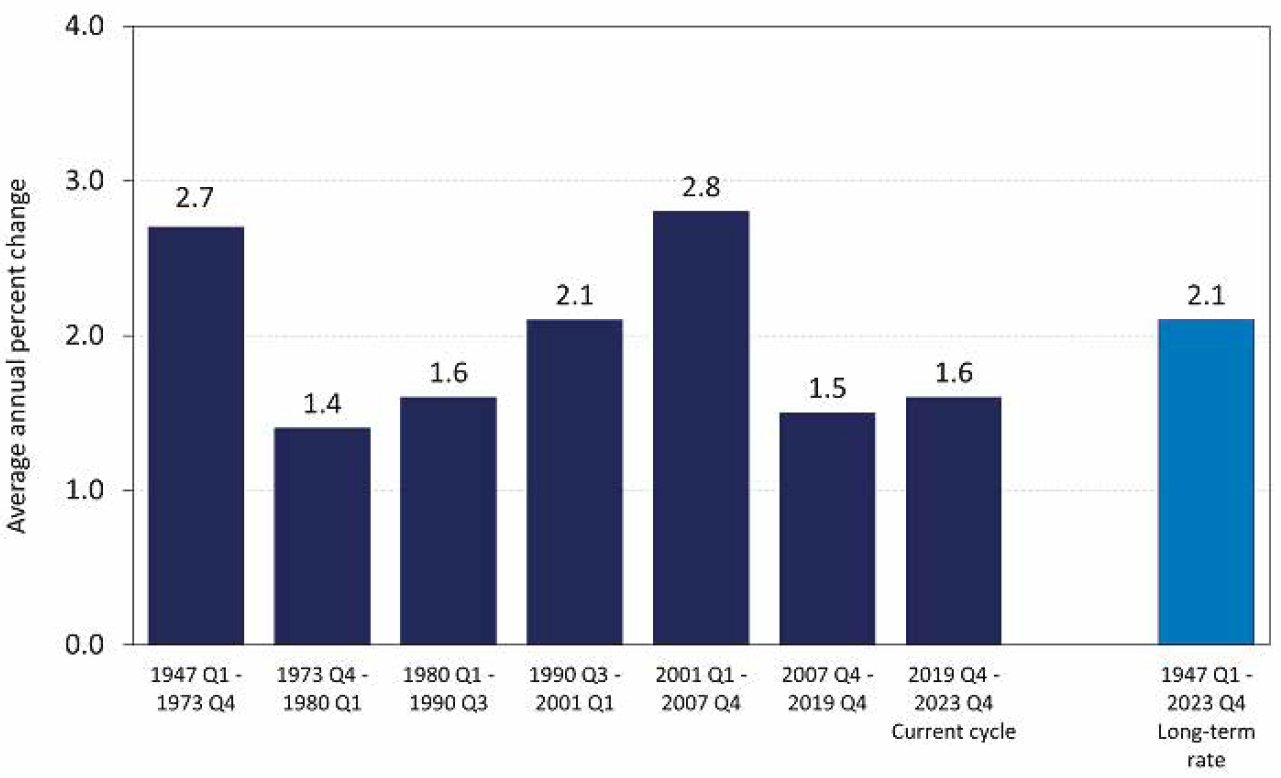
SOURCE: U.S. Bureau of Labor Statistics, 2024, “Long Term Labor Productivity by Sector for Selected Periods: Productivity Change in the Nonfarm Business Sector, 1947 Q1–2024 Q1,” last updated May 2, 2024, https://www.bls.gov/productivity/images/pfei.png.
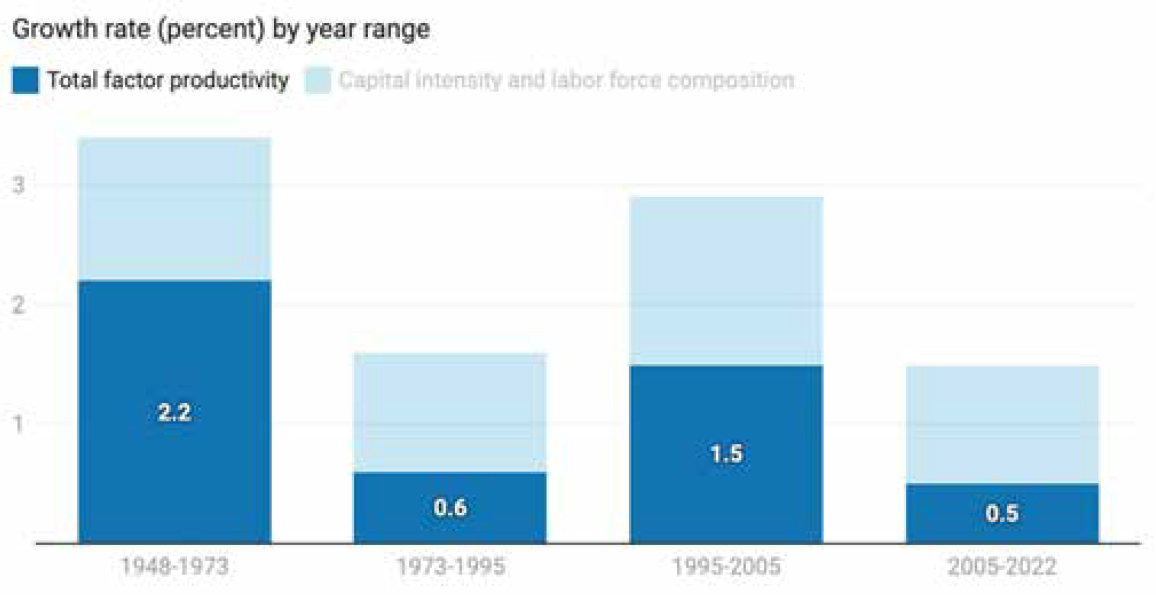
SOURCE: Based on data from the Federal Reserve Bank of San Francisco, n.d., “Total Factor Productivity,” https://www.frbsf.org/economic-research/indicators-data/total-factor-productivity-tfp, accessed August 1, 2024.

SOURCE: U.S. Bureau of Economic Analysis, 2024, “Real Gross Private Domestic Investment [GPDIC1],” retrieved from FRED, Federal Reserve Bank of St. Louis, https://fred.stlouisfed.org/series/GPDIC1.
information technology systems. It then fell during the 2007–2008 financial crisis and did not recover its 2006 peak until 2014.
Thereafter, real investment continued to rise, hitting a new peak in 2019, before declining sharply for a short time in 2020 as a result of the COVID-19 pandemic recession and recovering to a new peak in 2022. Overall, the macro environment affects not only business investment—the most procyclical component of spending—but also productivity growth. In particular, sluggish macroeconomic conditions, including the Great Recession of 2007–2009 and the COVID-19 pandemic recession of 2020–2021, slowed investment growth and capital deepening.
The anemic economic recovery after the Great Recession, with the macro economy operating below capacity and its potential for several years, also played a role in slower productivity growth. The Great Recession was sparked by a financial crisis that left many firms facing constraints on their investments in physical, intangible, and human capital. During the recovery, the decline in the growth of capital intensity per worker explains about one-third of the slowdown in labor productivity growth. But that slowdown actually began before the Great Recession, with labor productivity growth slowing each year from 2002 to 2006. TFP slowed precipitously across sectors and industries beginning in 2005–2006, which explains about 65 percent of the slowdown in labor productivity. In contrast, the composition of labor, a measure of the skills and experience of the workforce, was not a contributing factor to the productivity slowdown. Productivity growth from the composition of the workforce remained around 0.2–0.3 percentage points during the slowdown, similar to its long-run average.
How did productivity vary across industries? The slowdown in TFP growth in the United States in the 2005–2019 period was broad, affecting most sectors, industries, and geographies, albeit to differing extents.8 Overall, information and communications technology (ICT) producing and using industries—“high-tech” sectors—accounted for the surge in productivity growth between 1995 and 2004, and they led the significant decline thereafter. Byrne and colleagues provide compelling evidence of the role of these industries.9 Figure 3-4 shows patterns of growth rates of labor productivity in subperiods from 1990 to 2019 for high-tech and other industries. The widespread decline in productivity growth in both high-tech and non-high-tech industries in the post-2005 period is evident.
A 2023 study by McKinsey examines trends in productivity growth from 2005 through 2019. Mining, information, finance and insurance, and wholesale trade had the strongest productivity growth in the United States after 2005.10 With the exception of mining, which benefited from technical progress in natural gas, these sectors are among the most digitized and ICT-intensive of all sectors. The star productivity performer was the information sector—including software, telecommunications and Internet services, and publishing—which is the most digitized of all sectors.
Productivity growth in manufacturing, real estate, and utilities slowed after 2005 but continued to outpace the average. There are important differences, however, within the manufacturing sector, with the share of more productive research and development (R&D)-intensive subsectors expanding and the share of less productive labor-intensive subsectors declining. Within manufacturing, almost all of the TFP growth during the entire 1987–2019 period came from one industry: computer and electronics products. Surprisingly, and driving the slowdown in productivity in the manufacturing sector, this subsector appears to have experienced negative TFP growth between 2014 and 2019.
There were also significant differences in productivity growth within services. Between 2005 and 2019, labor productivity grew and converged toward the average in several services, including professional services, arts and entertainment, retail trade, and administrative services. Increasing digitization (e.g., e-commerce in retail and streaming services in arts and entertainment) was a major factor behind productivity gains in these services. In contrast, several labor-intensive service sectors, including accommodation and food service, health care, transportation, construction, and government services,
___________________
8 U.S. Bureau of Labor Statistics, 2021, “The U.S. Productivity Slowdown: An Economy-Wide and Industry-Level Analysis,” Monthly Labor Review, April, https://www.bls.gov/opub/mlr/2021/article/the-us-productivity-slowdown-the-economy-wide-and-industry-level-analysis.htm.
9 D.M. Byrne, J.G. Fernald, and M.B. Reinsdorf, 2016, “Does the United States Have a Productivity Slowdown or a Measurement Problem?” Brookings Papers on Economic Activity (1):109–182, https://doi.org/10.1353/eca.2016.0014.
10 C. Atkins, O. White, A. Padhi, K. Ellingrud, A. Madgavkar, and M. Neary, 2023, “Rekindling US Productivity for a New Era,” McKinsey Global Institute, February 16, https://www.mckinsey.com/mgi/our-research/rekindling-us-productivity-for-a-new-era#.

NOTE: “High tech” refers to the science, technology, engineering, and mathematics–intensive sectors (including information and communications technology and biotechnology) as defined in D.E. Hecker, 2005, “High-Technology Employment: A NAICS-Based Update,” Monthly Labor Review 128:57.
SOURCE: Created based on data from the U.S. Bureau of Labor Statistics, Office of Productivity and Technology, “Industry Productivity Viewer,” https://data.bls.gov/apps/industry-productivity-viewer/home.htm.
remained productivity laggards with below-average productivity growth rates. Together, these lagging productivity sectors accounted for nearly one-quarter of output, about 37 percent of hours worked, and two-thirds of employment growth, slowing aggregate productivity growth as workers shifted into less productive work.
EXPLANATIONS FOR THE SLOWDOWN IN PRODUCTIVITY GROWTH
Economists differ on explanations for the significant, unexpected, and persistent slowdown in labor productivity growth and TFP growth, which occurred not just in the United States but in the other advanced economies after 2006.
As noted in the preceding section, all of these economies were hit by the Great Recession and an anemic recovery that slowed investment and contributed to slower productivity growth. Small businesses, including many entrepreneurial start-ups, were hit the hardest; fewer new small businesses were started, and many were closed. Commercial bank lending to support and grow new businesses declined as did venture capital, which set higher bars for start-ups seeking funding. Business uncertainty about the future replaced the business euphoria of strong shared growth around the world that characterized the years leading up to the Great Recession. And investment is
strongly negatively associated with higher uncertainty.11 Overall, an adverse and uncertain macroeconomic environment was a major factor behind the productivity slowdown in the United States and other advanced industrial economies hit by the Great Recession, which had global repercussions for growth and investment.
Another explanation for the slowdown in productivity growth is that advances in innovation and technology fluctuate over time. Robert Gordon provides extensive evidence of the fluctuations in the pace of technological advances.12 He argues that the ICT innovations of the 1980s and 1990s yielded significant gains in productivity, but the effects dissipated by the mid-2000s. Relatedly, Bloom and colleagues argue that research productivity has declined, as the inputs required to generate new advances have increased over time.13
Distinct but potentially related explanations are based on headwinds to productivity growth that have emerged over the past couple of decades. To provide guidance about these possible headwinds, it is instructive to review important structural changes in the economy since the 2000s. As the slowdown occurred, the productivity gaps among firms within sectors grew to unprecedented levels. The within-industry dispersion in TFP across establishments in the manufacturing sector has been rising, especially in the post-2000 period (Figure 3-5). While TFP is more difficult to measure at the firm level for other sectors, dispersion in labor productivity is rising across firms within industries in all sectors of the economy.14 Andrews and colleagues provide evidence of rising productivity dispersion within industries in many Organisation for Economic Co-operation and Development (OECD) countries as well.15
Many factors appear to underlie the rising gaps in productivity performance across firms. The gap measures reflect rising dispersion of revenue per unit input and can reflect not only rising gaps in technical efficiency but also rising frictions and distortions that can be a drag on advances in productivity.16,17 On the technical efficiency side, differences in the digitization of firms appear to be an important driver of differences in their
___________________
11 N. Bloom, S.J. Davis, L.S. Foster, S.W. Ohlmacher, and I. Saporta-Eksten, 2022, “Investment and Subjective Uncertainty,” National Bureau of Economic Research Working Paper Series, No. 30654, November, https://doi.org/10.3386/w30654.
12 R. Gordon, 2017, “The Rise and Fall of American Growth: The US Standard of Living Since the Civil War,” Princeton University Press.
13 N. Bloom, C.I. Jones, J. Van Reenen, and M. Webb, 2020, “Are Ideas Getting Harder to Find?” American Economic Review 110(4):1104–1144, https://doi.org/10.1257/aer.20180338.
14 R.A. Decker, J. Haltiwanger, R.S. Jarmin, and J. Miranda, 2020, “Changing Business Dynamism and Productivity: Shocks Versus Responsiveness,” American Economic Review 110(12):3952–3990, https://doi.org/10.1257/aer.20190680.
15 D. Andrews, C. Criscuolo, and P.N. Gal, 2016, “The Best Versus the Rest: The Global Productivity Slowdown, Divergence Across Firms and the Role of Public Policy,” OECD Productivity Working Paper No. 05, November, https://www.oecd.org/global-forum-productivity/research/OECD%20Productivity%20Working%20Paper%20N°5.pdf.
16 Rising frictions and distortions can yield increases in misallocation such that resources (e.g., capital and labor) are allocated less efficiently.
17 C.-T. Hsieh and P.J. Klenow, 2009, “Misallocation and Manufacturing TFP in China and India,” Quarterly Journal of Economics 124(4):1403–1448, http://www.jstor.org/stable/40506263.
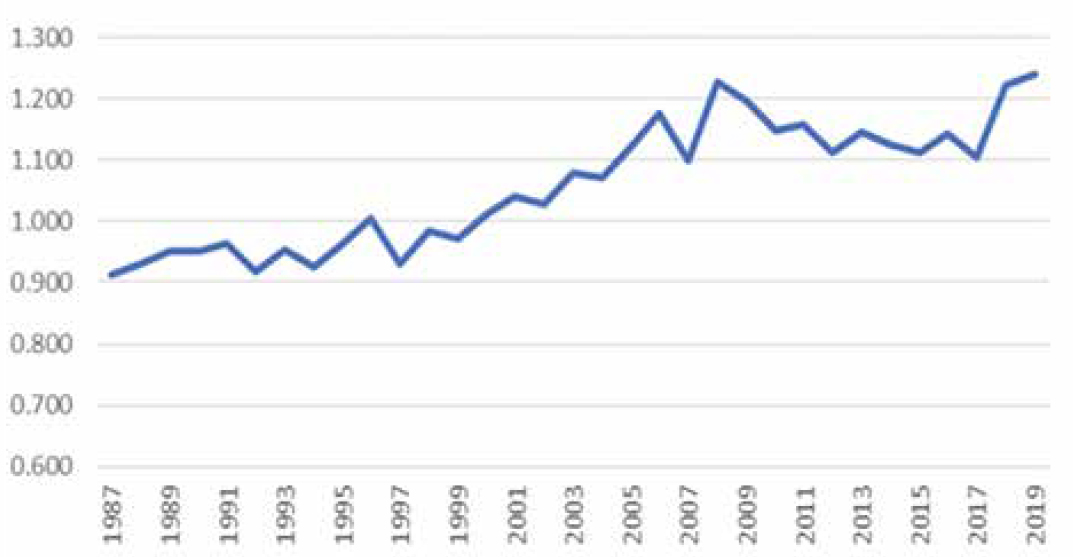
NOTE: Reported is the mean 90–10 within-industry differential of (log) total factor productivity across establishments across four-digit North American Industry Classification System industries in U.S. manufacturing.
SOURCE: Created based on data from U.S. Bureau of Labor Statistics and U.S. Census Bureau, 2023, “Dispersion Statistics on Productivity,” https://www.census.gov/programs-surveys/ces/data/public-use-data/dispersion-statistics-on-productivity.html.
productivity. There was a 70 percent correlation between a sector’s productivity growth and the level of its “digitization” during the past 30 years.18 In the United States within manufacturing, which includes both ICT producing and many ICT using sectors and businesses, leading businesses (firms at the 90th percentile of productivity) operated at four times the productivity level of laggards (businesses at the 10th percentile of productivity) in 2019. The comparable number in the semiconductor industry was 14 times the productivity level.19 Andrews and colleagues have suggested that an important factor underlying the rising productivity gaps among firms is slowing diffusion of technology as a result of rising frictions and distortions.20
The responsiveness of firms to changes in both their productivity performance and demand shocks appears to have slowed.21 This may be the result of a number of factors including rising dispersion in markups (prices above costs) and increases in political and
___________________
18 McKinsey Global Institute, 2023, “An Approach to Boosting US Labor Productivity,” May 25, https://www.mckinsey.com/mgi/our-research/an-approach-to-boosting-us-labor-productivity.
19 These statistics are drawn from the BLS/Census Dispersion Statistics on Productivity (DiSP) data product, https://www.bls.gov/productivity/articles-and-research/dispersion-statistics-on-productivity/home.htm. DiSP uses the Annual Survey of Manufactures and Census of Manufactures data.
20 D. Andrews, C. Criscuolo, and P.N. Gal, 2016, “The Best Versus the Rest: The Global Productivity Slowdown, Divergence Across Firms and the Role of Public Policy,” OECD Productivity Working Paper No. 05, November, https://www.oecd.org/global-forum-productivity/research/OECD%20Productivity%20Working%20Paper%20N°5.pdf.
21 R.A. Decker, J. Haltiwanger, R.S. Jarmin, and J. Miranda, 2020, “Changing Business Dynamism and Productivity: Shocks Versus Responsiveness,” American Economic Review 110(12):3952–3990, https://doi.org/10.1257/aer.20190680.
economic uncertainty.22 These factors may have slowed the diffusion of new technologies across firms and increased the frictions associated with adjusting the scale and mix of operations at firms, including the adjustment of capital and labor.23
Accompanying the rising productivity gaps across firms has been a decline in measures of business dynamism and entrepreneurship. The rising frictions and distortions discussed above are potential mechanisms underlying this decline in dynamism. Figure 3-6 reports trends in a summary measure of business dynamism—the pace of job reallocation across establishments. Job reallocation is equal to the sum of the pace of job creation (expansions plus entering) and job destruction (contractions plus exiting). There has been a trend of decline in the pace of overall job reallocation since the late 1980s, but key innovative (“high-tech”) industries have exhibited a decline only in the post-2000 period.24 Preceding and accompanying the productivity surge from the high-tech industries in the 1990s, the pace of job reallocation rose in those industries from the 1980s through the early 2000s.
The share of employment at young firms exhibits broadly similar trends to the overall pace of job reallocation (Figure 3-7) with entrepreneurship surging in the high-tech industries in the 1990s through the early 2000s but declining thereafter. Detailed industry data show that the surge in entry preceded the surge in productivity in these innovation-intensive industries.25 These patterns are consistent with waves of experimentation, innovation, dynamism, and productivity growth over the 20th century.26
___________________
22 S.R. Baker, N. Bloom, and S.J. Davis, 2016, “Measuring Economic Policy Uncertainty,” Quarterly Journal of Economics 131(4):1593–1636, https://doi.org/10.1093/qje/qjw024 and J. De Loecker, J. Eeckhout, and G. Unger, 2020, “The Rise of Market Power and the Macroeconomic Implications,” Quarterly Journal of Economics 135(2):561–644, https://EconPapers.repec.org/RePEc:oup:qjecon:v:135:y:2020:i:2:p:561-644.
23 J. De Loecker, T. Obermeier, and J. Van Reenen, 2022, “Firms and Inequality,” CEP Discussion Paper No. 1838, London School of Economics and Political Science, Centre for Economic Performance, London, investigates the implications of rising dispersion in markups for declining dynamism and productivity. U. Akcigit and S. Ates, 2021, “Ten Facts on Declining Business Dynamism and Lessons from Endogenous Growth Theory,” American Economic Journal: Macroeconomics 13(1):257–298, explores the contribution of slower diffusion for declining dynamism and productivity building in part on the evidence on declining diffusion in D. Andrews, C. Criscuolo, and P. Gal, 2016, “The Best Versus the Rest: The Global Productivity Slowdown, Divergence Across Firms and the Role of Public Policy,” OECD Productivity Working Paper No. 5, OECD Publishing, Paris, https://doi.org/10.1787/63629cc9-en. The role of rising adjustment costs for declining dynamism and productivity is explored in R.A. Decker, J. Haltiwanger, R.S. Jarmin, and J. Miranda, 2020, “Changing Business Dynamism and Productivity: Shocks Versus Responsiveness,” American Economic Review 110(12):3952–3990, https://doi.org/10.1257/aer.20190680.
24 “High-tech” is the set of four-digit industries that are the most science, technology, engineering, and mathematics-intensive. See D.E. Hecker, 2005, “High-Technology Employment: A NAICS-Based Update,” Monthly Labor Review 128:57. This includes the ICT industries in manufacturing and nonmanufacturing and the scientific development industries (new AI firms are often classified in the latter).
25 C. Cunningham, L. Foster, C. Grim, et al., 2019, “Dispersion in Dispersion: Measuring Establishment-Level Differences in Productivity,” NBER Conference on Research in Income and Wealth, July 15–16, https://www.nber.org/conferences/si-2019-conference-research-income-and-wealth.
26 M. Gort and S. Klepper, 1982, “Time Paths in the Diffusion of Product Innovations,” Economic Journal 92(367):630–653, https://doi.org/10.2307/2232554. Gort and Klepper document that innovation takes time and has distinct phases. The early innovation phase is dominated by entry and experimentation, including investments in changes in organization. During this time productivity growth may decline with a rise in experimentally oriented misallocation. A shakeout process ensues with successful innovators expanding while unsuccessful innovators contract and exit. The successful innovators grow rapidly (becoming the large, successful firms of that wave of innovation) with accompanying productivity growth. Historically, these dynamics can be stretched across many years.

SOURCE: Created based on data from U.S. Census Bureau, Business Dynamic Statistics Datasets, https://www.census.gov/data/datasets/time-series/econ/bds/bds-datasets.html.

SOURCE: Created based on data from U.S. Census Bureau, Business Dynamics Statistics Datasets, https://www.census.gov/data/datasets/time-series/econ/bds/bds-datasets.html.
The flip side of the declining share of activity in young firms is the rising share of activity in large superstar firms.27 One way of characterizing this pattern is to examine the share of activity in “mega firms” (firms with more than 10,000 employees). The rise in mega firms has been particularly pronounced in nonmanufacturing high-tech industries in the post-2000 period (Figure 3-8).
Overall, structural changes on many different dimensions have collectively spurred productivity growth. Economic theory suggests that over time, more productive firms grow while less productive firms are replaced or are driven by competition to improve their performance. Such productivity-enhancing reallocation has been an important contributor to productivity growth over time.28 Relatedly, the innovative process itself is closely tied to the pace of reallocation, with young firms playing an outsized role in major innovations.29,30 Unfortunately, as shown above, during the productivity slowdown there has been a decline in the pace of business dynamism and entrepreneurship in the United States. This has included a decline in the pace of entrepreneurship in the innovation-intensive sectors of the economy that played such an important role in the productivity surge in the 1990s.
The shift toward large mature firms likely reflects many factors. First, powerful network effects and economies of scale effects are likely behind the emergence of a handful of global high-tech producing and using firms such as Google, Apple, Meta, Microsoft, and Amazon. Related rises in concentration have occurred beyond the high-tech sector as globalization and information technologies have favored large incumbents. While rising concentration reflects the substantial innovations by superstar firms, the accompanying decline in competition is consistent with the rise in the level and dispersion of markups of price over cost. The rise in concentration and the accompanying rise in the dispersion of markups, possibly working together, might account for some or all of the decline in dynamism and productivity.31
Important changes in the allocation of talent across firms have accompanied these changes in the structure of firms. Sorting and segregation of workers across firms have increased—more highly educated workers are more likely to be at firms that offer higher wages and better working conditions, and less educated workers are more likely to be
___________________
27 D. Autor, D. Dorn, L.F. Katz, C. Patterson, and J. Van Reenen, 2020, “The Fall of the Labor Share and the Rise of Superstar Firms,” Quarterly Journal of Economics 135(2):645–709, https://doi.org/10.1093/qje/qjaa004.
28 L. Foster, J.C. Haltiwanger, and C.J. Krizan, 2001, “Aggregate Productivity Growth: Lessons from Microeconomic Evidence,” pp. 303–372 in New Developments in Productivity Analysis, C.R. Hulten, E.R. Dean, and M.J. Harper, eds., University of Chicago Press, http://www.nber.org/chapters/c10129.
29 U. Akcigit and W. Kerr, 2018, “Growth Through Heterogeneous Innovations,” Journal of Political Economy 126(4):1374–1443.
30 D. Acemoglu, U. Akcigit, H. Alp, N. Bloom, and W. Kerr, 2018, “Innovation, Reallocation, and Growth,” American Economic Review 108(11):3450–3491, https://doi.org/10.1257/aer.20130470.
31 R. Cherif, F. Hasanov, and P. Aghion, 2023, “Fair and Inclusive Markets: Why Dynamism Matters,” Global Policy 14(5):686–701, https://doi.org/10.1111/1758-5899.13250.

SOURCE: Created based on data from U.S. Census Bureau, Business Dynamics Statistics Datasets, https://www.census.gov/data/datasets/time-series/econ/bds/bds-datasets.html.
in low-wage firms and sectors.32 These sorting and segregation effects have arguably reinforced the gaps between low- and high-productivity performers within sectors. Relatedly, Akcigit and Goldschlag find that over the post-2000 period, “inventors are increasingly concentrated in large incumbents, less likely to work for young firms, and less likely to become entrepreneurs.”33 Moreover, they find that an inventor’s earnings increase and innovative output decreases when hired by an incumbent as compared to a young firm. They argue that these patterns are consistent with large incumbent firms having strategic reasons to slow innovation so as not to cannibalize their existing products and market shares. Their findings reinforce concerns about the potentially adverse implications for innovation and productivity growth of both increasing concentration of large incumbents in many sectors, especially mega firms in high-tech sectors, and decreasing entrepreneurship.
In spite of these structural headwinds to productivity growth, AI may yield a new and sustained surge in investment and productivity. Much of the remaining part of the chapter addresses this possibility. It remains to be seen whether AI yields this surge by disrupting the macroeconomic and structural changes discussed in this section and rekindling business dynamism. There is some evidence from the past few years that the
___________________
32 J. Song, D.J. Price, F. Guvenen, N. Bloom, and T. von Wachter, 2019, “Firming Up Inequality,” Quarterly Journal of Economics 134(1):1–50, https://doi.org/10.1093/qje/qjy025.
33 U. Akcigit and N. Goldschlag, 2023, “Where Have All the ‘Creative Talents’ Gone? Employment Dynamics of US Inventors,” Working Paper 23-17, Center for Economic Studies, U.S. Census Bureau.

SOURCE: Created based on data from U.S. Bureau of the Census, Business Formation Statistics.
decline in business dynamism in the United States is being reversed. Business formation has been surging in the United States since 2020.34 Some of this surge is undoubtedly associated with the structural changes induced by the COVID-19 pandemic in terms of changes in work and lifestyle (e.g., there has been a surge in business formation in e-commerce). This surge in business formation has continued through the present. As of May 2023, applications for new businesses that signal they are likely to be new employers remained more than 30 percent higher than in 2019. Moreover, this surge in business formation is occurring in key high-tech industries—the Information sector (NAICS 51) and the Professional, Scientific, and Technical Services sector (NAICS 54)—as shown in Figure 3-9. New AI firms are likely to be classified in one of these two industries.
EFFECTS OF ARTIFICIAL INTELLIGENCE ON PRODUCTIVITY
Overall Adoption Is Limited But Growing Rapidly
AI adoption in most firms is still low, but it has been gradually permeating economic activity over several years—for example, with the technology powering smartphones, in autonomous-driving features on cars, for digital retail sales via platforms like Amazon, for
___________________
34 J.C. Haltiwanger, 2021, “Entrepreneurship During the COVID-19 Pandemic: Evidence from the Business Formation Statistics,” pp. 9–42 in Entrepreneurship and Innovation Policy and the Economy, Vol. 1, National Bureau of Economic Research.
streaming services like Netflix, and in intelligent robots and intelligent systems in manufacturing. AI in the form of advanced analytics and machine learning algorithms has been effective at performing numerical optimization and predictive modeling in a wide range of industries.35
The adoption of AI tools has varied by firm characteristics and by sector. In the United States, larger, more highly digitized, and younger firms have been more likely to adopt AI.36 In addition, adoption has been higher at firms with younger, more educated, and more experienced owners.37 Overall, between 2016 and 2018, an estimated 13 percent of U.S. employees worked at firms using AI. Adoption rates also varied by industry; the largest percentages of firms with some AI adoption were found in information, financial services, management, and finance, and the largest percentages of workers with higher-than-average exposure rates to AI were found in these sectors as well as in retail trade transportation utilities and manufacturing.38,39
According to results in the 2019 Annual Business Survey for U.S. companies, the main barriers to AI adoption by a firm are inapplicability to its business and cost. Among AI-adopting firms, 80 percent (employment-weighted) adopted AI to improve product or service quality, 65 percent adopted AI to upgrade existing processes, and 54 percent adopted AI to automate existing processes. Acemoglu and colleagues also report that firms adopting AI have higher productivity and lower labor shares than similar firms, a result that is consistent with automation being a major application for AI.40 Of AI adopters, 15 percent reported an increase in employment and 6 percent reported a decrease, while 41 percent reported an increase in skill demand and none reported a decrease.
Although AI has affected specific applications and firms, to date the deployment of AI has been too small to have had a detectable effect on aggregate productivity growth or on productivity growth by industry. Indeed, the slowdown in TFP growth between 2005 and 2019 across sectors overlapped with the gradual roll-out of AI adoption.
___________________
35 M. Chui, E. Hazan, R. Roberts, et al., 2023, “The Economic Potential of Generative AI: The Next Productivity Frontier,” McKinsey & Company, June 14, https://www.mckinsey.com/capabilities/mckinsey-digital/our-insights/the-economic-potential-of-generative-ai-the-next-productivity-frontier.
36 It can be challenging to define precisely what it means to “adopt AI.” The following findings are drawn from the Annual Business Survey (ABS) of the U.S. Census, which targets owners and managers of about 850,000 U.S. firms of all sizes. The adoption question in the ABS starts with the following: “During the three years 2016 to 2018, to what extent did this business use the following technologies in production processes for goods or services?” Then for a series of technologies including AI, the responses possible are as follows: “Did not use; Tested but did not use in production or service; low use; moderate use; high use.” A series of follow-up questions draws out how and why they are using the technologies.
37 N. Zolas, Z. Kroff, E. Brynjolfsson, et al., 2020, “Advanced Technologies Adoption and Use by U.S. Firms: Evidence from the Annual Business Survey,” SSRN Electronic Journal, https://doi.org/10.2139/ssrn.3759827.
38 Ibid.
39 European Commission and the U.S. Council of Economic Advisors, 2022, “The Impact of Artificial Intelligence on the Future of Workforces in the European Union and the United States of America,” December 5, https://www.whitehouse.gov/wp-content/uploads/2022/12/TTC-EC-CEA-AI-Report-12052022-1.pdf.
40 D. Acemoglu, G.W. Anderson, D.N. Beede, et al., 2022, “Automation and the Workforce: A Firm-Level View from the 2019 Annual Business Survey,” NBER Working Paper No. 30659, November, National Bureau of Economic Research, https://doi.org/10.3386/w30659.
A few cases illustrate the various ways that AI has been affecting key industries. The information industry is the most digitized industry and has the highest share of both firms and employment with some AI adoption. AI is being applied in the financial services industry for a variety of purposes including risk assessment and capital allocation, stewardship in asset management, fraud detection, algorithmic trading, faster services (e.g., mortgage approvals), and core back-office support and compliance tasks. There have also been numerous AI applications in the auto industry including design and development, manufacturing and warehouse processes, analysis of road conditions, personalized vehicles and enhanced safety, auto insurance, and dealership experience.41
Yet, as noted above, the information sector experienced a sharp and unexplained deceleration in TFP growth after 2005. Information technology firms have been both the developers and the early adopters of AI technologies. Finance too has relatively high shares of firms and employment with some AI adoption, and it too experienced a significant deceleration in productivity growth. Indeed, in the area of securities and other financial investments, changes in productivity growth went from strongly positive in 1997–2005 to strongly negative in 2005–2019. The finance industry was hit hard by the 2007–2008 global financial crisis and the restructuring that followed, with negative consequences for its productivity growth.
A Framework for Thinking About the Effects of AI on Aggregate Productivity
How much will AI affect aggregate productivity? It is an important question but also one that is inherently difficult to answer. TFP has been called “a measure of our ignorance” because, by definition, it cannot be directly accounted for by any measured inputs.42 Instead, it is the residual or unexplained additional output that is created after increases in capital and labor inputs are included.
Typically, this residual is interpreted as the result of technology broadly defined. This includes not only advances in equipment and machinery but also new production techniques and methods. Nonetheless, there are some key variables that will affect the magnitude of an increase in productivity growth that can be expected from a new technology such as AI. This section develops a framework for estimating the potential effects of AI on productivity and growth and for establishing bounds on how much additional growth to expect. The framework identifies eight key factors to consider.
A good place to start is with Hulten’s theorem, which states that for efficient economies and under minimal assumptions, the first-order impact on aggregate output
___________________
41 M. Singhal, S. Kadam, and S. Sahay, 2022, “29 AI Use Cases—Transforming the Automotive Industry,” Birlasoft, CK Birla Group, https://www.birlasoft.com/articles/ai-use-cases-in-automotive-industry.
42 M. Abramovitz, 1989, “Resource and Output Trends in the United States Since 1870,” pp. 127–147 in Thinking About Growth: And Other Essays on Economic Growth and Welfare, Studies in Economic History and Policy: USA in the Twentieth Century, Cambridge University Press, https://doi.org/10.1017/CBO9780511664656.005.
of a TFP increase in an industry is proportional to that industry’s sales as a share of aggregate output.43 Hulten’s theorem gives the first two factors to consider: (1) the share of the economy that the technology affects and (2) the potential size of its productivity impact. For instance, if LLMs affect 50 percent of the tasks in the economy and make those tasks 20 percent more productive on average, then a first-order estimate of the net effect of LLMs on aggregative productivity would be 50 percent of 20 percent, or 10 percent.
But that is only a start. A third factor is that most new technologies require additional complementary investments in workers, tangible capital, and intangible capital in order to be used effectively. For example, complementary investments to train workers to use the technology may be required. New business processes and organizational forms can also be important complements to new technologies.44 Additional investment in physical capital may also be required. As an illustration, LLMs depend on training large neural networks that typically require significant investments in computing infrastructure. If such other investments are strict complements, meaning they are indispensable to using the new technology, then they can become bottlenecks. For instance, faster fiber-optic cables will generate no increase in bandwidth if they are not paired with suitable routers. Conceptually, if the production process in a manufacturing plant or industry consists of 1,000 steps that must be done in sequence, then speeding up 1 of them or even 999 of them will not increase throughput if at least one step remains a bottleneck.45 Thus the need for complements, particularly when they become bottlenecks, can reduce the aggregate productivity effects of AI below what might be expected from Hulten’s theorem.46
Over time, bottlenecks can be addressed. It’s not uncommon for a bottleneck to become a focus of attention because the returns from alleviating it can be very high. One reason that Moore’s law has advanced so consistently for more than 70 years is that whenever one aspect of the production process was not keeping up with the others, it
___________________
43 C.R. Hulten, 1978, “Growth Accounting with Intermediate Inputs,” Review of Economic Studies 45:511–518.
44 E. Brynjolfsson and P. Milgrom, 2012, “Complementarity in Organizations,” pp. 11–55 in The Handbook of Organizational Economics, R. Gibbons and J. Roberts, eds., Princeton University Press.
45 A related phenomenon is sometimes called “Baumol’s Cost Disease”; see W.D. Nordhaus, 2008, “Baumol’s Diseases: A Macroeconomic Perspective,” B.E. Journal of Macroeconomics 8(1):1–39. Even rapid productivity increases in one part of the economy will be dampened if other parts of the economy do not see an improvement. Over time, the productive sectors may require less labor and fall in cost. If demand does not grow commensurately, then the sectors with rapid productivity growth will shrink while the more stagnant sectors will become increasingly important.
46 In particular, Hulten’s theorem holds in a no frictions, no distortions, competitive (in output and factor markets) economy. The misallocation literature has emphasized that differences in productivity across countries, industries, and time depend critically on the frictions and distortions that inhibit the efficient allocation of resources. See C.-T. Hsieh and P.J. Klenow, 2009, “Misallocation and Manufacturing TFP in China and India,” Quarterly Journal of Economics 124(4):1403–1448, https://doi.org/10.1162/qjec.2009.124.4.1403. These frictions and distortions can impact both the level and growth of productivity. In Hulten’s economy, there is no dispersion in revenue productivity across firms because marginal revenue products are equalized instantaneously across firms (no markups, markdowns, other frictions, or distortions such as frictions in capital and labor markets). This perspective is not just that the productivity gains may take longer to be realized but also that they are dampened by the frictions and distortions inducing misallocation.
would draw attention, research, and investment. As bottlenecks are addressed, the long-run changes in output and productivity from a technology shock will tend to be larger in magnitude than the short-run changes.47
This highlights the role of time lags as a fourth factor. There are several reasons why the full impact of a new technology on productivity takes time. If the new technology changes tasks, jobs, and occupations—and the skills required for them—there could be considerable labor market disruption. The necessary labor market transitions could be substantial and costly. It also takes time to build and implement the new core technology as well as to implement complementary investments, which may include physical capital and infrastructure, human capital, and intangible assets. Furthermore, often the most effective combination of these assets is not well understood in advance and needs to be discovered by research or by experimentation. Overall, if a new technology can be expected ultimately to have a 10 percent effect on the level of productivity but it takes 10 years to fully implement, including time for the necessary redeployment of labor and time to create the necessary complements, then the technology’s average annual effect on productivity will be only about 1 percent.
A fifth factor to consider is that private returns do not necessarily add up to equal social returns. In particular, a new technology may cause positive or negative economic spillovers—benefits or costs for businesses and individuals that are not directly involved in purchasing or using the technology. These externalities can have a positive or a negative effect on aggregate productivity. For instance, the introduction of LLMs may trigger a cascade of complementary innovations that create a great deal of value beyond the value created by the initial investment. The ChatGPT plugin marketplaces are examples of this. And, as discussed below, AI’s tools for understanding protein folding are likely to create significant positive externalities in the pharmaceutical industry. With many general-purpose technologies like AI, complementary innovations ultimately do more to affect output and productivity than the initial innovation itself.
Spillovers can also be negative—for example, when AI is used for rent seeking or shifting market shares. For instance, a faster machine learning algorithm might make it possible to predict prices in a commodity market rapidly, allowing a trading firm to purchase or sell assets milliseconds before its competitors. That can result in large profits, but they largely come at the expense of others in the market. The social value of having the trade happen a few milliseconds earlier is negligible, but the private returns can be enormous. Similarly, some types of advertising may be aimed primarily at shifting market shares in a zero-sum way rather than increasing total market size or improving the match of products with customers. Relatedly, technology could allow for improved price discrimination and targeting, enabling sellers to capture consumer surplus from
___________________
47 P. Milgrom and J. Roberts, 1996, “The LeChatelier Principle,” American Economic Review 86(1):173–179.
buyers. Again, this can be very profitable without increasing total welfare. These kinds of negative business spillovers tend to be less of an issue in highly competitive markets, but AI could increase concentration, which would increase the potential for rent and thus rent-seeking behavior. More ominously, AI could create negative externalities by increasing cybersecurity risks and costs, by violating customer privacy, or by increasing the number and strength of homemade weapons or toxins.
Measurement issues are a sixth factor that should be considered when assessing the effects of a new technology on productivity, at least as it is conventionally reported. In particular, there are many benefits that are not captured in gross domestic product (GDP) and therefore are also missing from productivity. For instance, an AI-enabled innovation that leads to a new therapeutic drug may have some small direct effects on GDP when that drug is sold, but there may be even more important indirect effects if the drug leads to longer, healthier lives. Those health benefits generally will not show up in GDP or productivity. Health care is the top area for AI investment according to the 2023 edition of the AI Index report.48 In addition, many new products create far more consumer surplus than revenue. For instance, a free or low-cost version of a digital AI assistant might generate little or no business revenue but significant benefits for its users. In most cases, the small increase in revenue would be reflected in GDP, but the larger increase in consumer surplus generally would not be. William Nordhaus has estimated that more than 95 percent of the benefits of technological innovations ultimately end up in the hands of consumers not sellers.49
There are several alternative measures of well-being, including some that specifically focus on measuring consumer surplus.50,51 However, for now GDP and productivity are the primary metrics of economic growth used in the national accounts and by business, government, and the media.
The seventh factor to consider is substantial heterogeneity in the productivity effect of a new technology across sectors, firms, workers, and tasks. As noted earlier, there is evidence of a growing gap in the revenue productivity of the top 5 percent of firms in an industry in a given year (“the best”) compared to the remainder of firms (“the
___________________
48 N. Maslej, L. Fattorini, E. Brynjolfsson, et al., 2023, “The AI Index 2023 Annual Report,” AI Index Steering Committee, Institute for Human-Centered AI, Stanford University, April, https://aiindex.stanford.edu/ai-index-report-2023.
49 W. Nordhaus, 2004, “Schumpeterian Profits in the American Economy: Theory and Measurement,” NBER Working Paper No. 10433, National Bureau of Economic Research.
50 M. Fleurbaey, 2009, “Beyond GDP: The Quest for a Measure of Social Welfare,” Journal of Economic Literature 47(4):1029–1075.
51 E. Brynjolfsson, A. Collis, W.E. Diewert, F. Eggers, and K.J. Fox, 2019, “GDP-B: Accounting for the Value of New and Free Goods in the Digital Economy,” National Bureau of Economic Research Working Paper No. w25695.
rest”).52 While this could be owing to a variety of causes,53 it may reflect a growing gap between leaders and laggards in technology adoption and use. If AI exacerbates this trend, then looking only at average productivity may miss the growing heterogeneity in performance.
Last, it should be noted that the economy is not static, so the dynamic effects of technology are the eighth and final factor that should be considered.54 In the long run, the rate of change in productivity is more important than its level. AI can boost innovation itself, leading to a faster rate of change, not just a one-time boost. Over time, even small changes in the rate of growth compound to become significant. One promising aspect of recent AI advances is that tools like LLMs make it easier for larger and more diverse groups of people to contribute to innovation. For instance, the prompts used to direct LLMs can be written in English and do not require learning programming languages like Python or C. Furthermore, even in applications where such languages are needed, coding can increasingly be done using natural language interfaces, leveraging tools such as GitHub Copilot.
In sum, these eight factors provide a framework for understanding how AI, like other technologies, can affect productivity and well-being. Hulten’s theorem can provide the initial first-order estimate, based on the first two factors, highlighting that the aggregate effect is a function of all eight factors.
It is possible to develop estimates of some of these effects that can help put upper and lower bounds on the likely productivity impact of AI. That said, there will be uncertainties in all of the variables, so this framework is important less for the sake of getting precise predictions and more for getting a sense of where the main sources of uncertainty are and where the biggest policy levers are likely to be.
The following subsections go into more detail on each of these factors.
Factor 1: Share of the Economy Potentially Affected by AI
A major reason AI may significantly boost labor productivity growth is that it has potential applications in so many parts of the economy. Generative AI along with other types of AI and robotics have the potential to affect activities that today encompass a majority
___________________
52 See, for example, D. Andrews, C. Criscuolo, and P. Gal, 2015, “Frontier Firms, Technology Diffusion and Public Policy: Micro Evidence from OECD Countries,” OECD Productivity Working Paper No. 2, OECD Publishing, https://doi.org/10.1787/5jrql2q2jj7b-en; and E. Brynjolfsson, A. McAfee, M. Sorell, and F. Zhu, 2008, “Scale Without Mass: Business Process Replication and Industry Dynamics,” Harvard Business School Technology and Operations Management Unit Research Paper No. 07-016, September 30, http://dx.doi.org/10.2139/ssrn.980568.
53 Revenue productivity dispersion is revenue per unit input, and it potentially reflects many factors, including (1) rising dispersion of distortions and/or frictions impeding the equalization of marginal revenue products (e.g., rising uncertainty, adjustment costs); (2) rising dispersion of markups; (3) rising dispersion in fundamentals in the presence of a given set of frictions/distortions impeding the equalization of marginal revenue products; (4) rising correlation between fundamentals and distortions/frictions (e.g., markups rising especially for the largest firms); and (5) rising dispersion in within-industry differences in production processes.
54 M.N. Baily, E. Brynjolfsson, and A. Korinek, 2023, “Machines of Mind: The Case for an AI-Powered Productivity Boom,” Brookings Institution, May 10, https://www.brookings.edu/articles/machines-of-mind-the-case-for-an-ai-powered-productivity-boom.
of worker time. There is no perfect way to assess the tasks that will be affected. Eloundou and colleagues assess the alignment of occupations with LLM capabilities and find that LLMs alone could affect 80 percent of the U.S. workforce to some degree and affect, either as a complement or substitute, over half of the tasks done by 19 percent of the workforce.55 Furthermore, there are other types of AI, including machine learning used for classification and prediction tasks, that are suitable for thousands of other tasks.56 The net effect of AI on tasks will thus be quite widespread.
The set of tasks that can be affected by AI has expanded significantly over the past decade. The costly process of creating computer programs via labor-intensive manual coding is increasingly being replaced by automating machine learning algorithms.57
Supervised machine learning progress has been rapid owing to the availability of vast amounts of training data, which capture valuable and previously unnoticed regularities, often beyond human notice or even comprehension. In this way, tacit knowledge can be codified by creating usable software. These techniques work best when there are large amounts of input data (X) that can be mapped to labeled output data (Y). The machine learning algorithm can then find the relationships (X→Y) and, depending on the application, classify the outputs into categories or make predictions about outcomes. Table 3-1 gives some examples.
Foundation models,58 which include LLMs and other forms of generative AI, are the latest AI breakthrough. Investment in generative AI is a small fraction of total investments in AI but is growing rapidly, and generative AI is already expanding the possibilities of what AI overall can achieve. It is important to note that to date much of the investment in generative AI is concentrated in a handful of highly digitized tech giants and platform companies along with venture capital–financed firms in the United States.
Unlike other technological advances in recent decades that automated many routine physical and cognitive tasks done by humans, generative AI systems will mostly affect cognitive work—both routine tasks and nonroutine tasks. Routine tasks are ones that follow explicit rules and procedures. In contrast, the rules and steps in nonroutine
___________________
55 T. Eloundou, S. Manning, P. Mishkin, and D. Rock, 2023, “GPTs Are GPTs: An Early Look at the Labor Market Impact Potential of Large Language Models,” arXiv preprint, arXiv:2303.10130.
56 E. Brynjolfsson and T. Mitchell, 2017, “What Can Machine Learning Do? Workforce Implications,” Science 358:1530–1534, https://doi.org/10.1126/science.aap8062; E.W. Felten, M. Raj, and R. Seamans, 2023, “Occupational Heterogeneity in Exposure to Generative AI,” April 10, http://dx.doi.org/10.2139/ssrn.4414065; E. Felten, M. Raj, and R. Seamans, 2021, “Occupational, Industry, and Geographic Exposure to Artificial Intelligence: A Novel Dataset and Its Potential Uses,” Strategic Management Journal 42(12):2195–2217, https://doi.org/10.1002/smj.3286; and C.B. Frey and M.A. Osborne, 2017, “The Future of Employment: How Susceptible Are Jobs to Computerisation?” Technological Forecasting and Social Change 114:254–280.
57 E. Brynjolfsson and T. Mitchell, 2017, “What Can Machine Learning Do? Workforce Implications,” Science 358:1530–1534, https://doi.org/10.1126/science.aap8062.
58 As discussed in Chapter 1, foundation models are an approach for building AI systems in which a machine learning model is initially trained on a large amount of unlabeled data and can then be adapted to many applications. LLMs like GPT and Bard are examples of foundation models, and tools built around LLMs include ChatGPT. LLMs generate new content, making them a form of “generative AI,” along with tools like Midjourney and DALL·E, which create images, and Copilot, which helps coders write software.
TABLE 3-1 Examples of Machine Learning Applications
| Input X | Output Y | Application |
|---|---|---|
| Voice recording | Transcript | Speech recognition |
| Historical market data | Future market data | Trading bots |
| Photograph | Caption | Image tagging |
| Store transaction | Are the transaction details fraudulent? | Fraud detection |
| Purchase | Future purchase | Customer history-based behavior retention |
| Car locations and speed | Traffic flow | Traffic lights |
| Faces | Names | Face recognition |
| Chemical properties | Clinical effectiveness | Drug discovery |
SOURCE: Created based on data from E. Brynjolfsson and A. Mcafee, 2017, “The Business of Artificial Intelligence: What It Can—and Cannot—Do for Your Organization,” Harvard Business Review, July 18, https://hbr.org/2017/07/the-business-of-artificial-intelligence.
tasks cannot be codified. Systems based on foundation models can accomplish a growing number of nonroutine cognitive tasks that used to be done by cognitive workers. These tasks include composing fluent prose based on bullet points, summarizing documents, brainstorming, planning, and translating information from one language to another. These tasks include many tasks in administrative support, engineering services, financial and business operations, management, and sales. Many of these tasks are currently performed by workers with strong educational credentials, including bachelor’s and graduate degrees. People who were relatively immune to previous waves of automation like creative writers, graphic artists, lawyers, doctors, accountants, and even chief executive officers are now being affected. Furthermore, AI’s capabilities continue to evolve rapidly, suggesting that new effects are likely to emerge rapidly.
A useful approach to understanding the effects of these technologies is the task-based approach. Occupations consist of distinct tasks—according to O*NET, typically from 15 to 30 separate tasks. Rather than automating an entire occupation, AI will typically affect only some tasks in each occupation. For instance, applying the task-based approach, Brynjolfsson and colleagues found that of the 950 occupations they studied, there were none in which machine learning “ran the table” and affected all of the tasks, but AI could affect at least some tasks in most occupations.59
As noted above, using this task-based approach, Eloundou and colleagues estimated that “around 80% of the U.S. workforce could have at least 10% of their work
___________________
59 E. Brynjolfsson, T. Mitchell, and D. Rock, 2018, “What Can Machines Learn and What Does It Mean for Occupations and the Economy?” pp. 43–47 in AEA Papers and Proceedings, Vol. 108, American Economic Association.
tasks affected by the introduction of LLMs, while approximately 19% of workers may see at least 50% of their tasks impacted,” using a threshold of a 50 percent reduction in the time required to complete a task while maintaining quality.60 Even when a task is exposed, labor may remain indispensable for that task, even as overall productivity grows. There may be a transition period, with LLMs initially complementing tasks within occupations before automating them over time.61
Overall, Eloundou and colleagues found significant task exposure in occupations and employment in all industries, with wide sectoral heterogeneity and the highest relative exposures in the information processing industries and in hospitals. Manufacturing, agriculture, and mining show lower exposure. In contrast to the results from Acemoglu cited earlier, exposure appears to be uncorrelated with both recent factor productivity growth and labor productivity growth by sector. LLMs and related technologies could improve productivity in health care and education, two huge and perennially lagging productivity sectors. There is also growing evidence that AI can reduce the cost and duration of new drug discovery, another area in need of a productivity boost.
A recent study by Goldman Sachs estimated that generative AI can substitute for humans in about 25 percent of current tasks.62 The estimated effects vary significantly by job type and industry sector. Higher effects are expected in administrative and office support, legal services, business and financial operations, and management and sales. Lower effects are expected in physically intensive professions such as maintenance and construction and in services such as personal care and food and hospitality services. Only some of the tasks of most jobs are exposed to generative AI automation, ranging from jobs with 50 percent or more of the tasks exposed to generative AI automation—like legal services, sales, and business and financial services—to jobs with less than 49 percent of the tasks exposed to AI automation—like production, construction, personal services, and health care. The Goldman Sachs study conjectures that AI is likely to substitute for humans in jobs with high degrees of task exposure and to complement humans in jobs with lower degrees of task exposure.
Recent research by the McKinsey Global Institute (MGI) concludes that generative AI is likely to have the largest impact on four business functions—customer operations, marketing and sales, software engineering, and R&D. Using a detailed analysis of how generative AI could transform these four use cases, MGI estimates that applying generative AI could increase productivity in customer care by between 30 and 45 percent of
___________________
60 T. Eloundou, S. Manning, P. Mishkin, and D. Rock, 2023, “GPTs Are GPTs: An Early Look at the Labor Market Impact Potential of Large Language Models,” arXiv preprint, arXiv:2303.10130.
61 M.-H. Huang and R.T. Rust, 2018, “Artificial Intelligence in Service,” Journal of Service Research 21(2):155–172, https://doi.org/10.1177/1094670517752459.
62 Goldman Sachs, 2023, “Top of Mind: Generative AI: Hype or Truly Transformative?” Goldman Sachs Global Macro Research, Issue 120, July 5, https://www.goldmansachs.com/intelligence/pages/top-of-mind/generative-ai-hype-or-truly-transformative/report.pdf.
current function costs; could increase sales productivity by about 3 to 5 percent of current global sales expenditures; could increase the productivity for marketing between 5 and 15 percent of total marketing spending; could increase the productivity of software engineering from 20 to 45 percent of current annual spending; and could increase productivity in product R&D between 10 percent and 15 percent of overall R&D costs.63
A May 2024 paper by Acemoglu is more pessimistic about the magnitude of impacts of new advances in AI. Using existing estimates of AI exposure and task-level productivity improvements, it projects more modest macroeconomic impacts, with a maximum increase of 0.66 percent in TFP over a decade. The paper further suggests that these estimates might be overstated, as early evidence focuses on easy-to-learn tasks. By contrast, many future impacts will stem from hard-to-learn tasks, which are influenced by numerous context-dependent factors.64
The automotive, finance, and health care sectors are among those most likely to be affected by generative AI. In the automotive sector, generative AI will improve safety and reduce accidents, a central goal of automobile producers; will enable and accelerate the introduction of autonomous vehicles; will personalize vehicles to customer requirements; and will increase the efficiency of costly marketing and advertising functions. In finance, generative AI is building on traditional AI capabilities already adopted for task automation, algorithmic trading and asset management, fraud detection, and personalized services. In health care, prior to the generative AI breakthrough, AI was already affecting administrative services and insurance, diagnosis and treatment, and patient engagement and adherence.65 Generative AI has the potential to affect all parts of health care—providers, payers, pharmaceutical and medical equipment producers, and services and operations.66
Education, parts of health care, and other forms of personal care are productivity laggards compared to the rest of the economy. Many of the tasks in these sectors have lower exposure to AI than tasks in legal and accounting services and financial services. Moreover, many of these tasks require both physical and social interactions with humans. AI could increase productivity in these perennially low productivity sectors and mitigate the Baumol effect. Chapter 5 provides examples of AI productivity enhancements in education.
___________________
63 M. Chui, E. Hazan, R. Roberts, et al., 2023, “The Economic Potential of Generative AI: The Next Productivity Frontier,” McKinsey & Company, June 14, https://www.mckinsey.com/capabilities/mckinsey-digital/our-insights/the-economic-potential-of-generative-ai-the-next-productivity-frontier.
64 D. Acemoglu, 2024, “The Simple Macroeconomics of AI,” NBER Working Paper No. 32487, May, National Bureau of Economic Research, http://www.nber.org/papers/w32487.
65 T. Davenport and R. Kalakota, 2019, “The Potential for Artificial Intelligence in Healthcare,” Future Healthcare Journal 6(2):94–98.
66 M. Huddle, J. Kellar, K. Srikumar, K. Deepak, and D. Martines, 2023, “Generative AI Will Transform Health Care Sooner Than You Think,” Boston Consulting Group, June 22, https://www.bcg.com/publications/2023/how-generative-ai-is-transforming-health-care-sooner-than-expected.
Last, there is evidence that adoption of earlier AI systems by firms had a significant effect on within-firm worker average productivity growth, adding 2–3 percentage points annually.67 More recent AI systems could have a similar significant effect on average worker productivity over time. But it is dangerous to predict aggregate productivity effects based on case studies. For instance, it took decades for the productivity effects of computers to show up in aggregate growth and productivity.
Factor 2: Productivity Effects in Specific Applications
Even if AI affects many sectors of the economy, the total productivity impact may be limited if it is only a “so-so” technology that barely improves on existing systems—that adds to corporate profits and substitutes for humans without adding much to productivity.68 In a number of case studies, however, the productivity impact has already been quite large. If these cases generalize, that portends well for aggregate productivity growth.
Some of the key effects of generative AI can be observed in a paper about the phased roll-out of an LLM-based system designed to assist thousands of contact center workers.69 The research compared agents who had access to this system with those who did not. The researchers discovered average productivity gains of 14 percent within just a few months (Figure 3-10). Customer satisfaction increased, and an analysis of millions of transcripts revealed a positive shift in sentiment: consumers used more happy words and fewer angry words. Simultaneously, employee turnover decreased among those who used the system. Moreover, managerial roles evolved, with broader spans of control and fewer interventions needed.
Interestingly, the results showed very disparate effects on different types of workers. Productivity increased by more than 35 percent for the newest workers as well as the least skilled workers but showed almost no change for the most experienced and skilled employees.
How did the system achieve these results and change the organization? The key lies in the fact that while earlier types of software required painstaking coding by humans who needed to fully understand the processes they were detailing, machine learning systems like this one can capture tacit knowledge by examining the relationships among inputs and outputs. This opens up many new processes that were previously learned only through on-the-job experience. Specifically, this system analyzed millions of transcripts of customer interactions and identified the common patterns in
___________________
67 Goldman Sachs, 2023, “Top of Mind: Generative AI: Hype or Truly Transformative?” Goldman Sachs Global Macro Research, Issue 120, July 5, https://www.goldmansachs.com/intelligence/pages/top-of-mind/generative-ai-hype-or-truly-transformative/report.pdf.
68 D. Acemoglu and P. Restrepo, 2019, “Automation and New Tasks: How Technology Displaces and Reinstates Labor,” Journal of Economic Perspectives 33(2):3–30, https://doi.org/10.1257/jep.33.2.3.
69 E. Brynjolfsson, D. Li, and L.R. Raymond, 2023, “Generative AI at Work,” National Bureau of Economic Research Working Paper No. w31161.

SOURCE: E. Brynjolfsson, D. Li, and L.R. Raymond, 2023, “Generative AI at Work,” National Bureau of Economic Research Working Paper No. w31161, https://arxiv.org/abs/2304.11771v1. CC-BY-NC-ND 4.0 DEED.
successful exchanges. These tended to match the skills of the most skilled and experienced workers, so they benefited less than the newer workers. The system’s success can be attributed partly to the company founders’ strategic decision to develop a technology designed to augment workers rather than attempting to create a fully automated replacement.
Other interesting examples of the productivity effects of machine learning systems are medical image recognition and machine translation. A convolutional neural network trained on 129,450 medical images and 2,032 different diseases was able to diagnose different types of cancer at a level that matched or exceeded 21 board-certified dermatologists.70 The authors argue that AI could provide low-cost access to diagnostic care to billions of smartphone users, a dramatic increase in dermatology productivity. AI is also being used in radiology to improve diagnostic performance, help radiologists to prioritize images, and reduce the time it takes to read images. Recent studies have shown improved diagnostic performance with reduced reading times for images with AI in mammography and bone fracture analysis and treatment. Overall reading
___________________
70 A. Esteva, B. Kuprel, R.A. Novoa, et al., 2017, “Dermatologist-Level Classification of Skin Cancer with Deep Neural Networks,” Nature 542(7639):115–118, https://doi.org/10.1038/nature21056.
times—a measure of productivity—shortened when radiologists used AI, but abnormalities detected by AI could lengthen these times.71 That said, productivity benefits are not guaranteed, even when machines are very good at the relevant tasks. Agarwal and colleagues conducted an experiment with radiologists that varied the availability of AI assistance.72 They found that radiologists “do not fully capitalize on the potential gains from AI assistance.”
The trading platform eBay mediates about $14 billion of cross-board trade among 200 countries. It trained a machine learning–based translation system to translate listings for various language pairs, improving on their prior systems. Because the system was rolled out in a staggered fashion across different countries, it was possible to estimate the causal effects of the system on international trade carried out on the platform. The new machine learning translation system increased trade by 10.9 percent.73 Because prior research found that trade decreases in proportion to distance between countries, this was the economic equivalent of reducing the distance between the treated country pairs by 26 percent, a massive productivity gain for participants on the platform from a piece of software.74
There is a growing body of literature that estimates generative AI’s productivity effects on many other occupations or tasks. Noy and Zhang find that many writing tasks can be completed twice as fast.75 Korinek provides 25 use cases where economists can be significantly more productive using LLMs.76 Peng and colleagues find that software engineers can write code up to twice as fast using Codex, a tool based on the LLM GPT-3’s earlier version.77 Dell’Acqua and colleagues draw on data from a preregistered experiment involving 758 consultants doing 18 distinct tasks either with or without access to GPT-4 to find that consultants using AI completed 12 percent more tasks on average and completed tasks 25 percent more quickly, and that their output was 40 percent higher in quality compared to a control group.78
___________________
71 H.J. Shin, K. Han, L. Ryu, and E.-K. Kim, 2023, “The Impact of Artificial Intelligence on the Reading Times of Radiologists for Chest Radiographs,” NPJ Digital Medicine 6(1):82.
72 N. Agarwal, A. Moehring, P. Rajpurkar, and T. Salz, 2023, “Combining Human Expertise with Artificial Intelligence: Experimental Evidence from Radiology,” NBER Working Paper No. w31422, http://dx.doi.org/10.2139/ssrn.4505053.
73 E. Brynjolfsson, X. Hui, and M. Liu, 2018, “Does Machine Translation Affect International Trade? Evidence from a Large Digital Platform,” NBER Working Paper 24917, National Bureau of Economic Research.
74 A. Lendle, M. Olarreaga, S. Schropp, and P.-L. Vézina, 2016, “There Goes Gravity: eBay and the Death of Distance,” Economic Journal 126:406–441, https://doi.org/10.1111/ecoj.12286.
75 S. Noy and W. Zhang, 2023, “Experimental Evidence on the Productivity Effects of Generative Artificial Intelligence,” Science 381:187–192, https://doi.org/10.1126/science.adh2586.
76 A. Korinek, 2023, “Language Models and Cognitive Automation for Economic Research,” NBER Working Paper No. 30957, National Bureau of Economic Research.
77 S. Peng, E. Kalliamvakou, P. Cihon, and M. Demirer, 2023, “The Impact of AI on Developer Productivity: Evidence from GitHub Copilot,” arXiv preprint, arXiv:2302.06590.
78 F. Dell’Acqua, E. McFowland III, E. Mollick, et al., 2023, “Navigating the Jagged Technological Frontier: Field Experimental Evidence of the Effects of AI on Knowledge Worker Productivity and Quality,” Harvard Business School Working Paper, No. 24-013, September.
Although much of the research on AI’s effects on productivity is conducted in laboratory settings or as case studies, the contact center example shows that such gains in specific tasks can lead to substantial benefits in real-world situations. If there are comparable productivity effects in other knowledge and information work activities as AI is introduced, this would lead to significant gains in aggregate productivity. Generative AI, for example, could increase the productivity of workers who work with text—including reports, marketing, and coding—and those who use images, like graphic artists, designers, and engineers, among others.
Factor 3: Complements, Bottlenecks, and Redeployment
AI can increase labor productivity through three main channels. First, through automation and the resulting substitution of human labor, AI can increase labor productivity directly by reducing the worker hours required for a given amount of output. Second, AI can complement workers, making them more productive in their tasks. Third, the redeployment of the capacity of workers freed up by AI automation into other equally or more productive tasks can increase productivity. This redeployment can occur through the creation of new tasks within an organization or through the reallocation and reemployment of workers displaced by AI automation to both existing and new tasks and occupations. Some of the reemployment of displaced workers will emerge in response to higher aggregate demand and labor demand resulting from the productivity and income gains of nondisplaced workers. Some of the reemployment will result directly from the effects of AI automation on the creation of new jobs and occupations.
Thus, harnessing the productivity benefits of AI in the tasks and occupations where it can be applied is not simply a matter of substituting for labor. Instead, it is likely to require investment in worker skills and training, as well as other complements, and the creation of new occupations and redeployment of labor.
First, consider complementary investments and innovations that will be necessary to provide workers with the skills and training necessary to work with AI systems and to qualify for the new tasks and occupations they create over time. AI, like other general-purpose technologies, will also require complementary investments and innovations in both tangible and intangible capital and in new forms of organizations. For example, systems for diagnosing disease from medical images, such as the dermatology and mammography examples described above, have made impressive progress. In late 2016, AI pioneer Geoffrey Hinton famously said, “People should stop training radiologists now. It’s just completely obvious within 5 years deep learning is going to do better than radiologists.… It might be 10 years, but we’ve got plenty of radiologists already.”79
___________________
79 G. Hinton, 2016, “On Radiology,” 2016 Machine Learning and Market for Intelligence Conference, Toronto, ON, https://www.youtube.com/watch?v=2HMPRXstSvQ&t=29s.
The American College of Radiology’s AI Central site lists more than 200 Food and Drug Administration–approved radiology AI algorithms.80 However, actual adoption of these algorithms has been slow. In fact, 2021 was a record year for postings on the American College of Radiology’s job board; job postings continued to be high into early 2022, at more than double the rate of 2019.81
One reason for the increased job postings is that according to the Occupational Information Network (O*NET), radiologists perform 30 distinct tasks, and only one of them is reading medical images. The evidence suggests that some of the tasks performed by radiologists are subject to automation by AI while others are unaffected by AI. To the extent these other tasks are essential, human radiologists, or at least someone else doing those tasks, will be necessary. Furthermore, the other tasks can become bottlenecks, limiting the productivity gains from speeding up one part of the job. In addition, the automation of some tasks will save time, but imaging use will also increase; overall, the demand for radiology and for humans doing radiology tasks could increase if demand is sufficiently elastic.
Second, the creation of entirely new tasks and occupations as a result of AI is also likely. In fact, more than 60 percent of employment in 2018 was in occupations that did not exist in 1940.82 This implies that more than 85 percent of the employment growth over the past 80 years arises from the technology-driven creation of new tasks and occupations.83 The ICT revolution of the past 30 years introduced new occupations like web page design and software engineering that complemented the technology.
One consequence of the need for complementary innovation and investment and the bottlenecks and redeployments is that decades of technological advancement have not made it more difficult for workers to find jobs, as measured by the unemployment rate. However, fluctuations in labor demand are reflected in wage levels more than in employment opportunities. For many workers, the wage effects have been negative. For example, Acemoglu and Restrepo find that 50 percent to 70 percent of the changes in the wage structure in the United States over the past 40 years is accounted for by relative wage declines for workers specializing in routine tasks in industries undergoing rapid automation.84
___________________
80 M. Windsor, 2022, “This Radiologist Is Helping Doctors See Through the Hype to an AI Future,” UAB Reporter, December 5, https://www.uab.edu/reporter/people/achievements/item/9925-this-radiologist-is-helping-doctors-see-through-the-hype-to-an-ai-future.
81 S. Baginski, 2022, “2022 Radiologist Job Market Update: High Volume, High Pay, and a Search for High Quality of Life,” vRad, Eden Prairie, MN, May 2, https://blog.vrad.com/2022-radiologist-job-market-update-rrc.
82 D. Autor, C.M. Chin, A. Salomons, and B. Seegmiller, 2024, “New Frontiers: The Origins and Content of New Work, 1940–2018,” Quarterly Journal of Economics 139(3):1399–1465, https://doi.org/10.1093/qje/qjae008.
83 J. Hatzius, J. Briggs, D. Kodnani, and G. Pierdomenico, 2023, “Global Economics Analyst: The Potentially Large Effects of Artificial Intelligence on Economic Growth,” Goldman Sachs, March 26, https://www.gspublishing.com/content/research/en/reports/2023/03/27/d64e052b-0f6e-45d7-967b-d7be35fabd16.html.
84 D. Acemoglu and P. Restrepo, 2022, “Tasks, Automation, and the Rise in U.S. Wage Inequality,” Econometrica 90:1973–2016, https://doi.org/10.3982/ECTA19815.
Factor 4: Time Lags
Although AI’s effects on productivity growth may be substantial, it may take years for them to spread throughout the economy. Time lags vary for AI adoption.
In particular, the need for the complementary investments discussed in the previous section may temporarily delay or even reverse some productivity gains, as conventionally measured.85 For instance, it took 30–40 years for factories to experience significant productivity gains from electricity.86 Those gains were achieved only when factories reorganized around the flow of materials, with each machine powered by a separate electric motor instead of a central steam engine. This process of reorganization involved experimentation and an eventual shakeout process, with successful implementers expanding and unsuccessful implementers contracting and exiting.87
That said, for many AI systems the productivity effects could be realized more quickly than those for earlier general-purpose technologies because much of the necessary core infrastructure is already in place. The Internet, cloud computing, office software, and mobile devices are already widely used and can be updated efficiently with AI tools. Rapid adoption via this infrastructure is a major reason ChatGPT famously reached 100 million users in just 60 days. As Microsoft and Google introduce LLMs and other generative AI technologies into their office suites in the coming months, hundreds of millions of users will instantly gain access to the power of these innovations. Similarly, both the example of machine translation at eBay and the example of the LLM in the call center discussed above demonstrate that in some cases, generative AI technologies can be rapidly fielded and translate into significant productivity grains.
In fact, according to one recent study, generative AI is on pace to achieve the speed of diffusion in 1 year that took the Internet 7 years to achieve and that took electricity more than 20 years to achieve. Reaching 30 percent diffusion spillover into adjacent segments took electricity 30 years and the Internet half that time, and generative AI is on pace to halve that time yet again.88
___________________
85 E. Brynjolfsson, D. Rock, and C. Syverson, 2021, “The Productivity J-Curve: How Intangibles Complement General Purpose Technologies,” American Economic Journal: Macroeconomics 13(1):333–372, https://doi.org/10.1257/mac.20180386.
86 E. Brynjolfsson, D. Rock, and C. Syverson, 2018, “Artificial Intelligence and the Modern Productivity Paradox: A Clash of Expectations and Statistics,” pp. 23–57 in The Economics of Artificial Intelligence: An Agenda, National Bureau of Economic Research.
87 The transformative effect of AI is multifaceted, as noted in several recent articles—for example, E. Selenko, S. Bankins, M. Shoss, J. Warburton, and S.L.D. Restubog, 2022, “Artificial Intelligence and the Future of Work: A Functional-Identity Perspective,” Current Directions in Psychological Science 31(3):272–279, https://doi.org/10.1177/09637214221091823; and D.J. Putka, F.L. Oswald, R.N. Landers, A.S. Beatty, R.A. McCloy, and M.C. Yu, 2022, “Evaluating a Natural Language Processing Approach to Estimating KSA and Interest Job Analysis Ratings,” Journal of Business and Psychology, advance online publication, https://doi.org/10.1007/s10869-022-09824-0.
88 E. Stanley, 2023, “Tech Diffusion: 10 Lessons from 100 Years,” Morgan Stanley Research, June 2.
Factor 5: Externalities and Rent Seeking
Many of the innovative applications of AI are beneficial not only to those implementing them but also to others, creating positive externalities. For instance, improvements in education and health are often considered public goods, with widespread benefits for the economy. A faster rate of scientific discovery can boost economic growth and improve well-being. More generally, Nordhaus has argued that while innovators may get large profits initially, in the long run, they capture “only a miniscule fraction of the social returns” from their technological advances—perhaps as little as 2.2 percent—with the rest eventually going to consumers and others.89 If this is true for AI as well, then even the high private returns observed in some of these early case studies may not fully reflect the eventual benefits to consumers and others.
Innovations can also create negative externalities, like pollution and congestion. For instance, some have argued that deep fakes will make it harder to distinguish truth from fiction, creating an “epistemic threat.”90 When AI is used to increase engagement in social media, it might also lead to “digital addiction.”91 These and other negative externalities would make private returns an overestimate of the net productivity (or at least welfare) contribution of AI.
AI technologies can also be used for business stealing or rent seeking, which can be privately profitable but not drive productivity in the aggregate. For instance, better tools for high-frequency trading or deep fakes for fooling people could be privately lucrative innovations that do not necessarily translate into faster productivity growth. More effort repackaging existing art and literature and less secure property rights for artists, writers, and inventors may also lead to less innovative output. The regulatory environment, property rights, and types of innovation incentives will play a key role here.
Some of the most important rent-seeking effects of the technology may be between employers and employees. As with other automation technologies, AI affects human tasks through three effects: displacement (decrease in demand for labor in tasks that are automated), productivity (increase in the demand for labor in nonautomated tasks), and reinstatement (creation of new tasks for labor). Over time, but at a highly uncertain pace, displacement effects are offset by both productivity and reinstatement effects.92
___________________
89 W. Nordhaus, 2004, “Schumpeterian Profits in the American Economy: Theory and Measurement,” NBER Working Paper No. 10433, April.
90 D. Fallis, 2021, “The Epistemic Threat of Deepfakes,” Philosophy and Technology 34:623–643, https://doi.org/10.1007/s13347-020-00419-2.
91 H. Allcott, M. Gentzkow, and L. Song, 2022, “Digital Addiction,” American Economic Review 112(7):2424–2463, https://doi.org/10.1257/aer.20210867.
92 D. Acemoglu and P. Restrepo, 2019, “Automation and New Tasks: How Technology Displaces and Reinstates Labor,” Journal of Economic Perspectives 33(2):3–30, as summarized in L.D. Tyson and J. Zysman, 2022, “Automation, AI and Work,” Daedalus 151(2):256–271, https://doi.org/10.1162/daed_a_01914.
However, displacement effects can be immediate and palpable, with negative effects on employment. By contrast, the benefits to labor from productivity and reinstatement effects can take years or even decades to appear, with significant adverse impacts on labor—unemployment, wage losses, and growing inequality—during that time.93
In the long run, automation, productivity growth, and employment move together. But there is no guarantee that productivity growth results in average or median wage growth. Indeed, throughout the information technology and Internet revolutions, the gap between productivity growth and average and median wage growth grew. Some scholars have argued that the advent of AI may mark an inflection point in this trend; AI may directly substitute for the expertise of elite professionals while complementing the practical knowledge of many middle-skill workers, such as nurses, skilled tradespeople, and paralegals.94
The disruption that accompanies major technological progress always leaves winners and losers, with trade-offs around the time horizons that matter to businesses, workers, citizens, and political leaders. Moreover, the costs of displacement may be felt in certain locations while the benefits of productivity and reinstatement fall elsewhere.95 There is evidence that over the past 30 years, “while automation’s displacement effects have accelerated and intensified, its productivity and reinstatement effects have been slower to materialize and smaller than expected.”96
A key question is whether as AI drives technological change in the future, the displacement of labor will continue to outpace the creation of new employment opportunities. The answer is uncertain. Another question with an uncertain answer is whether businesses will deploy generative AI in “so-so” applications that reduce costs by replacing labor without generating much productivity growth or improvements in the quality of service—think self-checkout kiosks at stores as an example.97 What is certain, as this example indicates, is that the productivity effects of generative AI will depend on how it is used—to create revenues, to reduce costs, or to enhance productivity.
___________________
93 L.D. Tyson and J. Zysman, 2022, “Automation, AI and Work,” Daedalus 151(2):256–271, https://doi.org/10.1162/daed_a_01914.
94 A. Agrawal, J.S. Gans, and A. Goldfarb, 2023, “Do We Want Less Automation?” Science 381(6654):155–158, July 14; and D. Autor, 2024, “Applying AI to Rebuild Middle Class Jobs,” NBER Working Paper No. w32140, February, National Bureau of Economic Research.
95 S. Lund, J. Manyika, L. Hilton Segel, et al., 2019, “The Future of Work in America: People and Places, Today and Tomorrow,” McKinsey Global Institute; and M. Muro, 2019, “Countering the Geographical Impacts of Automation: Computers, AI, and Place Disparities,” Brookings Institution.
96 L.D. Tyson and J. Zysman, 2022, “Automation, AI and Work,” Daedalus 151(2):256–271, https://doi.org/10.1162/daed_a_01914.
97 D. Acemoglu and P. Restrepo, 2019, “Automation and New Tasks: How Technology Displaces and Reinstates Labor,” Journal of Economic Perspectives 33(2):3–30.
Factor 6: The Heterogeneous Effects of AI
Looking only at average productivity may mask important differences—some groups may be left behind even as others benefit. AI could exacerbate this trend or mitigate it, depending in part on the policies implemented.
In recent years, dispersion has generally increased. For instance, within-industry dispersion in TFP across establishments in the U.S. manufacturing sector has been rising, especially in the post-2000 period (see Figure 3-5). Although TFP is more difficult to measure at the firm level for other sectors, dispersion in labor productivity is rising across firms within industries in all sectors of the economy.98 Andrews and colleagues provide evidence of rising productivity dispersion within industries in many OECD countries.99 This increase in dispersion has not been well explained but may in part reflect growing digitization and information technology use among firms.100,101
Technological automation in recent decades has been skill or routine replacing, with the biggest impact on workers in routine middle-skill, middle-wage jobs. The result has been a “hollowing out” of such jobs that have declined as a share of total employment, along with a significant increase in the share of high-skill, high-wage jobs in total employment and a smaller increase in the share of low-skill, low-wage jobs in total employment.
AI technologies, prior to generative AI, could be characterized as “routine-biased technological change on steroids,” automating both noncognitive and increasingly cognitive routine tasks.102 But generative AI is a step change in the development of AI and its capabilities, extending beyond routine tasks to several nonroutine tasks that require human skills like finding patterns and summarizing content, generating novel solutions, and using basic creativity. Indeed, generative AI is likely to have the biggest impact on nonroutine “knowledge” work that previously had the lowest risk of automation. Generative AI could have the largest impact on high-wage, high-skill jobs that require significant educational credentials. The natural language ability of generative AI implies that occupations heavy on communicating and documenting may be disproportionately exposed.
___________________
98 R.A. Decker, J. Haltiwanger, R.S. Jarmin, and J. Miranda, 2020, “Changing Business Dynamism and Productivity: Shocks Versus Responsiveness,” American Economic Review 110(12):3952–3990, https://doi.org/10.1257/aer.20190680.
99 D. Andrews, C. Criscuolo, and P. Gal, 2016, “The Best Versus the Rest: The Global Productivity Slowdown, Divergence Across Firms and the Role of Public Policy,” OECD Productivity Working Paper No. 5, OECD Publishing, https://doi.org/10.1787/63629cc9-en.
100 C. Atkins, O. White, A. Padhi, K. Ellingrud, A. Madgavkar, and M. Neary, 2023, “Rekindling US Productivity for a New Era,” McKinsey Global Institute, February 16, https://www.mckinsey.com/mgi/our-research/rekindling-us-productivity-for-a-new-era#introduction.
101 E. Brynjolfsson, W. Jin, and X. Wang, 2023, “Information Technology, Firm Size, and Industrial Concentration,” NBER Working Paper No. w31065, National Bureau of Economic Research.
102 L.D. Tyson and J. Zysman, 2022, “Automation, AI and Work,” Daedalus 151(2):256–271, https://doi.org/10.1162/daed_a_01914.
It is important to note that occupations in many of the services that have been lagging in productivity growth—such as hospitality services, personal care, and some segments of health care—have less exposure to generative AI. Many of the tasks in these jobs require human interaction, social and emotional reasoning and sensing, and physical capabilities—areas in which humans continue to outperform generative AI. Many of these jobs are low-wage, low-skill jobs filled by workers without college degrees. Such services account for most of the growth in jobs predicted by the U.S. Bureau of Labor Statistics over the next decade. If demographics and consumer demand increase employment in jobs in low-productivity sectors with low exposure to AI as a share of total employment, this will limit the economy-wide aggregate productivity effects of AI.
Factor 7: Imperfect Measurement
Using GDP as the sole or principal measure of living standards can lead to an incomplete and distorted understanding of the true well-being of individuals and societies. Because productivity is simply defined as GDP divided by labor (for labor productivity) or GDP divided by the weighted sum of labor and capital (for TFP), these measures are imperfect measures of technical progress and only partial drivers of living standards.
GDP is an incomplete measure of living standards for several reasons. First, GDP fails to capture nonmonetary aspects that affect living standards, such as quality of life, environmental sustainability, and social indicators like crime rates, political stability, and social cohesion. With few exceptions, goods and services with zero price, like many digital goods, have zero weight in the GDP numbers. Likewise, GDP largely disregards the value of unpaid work, such as caregiving and household chores, which predominantly affects women and can significantly affect living standards.
Second, even for the goods and services that are measured, GDP considers only the aggregate level of economic output of a country and does not take into account distributional factors that affect well-being such as income inequality, the distribution of wealth, and access to goods like health care and education. Even if overall GDP increases, that does not guarantee equitable distribution of wealth, income, and opportunities, which can result in significant disparities in living standards among different socioeconomic groups.
Additionally, GDP growth can be driven by unsustainable practices, such as over-exploitation of natural resources or increased production of goods with negative impacts on health and the environment. These practices may undermine long-term well-being and sustainability, even if they contribute to higher GDP figures in the short term.
Another metric, GDP-B, seeks to assess the benefits (specifically the changes in consumer surplus) created by goods and services, not their costs or prices. In this way, GDP-B captures the value of free digital services, such as search engines and online content, as well as household production and other unpriced services that traditional GDP
calculations fail to take into account.103 One recent study found that 10 digital goods generate more than $2.5 trillion in annual consumer welfare gains across 13 countries, with relatively larger benefits for the poorer countries and poorer individuals within countries.104
There are several alternative metrics of well-being that AI could affect, including the following:
- Human Development Index—This composite index measures achievements in health, education, and income to assess the overall well-being and development of a country.105
- Gross National Happiness—Originating from Bhutan, this measures the happiness and well-being of individuals and societies by considering factors beyond economic indicators, such as mental and emotional well-being, social connections, and environmental sustainability.106
- Social Progress Index—This index measures the extent to which a country provides for the social and environmental needs of its citizens, focusing on areas like basic human needs, health and wellness, educational access, personal freedom, and environmental sustainability.107
- Better Life Index—Developed by OECD, this index covers a wide range of factors that contribute to well-being, including income, education, health, work–life balance, social connections, and civic engagement.108
These metrics help provide a more comprehensive understanding of well-being by considering a broader range of factors beyond economic measures like GDP.
AI could improve many of these metrics without affecting GDP and productivity. For instance, if AI-based diagnoses were made widely available via smartphones as suggested by Esteva and colleagues,109 perhaps at low or zero cost, then health and well-being might dramatically increase while medical spending and thus GDP would decline. Likewise, great energy efficiency and reduced resource use from better use of AI and
___________________
103 E. Brynjolfsson and A. Collis, 2019, “How Should We Measure the Digital Economy,” Harvard Business Review 97(6):140–148.
104 E. Brynjolfsson, A. Collis, A. Liaqat, et al., 2023, “The Digital Welfare of Nations: New Measures of Welfare Gains and Inequality,” NBER Working Paper No. w31670, National Bureau of Economic Research.
105 S. Anand and A. Sen, 2003, “Human Development Index: Methodology and Measurement,” pp. 138–151 in Human Development and Capabilities: Re-imagining the University of the Twenty-First Century, S. Parr and A. Kumar, eds., Oxford University Press.
106 W. Bates, 2009, “Gross National Happiness,” Asian-Pacific Economic Literature 23(2):1–16.
107 M.E. Porter, S. Stern, and M. Green, 2014, Social Progress Index 2014, Social Progress Imperative.
108 Á. Kerényi, 2011, “The Better Life Index of the Organisation for Economic Co-operation and Development,” Public Finance Quarterly 56(4):518–538.
109 A. Esteva, B. Kuprel, R. Novoa, et al., 2017, “Dermatologist-Level Classification of Skin Cancer with Deep Neural Networks,” Nature 542:115–118, https://doi.org/10.1038/nature21056.
other technologies could allow us to increase living standards while reducing carbon emissions and living more lightly on the planet, often in ways that would not show up in conventional measures of productivity.110 For instance, DeepMind used an AI-based cluster of algorithms to reduce cooling costs at data centers by 40 percent.111
Factor 8: Dynamic Effects
One of the most intriguing aspects of AI is that, to an increasing extent, it can be creative.112 AI systems have come up with new strategies in simple games like chess or Go as well as new kinds of images, stories, poems, and music.113
In fact, there is growing evidence that these systems can contribute to business and scientific innovation as well. Thus, another major channel through which AI can affect productivity is the acceleration of invention and discovery of new goods, services, methods, and scientific knowledge itself. This process of innovation involves not only scientists and R&D but also chief executive officers and managers who deploy innovations into productive activities. It also involves cognitive workers more broadly, who not only produce current output but also invent and discover technological advances.
For example, AI can now predict protein structures, one of biology’s greatest challenges. This capability is now being used to accelerate drug discovery and to shorten lengthy and costly clinical trials. AI can design tailor-made functional proteins, including a new protein structure with specific features like toughness and flexibility.114,115 Mullainathan and Rambachan recently described how machine learning systems can be used to detect anomalies where data are inconsistent with existing theory and thus facilitate the creation of new scientific theories.116 There are numerous other examples of how AI can accelerate scientific discovery.
Increasing the rate of innovation will have little effect on the level of productivity or output in the short run but is likely to dominate the long-run economic contributions of AI. As an example, if innovations that enhance the growth rate of productivity are 80 percent owing to cognitive work and cognitive labor becomes 25 percent more productive, then
___________________
110 A. McAfee, 2019, “More from Less: The Surprising Story of How We Learned to Prosper Using Fewer Resources—And What Happens Next,” Scribner.
111 W. Knight, 2018, “Google Just Gave Control Over Data Center Cooling to an AI,” MIT Technology Review, August 24, https://www.technologyreview.com/s/611902/google-just-gave-control-over-data-center-cooling-to-an-ai.
112 University of Montana, 2023, “AI Tests into Top 1% for Original Creative Thinking,” ScienceDaily, July 5, https://www.sciencedaily.com/releases/2023/07/230705154051.htm.
113 Z. Epstein, A. Hertzmann, and the Investigators of Human Creativity, 2023, “Art and the Science of Generative AI,” Science 380(6650):1110–1111, https://doi.org/10.1126/science.adh4451.
114 A. Zhavoronkov, Q. Vanhaelen, and T.I. Oprea, 2020, “Will Artificial Intelligence for Drug Discovery Impact Clinical Pharmacology?” Clinical Pharmacology and Therapeutics 107(4):780–785, https://doi.org/10.1002/cpt.1795.
115 B. Ni, D.L. Kaplan, and M.J. Buehler, 2023, “Generative Design of De Novo Proteins Based on Secondary-Structure Constraints Using an Attention-Based Diffusion Model,” Chem 9(7):1828–1849.
116 S. Mullainathan and A. Rambachan, 2024, “From Predictive Algorithms to Automatic Generation of Anomalies,” NBER Working Paper No. w32422, https://ssrn.com/abstract=4826029.
this could raise the rate of change of the productivity growth rate by 20 percent as more innovations are created each year. These higher rates of productivity growth compound over time. More fundamentally, if one of the applications of AI is to improve AI itself,117 future growth could increase even more, as the change in the rate of growth also increases.
The Net Effect on Aggregate Productivity Growth
There is considerable uncertainty surrounding each of these factors, and there is no way to be sure about AI’s ultimate effects on productivity growth over the coming decade. That said, this framework suggests that they could be quite large. As an illustration, if generative AI were to make cognitive workers 50 percent more productive on average over a decade and if one assumes that cognitive work accounts for about half of all value added in the economy, this would imply a 25 percent increase in aggregate productivity from these two factors. This increase in output would be attenuated or amplified by the other factors noted and spread out over the decade.
This broad impact leads Baily and colleagues to estimate that generative AI could boost productivity by 18 percent cumulatively over the coming decade, or an average of about 1.7 percent per year beyond existing growth rates.118 Similarly, MGI estimates that these technologies could increase annual productivity growth in the United States by 0.6 percent to 3.6 percent from 2022 to 2040, with a midpoint of 2.1 percent.119 These estimates more than double the current estimate by the Congressional Budget Office of just 1.4 percent productivity growth for the coming decade.120
For comparison, productivity growth averaged 2.9 percent in the decade from 1995 to 2005, powered by advances in digital technologies like the Internet and large enterprise systems. Thus, an AI-powered increase in productivity growth to 3 percent or more is not implausible. While considerable uncertainty remains, substantial gains like this reflect the breadth of tasks affected and the potential magnitude of productivity gains in each task, as well as the other six factors enumerated above.
___________________
117 As I.J. Good put it, “Let an ultra-intelligent machine be defined as a machine that can far surpass all the intellectual activities of any man however clever. Since the design of machines is one of these intellectual activities, an ultra-intelligent machine could design even better machines; there would then unquestionably be an ‘intelligence explosion,’ and the intelligence of man would be left far behind.” See I.J. Good, 1966, “Speculations Concerning the First Ultraintelligent Machine,” pp. 31–88 in Advances in Computers, Vol. 6, Elsevier.
118 M.N. Baily, E. Brynjolfsson, and A. Korinek, 2023, “Machines of the Mind: The Case for an AI-Powered Productivity Boom,” Brookings Institution, May 10, https://www.brookings.edu/articles/machines-of-mind-the-case-for-an-ai-powered-productivity-boom.
119 M. Chui, E. Hazan, R. Roberts, et al., 2023, “The Economic Potential of Generative AI: The Next Productivity Frontier,” McKinsey & Company, June 14, also estimates that generative AI alone could add 0.3–0.7 percentage points to U.S. productivity growth.
120 A. Betz, 2022, “CBO’s Economic Forecast: Understanding Productivity Growth,” NABE Foundation 19th Annual Economic Measurement Seminar, July 19, https://www.cbo.gov/publication/58265. Globally, McKinsey Global Institute also estimates large contributions to productivity growth from these technologies. Worldwide, it predicts that they would add 0.2–3.3 percentage points to 2022–2040 and 0.1–0.6 percentage points from generative AI alone.
That said, these estimates of potential gains rest on the assumption that workers who are required to shift to other work activities and occupations as a result of AI adoption and displacement will find new ones with productivity levels at least as high as those in their previous work. Productivity gains will also require complementary investments both in worker training and skill development and in programs to support the worker transitions necessitated by shifts in activities, occupations, and sectors. Experimentation in the organizational changes best suited to implement AI will also be necessary. Such experimentation takes time, with heterogeneity in success across firms. Furthermore, these estimates of potential productivity gains do not take into account new high-productivity economic activities that may be created by AI.
Last, it is important to note that even if the potential for AI to automate or augment a particular work activity is large, the pace of AI adoption and deployment in market economies like the United States will depend on business decisions and on a comparison of the costs of AI compared to the costs of labor. As a result, AI adoption and the associated productivity gains are likely to be considerably faster in sectors and regions where wages are high and where the labor supply is growing slowly as a result of demographic changes. The slowdown in the growth of the labor supply in the United States and the other advanced industrial economies, resulting from demographic trends, will be a powerful tailwind encouraging AI adoption to offset human labor scarcity.121
PRODUCTIVITY, LABOR MARKETS, AND INEQUALITY
Even if AI delivers large productivity gains, an unanswered question is how the benefits of greater productivity will be shared. Will the benefits be inclusive, or will they result in more income and wealth inequality? The evidence from the information technology and Internet technological revolutions indicates reasons for concern.
During the past 20 to 30 years, real wages grew more slowly than labor productivity in the United States and the other advanced economies. This was true both during the period of strong productivity growth between the mid-1990s and 2005 and the period of slow productivity growth through 2019–2020. The gap between wage growth and productivity growth was larger for the median wage than for the average wage, reflecting growing wage inequality. And decoupling contributed to a drop in labor’s share of national income to differing degrees in the advanced economies (Figure 3-11).
___________________
121 H. Varian, 2020, “Automation Versus Procreation (aka Bots versus Tots),” VoxEU, https://voxeu.org/article/automation-versus-procreation-aka-bots-versus-tots.
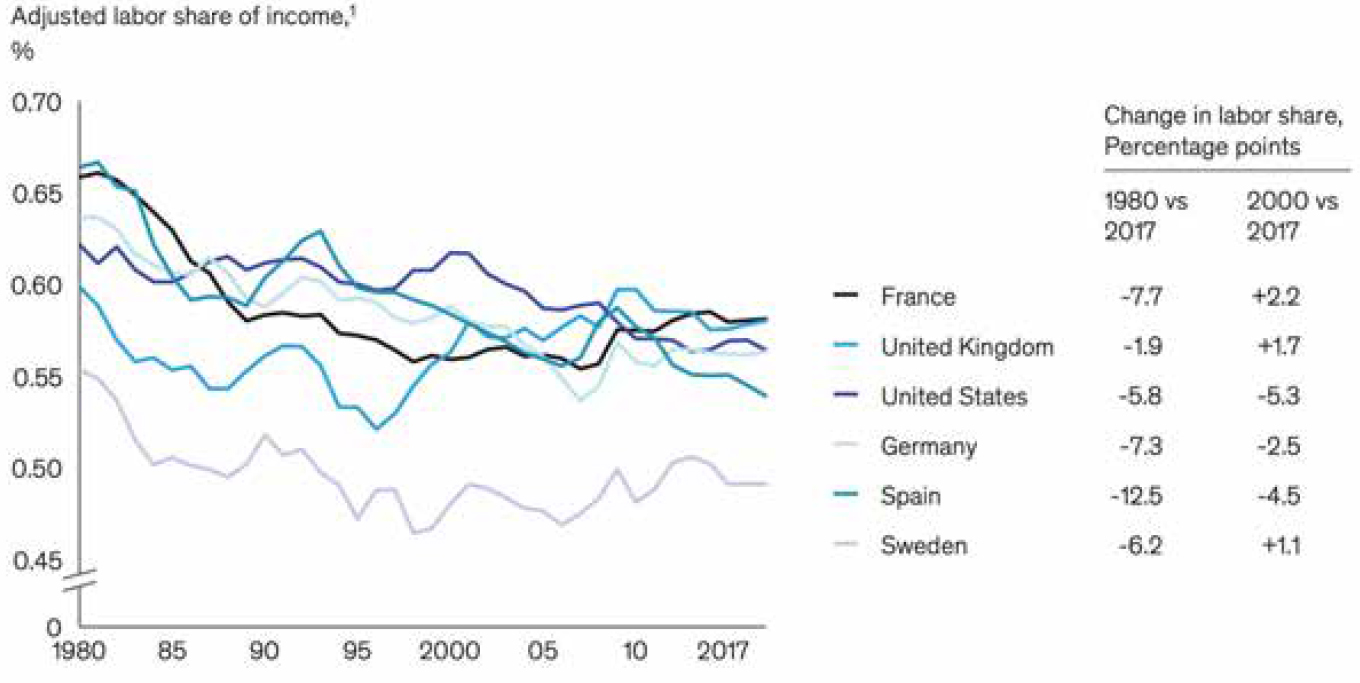
NOTES: Footnote 1 in the figure: “Adjusted labor share for total economy over GDP at market prices from AMECO, based on ratio of total compensation of employees to GDP multiplied by the ratio of total employment to the number of employees (salaried people). This helps account for income of self-employed households assuming that their wage is similar to salaried households.” AMECO is the annual macro-economic database of the European Commission’s Directorate General for Economic and Financial Affairs.
SOURCE: Exhibit 1 from J. Manyika, J. Mischke, J. Bughin, L. Woetzel, M. Krishnan, and S. Cudre, 2019, “A New Look at the Declining Labor Share of Income in the United States,” May, McKinsey Global Institute, https://www.mckinsey.com/featured-insights/employment-and-growth/a-new-look-at-the-declining-labor-share-of-income-in-the-united-states. Copyright © 2024 McKinsey & Company. All rights reserved. Reprinted by permission.
Economists have identified many factors behind the decline in the labor share of income and the decoupling of productivity growth and wage growth.122,123 These include both macroeconomic factors—such as skill or routine-biased technological change, globalization, and the decline in workers covered by collective bargaining—and micro-economic factors—such as increasing concentration in product and labor markets and growing differences in firms’ productivity, profits, and wages.124,125
___________________
122 M. Pak and C. Schwellnus, 2019, “Labour Share Developments Over the Past Two Decades: The Role of Public Policies,” OECD Economics Department Working Paper No. 1541, OECD Publishing, https://doi.org/10.1787/b21e518b-en.
123 A. De Serres and C. Schwellnus, 2018, “A General Equilibrium (LM and PM Reforms) Perspective to Inequality,” pp. 66–86 in Inequality and Structural Reforms: Methodological Concerns and Lessons from Policy, C. Astarita and G. D’Adamo, eds., European Economy Discussion Paper No. 71, European Commission.
124 C. Schwellnus, M. Pak, P.-A. Pionnier, and E. Crivellaro, 2018, “Labour Share Developments Over the Past Two Decades: The Role of Technological Progress, Globalisation and ‘Winner-Takes-Most’ Dynamics,” OECD Economics Department Working Paper No. 1503, OECD Publishing, Paris, https://doi.org/10.1787/3eb9f9ed-en.
125 L. Tyson and M. Spence, 2017, “Exploring the Effects of Technology on Income and Wealth Inequality,” pp. 170–173 in After Piketty: The Agenda for Economics and Inequality, H. Boushey, J. B. DeLong, and M. Steinbaum, eds., Harvard University Press.
The question for the future is whether the potential significant productivity gains from generative AI will be reflected in real wage gains or the decoupling of wage and productivity growth and the decline in labor’s share of national income will persist.
In the United States and other market economies, profit-motivated businesses will decide how and whether to deploy AI systems based on the incentives they face. As Daron Acemoglu and Simon Johnson have emphasized in their recent book Power and Progress: Our 1000-Year Struggle Over Technology and Prosperity, the governance of these institutions and policies can shape these incentives.126 As companies invest in AI, they must choose whether to emphasize AI to substitute for labor or to complement labor. For example, a call center can use AI technology to complement its human operators or restructure its processes so that AI technologies substitute for these operators.127 However, much of the focus among technologists, business executives, and policy makers, intentionally or unintentionally, has been to develop AI systems that mimic and thus substitute for human labor rather than complement it.128
DRIVERS, BARRIERS, AND RISKS OF ARTIFICIAL INTELLIGENCE ADOPTION
Although there is reason for optimism about the pace at which AI technology will reshape work and significantly boost productivity, there are also reasons for caution. AI adoption may not proceed as rapidly as many expect or hope. As noted above, there are eight factors that will affect the size and the timing of AI’s effect on aggregate productivity.
As discussed in the explanations of the productivity slowdown, structural changes imply headwinds to productivity growth. These include declining dynamism, rising concentration, rising market power, and rising markups of price over cost at the largest firms. Young and small firms have played an outsized role in driving the kinds of innovations that have large GDP growth effects relative to large, incumbent firms.129 The latter face the innovator’s dilemma. Major innovations can cannibalize the market for the incumbents’ current set of products. Relatedly, large incumbents have incentives to acquire young and small innovative firms to deter the adverse impact on their product
___________________
126 D. Acemoglu and S. Johnson, 2023, Power and Progress: Our 1000-Year Struggle Over Technology and Prosperity, PublicAffairs.
127 M.N. Baily, E. Brynjofsson, and A. Korinek, 2023, “Machines of Mind: The Case for an AI-Powered Productivity Boom,” Center on Regulation and Markets, Brookings Institution, May 10, https://www.brookings.edu/articles/machines-of-mind-the-case-for-an-ai-powered-productivity-boom.
128 E. Brynjolfsson, 2022, “The Turing Trap: The Promise and Peril of Human-Like Artificial Intelligence,” Daedalus 151(2):272–287.
129 U. Akcigit and W.R. Kerr, 2018, “Growth Through Heterogeneous Innovations,” Journal of Political Economy 126(4):1374–1443.
base.130 And it is large incumbents that are the most digitized firms with the highest productivity growth rates and that have the infrastructure in place for rapid adoption and deployment of new AI systems. Indeed, five major global firms and a handful of venture capital firms are currently responsible for most of the investment in AI systems. The danger that AI will drive further productivity gaps between a few large leading firms and the rest of the firms in each sector is real, along with the danger of increasing market concentration.
International research collaborations have been central to advances in AI. A potential decline in open international collaboration, motivated by national security and economic competitiveness concerns, could impact the future pace and patterns of AI innovation.
Legal, institutional, and regulatory issues also imply significant hurdles in the implementation of AI in specific sectors and applications. Although generative AI may be new, existing laws on data protection and copyright protection have significant implications for its use. AI thrives and depends on access to information, but access to medical records, legal records, and financial records is controlled by laws and regulations. More broadly, privacy and copyright restrictions are another barrier to access the data required for AI models. AI poses risks of intellectual property infringement; in the United States, courts are already looking at a variety of issues including patent and trademark infringements by AI creators and the use of unlicensed content for training data.
A 2023 survey of 443 midsize and large law firms conducted by the Thomson Reuters Institute found a clear openness to using AI tools but also caution. Firms cited concerns about the accuracy of AI, noting that they would be liable for errors and omissions, and about the confidentiality of client material that would be needed as training data for natural language models. Firms also expressed concern about nonhumans doing certain types of legal work. One survey respondent argued that attorneys “are guided by ethical rules that take heartfelt understanding that simply cannot be programmed by algorithm.”131
Antiquated software and often bespoke electronic medical record systems could slow the adoption of AI in the health care sector. The opacity of some AI systems is a barrier to trust by health care providers and could lengthen the time to adoption.132 In addition, the opaque nature could raise liability issues and challenges in determining which providers get reimbursed for which services in the course of complex patient treatment. The confidentiality of the medical records needed to train AI models is potentially a major barrier to widespread adoption.
___________________
130 C. Cunningham, F. Ederer, and S. Ma, 2021, “Killer Acquisitions,” Journal of Political Economy 129(3):649–702.
131 Thomson Reuters Institute, 2023, “ChatGPT and Generative AI Within Law Firms,” https://www.thomsonreuters.com/en-us/posts/wp-content/uploads/sites/20/2023/04/2023-Chat-GPT-Generative-AI-in-Law-Firms.pdf.
132 J. Adler-Milstein, N. Aggarwal, M. Ahmed, et al., 2022, “Meeting the Moment: Addressing Barriers and Facilitating Clinical Adoption of Artificial Intelligence in Medical Diagnosis,” NAM Perspectives, September 29.
Bespoke AI enterprise models could be a solution to confidentiality concerns among law firms and health care providers. But there are important questions related to ownership of training data, where those data are stored, and who can access them. Enterprise solutions may not be as useful given more limited training data, and the costs to firms of using enterprise solutions will be higher than using publicly available AI tools.
Liability and associated regulatory issues are also likely to be a hurdle. In the 2017 National Academies’ report on information technology, wide deployment of driverless vehicles was anticipated in the near future.133 In addition to a variety of technical challenges, that discussion did not fully appreciate the liability and in turn insurance issues associated with driverless vehicles. Such liability issues are likely to slow the implementations of AI in a variety of autonomous equipment.
Another potential obstacle that may slow the pace of adoption is consumer trust. Misinformation and disinformation—for example, deep fakes of political leaders—could increase the level of distrust of generative AI tools in general. Given the rapid advancements in AI technology, it is conceivable that the ability of AI to perform tasks—for example, heart surgery—may advance faster than consumer preferences to be serviced by a machine and not a human.
Last, there is growing concern among the public and policy makers about serious risks created by AI.134 These risks, not all of which are well understood, include risks to privacy, risks of discrimination and bias, risks of AI-powered digital addiction, risks to democracy and political stability, ethical risks, national security risks, cybersecurity risks, and risks of military arms races driven by new AI weapons.
Privacy protection can lead to both positive and negative effects on individuals and society, creating complex trade-offs that are particularly relevant in the context of AI. Privacy safeguards can protect individuals from harms, but restricting personal data flows can also impede the development and effectiveness of AI systems (which often rely heavily on large data sets for training) that would provide individuals and society with benefits. Privacy-enhancing technologies that anonymize or limit access to personal data may reduce privacy risks, but they often come at the cost of reduced AI performance in applications such as personalized recommendations and predictive analytics. The
___________________
133 National Academies of Sciences, Engineering, and Medicine, 2017, Information Technology and the U.S. Workforce: Where Are We and Where Do We Go from Here? The National Academies Press, https://doi.org/10.17226/24649.
134 A. Tong, 2023, “AI Threatens Humanity’s Future, 61% of Americans Say: Reuters/Ipsos Poll,” Reuters, May 17, https://www.reuters.com/technology/ai-threatens-humanitys-future-61-americans-say-reutersipsos-2023-05-17. The European Commission announced that “unacceptable risk AI systems are systems considered a threat to people and will be banned.” See U. von der Leyen, 2023, “State of the Union Address by President von der Leyen,” European Commission, https://ec.europa.eu/commission/presscorner/detail/ov/speech_23_4426.
challenge is thus one of striking the right balance in an array of contexts, which requires careful analysis to navigate the nuanced trade-offs in each.135
Some see more existential risks on the horizon. A recent open letter from some leading AI experts warned that “mitigating the risk of extinction from AI should be a global priority alongside other societal-scale risks such as pandemics and nuclear war.”136
Different societies will adopt different norms on some of these risks, such as privacy and other personal rights, depending on their cultural contexts and values. However, many of these risks are common to all societies. In a recent Foreign Affairs essay, Ian Bremmer and Mustafa Suleyman argue that the coming wave of technological innovation will “initiate a seismic shift in the structure and balance of global power as it threatens the status of nation-states as the world’s primary geopolitical actors.”137 They characterize AI as a global commons problem that will require a global AI governance structure.
In response to the risks posed by AI and after many other nations have jumped ahead on AI governance proposals, the Biden administration recently issued an executive order as a first step to assessing regulation for the responsible development and deployment of AI. This executive order covers a broad range of issues, leaning heavily on safety, privacy, civil liberties, and rights. Among other things, the order proposes that companies working on advanced AI systems, measured by compute performance that has not yet been achieved in existing models, be required to share their safety tests and develop safety and security standards through the National Institute of Standards and Technology. The proposed reporting requirements are mild, and the compute standard means that they are likely to affect only a few large corporations.
___________________
135 A. Acquisti, C. Taylor, and L. Wagman, 2016, “The Economics of Privacy,” Journal of Economic Literature 54(2):442–492.
136 Center for AI Safety, “Statement on AI Risk,” https://www.safe.ai/statement-on-ai-risk.
137 I. Bremmer and M. Suleyman, 2023, “The AI Power Paradox: Can States Learn to Govern Artificial Intelligence—Before It’s Too Late?” Foreign Affairs 102:26.


