Artificial Intelligence and the Future of Work (2025)
Chapter: 4 Artificial Intelligence and the Workforce
4
Artificial Intelligence and the Workforce
Despite widespread popular and academic concern that artificial intelligence (AI) and robotics are ushering in a jobless future, the industrialized world is currently awash in jobs.1 Three years after the onset of the deepest recession since the Great Depression, the U.S. unemployment rate has returned to its historically low prepandemic level of 3.5 percent, and, similarly, labor force participation and employment-to-population rates have nearly fully recovered.2 A comparable situation is unfolding across many industrialized countries. At the end of 2022, average Organisation for Economic Co-operation and Development (OECD)-wide employment and labor force participation rates were at their highest recorded levels, with half of all OECD countries exceeding previous high-water marks on both metrics.3
It is difficult to predict how unemployment rates may change in the years to come. The Congressional Budget Office projects that the U.S. population will grow at a glacial rate of 0.3 percent between 2023 and 2053, one-third the pace prevailing during the
___________________
1 On the possibility of a jobless future, see J. Rifkin, 1995, The End of Work: The Decline of the Global Labor Force and the Dawn of the Post-Market Era, GP Putnam’s Sons; M.R. Ford, 1995, The Rise of the Robots: Technology and the Threat of Mass Unemployment, Basic Books; C.B. Frey and M.A. Osborne, 2017, “The Future of Employment: How Susceptible Are Jobs to Computerisation?” Technological Forecasting and Social Change 114:254–280; D. Susskind, 2020, A World Without Work: Technology, Automation and How We Should Respond, Penguin UK; A. Korinek and M. Juelfs, 2022, “Preparing for the (Non-Existent?) Future of Work,” NBER Working Paper No. w30172, June.
2 U.S. Bureau of Labor Statistics, 2023, “BLS Employment Situation Summary, April 7, 2023,” https://www.bls.gov/news.release/empsit.nr0.htm.
3 OECD, 2023, “Labour Market Situation: OECD Employment and Labour Force Participation Rates Reach Record Highs in the Fourth Quarter of 2022, April, https://www.oecd.org/sdd/labour-stats/labour-market-situation-oecd-updated-april-2023.htm. Note that these labor force participation and employment-to-population series commenced in 2005 and 2008, respectively, so the historical comparison window is comparatively short.
prior four decades and below any sustained growth rate seen since the Census Bureau began tracking these statistics in 1900.4 This backdrop of mounting labor scarcity would seem to diminish prospects for widespread technological unemployment.
Although broad forecasts of AI’s effects on total labor demand are generated regularly by consultancies and are reported credulously by the press, such forecasts are highly speculative. An extraordinarily highly cited 2017 academic study by Frey and Osborne projected that “47% of total U.S. employment is in the high risk category” for automation, where “high probability occupations are likely to be substituted by computer capital relatively soon.”5 No such occupational apocalypse has come to pass. To take a specific example, one might have anticipated that the advent of accounting, bookkeeping, payroll, and tax preparation software over the past several decades would have eroded employment in accounting, bookkeeping, payroll, and tax preparation services. Indeed, Frey and Osborne placed the probability of computerization of each of these four categories at 97 percent or above. Instead, U.S. employment in this group of occupations grew by 19 percent in the 7 years since the publication of Frey and Osborne’s paper and doubled between 1990 and 2024 from 0.6 million to 1.2 million workers (more than twice the growth rate of overall nonfarm employment).6
A key theme of this report, and this chapter in particular, is that the most relevant concern for present and future workers is not whether AI will eliminate jobs in net but rather how it will shape the labor market value of expertise—specifically, whether it will augment the value of the skills and expertise that workers possess (or will acquire) or instead erode that value by providing cheaper machine substitutes. The most pernicious prospect that AI and robotics hold for the labor market is that they could substantially erode the value of human expertise—certainly within specific domains and perhaps more broadly. Shifts in the market value of human expertise are where the labor market effects of technical change generally, and AI specifically, may first be seen.
___________________
4 Congressional Budget Office, 2023, “The Demographic Outlook: 2023–2053,” January, www.cbo.gov/publication/58612; W.S. Frey, 2021, “U.S. Population Growth Has Nearly Flatlined, New Census Data Shows,” Brookings Institution, December, https://www.brookings.edu/research/u-s-population-growth-has-nearly-flatlined-new-census-data-shows. The United States is on a relatively favorable trajectory. The United Nations projects that most industrialized countries will commence population decline during the 21st century. And populations are already falling in multiple continental European countries as well as in Japan and China. The United Nations report states, “Whereas the populations of Australia and New Zealand, Northern Africa and Western Asia, and Oceania (excluding Australia and New Zealand) are expected to experience slower, but still positive, growth through the end of the century, the populations of Eastern and South-Eastern Asia, Central and Southern Asia, Latin America and the Caribbean, and Europe and Northern America are projected to reach their peak size and to begin to decline before 2100.” See United Nations: Department of Economic and Social Affairs, 2022, “World Population Prospects 2022,” https://www.un.org/development/desa/pd/sites/www.un.org.development.desa.pd/files/wpp2022_summary_of_results.pdf; and EuroNews with AFP, 2023, “The Countries Where Population Is Declining,” EuroNews, January 20, https://www.euronews.com/2023/01/17/the-countries-where-population-is-declining.
5 C.B. Frey and M.A. Osborne, 2017, “The Future of Employment: How Susceptible Are Jobs to Computerisation?” Technological Forecasting and Social Change 114:254–280.
6 On employment in accounting, tax preparation, bookkeeping, and payroll services, see https://fred.stlouisfed.org/graph/?g=1oMKn. On nonfarm employment, see https://fred.stlouisfed.org/graph/?g=1oMKB.
To define terms, “expertise” denotes a specific body of knowledge or competency required to accomplish a particular objective—for example, baking a loaf of bread, taking vital signs, or coding an app (Box 4-1).7 Human expertise commands a market premium to the degree that it is, first, necessary for accomplishing valuable objectives and, second, not possessed by most people. This scarcity may arise because the relevant skills are costly or time-intensive to acquire (e.g., training to become a surgeon, pilot, or cabinetmaker); certain talents are intrinsically rare (e.g., gifted athletes, musicians, or mathematicians); market conditions create temporary scarcity (e.g., surging demand for COBOL programmers during the run-up to Y2K); or legal and regulatory barriers limit the number of trained or certified workers (e.g., residency training in medical specialties such as endocrinology).
BOX 4-1 Defining Concepts Related to Expertise
The following are other related terms frequently used in discussions of technology and labor markets:
- Skill formally means the ability to do something well. Economists often use skill in a unidimensional sense: a worker is low-skilled, mid-skilled, or high-skilled. This is too simplistic, however: one can be highly skilled in carpentry and unskilled in software development, or vice versa. But making this distinction requires specifying what someone invoking the term is “skilled in,” which means specifying what expertise the worker possesses. In that case, the term “skill” adds little value, whereas the term “expertise” unambiguously refers to skill in a specific domain.
- Education and credentials are means of acquiring and certifying expertise. But expertise is often acquired through on-the-job experience and noncredentialed training, so education and credentials pertain to only a subset of the expertise that workers possess.
- Occupations provide a useful shorthand to denote broad categories of work, often conveying both specific skill sets and formal certification (e.g., attorney, master plumber). At the same time, occupational categories are not as crisp as they sometimes appear. One reason is that the set of specific duties (“tasks”) in occupations changes over time, even without any change in occupational titles. Prior to the advent of office computing, for example, secretarial duties typically included answering phones, taking shorthand, filing papers, and typing. Aside from typing, contemporary clerical workers do few of these traditional tasks, but they increasingly do complex technical and organizational tasks like expense accounting and event planning. A second reason is that the set of occupational categories evolves and expands as technologies, tastes, and demographics change. There were, for example, essentially no
___________________
7 Many dictionaries define expertise as expert skill or knowledge in a particular field—which is essentially tautological. For example, see https://www.merriam-webster.com/dictionary/expertise, where expertise is defined as “the skill of an expert.”
- software developers in the United States before the advent of commercial computing in the 1950s, yet at present there are more than 1.5 million.a Autor and colleagues estimate that the majority of current employment (more than 60 percent) is currently found in new job specialties introduced since 1940.b This chapter uses dozens of occupational examples for illustrative purposes, while recognizing that the expertise required by specific occupations is not static and that new occupations come into existence as new forms of expertise gain relevance.
- Tasks, in economic parlance, are the constituent building blocks of work: workers apply skills to accomplish tasks that produce desired outputs. A job may comprise dozens or hundreds of tasks, depending on how broadly or narrowly tasks are defined. A burgeoning economic literature uses the concept of tasks to describe the interplay between technological change, occupational structure, and skill demands.c The concepts of tasks and expertise are closely related; one can think of tasks as checklists of items to be accomplished (the “what”), while expertise is the know-how required to accomplish those items on the list (“the how”).
- Routine tasks, as used in economics literature, are physically or cognitively repetitive tasks that follow tightly scripted codifiable procedures.d For the purposes of this report, one can equate “mass expertise” with the ability to execute routine tasks. The term “expertise” is used throughout this chapter to distinguish different domains of expertise that do not map tightly to the routine/nonroutine distinction, including artisanal expertise, elite expertise, and translational expertise.
- Automation refers to technological advances that facilitate the substitution of capital for labor at a widening range of tasks or productive processes. Concretely, when a task that was formerly done by workers is delegated to machines, that task is automated.
- Augmentation is a case where a technology enables workers to work more effectively, perform higher-quality work, or accomplish previously infeasible tasks.
__________________
a See U.S. Bureau of Labor Statistics, 2023, “Occupational Employment and Wage Statistics: 15-1252 Software Developers,” https://www.bls.gov/oes/current/oes151252.htm.
b D. Autor, C.M. Chin, A. Salomons, and B. Seegmiller, 2024, “New Frontiers: The Origins and Content of New Work,” 1940–2018, Quarterly Journal of Economics 139(3):1399–1465, https://doi.org/10.1093/qje/qjae008.
c See, among other sources, D.H. Autor, F. Levy, and R.J. Murnane, 2003, “The Skill Content of Recent Technological Change: An Empirical Exploration,”The Quarterly Journal of Economics 118(4):1279–1333; F. Levy and R.J. Murnane, 2005, The New Division of Labor, Princeton University Press; D. Acemoglu and D. Autor, 2011, “Skills, Tasks and Technologies: Implications for Employment and Earnings,” pp. 1043–1171 in Handbook of Labor Economics, Vol. 4, Elsevier; and D. Acemoglu and P. Restrepo, 2019, “Automation and New Tasks: How Technology Displaces and Reinstates Labor,”Journal of Economic Perspectives 33(2):3–30.
d This terminology originates in D.H. Autor, F. Levy, and R.J. Murnane, 2003, “The Skill Content of Recent Technological Change: An Empirical Exploration,” The Quarterly Journal of Economics 118(4):1279–1333.
Much of the value of labor in industrialized economies derives from the scarcity of expertise rather than from the scarcity of workers per se. Consider, for example, the jobs of air traffic controller and crossing guard. Both make rapid-fire, life-or-death decisions to avert collisions between vehicles, passengers, and bystanders. Despite their fundamental similarities, the median annual pay of air traffic controllers in 2021 ($131,000) was more than four times the corresponding remuneration for crossing guards ($31,500). The key difference separating these jobs is expertise. In most of the United States, working as a crossing guard requires no formal training or certification. Conversely, the job of air traffic controller requires an associate’s or bachelor’s degree in air traffic control complemented by several years of on-the-job apprenticeship.8 These training requirements potentially give rise to scarcity. If an unexpectedly urgent need arose for crossing guards, most air traffic controllers could presumably fill these roles. If an urgent need for air traffic controllers arose, the reverse would not be true.9
Jobs for which mass expertise suffices—such as table-waiting, cleaning and janitorial services, manual labor, and (even) child care—tend to pay poorly, not just in the United States but in all industrialized countries.10 The low pay in these jobs does not reflect a lack of intrinsic value of the services they provide but rather the abundance of workers who are able to do this work.11
Expertise is often acquired through formal education, but the two are not synonymous. Much expertise is acquired through training and experience rather than through schooling. Many occupations in the skilled trades—electrical work, plumbing, heating and cooling, construction, manufacturing production, and so on—do not require formal education beyond post-secondary schooling but are mastered through intensive apprenticeships. Certification for many health vocations—such as dental hygienists, magnetic resonance imaging technologists, and diagnostic medical sonographers—requires an associate’s degree but not a bachelor’s degree. All of these occupations (trades workers,
___________________
8 On crossing guards, see https://www.bls.gov/ooh/about/data-for-occupations-not-covered-in-detail.htm. On air traffic controllers, see https://www.bls.gov/ooh/transportation-and-material-moving/air-traffic-controllers.htm.
9 The fact that expertise is both scarce and necessary to produce a good or service does not guarantee that this expertise will be highly rewarded. The product or service enabled by this expertise must also have significant market value (e.g., expertise in slide rule mathematics is no basis for a career). But occupations that require little expertise are poorly paid as a rule.
10 G. Mason and W. Salverda, 2010, “Low Pay, Working Conditions, and Living Standards,” pp. 35–90 in Low-Wage Work in the Wealthy World, J. Gautié and J. Schmitt, eds., Russell Sage Foundation, http://www.jstor.org/stable/10.7758/9781610446303.6.
11 That does not mean the wage will be zero; workers can choose not to work at all. But wage levels in jobs that require only generic skill sets will not depend primarily on the supply of suitably trained workers but rather on the set of alternative options available to workers with generic skills, a point that goes back to W.J. Baumol, 1967, “Macroeconomics of Unbalanced Growth: The Anatomy of Urban Crisis,” The American Economic Review 57(3):415–426. Provided that workers are necessary to perform these generic work tasks, and that consumers do not find non-labor-using substitutes for them or choose to forego these services altogether, earnings in this type of work will tend to rise with societal incomes. Thus, as Baumol observed, earnings of hair stylists, while typically low, have roughly kept pace with overall economic growth.
health technicians) are relatively well paid, reflecting the expertise they require.12 Expertise does not by itself guarantee high pay, of course; the product or service enabled by this expertise must also have significant market value. For this reason, expertise in data science is a sound basis for a wide range of careers, whereas expertise in historical baseball statistics is not.
The objective of this chapter is to assess the implications of rapid advances in AI for the nature of work and the jobs available to workers. The chapter is framed around the demand for expertise because AI is most likely to impact the labor market profoundly by reshaping this demand. The chapter addresses three central questions:
- Substitution: What expertise is likely to be substituted or made obsolete?
- Complementarity: What expertise is likely to be augmented or newly demanded?
- Transition: How feasible will it be for workers to acquire newly valuable expertise?
As is evident, none of these questions directly concern the impact of AI on aggregate employment or unemployment. However, there is ample reason to believe that AI, at least initially, will affect the value of expertise in a multitude of dimensions, and this will be consequential for worker welfare.
Although this report focuses on the United States, similar lessons likely apply to many other industrialized countries—though not necessarily to low- and middle-income countries. One topic on which this chapter will not focus is the demand for AI developers specifically—that is, people who build AI systems. Building AI systems is expert work, of course, and it is reasonable to expect there to be much more of it. But it will not be a large part of overall employment. Consider the example of software developers: Despite decades of sustained growth in investment in computer technology, slightly less than 1 percent of the U.S. workforce is currently employed in software development.13 If this fraction were to double to 2 percent, this would still comprise a smaller share of the workforce than is currently employed as fast food and counter workers.14
Before applying the expertise framework to assess the potential labor market impacts of AI, it is first used to interpret the labor market impacts of the two preceding technological revolutions: the Industrial Revolution and the computer revolution. This framing will both put AI in context with earlier technological eras and demonstrate that
___________________
12 These examples are drawn from the U.S. Bureau of Labor Statistics, 2024, “Occupational Outlook Handbook,” https://www.bls.gov/ooh.
13 As noted earlier, employment in software development was 1.53 million in May 2022 (see https://www.bls.gov/oes/current/oes151252.htm), whereas overall U.S. employment was 158.3 million in June 2022 (see Summary Table A of “News Release: The Employment Situation—July 2023,” USDL-23-1689, https://www.bls.gov/news.release/pdf/empsit.pdf).
14 U.S. Bureau of Labor Statistics, 2023, “Occupational Employment and Wage Statistics: 35-3023 Fast Food and Counter Workers,” https://www.bls.gov/oes/current/oes353023.htm.
the lens of expertise brings key elements into focus across multiple eras of economic history. The chapter begins explaining how technological change simultaneously erodes and augments demand for expertise.
Alongside highlighting these potential employment consequences, the final section of this chapter considers other nonemployment risks arising from the widespread adoption of AI including algorithmic fairness and discrimination, worker surveillance and privacy, and issues around the ownership of creative output and intellectual property.
THE ROLE OF TECHNOLOGY IN ERODING AND AUGMENTING DEMAND FOR EXPERTISE
The term “expertise” refers to capacities that reside in people. Yet, the value of expertise is often inseparable from the tools and technologies that are used by experts. For example, it is self-evident that the tools used by air traffic controllers enhance rather than erode the value of their expert knowledge: absent radar, the Global Positioning System (GPS), and two-way radios, air traffic controllers could do little more than stare at the sky. Similarly, the expertise of plumbers, electricians, and medical technicians would be less valuable—and in some cases irrelevant—absent the tools with which that expertise is applied. The principle is a general one: tools often augment the value of expertise by increasing workers’ capabilities and conserving their time.
But not all technologies augment the value of expertise; some render it superfluous. For example, the market value of taxi drivers’ exhaustive and painstakingly acquired knowledge of the streets and alleys of London was diminished when GPS-enabled ride-hailing apps made that expertise widely available through smartphones. Although there are currently as many London cabbies as ever, their earnings dropped by about 10 percent when Uber entered the market.15 Similarly, the roll-out of an AI-based taxi-routing program in Yokohama, Japan, erased the routing advantage of expert versus novice drivers, largely eliminating the value of expertise.16 In the foreseeable future, the job of air traffic control may be handled primarily by AI, potentially eroding the earnings potential of air traffic controllers. Where technology eliminates the need for human expertise, this generally yields efficiency gains and reduces costs for consumers and
___________________
15 T. Berger, C. Chen, and C.B. Frey, 2018, “Drivers of Disruption? Estimating the Uber Effect,” European Economic Review 110:197–210. Consistent with falling barriers to expertise, the number of self-employed drivers who did not have the traditional London taxi credential rose steeply.
16 K. Kanazawa, D. Kawaguchi, H. Shigeoka, and Y. Watanabe, 2022, “AI, Skill, and Productivity: The Case of Taxi Drivers,” NBER Working Paper No. w30612, National Bureau of Economic Research.
businesses. But this will in many cases lessen the earnings and employment prospects of workers whose expert skills are made less scarce.17
In reality, a stream of technological advances—from automatic transmissions to tax preparation software—continuously erodes the value of expertise by simplifying and automating formerly expert tasks. These technologies are effective: the expertise required to perform simple bookkeeping calculations, for example, was once highly coveted and handsomely remunerated but is now abundantly supplied, is heavily automated, and commands almost no skill premium.18
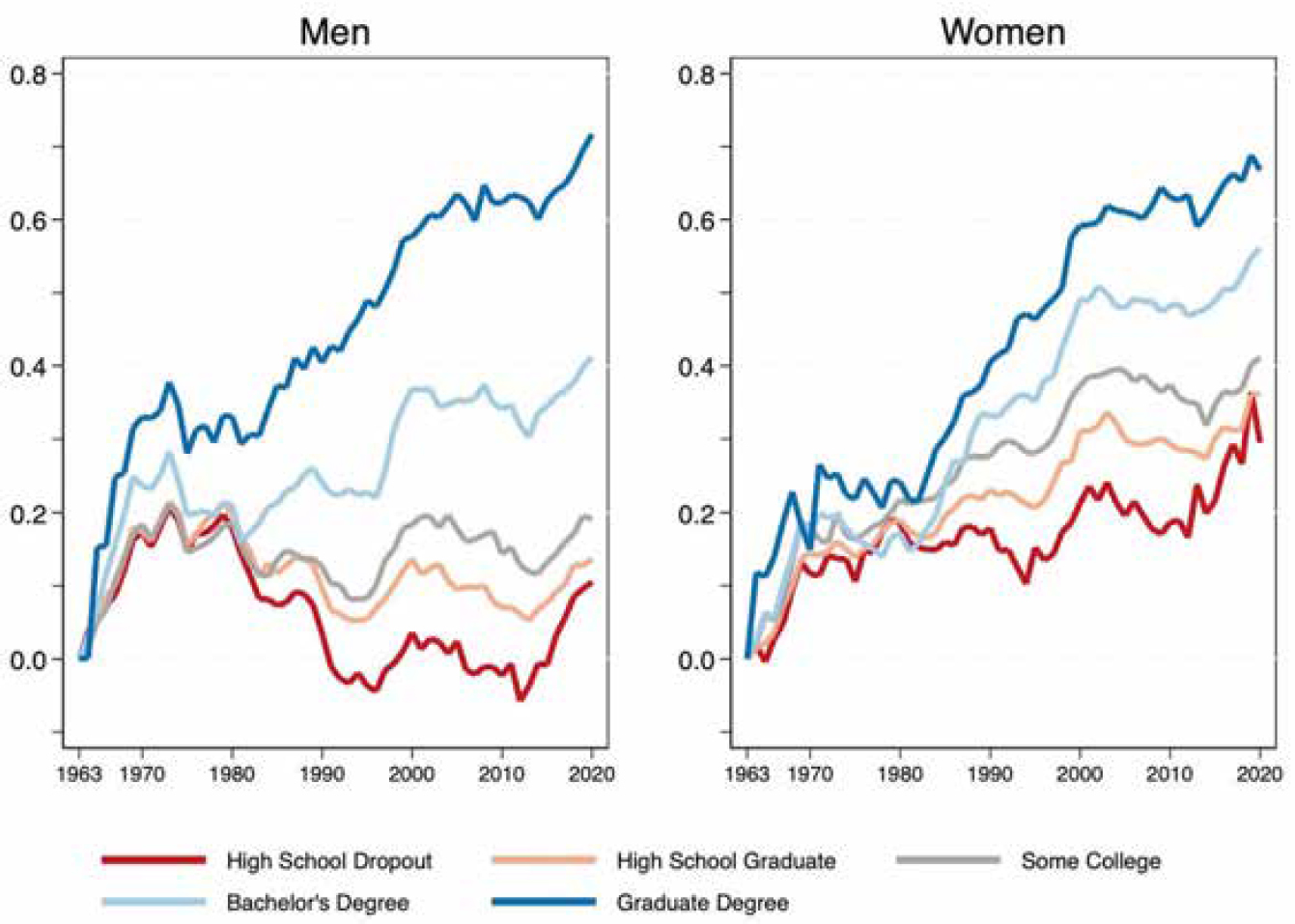
One can see this phenomenon writ large in the U.S. labor market, as shown in Figure 4-1. Despite substantial economic growth over the past four decades, real wages of noncollege workers19 (especially noncollege men) fell steeply from approximately 1980 to 2010 as these workers were displaced from skilled manufacturing and mid-level administrative jobs into generic personal service positions requiring little formal expertise.20
Yet, despite ongoing technological advances that simplify and automate formerly expert work, the return to formal skills—one form of expertise—has been rising for decades. Why has the expertise-commodifying effect of innovation not overwhelmed its augmenting effect? This extinction of expertise—or, more precisely, of its market value—would very likely occur were it not for a central countervailing force: the domain of expertise is continually expanding. Many of the most highly paid jobs in industrialized economies—oncologists, software engineers, patent lawyers, therapists, movie stars—did not exist until specific technological or social innovations created a need for them. Prior to the era of air transport, for example, there was neither a market demand for nor supply of air traffic controller skills. Less than 1 year ago, the job of “prompt engineering”—crafting text queries for chatbots that produce optimal outputs—was essentially nonexistent. It is now in high demand.21
Very few occupations are entirely eliminated by automation (though the occupation of elevator operator serves as the exception that proves the rule).22 But some
___________________
17 R.E. Susskind and D. Susskind, 2015, The Future of the Professions: How Technology Will Transform the Work of Human Experts, Oxford University Press.
18 C. Goldin and L.F. Katz, 1995, “The Decline of Non-Competing Groups: Changes in the Premium to Education, 1890 to 1940,” NBER Working Paper No. 5202.
19 That is, workers with less than a bachelor’s degree.
20 Only in the past decade have earnings of noncollege men regained most of the ground that they lost after 1980. Real earnings declines were, fortunately, shallower and not as enduring among noncollege women. See D. Autor and D. Dorn, 2013, “The Growth of Low-Skill Service Jobs and the Polarization of the U.S. Labor Market,” American Economic Review 103(5):1553–1597; D. Autor, 2019, “Work of the Past, Work of the Future,” AEA Papers and Proceedings 109:1–32; and D. Acemoglu and P. Restrepo, 2022, “Tasks, Automation, and the Rise in U.S. Wage Inequality,” Econometrica 90(5):1973–2016.
21 A. Mok, 2023, “‘Prompt Engineering’ Is One of the Hottest Jobs in Generative AI. Here’s How It Works,” Business Insider, March 1, https://www.businessinsider.com/prompt-engineering-ai-chatgpt-jobs-explained-2023-3; and Wikipedia, 2023, “Prompt Engineer,” Wikimedia Foundation, March 10, https://en.wikipedia.org/wiki/Prompt_engineering.
22 Only one occupation has been fully automated in the post-war period—elevator operators. See E. Bessen, 2016, “How Computer Automation Affects Occupations: Technology, Jobs, and Skills,” Boston University School of Law, Law and Economics Research Paper No. 15-49, October 3, http://dx.doi.org/10.2139/ssrn.2690435.
SOURCE: D. Autor, 2019, “Work of the Past, Work of the Future,” AEA Papers and Proceedings 109:1–32, https://doi.org/10.1257/pandp.20191110. Copyright American Economic Association; reproduced with permission of the AEA Papers and Proceedings.
occupations shrink to near insignificance in the face of technological shifts, and those that remain may be distinct from what preceded them. Between 1920 and 1940, automation of the switchboard operator occupation, one of the most common occupations for American women, resulted in significant displacement, with a small remaining core of operators who performed high-level services.23 In the metropolitan areas where these job contractions were concentrated, however, these losses were offset by employment growth in middle-skill clerical jobs and lower-skill service jobs, including new categories of work—jobs that employed workers of similar demographic characteristics to those who worked as switchboard operators in the prior generation.
These examples may be familiar, but the point is general. The creation of demand for new expertise is a critical force that counterbalances the tendency of
___________________
23 J. Feigenbaum and D.P. Gross, 2024, “Answering the Call of Automation: How the Labor Market Adjusted to Mechanizing Telephone Operation,” The Quarterly Journal of Economics 139(3):1879–1939.
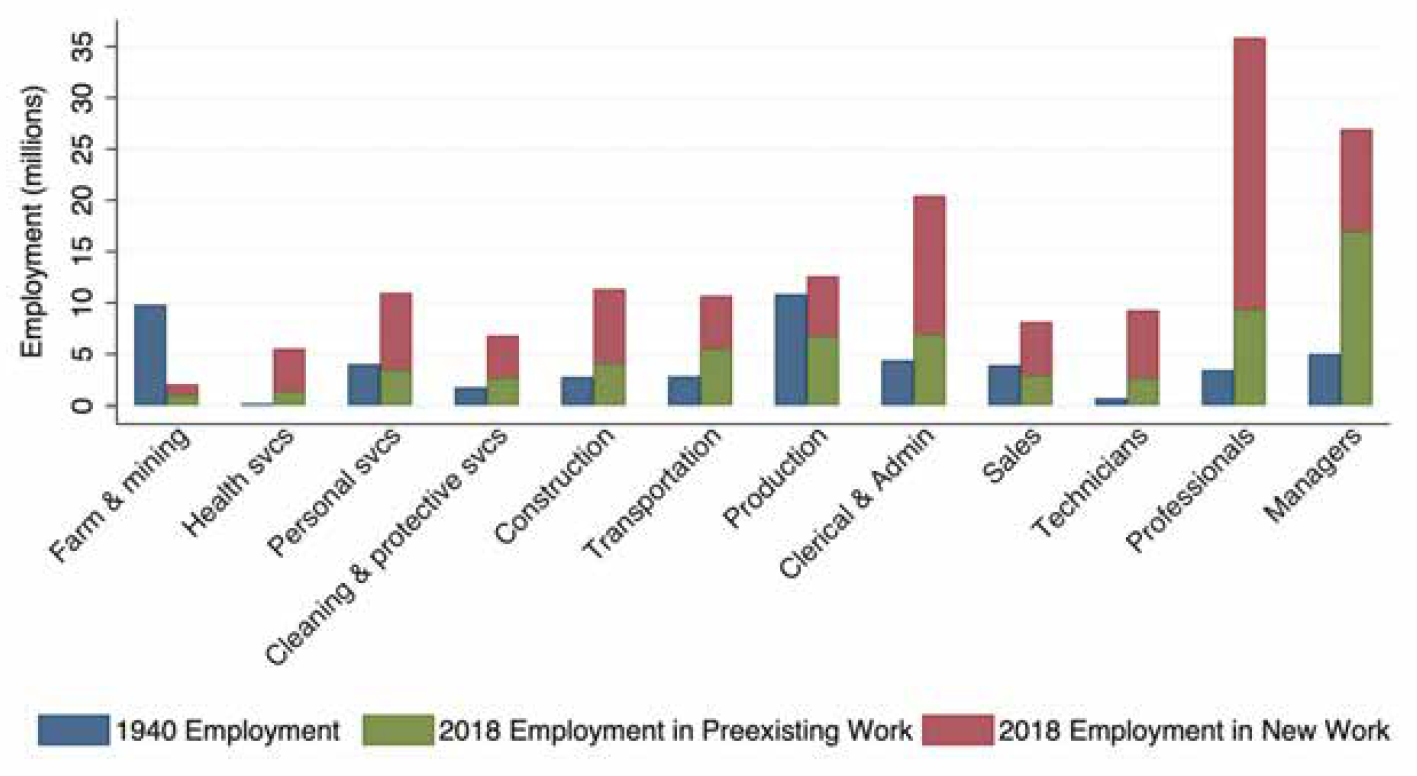
automation to erode the value of old expertise.24 Figure 4-2 documents that more than half (60 percent) of the job activities that U.S. workers performed in 2018 were not present—had not yet been invented—as of 1940. What makes work “new” is that it requires expertise that was not previously in demand or perhaps did not exist (e.g., pediatric oncology, AI prompt engineering, or pneumatic hammering). Human expertise has remained valuable not because it is timeless but because it is continually changing. The force of innovation has been central to this replenishment. But this is not the only force: rising wealth, changing demographics, and changing tastes also play central roles.25
Both automation of traditional work and new task creation occur simultaneously, but there is no reason to assume that these forces exactly offset one another. For much of the 20th century, these forces were in rough balance—new technologies not only displaced existing tasks but also complemented humans, generating new tasks and enabling humans to perform higher-quality work. This balance underpinned the period’s wage and employment growth and shared prosperity.
Sometime after approximately 1970, for reasons that are not well understood, this balance was lost. Automation maintained its pace or even accelerated over the following decades, but new task creation slowed, especially for those workers without 4-year degrees.26 Computerization displaced noncollege workers from factories and offices, and blue-collar workers were displaced by import competition.27 Although employment is rising in health and skilled personal service occupations that may ultimately constitute a “new middle,” this growth has not yet fully offset the loss of equivalently well-paid traditional middle-skill jobs, particularly among noncollege males.28 Non-college-educated workers increasingly have taken shelter in low-paid service sector jobs such as food service, security, cleaning, and entertainment. Their work is socially valuable, as above,
___________________
24 D. Acemoglu and P. Restrepo, 2018, “The Race Between Man and Machine: Implications of Technology for Growth, Factor Shares, and Employment,” American Economic Review 108(6):1488–1542; and D. Autor, C. Chin, A.M. Salomons, and B. Seegmiller, 2022, “New Frontiers: The Origins and Content of New Work, 1940–2018,” NBER Working Paper No. 30389, August.
25 D. Autor, C. Chin, A.M. Salomons, and B. Seegmiller, 2022, “New Frontiers: The Origins and Content of New Work, 1940–2018,” NBER Working Paper No. 30389, August.
26 D. Acemoglu and P. Restrepo, 2019, “Automation and New Tasks: How Technology Displaces and Reinstates Labor,” Journal of Economic Perspectives 33(2):3–30; D. Autor, C.M. Chin, A. Salomons, and B. Seegmiller, 2022, “New Frontiers: The Origins and Content of New Work, 1940–2018,” NBER Working Paper No. w30389, August; and D. Acemoglu and S. Johnson, 2023, Power and Progress: Our 1000-Year Struggle Over Technology and Prosperity, PublicAffairs.
27 D.H. Autor, D. Dorn, and G.H. Hanson, 2013, “The China Syndrome: Local Labor Market Effects of Import Competition in the United States,” American Economic Review 103(6):2121–2168.
28 Examples of this new middle include “sales representatives, truck drivers, managers of personal service workers, heating and air conditioning mechanics and installers, computer support specialists, self-enrichment education teachers, event planners, health technologists and technicians, massage therapists, social workers, marriage and family counselors, audiovisual technicians, paralegals, healthcare social workers, chefs and head cooks, and food service managers.” See M.R. Strain, 2020, “The Middle Class Is Changing, Not Dying.” Discourse, April 20, https://www.discoursemagazine.com/p/the-middle-class-is-changing-not-dying.
SOURCE: D. Autor, C.M. Chin, A. Salomons, and B. Seegmiller, 2024, “New Frontiers: The Origins and Content of New Work, 1940–2018,” Quarterly Journal of Economics 139(3):1399–1465, https://doi.org/10.1093/qje/qjae008.
but because the positions require little in the way of specialized education, training, or expertise, they pay poorly.29
This expertise framework helps shed light on the following key questions:
- Is AI likely to raise wages or lower them, and for whom?
- Will AI further expand wage inequality or potentially reduce it?
- Will AI make worker expertise more valuable, or will it make it less necessary?
- What types of expertise are likely to be displaced by AI automation, and what types of expertise are likely to be made more valuable?
Before turning to AI, it is instructive to consider two prior technological revolutions: the Industrial Revolution and the computer revolution.
Table 4-1 provides an overview of the impact of each of these eras on the demand for expertise, and Table 4-2 provides a rubric for different types of expertise.
___________________
29 D. Acemoglu, D. Autor, and S Johnson, 2023, “Can We Have Pro-Worker AI? Choosing a Path of Machines in Service of Minds,” MIT Shaping the Future of Work Initiative Policy Memo, September 19, https://shapingwork.mit.edu/wp-content/uploads/2023/09/Pro-Worker-AI-Policy-Memo.pdf.
TABLE 4-1 Impacts of Three Technological Eras on the Demand for Expertise
| Expertise Substituted/Made Obsolete | Expertise Augmented/Newly Demanded | Ease of Acquiring Needed Expertise | |
|---|---|---|---|
| Industrial era | Artisanal expertise (e.g., weaving, shoemaking, clock-making). | Mass expertise. Learning rules and mastering tools for manufacturing/production and office/information tasks (“accomplishing routine tasks”). |
Literacy and numeracy needed. Owing to high school movement, workers well prepared to acquire industrial era mass expertise. |
| Information era | Mass expertise. Expertise in learning rules and mastering tools (i.e., carrying out routine tasks). | Elite expertise. Combining expert knowledge with acquired judgment to make high-stakes decisions in nonstandard cases. Needed for abstract decision making, communications, and management. Elite expertise becomes the bottleneck when routine tasks are automated. |
Often requires a college degree or significant post-secondary education plus years of hands-on supervised practice or apprenticeship (e.g., medical doctor, pilot). Less than one-third of workers qualified. |
| Artificial intelligence era | May substitute for some “elite expertise”—making it less scarce. | Translational expertise. Combining expert judgment with inputs and guidance from artificial intelligence to carry out “elite expert” tasks. |
May require foundational training in subject expertise (e.g., law, medicine) plus acquired judgment without necessarily requiring professional levels of post-secondary education. |
TABLE 4-2 Types of Expertise: A Rubric
| Definition | Educational Requirements | Representative Occupations | |
|---|---|---|---|
| Artisanal expertise | Mastery of full sequence of steps for producing a product. | Apprenticeship | Blacksmith, wheelwright, clockmaker |
| Mass expertise | Executing precise rules-based tasks (routine tasks) in production or office environments. Learning rules, mastering tools. | Typically, high school education and on-the-job training/experience | Production worker, machinist, typist, bookkeeper |
| Elite expertise | Combining formal training with acquired judgment to make high-stakes decisions (nonroutine cognitive tasks). | Often 4-year college degree plus graduate or professional degree | Medical doctor, lawyer, scientist, engineer, nurse, architect |
| Translational expertise | Combining foundational technical knowledge with supporting tools to accomplish high-stakes tasks. | Likely post-secondary vocational training that may not require a 4-year degree | Nurse practitioner, tradesperson, construction contractor |
DEMAND FOR EXPERTISE IN THE INDUSTRIAL REVOLUTION
Although the Industrial Revolution is a monumentally broad topic, the discussion here will summarize its implications for work in the simplest possible terms. Prior to the Industrial Revolution, there was no concept of mass production. Most goods were handmade one at a time by skilled craftspeople (artisans). No two instances of the same item—be it a horseshoe, a wagon wheel, or a work boot—were identical. Artisanal work was generally expertise-intensive. The artisan was responsible for producing the complete product, not simply for accomplishing a few steps along the way.
This changed in the 18th and 19th centuries as industries mastered a new form of work organization that became known as mass production.30 Mass production involved breaking the complex work of artisans into discreet, self-contained, and often quite simple steps that could be carried out mechanistically by a team of production workers, often abetted by machinery and overseen by managers.31 As a case in point, the Ford Motor Company’s River Rouge production plant, an archetype of mass production, employed more than 100,000 workers at its peak.32
The transition from artisanal to mass production profoundly changed the demand for worker expertise—what expertise was needed, who supplied it, and what wages it commanded. Most directly, mass production reduced demand for artisanal labor by providing a faster, cheaper production system that combined high-tech machinery, managerial expertise, and vast numbers of comparatively unskilled workers.33 Although the skilled British weavers and textile workers who rose up in protest against mechanization in the 19th century—the eponymous Luddites—are frequently derided for their naive fear of technology, these fears were not misplaced. As the economic historian Joel Mokyr and colleagues wrote in 2015, “The handloom weavers and frame knitters with their little workshops were quite rapidly wiped out by factories after 1815.”34
But mass production did not merely displace existing expertise. It created enormous demand for new forms of expertise. Initially, this demand was most concentrated on uneducated, untrained workers who could perform repetitive production steps. Whereas skilled artisans were almost necessarily adults—reflecting the years of
___________________
30 D. Hounshell, 1984, From the American System to Mass Production, 1800–1932: The Development of Manufacturing Technology in the United States, No. 4, Johns Hopkins University Press.
31 For detailed examples, see J. Atack, R.A. Margo, and P.W. Rhode, 2019, “Automation of Manufacturing in the Late Nineteenth Century: The Hand and Machine Labor Study,” Journal of Economic Perspectives 33(2):51–70.
32 Ford Motor Company, n.d., “Company Timeline: 1917,” https://corporate.ford.com/about/history/company-timeline.html.
33 C. Goldin and L.F. Katz, 1998, “The Origins of Technology-Skill Complementarity,” The Quarterly Journal of Economics 113(3):693–732.
34 J. Mokyr, C. Vickers, and N.L. Ziebarth, 2015, “The History of Technological Anxiety and the Future of Economic Growth: Is This Time Different?” Journal of Economic Perspectives 29(3):31–50. Mokyr and colleagues were in turn drawing on D. Bythell, 1969, The Handloom Weavers: A Study in the English Cotton Industry During the Industrial Revolution, Cambridge University Press.
apprenticeship required to master their trades—early factories made abundant use of children and unmarried women. Conditions in early factories were often grueling, dangerous, and exhausting. And the only essential capacities needed were physical dexterity and willingness to work (or inability to not work) under punishing conditions, often for extremely low pay.35
But these initial abysmal conditions improved in the early 20th century as a consequence of three powerful undercurrents. First, the enormous productivity gains stemming from the Industrial Revolution generated vast wealth while reducing the cost of everyday products, leading to a surge in demand. Households could for the first time afford luxuries such as full wardrobes, factory-made household goods, and new industrial products, including electric toasters and irons. The rapid expansion of industrial activity created new demand for labor and bid up wages. Rising incomes in turn enabled a change of norms, spurring laws restricting child labor and mitigating dangerous working conditions. This further promoted rising living standards.
Second, and as important, while early factory work required little skill or training, as new products and new production techniques emerged, workers operating and maintaining complex equipment needed expertise and training to carry out their work, such as skills in machining, fitting, welding, chemical processes, textiles, dyeing, calibrating precision instruments, and so on.36 The growing need for expertise was not limited to production workers. The demand for educated and highly trained workers rose across the board in maintenance, engineering, production infrastructure, product design, logistics, accounting, communications, sales, and management to coordinate these many sophisticated parts. Whereas mass production was initially expertise-displacing, relying primarily on cadres of untrained workers accomplishing rote tasks under brutal conditions, it ultimately generated demand for mass expertise. Workers increasingly required experience, training, and formal knowledge to master and manage sophisticated tools and valuable materials in a complex environment.37 In a phrase, workers needed to master tools and follow rules. (In contemporary economic parlance, many of these rule- and-tool activities would be classified as “routine tasks.” Similarly, mass expertise could be defined as the skill to carry out routine tasks in production and office environments.)
Ultimately, although the rise of mass production eclipsed a substantial stock of artisanal expertise, the demand for new expertise that it generated proved vastly larger than these displacement effects. Much of the expertise required was novel. There had
___________________
35 In Britain, textile workers were often orphans who were placed in indentured servitude to the mill, which provided food and boarding and, perhaps, education until the children were released at age 18.
36 Of course, the design and integration of early industrial era tools and factories required mechanical expertise that was exceedingly rare in the late 18th and early 19th centuries. See M. Kelly, J. Mokyr, and C.Ó. Gráda, 2023, “The Mechanics of the Industrial Revolution,” Journal of Political Economy 131(1):59–94.
37 C. Goldin and L.F. Katz, 1998, “The Origins of Technology-Skill Complementarity,” The Quarterly Journal of Economics 113(3):693–732.
been no demand for electricians until electricity found industrial and consumer uses. There were no skilled machinists prior to the invention of the machines that they operated. And there were no production engineers prior to the rise of mass production. In short, much of the expertise made valuable by the era of mass production was not required and did not exist before changes in technology and work organization made that expertise essential for delivering goods and services. The new ideas, institutions, and technologies of the Industrial Revolution thus spurred a vast expansion of the breadth and depth of expertise required of workers.
Third, the Industrial Revolution did not simply change industry. It fundamentally reshaped the basket of goods and services produced and consumed by citizens of industrializing countries. Even at the height of U.S. industrial activity in the early 1950s, less than 40 percent of employment was in industry (i.e., manufacturing, mining, and utilities) and only about 10 percent was in agriculture.38 The remainder was in services, a residual sector that encompasses everything from education to finance, insurance, real estate, business services, health care, food and hospitality, transportation, power generation, and travel (among other examples). Services comprised only one-third of employment in 1900 but encompassed more than half by 1950 and nearly four-fifths by 2020. The growth of services also generated vast new demands for labor and accompanying demands for new expertise. Many of these services were not themselves a direct product of the Industrial Revolution. But the transformative economic growth stemming from the Industrial Revolution allowed countries to focus their resources on these service activities, many of which would be considered nonessential in a poorer society. For example, while it would be a stretch to claim that the advent of mass production created the movie industry, neither the technology for producing and projecting movies nor the mass market consumer audience that was willing and able to pay for them would have been conceivable absent the rise in living standards that mass production afforded.39
This section thus far has addressed two of the three questions posed at the beginning of this chapter: What expertise was replaced (artisanal expertise), and what expertise was newly demanded by the Industrial Revolution (mass expertise)? The answer to the third question—relating to the feasibility of acquiring newly required expertise—is crucial to understanding why the Industrial Revolution created so much mass prosperity. Much of the expert work created in the industrial era demanded specific training and experience. Yet, workers typically needed no more than a high school education to enter these specialties. This fact was critically important because during the early 20th century,
___________________
38 L. Johnston, 2012, “The Growth of the Service Sector in Historical Perspective: Explaining Trends in US Sectoral Output and Employment, 1840–1990,” unpublished manuscript, College of Saint Benedict, Saint John’s University.
39 Clark makes the case that demand for services rises relative to demand for goods as societies get wealthier. See C. Clark, 1957, The Conditions of Economic Progress, London, Macmillan.
most of the United States moved to institute universal, publicly funded secondary school education.40 A large and growing fraction of U.S. adults was therefore equipped with the foundational formal skills needed to enter the expert occupations that were on the rise. To be clear, a high school education did not guarantee entry into the middle class, nor did high school–educated workers earn as much as those with college or post-college degrees. Moreover, discrimination against minorities and women denied a large fraction of the population access to these opportunities.41 But the excellence of U.S. public education in this era enabled a significant portion of the U.S. workforce—those who were not the targets of systemic discrimination—to make a successful transition into 20th century industry and services. Absent that educational foundation, it is unlikely that the United States would have reaped the same rapid, broadly shared income growth in the ensuing decades.42
DEMAND FOR EXPERTISE IN THE COMPUTER ERA BEFORE ARTIFICIAL INTELLIGENCE
Stemming from the innovations pioneered during World War II, the computer era reshaped this mass expertise trajectory. Like other general-purpose technologies that preceded it (e.g., electricity, the steam engine), the digital computer was highly applicable to a vast number of products, processes, and workplace settings. Relative to all technologies that had preceded it, however, the computer’s unique power was its ability to execute cognitive and manual tasks cheaply, reliably, and rapidly that were encoded in explicit, deterministic rules—that is, programs. This might seem prosaic: Do all machines not simply follow deterministic rules? At one level, yes. Machines do what they are built to do unless they are malfunctioning. But at another level, no. Distinct from prior machines, computers are symbolic processors that access, analyze, and act upon abstract information.43 Prior to the computer era, there was essentially only one tool for processing abstract information: the human mind. And not just any mind would do. Often, literacy and numeracy were required.
___________________
40 C. Goldin and L.F. Katz, 2009, The Race Between Education and Technology, Harvard University Press.
41 D. Autor, C. Goldin, and L.F. Katz, 2020, “Extending the Race Between Education and Technology,” AEA Papers and Proceedings 110:347–351.
42 Between 1947 and 1973, the rate of real mean family income growth was roughly identical across all five quintiles of the U.S. household income distribution, as well as among the top 5 percent of households. After 1973, this pattern skewed radically, with almost all income growth occurring among the top 40 percent, and especially the top 20 percent and 10 percent, of the income distribution. See C. Goldin and L.F. Katz, 2007, “Long-Run Changes in the Wage Structure: Narrowing, Widening, Polarizing,” Brookings Papers on Economic Activity 38:135–168. However, income levels, wealth, and access to opportunity differed radically between Black and White Americans owing to both historical and contemporary discrimination.
43 E. Brynjolfsson and L.M. Hitt, 2000, “Beyond Computation: Information Technology, Organizational Transformation and Business Performance,” Journal of Economic Perspectives 14(4):23–48.
The widespread adoption of powerful, inexpensive machines that could perform symbolic processing led to a seismic shift in the expertise demanded of workers. To understand how this worked, it is useful to conceptualize a job as performing a series of tasks required to accomplish a specific goal. Consider the tasks involved in writing a research report—such as assembling and managing a research team; collecting data; developing and testing hypotheses; performing calculations; drafting, editing, and proofreading; and distributing the report to readers. Before computers, most research and writing tasks would have been accomplished manually, aided by books, adding machines, typewriters, and postal mail. Human expertise would have been critical in such tasks as leading research teams, interpreting data, developing and testing hypotheses, calculating quantitative implications, and report writing.44
Computerization enabled the reassignment of a crucial set of tasks from humans to machines—in the above example, organizing data, performing calculations, proofreading text for misspellings, and distributing results. Now computers accomplish a well-delineated subset of tasks—that is, precise replicable steps that can be specified fully in advance. These are what economists typically refer to as “routine tasks” and what coders refer to as “programs.”45 Because a computer programmer must specify the sequence of steps required to accomplish a task before a computer can execute it, routine tasks are well suited to computerization. The cost of executing these programmed instructions has fallen dramatically. A 2007 paper by William Nordhaus estimated that the cost of performing a given computational task has fallen at least 1.7 trillion-fold since the predawn of the computer age, with most of that decline occurring since 1980.46
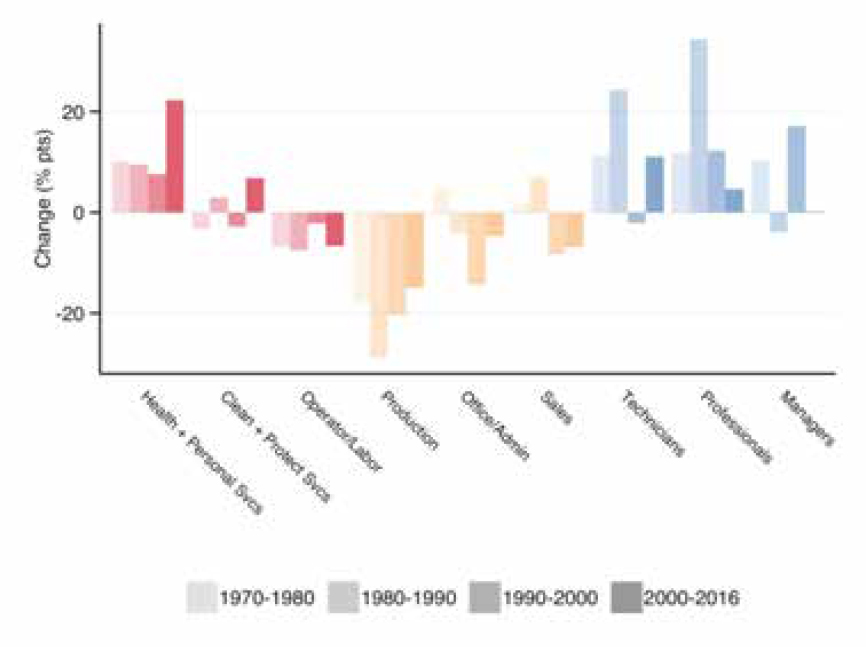
The spectacular fall in the cost of computing—accompanied by stunning improvements in speed and miniaturization—created powerful economic incentives for firms to use machines rather than workers to perform routine job tasks. This was a major step forward for productivity. But it was a mixed blessing for many workers because, in many instances, computers proved more proficient and far less expensive than workers in mastering tools and following rules. In the precomputer era, workers who specialized in skilled office and production tasks were the embodiment of the “mass expertise” of the industrial era. As computing advanced, it eroded the value of that mass expertise by displacing some of the core routine tasks that these workers performed. This catalyzed a contraction in the share of employment found in middle-skill production, office,
___________________
44 D. Autor, K. Basu, Z. Qureshi, and D. Rodrik, 2022, “An Inclusive Future? Technology, New Dynamics, and Policy Challenges,” Brookings Institution’s Global Forum on Democracy and Technology, May 31, https://www.brookings.edu/articles/an-inclusive-future-technology-new-dynamics-and-policy-challenges.
45 D.H. Autor, F. Levy, and R.J. Murnane, 2003, “The Skill Content of Recent Technological Change: An Empirical Exploration,” The Quarterly Journal of Economics 118(4):1279–1333; F. Levy and R.J. Murnane, 2005, The New Division of Labor, Princeton University Press.
46 W.D. Nordhaus, 2007, “Two Centuries of Productivity Growth in Computing,” The Journal of Economic History 67(1):128–159.
administrative, and sales occupations (Figure 4-3).47 The routine tasks once supplied by these workers were still needed—in fact, such tasks were used ever more intensively as their cost fell—but they were now performed by machines.
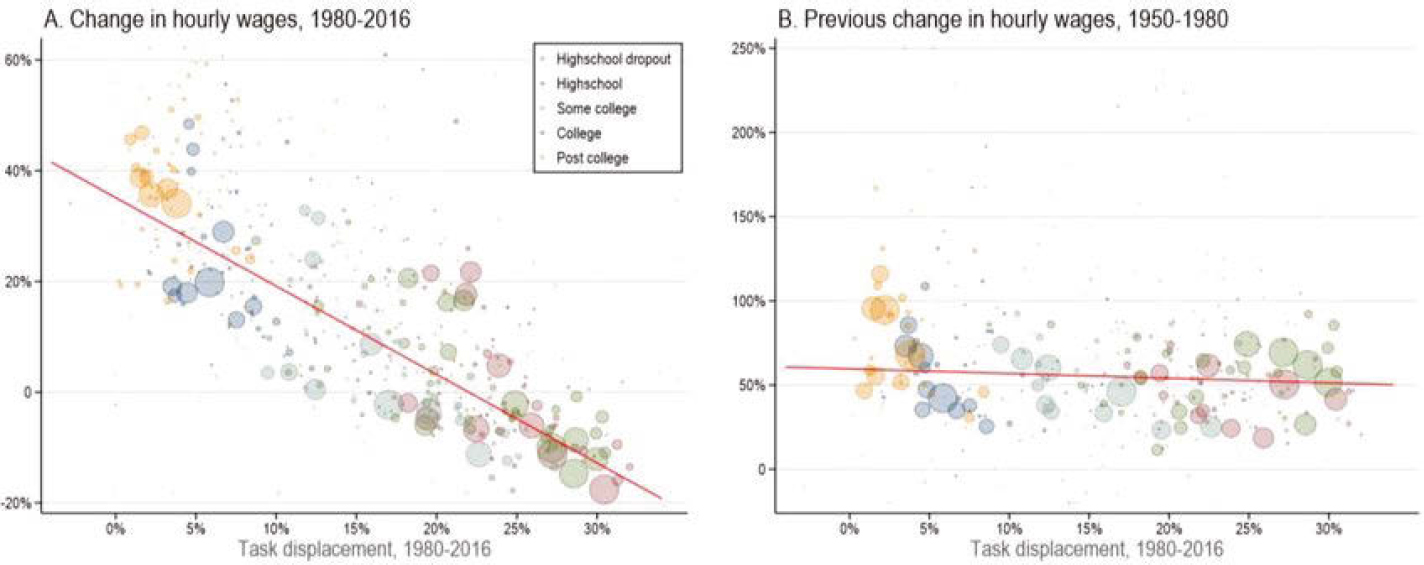
The wage consequences of routine task displacement were stark. Workers whose industries and occupations were most exposed to the automation of routine tasks saw sharp falls in their real earnings from 1980 forward, as shown in Panel A of Figure 4-4. Those most affected were disproportionately workers with a high school education but no post-secondary schooling, a group that—not by coincidence—fared extremely poorly overall during the past four decades (see Figure 4-1). Notably, this downward-sloping relationship between routine task–exposure and wage declines was absent before 1980, prior to the advent of large-scale commercial computerization (Figure 4-4, Panel B). This adds to the case that it was computerization specifically—not some other force—that depressed the earnings of workers who were specialized in routine task–intensive jobs. Computerization was therefore a critical force (though not the only factor) in the displacement and devaluation of the “mass expertise” that the industrial era had robustly demanded.
Not all tasks are, however, suited to computer execution. Many critical tasks follow rules and procedures that are known neither to computer programmers nor to the people who regularly perform them. The scientist and philosopher Michael Polanyi observed in 1966 that “we know more than we can tell,” meaning that people’s tacit knowledge often exceeds their explicit formal understanding.48 Making a persuasive argument, telling a joke, riding a bicycle, or recognizing an adult’s face in a baby photograph are subtle and complex undertakings that people seemingly accomplish with little effort without ever understanding precisely how. Mastery of these so-called “nonroutine” tasks is attained not through formal education (i.e., by learning the rules) but instead by learning-by-doing. A child learning to ride a bicycle does not need to study the physics of gyroscopes. But for a computer to control a motorized bicycle, a programmer would (in the pre-AI era) need to specify all the relevant instructions in advance. This observation—that human beings instinctively understand and perform many tasks, yet they cannot articulate the specific rules or procedures involved—is often referred to as Polanyi’s paradox.49
The capacity of computers to execute routine tasks with unprecedented speed at minimal cost proved highly complementary to managerial, professional, and technical
___________________
47 Similar evidence for European Union countries is found in M. Goos, A. Manning, and A. Salomons, 2014, “Explaining Job Polarization: Routine-Biased Technological Change and Offshoring,” American Economic Review 104(8):2509–2526.
48 M. Polanyi, 1966, The Tacit Dimension, University of Chicago Press.
49 D. Autor, 2014, “Polanyi’s Paradox and the Shape of Employment Growth,” Proceedings of the Federal Reserve Bank of Kansas City, Jackson Hole Economic Policy Symposium, August.
SOURCE: D. Autor, 2019, “Work of the Past, Work of the Future,” AEA Papers and Proceedings 109:1–32, https://doi.org/10.1257/pandp.20191110. Copyright American Economic Association; reproduced with permission of the AEA Papers and Proceedings.
SOURCE: D. Acemoglu and P. Restrepo, 2022, “Tasks, Automation, and the Rise in U.S. Wage Inequality,” Econometrica 90(5):1973–2016, https://doi.org/10.3982/ECTA19815. CC BY-NC-ND 4.0 DEED.
workers—whose work is concentrated in nonroutine abstract and interpersonal tasks.50 This complementarity arises because professional workers regularly make high-stakes decisions that are tailored to specific circumstances—for example, diagnosing a patient, crafting a legal brief, leading a team or organization, designing a building, or engineering a software product. For such tasks, knowing the rules is necessary but not sufficient; professionals must combine domain-specific knowledge with judgment and creativity to devise appropriate responses to novel problems. The discussion here refers to this as “elite expertise”: the technical knowledge and acquired judgment needed to make high-stakes, one-off decisions. Computerization complements elite expertise by enabling professionals to spend less of their time acquiring information and conducting routine analysis and more of their time interpreting and applying that information. It thus augments the accuracy, productivity, and thoroughness of professional decision making, rendering professional expertise more valuable. It is therefore no coincidence that the earnings of workers with 4-year and especially graduate degrees (in law, medicine, science, engineering, design, and management) rose steeply as computerization advanced.
These advances in routine task execution came at a cost to others. Computerization augmented the value of elite expertise in part by automating away the mass expertise of the workers on whom professionals used to rely. This created inequality in opportunity because entry into the professions is expensive, requiring both high levels of formal education—often in the form of graduate degrees and professional credentials—and significant time spent in training—for example, medical residencies, postdoctoral fellowships, junior status in law or academia, management of small organizations, and so on. In the era of mass production, the advancing high school movement dovetailed with the skill demands of the industrializing economy, so the supply of high school–educated workers kept pace with the rapidly rising demand. To use the terminology of Goldin and Katz, in the “race between education and technology” in the early decades of the 20th century, education decidedly won that heat.51 But there was no corresponding college movement on the scale of the high school movement to meet the rising demands for elite expertise in the computer era. Instead, the rising demand for elite expertise in this period contributed to rising inequality, with earnings growth concentrated among the educated elite.
Not all nonroutine tasks require elite expertise, however. Some tasks—such as cleaning rooms, waiting tables, picking items in a warehouse, driving a vehicle in city traffic, or assisting elderly people with daily living—rely on dexterity, simple
___________________
50 On the value of social skills, see D.J. Deming, 2017, “The Growing Importance of Social Skills in the Labor Market,” The Quarterly Journal of Economics 132(4):1593–1640.
51 For a deep historical account, see C. Goldin and L.F. Katz, 2009, The Race Between Education and Technology, Harvard University Press.
communication, and common sense.52 Because these nonroutine manual (or “service”) tasks draw on substantial reservoirs of tacit knowledge, they have proved stubbornly difficult to automate. Yet, because the vast majority of workers can master these tasks with modest training, the workers performing service tasks typically earn low wages.
Computerization did not improve this situation. Although computerization neither automates the central tasks of nonroutine manual work nor strongly augments the workers doing these tasks, it substantially affected this work indirectly—in many cases not positively. As the automation of routine tasks eroded employment in clerical, administrative, and production occupations, many of the noncollege workers who would have performed this work were increasingly shunted into hands-on service occupations such as food service, cleaning and janitorial services, security, and personal care. This placed downward pressure on wages in this (already) low-wage work, providing an additional force for rising inequality.53
Applying the three questions posed at the beginning of this chapter to the computer era helps to weave together these threads:
- What expertise was substituted or made obsolete in the computer era? Mass expertise. Expertise in carrying out middle-skilled, routine-intensive tasks in offices and factories was devalued as computers could carry out this work faster, cheaper, and more accurately than the workers they replaced.54
- What expertise was augmented or newly demanded? Elite expertise. Abstract reasoning, strong interpersonal and leadership skills, and expertise in high-stakes, situation-specific decision making were more valuable as computers automated the routine components of these tasks. As the value of expert nonroutine tasks rose, workers with graduate degrees (“elite expertise”) were the biggest beneficiaries.
- How feasible was it for workers to acquire newly valuable expertise? Acquiring elite expertise is costly in time and money. If workers could have entered growing, highly educated professions rapidly, many would have benefited from the
___________________
52 Although half-a-dozen years ago, autonomous vehicles were predicted to overtake and replace human drivers rapidly, the problem has proved much harder than anticipated because the complexity of high-stakes nonroutine decision making required is immense; even experienced drivers find the process almost effortless. See S.E. Shladover, 2021, “‘Self-Driving’ Cars Begin to Emerge from a Cloud of Hype,” Scientific American, September 21, https://www.scientificamerican.com/article/self-driving-cars-begin-to-emerge-from-a-cloud-of-hype.
53 D. Acemoglu and P. Restrepo, 2022, “Tasks, Automation, and the Rise in US Wage Inequality,” Econometrica 90(5):1973–2016.
54 By contrast, dexterous physical tasks that are performed in relatively fluid, nonstandardized environments, such as construction sites, homes, or restaurants, have not been subject to automation because the lack of environmental control makes these tasks nonroutine. As Herbert Simon wrote in 1960, “Environmental control is a substitute for flexibility.” Factories enable automation by reducing the need for flexibility. This is far harder to accomplish on construction sites. See H.A. Simon, 1960, “The Corporation: Will It Be Managed by Machines?” pp. 17–55 in Management and the Corporations, M.L. Anshen and G.L. Bach, eds., McGraw-Hill.
- labor market changes wrought by computerization. But the virtuous synergy between public education and new demands for expertise seen in the early 20th century was absent during the computer revolution. Mass education did not provide the needed number of 4-year degrees that would have allowed workers to enter expanding professions, often through graduate training, and that would have been required to maintain the shape of the earnings distribution. Moreover, college enrollment among U.S. adults, especially U.S. males, responded with remarkable sluggishness to the rising demand for educated workers after 1980.55 Rather than catalyzing a new era of “mass expertise,” computerization instead bolstered a decades-long trend of rising inequality. Workers with expertise in professional, technical, and managerial tasks saw their skills become even more valuable. Workers lacking elite expertise were increasingly relegated to nonexpert service work as the broad middle set of occupations was eroded by automation. Thus, in the long-running race between education and technology, education lost decisively in these decades.
DEMAND FOR EXPERTISE IN THE ARTIFICIAL INTELLIGENCE ERA
Earlier chapters discussed the technical attributes of AI. This chapter discusses its implications for the operation of the labor markets—specifically, its potential impact on the demand for expertise. These potential impacts stem from one attribute that AI possesses and previous technologies lacked: the capacity to master and execute nonroutine tasks. While in the pre-AI era engineers struggled to program computers to accomplish tasks that humans understand only tacitly, this is no longer an intrinsic obstacle for AI. AI learns by example, mastering tasks without explicit instruction and acquiring capabilities that it was not designed to perform. In short, AI can infer tacit relationships, meaning that it has made substantial progress toward overcoming Polanyi’s paradox.
To understand the power of this tacit learning capability, consider one simple application: identifying pictures of chairs. Although it seems trivial, explicitly defining what makes a chair a chair is extraordinarily challenging: Must it have legs and, if so, how many? Must it have a back? What range of heights is acceptable? Must it be comfortable, and what makes a chair comfortable? Writing the rules for this problem is maddening.56
___________________
55 D. Autor, 2014, “Skills, Education, and the Rise of Earnings Inequality Among the ‘Other 99 Percent,’” Science 344(6186):843–851.
56 See D. Autor, 2022, “The Labor Market Impacts of Technological Change: From Unbridled Enthusiasm to Qualified Optimism to Vast Uncertainty,” NBER Working Paper No. 30074, May.
If written too narrowly, they will exclude stools and rocking chairs. If written too broadly, they will include tables and countertops. In a well-known paper, Grabner and colleagues argue that the fundamental problem is that what makes a chair a chair is its suitability for sitting upon.57 What makes something “suitable” for sitting upon is as elusive as the original problem. Given this morass, this chair classification task would be categorized as “nonroutine” for purposes of conventional computing—a human task rather than a machine task.
Fast forward to the present, and AI can “solve” this classification problem but not by following explicitly programmed rules. Rather, AI infers the solution inductively by training on examples. Given a suitable database of tagged images and sufficient computing power, AI can infer what image attributes are statistically associated with the label “chair” and can then use that information to classify untagged images of chairs with a high degree of accuracy.58 It can then refine this typology as its outputs are affirmed or corrected by human users. In general, the rules that AI uses for this classification remain tacit. Nowhere in the learning process does AI formally codify or reveal the underlying features (i.e., rules) that constitute “chair-ness.” The classification instead emerges from layers of learned statistical associations with no human-interpretable window into that decision-making process. This absence of transparency, which David Autor refers to as “Polanyi’s revenge”—“computers now know more than they can tell us”—creates a new set of challenges touched upon briefly below.59
Three key properties emerge from AI’s capacity to infer tacit relationships:
- AI tools can learn and adapt. AI, when based on machine learning, acquires capabilities from examples, draws inferences from unstructured information, and generalizes acquired capacities across domains—for example, large language models (LLMs) can craft prose, explain jokes, and write computer code. This capacity is distinct from prior technologies that were, in a fundamental sense, scripted to execute prespecified actions that were encoded mechanically or symbolically.
- AI tools are generative. AI can produce novel output that would be judged by many casual observers and professional experts to be competent; useful; and in some cases, creative. While some earlier pre-AI software packages
___________________
57 H. Grabner, J. Gall, and L. Van Gool, 2011, “What Makes a Chair a Chair?” pp. 1529–1536 in Proceedings of the 2011 IEEE Conference on Computer Vision and Pattern Recognition, IEEE Computer Society, https://doi.org/10.1109/CVPR.2011.5995327.
58 E. Brynjolfsson and T. Mitchell, 2017, “What Can Machine Learning Do? Workforce Implications,” Science 358(6370):1530–1534; E. Brynjolfsson, T. Mitchell, and D. Rock, 2018, “What Can Machines Learn, and What Does It Mean for Occupations and the Economy?” AEA Papers and Proceedings 108:43–47.
59 D. Autor, 2022, “The Labor Market Impacts of Technological Change: From Unbridled Enthusiasm to Qualified Optimism to Vast Uncertainty,” NBER Working Paper No. 30074, May.
- generated music, prose, and original graphical art, the results were highly programmatic. Works created by contemporary AI tools are in many cases on par with human creations.
- AI tools may alter the order of operations between human ideation, expertise creation, and subsequent expertise erosion (i.e., automation). Historically, human expertise has preceded and was necessary for subsequent automation. New technologies were conceived by inventors, engineers, and designers; deployed using novel tools and expertise; and (if successful) broadly adopted, along with supporting expertise. Over the longer run, these technological innovations might be automated as the relevant processes and knowledge are codified and routinized.
A corollary to the third property is that AI will likely reverse this flow of innovation. In numerous conceivable cases, AI will solve problems that presently confound current understanding. Humans will then be left to decipher how AI solved the problem and how this solution actually works.60 The same logic applies to other well-known examples, such as AI’s progress on the epochal problem of protein folding61 or its mastery of open-ended games like Go. It is highly plausible that frontier innovations will increasingly precede, and perhaps defy, human understanding. Humans will then face a substantial challenge both in understanding how AI systems accomplish tasks and in supervising AI systems to thwart erroneous or dangerous decisions.
These challenges are already visible in the complex interaction between partially autonomous vehicles and their human drivers. In the vast majority of typical driving settings, partially autonomous vehicles are arguably more attentive and less error-prone than human drivers. But they are susceptible to making catastrophic errors that an attentive driver would not make—for example, driving at highway speed into a roadside safety vehicle, as some Tesla vehicles have done.62 In theory, the combination of human drivers and partially autonomous vehicles should be safer than either operating alone. In reality, because drivers have difficulty sustaining passive attention, they are often ill-prepared to accept an emergency “handoff” when required. This problem will likely become more acute as the proficiency of autonomous vehicles improves and the attentiveness and even the underlying driving expertise of human drivers atrophy.
___________________
60 For a vivid example of this process in the case of judicial bail decisions, see J. Ludwig and S. Mullainathan, 2023, “Machine Learning as a Tool for Hypothesis Generation,” NBER Working Paper No. w31017, March.
61 R.F. Service, 2020, “‘The Game Has Changed.’ AI Triumphs at Protein Folding,” Science 370(6521):1144–1145.
62 F. Siddiqui, R. Lerman, and J.B. Merrill, 2022, “Teslas Running Autopilot Involved in 273 Crashes Reported Since Last Year,” Washington Post, June 15.
Implications of Artificial Intelligence for the Demand for Expertise
Before applying the three-part rubric to consider how demand for human expertise may be reshaped in the AI era, two major caveats are needed. First, this report was written in the early years of what appears to be a revolution in machine capabilities. There is almost no representative or authoritative evidence so far to guide forecasts of how the widespread adoption and continued advancement of AI may affect work and workers. Second, commentators and experts of all stripes—social and natural scientists, historians, and journalists—have an almost unblemished record of incorrectly forecasting the long-run consequences of technological innovations. For example, Aristotle prophesied in the fourth century BC that if “the shuttle would weave and the plectrum touch the lyre without a hand to guide them, chief workmen would not want servants, nor masters slaves.”63 But slavery was not universally abolished for more than 150 years after the 1785 invention of the power loom,64 and in some places, it even persists today.65 The study committee does not claim greater foresight than Aristotle.
As important, in attempting to forecast the “consequences” of technological change, there is a risk of portraying the future as a fate to be divined rather than an expedition to be undertaken. This would be an error. Both the technologies developed and the manner in which they are used—for exploitation or emancipation, for broadening prosperity or concentrating wealth—are determined foremost not by the technologies themselves but by the incentives and institutions in which they are created and deployed.66 For example, scientific mastery of controlled nuclear fission in the 1940s enabled nations to produce both massively destructive weapons and carbon-neutral electricity generation plants. Eight decades on, countries have prioritized these technologies differently. North Korea possesses an arsenal of nuclear weapons but no civilian nuclear power plants. Japan, the only country against which an offensive nuclear weapon has been used, possesses no nuclear weapons and 12 civilian nuclear power plants in current operation.67
AI is far more malleable and broadly applicable than nuclear technology; hence, the range of both constructive and destructive uses is far wider. Some nations already use AI to surveil their populations heavily, squelch viewpoints that depart from official
___________________
63 Aristotle. Politics, Translated by H. Rackham, Harvard University Press, 1932, book 1, section 1253b.
64 M. Cartwright, 2023, “The Textile Industry in the British Industrial Revolution” in World History Encyclopedia, https://www.worldhistory.org/article/2183/the-textile-industry-in-the-british-industrial-rev and M.A. Klein, 2002, Historical Dictionary of Slavery and Abolition, Scarecrow Press, p. 22.
65 International Labour Organization, 2024, “Joining Forces to End Forced Labor,” September 9, https://www.ilo.org/publications/joining-forces-end-forced-labour.
66 For an in-depth treatment of this topic, see D. Acemoglu and S. Johnson, 2023, Power and Progress: Our 1000-Year Struggle Over Technology and Prosperity, PublicAffairs.
67 Arms Control Association, 2024, “Nuclear Weapons: Who Has What at a Glance,” July, https://www.armscontrol.org/factsheets/nuclear-weapons-who-has-what-glance and International Atomic Energy Agency, 2024, “Country Nuclear Power Profiles,” AIEA Non-serial Publications, https://cnpp.iaea.org/public.
narratives, and identify (and subsequently punish) dissidents—and they are exporting these capabilities rapidly to like-minded autocracies.68 In other settings, the same underlying AI technologies are used to advance medical drug discovery (including the development of COVID-19 vaccines), enable real-time translation of spoken languages, and provide free online tutoring in frontier educational subjects.
What these examples highlight is that the potential effects of AI on the work of the future depend critically on what objectives individuals, corporations, educational institutions, and governments pursue; what investments they make; and even what vision of the future guides these decisions. The discussion below considers possible paths for how labor markets may be shaped by the development and deployment of AI, recognizing that none of these paths are inevitable. The fact that some paths are more desirable than others provides a strong impetus for choosing policies carefully.
What Expertise Will Be Substituted or Made Obsolete?
It is reasonable to assume that AI tools will likely soon equal or exceed human capacities in numerous “elite expert” tasks (at substantially lower cost): writing business and legal documents; digesting, distilling, and synthesizing research; producing presentations, charts, illustrations, and animations; performing state-of-the-art medical diagnoses and providing treatment plans; solving engineering and design problems; managing complex systems such as power grids, server clusters, and air traffic control systems; and developing educational content.69
The rapid progress of AI in these domains is illustrated in Figure 4-5, which shows that OpenAI’s ChatGPT v4.0 LLM is currently able to score above the 80th percentile on numerous high school Advanced Placement exams (statistics, macroeconomics, microeconomics, and psychology) as well as on the Uniform Bar Examination, the quantitative reasoning section of the Graduate Record Examination, and the mathematics section of the SAT.70 While acing standardized tests is not equivalent to practicing successfully in a professional environment (i.e., lawyers do not take standardized tests for a living), these results strongly suggest that LLMs will be able to carry out some of the core nonroutine tasks of highly paid professionals in the years ahead.
___________________
68 M. Beraja, A. Kao, D.Y. Yang, and N. Yuchtman, 2021, “AI-tocracy,” NBER Working Paper No. 29466, November, National Bureau of Economic Research, http://www.nber.org/papers/w29466.
69 Relatedly, Daniel Rock and colleagues used a decade of data from private-sector posting sources to create a geometric analysis of change in occupations. They found that digital technologies are densifying the occupational landscape—increasing occupations by as much as 4 percent per year with less “distance” as defined by specific skill needs between occupations. If this were to hold during the introduction of generative AI, it would add emphasis to the potential value of expansive access to targeted training. See D. Rock, 2022, “Work2Vec: Measuring the Latent Structure of the Labor Market,” ESCoE Economic Measurement Webinars, https://escoe-website.s3.amazonaws.com/wp-content/uploads/2022/01/25103832/Daniel-Rock-Slides.pdf.
70 This model was state of the art as of March 2023. Readers of this report will surely encounter more powerful successors to this model.
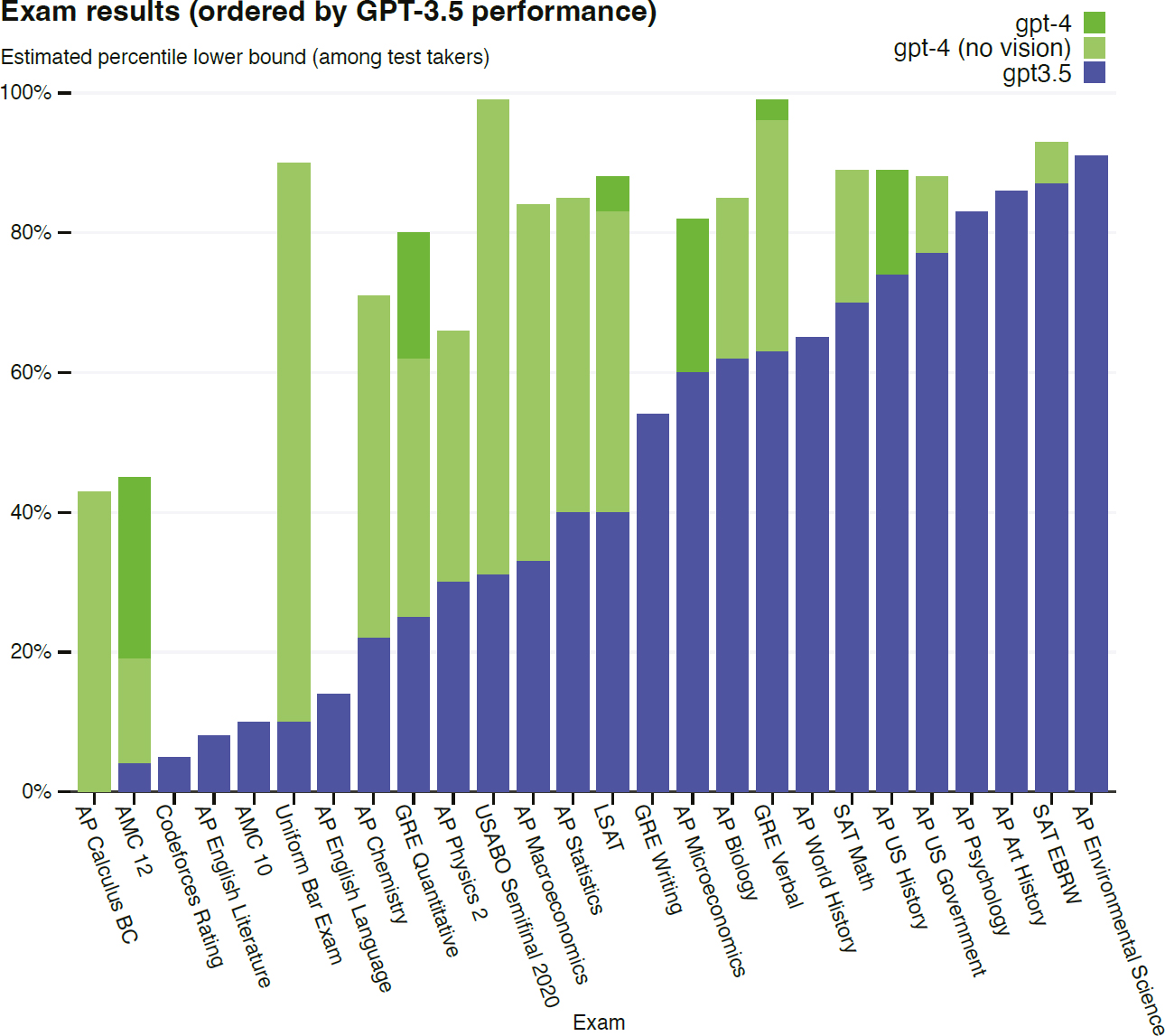
SOURCE: OpenAI, J. Achiam, S. Adler, et al., 2023, “GPT-4 Technical Report,” https://doi.org/10.48550/arXiv.2303.08774.
This does not mean that human expertise will be superfluous. For instance, expertise will be needed to develop, implement, maintain, and upgrade AI. More generally, expertise will be required at the frontier of every field—medicine, law, engineering, design, and laboratory and natural sciences, among many others. It is much more likely that AI will accomplish a growing fraction of “conventional” cases, even as human expertise remains essential in frontier and nonstandard cases. There will be significant heterogeneity in tasks within the broader category of AI technologies, with some amenable to full automation and many others requiring significant human expertise and involvement.
AI will also speed progress in robotics. But the era in which it is feasible and cost-effective to deploy robots to perform physically demanding tasks in unpredictable real-world environments—rather than in tightly controlled factory settings—remains further away. If that sounds unduly pessimistic, consider the faltering rate of technological progress toward fully autonomous driving—despite tremendous investment in that goal and widespread pronouncements of imminent technological mastery. Note further that driving an automobile requires far less physical dexterity and cognitive flexibility than, for example, installing plumbing, landscaping a house, assisting an elderly person to bathe, cooking a meal from fresh ingredients, or cleaning up after that meal is over. This observation suggests that a vast set of nonroutine manual tasks, particularly those performed in variable and unpredictable environments, will require human labor and expertise for quite some time. Here too, the committee expects uneven progress with robotics continuing to advance in many predictable workplace environments, such as factories and warehouses, where the requirements for flexibility and situational adaptability are far less demanding. Note that there is also some possibility, as discussed in Chapter 2, that a new generation of multimodal foundation models—trained on text, video, voice, and sounds—could yield sudden advances in AI abilities to model the physical world and corresponding advances in robotics.
Given these assessments, AI is likely to substitute for human labor in two broad categories of tasks:
- AI will speed the rate of automation of “mass expertise” (i.e., learning rules, mastering tools) by enabling machines to complete the “last mile” of tasks that were previously out of reach—for example, taking retail inventory at a convenience store; stocking a warehouse; or boxing small, irregular objects in a direct-to-consumer sales warehouse.
- More profoundly, AI will enable partial automation of many high-value intellectual services supplied by workers with elite expertise in fields such as law, medicine, engineering, education, architecture, tax accounting, research, and so on. Many forms of elite expertise may become more accessible and less expensive in the AI era.
These observations are consonant with a growing set of studies that seeks to classify which workplace tasks, occupations, and industries are most “exposed” to AI—meaning that they are engaged in tasks that appear within the realm of AI’s
capabilities.71 A consistent result from this body of work is that AI’s potential to replicate the core tasks of occupations is generally greater for high-education, high-wage occupations—though perhaps not for the most highly educated occupations—and generally less for low-education, low-wage occupations, particularly those that engage in physical tasks in high-variability environments (i.e., not assembly lines and warehouses), as is also discussed in Chapter 3.
The predictions above for which tasks AI can readily substitute are in the committee’s estimation credible and relatively uncontroversial. But this is the least challenging part of forecasting the labor market consequences of widespread AI deployment. At the onset of prior technological revolutions, it was comparatively easy for contemporaries to predict that the Industrial Revolution would displace artisanal expertise—the Luddites seem to have caught on to this idea quickly—or that the computer era would displace worker expertise in routine clerical and production tasks. Similarly, it is self-evident that AI will substitute for some of the nonroutine cognitive labor tasks supplied by professional workers. It is a far greater challenge to anticipate what forms of worker expertise will be augmented (i.e., made more valuable) by the deployment of AI and, similarly, what novel forms of expertise will be newly demanded to support the products, processes, services, and work modalities enabled by this technological revolution.
The next section develops three scenarios that cover a range of cases. They are potentially relevant over the next 5–15 years and could unfold by 2040 or sooner.
What Expertise Will Be Augmented or Newly Demanded?
Scenario 1: Further Occupational Polarization
Advances in AI could extend the reach of automation to “routine-like” tasks, thus prolonging or accelerating the decades-long trend of occupational polarization shown earlier in Figure 4-3.72 In this scenario, the substitution of AI for human tasks would radiate outward from the current locus of computer automation. This would enable machines
___________________
71 E. Brynjolfsson, T. Mitchell, and D. Rock, 2018, “What Can Machines Learn, and What Does It Mean for Occupations and the Economy?” AEA Papers and Proceedings 108:43–47; E. Felten, M. Raj, and R. Seamans, 2018, “A Method to Link Advances in Artificial Intelligence to Occupational Abilities,” AEA Papers and Proceedings 108:54–57; E. Felten, M. Raj, and R. Seamans, 2019, “The Effect of Artificial Intelligence on Human Labor: An Ability-Based Approach,” Academy of Management Proceedings 1; E. Felten, M. Raj, and R. Seamans, 2021, “Occupational, Industry, and Geographic Exposure to Artificial Intelligence: A Novel Dataset and Its Potential Uses,” Strategic Management Journal 42(12):2195–2217; E. Felten, M. Raj, and R. Seamans, 2023, “Occupational Heterogeneity in Exposure to Generative AI,” Social Science Research Network, https://dx.doi.org/10.2139/ssrn.4414065; M. Webb, 2020, “The Impact of Artificial Intelligence on the Labor Market,” unpublished manuscript, Stanford University; and T. Eloundou, S. Manning, P. Mishkin, and D. Rock, 2023, “GPTs Are GPTs: An Early Look at the Labor Market Impact Potential of Large Language Models,” arXiv preprint, arXiv:2303.10130, March 27.
72 These tasks are labeled “routine-like” because they are not routine in the sense of following fully codifiable procedures that are amenable to classical computing. But these “routine-like” tasks are arguably adjacent to those routine tasks because the nonroutine component is not highly expertise-intensive.
to take on a larger set of nonroutine managerial tasks, such as evaluating worker performance, and a larger set of nonroutine manual tasks, such as operating a burger grill or fryolator in the assembly-line-like production environment of a fast-food restaurant.
By substituting for a broader set of middle-skill tasks, AI would further amplify the value of the “elite expertise” that is characteristic of professional occupations, similar to what the adoption of computers has done in recent decades. Owing to AI’s additional capabilities in nonroutine tasks, substitution would reach further into the ranks of white-collar work, enabling some “college” tasks to be automated. The definition of what constitutes “elite” work would therefore ratchet upward.73
Machines might perform the first pass of medical diagnosis tasks, legal brief–writing tasks, engineering design tasks, syllabus development, or data analysis. But the final pass would still require human review, refinement, and improvement. “Elite experts” would therefore be called upon to complete the job. Presumably, this final step would require the most capable experts, given that AI has already completed the journeyman-level work. In this scenario, the demand for increasingly rarified “elite expertise” would rise; tasks performed by workers with “mass expertise” would be further imperiled by automation; and downward wage pressure on the earnings of workers in nonexpert service work would intensify as another wave of middle-tier workers is displaced from white- and blue-collar jobs.74
There are reasons for skepticism about this scenario, however. The foundational claim that “elite experts” will be indispensable for performing the “final draft” of many nonroutine tasks appears suspect. It is plausible, instead, that machines will exceed human performance even without elite supervision in producing many conventional professional products, such as legal briefs, marketing presentations, summaries of reports or meetings, letters of promotion or termination, news stories summarizing sporting events, or earnings reports. Rather than elite expertise becoming a gatekeeper for many professional products, it may become increasingly optional—called for only when the stakes are high or the appropriate course of action is highly uncertain.
More broadly, if the defining feature of classical computing is that it is uniquely capable of carrying out routine tasks rapidly, then the defining feature of AI is that it excels at mastering nonroutine tasks. Indeed, AI in its current incarnation is poorly suited to accomplishing canonical routine tasks: witness the unreliability of LLMs in distinguishing facts that the model has learned from fictions that its probabilistic reasoning hallucinates. Recognizing that AI and classical computing have profoundly different strengths
___________________
73 Tyson and Zysman memorably refer to this scenario as “routine-biased technological change on steroids.” See L.D. Tyson and J. Zysman, 2022, “Automation, AI and Work,” Daedalus 151(2):256–271.
74 As noted in Chapter 1, demand for such service tasks is very likely to grow with the aging of the population, which is occurring rapidly in the United States and throughout the industrialized world. Nevertheless, service tasks are expected to remain generally low in the pay scale across industrialized countries because these tasks use primarily generic, nonexpert skills.
and weaknesses, it would be surprising if these technologies had the same implications for the division of labor between workers and machines.
Scenario 2: The Elimination of Expertise
A second scenario is that advancements in AI and in AI-enabled machines (such as dexterous robotics) grow so capable and inexpensive in the years ahead that they come to outcompete humans across essentially every domain, effectively reducing the value of human labor to near zero. This scenario is ubiquitous in dystopian science fiction (e.g., the well-known 2008 animated movie Wall-E). Despite its origins in fiction, this scenario is economically coherent and has gained renewed currency in academic debate.75 Four decades ago, the Nobel laureate economist Wassily Leontief forecast that “progressive introduction of new computerized, automated, and robotized equipment can be expected to reduce the role of labor … similar to the process by which the introduction of tractors and other machinery first reduced and then completely eliminated horses and other draft animals.”76 Leontief’s argument was not that humanity would run out of work (what economists call a “lump of labor” fallacy) but rather that workers would become unemployable in that work if machines could do the same tasks better, faster, and cheaper.
This scenario envisions what Nobel Prize–winning economist Herbert Simon labeled a “problem of intolerable abundance”—too much labor available too cheaply.77 To understand the challenge that this could create, observe that the labor market serves two distinct but interdependent functions in market economies. First, it allocates people to jobs in which they produce the goods and services on which society depends. Second, it provides the primary means of income distribution. Absent chattel slavery, indentured servitude, and labor coercion, citizens possess an inalienable right to their own labor. This enables most (but far from all) adults to earn a living by providing (more precisely, selling) their labor to employers (including to themselves in the form of self-employment). In 2019, $6 in every $10 of U.S. gross national product was paid to workers as wages and fringe compensation—that is, labor’s share of national income was about 60 percent.78
___________________
75 See, for example, D. Susskind, 2020, A World Without Work: Technology, Automation and How We Should Respond, Penguin UK; and A. Korinek and M. Juelfs, 2022, “Preparing for the (Non-Existent?) Future of Work,” NBER Working Paper No. w30172, June.
76 W.W. Leontief, 1983, “The Distribution of Work and Income,” Scientific American 247(3):188–205, September.
77 In a letter published on March 16, 1966, in the New York Review of Books, Herbert Simon wrote, “Insofar as they are economic problems at all, the world’s problems in this generation and the next are problems of scarcity, not of intolerable abundance. The bogeyman of automation consumes worrying capacity that should be saved for real problems—like population, poverty, the bomb, and our own neuroses.”
78 University of Groningen and University of California, Davis, n.d., “Share of Labour Compensation in GDP at Current National Prices for United States,” retrieved from FRED, Federal Reserve Bank of St. Louis, https://fred.stlouisfed.org/series/LABSHPUSA156NRUG, accessed June 29, 2024.
If advances in AI were to cause labor’s share to fall to zero—or even to fall by half—a formidable distributional challenge would be created.79 Although, in theory, nations would be immensely wealthier if all work were performed by machines and citizens were free to pursue other interests, these nations would be gravely challenged to implement an alternative means of income distribution. Distinct from the inalienable right to one’s own labor, ownership rights to material resources are highly “alienable” and hence often the subject of civil conflict. Allocating the ownership and distribution of these material resources absent claims based on labor ownership would likely create severe governance problems.80 Although these challenges are outside the scope of this report, they are a reminder that a future without work appears far from utopian.
The committee does not, however, believe that AI will displace most human labor tasks in the near future. First, as noted above, a vast set of dexterous blue-collar and in-person service tasks appears likely to remain out of the reach of cost-effective automation for many years to come. Second, as highlighted in Chapter 1, industrialized countries face decades of sustained demographic scarcity. This scarcity creates a headwind against rising unemployment, even if labor demand were declining.81 Last, the full automation scenario assumes that novel work requiring new expertise and aptitudes that humans but not machines possess will not be created. Although it is difficult to predict what such work might be, history suggests that human society will nevertheless be effective at creating it. Were that not the case, the transition to manufacturing and services from agriculture in the 19th and 20th centuries, or the substantial occupational reallocations wrought by the past four decades of computerization, might have led to sustained increases in joblessness. Instead, employment rates are currently reaching multidecade highs across the industrialized world.
But complete automation is an extreme case in a broader set of plausible scenarios. AI certainly will enable machines to displace a broader set of human tasks than was possible in the pre-AI era. The consequences of that displacement do not fundamentally depend on how much work is displaced; they depend instead on the value of labor (i.e., the value of expertise) in the tasks that remain, the extent of new expert tasks created and demanded, the rate at which people are displaced from existing work, their capacity
___________________
79 Labor’s share of national income has fallen by 3 to 10 percentage points in many industrialized countries during the past three decades, but it is not clear that this fall is owing to automation. See D. Autor, D. Dorn, L.F. Katz, C. Patterson, and J. Van Reenen, 2020, “The Fall of the Labor Share and the Rise of Superstar Firms,” The Quarterly Journal of Economics 135(2):645–709.
80 This problem is known to economists and political scientists as the “resource curse”: nations with large, geographically concentrated national resources (such as fossil fuels or valuable minerals) tend to experience slower economic growth, higher levels of corruption, weaker institutions, and inferior development outcomes compared to countries with fewer natural resources. See M.L. Ross, 2015, “What Have We Learned About the Resource Curse?” Annual Review of Political Science 18:239–259.
81 This scarcity also accelerates the rate of automation, however. See D. Acemoglu and P. Restrepo, 2022, “Demographics and Automation,” The Review of Economic Studies 89(1):1–44.
to retrain to acquire newly valuable expertise, the rate at which they can acquire these skills, and the productivity gains that stem from automation itself.
Scenario 3: Reinstatement of Mass Expertise
This scenario is speculative but plausible and attainable but not inevitable. It rests on the hypothesis that the future of expertise may borrow attributes from both elite and mass expertise.
Mass Expertise Versus Elite Expertise
The key distinction between mass expertise and elite expertise is the types of problems to which they are applied. Consider a set of canonical mass expertise tasks: proofreading a document, managing an expense account, operating a computerized lathe, or installing electrical circuitry. Workers’ expertise is indispensable for performing these tasks correctly and efficiently. But, owing to the tight parameters of these tasks, increased worker expertise is unlikely to produce qualitatively better results. Expense accounts are either error-free or they are not; electrical installations are either neat, safe, and up to code or they are not.
Contrast these cases with canonical elite expertise tasks such as managing a patient’s cancer care, writing a legal brief, drafting an advertising campaign, architecting a building, or leading a team or organization. There is not a single correct or best way to perform these tasks, nor is there an upper bound on how well they can be done. Each is a high-stakes, one-off case where the range of potential outcomes spans from extraordinary to catastrophic. Achieving excellent results requires both subject matter expertise and professional judgment. The latter component is usually acquired through experience. Elite professionals are generally not assigned high-stakes cases until they have first demonstrated mastery in a supervised apprenticeship or in a lower-stakes professional assignment (e.g., medical resident, junior law partner, postdoctoral researcher, division manager).
How might AI change this picture? As previously mentioned, it is likely that AI will soon take on the “last mile” of many mass expertise tasks, particularly cognitive tasks (e.g., expense accounting) and manual and physical tasks performed in a controlled, predictable setting (e.g., operating a computerized lathe) but not tasks performed in highly variable real-world settings (e.g., installing electrical wiring). In these cases, AI’s impacts are primarily incremental, expanding the range of tasks where classical computing already holds a comparative advantage. What remains unanswered—and potentially is more novel—is how the emerging capability of AI to perform “elite” tasks (e.g., writing, medical diagnosis, software development, legal analysis, engineering) might enable changes in the demands for human expertise in carrying out these tasks.
By making elite expertise more accessible and less expensive, AI can be used to complement the judgment, ingenuity, creativity, and interpersonal acumen of workers engaged in elite tasks while simultaneously reducing the extent of expert knowledge required to perform them. That is, applied effectively, the hypothesis is that AI could enable less-expert workers to carry out more expert tasks.
A Motivating Example
As a motivating example (not from the AI realm), consider the job of nurse practitioner (NP). NPs are registered nurses who have earned an additional master’s degree and passed a certification exam. NPs diagnose and treat illness, practicing either independently or as part of a health care team. Some focus on health promotion and disease prevention while others perform, order, or interpret diagnostic tests. NPs also may prescribe medication. The NP occupation was founded in the mid-1960s but did not become prevalent until the past two decades. NP employment more than tripled between 2011 and 2022, with approximately 300,000 NPs working at present, and is projected to increase by 40 percent in the next decade—far above the growth rate of overall employment. Simultaneously, the range of tasks performed by NPs has broadened substantially, and NPs’ earnings have risen. In 2021, the median salary for NPs was $123,000.82 NPs exemplify the above definition of professionals: They confront high-stakes, one-off cases, where the set of potential outcomes ranges from extraordinary to catastrophic. They provide diagnostic, treatment, and prescribing services that were once within the exclusive dominion of medical doctors (MDs).
What enabled the reallocation (or sharing) of high-stakes tasks from MDs to NPs? In part, medical professionals perceived a care shortcoming in the health care system, recognized that the skills of registered nurses were underused, and chose to pioneer a new professional occupation. This in turn required a supporting set of training institutions and (eventually) a change in the scope of medical practice rules.83 Information technologies, combined with improved training, also facilitated this new division of labor. For example, a 2012 study reported that information and communications technology (ICT) plays a critical role in enabling NPs to deliver advanced practice care: “ICT supported the advanced practice dimension of the NP role in two ways: availability and completeness of electronic patient information enhanced timeliness and quality
___________________
82 It is challenging to find consistent time-series data on NP employment in the United States. The U.S. Bureau of Labor Statistics reports an increase from 81,000 NPs in 2011 to 224,000 in 2022. See U.S. Bureau of Labor Statistics, n.d., “Employed Full Time: Wage and Salary Workers: Nurse Practitioners Occupations: 16 Years and Over,” retrieved from FRED, Federal Reserve Bank of St. Louis, https://fred.stlouisfed.org/series/LEU0257870000A, accessed June 29, 2024.
83 P. Asubonteng, K.J. McCleary, and G. Munchus, 1995, “Nurse Practitioners in the USA—Their Past, Present and Future: Some Implications for the Health Care Management Delivery System,” Health Manpower Management 21(3):3–10.
of diagnostic and therapeutic decision-making, expediting patient access to appropriate care.”84
Looking forward, it is a near-certainty that AI will further augment this occupation, enabling NPs to perform a broader variety of expert tasks. Indeed, one can imagine a future in which a student would attend a 4-year program to obtain a bachelor’s of science degree in health care followed by an apprenticeship in medical practice. When training is complete, a certified health care worker, assisted by AI, could perform a far larger set of diagnostic and care tasks than is currently feasible.85
The NP occupation provides a focal example of how a technology such as AI could be used to complement the expertise of nonelite workers. Specifically, by providing relevant frontier expertise, guidance, and a set of digital guardrails, AI could enable less-expert workers to perform more expert tasks.
Note that the claim is not that AI can enable untrained, nonexpert workers to carry out expert tasks. It is not plausible that “any worker” overseen by AI could perform the tasks of NPs or MDs (or legal counsels, architects, engineers, managers of large organizations, etc.). The claim instead is that AI can reduce the demand for frontier expertise in some high-stakes tasks, thereby enabling trained workers to play a greater practical role in translating between elite knowledge and everyday practice. Concretely, AI could provide guidance and guardrails for workers who grasp the totality of the specific case or challenge they are confronting; exercise judgment; and communicate dexterously with coworkers, clients, and third parties. This model, if successful, would reinstate a form of “mass expert” work—the type of work that was arguably more prevalent prior to the computer revolution.
To develop this idea further, consider again the example of NPs. Efficacy as an NP requires three complementary skill sets:
- Technical knowledge—Foundational technical and scientific knowledge of human biology, anatomy, physiology, epidemiology, psychology, and so on. This enables analytical thinking about diagnostic information, symptoms, treatments, and so on.
- Procedural knowledge—Protocols for executing specific medical procedures—for example, taking vital signs, drawing blood, inserting a catheter, performing cardiopulmonary resuscitation, staunching bleeding, and so on. Such
___________________
84 J. Li, J. Westbrook, J. Callen, and A. Georgiou, 2012, “The Role of ICT in Supporting Disruptive Innovation: A Multi-Site Qualitative Study of Nurse Practitioners in Emergency Departments,” BMC Medical Informatics and Decision Making 12:1–8.
85 The growth of the NP occupation offers a relatively uncommon large-scale case where high-stakes professional tasks—diagnosing, treating, and prescribing—were reallocated (or co-assigned) from the most elite professional workers (MDs) to another set of professionals (NPs) with somewhat less elite (though still substantial) formal expertise and training.
- protocols are the standard rules and tools used for delivering medical care. Protocols reduce the probability of error and establish rules and lines of authority for contingencies that might arise.
- Expert judgment—Expert judgment intermediates between formal knowledge and hands-on practice. Because the stakes in patient care are high and the “correct” steps are not fully specified, expert judgment is required to draw a link from the domain of technical and procedural knowledge to any specific practical instance—for example, evaluating whether a patient needs routine versus emergency care, determining which diagnostic tests should be administered, knowing when to probe for specific symptoms that the patient might not report, deciding whether or not to execute a risky life-saving procedure, and so on. Expert judgment is almost invariably gained through supervised learning, where established experts advise, coach, and (critically) prevent consequential errors by novices. Expert judgment is arguably closely related to tacit knowledge: expertise that is acquired through experience rather than explicit instruction.
The hypothesis here is that by serving as a substitute for some technical and procedural knowledge, AI can serve as a complement to NPs’ expert judgment:
- AI can supplement (or substitute for) technical knowledge. The reservoir of medical knowledge is vast and constantly expanding. Because it is impossible for a single expert to master the entire medical frontier, the field of medicine contains a large and continually expanding set of specialties. It is, however, entirely feasible for AI tools to absorb the reservoir of frontier medical knowledge. As AI tools develop, they will be increasingly useful for surfacing the relevant knowledge at the appropriate time. Indeed, while professionals already have access to vast repositories of professional journals and databases, significant expertise is often required simply to use these tools. By responding to natural language and contextual queries to surface frontier expertise, AI can make expert knowledge far more accessible. These tools may reduce the quantity of technical knowledge that health care workers are required to master. Human experts will still be needed at the frontier of every medical field, but the modal health care worker may require less frontier expertise if many specific technical details can be supplemented by AI.
- AI can likely substitute for procedural knowledge. Many medical procedures (and technical procedures generally) require a health care worker to follow a specified series of steps. AI can provide guidance for carrying out unfamiliar
- procedures. But executing such steps almost always requires practice and judgment. An untrained adult cannot safely insert a catheter by following instructions on a computer screen. An experienced medical worker could, however, likely use a new medical device—or a new type of catheter—by following instructions and guidance provided by AI. AI can likely supplement or substitute for procedural knowledge, but this capability is useful primarily to workers who have the expertise (i.e., the expert judgment) to carry out such procedures.
- AI can likely complement expert judgment. By supplementing technical and procedural knowledge, AI can enable workers who possess expert judgment to perform a broader range of expert tasks. Concretely, it is extremely unlikely that an untrained adult could safely perform the caregiving duties of an NP, regardless of what AI tools were available to provide guidance, coaching, and supervision. The potential for catastrophic error would be extremely high, and the untrained worker would not have the capacity to respond should such an error arise. Conversely, it is highly plausible that an NP could safely perform a broader range of procedures if supported by AI. What distinguishes these scenarios is expert judgment. Expert judgment enables experienced workers to make high-stakes decisions in their domain of expertise, even in unfamiliar cases. Stated succinctly, the hypothesis is that AI could complement expert judgment, enabling those possessing it to accomplish a broader set of tasks.
These claims are difficult to evaluate in the abstract, but consider a few occupations for which expert judgment is prevalent: electrician, software developer, chef, attorney, architect, aircraft mechanic, and store manager. Is it plausible that AI could fully substitute for the expertise of workers in performing the primary tasks of these occupations? If the answer were “yes,” it seems likely that these occupations might eventually become economically equivalent to jobs in food service, cleaning, security, crossing guard services, and so on—work that is socially valuable but relatively poorly paid because it requires primarily mass expertise.
“No” is a more realistic answer. Each of these occupations calls on workers to apply expert judgment to translate from technical and procedural knowledge to professional practice. AI will broaden the reach of those with expert judgment rather than making their expertise superfluous:
- AI will assist electricians in tackling unfamiliar installations. Electricians will need judgment, dexterity, and mastery of appropriate tools to perform safe electrical installations.
- AI will assist software developers to write code rapidly. Developers will need to develop and review the architecture of the software they are developing.
- AI will enable chefs to master a larger range of cuisines—recommending recipes, proposing new recipes, and suggesting cooking techniques. Chefs will require judgment, dexterity, and acute taste to cook.
- AI will augment attorneys and paralegals by generating legal documents and proposing lines of argument. Attorneys will assess what lines of argument are most persuasive and will make those arguments to judges, juries, and other attorneys.
- AI will assist architects to develop and visualize designs and to perform engineering calculations. Architectural expertise will be needed to judge the suitability, practicality, and desirability of those designs.
- AI will enable aircraft mechanics to tackle a broader range of installation and repair tasks by interpreting data, proposing diagnostic tests, and searching for relevant service bulletins. Executing that mechanical work will require experience, judgment, and finesse.
- AI will assist store managers to track inventory and staffing, anticipate demand peaks and troughs, follow consumer fashions, and minimize wastage. Managers will provide leadership and coaching to workers, engage with customers, solve myriad problems, and maintain esprit de corps.
AI will serve to supplement technical and procedural knowledge for workers performing each of these occupations. It will provide information to improve performance and guardrails to reduce the likelihood of error. But it likely will not eliminate the expert judgment required, which is gained through training, coaching, and practice. This expertise will be required to intermediate between formal knowledge and hands-on practice.
Figure 4-6 presents a stylized version of this hypothesis. The horizontal axis on this figure represents the expertise that a worker brings to an expert occupation (such as those listed above), ranging from no knowledge (far left) to frontier expertise (far right). The vertical axis represents the potential for AI to augment worker performance in the high-stakes tasks in that occupation. As the figure suggests, there is potentially little opportunity for AI to augment performance of untrained workers placed in situations with high-stakes tasks. Plausibly, it may be unproductive or dangerous for untrained workers to take on such tasks even when supported by AI (e.g., an untrained worker attempting to insert a catheter or perform a high-voltage electrical installation).
At the midpoint are workers who possess some expert judgment obtained through training and experience but who are not at the frontier of their field. Here, AI
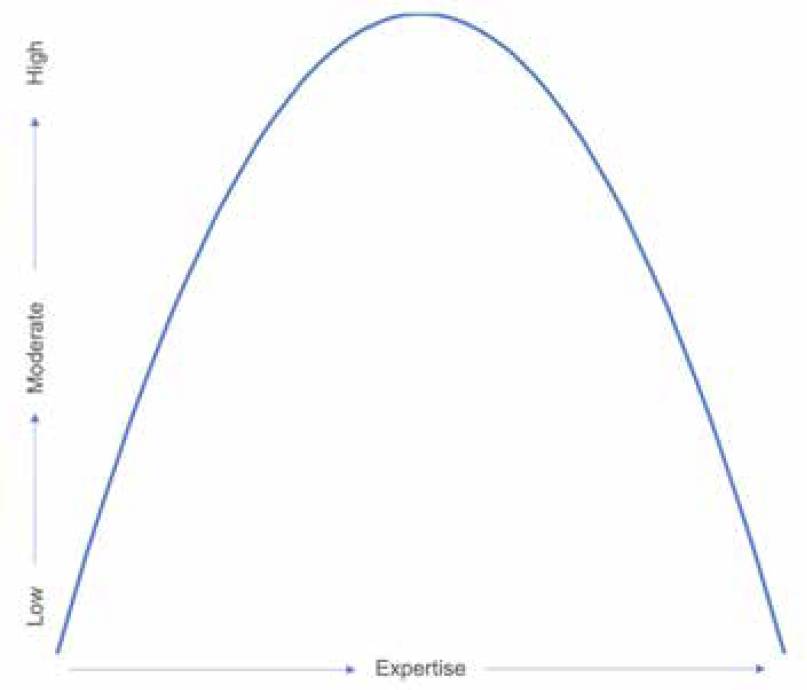
NOTE: On the left-hand side of this figure, AI is unhelpful or potentially dangerous when used by novice workers for high-stakes tasks. AI is increasingly complementary to workers with relevant judgment and training. AI potentially adds less value for workers with the full complement of technical and procedural expertise as well as expert judgment (though even there, it may save time).
can potentially supplement technical and procedural knowledge, while providing guidance and guardrails for performing expert tasks. Workers will apply expert judgment in carrying out those tasks and respond appropriately in the case of unexpected outcomes (e.g., unexpected bleeding, short circuit).
AI may be less complementary to frontier experts (far right side of the figure) who are performing high-stakes tasks, simply because these experts already bring the full complement of technical and procedural knowledge plus expert judgment. However, AI may save frontier experts considerable time, enable their exploration of additional approaches and techniques, and supply novel frontier information that has only just emerged from other experts. Hence, a more ambitious version of this figure could posit negative augmentation (adverse impact) on the left-hand side of the figure, substantial positive augmentation at the center, and nonzero positive augmentation on the right-hand side.
EVIDENCE ON ARTIFICIAL INTELLIGENCE AND EXPERTISE
At the time of this writing, there is little rigorous, representative evidence on the potential complementarity or substitutability between AI and human expertise in workplace settings. The following are among the relevant studies.
Noy and Zhang
This study experimentally evaluated the use of generative AI (ChatGPT v3.5) by college graduates (sampled from Prolific) for professional writing tasks.86
- Using ChatGPT cuts work time by approximately 40 percent on professional writing tasks that take an average of 20 minutes when done using standard tools.
- The average quality of output, evaluated by a panel of double-blinded college graduates who are experts in professional writing tasks, improved slightly.
- Writing quality improved substantially more among less-skilled writers, where writing skill is measured using performance on round 1 of the task (for which ChatGPT was not used).
- This study does not fully test the hypothesis shown in Figure 4-6 because all subjects in the experiment were skilled writers. The study confirms the right-hand side of Figure 4-6 (from the midpoint of the x-axis). It does not test the left-hand side.
- Hypothesis: Had Noy and Zhang included high school graduates who were not skilled writers in their study, the graduates’ performance even using ChatGPT would have remained poor.
- Interpretation: If AI completely supplants the need for expertise, then there is no complementarity. If AI supplements expertise but does not obviate the need for it, there is complementarity.
Brynjolfsson and Colleagues
This team conducted a study on the use of an AI chatbot for customer support tasks. Trained on a database of previous customer support calls, the AI chatbot provides real-time suggested responses to customer support agents. It does not directly respond to customers.87
___________________
86 S. Noy and W. Zhang, 2023, “Experimental Evidence on the Productivity Effects of Generative Artificial Intelligence,” Science 381(6654):187–192.
87 E. Brynjolfsson, D. Li, and L.R. Raymond, 2023, “Generative AI at Work,” NBER Working Paper No. w31161, April.
- Use of the tool increased throughput (chat resolutions per hour) by 14 percent on average, reflecting (1) a decline in the time it takes an agent to handle a chat; (2) an increase in the number of chats that an agent can handle per hour; and (3) a small increase in the fraction of chats resolved successfully.
- Customer satisfaction was not greatly affected. However, escalation requests (requests for manager assistance) fell. Use of the chatbot substantially improved how customers treat agents, as measured by sentiment analysis applied to their chats. Worker attrition declined, particularly among novices.
- Critically, and similar to the findings of Noy and Zhang, use of the tool substantially reduced productivity inequality. Less experienced workers became almost as effective as expert workers when supported by the AI tool. Agents not using the tool reached maximum productivity in approximately 10 months on average. Agents using the tool attained this productivity level after only 3 months and exceeded it thereafter.
- Like the study by Noy and Zhang, this study confirms the right-hand side of Figure 4-6 but does not test the left-hand side.
- Hypothesis: Had Brynjolfsson and colleagues included customer support workers with no training or expertise in the products they were supporting, unsatisfactory customer service results would have emerged.
- Interpretation: If AI completely supplants the need for expertise in this customer service role—so that “any worker” can do this job equally effectively with no training—this implies no expertise complementarity. If AI supplements expertise but does not obviate the need for it, this indicates complementarity (at least up to some level of expertise, as is shown in Figure 4-6).
Agarwal and Colleagues
This team conducted an experiment using diagnostic AI with professional radiologists, varying the availability of AI support and contextual information.88
- Providing AI did not uniformly increase diagnostic quality. Even though the AI predictions were more accurate than almost two-thirds of the participants’ assessments in the experiment, AI assistance did not improve radiologists’ diagnostic quality on average. Radiologists were unsuccessful, and in many cases counterproductive, in integrating their assessments with information provided by the AI.
___________________
88 N. Agarwal, A. Moehring, P. Rajpurkar, and T. Salz, 2023, “Combining Human Expertise with Artificial Intelligence: Experimental Evidence from Radiology,” NBER Working Paper No. w31422, July.
- Providing contextual information—information accessible to radiologists but not currently used by AI tools—does increase radiologists’ diagnostic quality.
- Implication: AI and radiologists are substitutes not complements (in fact, radiologists often perform worse when supplemented by AI—implying negative complementarity).
- This experiment does not directly test the consequences of giving AI to “any worker” to perform radiological services.
- As the authors hypothesize, with appropriate training, radiologists would be able to use AI more effectively—yielding better results than AI or doctors alone.
- If this conjecture were proved correct, it would support the conceptual framing shown in Figure 4-6.
In summary, none of these three studies provides a conclusive confirmation or rejection of the conceptual framework above. The committee is, however, cautiously optimistic that this framework will prove relevant in a large number of instances—although certainly not in all.
HOW FEASIBLE WILL IT BE FOR WORKERS TO ACQUIRE NEWLY VALUABLE EXPERTISE?
The answer to the question of whether workers can acquire new expertise will depend on three factors. The first is the type of expertise that is newly required: primarily elite expertise, as polarization extends substantially upward into many college-educated white-collar occupations (Scenario 1); none, as all expertise is eliminated (Scenario 2); or substantial expert judgment, as AI supports the reinstatement of a new era of mass expertise (Scenario 3). The learning challenges posed by these scenarios differ dramatically.
A second factor is how effective AI proves to be as an educational tool. As will be discussed in Chapter 5, AI has the potential to make education more accessible, personalized, immersive, and cost-effective. Tools such as LLMs that can customize interactive instructional content as well as augmented and virtual reality devices that can transform education into simulation could make learning more interactive and engaging. For many tasks requiring the acquisition of expert judgment, it is highly plausible that AI could be used to create simulated environments, where workers perform high-stakes tasks in low-stakes settings. At present, simulation training is used widely in aviation, where the cost of error is potentially catastrophic and the need for ongoing practice is substantial. Commercial pilots in the United States are required to undergo 2 days of flight simulator
training every 6 months to retain their certification.89 Simulation-based training may prove particularly valuable for adults, who are generally less amenable to classroom-based instruction than younger learners.
A final factor that will prove crucial is the quality and cost of the training institutions that are made publicly and privately available to support skill acquisition. A growing body of evidence finds that training programs that are effective in enabling adults to enter skilled occupations typically “combine upfront screening, occupational and soft skills training, and wraparound services.”90 These wraparound services are often expensive because they must financially support learners during intensive training, which often precludes paid employment. Denmark, which is renowned for its capacity to support displaced workers to return to gainful employment, spends 3.1 percent of its gross domestic product (GDP) on active and passive labor market programs. By comparison, the United States spends 0.3 percent of its GDP on these programs.91 A key lesson to draw is that new educational technology, no matter how spectacular, will not itself be sufficient to support the training needs of present and future workers, particularly displaced adult workers. Substantial public investments will be required.
WORKFORCE RISKS
Although the study committee does not foresee an imminent prospect of AI causing a vast increase in technological unemployment, advances in AI could very well put downward pressure on the wages of many workers. Alongside this risk, worker surveillance and privacy, issues around the ownership of creative output, and algorithmic fairness and discrimination are all of concern.
Many workers—for example, call center employees, truckers, and warehouse workers—have long been subject to strict output metrics. AI will expand the share of the workforce subject to strict monitoring and allow for more intrusive monitoring. For example, AI tools may be able to monitor how often white-collar workers are shopping online or checking their personal email during the workday, or to keep tabs on how many hours per day they are physically in front of their computers. AI-powered cameras with biometric feedback indicators can monitor delivery drivers’ tendencies to brake
___________________
89 C. Page, 2022, “How Pilots Use Flight Simulators to Prepare for Any and All Eventualities,” The Points Guy, July 11, https://thepointsguy.com/news/how-pilots-use-flight-simulators.
90 L.F. Katz, J. Roth, R. Hendra, and K. Schaberg, 2022, “Why Do Sectoral Employment Programs Work? Lessons from WorkAdvance,” Journal of Labor Economics 40(S1):S249–S291.
91 C.T. Kreiner and M. Svarer, 2022, “Danish Flexicurity: Rights and Duties,” Journal of Economic Perspectives 36(4):81–102.
hard, speed, or look away from the road while driving.92 An AI-powered program called Cogito reminds call-center workers to sound cheerful and upbeat when it identifies concerns with workers’ tones of voice.
AI image generators like Stable Diffusion and DALL·E 2 use training data from enormous image archives. Many artists are concerned that generative AI platforms are mimicking their artistic style, creating images that are insufficiently different from the artists’ original work.93 If this were the case, AI platforms would be violating existing copyright laws. As AI capabilities advance, one can easily imagine this problem extending to authors of fiction and nonfiction, movies, and music. In addition, there are substantial unresolved legal issues around the ownership of AI-generated images and documents—for example, are they owned by the AI platform, by the user, or by any customers of the user? If one asks an AI platform to write a song in the style of Bob Dylan, does Bob Dylan have an ownership claim over the platform’s output?
The output from AI solutions may perpetuate socioeconomic, racial, or gender bias due, for example, to bias in underlying training data. For example, in 2014 Amazon attempted to build a program to vet job applicants. The company’s training data came from a job applicant pool that was mostly male. Amazon’s model disrated résumés including the word “women’s” and downgraded applicants who were graduates of two women’s colleges. Amazon recognized the problem and retired the tool, but this remains a cautionary tale.94 Buolamwini and Gebru studied commercial gender classification systems and found that error rates for darker-skinned females were substantially higher than for lighter-skinned males, potentially owing to the use of training data that were not representative of the population as a whole.95
Something similar could happen with health services. If training data come from people with health insurance and if optimal treatment differs between people with and without health insurance, then AI-driven treatment could show preference for the insured over the uninsured or allocate resources to patients who have historically received more intensive treatment.96 Beyond training data, the choice or design of algorithms could inadvertently perpetuate bias.
___________________
92 The Daily Telegraph, 2022, “Amazon Installs AI Cameras to Monitor Its Delivery Drivers,” The Daily Telegraph,https://www.telegraph.co.uk/business/2022/05/22/amazon-installs-ai-cameras-monitor-delivery-drivers.
93 See, for example, Anderson v. Stability AI, et al., described in G. Karger, 2023, “AI-Generated Images: The First Lawsuit,” Science and Technology Law Review, January 25, https://journals.library.columbia.edu/index.php/stlr/blog/view/479.
94 J. Dastin, 2018, “Insight—Amazon Scraps Secret AI Recruiting Tool That Showed Bias Against Women,” Reuters, October 10, https://www.reuters.com/article/world/insight-amazon-scraps-secret-ai-recruiting-tool-that-showed-bias-against-women-idUSKCN1MK0AG.
95 J. Buolamwini and T. Gebru, 2018, “Gender Shades: Intersectional Accuracy Disparities in Commercial Gender Classification,” Proceedings of Machine Learning Research 81:1–15.
96 Z. Obermeyer, B. Powers, C. Vogeli, and S. Mullainathan, 2019, “Dissecting Racial Bias in an Algorithm Used to Manage the Health of Populations,” Science 366(6464):447–453.
Socioeconomic, gender, and racial bias are serious concerns. Real-world experiences—some discussed above—demonstrate the risk that the continued adoption of AI could perpetuate these biases. But there is reason for optimism, as well. As Kleinberg and colleagues argue,
Algorithms by their nature require a far greater level of specificity than is usually involved with human decision making, which in some sense is the ultimate “black box.” With the right legal and regulatory systems in place, algorithms can serve as something akin to a Geiger counter that makes it easier to detect—and hence prevent—discrimination.97
The committee recognizes potential benefits but is concerned by these workforce risks. Increased worker surveillance could in some settings increase worker safety, advance workplace equity, or strengthen the link between individual worker performance and compensation. Simultaneously, stepped-up surveillance may strip workers of autonomy and discretion, shifting the balance of bargaining power from workers to firms.98 These potential benefits and risks will need to be weighed alongside workers’ rights to reasonable privacy and expectations of just treatment. The same is true of the competing interests of human content creators and generative AI outputs. Adjudication of these benefits and risks will be shaped by regulation, judicial interpretation of existing law, new laws designed to address these specific issues, and negotiations among firms and worker representatives.
Although the risks posed by surveillance, privacy invasion, and coercive monitoring are particularly salient in the case of AI, the consequences of previous technological transitions for the welfare of workers and the strength of the middle class have depended not only on the nature and application of technologies but also on the negotiation frameworks and legal institutions that have shaped the design, adoption, and uses of technology as well as the distribution of rents (economic surplus) between owners, managers, and line workers. The positive strides in middle-class prosperity that accompanied the second industrial revolution were in part due to the success of labor unions, and supporting federal and state legislation, in negotiating for higher standards of pay, reasonable hours, safe working conditions, and employment security. In more recent decades, worker bargaining power in the United States has eroded in the face of contracting labor union representations; aggressive employer mobilization against worker
___________________
97 J. Kleinberg, J. Ludwig, S. Mullainathan, and C.R. Sunstein, 2020, “Algorithms as Discrimination Detectors,” Proceedings of the National Academy of Sciences 117(48):30096–30100.
98 A. Levy, 2022, Data Driven, Princeton University Press; and A. Picchi, 2021, “Amazon Apologizes for Denying That Its Drivers Pee in Bottles,” CBS News, April 5, https://www.cbsnews.com/news/amazon-drivers-peeing-in-bottles-union-vote-worker-complaints.
organizing efforts; and the “fissuring” of the labor market, denoting the process of companies outsourcing tasks and responsibilities that were previously handled in-house to third-party contractors, subcontractors, or other external entities.99
Some central property rights and norms that citizens view as intrinsic (e.g., the expectation that a worker’s location, movement, and activity will not be monitored in continuous time by a digital tracking device) have become increasingly contestable in the era of AI, including the definition and ownership of intellectual property, the right to privacy, and expectations about surveillance and coercive monitoring. When such rights and expectations become contestable, interested parties likely will encroach on these rights and expectations unless either regulatory or bargaining institutions intercede. The law is unlikely to prevent these interested parties from doing otherwise because laws are not generally crafted to constrain activities that are perceived as infeasible. One must anticipate that firms will violate such expectations and norms when new technological capabilities permit, not owing to malevolence but because such encroachments appear profitable.100 Workers may also exploit newfound technological capabilities to violate employer expectations—for example, by covertly recording workplace activities or by using AI to perform unauthorized job tasks. What is clear is that well-functioning bargaining and regulatory institutions are indispensable for ensuring a socially desirable resolution of newly contestable (as well as existing) rights and expectations.101 These issues are morally charged and socially consequential, affecting not only economic efficiency but also income distribution, political power, and civil rights. Both the pernicious uses of AI technology and its socially valuable applications are already visible and will become more potent and salient in the years ahead. The stakes are extremely high. How AI is deployed and who gains and loses from this process will depend upon the collective (and conflicting) choices of industry, governments, foreign nations, nongovernmental organizations, universities, worker organizations, and individuals.
DIRECTIONS FOR FURTHER RESEARCH
This is a highly uncertain time for forecasting the future of work. If AI lives up to the potential that many believe it holds, it is likely to reshape substantially the demand for
___________________
99 D. Weil, 2014, The Fissured Workplace: Why Work Became So Bad for So Many and What Can Be Done to Improve It, Harvard University Press.
100 Many salient historical examples are provided by D. Acemoglu and S. Johnson, 2023, Power and Progress: Our 1000-Year Struggle Over Technology and Prosperity, PublicAffairs.
101 As noted above, this is a simple Coasean observation, not an indictment of markets per se: when the ownership of a property right (including the right to take or not take an action) is ill-defined, the market equilibrium set of actions involving this property right is likely to be inefficient because externalities in the exercise of this right will not be internalized. See R.H. Coase, 1960, “The Problem of Social Cost,” The Journal of Law and Economics 3(October):1–44.
expertise and the demand for labor more generally. While this will be disruptive, these costs can be accompanied by substantial benefits if AI is used well. At a macroeconomic level, successful implementation of AI could improve productivity; advance science and engineering; and help humanity to tackle some of its greatest challenges, including poverty reduction, food production, mass education, climate change mitigation, and preservation of biodiversity. At a labor market level, the greatest potential—though by no means an inevitable or intrinsic consequence—of AI deployment is to improve the quality of work and the value of workers. This would mean using AI as a tool that enables a larger fraction of the workforce to perform valuable, expert work that at present is primarily only accessible to workers with elite levels of education. This would require the following:
- Developing AI tools that enable less-specialized workers to perform more-specialized work;
- Harnessing AI to make education and reskilling more immersive, more accessible, less expensive, and more effective—particularly for adults and mid-career workers; and
- Steering the development of AI toward applications that augment the value of human expertise by complementing intrinsic human strengths in holistic thinking, seasoned judgment, and rich communication with others.


