Practices for Controlling Tunnel Leaks (2024)
Chapter: 3 State of the Practice
CHAPTER 3
State of the Practice
To assess the current knowledge and practices regarding water infiltration problems from tunnel owners, a survey was prepared and distributed to the 50 state highway DOTs, plus Puerto Rico and the District of Columbia. The survey was sent to the state bridge or tunnel manager of each DOT. A copy of the survey with the responses is provided in Appendix B. Because the intent was to find states with tunnels with water infiltration issues, if the DOT surveyed indicated they did not own any tunnels they were directed to the end of the survey. If a DOT answered yes to having tunnels and tunnel-type structures, they were then asked about their inventory and if any of their tunnels have experienced water infiltration issues currently or within the past 10 years. The information provided herein is based solely on the survey responses received.
Thirty-three DOTs responded to the survey, representing a response rate of 63%. Of those respondents, 26 (79%) responded that they have DOT-owned tunnels. The total number of tunnels entered in the survey for these states represents 206 of the total 552 tunnels in the 2022 NTI, accounting for 37% of the total U.S. tunnels, and is inclusive of all types of tunnels and construction conditions.
In addition to tunnel inventory, the survey attempted to identify states with long tunnel-type structures with specialized systems. These structures (referred to variously as deck-overs, lids, or air rights structures, etc.) may currently be in the state’s bridge inventory, but the intent was to capture these deck-over structures (which could be considered tunnels) to determine whether water infiltration is also an issue for them. Of the 26 responding state DOTs with tunnels, 21 also have deck-over structures with specialized systems.
Prevalence of Water Infiltration and Resulting Problems
Water infiltration is common in the tunnels owned by the survey respondents. Figure 6 shows the percentage of tunnels that have water infiltration or have experienced leaks within the last 10 years. Of the 206 tunnels owned by responding state DOTs, 121 tunnels (59%) leak.
Deck-over structures, which are like cut-and-cover tunnels, received similar results. Although many responding DOTs did not know how many DOT-owned deck-over structures experienced leakage, 15 DOTs responded that they have a total of 83 of these tunnel-type structures that currently have or have experienced water infiltration in the past 10 years.
The survey attempted to determine how prevalent water infiltration is within other (non-DOT-owned) tunnels in the state, which are owned and maintained by municipalities or other agencies.
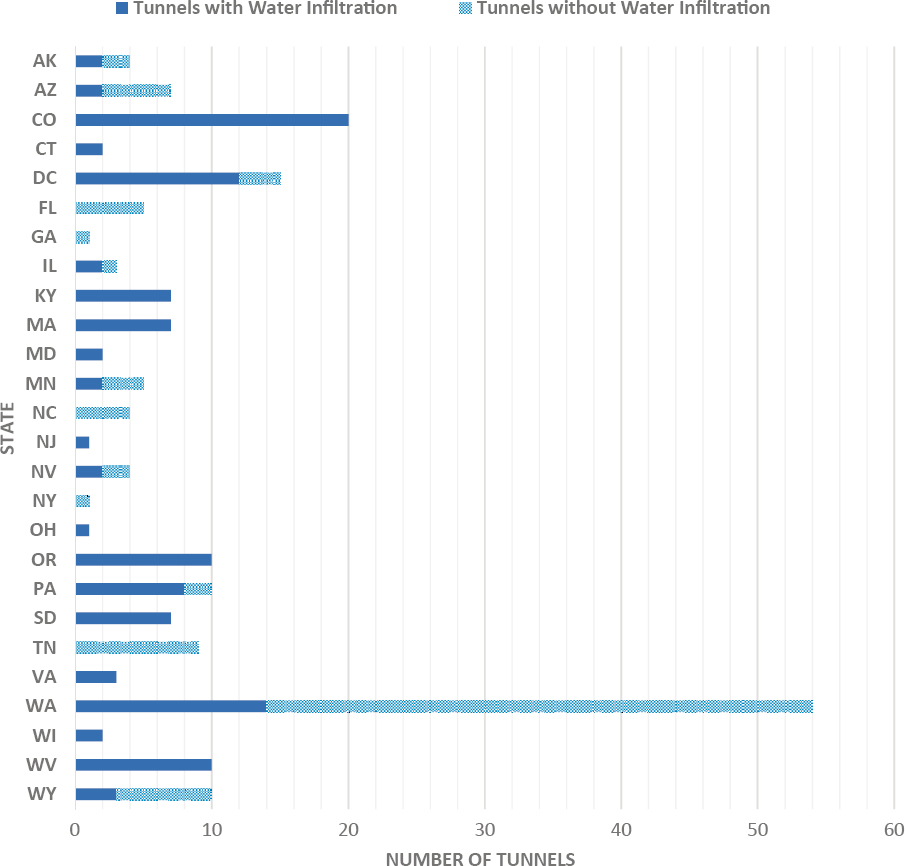
Recognizing that many survey respondents would not know the answer to this question, the intent was to identify other potential resources with valuable experience in controlling water infiltration. CDOT and PennDOT listed 12 and 13 tunnels, respectively, within their states known to have water infiltration issues and owned by others. Chapter 4, Case Examples, provides more information on the tunnels owned by others in Pennsylvania.
The survey asked states about the problems that result from water infiltration within their tunnels. Figure 7 shows that the most common problems caused by water infiltration in state DOT highway tunnels are structural deterioration and icicles. Deterioration of functional systems and/or their supports is another prevalent problem. Respondents indicated they address structural deterioration as it arises on a case-by-case basis, often using maintenance contractors or on-call specialty contractors to make repairs and/or mitigate hazards. The formation of icicles, along with slippery roads, are hazards that occur when temperatures are low. DOTs noted they regularly monitor for icicles and remove them before their size begins to pose hazards to motorists; some DOTs have had to stop traffic or close lanes so icicles can be removed. Roadways are treated with deicer chemicals, including the roadways approaching the tunnels. Six DOTs responded they have had problems with mineral deposits forming in the drainage system of their rock tunnels because of infiltration. To address this issue, they flush the drainage system
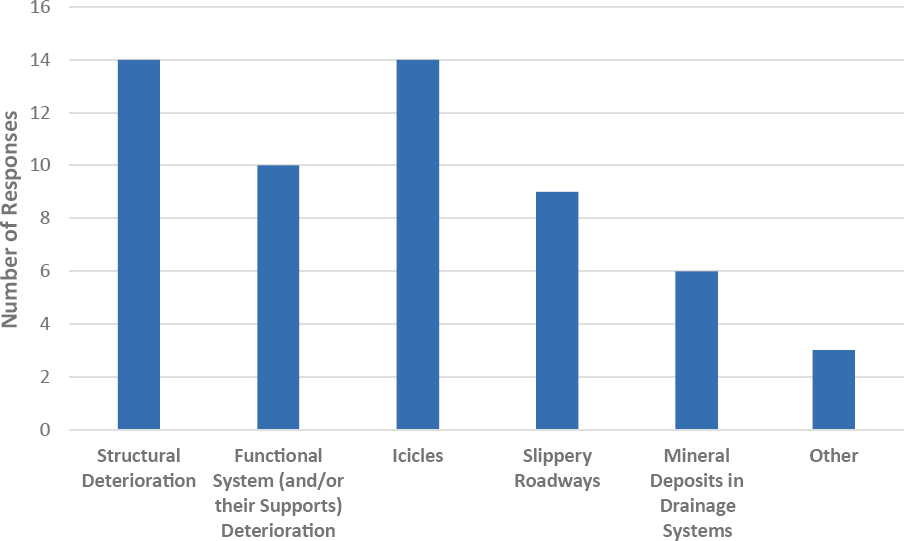
annually, and one agency indicated they have established large collection systems to collect the water before it is sent to the drainage system. Three DOTs commented that water infiltration is a nuisance for them and causes tile failures and staining.
Locating Leaks and Identifying the Sources
How best to locate and identify the source of leaks varies according to tunnel construction type, substrate, and location (such as when utilities may contribute to water infiltration). Of the 26 DOTs with leakage issues, 22 agencies find water infiltration through visual inspections. Most of the responding DOTs have little experience using non-destructive testing (NDT) methods such as ground-penetrating radar (GPR), high-resolution photogrammetry, LiDAR scans, or thermography; 20 of the 26 responding DOTs said they have not used any of these methods to detect leaks. Six DOTs indicated they had prior experience with at least one of the NDT methods (e.g., GPR). Figure 8 presents the various methods DOTs use to identify the location of water infiltration.
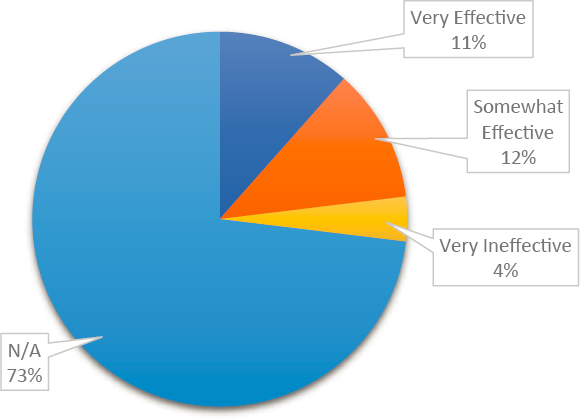
Seven DOTs reported on the effectiveness of NDT methods for detecting leak locations. Three of them thought it was very effective; three thought the methods were somewhat effective; and one responded it was very ineffective. Two of the positive respondents were interviewed; Chapter 4, Case Examples, provides more information on their experiences. The NDT effectiveness results are summarized in Figure 9.
As shown in Figure 10, groundwater and surface runoff are the primary sources of infiltration in tunnels for the responding DOTs. Almost all responding DOTs indicated groundwater or surface runoff or both were the source(s) of infiltration in their tunnels. Two responding DOTs identified utilities as the primary source of infiltration while one DOT indicated that staff are still trying to determine the source of infiltration in their tunnels. Another DOT indicated the source of water might be an irrigation system for the park above their tunnel. As indicated in Figure 11, to determine the water source, state tunnel owners typically investigate the construction documents

for the presence of potential contributors to infiltration, such as utilities, and, if utilities are present, tunnel owners may proceed with chemical testing or dye testing to confirm the source. Five states have used these testing methods to help identify the source of infiltration. Also a few DOTs indicated they detected the leakage and tracked the source during visual inspections.
Tunnel-Specific Information on Water Infiltration
To gain an understanding of the extent of water infiltration in state DOT tunnels, the next section of the survey requested input on specific tunnels to facilitate an understanding of water infiltration in certain tunnel conditions. The type of tunnel and its substrate were included in the


questions so as to better understand the tunnel construction method and look for relationships among types of tunnels and locations and sources of leaks. Table 3 is organized by tunnel type and substrate to facilitate comparison of similar tunnels.
The information provided in Table 3 represents responses from 23 different DOTs and includes information on 57 different tunnels. Two DOTs provided one entry to address all their tunnels. Conditions (e.g., tunnel types, substrates, and the sources and locations of water infiltration) vary among the DOTs:
- Cut-and-cover tunnels (15) are constructed in soft ground or mixed conditions. Of the 10 states providing input on cut-and-cover tunnels, 4 states indicated a high level of concern for infiltration (either 1 = Top concern/needs remediation within 2 years or 2 = High concern/remediation planned in next 5 years). The remaining six DOTs rated water infiltration as a 3 or 4 in terms of priority (3 = Concerning but Not High Priority and 4 = Not a concern). For all the cut-and-cover tunnels, surface runoff, utilities, and groundwater are the sources of infiltration, and joints (8 of 15) and cracks (5 of 15) are the locations of greatest leakage. Two tunnels have penetrations through the liner as the greatest contributor to leakage.
- Horseshoe or oval drill-and-blast tunnels (14 entries), representing 23 tunnels (West Virginia DOT listed all 10 tunnels in one entry). Twenty of these tunnels were constructed through rock, two were constructed through mixed conditions, and one tunnel substrate was unknown. The level of concern for the infiltration varied from high to low. Groundwater and surface runoff were cited as the primary sources of infiltration. Joints in the liner (15 of 23) and cracks (6 of 23) were listed most frequently as the primary locations contributing the heaviest leakage. Other leakage locations were penetrations through the liner (1 of 23) and transitions in structure (1 of 23).
- Two tunnels are circular shield-driven or circular TBM tunnels. Both were listed as being constructed in mixed conditions. Joints were the primary location for groundwater entry, but penetrations through the liner were also noted.
- Four tunnels included in Table 3 are horseshoe or oval SEM tunnels. These tunnels are typically constructed in soft ground or mixed conditions. Groundwater and surface runoff were the primary sources of infiltration, and the worst leakage was at joints and cracks in the liner.
- Six unlined rock tunnel entries were included in the listing, accounting for 12 tunnels (South Dakota DOT listed 7 tunnels in one entry). These tunnels are typically designed as drained structures, with water permitted to infiltrate through cracks in the rock. Because the rock where these tunnels were constructed is likely less fragmented and permeable, the DOTs indicated relatively low levels of concern for water infiltration. Cracks in the rock were cited as the primary source of water for these tunnels; one tunnel owner noted that a roadway over the tunnel portal section is the location of the primary source of water.
- VDOT included one tunnel that is circular and was constructed with the immersed tube method. Water infiltration was a top concern, and the primary location of infiltration is through the joints.
The summary of results reflects the various tunnel construction types that exist across the United States and that joints and cracks in the liner are where water infiltration is the greatest.
Leakage Mitigation Methods
The decision to initiate a leakage remediation project varies by state and the thresholds they consider may vary by tunnel based on conditions. DOTs indicated that when the water infiltration in a tunnel causes issues that affect the flow of traffic or the safety of the traveling public (e.g., icicles over traffic, ponding, or slippery roadways), then control of leaks is prioritized. DOTs also noted consistent leakage resulting in structural deterioration and affecting functional system safe performance and longevity necessitates remediation projects to prevent further deterioration and potential safety hazards.
Table 3. Sampling of state DOT tunnels with leakage.
| DOT TUNNELS WITH LEAKAGE | |||||||
| Tunnel Shape and Construction Type | Primary Substrate Makeup Behind Tunnel Liner | State | Tunnel Name | Leakage Level of Concern/Priority of Repair | Primary Sources of Water Infiltration | Location(s) of Water Infiltration | Location Contributing Heaviest Leakage |
| Circular Shield-Driven | Mixed conditions | MD | Baltimore Harbor Tunnel | 3 - Concerning but not high priority | Groundwater; Surface runoff | Penetrations through the liner | Joints |
| Circular TBM Tunnel | Mixed conditions | FL | Port of Miami | 4 - Not a concern nor top priority | Surface runoff | Unknown | Unknown |
| Circular Immersed Tube | Not certain | VA | Hampton Roads Bridge/Tunnel | 1 - Top concern/needs remediation within 2 years | Groundwater | Joints; Cracks | Joints |
| Cut-and-Cover Rectangular Box | Mixed conditions | AZ | Deck Park Tunnel | 2 - High concern/remediation planned in next 5 years | Utilities | Joints | Joints |
| Mixed conditions | DC | 173 | 1 - Top concern/needs remediation within 2 years | Still investigating | Joints; Penetrations through the liner | Joints | |
| Mixed conditions | MD | Baltimore Harbor Tunnel | 3 - Concerning but not high priority | Groundwater; Surface runoff | Joints | Joints | |
| Mixed conditions | MN | Portland Rigid Frame-Bridge Number 27851 | 3 - Concerning but not high priority | Surface runoff | Joints | Joints | |
| Mixed conditions | OH | Lytle Tunnel | 3 - Concerning but not high priority | Groundwater | Cracks | Cracks | |
| Mixed conditions | WA | Alaskan Way Tunnel | 1 - Top concern/needs remediation within 2 years | Groundwater; Surface runoff | Joints; Cracks; Transitions in structure types; Penetrations through the liner | Penetrations through the liner | |
| Soft ground | IL | 016-2020 Hubbards Cave | 4 - Not a concern nor top priority | Surface runoff | Joints | Joints | |
| Soft ground | IL | 016-1171 SB Lower Wacker Tunnel | 4 - Not a concern nor top priority | Groundwater | Joints | Joints | |
| DOT TUNNELS WITH LEAKAGE | |||||||
| Tunnel Shape and Construction Type | Primary Substrate Makeup Behind Tunnel Liner | State | Tunnel Name | Leakage Level of Concern/Priority of Repair | Primary Sources of Water Infiltration | Location(s) of Water Infiltration | Location Contributing Heaviest Leakage |
| Cut-and-Cover Rectangular Box | Soft ground | MA | I-90 Connector | 2 - High concern/remediation planned in next 5 years | Groundwater; Utilities; Surface runoff | Joints; Cracks; Penetrations through the liner; Embedded Utilities | Joints |
| Soft ground | MA | Thomas P. O’Neill Jr. | 2 - High concern/remediation planned in next 5 years | Groundwater; Utilities; Surface runoff | Joints; Cracks; Transitions in structure types; Penetrations through the liner | Cracks | |
| Soft ground | MA | Ted Williams | 2 - High concern/remediation planned in next 5 years | Groundwater; Utilities; Surface runoff | Joints; Cracks; Transitions in structure types; Embedded utilities | Cracks | |
| Soft ground | NJ | NJ 29 Tunnel | 3 - Concerning but not high priority | Surface runoff | Joints; Cracks | Joints | |
| Soft ground | WI | B-40-832 | 3 - Concerning but not high priority | Surface runoff; Utilities | Cracks; Joints; Penetrations through the liner | Penetrations through the liner | |
| Soft ground | WI | B-40-821 | 3 - Concerning but not high priority | Surface runoff; Unknown | Cracks; Joints | Cracks | |
| Soft ground | WI | B-40-827 | 3 - Concerning but not high priority | Surface runoff; Unknown | Cracks; Joints | Cracks | |
| Horseshoe or Oval Drill- and-Blast | Mixed conditions | AZ | Mule Pass Tunnel | 2 - High concern/remediation planned in next 5 years | Surface runoff | Cracks; Joints | Cracks |
| Mixed conditions | PA | Squirrel Hill Tunnel - PennDOT District 11 (Allegheny County) | 4 - Not a concern nor top priority | Groundwater; Surface runoff | Joints; Roof of tunnel buildings; Icicle buildup on portal facades of tunnels | Roof of tunnel portal buildings | |
| Not certain | WA | Mount Baker Ridge Tunnel | 1 - Top concern/needs remediation within 2 years | Groundwater | Joints; Cracks | Joints | |
| Rock | CO | Boulder Tunnel | 1 - Top concern/needs remediation within 2 years | Surface runoff | Cracks | Cracks | |
| Rock | AK | Portage Lake Tunnel | 3 - Concerning but not high priority | Surface runoff; Groundwater | Cracks; Penetrations through the liner | Penetrations through the liner | |
| Rock | CO | Eisenhower Tunnel | 1- Top concern/needs remediation within 2 years | Groundwater; Surface runoff | Joints; Cracks; Penetrations through the liner | Cracks | |
| Rock | CT | Bridge TU00773, Heroes Tunnel | 2 - High concern/remediation planned in next 5 years | Groundwater; Surface runoff | Joints; Cracks | Cracks | |
| Rock | KY | 099BT0001N | 4 - Not a concern nor top priority | Groundwater | Cracks | Cracks | |
| Rock | NV | US 50 Dave Rock Tunnel Eastbound | 3 - Concerning but not high priority | Groundwater | Joints; Cracks | Joints | |
| Rock | NV | US 50 Dave Rock Tunnel Westbound | 3 - Concerning but not high priority | Groundwater | Joints; Cracks | Joints | |
| Rock | OR | Vista Ridge Tunnel | 3 - Concerning but not high priority | Groundwater; Surface runoff | Cracks; Joints; Transitions in structure types; Penetrations through the liner | Joints |
| DOT TUNNELS WITH LEAKAGE | |||||||
| Tunnel Shape and Construction Type | Primary Substrate Makeup Behind Tunnel Liner | State | Tunnel Name | Leakage Level of Concern/Priority of Repair | Primary Sources of Water Infiltration | Location(s) of Water Infiltration | Location Contributing Heaviest Leakage |
| Horseshoe or Oval Drill- and-Blast | Rock | OR | Cape Creek Tunnel | 3 - Concerning but not high priority | Groundwater; Surface runoff | Cracks; Transitions in structure types; Joints; Penetrations through the liner | Cracks |
| Rock | WV | All (10) | 3 - Concerning but not high priority | Groundwater | Joints; Penetrations through the liner; Cracks | Joints | |
| Rock | PA | Stowe Tunnel - PennDOT District 11 (Allegheny County) | 4 - Not a concern nor top priority | Groundwater | Joints; Cracks | Joints | |
| Horseshoe or Oval SEM | Mixed conditions | CO | Johnson | 1 - Top concern/needs remediation within 2 years | Groundwater; Surface runoff | Joints; Cracks; Transitions in structure types; Penetrations through the liner | Transitions in structure types |
| Rock | MN | Silver Creek/Hasty TH61 North Shore Tunnels | 3 - Concerning but not high priority | Groundwater | Cracks | Cracks | |
| Soft ground | KY | 061CT0001N | 4 - Not a concern nor top priority | Groundwater; Surface runoff | Joints | Joints | |
| Soft ground | KY | 096BT0001N | 4 - Not a concern nor top priority | Groundwater | Joints | Joints | |
| Unlined Rock | Rock | AK | Anton Anderson Memorial Tunnel | 3- Concerning but not high priority | Groundwater; Leakage through the rock from the glacier above | Cracks | Cracks |
| Rock | NY | Breakneck | 4 - Not a concern nor top priority | Surface runoff | Portals (basically its water flowing on the road) | Portals | |
| Rock | SD | All of our tunnels (7) would be similar - none that has more or less than the others. | 4 - Not a concern nor top priority | Groundwater; Surface runoff | Unlined bare rock tunnels - in cracks/joints of the rock | Unlined bare rock tunnels - in cracks/joints of the rock | |
| Rock | WY | Wind River Canyon Tunnel 1 | 3 - Concerning but not high priority | Groundwater | Cracks | Cracks | |
| Rock | WY | Wind River Canyon Tunnel 2 | 3 - Concerning but not high priority | Groundwater | Cracks | Cracks | |
| Rock | WY | Wind River Canyon Tunnel 3 | 3 - Concerning but not high priority | Groundwater | Cracks | Cracks |
DOT tunnel owners have used various leak remediation methods—from drainage troughs to injection of materials in leaks. The survey asked what methods have been used to stop leaks, what has had success for more than 10 years at stopping leaks, and what has been most successful. Figure 12 shows the number of responses for various leak remedies.
From the results, DOT tunnel owners most commonly use catchment systems (by redirecting drainage with troughs, pipes, gutters, and other means) to control water infiltration. This method was rated the highest for being successful after 10 years and for being most successful overall. This is a common control method for drained tunnels but is also a common remediation for any type of tunnel to help direct the water to the drainage system to prevent hazards and deterioration. The next most frequent repair methods are repairing or replacing joint material to prevent the inflow of water through tunnel joints and injection of cracks with grouts. Of these methods, crack injection was identified as the more successful over the long term. The other methods in Figure 12 have not been used extensively by state DOTs. When it is possible to excavate and repair or install new waterproofing on the outside (positive side waterproofing) of the tunnel, half of the respondents that did this indicated the results have been favorable for the long term.
The results in Figure 12 show a reduction in the number of responses for most of the mitigation methods when considering effectiveness of the treatment over time. One potential explanation for this reduction may be because the remediation work was less than 10 years old or the DOT representative responding to the survey did not have knowledge of repairs completed more than 10 years prior. However, based on the results received, DOTs have had most success by attempting to control water infiltration by redirecting drainage through catchment systems rather
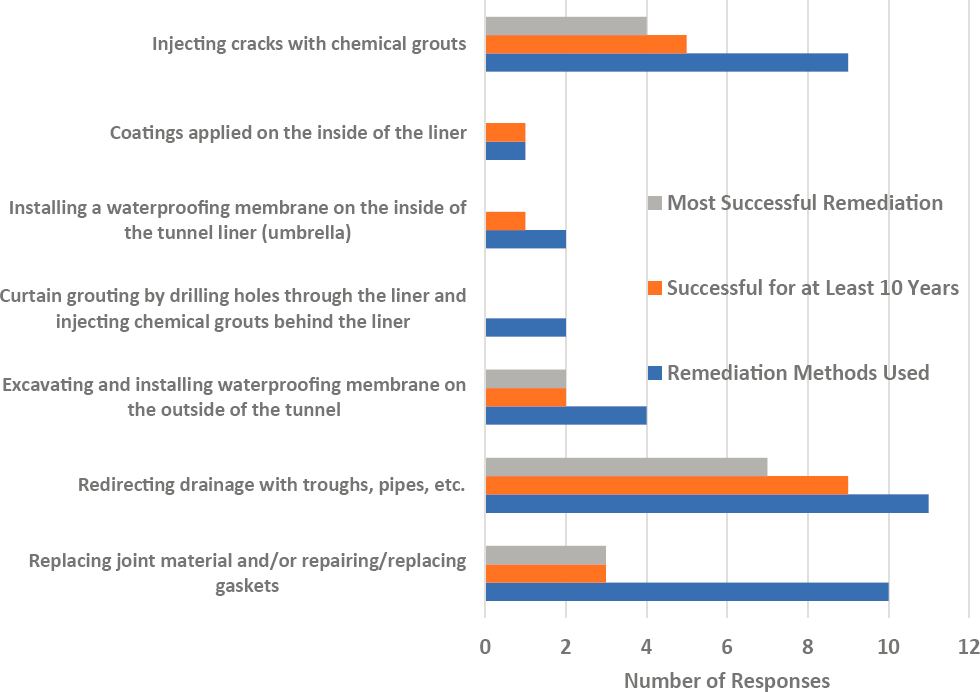
than eliminating leakage altogether. Injecting cracks and joints with chemical grouts has also been relatively successful according to the survey respondents and has had more success than repair of joints.
The DOT tunnel owners responding to the survey voiced frustrations in trying to mitigate leakage in their tunnels. Of the 26 responses, most (23) commented that the remediation was not effective in the long term, or the water moved to a new location, or there was so much water that it was difficult to control. One DOT explained the challenge they experience with water infiltrating in a drained (open) tunnel where the volume of infiltration is large. Although an umbrella system might help to direct the water to the drainage system, the DOT’s concerns for maintenance and long-term durability of a new umbrella have led them to the contain-and-control approach. Durability of mitigation systems was raised by one DOT as a problem in mitigating leakage; effective mitigation methods may be limited in extreme climates where the structure is subject to wide temperature variations. Three of the respondents noted challenges in locating the point of infiltration and identifying its source. These tunnel owners have structures in urban areas where utilities and irrigation systems atop the tunnels may be the source of infiltration.
Acceptance Criteria
The results of the survey underscore the challenges in addressing water infiltration in underground structures. Recognizing that complete water tightness of tunnel structures, when constructed below ground and below the water table, is difficult to achieve, acceptance criteria may be considered for inclusion in contracts. The survey investigated leakage acceptance thresholds for new construction and for rehabilitation/leak remediation projects. For new construction projects, only WSDOT uses leakage criteria in tunnel construction contracts. No acceptance criteria were provided for rehabilitation/leak remediation projects.
Future Research
Finally, DOTs were asked about what information would be most helpful to them in mitigating water infiltration. The responses can be categorized in two primary areas: (1) methods to remediate leaks and their effectiveness and (2) locating and identifying the source of infiltration. Many respondents indicated wanting more information on specific methods to be used for various types of tunnels, methods to be used in extreme temperatures, and the effectiveness of various methods. Such respondents were interested in (1) the limitations of specific methods or materials and (2) successful techniques and lessons learned from other DOTs on materials used in the past. Several DOTs wanted more information on identifying the sources of leaks, including the use of NDT methods for locating leaks. These responses are reflected in the future research for this topic in Chapter 5, Summary of Findings.


