Artificial Intelligence Opportunities for State and Local DOTs: A Research Roadmap (2024)
Chapter: Appendix C: Synergy Analysis and Interview with DOTs
NCHRP 23-12
ARTIFICIAL INTELLIGENCE OPPORTUNITIES FOR STATE AND LOCAL DOTS – A RESEARCH ROADMAP
Appendix C: Synergy Analysis and Interview with DOTs
Prepared for NCHRP
Transportation Research Board
of
The National Academies of Sciences, Engineering, and Medicine
TRANSPORTATION RESEARCH BOARD OF THE NATIONAL ACADEMIES OF SCIENCES, ENGINEERING AND MEDICINE PRIVILEGED DOCUMENT
This document, not released for publication, is furnished only for review to members of or participants in the work of NCHRP. This document is to be regarded as fully privileged and the dissemination of the information included herein must be approved by NCHRP.
Laurel Glenn
Aditi Manke
Alejandra Medina
Matthew Camden
Rich Hanowski
Abhijit Sarkar
Virginia Tech Transportation Institute
Blacksburg, VA
Permission to use an unoriginal material has been obtained from all copyright holders as needed
Introduction
This report targets Task 3 of the project, aimed at obtaining a snapshot of where state DOTs are in their adoption, understanding, and needs for successful implementation of AI-based methods to solve their state’s transportation problems. This also includes understanding challenges, the current state of infrastructure in DOTs for such adoptions, and the requirements that DOTs may have to adopt AI-based applications. The report summarizes these topics through a series of interviews with DOT personnel.
Following is the description of a few transportation topics discussed across the interviews where integration of AI could be beneficial to the DOTs:
- Incident Detection: Involves collection and analysis of traffic data. AI methods such as NLP and ML tools can be used to detect and predict traffic incidents using data from sensors, videos, images, connected vehicles messages, and other sources of data. AI can reduce the time to detect incidents and can be embedded in the CCTV cameras. Further, ML tools can be used in real time by DOTs to forecast traffic delays and queues due to incidents (Vasudevan et al., 2020).
- Traffic Management: “Refers to the organization, arrangement, guidance, and control of stationary and moving traffic which includes pedestrians, bicyclists and all kinds of vehicles” (Underwood, 1990). ML algorithms, computer vision, sensors, and data analytics tools can collect and analyze traffic data to provide solutions and apply them to the traffic infrastructure. These tools are beneficial in monitoring road conditions, travel time, and traffic signals, which can help reduce congestion and maximize fuel consumption.
- Safety: Measures and methods undertaken by agencies to reduce road accidents. AI can be useful in capturing the spatial-temporal patterns of accidents in crash databases and identify patterns for which mitigation strategies can be provided (Abduljabbar et al., 2019).
- Asset Management: AI tools can be used to address the strategic and systematic process of operating, maintaining, and improving physical assets of transportation throughout their lifecycle. The physical assets include pavements, bridges, pavement markings, signs, guardrails, slopes, culverts, etc. (Vasudevan et al., 2020).
- Transportation System Management and Operations (TSMO): A set of processes and programs that can optimize the performance of existing infrastructure through application of services, systems, and projects to improve the safety, security, and reliability of transportation systems. Intelligent tools like deep learning, fuzzy logic models, land use data, NLP, etc., can cover a range of TSMO programs such as work zone safety, traffic incident management, ramp metering, and adaptive traffic signals (Vasudevan et al., 2020).
Methods
For this study, VTTI researchers conducted eight 90-minute Zoom videoconference interviews with individuals who work for or with state DOTs. Participants were individuals who work on transportation issues and are involved with, or interested in, incorporating AI in their state’s DOT work. The 90-minute session included four key segments where the DOT personnel discussed the following four topics:
- Current AI practice: Many DOTs have already started to adapt AI techniques and advanced sensor technologies for selected applications. For example, the city of Bellevue, Washington, partnered with Microsoft to study traffic patterns and intersections using cameras and computer vision to detect and track cars, pedestrians, and bicyclists (Samara et al., 2020). In this segment, we planned to get a broad understanding of areas where DOTs have already started using AI-based solutions, their maturity level, and satisfaction level. This also highlighted if DOTs are already using advanced AI methods including deep learning-based solutions in their research and development.
- Challenges with AI work: Adaptation of a new technology poses a variety of challenges. In this segment, we wanted to hear from experts in DOTs about the challenges that they have faced with such adaptation.
- Workforce and infrastructure related to AI: Most AI applications and developments require specific hardware- and software-based infrastructure, skilled labor and engineers, and specialized project management skills. In this segment, we aimed to understand if DOTs have such workforce and infrastructure.
- Future direction: AI is a growing field and has shown promise in multiple transportation-related areas. In addition, with the possible deployment of automated and connected vehicles in the coming years, new research areas and associated challenges are expected to emerge. In this part of the interview, we aimed to understand how DOTs are planning to use AI in the next 5 to 10 years to address current and future problems.
Participant Recruitment
Researchers recruited participants for interviews on AI opportunities for state and local DOTs via email. The team initially contacted 55 individuals to introduce the study and to request their participation or solicit recommendations for others who may be interested in participating in this research project or could help spread the word to gain participation (See Appendix A). Researchers reached out to the following Transportation Research Board committees: AED50 Standing Committee on Artificial Intelligence and Advanced Computing Operations, ACS20 Safety Performance and Analysis, and ACS10 Safety Management Systems. In addition, researchers also reached out to employees from 25 state DOTs. Twenty-four individuals from 11 states reported interest in participating in the interviews. We selected eight states for final interview.
Data Collection
This research project was approved by Virginia Tech’s Institutional Review Board (IRB # 22-411). All participants were interviewed via Zoom (virtual meeting application). During the interviews, a researcher verified that all participants had read the informed consent form previously sent to them and went over key information from the form. Researchers also gave all participants a brief introduction to the purpose of the interviews and introduced the four main areas of conversation for the interview: current AI practice in their state DOT, challenges with AI work, workforce and infrastructure needed for AI work, and the future scope of AI integration (See Appendix B). Each topic was discussed for approximately 15 minutes. After discussing the four main topics, researchers opened the discussion to any other thoughts or comments about the use of AI in state DOT operations that participants still wanted to discuss. At the conclusion of the interview, researchers thanked everyone for their time and gave a brief overview of the upcoming workshops with stakeholders regarding the status of AI practices and future research needs. Participants were informed that they would receive an email about workshop participation in the near future as well as a link to a survey asking a few more questions about AI use at their state DOT (See Appendix C).
Data Analysis
Researchers reviewed interview transcripts and performed a content analysis to glean key themes and subthemes regarding the four main topics that were presented in each interview. Researchers then combined information from all the participating state DOTs and developed a list of all the topics presented from all the interviews. Additionally, researchers noted:
- How many state DOTs were engaged in each AI activity,
- Each concern regarding challenges in implementing AI,
- AI workforce and infrastructure needed, and
- How they envisioned future AI activities within their DOT.
Results and Analysis
Eight state DOTs, including 29 individuals, participated in the interviews. In addition to the 24 who initially reported interest, five additional individuals from state DOTs joined one of the interviews. The participating states represented northwest, south, and mid-east regions of the U.S. The individuals participating held positions in traffic operations, research and innovation, and IT departments within their DOTs. Six individuals from five different states completed the survey.
Current AI Practices
This section aimed to understand the key areas within transportation where state DOTs envisioned that AI applications could be useful or where they might incorporate AI to resolve certain transportation-related concerns in the state (e.g., traffic management, pavement, road safety, etc.). In addition, the team was interested to know if there were any successful cases of AI deployment. The responses under this section are categorized into three sub-sections: 1) transportation focus areas which are a priority for state DOTs and where they perceive AI will be useful, 2) examples of areas in which AI is currently being incorporated within the DOTs, and 3) collaboration efforts with private sector or academia to implement AI methods.
Transportation Focus Areas for DOTs and Where AI Can be Used
- Incident management and detection: Five state DOTs stated that one of the top priorities for their state was incident detection and management. Participants mentioned that using ML or AI technologies in this sector could provide them with accurate information and fast notifications of incidents and crashes on a highway, which in turn could allow them to respond more quickly to the situation.
- Traffic management: Three state DOTs noted that one of their focus areas was controlling and monitoring traffic. One participant noted that AI could be useful for active traffic management to monitor and better optimize the traffic flow before any incident occurs, such as a crash or traffic jam.
- Safety: Five state DOTs indicated that ensuring road safety and reducing fatal accidents in their state were key priorities but offered no suggestions on how AI could help improve work in this area.
- Mobility: Two state DOTs highlighted mobility as a high priority issue and emphasized the importance of maintaining the performance of their transportation systems. These participants felt that connected mobility can help in reducing congestion and highlighted the importance of working with other modes of transportation and the private sector to provide reliable services.
- Asset Management: Two state DOTs discussed the importance of asset management and how it helps states improve their efficiency. Incorporating AI into asset management could help improve the management of multiple assets within DOT departments, such as using connected vehicles to gather information on asset and traffic conditions for situational awareness.
- Infrastructure: Two state DOTs noted that assessment and extending the lifecycle of infrastructure was a top priority for their state agency, including using ML algorithms to monitor the deterioration of pavement or bridges and taking necessary actions to extend the life of the infrastructure.
- Transportation Systems Management and Operations: Three state DOTs stated that operations were one of their priority focus areas. The focus for these states is not to expand the roadway network, but rather to improve the existing transportation systems through technologies. Some of the priorities within operations discussed during the interviews included maintenance and upkeep of the infrastructure, pedestrian detection at traffic signals, analyzing archived data for errors, and
- determining better operating parameters. All three participants who mentioned operations as a priority felt that integration of AI or ML technology would improve the optimization of operations.
- Multimodal: Three state DOTs stated that developing and managing a transportation system with a multimodal perspective was a priority. One participant noted that multimodal connectivity would be useful in reducing and managing congestion. A participant from another state touched upon a complete streets project, where completing the multimodal network for all modes—from pedestrians to bicyclists to public transit—was one of the focus areas. Incorporating AI could facilitate safe integration of various modes of transportation.
- Pavement: For two state DOTs, measuring pavement condition, performance, and how pavement can affect safety was a key priority.
- Project Prioritization: One state DOT discussed the importance of ranking the state’s project needs and how AI could assist with determining what exactly needs to be done and when.
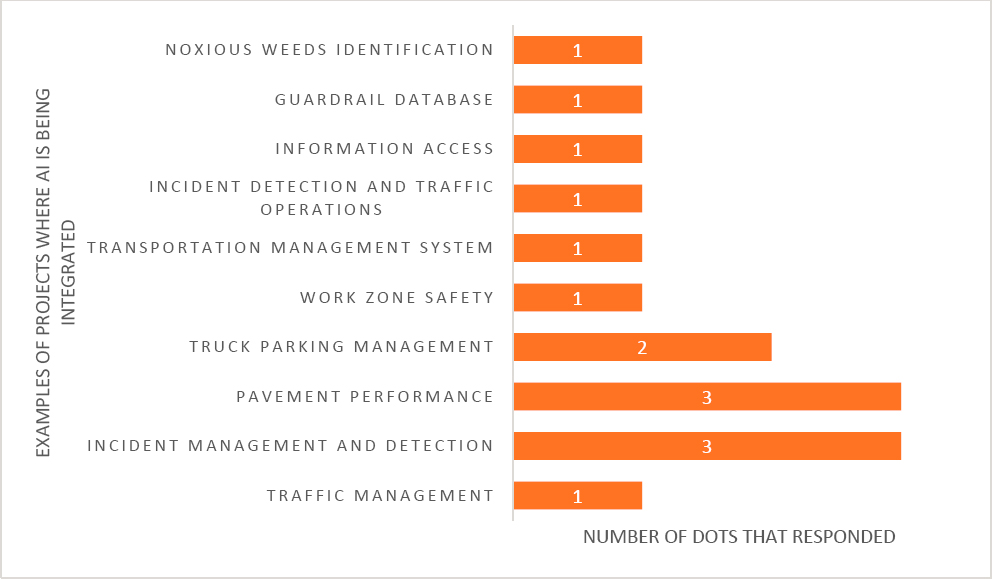
Examples of Projects where AI is Being Integrated
-
- Traffic Management: One state DOT has created a travel website to tackle traffic management. The platform takes data from all the sensors and traffic monitoring systems at state, municipal, and county levels and gives access to traffic time, congestion, construction, incidents, camera views, and information about where and what dynamic signage are posted. This platform also incorporates available data from neighboring states. The DOT mentioned that this project was not an exclusive application of AI, but that it could be treated as the first stage of AI, which is now starting to centralize and transform the physical world into a digital world. With this platform and collected data, they feel that more AI work can be accomplished. A county within this state collects real-time camera and traffic signal data through a fiber optic network. Using this data, the traffic operators respond to issues like congestion by adjusting the signal timings or by dispatching messages. This application, which is facilitated by a privately owned, digitally enabled solutions provider, will be integrated across the state for critical infrastructure decision-making.
- Incident Management and Detection: Three DOTs mentioned that they are exploring the use of AI technology in incident management and detection. One of the DOTs described that in one city, they receive data on incidents from various sources, including traffic vision video analytics, 911 dispatch calls, and a third-party provider. The issue with these multiple methods of incident detection is that the DOTs do not know which source will notify them first about the incident and they end up with duplicate entries. This scenario could be avoided with the help of ML wherein duplicate entries of the same incident could be deleted and not clog the flow of information.
- Another city under the same DOT jurisdiction is using an AI tool (provided by a private company) which filters duplicate entries and detects where the crash has occurred. In the city’s last quarterly report, the system was able to detect 13% of the crash locations according to DOT personnel. This DOT has yet to implement any AI technology for incident management and detection but is currently discussing its usefulness. They believe that AI tools could help them reach the scene of a crash faster and help them stage safety service patrols in the areas where AI predicts crashes are most likely to happen.
- The third state DOT exploring AI use in incident management and detection has procured a product from a private company called Citilog. The system in use actively looks for incidents using video detection cameras. They are currently operating this system on one of the state route tunnels.
- Pavement Performance: Three DOTs mentioned data tools and AI applications they are currently using or procuring to measure pavement performance. In one state, the DOT uses a data collection tool that investigates the geometry of the roadway, cross slopes, and rut depths. They are looking into the potential of tying hydroplaning to crash data to understand where the
-
- geometry of the roadway can lead to crashes. This DOT recently finished a research project conducted in conjunction with an academic institution where they used 3D pavement images to look for raveling on the pavement. The 3D product was procured from a private company which produces laser crack measurement systems.
- Another state DOT talked about using computer vision and ML algorithms to study the deterioration of the pavement. For example, they discussed using ML to discover how fast some segments of the pavement are deteriorating compared to other segments. The DOT further discussed different vendors that use computer vision to identify pavement conditions and pavement marking conditions. For example, they classify each segment of pavement as having a condition between one and four, one being poor and four being good. The DOT stressed that they have about 12 to 15 million images covering every inch of the road in the state, and this is clearly an opportunity to use computer vision to extract information on signs, pavement markings, guard rails, etc.
- Finally, one DOT described their use of a van to take pictures of the roadways and to measure pavement distress. They then compare their measurements with field inspections of pavement distress. Currently, this DOT is assessing the accuracy of the measurements taken by the van and are working towards solely using the van measurements for information.
- Truck Parking Management: Two DOTs stated that they are using AI applications for truck parking management. In one state, the DOT is using AI to take images of truck rest areas and tracking how long trucks are parked there. If the truck is parked for too long, the images are then sent to law enforcement to investigate the situation.
- The second DOT has developed truck parking prediction algorithms in which cameras are set up at weigh stations, rest areas, and other locations. They visually monitor and use census magnetometers in the trucking stalls to determine the parking occupancy at various locations.
- Work Zone Safety: One DOT stated that they were evaluating a product which looks at work zone safety. The product is distributed by a third-party company that takes the information from crowdsourced video dash cams and stores it in a big data analytics system. Using ML algorithms, the product processes the information to look for work zone equipment such as barrels, cones, flashing lights, etc. According to the DOT, this kind of information could be used at some point for work zone compliance.
- Driver Behavior: One of the state DOTs partnered with an academic institution to implement an app that encourages commuters to earn cash rewards by using public transit, ridesharing, biking, and walking. The app learns people’s travel behavior using AI and algorithms.
- Transportation Management System: One DOT talked about a federal award they received to implement an advanced integrated transportation management system based on AI and ML. The project is currently at the stage of developing and implementing the software. Over the years, the DOT has installed a significant amount of detection technology and weather technology to monitor transportation systems. The project is at the point of data collection and storage, and data is being used for real-time operations. The DOT is currently testing the applications and working on the predictive portion of the system where the software uses data to predict what will happen in the future. According to the DOT, the program will not focus on traffic management alone; there are plans to integrate transit into the system.
- Incident Detection and Traffic Operations: One DOT elaborated on the plans of moving away from response-based approaches and its decision to automate incident detection and traffic operations almost 20 years ago. The DOT built its own advanced traffic management system rather than using the system that was available on the market. This allowed the DOT to design the system in a way that met their requirements for operational responses. Today, the DOT feels that they have a decision support system where the operator is given useful information regarding incidents. They are not looking for more AI, but rather for the same amount of help available within their system but for more datasets. The DOT requires a
- decision support system for multiple occurrent events instead of a single event. In future work, their goal is to consistently respond to incidents quickly.
- Information Access: One DOT previously conducted a manual modernization project where they used ML to mine the content of eight manuals and built ontologies with the assistance of subject matter experts in storm water, then used the information to auto tag the content. This project used an NLP back-end to do the auto classification and the DOT has done some concept extraction with the ontologies. The intent of the project was to improve access to relevant information across the manuals. The project showed that with better vocabulary management, the ontologies and ML improved the efficiency of information access. The ML aspect gives the ability to look up terms and filter content. The DOT added that they have not funded the implementation of this project. The DOT further elaborated that AI has more of an enterprise management role and that it is something that is procured in a product rather than something developed within the DOT.
- Guardrail Database: One DOT used photographs taken by a van which drives all state routes through the year to create a database of the guardrails within the state. This database includes information on where the guardrails are located, what type of guardrails are in each location, and their conditions. Once this system was refined, the process yielded 97% information accuracy. This information could then be used for maintenance and improvement needs.
- Noxious Weeds Identification: One DOT performed a proof-of-concept project identifying noxious weeds on the sides of the roads. Using photographs collected by their van along all roads, they tried to train an algorithm on identifying certain plant species. These plant species grow in a different manner and rate than normal grass and overrun other species of plants in the area or cause road hazards. This particular project only reached into the 70th percentile of accuracy; however, the DOT believes that with more time and training, this could be a useful area for AI.
Collaborations
- Six DOTs mentioned that they have collaborated with academic institutions to either implement or evaluate AI-related field research.
- Five DOTs stated that they have collaborated with private sector companies to evaluate company products related to AI and ML algorithms. Two DOTs mentioned that they are currently procuring products from these companies.
Challenges with AI Work
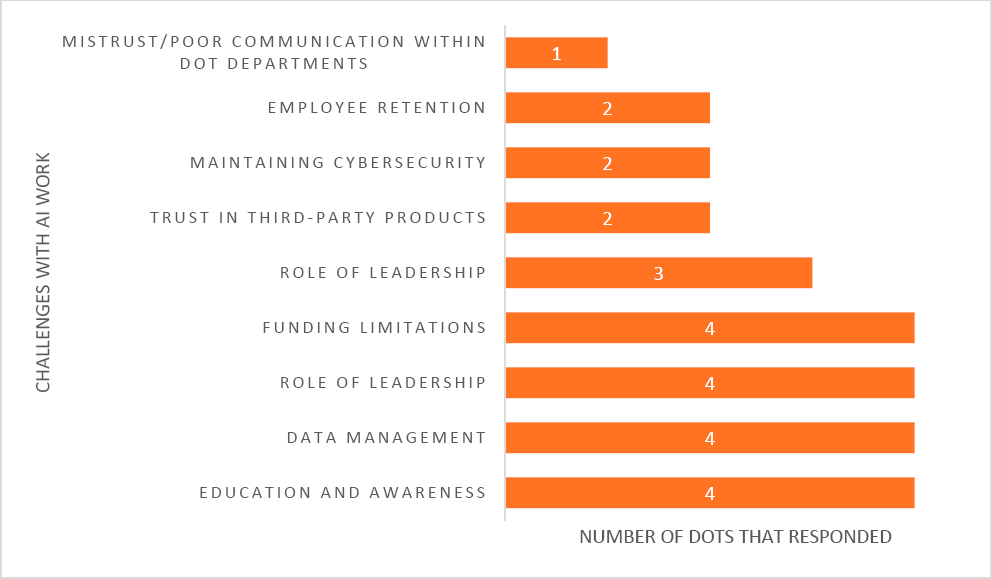
In this section, researchers asked DOTs what kind of challenges they have faced or anticipate with AI in terms of decision-making and planning, and how are they planning to overcome these challenges. There were nine challenges that emerged across the interviews.
- Education and Awareness: Four DOTs felt that there is lack of knowledge regarding AI and its use in DOTs. There is lack of understanding about the differences between various technologies. DOTs are looking for clarity on the definition of AI and a better understanding of the role of DOTs in emerging technologies.
- Data Management: Four DOTs indicated that data management and availability was a challenge. DOTs need the ability to store and maintain all the data they collect and a way to incorporate various data sources as more become available. They also need to have a system in place to manage duplicate records, as they are receiving continuous or timelapse data versus a single snapshot of data.
- Workforce Expertise in AI and ML: Five DOTs stated that they do have enough staff and people with experience who can understand and identify AI opportunities.
- Funding Limitations: Four DOTs stated that there was lack of funding to carry out big data analytics work. Funding limitations create a barrier for the DOTs to evaluate the products that are readily available in the market.
- Role of Leadership: Three DOTs expressed that it is difficult to get leadership on board with AI adoption. Sometimes it is hard to explain the benefits of AI and ML to upper management. Since these technologies come at a high cost, leadership is often hesitant to invest money in them.
- Trust in Third-party Products: For two DOTs, the challenge was to find “off-the-shelf” products from trusted companies. It is also a challenge to easily adapt and implement the software in a particular state based on what information is available in that state as data inputs into the system. According to one DOT, an agency-developed tool would be more useful in increasing the efficiency of the DOT.
- Maintaining Cybersecurity: Two DOTs saw challenge with cybersecurity. Further citing security concerns, they noted that they do not want to lose credibility with the public and it is important for them to protect personal citizen information.
- Employee Retention: Two DOTs expressed that it is difficult to retain employees who have ML or data science expertise. They face challenges in competing with the private sector, as private companies can offer salaries which are significantly greater than state wages.
- Mistrust/Poor Communication Within DOT Departments: One DOT mentioned that there is a trust and communication issue between departments within the DOT in handling AI responsibilities. The departments all have their role in the AI work and may not fully understand the ability of the other departments in this field, which can lead to a misunderstanding of what AI work is actually possible and needed for a project and who can perform the work properly.
Ways to Overcome Challenges
- Two DOTs felt it was important to listen to what other states are doing in terms of AI applications and to learn from them. They also highlighted that DOT employees need to attend webinars and listen to pitches from private companies.
- One DOT felt that it was equally important to have personal interactions with system operators to get qualitative data since there are times that key information might get buried under all the numbers and data points. This DOT noted that there is a higher chance of getting good information from field operators and people monitoring the cameras.
- For one DOT, a significant increase in the use of public-private partnerships from planning and design through long-term maintenance, operations, and life-cycle asset management would be helpful.
- One DOT uses Google Cloud to store, manage, and work with all their data to overcome their data storage and manipulation limitations.
Workforce and Infrastructure
Researchers asked the state DOT representatives what they needed in terms of workforce and infrastructure to be successful in AI integration. There were two main comments about workforce needs for successfully integrating AI in transportation work at DOTs and 14 suggestions about infrastructure needs.
Workforce
- Knowledgeable Individuals: All eight DOTs interviewed mentioned that one key component is having individuals with knowledge about AI methods working with the DOT. The current internal workforce skillset is not great enough for AI work. DOTs can contract some of this
- work out; however, the concern is that those outside individuals will not have the necessary institutional knowledge. In addition, accurate job descriptions need to be written in order to hire people to fill these roles in the governmental sector. Particular roles that the DOTs felt were needed in order to be successful are:
- Data scientists
- Data Analytics Team to build algorithms
- Software development team
- Technology managers
- Subject matter experts in ML
- Civil engineers
- Proper Compensation: One DOT noted that proper compensation is key to finding and retaining the individuals needed to work for the state DOT and assist with AI technology. One suggestion to meet this need while keeping budgets low was to outsource some of the work.
Infrastructure
- Willing Leadership: Three DOTs emphasized the need to have leadership within the DOT with the willingness and desire to use AI.
- Flexible Operating Systems: Three DOTs mentioned that DOTs will require operating systems that can continuously work with new data sources that are integrated into the system. These new sources should not cause system crashes. To ensure this capability, the DOT will have to test all new data sources and their integration into the current operating systems.
- Computer Processing Capabilities: Four DOTs mentioned the need for computer processing capabilities, possibly outside the DOT.
- Storage Capacity for Data: Three DOTs mentioned large storage capacity needs for data. As AI capabilities grow, so will the need for more and more data storage.
- Connected Data Platform: Two DOT representatives suggested that the data should come from all sources to one central system like an advanced traffic management system. However, data should also be allowed to easily flow back out of the centralized location.
- Funding: Three DOTs mentioned the large need for funding for the continued support of AI work.
- Fiber Network: Three DOTs mentioned the need for a network of fiber cables to improve AI activities. Fiber networking is currently the fastest way to move data. Enough fiber must be laid to handle the large amounts of data that will be coming though.
- Cameras: One DOT mentioned the need for a high number of cameras sufficient to support AI activities.
- Firewalls: One DOT stated the need for strong network security to protect all the data collected for AI activities.
- Technology Maintenance: One DOT mentioned the need for having a system and crew in place to ensure that all technology used for AI activities is serviced when needed and is in good working order to continue operations.
- Ability to Run Simulations: Two DOTs emphasized that the infrastructure data should be interconnected so simulations of situations can be run to assist the ML. Through the ability to run simulations, the DOT can gain confidence in the AI decision process, since it will not be relying only on a handful of real-life scenarios but rather on millions of simulated situations from which it has learned and created solutions.
- Flexibility in Approach to Product Adoption: One DOT stated that most of the DOT-related work takes an academic approach to testing new methods and products. This method takes a
- lot of time and funding. There are “off-the-shelf” products which could be useful to the DOT but the current framework for product adoption would need to change to become more flexible.
- Software Customization: One DOT highlighted that using “off-the-shelf” products can be less expensive than personal development and still useful for DOTs to find quick solutions to problems with AI. However, one DOT stated that these products would need to be customizable for the user so that the DOT can select the best solution for their state’s needs.
- Ethical Obligation of System Accuracy: The information generated by AI or ML algorithms must be accurate. Due to the availability of multiple free travel apps for the public, such as Google Maps, Apple Maps and Waze, one DOT felt that people had unrealistic expectations about how accurate released information is. The accuracy of these apps is below DOT standards and any work to create a better system needs to meet a very high accuracy mark to gain public trust. The accuracy of systems must be tested and validated before allowing them to run fully automated.
Future Scope of AI Integration
Finally, researchers asked state DOT representatives what their DOTs thought would be the most effective use of AI methods in future DOT work and in what areas they foresaw their DOT using AI in the next 5 to 10 years. Thirteen different areas of future work were mentioned, with the most commonly mentioned work being the use of AI in predicting conditions for use in traffic management. There were also topics mentioned that did not necessarily deal directly with a transportation topic but rather with how the DOT is run and how AI could help DOT departments run more effectively. Below are all the participating state-DOT-suggested AI topics of focus in the next 5 to 10 years.
- Prediction of Traffic Management: Six DOTs mentioned that they saw more AI involvement in the prediction of traffic management in the near future. They would like to see more predictive capabilities for traffic patterns and congestion as well as a system which can execute decisions proactively. For example, participants voiced the desire to have a system which not only predicts upcoming traffic patterns but one which makes manipulations, such as changing traffic signal timing or ramp metering logic, based on the predictions to avoid congestion or potential crashes.
- Asset Management: Three DOTs mentioned ways that AI methods could be used for improving asset management. They envisioned using AI methods to detect and predict maintenance issues. Systems would ideally have automatic alert triggers to schedule the appropriate maintenance needed and request the purchase of replacements when necessary. This work would effectively allow the DOTs to do more work with less human and behind-the-scenes effort.
- Vulnerable Road User (VRU) Protection: One DOT mentioned the use of AI in future work to increase the safety of VRUs. Using AI, this DOT would like to investigate near misses of VRU injuries/fatalities to identify risky areas and monitor interventions designed to increase the safety of VRUs.
- Incident Management and Detection: Three DOTs discussed that the future use of AI in their incident management and detection work would enable them to respond more quickly to hazardous situations on the road, be it debris in the roadway or a crash. Faster responses will lead to a faster resolution.
- 511 Integration: One DOT discussed how the integration of AI into the federal traffic and road closure information system (511) could provide real-time information and predictive analytics to motorists.
- Truck Parking: One DOT indicated that their state would like to use AI capabilities to advertise real-time truck parking spot availability for truck drivers.
- Vehicle Monitoring: One DOT believed that AI methods could be used for vehicle monitoring services on the roadway. Using AI, the DOTs could determine oversize and overweight trucks and ensure that the correct signage is being used. In addition, AI could help categorize all vehicles on the roads by length and weight for reporting purposes.
- Pavement Condition Monitoring: One DOT saw AI playing a large role in the supervision of pavement conditions. This DOT described using AI to determine how automated vehicles may impact pavement conditions. They also envisioned that suspension systems could be used to measure pavement conditions and to gather information on pavement surface texture. This information could then be used to create 3D representations of pavement lanes, which could be used to extract useful information.
- Mental Adoption of AI: One DOT voiced that over the next five years, AI may not be very integrated into actual DOT work, but that the mental adoption of using AI methods to further the work at state DOTs could be achieved.
- Cybersecurity Monitoring and Vulnerability Assessments: Currently, one DOT manages cybersecurity threats for roadside infrastructure by developing closed-loop systems and by pushing the data one way. Their system does not provide inroads for data coming from the private sector as a direct feed to the DOT system. In order to bridge the gap and enjoy two-way communication of connected infrastructure, the DOT has to fundamentally shift the way it protects people from cybersecurity challenges as they move towards wireless applications.
- Continuous Performance Measurement: One DOT stated that they see AI improving performance measurements. Currently, performance measurements are done once a year. With the integration of AI, measurements can be conducted continuously and the DOTs responses to areas of poor performance could be immediate instead of being dependent on a yearly evaluation.
- Documentation Services: One DOT sees AI aiding documenting services in the near future. AI could inform the DOT of work that needs to be done and issue tickets for humans to resolve the issue instead of having a DOT employee compile duplicate information from various sources all over the state about services needed (i.e., potholes that need to be fixed).
- Logistics in DOT Operations: Three DOTs saw using AI to improve the logistics and daily efficiency of DOT work. This work may include using bots for customer service, improving the access and management of information, and graphing the knowledge base within the DOT to provide information about what knowledge each department has and how it can best be used.
- Project Prioritization: One DOT would like to see more AI used in the decision-making process for prioritizing future projects.
Summary
Researchers conducted eight interviews with state DOTs. A total of 29 personnel associated with DOTs participated across the eight interviews. The interviews focused on four main areas related to the states’ practice and readiness assessment of DOTs: current AI practices, challenges with AI work, workforce and infrastructure, and future scope of AI integration. Incident detection and pavement performance were the areas where DOTs indicated they had incorporated AI methods (Figure 33). Lack of education and funding, followed by data management, are some of the challenges that DOTs are facing related to AI work (Figure 34).
Following are the highlights of the key findings:
- Consistent with our literature review (Task 2 report which is under preparation), researchers learned that many DOTs are either in nascent stages or are actively working towards applying AI-based applications.
- Incident detection, traffic management, pavement, safety, and transportation system management and operations were some of the key focus areas where DOTs felt the integration of AI could be useful.
- A few DOTs have already started using off-the-shelf products to employ AI and ML tools in some of the transportation areas discussed above. Researchers found that there is an active collaboration among DOTs and academic institutions and private sector companies for research and development of AI-based methods, but more collaborations are required.
- DOTs are facing challenges in hiring and retaining employees who have the knowledge base for AI applications. The employees at DOTs also lack understanding about the differences that exist between various technologies. They are looking for more education and clarification on the definition of AI. Thus, the DOTs envision purchasing AI as a product rather than developing these tools in-house.
- To overcome these challenges and successfully integrate AI methodologies, DOTs require a strong workforce that consists of data scientists, technology managers, subject matter experts in ML, civil engineers, and a software development team. DOTs mentioned a significant need for infrastructure that could facilitate integration of AI. The key infrastructure needs discussed during the interviews included storage capacity for data, computer processing capabilities, fiber networks, willing leadership, flexible operating systems, and a steady source of funding.
- Asset management and prediction of traffic management were the two areas where DOTs want to focus on adopting AI and ML methods in the next 5 to 10 years.
- Survey results show that the DOTs are currently using AI and ML applications in managing tolls using sensors, asset management activities like issuing alerts for required maintenance, and monitoring pavement surfaces for raveling through automated pavement distress data collection systems. In the surveys, the DOTs even mentioned that they are actively collaborating with academic institutions as well as partnering with neighboring states.
Conclusions
This task attempted to investigate the current state of AI practices at DOTs across the U.S. One goal was to identify priority areas within transportation where AI integration could be useful for DOTs. The other goal was to gather information, opinions, and requirements in terms of challenges, infrastructure, workforce, and benefits of incorporating AI in DOT operations. Results from this task show that state DOTs are currently looking forward to using more AI and ML functions in their daily work to address transportation problems. Some DOTs are already beginning to use AI features or are in the development phase of using them. Traffic management seems to be the main area of current work and future interest for AI opportunity. However, overall, there is a general lack of understanding, education, and support in terms of how AI can be used to help solve transportation problems. To move forward with AI work, the states have several needs to fulfil in their workforce and infrastructure. These changes will require a great deal of upfront funding. However, once the longer term cost savings resulting from AI can be demonstrated, the support and acceptance of AI integration should grow.
References
Abduljabbar, R.L., Dia, H., Liyanage, S., & Bagloee, S.A. (2019). Applications of artificial intelligence in transport: An overview. Sustainability.
Joshi, S. (2022), Traffic Management Market Worth $77.34Bn by 2028 at 11.7% CAGR Lead by AI andML, Deep Dive Analysis of 18+ Countries across 5 Key Regions, 50+ Companies Scrutinized in New Research by The Insight Partners, Bloomberg, https://www.bloomberg.com/press-releases/2022-07-04/traffic-management-market-worth-77-34bn-by-2028-at-11-7-cagr-lead-by-ai-and-ml-deep-dive-analysis-of-18-countries-across-5
Iyer, L. S. (2021). AI enabled applications towards intelligent transportation. Transportation Engineering, 5. https://doi.org/10.1016/j.treng.2021.100083
Nikitas, A., Michalakopoulou, K., Njoya, E. T., & Karampatzakis, D. (2020). Artificial intelligence, transport and the smart city: Definitions and dimensions of a new mobility era. Sustainability, 12(7), 2789. https://doi.org/10.3390/su12072789
Samara, L., St-Aubin, P., Loewenherz, F., Budnick, N., & Miranda-Moreno, L. (2020, January). Video-based network-wide surrogate safety analysis to support a proactive network screening using connected cameras: Case study in the City of Bellevue (WA) United States. In Proceedings of the Transportation Research Board 100th Annual Meeting, Washington, DC, USA (pp. 9-13).
Vasudevan, M., Townsend, H., Schweikert, E., Wunderlich, K. E., Burnier, C., Hammit, B. E., … & Ozbay, K. (2020). Identifying real-world transportation applications using artificial intelligence (AI): Real-world AI scenarios in transportation for possible deployment (No. FHWA-JPO-20-810). United States. Department of Transportation. Intelligent Transportation Systems Joint Program Office.
Underwood, R.T. (1990). Traffic management: An introduction. Hargreen Publishing.
Appendix C1
SOLICITATION OF INTEREST LETTER
Subject: Artificial Intelligence Opportunities for State and Local DOTs- A research Road Map
Dear XXXX,
We at the Virginia Tech Transportation Institute are conducting the NCHRP project 23-12 Artificial Intelligence Opportunities for State and Local DOTs- A research Road Map The objective of this research is to develop a research roadmap that identifies and prioritizes research needs. The roadmap will provide state and local DOTs with a better understanding of AI, what activities are suited for AI, the potential ways AI could be applied, current AI related practice, and challenges encountered in AI related deployment and development. The roadmap will build upon existing research and be informed by outreach to the transportation community. The focus of this research is on AI applications for state and local DOTs, but the research should also be relevant to a wide variety of research organizations beyond NCHRP. As part of the project, we are conducting a series of interviews with DOT personnel and two virtual workshops to engage industry stakeholders regarding the status of AI practice and future research needs.
We would really appreciate if you can answer the two short questions below by XXXX:
- Can you suggest DOT personnel that can be candidates for our telephone interviews? If yes, please provide their names, DOT affiliation, and, if possible, their contact information. The interview may discuss current practices, previous initiatives, current infrastructure, and domain knowledge available, challenges faced, external partnership, and long-term focus of AI use at DOTs.
- Are you interested to participate in the workshops? If yes, please provide your name and contact information). The workshop may focus on the current state, research needs, challenges, guidance and standards, workforce development, and readiness for AI related tasks at DOTs.
Please reply to this email to Laurel Glenn at lglenn@vtti.vt.edu, or call at 540-231-1543 if you have any additional questions.
Appendix C2
PHONE INTERVIEW SCRIPT AND PROCEDURES FOR DOT EMPLOYEES AND DOT CONTRACTORS INVOLVED WITH AI RELATED WORK
I. OVER-THE-PHONE: Greeting and Informed Consent (10 minutes)
Hello, our names are NAME and NAME. We are researchers at the Virginia Tech Transportation Institute. We want to thank you for taking the time today to discuss the current state of practice of Artificial Intelligence (AI) in (STATE DOT NAME).
I want to start by confirming that you had a chance to read over the informed consent document that we emailed to you.
Great. Let me go over some key parts of the information and find out if you have any questions for me.
PURPOSE
These interviews are part of a project “Artificial Intelligence Opportunities for State and Local DOTs- A Research Road Map,” which is sponsored by the National Cooperative Highway Research Program (NCHRP 23-12). The overall objective of this research is to develop a research roadmap that identifies and prioritizes the research needs of AI work within the DOT. The purpose of this interview is to discuss the current state of practice for the use of AI by (STATE DOT NAME) and identify transportation-related problems that could be solved with AI and the benefits of incorporating AI to solve those problems. During this interview, we are going to ask you to participate in a series of small discussions to collect some details regarding (STATE DOT NAME)’s previous experience and future plans with AI.
CONFIDENTIALITY
- This discussion is strictly for research purposes, we are not selling anything, and we will not connect anything you say with your name.
- We are recording the discussion, so please speak loudly and clearly so that we get a good recording of your comments.
- We will not match any specific comments we use with names, but merely compile all information from each participating State DOT and report as “State DOT A”.
- If you ever feel uncomfortable, you can refuse to answer a question, or you may stop the questioning at any time.
- Your participation or lack of participation will have no impact on your job.
LOGISTICS
- This meeting will run for a maximum of 90 minutes but may be shortened according to your time constraints if necessary. We are very appreciative of the time that you are spending and will honor it by not running over.
COMPENSATION
- You will not be compensated for your participation in this phone (virtual) interview.
The following are discussion starters. Secondary probes may be used and will depend upon the subjects that arise during the discussion. Secondary probes will not stray from the general line of questioning with examples given for each discussion topic. Time allotments for each set of questions are estimates and may be changed if more or less time is required for a particular set of questions.
II. Introductions and Warm-up (5 minutes)
Facilitator Question/Directions:
To get started, I’d like to know your current affiliation at (STATE DOT NAME) and how regularly you use AI-based methods in your DOT-related tasks.
- Activity: If multiple participants are in the interview, do a round-robin. Make sure and check in with the participant(s) to ensure you have captured their role(s) in the DOT.
For this interview, we will have four open discussions on areas within your DOT as they relate to Artificial Intelligence (AI) work. We will discuss the current use of AI in your DOT, the challenges with AI work, the support of such work within your DOT’s workforce, and the future plans of integrating AI in (STATE DOT)’s work.
III. Current AI Practice (15 minutes)
First, we would like to have a discussion regarding the current AI practice in (STATE DOT’S NAME). To start off, I would like you to discuss some of the key areas related to transportation that are a priority in your state and how they have been addressed in the past.
- During this discussion, the discussion leaders may prompt the participant(s) and clarify understanding by asking:
- How was AI involved in any of these issues (if at all), or is there general support within the DOT that AI would be useful in addressing these issues?
- What are some examples of successful cases of deployment of AI methods within the State DOT, if any? This would target how AI influences solutions for standard transportation topics like pedestrian safety, work zone safety, urban mobility, winter road maintenance, pavement and infrastructure, etc.
Examples of AI applications in Transportation Research:
- Research studies are using Deep Reinforcement Learning to explore how this AI technique could efficiently optimize traffic management, increase safety for all road users at traffic intersections, provide a framework for connected and autonomous vehicles to safely navigate in traffic congestions, detect driver behavior and their interaction with pedestrians.
- Use of Markovian processes to manage and rehabilitate roadways and key infrastructure components that are essential for transportation.
- Use of pattern recognition model and neural network model to predict travel time that would be useful in traffic monitoring, freeway management, and prevent traffic congestion on the arterial roadways of urban areas.
- Using Graph Convolutional Neural Network to predict pedestrian trajectories at intersections, modeling pedestrian and vehicle interactions at graph.
IV. Challenges with AI Work (15 minutes)
Now we would like to discuss challenges (STATE DOT NAME) has faced or expects to encounter with AI in DOT decision making and planning. What are some major challenges the DOT faces in incorporating AI into DOT work (for example, legal issues, funding, external collaboration, infrastructure, etc.) and what work will the DOT do to overcome them?
- During this discussion, the discussion leaders may prompt the participant(s) and clarify understanding by asking:
-
- What is the (STATE DOT NAME)’s most urgent challenge to be solved in order to have successful applications of AI in (STATE DOT NAME)?
- How are the benefits of using AI in DOT work communicated to both DOT workers and those outside the DOT that you work with on projects?
V. Workforce and Infrastructure (15 minutes)
For the next discussion, we would like to know about facilities, infrastructure, and workforce in your DOT for conducting AI activities. We envision that your DOT is either involved in the development and implementation process of AI-based methods, or in the evaluation process of an AI-driven method that is developed by a third party. In both cases, DOT personnel are required to have both adequate knowledge of AI and an infrastructure to execute them (software, computing resources, etc.). Considering this development, are employees and authorities of (STATE DOT NAME) convinced of AI benefits as they relate to DOT work, and are there enough appropriate staff within the DOT to conduct or evaluate the desired AI activities?
- During this discussion, the discussion leaders may prompt the participant(s) and clarify understanding by asking:
- What support does your DOT have and/or need for AI work?
- Does your DOT have a plan to develop a workforce for AI within your DOT (such as IT support, computing resources, software engineers, etc.)?
VI. Future Scope for AI Integration (15 minutes)
In this final discussion, we will be discussing the future of AI in DOT work. What does the (STATE DOT NAME) envision to be the most effective use of AI methods in future work, and in what areas do you foresee your DOT actually using AI in the next 5-10 years?
VII. Closing (10 minutes)
Thank you all for your time to discuss this important topic with us today. Before we end our conversation, is there anything else you would like to discuss related to using AI in (STATE DOT NAME)’s work that we did not cover already?
Appendix C3
FOLLOW-UP SURVEY
Optional Questionnaire to be distributed by Question Pro after individual interviews take place
Hello:
You are invited to participate in our survey about the use of Artificial Intelligence (AI) technologies in DOT work. It will take approximately 10-15 minutes to complete this questionnaire.
Your participation in this study is completely voluntary. There are no foreseeable risks associated with this project. However, if you feel uncomfortable answering any questions, you can withdraw from the survey at any point.
Your survey responses will be strictly confidential and data from this research will be reported only in the aggregate. Your information will be coded and will remain confidential. If you have questions at any time about the survey or the procedures, you may contact Laurel Glenn at 540-231-1543 or by email at LGlenn@vtti.vt.edu
Thank you very much for your time and support. Please start with the survey now by clicking on the START button below.
- For which State Department of Transportation (DOT) do you work?
- How would you describe your state DOT’s past and current involvement in the adoption of AI (artificial intelligence)?
- Does/Has your State DOT contracted out any AI activities? (If Yes, Q4 is displayed)
- To whom has your state DOT contracted out AI activities?
- Are you aware of any projects at a State or Municipal level where AI or ML applications have been used to address transportation problems? (If Yes, Q6 is displayed)
- Please briefly describe the project and who is/was involved.
- Is your State DOT in collaboration with neighboring states on highway management and/or rural roads development? (If Yes, Q8 is displayed)
- Which States or other agencies does your State DOT collaborate with for highway management and/or rural roads development?
- Do you collaborate with an academic institute or university? (If Yes, Q10 is displayed)
- Which academic institutes/universities does your State DOT collaborate?
- Does your DOT have policies regarding the ethical/responsible use of AI? (If Yes, Q12 is displayed)
- What are your State DOT’s policies on ethical/responsible use of AI?


