Artificial Intelligence Opportunities for State and Local DOTs: A Research Roadmap (2024)
Chapter: 1 Introduction
CHAPTER 1
Introduction
Project Background
The last decade has seen enormous growth in the field of artificial intelligence (AI). This has propelled research and development in numerous fields, including applications in state Department of Transportation (DOTs). Although AI has been in focus for several decades, the recent revolution has been accelerated by success in four areas: development of advanced machine learning (ML) algorithms, high-performance computing, availability of low-cost high-performance sensors, and availability of large-scale data. The advent of deep neural networks (DNNs), one of the key tools in the AI revolution has fueled interest in both industry and academia. Open-source toolbox and sharing platforms like GitHub have further accelerated collaboration between researchers and developers, boosting the development of AI. It has also dramatically changed the world economy and will likely continue to do so.
With all these developments in AI, renewed interest in autonomous vehicles (AVs) has been one of the breakthroughs in the field of transportation. Waymo, Ford, Tesla, Uber, and others are preparing for the deployment of AVs with SAE level 4 automation1 in coming years. Although the introduction of AVs raises questions regarding safety and operation, it also gives rise to questions and concerns about the public benefit and wide-scale adaptation strategies.
Apart from AVs, the adaptation and application of AI holds enormous potential to provide broad public benefits to transportation in many ways.2 AI can be used to improve traffic flow at signalized intersections or along specific routes as part of integrated corridor management. AI can also be applied to support human decision-making processes in Traffic Management Centers for various tasks (e.g., incident detection and management, traffic demand prediction, and detouring corridor signal control). AI can facilitate traffic safety by monitoring real-time traffic and weather conditions and sending those data to traffic signals and platoons of partially or fully AVs. AI can be used to discern and predict how drivers might react under certain traffic situations based on naturalistic driving data or provide information to travelers with disabilities to aid in trip planning and increased situational awareness while traveling.
This project will focus on the opportunities and benefits that AI brings to research and development (R&D) for both state and local DOTs along with the relevant challenges required to realize the benefits of AI. The primary outcome of this work will be a systematic roadmap of sustainable infrastructure for AI adaptation.
Intersection of Transportation Research and AI at DOTs
AI is a transformative technology that has the potential to generate tremendous societal and economic benefits for transportation research. A report from Noblis identified 11 areas in transportation that could potentially benefit from the adoption of AI-based methods. These areas encompass transportation safety,
___________________
1 SAE International (2018). Taxonomy and Definitions for Terms Related to on-Road Motor Vehicle Automated Driving Systems (J3016_201806). Retrieved from: https://doi.org/10.4271/J3016_201806.
2 https://www.fhwa.dot.gov/publications/research/ear/18066/18066.pdf.
operation, mobility, maintenance, and policy and include advanced driver assistance systems and AVs, cybersecurity, accessible transportation, commercial vehicle and freight operations, and transportation systems management and operations. Many state and local DOTs have already adopted and tested AI-based solutions is these areas. For example, the city of Bellevue, Washington has partnered with Microsoft to study traffic patterns and intersection safety using traffic cameras and computer vision to detect and track objects like car, pedestrians, and bikes. Microsoft has used distributed computing resources from across the world to create an efficient computing model. Similarly, the Virginia Tech Transportation Institute (VTTI) and Virginia Beach have collaborated to study crash surrogates at intersections using existing traffic camera-based infrastructure. DOTs including DDOTs are using cameras, radars to monitor traffics. Hence, it shows that many DOTs have started to adapt AI techniques and advanced sensor technologies for their targeted application. It is only interesting to know the extent of such applications and scopes to improve and accelerate. With advancement of AI, we are witnessing more avenues of application in traditional research in transportation. However, the intersection in AI and transportation is still in a nascent stage, especially at DOTs, and need more introspection to accelerate the involvement of AI in research and deployment.
Expected Benefits of AI Application in State and Local DOTs
The application of Artificial Intelligence (AI) in State and Local Departments of Transportation (DOTs) holds the potential for a wide range of benefits that can significantly enhance transportation infrastructure and services. These expected benefits encompass various aspects of DOT operations. First and foremost, AI can revolutionize traffic management and safety within the jurisdiction of State and Local DOTs. Through real-time analysis of traffic patterns, accident detection, and predictive modeling, machine learning algorithms can predict potential congestion and enhance overall road safety by providing better surveillance and early warning systems. AI can significantly improve emergency response and disaster management by predicting the impact of natural disasters or accidents on transportation networks. This enables quicker and more effective responses, potentially saving lives and reducing property damage.
Additionally, AI holds potential for maintenance and infrastructure management. It can predict maintenance needs for roads, bridges, and other infrastructure assets by analyzing data from sensors and historical maintenance records. This not only reduces downtime and lowers maintenance costs but also enhances the overall resilience of these critical structures. AI-driven data analysis empowers DOTs to make informed decisions regarding road maintenance, infrastructure upgrades, and safety measures. This data-driven approach is instrumental in addressing transportation challenges more effectively.
AI based systems are efficient in optimizing routes and schedules. AI can be helpful to study the requirements of local people and help developing strategies that can result is increased ridership, reduced traffic congestion, and fewer emissions. AI plays a crucial role in reducing the environmental impact of transportation. It optimizes traffic flow to minimize emissions and promotes the use of electric and autonomous vehicles, contributing to a cleaner and more sustainable transportation system.
AI can also bring significant improvements in customer service and communication. Chatbots and AI-driven customer service applications can provide real-time information to travelers, addressing their queries and issues promptly. This, in turn, enhances the overall experience for commuters and tourists, leading to greater user satisfaction.
Automation in general can bring consistency, uniformity, and remove human bias. While AI may require an initial investment, it has the potential to ultimately reduce cost. Lastly, the application of AI may significantly reduce processing time for tasks and jobs that are repetitive and require significant manual labor. This will allow DOT employees to focus on more complex and creative aspects of their work. This not only increases efficiency but can also lead to a more fulfilling work environment for staff. In summary, the implementation of AI by DOTs can not only improve performance and speed of operation, but it can also reduce the cost of operation and minimize bias. The integration of AI into State and Local DOT
operations promises to bring about a transformative change in transportation management and service delivery.
Scope and Challenges Towards AI Application in State and Local DOTs
While the expected benefit from successful adoption of AI in DOTs are paramount, there remains a number of key challenges and questions. Several research has demonstrated the power of AI in transportation, but prior to deployment of such AI based solutions at scale, we need more intricate studies that can provide more evidence in their benefits and risks. Moreover, AI systems are costly. They require efficient and specialized infrastructure, and skilled workforce. It is unknown if all DOTs including state and locals can afford such facilities and personnel. Developing such systems from ground up is a monumental effort and requires proper strategy, planning, coordination, and financial support.
Furthermore, before the large-scale adoption of AI systems at different levels of DOTs, there needs to be a proper understanding of the benefits to public with the deployment. The systems should be trustworthy, devoid of biases. We need to guarantee that the systems are interpretable, rational, accountable, ethical, and transparent. Due to their ‘black box’ nature, most modern AI systems fails to provide adequate explainability. For most DOT applications, public trust is important. Ensuring that citizens have confidence in AI systems used in public services, especially when they influence decisions that impact people’s lives, requires transparent communication and consistent, positive outcomes.
Interoperability is another significant challenge. Integrating AI systems into existing public service infrastructure, which often consists of diverse legacy systems, can be technically intricate. Achieving seamless compatibility and data exchange between these systems requires careful planning and technical expertise. More research is needed to find out effective roadmap for such change.
The large-scale deployment of AI in public services holds great promise, but it must contend with challenges related to data privacy, interoperability, transparency, workforce training, finances, and public trust. Addressing these challenges is essential to harnessing the full potential of AI in enhancing public services.
Project Objective
Following the scope and challenges of AI, the project primarily addresses the following objectives:
- Understand the current state of practice for the use of AI by state and local DOTs. (Task 3)
- Highlight AI developments (tools, methods, technologies, platforms, etc.) in the larger transportation universe and in other fields that can be adapted to transportation applications for state and local DOTs. (Task 2)
- Identify transportation-related problems that could be solved with AI, the benefits of incorporating AI to solve those problems, and how those benefits can be communicated. (Task 3)
- Determine how state and local DOTs can evaluate proposed AI solutions, how they would know they are ready to use AI, and the prerequisites of using the AI solutions. (Tasks 2 and 4)
- Identify guidance, policies, and/or standards that are needed to assist transportation agencies in successfully applying AI.
- Identify potential risks, limitations, and challenges of AI for transportation and transportation agencies, transportation modes, and transportation systems. (Tasks 4 and 5)
- Identify ethical, data security, and privacy challenges of AI and how they can be addressed and overcome. (Tasks 2 and 5)
- Reveal the diversity, fairness, and equity implications of AI. (Tasks 2 and 5)
- Identify the workforce development implications of AI, including preparing and training the workforce. (Task 5)
Research Approach
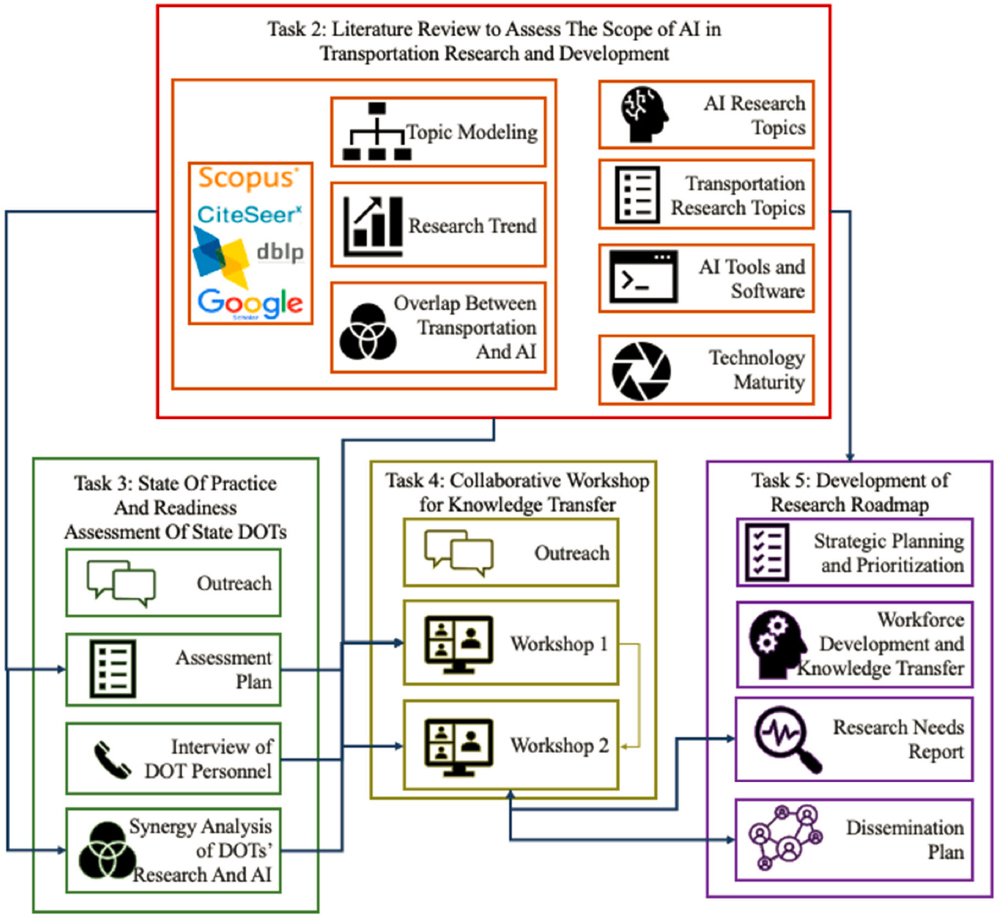
Summary of Tasks and Deliverables
The project was originally planned across six tasks. Figure 1 shows the details of the technical tasks and their dependencies. Task 2 summarizes the literature that surveys the trends in AI and transportation; Task 3 aims to summarize recent practices in DOTs through stakeholder interviews. The workshops from Task 4 aims to facilitate knowledge transfer and planning. This task specifically aims to receive feedback in the current requirements of AI involvements in DOTs as well as develop and review the roadmap; Task 5 aims to summarize learning from all the tasks to create detailed research needs report and research problem statement with a proper dissemination plan. Task 6 summarizes the project and develop a final report, which is this document. Table 1 shows the list of milestones and deliverables. During the tenure of the project, the research team has delivered multiple interim deliverables after completing individual tasks. The list and details are highlighted in the next section.
Table 1. List of milestones (M) and deliverables (D).
| Task Number | Milestones and Deliverable | M/D |
|---|---|---|
| 1 | Amplified work plan | D1 |
| 1 | Kickoff meeting and associated presentation materials | M1 |
| 1 | Quarterly progress reports | D2 |
| 1 | Monthly progress report | D2 |
| 1 | Interim project briefing | M2 |
| 2a | Report of literature survey for the technical documents | D3 |
| 2b | Summary report of AI tools | D4 |
| 3b | Developing assessment plan and questionaries | M3 |
| 3c | Conduct telephone interview with DOT personnel | M4 |
| 3d | Synergy analysis of DOT research and AI: Summary report | D5 |
| 4c | Conduct Workshop 1 | M5 |
| 4e | Conduct Workshop 2 | M6 |
| 4 | Summary report of workshops | D6 |
| 5b | Research needs report with detailed research plan statement | D7 |
| 5 | Draft dissemination plan | D8 |
| 6 | Draft final report delivery | D9 |
| 6 | Final deliverables | M7/D10 |
Summary of Project Outcomes
During the project, the team developed multiple interim deliverables including reports and presentation materials. The final report (this document) summarizes the key process and key findings from each task as part for each chapter. The following list indicates the details of each document, associated task, and associated Chapter number in this final report.
- A detailed literature review of the literature on AI and transportation from last 11 years. This report summarizes the dependency and maturity of AI in connection to transportation research. This report summarizes more than 60000 technical articles using topic modeling. (Task 2, Chapter 2)
- A report on relevant active and completed research on AI that focused implementation efforts at the state and local DOT level. (Task 2, Chapter 2)
- A report on relevant current and forthcoming resources on AI and their applications that could be referenced by state and local DOTs. This report provides a detailed guideline on how to use AI from inception to completion. This report also summarizes key components in AI including tools, software, and infrastructure. (Task 2, Chapter 2)
- A detailed report on the synergy analysis of the DOT research and AI. This report is based on a set a set of interviews that was conducted with DOT personnel. This report summarizes an insight of current state of research at DOT in the intersection of AI and transportation, key research problems states want to solve, readiness of state and local DOTs for AI deployments, and challenges and bottlenecks at widespread deployment of AI. (Task 3, Chapter 3)
- A comprehensive report summarizing the findings from two workshops conducted as part of the project. The first workshop helps in determining key areas to develop the roadmap. The second workshop aims to receive feedback on the proposed roadmaps. (Task 4, Chapter 3)
- Research needs report that includes general descriptions of research that should be conducted within the next 5 years. This includes 11 detailed research problem statements that were distributed to NCHRP and other stakeholders, a dissemination plan, and a workforce development plan. (Task 5, Chapter 4)
- A final report (this document) that documents the entire research effort, and the research findings and recommendations of the research team, including a stand-alone executive summary and a brochure. (Task 6, This document)
Arrangement of the Document
As mentioned in the previous section, the project has already produced several interim deliverables summarizing findings from different tasks. Therefore, this document mainly highlights the key outcome from each task and each deliverable. Chapter 2 summarizes the finding from literature review and review of AI tools and software. Chapter 3 summarizes the outreach efforts including the findings from the two workshops. Chapter 4 summarizes the development of research roadmaps and their implementation plans. Finally, Chapter 5 includes the concluding remarks. Each chapter in this report is a summary of key finding from previous deliverables. The previous deliverables are added at the end of this document as appendices.


