Artificial Intelligence Opportunities for State and Local DOTs: A Research Roadmap (2024)
Chapter: Appendix A: Literature Review
NCHRP 23-12
ARTIFICIAL INTELLIGENCE OPPORTUNITIES FOR STATE AND LOCAL DOTS – A RESEARCH ROADMAP
Appendix A: Literature Review
Prepared for NCHRP
Transportation Research Board
of
The National Academies of Sciences, Engineering, and Medicine
TRANSPORTATION RESEARCH BOARD OF THE NATIONAL ACADEMIES OF SCIENCES, ENGINEERING AND MEDICINE PRIVILEGED DOCUMENT
This document, not released for publication, is furnished only for review to members of or participants in the work of NCHRP. This document is to be regarded as fully privileged and the dissemination of the information included herein must be approved by NCHRP.
Surendrabikram Thapa
Aditi Manke
Abhijit Sarkar
Debanjan Datta
Alejandra Medina
Matthew Camden
Virginia Tech Transportation Institute
Blacksburg, VA
Permission to use an unoriginal material has been obtained from all copyright holders as needed
Introduction
Artificial intelligence (AI) has seen enormous growth in the last decade, resulting in research and development in numerous fields, including in AI applications at departments of transportation (DOTs). The use of AI has accelerated due to success in four key areas: development of advanced machine learning algorithms, high-performance computing, availability of low-cost, high-performance sensors, and availability of large-scale data. The adaptation and application of AI can provide public benefits to transportation in many ways.
A report from Noblis identified 11 areas of transportation that could benefit from AI-based applications (Vasudevan et al., 2020). These areas encompass transportation safety, operation, mobility, maintenance, and policy and include advanced driver assistance systems and automated vehicles (AVs), cybersecurity, accessible transportation, commercial vehicle and freight operations, and transportation systems management and operations. For example, AI can be used to improve traffic flow at signalized intersections and support human decision-making processes at Traffic Management Centers for tasks like incident management, traffic-demand prediction, and detouring corridor signal controls. Many state and local DOTs have adopted and tested AI-based solutions in these areas. For example, Bellevue, a city in Washington, partnered with Microsoft to study traffic patterns and intersection safety using traffic cameras and computer vision to detect and track objects like cars, bicyclists, and pedestrians (Samara et al., 2020).
AI stands to benefit a variety of transportation-related applications for DOTs. The scope of AI is enormous and includes road transport, safety, infrastructure management, and energy efficiency. AI has the potential to make traffic more efficient, ease traffic congestion, free up time spent driving, make parking more accessible, and encourage car- and ridesharing. As AI helps to keep road traffic flowing, it can also reduce fuel consumption caused by vehicles idling when stationary and improve air quality and urban planning. AI can be applied to use advanced sensors effectively for targeted applications. Automation, in general, can bring consistency, uniformity and remove human bias. While AI may require an initial investment, it has the potential to reduce cost ultimately. Lastly, the application of AI may significantly reduce processing time for tasks and jobs that are repetitive and require significant manual labor. In summary, the implementation of AI by DOTs can not only improve performance and speed of operation, but it can also reduce the cost of operation and minimize bias.
What is AI?
AI is a research field in computer science. As one of the pioneers in AI, McCarthy (2004) stated, “[AI] is the science and engineering of making intelligent machines, especially intelligent computer programs. It is related to the similar task of using computers to understand human intelligence, but AI does not have to confine itself to methods that are biologically observable.”
Over the years, several Machine Learning (ML) algorithms have been developed to help machines learn and often achieve a perception and performance similar to a human. These methods are widely used in industry and in daily life to perform tasks that may take a human longer, or where a human may introduce subjective biases. Therefore, many ML methods have proven effective in bringing efficiency and increased accuracy over the years. While ML is more of a research field in computer science, the fundamentals and domain of development of ML overlap with multiple other fields of study, including statistics, control systems engineering, information theory, computer programming, psychology, and mathematics. The application domains also expand to many interrelated fields of study, such as computer vision, image processing, natural language processing (NLP), communication science, manufacturing, robotics, high performance computing, data engineering, and transportation research, to mention a few. Therefore, although AI can often be referred to as a field of computer science, it can only be studied or implemented with an understanding of the overlapping nature and dependencies with other fields of research (see the AI Literature Review Report deliverable for this project for more details).
The modern development of AI and ML has several components. Most of the modern ML models are based on data-driven approaches. In most of the algorithms developed currently, a machine learns by examples and their associated annotations, similar to a human. This process is often referred to as supervised learning. However, machines can also learn in an unsupervised manner from data where specific annotations are not provided. In the last 30 years, several ML models and philosophies have been developed to address both supervised and unsupervised methods. These include basic models like logistic regression, decision trees, k nearest neighbor, naïve Bayes, etc. More advanced methods like random forests, support vector machines (SVMs), probabilistic graphical models, and neural networks have been developed to address issues with generalization, performance, and speed of operations. However, most of these methods were based on intermediate features that are crafted manually. Also, these methods could not be scaled while learning from large-scale data. Hence, these algorithms were limited to a small domain of applications. However, an ideal ML algorithm should generalize across all domains of applications and should perform with the highest accuracy and speed across all variations. Deep Neural Network (DNN)based methods broadly address these issues and help with real-time inference by learning from large-scale data. Also, DNNs are efficient in generating many features that are not manually crafted, hence eliminating a large portion of human bias. The modern revolution in AI was mainly fueled by the advent of DNNs and their variants. However, in recent years, we have observed that real-world problems vary by different data modalities, data volumes, and accuracy requirements. This also demands overlaps with other filed of research. Therefore, AI does not comprise ML alone, but its scope is much broader, encompassing, and inspiring innovation in other related fields. In order to capture the broader structure and interconnectivity of scientific innovation, we have considered topics beyond ML and DNN-based research. This expanded view will help us capture the complete picture of the solutions for different transportation topics.
Focus of the Task
This task within the Artificial Intelligence Opportunities for State and Local DOTs – A Research Roadmap is divided into two parts. The part one aimed to understand the relationship between a certain transportation research problem (e.g., traffic monitoring) and its solution using AI techniques. The task further identified transportation research trends and AI-based solutions’ maturity. We have summarized research of last 11 years and more than 65000 research articles. Due to the large volume of the literature, we used Topic modeling, a tool from natural language processing. Part two of the task focused on identifying transportation topic trends that are highly researched for AI-applications. Part two also aimed at identifying AI application trends in transportation research projects sponsored by state DOTs. Following are the research questions of focus for this task:
- What transportation areas are researched often?
- What transportation topics are trending?
- What AI topics have been used extensively in the last decade? What are the trends of AI-based methods?
- What are some of the AI tools that are required for solving transportation problems?
- What transportation areas have been solved using AI tools?
- How interlinked is each transportation problem with other components of AI?
Part 1. Research Trend Identification Using Topic Modeling and Co-occurrence Matrix
Introduction and Motivation
The main goal of this task is to understand the relationship between a particular transportation research problem (e.g., traffic monitoring) and its possible solution using AI techniques (e.g., machine vision and deep learning). We will also identify trends in transportation research and the maturity of AI-based solutions. We plan to survey articles from the last 11 years (2011–2021). The number of articles focused on transportation research has increased exponentially during this period, making it impossible to read and summarize each publication manually. Therefore, we will use automatic text mining and NLP techniques. We plan to select top journals and conferences (e.g., IEEE, Elsevier, SAE, and IET) using their cite-score or h5 index in Google Scholar.3 Next, we will use Scopus to download the details of all publications over the last 10 years for each selected journal and conference. For example, IEEE Transactions on Intelligent Transportation Systems published 3,226 documents in the last decade. Using Scopus, we will download the title, keywords, abstract, and funding agency. We will then use mainly titles and keywords to perform topic modeling. Topic modeling is an NLP-based method that automatically highlights a group of key topics and their connection to other topic members/words.
Topic modeling is a standard method of summarizing texts (Blei & Lafferty, 2009; Wallach, 2006). In recent years, several analyses of research trends in the fields of AI (Liu et al., 2019) and transportation (Das et al., 2020) have been conducted, often based on text mining and topic modeling of publication keywords and titles. Sun and Yin (2017) analyzed 17,000 publications in the last 10 years to understand the different topics focused on by researchers and how the topics evolve over time. In this project, we plan to use a similar strategy to understand the dependencies between two major areas: transportation and AI. For the transportation-related topic modeling, we propose following the method of Sun and Yin, who performed a detailed trend analysis and discovered 50 topics related to transportation research. This task aims to examine a specific topic in transportation (e.g., road safety) and understand how AI techniques influence research related to that topic (e.g., computer vision) along with the maturity level of the techniques. To do so, we will examine the co-occurrence graph (Mihalcea, & Tarau, 2004) of the two keywords (road safety and computer vision) and topic prevalence over time (Wang & McCallum, 2006). This will help us identify some key topics in the research area. The identified topics will be reviewed by the subject matter experts and sent to the panel members for further review and refinement. While the team expects to cover a broad spectrum of topics, we may select a final set of 20 topics maximum and perform detailed analysis on their AI-based solutions and research trends.
Artificial Intelligence is integrated into various aspects of transportation. In order to assess the scope of AI in transportation research and development, we collected over 65,000 articles from Scopus related to transportation and AI. Most of the articles have keywords, and keywords are representative of what the paper discusses. If one scans the keywords, one can understand the paper's overarching goal and the article’s critical technical component. It also explains how different research fields come together to solve a problem. In our case, we search for AI and transportation keywords co-occurrence. The assumption is that if one AI keyword and one transportation keyword cooccur, then it is highly probable that the transportation problem is solved using the AI tool. This is a well-practiced field of research. We demonstrate this idea through examples of two papers by Rangesh et al. (Rangesh et al., 2018) and Vora et al. (Vora et al., 2018) as shown below.
Title: When Vehicles See Pedestrians with Phones: A Multicue Framework for Recognizing Phone-Based Activities of Pedestrians (Rangesh et al., 2018)
___________________
3 https://scholar.google.com/citations?view_op=top_venues&hl=en&vq=eng_transportation.
- Keywords: Articulated pose tracking; computer vision; deep learning; exemplar support vector machines (SVMs); highly autonomous vehicles; panoramic surround behavior analysis; pedestrian activity recognition
Title: Driver gaze zone estimation using convolutional neural networks: A general framework and ablative analysis (Vora et al., 2018)
- Keywords: Advanced driver assistance systems; Automobile drivers; Behavioral research; Classification (of information); Computer vision; Convolution; Image classification; Intelligent systems; Large dataset; Neural networks; Pattern recognition; Pattern recognition systems; Statistical tests; Driver assistance system; Driver distractions; Driver information systems; Facial feature extraction; Gaze estimation; Gaze tracking; On-road studies; Visual Attention; Eye tracking
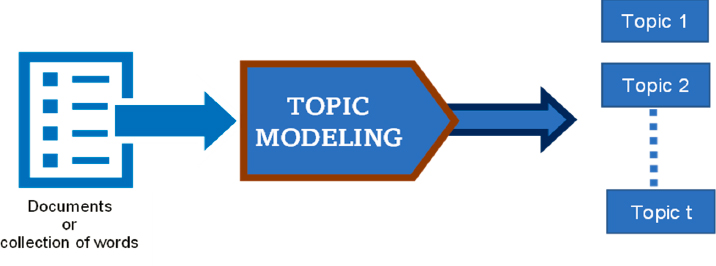
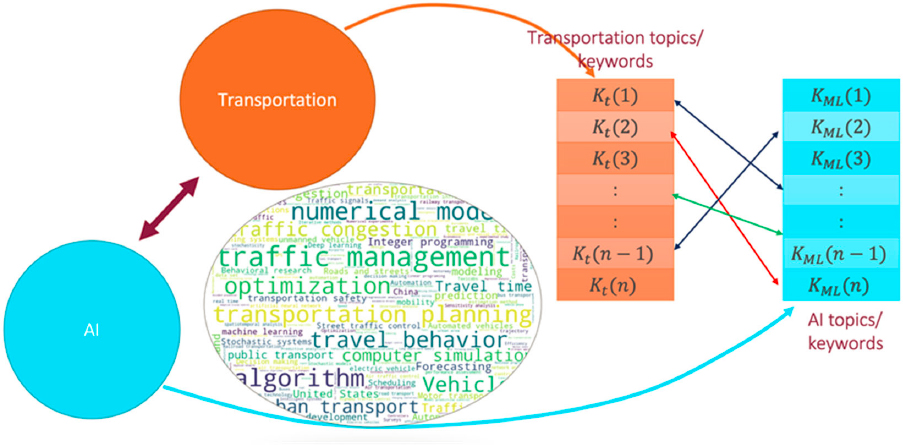
In the paper by Rangesh et al. (Rangesh et al., 2018), the keywords include the keywords like computer vision, deep learning, SVMs from AI domain. The keywords like highly autonomous vehicles, pedestrian activity recognition, etc. are from transportation domain. This shows that the paper simultaneously discusses the topics like computer vision and deep learning alongside pedestrian activity recognition. Thus, it can be inferred the paper discusses a specific transportation problem “pedestrian activity recognition” being solved by AI topics “computer vision” and “deep learning”. Thus, the co-occurrence of keywords can be important direction to explore how various AI topics are being used in transportation. Topic modeling is very useful to find out the topics with the help of given keywords. It is unsupervised technique in machine learning that deals with iterating through the set of provided documents or a collection of words to detect patterns within them and cluster them into groups that have similar lexical or semantic meanings. The general overview of topic modeling is given in Figure 8. Topic modeling helps us to discover the topics from given keywords. Query expansion helps to expand the keywords from a limited set of keywords. The conjunction of co-occurrence, topic modeling and query expansion is used to address our research problems. Our approach for topic modeling and query expansion is based on the concept of homophily of the networks where similar nodes share direct or indirect connections (Vayansky et al., 2020; Carpineto et al., 2012; Vechtomova et al., 2006; Wallach, 2006). Thus, the problem of discovering clusters and their associations is treated as a graph problem. We hence build a keyword co-occurrence graph for the keywords from the journals and formulate the task as a graph-based problem.
Methods
To address the research questions, we have extensively used topic modeling and query expansion along with a co-occurrence matrix. Figure 8 and Figure 9 give an overview of the process implemented to study the trend. A detailed overview of how the data was collected is given in the Data Collection section.

Data Collection
We selected the 26 journals listed in Table 8 below, using cite score and h5 index in Google Scholar. Scopus was used to download details such as title, keywords, abstract, and funding agency for all publications over the last 10 years for each of the selected journals. The total numbers of articles from each journal are given in the table below. The choice of the journals and proceedings were mainly chosen for their overlap with artificial intelligence. In order to reduce redundancy and noise in the topic modeling we did not consider venues where prevalence of AI is minimal.
Table 8. Journal articles in the report.
| Journal Name | Articles | Year |
|---|---|---|
| Accident Analysis and Prevention | 4,231 | 2010–2021 |
| ACM SIGKD International Conference on Knowledge Discovery and Data Mining | 1,135 | 2010–2015 |
| ACM Transactions on Knowledge Discovery from Data | 566 | 2010–2021 |
| Data Mining and Knowledge Discovery | 652 | 2010–2021 |
| Engineering Applications of Artificial Intelligence | 2,625 | 2010–2021 |
| IEEE Computer Society Conference on Computer Vision and Pattern Recognition | 7,827 | 2010–2021 |
| IEEE Intelligent Transportation Systems Magazine | 673 | 2010–2021 |
| IEEE Intelligent Vehicles Symposium | 1,304 | 2010–2015 |
| IEEE International Conference on Computer Vision | 3,591 | 2011–2019 |
| IEEE Transactions on Image Processing | 5,550 | 2010–2021 |
| IEEE Transactions on Intelligent Vehicles | 336 | 2016–2021 |
| IEEE Transactions on ITS | 4,142 | 2010–2021 |
| IEEE Transactions on Knowledge and Data Engineering | 2,807 | 2010–2021 |
| IEEE Transactions on Neural Networks and Learning Systems | 4,044 | 2010–2021 |
| IEEE Transactions on Pattern Analysis and Machine Learning | 3,111 | 2010–2021 |
| IEEE Transactions on Vehicular Technology | 9,591 | 2010–2021 |
| IEEE Vehicular Technology Magazine | 677 | 2010–2021 |
| International Conference on Pattern Recognition | 5,653 | 2010–2020 |
| Journal Name | Articles | Year |
|---|---|---|
| International Journal of Computer Vision | 1,271 | 2010–2021 |
| Journal of Machine Learning Research | 3,314 | 2010–2021 |
| Pattern Recognition | 4,344 | 2010–2021 |
| SAE Technical Papers | 23,593 | 2010–2021 |
| Transport Research Part A | 2,425 | 2010–2021 |
| Transport Research Part D | 2,387 | 2010–2021 |
| Transportation Research Part C | 4,087 | 2010–2021 |
| Transportation Research Part E | 1,824 | 2010–2021 |
| Transportation Research Record | 10,081 | 2010–2021 |
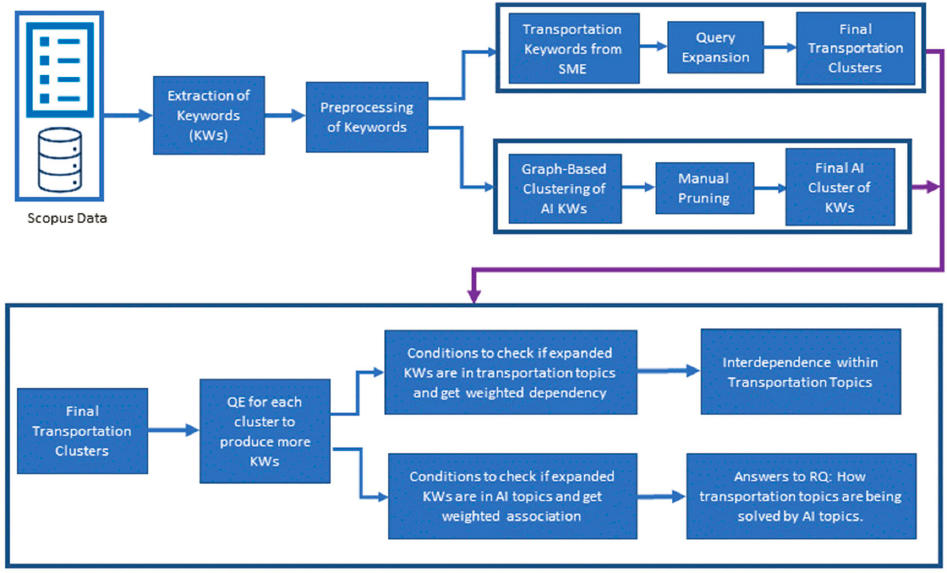
The process followed in this research takes two different directions. The first direction leveraged the idea of topic modeling to find interdependencies within transportation topics and also tried to determine how different AI topics are solving transportation topics. The schematic overview of the process is shown in Figure 10. From the Scopus data, index keywords are taken, and appropriate preprocessing is done to clean the data from noise. The clusters are then created for both transportation and AI topics. For the keywords in transportation clusters, query expansion was done again to produce more. Finally, the expanded keywords were taken to check if they were in specific AI clusters. If there are matching keywords, the association weight is updated.
Similarly, the expanded keywords are also checked in transportation clusters. The interdependence weight is updated if matching keywords exist in the expanded keywords set of one transportation cluster and the original keywords set of as given transportation cluster. The process is explained in detail in the following sections.
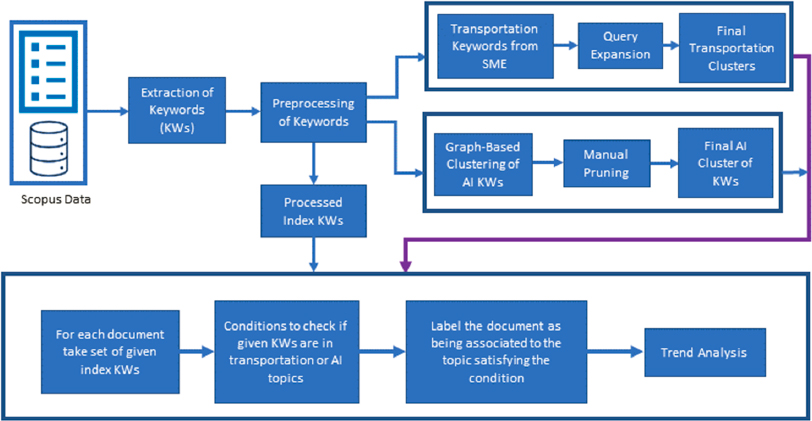
The second direction was a trend analysis of how, over the years, AI topics have been used to solve problems in transportation. We also quantitatively analyzed the number of AI applications in specific transportation areas. The schematic overview of the process is shown in Figure 11. The clusters were created for AI and transportation topics following a process similar to the first approach. For the trend analysis, we have followed the calculation of the co-occurrence approach. For each document, the set of given index keywords was taken to check if they are in the transportation or AI clusters we have. If they are in AI or transportation clusters, the document is labeled as the document with the AI or transportation clusters in which index keywords match. We then do a trend analysis to see how AI solves transportation problems.
The steps for our approach are detailed below.
Scopus Data, Keywords Extraction and Preprocessing
The index keywords of the scholarly articles from the journals in Table 8 were examined. First, scholarly articles with no index keywords were discarded. After this process, preprocessing for keywords was done. All keywords were made lowercase to maintain uniformity across all index keywords taken from different sources. Keywords that did not meet a minimum threshold of five occurrences were discarded before they were fed for topic modeling.
Topic Modeling and Query Expansion to Create Clusters
Topic modeling was extensively used for creating clusters of transportation and AI topics. The high-level overview of topic modeling used in this project is shown in Figure 12. The project aimed to help DOTs identify major AI areas used in given transportation problems. To achieve this purpose, SMEs helped identify relevant areas in transportation and the key AI topics used to solve the given problems. Thus, the process allowed SMEs to select the desired relevant transportation areas and provide the keywords for those areas. More details about the process to generate clusters for transportation areas, as well as AI topics, are provided below.
Generation of Keywords Clusters for Transportation Topics
A two-step approach was followed for generating the cluster of keywords for transportation topics. First, transportation topics of interest were identified by SMEs. For each transportation topic of interest, the keywords related to that topic (referred to in this document as seed keywords) were provided by SMEs. The number of keywords varied from one transportation topic to another. Some transportation topics had fewer keywords than others, as they were not heavily researched but were very important in transportation research. The transportation topics and keywords were identified through various brainstorming sessions and workshops. After SMEs selected the seed keywords, query expansion was performed to get more transportation keywords from the given seed keywords. The maximum number of keywords expanded from each seed keyword was 40. The expanded keywords were merged into the seed keywords to create the list of keywords in the transportation cluster. Figure 13 shows the word cloud of some of the transportation topics. The word clouds contain the top 20 keywords for the given transportation cluster. As can be seen from the examples, The public transportation topic includes all the relevant keywords and subtopics, including service quality, transportation infrastructure, transportations cost, etc.

A total of 21 transportation topics were selected for the research where AI tools can be integrated. Table 9 lists the AI-Transportation topics the research project focused upon with a general description. The selection of topics was restricted to roadway transport as the technical team carries years of experience in studying safe driving behavior, automated driving systems, intelligent systems in trucking, road safety, and other areas of roadway transportation. Since road transport is one of the sectors where AI has most successfully been applied, it has opened new levels of cooperation between various road users. Subject matter experts focused on issues that are relevant to current times of rapid urbanization, increased vehicle ownership, time spent in traffic congestion, emissions, and increase in active transportation modes.
Table 9. Definition of transportation AI topics.
| S.N. | Transportation Topics | Description |
|---|---|---|
| 1. | Traffic Management | Refers to the organization, arrangement, guidance, and control of stationary and moving traffic which includes pedestrians, bicyclists, and all kinds of vehicles. (Underwood, 1990). The goal here is to provide for the safe, orderly, and efficient movement of persons and goods and enhance the quality of the local environment adjacent to the traffic facilities. |
| 2. | Work- Zone Analysis | Refers to the analysis of work zone impact on mobility and safety; nearby intersections and interchanges and affected businesses and residencies (Federal Highway Administration, n.d.). |
| 3. | Transportation Systems Management and Operations | Includes efforts to proactively operate and improve the performance of the multimodal transportation system as a whole, by managing current and predicted travel demand (Vasudevan, et al., 2020b). |
| 4. | Transportation Infrastructure | Transport infrastructure is critical for economic and social well-being in a modern society, as it is a means to provide mobility, accessibility, and the movement of goods (Taylor, 2021). Infrastructure includes roads, bridges, public transportation, roads, highways, sidewalks, bicycle lanes, rail transport, bus terminals, etc. |
| 5. | Highway Management/Design | A highway system serves as a set of objectives, such as provision of an adequate level of service, preservation of the facility condition, safety, and economic development. It consists of physical facilities- pavements, bridges, roadside elements, and traffic control devices (Sinha, et al., 1989) |
| 6. | Pavement | Refers to pavement structure and evaluation. |
| 7. | Road Safety | Measures undertaken to reduce the risk of a road user being involved in an accident (Pan America Health Organization, n.d.) Road safety not only extends to motor vehicles but also covers pedestrian and bicyclist safety. |
| 8. | Asset Management | Delivers efficient and cost-effective investment decisions to support transportation infrastructure and system usage performance measured in economic, social, health, and environmental terms (Vasudevan, et al., 2020b) |
| 9. | Policy and Planning | Within transportation, policy and planning comprises economic, social, and political actions that determine the distribution of development, goods, and services (Slack, et al., 2017) |
| 10. | Urban Multimodal Corridors | They are a combination of highways and arterial streets that serve as major regional travel routes, typically managed collaboratively by a group of state, regional, and local agencies (Vasudevan, et al. 2020a) |
| 11. | Mobility | The ability to choose from various modes of transport to move from one place to another (Community Planning and Zoning, 2019). |
| S.N. | Transportation Topics | Description |
|---|---|---|
| 12. | Accessibility | The quality of travel at the community and individual level. Will focus on travel time, travel cost, travel options, comfort, and risk while addressing the needs of all within the community (Community Planning and Zoning, 2019) |
| 13. | Transit Operations and Management | Includes the operation and management of the transit system in a safe and efficient manner (Vasudevan, et al., 2020b) |
| 14. | Travel Behavior/Behavior Modelling | Aims to understand how traveler values, norms, attitudes, and constraints lead to observed behavior. Refers to the complicated decision-making process of travelers during a trip regarding travel mode choice, route choice, departure time choice, and destination choice (Li, et al., 2019) |
| 15. | Equity | Accessible and affordable transportation for everyone in the community which results in fair distribution of transportation resources, benefits, costs, programs, and services (Leahy & Takesian, n.d.) |
| 16. | Driver Behavior and Monitoring | Refers to the intentional and unintentional characteristics and actions a driver performs while operating a motor vehicle (nauto, n.d.). |
| 17. | Winter Road Operations | Aims to reduce the negative effect of snow and ice on traffic on road winter operations. |
| 18. | Supply- Chain & Logistics | The management of the flow of goods and services. |
| 19. | Commercial Vehicle and Freight Operations | Addresses the management of the efficiency, operation, and safety of fleets and movement of freights (Vasudevan et al., 2020b) |
| 20. | Vulnerable Road User | Describes those unprotected by an outside shield, as they sustain a greater risk of injury in any collision and therefore are highly in need of protection against such collisions (National Safety Council, 2018) |
| 21. | Connected and Automated Vehicles (CAVs) | Vehicles that can guide themselves without human intervention using sensors or communication technologies. |
AI Topics from Keyword
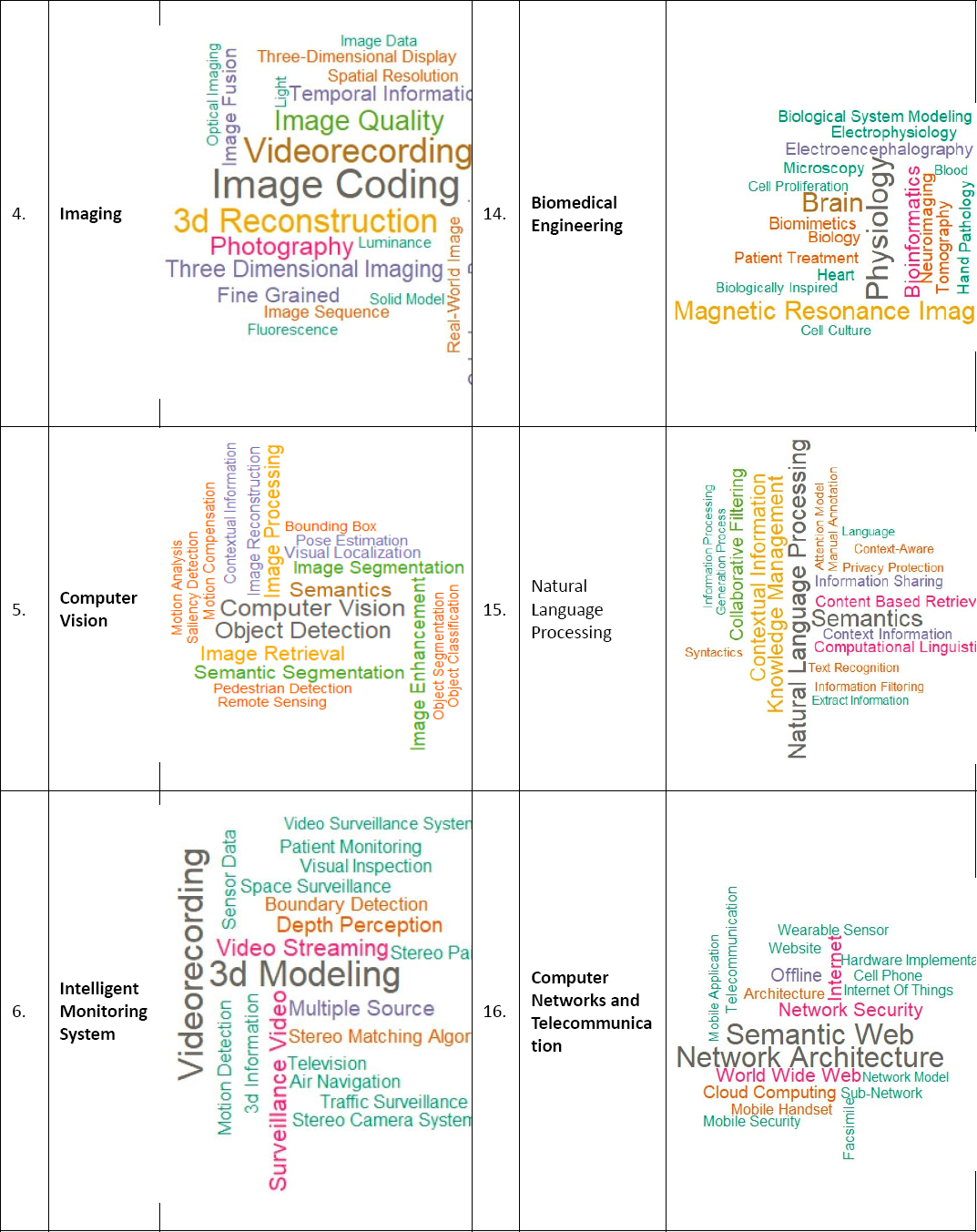
Common keywords in both transportation and AI journals were used to generate the cluster of keywords for AI topics. The common keywords were subjected to topic modeling to get different clusters. The obtained clusters had some anomalies that needed to be fixed. Some of the clusters formed using topic modeling were smaller, and some were quite large. To address this issue, more significant clusters were again divided into sub-clusters. The sub-clusters that did not belong to the parent cluster in terms of scientific similarity were then merged into other clusters with similar keywords. Manual pruning was also done to remove some noise (such as widespread words). The final clusters and their definitions are shown in Table 10. The word clouds for some of the AI topics are shown in Figure 14. The word clouds in Figure 14 show the top 20 keywords in given clusters.

Table 10. Definition of AI topics used in this project.
| S.N. | AI Topic | Description |
|---|---|---|
| 1 | Traditional Machine Learning | Includes keywords which are mostly related to works from the predeep learning era. The learning methods that extensively use handpicked features as inputs and require human interventions were put in this topic. |
| 2 | Statistical Machine Learning and Analytics | Mostly includes keywords that deal with the use of statistics to discover insights in data. Also includes keywords that deal with finding an appropriate predictive function based on the given data. There is a thin line between traditional machine learning and statistical machine learning. Statistics mostly focuses on drawing inferences from a given sample whereas machine learning tries to give more generalizable predictive patterns. |
| 3 | Numerical Methods and Optimization | Includes keywords related to numerical methods, a method of computing that moreover deals with approximation to the problem rather than attempting to find exact solutions. Numerical methods are often used for mathematical problems that have no analytical solution. |
| 4 | Imaging | Deals with how we can create a visual representation of something. Broadly includes the keywords related to imaging techniques and factors associated with imaging (like fluorescence, luminance, spatial resolution, etc.). Also contains keywords related to the techniques used for visual representation (e.g., solid model, 3D reconstruction, etc.). |
| 5 | Computer Vision | Broadly deals with how computers can derive meaningful information from digital images or videos. This topic thus contains keywords related to image processing, manipulation of images, detection models, interpretation of images (e.g., semantic segmentation), etc. |
| 6 | Intelligent Monitoring System | Mostly contains keywords related to recording, surveillance, etc. The surveillance system includes keywords related to technologies for surveillance, sensors used for monitoring, etc. The topics of computer |
| S.N. | AI Topic | Description |
|---|---|---|
| vision, imaging, and intelligent monitoring systems are closely related but have different relevance in the transportation domain. | ||
| 7 | Deep Learning (Advanced Machine Learning) | One of the broader topics, this includes terms related to learning methods based on artificial neural networks (ANN) along with techniques related to representation learning. Advanced Machine Learning has been widely used in the past decade to solve problems in computer vision, speech recognition, machine perception, natural language processing, etc. Mostly contains keywords that represent deep learning’s theory and implementation. There are other domain-specific topics like computer vision, natural language processing, etc. which contain keywords that are more specific to domain-specific downstream tasks. |
| 8 | Mathematical Model and Simulation | With advancement in computational power, computer-aided modeling driven research is seen as a hot topic. Includes keywords related to modeling real-world scenarios in computer-aided modeling. Also includes keywords related to simulation of real-world scenarios. |
| 9 | Performance Evaluation and Quantitative Analysis | Evaluation is important in any research. This topic includes keywords that are associated with different performance evaluation techniques. Also includes keywords associated with quantitative analysis of data and keywords that represent smaller steps in evaluation like those related to calibration, benchmarking, etc. |
| 10 | Control Engineering | Includes keywords related to techniques in control systems theory and applications. Because it is highly associated with control engineering, the keywords associated with implementation of control systems in electrical circuits and microcontrollers can also be frequently found under this topic. Control systems are widely used in today’s various advanced driver-assistance systems, which makes it one of the most useful topics. |
| 11 | Robotics | Robotics is at the heart of automated systems used in modern vehicles and is an interdisciplinary field of engineering. Includes keywords related to various sub-tasks in robotics like path planning, object tracking, cognition, etc. The keywords related to both software and hardware implementations can be found in this topic. |
| 12 | Software Design and Analysis | Various areas in transportation actively require software design and analysis. For example, software systems are widely used in supply-chain and logistics. Thus, keywords relating to scalability of the software, efficiency in implementation, system design, etc. fall under this topic. |
| 13 | Signal Processing | Signal processing is widely used in transportation safety research. As an example, studies relating to study of mental state, fatigue state, etc. involve analysis of brain signals collected using various devices like EEGs, ECGs, etc. (Sarkar et al., 2014). This topic hence includes keywords related to signal analysis and manipulation. |
| 14 | Biomedical Engineering | In general, includes study of various principles of biological systems and applies them to design of equipment and devices for healthcare purposes. Biomedical engineering in transportation largely deals with analytical approaches to various biological signals. The keywords in this topic include terminologies ranging from general physiology to analysis of brain signals. |
| S.N. | AI Topic | Description |
|---|---|---|
| 15 | Natural Language Processing | A subfield of linguistics, computer science, and AI that is widely being used in various transportation areas. For an example, natural language processing can be used for the interpretation of warning signs on the road (Pramkeaw et al., 2019). Consists of keywords that are typically related to techniques used in natural language processing. |
| 16 | Computer Networks and Telecommunication | In intelligent transportation systems, communication among different sensors, servers, and data centers are quite important. Includes keywords relating to telecommunication and communication within closed networks. The keywords that denote devices and equipment used in telecommunication are also included. |
| 17 | Human-computer Interaction | Largely deals with system design, product design, and usability engineering. Keywords relating to design of products, social behavior of people and people’s interaction with technology in general are found in this topic. |
| 18 | Preprocessing and Feature Engineering | The process of making data more useful by applying various processing techniques at different steps. For an example, data with some of the missing values need preprocessing to address missing values. Keywords related to data pre-processing, feature extraction, etc. fall under this topic. |
| 19 | Big Data Analytics | The process of analyzing large data to discover trends and patterns which can help to make data-driven informed decisions. Broadly, includes methods of collecting, mining, visualizing, and storing large amounts of data. Keywords related to operations in big data are included in this topic. |
Assessment of Interdependencies Within Transportation Topics
Transportation topics are often interrelated. For example, the topic of highway design is often dependent on policy and planning. We thus calculated the interdependencies within transportation topics. This helps us to understand the connection between resources and personnel in different areas of transportation more effectively. The final keywords in transportation clusters were used for query expansion. For each keyword in each transportation topic, the comprehensive list of keywords obtained after query expansion was compared to keywords in existing transportation clusters to see if the clusters contained keywords from the expanded query list. In this way, interdependencies within transportation topics were calculated.
Assessment of How Transportation Problems Are Being Solved by AI
This part of the task identifies how AI topics solve a specific transportation topic. We started again from the co-occurrence graph we created. The final keywords in transportation clusters were again put through query expansion. For each keyword in each transportation topic, we obtained a list of keywords after query expansion. Then, the list was compared to keywords in the AI topics to see if the AI topics contained keywords from the expanded query list. If keywords from AI topics were present in the query list, we could conclude that the given transportation keyword in a given transportation topic was being solved by the AI topic or topics for which there was a match.
Trend Analysis
Different AI topics have been used over the years to solve transportation related problem. However, the trend and concentration changes over time due to new innovations in the field of AI. As we have seen new advances in ML and DNN-based methods in the last 10 years, we studied how these changes have affected how researchers solve the transportation problem. This analysis also indicates the maturity of new technology in solving a specific problem. For the analysis, the index keywords of each scholarly document were taken. Then, the keywords were compared with those in the transportation and AI clusters. Suppose the keywords matched with keywords from one or more transportation or AI topics; the document was tagged with all the matching topics. Then we calculated the percentage of time an AI topic used to solve the transportation topic. We perform this analysis for publications for each year, 2011 to 2021.
Results and Analysis
Ambiguity and Overlap
Research is often interdisciplinary, and it is common to observe dependencies and similarities across different disciplines. A great deal of overlap can be seen when talking about topics within the same area. While the creation of clusters helps define and separate topic areas, there can be some overlap and ambiguity. Note that the overlap presented in this section differs from the interdependency we introduced in the previous section. The overlap mainly reflects the structural overlap where a topic may be a subtopic of another topic. Nevertheless, both topics have a very high prominence in the research community. One prominent example is that deep learning is one of the machine learning algorithms, but deep learning is an essential field of study that has had very high prominence in the last decade.
Overlap Within Transportation Topics
The transportation topics described above also share similarities and interrelationships. For example, 15 displays the overlapping relationships between topics. Where mobility and accessibility focus on ability and access to all modes of transportation, urban planning focuses on providing the means to ensure people have the choice to choose from various modes of transportation, increasing their mobility, and assuring equal access to transportation services.

Overlap Within AI Topics
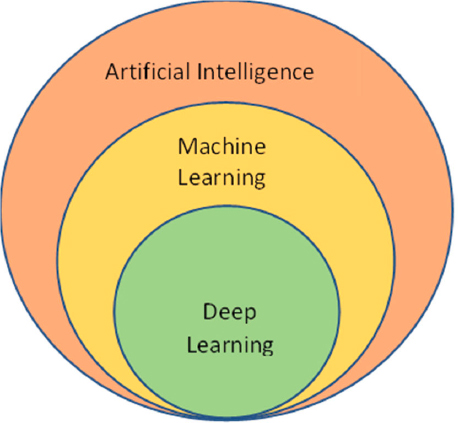
The topics in AI described above are also intertwined with each other. For example, as shown in Figure 16, deep learning is a sub-topic of machine learning. It is often challenging to clearly delineate one topic from another. To address the problem of topic ambiguity, we have tried to make definitions as informative as possible.
Interdependencies Within Transportation Topics
Any real-world problem is interdisciplinary. Therefore, any particular problem may comprise multiple research topics. Thus, one area of transportation is often supplementary to solving a problem in another area, for example, solving accessibility problems in transportation with policy and planning. Policy and planning are highly intertwined with almost every aspect of transportation. To address this issue, we have studied how one transportation problem is cooccurring and coexisting with another. We performed a quantitative analysis to examine how one transportation topic is associated with solving another transportation problem.
We emphasized quantitative results regarding what extent topics are interrelated to help identify the areas of research. For example, there might be multiple broad transportation topics that are identified for a project. The projects can be made much more efficient if an estimate of the relative importance of transportation topics is known. In addition, DOTs can enlist more SMEs to oversee topics that are highly intertwined with other topics than they might for topics in which fewer topics have interdependency on quantitative grounds.
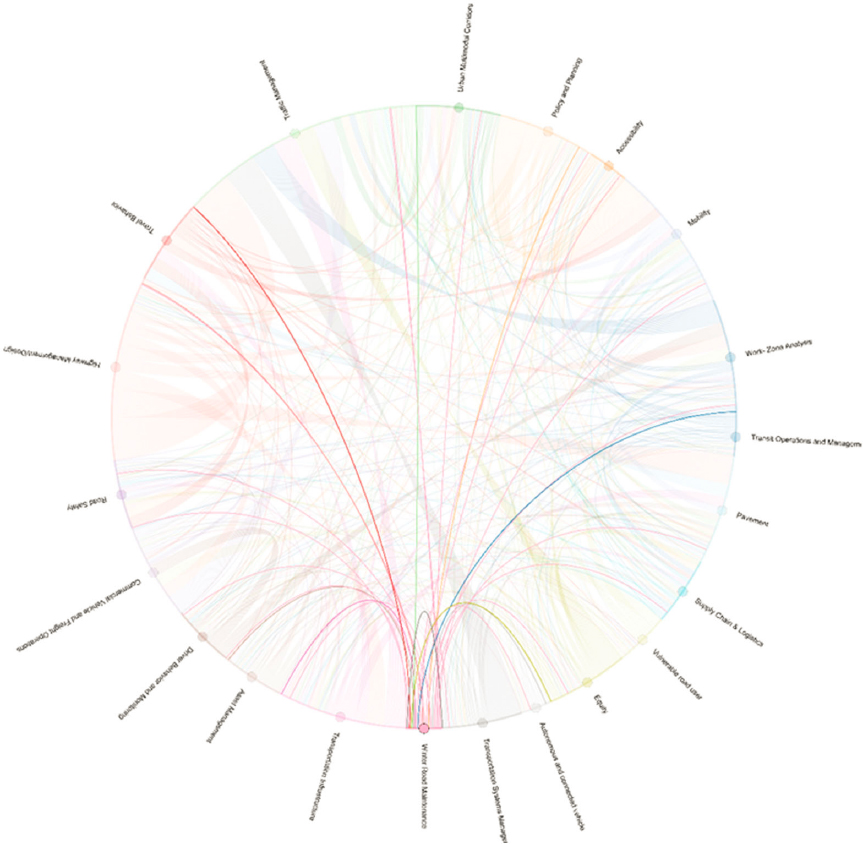
Figure 17 shows the interconnection of one transportation topic with another. Clearly, there is a large inter dependency between the topics. We illustrated with two examples. Similarly, Figure 18 and Figure 19 show how a particular transportation topic is related with other transportation topics. As these figures show, that topic “traffic management” has a high level of intersection with many different transportation topics. In the chord diagram, the width of a given transportation topic is proportional to how strong the interrelation of the given topic is with other transportation topics. For instance, winter road management has low interrelations with other transportation topics.


Assessment of How Transportation Problems Are Being Solved
Correctly knowing what transportation topics are solved by which AI technologies can save DOTs time and resources. However, identifying how transportation problems can be solved using AI can take time and effort. Going through the literature can be an excellent approach to knowing what technologies have been used recently, but a thorough literature review would take a great deal of time. Furthermore, even SMEs in transportation might need to be made aware of how AI can approach transportation problems and to what extent. As noted, going through the vast quantities of the available literature is a time-consuming and cumbersome process, but it can be made much more efficient using our approach. Our approach considers more than 65,000 papers to assess what AI topics are used to solve transportation problems.
The quantitative results of our analysis of how AI technologies solve transportation problems are presented here. The overall dependency is shown in Figure 20. The width of the arrow is proportional to what extent a transportation topic can be solved using an AI topic. The results in the Sankey diagram are obtained from the query expansion approach. One prominent example from the Sankey plot shows that traffic management is mostly solved using control systems. This way, we can study each of the transportation topics and find out what the AI topics are used to solve them.

After analyzing the Shankey graph, we selected top five AI topics used to solve each transportation problems and summarized in Table 11. We also created an alternative visualization through pie charts that shows the dependency for each of the topics. The pie chart in Figure 21 shows how the transportation topic “work zone analysis” is being solved by AI topics. The pie charts for all the transportation topics are provided in Appendix A.

Table 11. Top five AI topics used for transportation topics.
| Transportation Topic | Top Five AI Topics | ||||
|---|---|---|---|---|---|
| Traffic Management | Numerical Methods & Optimization | Advanced Machine Learning | Control Systems | Traditional Machine Learning | Software Design and Analysis |
| Work- Zone Analysis | Numerical Methods & Optimization | Evaluation & Quantitative Analysis | Traditional Machine Learning | Advanced Machine Learning | Control Systems |
| Transportation Systems Management and Operations | Numerical Methods & Optimization | Advanced Machine Learning | Traditional Machine Learning | Control Systems | Software Design and Analysis |
| Transportation Infrastructure | Advanced Machine Learning | Numerical Methods & Optimization | Evaluation & Quantitative Analysis | Statistical Machine Learning | Mathematical Modeling & Simulation |
| Highway Management/Design | Traditional Machine Learning | Numerical Methods & Optimization | Advanced Machine Learning | Robotics | Mathematical Modeling & Simulation |
| Pavement | Statistical Machine Learning | Mathematical Modeling & Simulation | Advanced Machine Learning | Evaluation & Quantitative Analysis | Numerical Methods & Optimization |
| Road Safety | Robotics | Mathematical Modeling & Simulation | Traditional Machine Learning | Advanced Machine Learning | Computer Vision |
| Asset Management | Numerical Methods & Optimization | Advanced Machine Learning | Traditional Machine Learning | Mathematical Modeling & Simulation | Statistical Machine Learning |
| Policy and Planning | Numerical Methods & Optimization | Advanced Machine Learning | Statistical Machine Learning | Robotics | Control Systems |
| Urban Multimodal Corridors | Numerical Methods & Optimization | Advanced Machine Learning | Software Design and Analysis | Statistical Machine Learning | Computer Networks & Telecommunication |
| Mobility | Advanced Machine Learning | Numerical Methods & Optimization | Software Design and Analysis | Statistical Machine Learning | Mathematical Modeling & Simulation |
| Accessibility | Numerical Methods & Optimization | Advanced Machine Learning | Software Design and Analysis | Statistical Machine Learning | Control Systems |
| Transit Operations and Management | Numerical Methods & Optimization | Advanced Machine Learning | Computer Vision | Software Design and Analysis | Traditional Machine Learning |
| Travel Behavior | Advanced Machine Learning | Numerical Methods & Optimization | Robotics | Human Computer Interaction | Traditional Machine Learning |
| Driver Behavior and Monitoring | Robotics | Mathematical Modeling & Simulation | Advanced Machine Learning | Computer Vision | Traditional Machine Learning |
| Transportation Topic | Top Five AI Topics | ||||
|---|---|---|---|---|---|
| Equity | Numerical Methods & Optimization | Advanced Machine Learning | Statistical Machine Learning | Software Design and Analysis | Computer Networks & Telecommunication |
| Winter Road Maintenance | Advanced Machine Learning | Mathematical Modeling & Simulation | Computer Networks & Telecommunication | Numerical Methods & Optimization | Statistical Machine Learning |
| Supply Chain & Logistics | Advanced Machine Learning | Numerical Methods & Optimization | Evaluation & Quantitative Analysis | Signal Processing | Robotics |
| Commercial Vehicle and Freight Operations | Numerical Methods & Optimization | Software Design and Analysis | Traditional Machine Learning | Advanced Machine Learning | Statistical Machine Learning |
| Vulnerable road user | Robotics | Advanced Machine Learning | Traditional Machine Learning | Mathematical Modeling & Simulation | Human Computer Interaction |
| CAVs | Numerical Methods & Optimization | Intelligent Monitoring System | Computer Networks & Telecommunication | Signal Processing | Computer Vision |
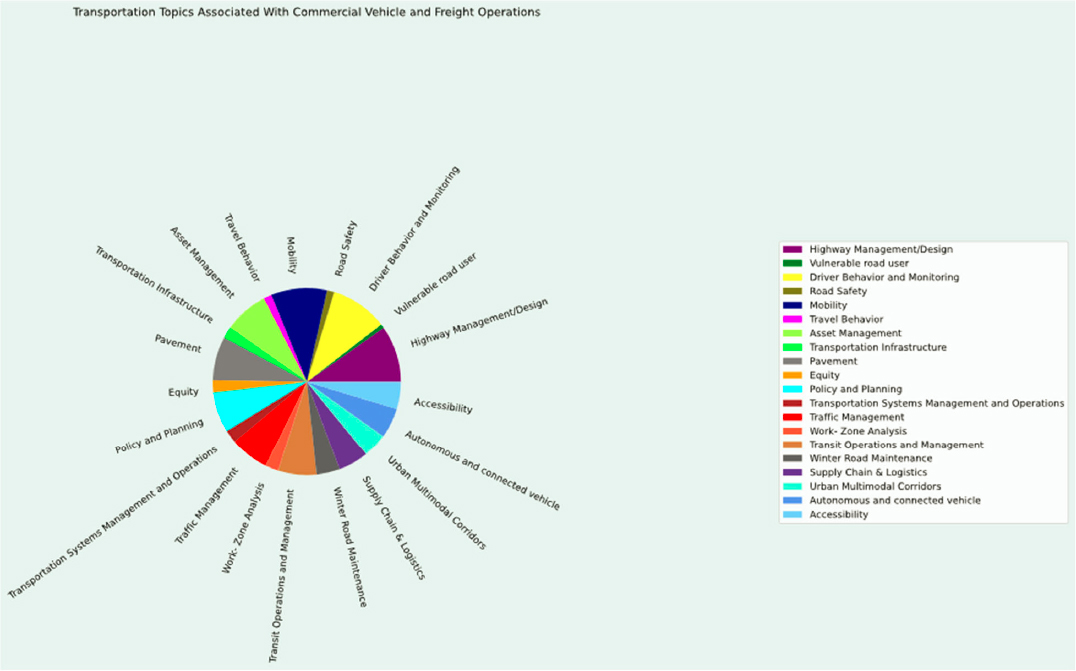
Similarly, Table 12 shows the top five transportation topics which have strong association with the topics given in the first column of the table. The pie chart representing how the transportation topic “commercial vehicle and freight operations” is associated with other transportation topics is given in Figure 22. The pie charts for all the transportation topics are provided in Appendix B.
| Transportation Topic | Top Five Transportation Topics Having Strong Association | ||||
|---|---|---|---|---|---|
| Traffic Management | Highway Management/Design | Transportation Systems Management and Operations | Work- Zone Analysis | Transportation Infrastructure | Equity |
| Policy and Planning | Equity | Work- Zone Analysis | Travel Behavior | Highway Management/Design | Transportation Infrastructure |
| Highway Management/Design | Transportation Systems Management and Operations | Traffic Management | Equity | Commercial Vehicle and Freight Operations | Transportation Infrastructure |
| Transportation Infrastructure | Highway Management/Design | Transportation Systems Management and Operations | Traffic Management | Work- Zone Analysis | Equity |
| Pavement | Highway Management/Design | Transportation Infrastructure | Mobility | Asset Management | Traffic Management |
| Transportation Topic | Top Five Transportation Topics Having Strong Association | ||||
|---|---|---|---|---|---|
| Travel Behavior | Pavement | Transportation Infrastructure | Highway Management/Desi gn | Asset Management | Driver Behavior and Monitoring |
| Vulnerable road user | Highway Management/Design | Driver Behavior and Monitoring | Road Safety | Mobility | Travel Behavior |
| Driver Behavior and Monitoring | Asset Management | Highway Management/Desi gn | Mobility | Transportation Infrastructure | Equity |
| Mobility | Policy and Planning | Highway Management/Desi gn | Travel Behavior | Transportation Infrastructure | Work- Zone Analysis |
| Equity | Urban Multimodal Corridors | Travel Behavior | Traffic Management | Transportation Infrastructure | Mobility |
| Urban Multimodal Corridors | Mobility | Highway Management/Desi gn | Equity | Transportation Infrastructure | Policy and Planning |
| Transportation Systems Management and Operations | Mobility | Accessibility | Equity | Urban Multimodal Corridors | Transportation Infrastructure |
| Asset Management | Highway Management/Design | Transit Operations and Management | Transportation Infrastructure | Traffic Management | Transportation Systems Management and Operations |
| Road Safety | Travel Behavior | Policy and Planning | Highway Management/Desi gn | Equity | Mobility |
| Work- Zone Analysis | Highway Management/Design | Driver Behavior and Monitoring | Vulnerable road user | Mobility | Road Safety |
| Supply Chain & Logistics | Equity | Policy and Planning | Work- Zone Analysis | Travel Behavior | Transportation Infrastructure |
| Autonomous and connected vehicle | Winter Road Maintenance | Traffic Management | Highway Management/Desi gn | Policy and Planning | Mobility |
| Accessibility | Highway Management/Design | Supply Chain & Logistics | Transportation Infrastructure | Traffic Management | Equity |
| Transit Operations and Management | Commercial Vehicle and Freight Operations | Traffic Management | Transportation Systems Management and Operations | Equity | Work- Zone Analysis |
| Transportation Topic | Top Five Transportation Topics Having Strong Association | ||||
|---|---|---|---|---|---|
| Commercial Vehicle and Freight Operations | Highway Management/Design | Vulnerable road user | Driver Behavior and Monitoring | Road Safety | Mobility |
| Winter Road Maintenance | Autonomous and connected vehicle | Policy and Planning | Highway Management/Desi gn | Work- Zone Analysis | Transportation Infrastructure |
Table 13 (Attachment A, Appendix C) and Table 14 (Attachment A, Appendix C) show the number of AI papers that have keywords in co-occurrence with transportation topics. This gives us an idea of how mature a given topic is. For example, advanced machine learning has over 24,000 papers which shows that use of advanced machine learning in transportation is widely explored. On the other hand, natural language processing (NLP) has just over 3,000 papers. It shows that NLP is not widely explored in transportation research.
Trend Analysis
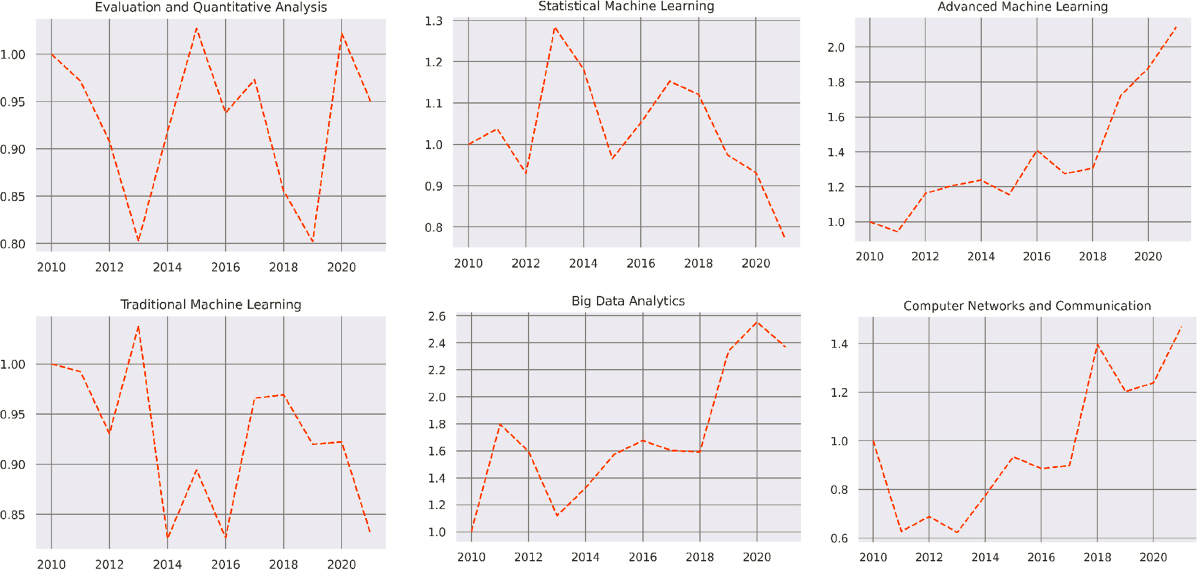
It is essential to know what AI topics are being used frequently and the trend over the years. Figure 23 (Attachment A) shows that there are upwards and downward trends for different topics. For example, statistical machine learning has seen a downward trend in the past years, whereas advanced machine learning has shown upward trends. For statistical machine learning, the correlation coefficient over the years was -0.36, whereas advanced machine learning, which includes the topics in deep learning, has a correlation coefficient of 0.90. Similarly, computer networks and telecommunication have also shown a positive trend with a correlation coefficient of 0.80. Some of the topics have stayed more or less relevant with time. For example, evaluation and quantitative analysis have a correlation coefficient of -0.08, showing similar interest in the field throughout the decade.
Further, we have calculated correlations of the number of papers in which different AI topics have solved transportation problems. The correlation is presented in Table 15 (Attachment A, Appendix C) and Table 16 (Attachment A, Appendix C). The approach used for the literature analysis has enabled us to unravel various kinds of information. It was interesting to observe how transportation topics are intertwined with each other. Similarly, the approach that we have employed enabled us to get ideas of what transportation areas are researched often. Therefore, the approach was essential to know the trends of different AI topics used to solve transportation problems. The maturity of the topic is another critical area that we were able to assess using the approach.
Key Findings
From our findings, the topics within the transportation domain are interlinked, but the relative interdependence of one topic with another varies a lot. For example, Figure 19 shows that the transportation topic “traffic management” is highly related to other transportation topics. On the contrary, from Figure 20, the transportation topic “winter road management” is much less studied and does not show much dependence on other transportation areas. This may be mainly because this topic is rarely used in relation to artificial intelligence-based methods. Table 4 shows the top five AI topics for each transportation topic, from which it can be observed that AI topics like advanced machine learning and Numerical Methods and Optimization are widely used in most transportation topics. It is also noteworthy that some transportation topics have specific AI topics that are being used. For example, travel behavior extensively uses “Human--
computer interaction,” whereas it is less used in solving other transportation problems. Identifying such specific technologies helps local DOTs look for SMEs in particular areas.
Table 5 shows that highway management/design and traffic management are interdependent with most of the transportation topics. This shows that a lot of areas need to be considered when we are tackling with the problem of traffic management and vice-versa. Table 13 (Attachment A, Appendix C) and Table 13 (Attachment A, Appendix C) show the number of AI papers that have keywords in co-occurrence with transportation topics. This gives us an idea of how mature a given topic is. For example, advanced machine learning has over 24,000 papers which shows that the use of advanced machine learning in transportation is widely explored and matured to be used in future applications.
On the other hand, natural language processing (NLP) has just over 3,000 papers. It shows that NLP is not widely explored in transportation research. Furthermore, this shows that advanced machine learning is mature compared to natural language processing.
Similarly, Table 15 and Table 16 show the correlation of AI topics used in various transportation areas over the years (2010 to 2021). The AI topics like traditional machine learning and statistical machine learning have declined. In contrast, computer networks and telecommunication, big data analytics, advanced machine learning, etc., have increased. This helps us to know the trends of research in the last decade. Figure 23 shows the trend of AI topics in overall transportation areas, from which we can see that there is a highly increasing trend for topics like advanced machine learning and big data analytics, whereas a decreasing trend for statistical machine learning and traditional machine learning.
Part 2. Trend Analysis of AI in Transportation Research
The objective of part two of the literature review was to focus on state and regional transportation problems that can be solved using AI tools. We first aimed to understand the research trends in transportation agencies over the past 5 years. The Transportation Research Board (TRIS) database was used to search for completed and active projects. Searches were made using keywords related to like AI, machine learning, deep learning, computer vision, and neural networks. SMEs manually selected the projects by reading the project titles and abstracts. Selection of projects was restricted to surface transportation, so projects focused on aviation and water-related transportation were not part of the analysis.
Projects that involved AI-based or machine learning-based applications in resolving transportation concerns related to traffic management, infrastructure improvement, highway maintenance, transportation planning, operations, driving behavior, road weather conditions, pavement performance, and improvement in mobility were selected. The information that was extracted from the TRB database included project title, abstract, sponsor organization, managing organization, program manager, principal investigator, and the status of the project. We selected 106 projects that were either completed or active between 2017 to 2021 (5-year period). The wide representation of transportation focus was ensured during the selection of projects.
Methodology
Analysis of Abstracts
To identify the use of AI tools in transportation sector, only those projects were selected which focused on using machine learning or AI applications in the transportation research. The projects were analyzed using the abstracts. The next step in the analysis involved manually annotating the keywords related to transportation and AI. Keywords represent the main concepts of research topic and are the words used in everyday life to describe the topic.
Based on the knowledge of SMEs and the literature on transportation research, groups of words related to transportation were assigned a topic. For example, “traffic congestion, traffic flow, signal control, travel time, peak periods, etc.” are mostly associated with traffic management and operations (Sun & Yin, 2017). Thus, in this process, each keyword under transportation signifies a broader transportation focus, and each keyword under AI indicates the tools or applications that were used in the project. The analysis also recorded the number of projects sponsored by state DOTs, the project start year, and states where the project was being pilot tested.
Results
Transportation Focus Areas
Transportation topics that were discovered under topic modeling formed a basis for associating each keyword found in the project abstracts with topics. Figure 24 represents the frequency of a few of the topics across the projects. There are 43 projects that use AI tools to focus on traffic management concerns, 43 projects that focus on improving transportation infrastructure, and 17 projects that center around road safety. The other topics of interest amongst completed and active research include 22 projects with a focus on mobility, 21 projects on policy and planning, and 15 projects centering around driver behavior and monitoring.

State DOT Involvement
One of the objectives of this research was to assess the awareness and knowledge of state DOT employees regarding the use of AI tools in transportation research. To that end, the technical team decided to look at the number of projects sponsored by state DOTs that focus on AI and machine learning applications out of the 106 selected research projects. The team found that 16 state DOTs had sponsored projects that focused on applying AI and machine learning tools to resolve transportation problems in their states. Out of 106 projects, 28 projects were sponsored by these state DOTs. Table 10 lists the state-sponsored project and the transportation focus areas.
Table 10. Transportation focus area for state-sponsored projects.
| Project Title | Transportation Focus Area | |
|---|---|---|
| Bigdata Analytics and Artificial Intelligence for Smart Intersections | Traffic Management | Pedestrian |
| Exploring the Use of Artificial Intelligence to Leverage TxDOT’s Data for Enhanced Corridor Management and Operations | Transportation Systems Management and Operation | Highway Management/Design |
| Automated Real-Time Weather Detection System using Artificial Intelligence | Road Safety | Winter Road Maintenance |
| Evaluating the Operations and Safety Benefits of AI-driven Driver Information-focused Countermeasures for CAV Technologies | Connected and Autonomous Vehicle | Road Safety |
| Artificial Intelligence (AI) based Tool to Estimate Contract Time | Transportation Infrastructure | |
| Rapid Safety Assessment Tool for Non-Conventional Roadway Designs and Emerging Technologies: Innovative Artificial Intelligence Application | Driver Behavior | Road Safety |
| Project Title | Transportation Focus Area | |
|---|---|---|
| Forecasting Impact of Connected, Automated, Shared and Electric Vehicles on Florida's Highway Network’s Safety between 2020 & 2045 using Simulation & Artificial Intelligence | Connected and Autonomous Vehicle | |
| AI-Based Prediction Models for Transportation Infrastructure Asset Management Data Hub – Phase I | Transportation Infrastructure | Asset Management |
| Synthesis on Automated Pedestrian Data Collecting Techniques and Applications in Transportation Planning, Design and Management | Transportation Systems Management and Operation | Pedestrian |
| SPR-4620: Developing AI-assisted In-situ NDT Method for Air-Void Distribution Testing in Fresh and Hardened Concrete | Pavement | |
| Leveraging Artificial Intelligence (AI) Techniques to Detect, Forecast, and Manage Freeway Congestion | Traffic Management | Highway Management/Design |
| Implementing Machine Learning with Highway Datasets | Highway Management/Design | Pavement |
| 3D Image Analysis Using Deep Learning for Size and Shape Characterization of Stockpile Riprap Aggregates - Phase 2 | Sustainability | |
| RES2021-09: Using Big Data and Machine Learning to Evaluate and Optimize the Performance of Traffic Signals in Tennessee | Policy and Planning | Urban Arterial Network |
| 2291 A Fatigue Assessment Framework for Steel Bridges using Fiber Optic Sensors and Machine Learning | Transportation Infrastructure | |
| Using IoT Technology to Create “Smart Work Zones” | Work Zone Analysis | |
| SPR-4213: Determining Concrete Patch Locations other than Visual | Pavement | |
| Curve Safety Improvements Using Mobile Devices and Automatic Curve Sign Detection (Ph. I) | Road Safety | |
| Curve Safety Improvements Using Mobile Device and Automatic Curve Sign Detection – Phase II | Road Safety | |
| Identify Risk Factors that Lead to Increase in Fatal Pedestrian Crashes and Develop Countermeasures to Reverse Trend | Pedestrian | Urban Arterial Network |
| Mixed Reality-Assisted Element Level Inspection and Documentation | Transportation Infrastructure | |
| Working with Autonomous Trucks to Improve Routine Maintenance Operations | Public-Private Partnership | Asset Management |
| Using Computer Vision and Deep Learning Techniques to Extract Roadway Geometry from Aerial Images | Asset Management | Traffic Management |
| Enhancing AV Traffic Safety through Pedestrian Detection, Classification, and Communication | Pedestrian | Urban Planning |
| Designing an autonomous service to cover transit last mile in low-density areas | Travel Behavior | Urban Planning |
Trend in AI Applications by Year
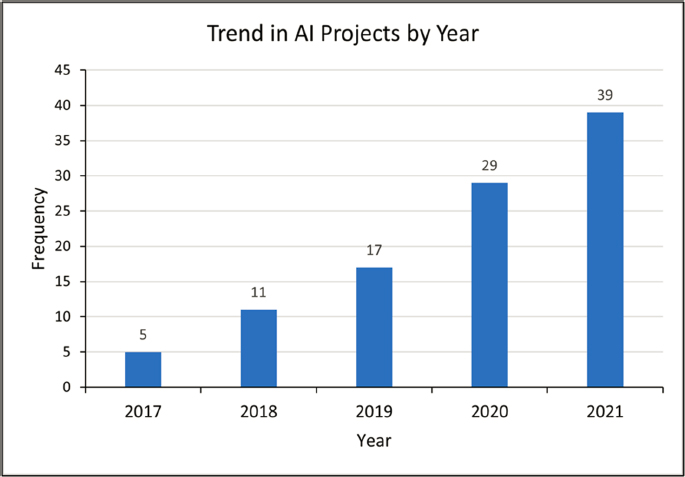
The team was interested in understanding the trend in AI application research within the transportation area over the years. Figure 25 presents the number of projects started from the year 2017 to early 2022. The graph shows a steady increase in the use of AI tools in transportation research.
Brief Summary of Four Completed Reports
Four completed reports were selected from 106 projects to summarize the AI tools used in addressing some of the transportation concerns. Following is a summary of each report highlighting the transportation focus area and the AI tools that were discussed in these projects.
Deep-Learning Based Trajectory Forecast for Safety of Intersections with Multimodal Traffic (Phase II)
Predicting pedestrian trajectories is of major importance for several applications including autonomous driving and surveillance systems. In autonomous driving, an accurate prediction of pedestrian’s trajectories enables the controller to plan the motion of the vehicle in an adversarial environment.
In this report, the project presents the Social Spatio-Temporal Graph Convolutional Neural Network (Social-STGCNN) tool, which uses graph theory to encode pedestrian/environment interactions. This method is based on artificial neural networks (CNNs) and graph theory-based potential functions. The researchers validated this algorithm based on experimental drone-captured data. Through qualitative analysis, project researchers showed that their model inherited social behaviors that can be expected between pedestrians’ trajectories, including collision avoidance, or merging of pedestrian trajectories.
- Transportation focus area: Pedestrian movement, safety at intersections, and multimodal planning
- AI tools use: CNN, Social-STGCNN
Green Waves, Machine Learning, and Predictive Analytics: Making Streets Better for People on Bikes
This project was a follow-up to two prior National Institute for Transportation and Communities (NITC) projects: (1) V2X: Adding Bikes to the Mix, NITC-ED-1027 and (2) FastTrack: Allowing Bikes to
Participate In A Smart-Transportation System, NITC-1160. The overall goal of these two prior projects and the current project was to give bicyclists a safer and more efficient use of a city’s signaled intersections. The project report summarizes the machine-learning algorithms that can be used to predict traffic signals and the past trajectories of bicyclists. The long-term goal is to give a bicyclist real-time information on whether to slow down, speed up, or maintain speed to make a green light.
- Transportation focus area: traffic management, infrastructure, policy and planning, mobility, Micromobility, travel behavior
- AI tools use: machine learning algorithms, traffic signal prediction, trajectories prediction
Evaluating Mobility Impacts of Construction Work Zones on Utah Transportation System Using Machine Learning Techniques
To address work zones' capacity on roadways, the project researchers proposed an ANN model based on the data collected by Utah transportation agencies. To determine the most influential factors of work zones, a comprehensive literature review was conducted on 70 previously published papers. Lane width, work zone length, project duration, time of day, day of the week, and heavy vehicle percentage are among the most common factors considered in the literature. The suggested neural network model is trained and evaluated on around 400,000 data points collected from about 80 projects on Utah roadways. Based on the collected data from various resources, a four-layer neural network was developed with 256 neurons in each hidden layer. The developed model was trained on 70% of the data and evaluated using the other 30%, divided into 15% of validation and 15% of the test set. Numerical results of a random seed show consistent outperformance of the proposed model, with an R-squared (R2), root mean squared error (RMSE), and mean absolute error (MAE) being 0.98, 158, and 101, respectively. Based on the results of this project, future studies could be carried out using the probe vehicle data to improve the model’s performance by decreasing the RMSE, MAPE, and MAE values.
- Transportation focus area: traffic management, work-zone analysis, urban multimodal corridor, commercial vehicle & freight operations
- AI tools use: big data analytics, neural networks, ANN, machine learning
Predicting Travel Time on Freeway Corridors: Machine Learning Approach
The objectives of this project were to: 1) Develop the travel time prediction model using an advanced, efficient, and accurate machine learning-based approach, 2) Select a real-world freeway corridor to evaluate the developed prediction model, and 3) Evaluate the prediction results of the developed model.
In this study, an advanced machine learning-based approach (i.e., XGBoost model) was employed to predict freeway travel time. Detailed information about the input variables and data pre-processing was presented. Parameters of the XGBoost model were introduced and the parameter tuning process was discussed. The results demonstrated that the developed XGBoost travel time prediction model significantly improved computation accuracy and efficiency.
- Transportation focus area: traffic management, urban arterial network
- AI tools use: machine learning, forecasting, pattern recognition model, neural network model, predictive analysis
Key Findings
The secondary aim of the literature analysis was to explore the extent of AI applications in transportation research in the last 5 years. The results of the TRID database show that most of the AI applications research is around traffic management and transportation infrastructure. Since urban areas constantly face traffic congestion issues, AI tools can provide real-time information from vehicles for traffic management. The other areas where AI applications’ research trend is prevalent include mobility, policy and planning, and safety. We also explored whether there were projects of vital interest to the State DOTs. The results showed
that 16 State DOTs had funded transportation research that looked at applying AI tools in the last 5 years. Table 10 lists the list of projects with the transportation focus area. For 4 projects, the primary focus area of the research was infrastructure, 3 projects had a focus on road safety, and 3 projects had a primary focus on traffic management.
We also found that there has been an increase in the number of funded projects for AI applications in transportation research over the last 5 years. With the current pace of technological advancement, the trend will keep rising. We briefly summarized 4 completed projects that looked at using some form of AI tool to answer transportation research questions. These projects addressed traffic management issues and the safety issues that arise from them, such as pedestrian safety at intersections, protected bike lanes, the impact of congestion on freeways, and increased travel time. The AI applications used in these projects include pattern recognition models, neural network models, traffic signal predictions, and trajectories prediction. These research trends show that AI has the potential to revolutionize the way we could approach a transportation problem. The literature analysis presents multiple tools that are available for state DOTs, local DOTs, and the stakeholders to apply in various transportation research areas.
References
Blei, D. M., & Lafferty, J. D. (2009). Topic models. Text mining: classification, clustering, and applications, 10(71), 34.
Carpineto, C., & Romano, G. (2012). A survey of automatic query expansion in information retrieval. ACM Computing Surveys (CSUR), 44(1), 1-50.
Das, S., Dutta, A., & Brewer, M. A. (2020). Case study of trend mining in Transportation Research Record articles. Transportation research record, 2674(10), 1-14.
Federal Highway Administration (n.d.). Work Zone and Traffic Analysis. Retrieved from Work Zone Management Program: https://ops.fhwa.dot.gov/Wz/traffic_analysis/index.htm#:~:text=Analysis%20of%20the%20work%20zone,alternate%20route%20for%20another%20project
Leahy, A., & Takesian, Y. (n.d.). The Importance of the Equity Lens in Transportation Planning and Design. Retrieved from Kittelson & Associates: https://www.kittelson.com/ideas/the-importance-of-the-equity-lens-in-transportation-planning-and-design/
Li, M., Zou, M., & Li, H. (2019). Urban Travel Behavior Study Based on Data Fusion Model. In Y. Wang, & Z. Zeng, Data-Driven Solutions to Transportation Problems (pp. 111-135). Elsevier.
Liu, J., Tian, J., Kong, X., Lee, I., & Xia, F. (2019). Two decades of information systems: a bibliometric review. Scientometrics, 118(2), 617-643.
Liu, J., Kong, X., Zhou, X., Wang, L., Zhang, D., Lee, I., … & Xia, F. (2019). Data Mining and Information Retrieval in the 21st century: A bibliographic review. Computer science review, 34, 100193.
Liu, J., Kong, X., Xia, F., Bai, X., Wang, L., Qing, Q., & Lee, I. (2018). Artificial intelligence in the 21st century. IEEE Access, 6, 34403-34421.
McCarthy, J. (2004). What is Artificial Intelligence? http://www-formal.stanford.edu/jmc/whatisai.pdf
Mihalcea, R., & Tarau, P. (2004, July). Textrank: Bringing order into text. In Proceedings of the 2004 conference on empirical methods in natural language processing (pp. 404-411).
National Safety Council (2018). Vulnerable Road Users.
nauto. (n.d.). What is Driver Behavior? Retrieved from nauto: https://www.nauto.com/glossary/what-is-driver-behavior
Pan America Health Organization (n.d.). Road Safety. Retrieved from https://www.paho.org/en/topics/road-safety
Pramkeaw, P., Ketcham, M., Limpornchitwilai, W., & Chumuang, N. (2019, October). Analysis of detecting and interpreting warning signs for distance of cars using analyzing the license plate. In 2019 14th International Joint Symposium on Artificial Intelligence and Natural Language Processing (iSAI-NLP) (pp. 1-8). IEEE.
Rangesh, A., & Trivedi, M. M. (2018). When vehicles see pedestrians with phones: A multicue framework for recognizing phone-based activities of pedestrians. IEEE Transactions on Intelligent Vehicles, 3(2), 218-227.
Samara, L., St-Aubin, P., Loewenherz, F., Budnick, N., & Miranda-Moreno, L. (2020, January). Video-based network-wide surrogate safety analysis to support a proactive network screening using connected cameras: Case study in the City of Bellevue (WA) United States. In Proceedings of the Transportation Research Board 100th Annual Meeting, Washington, DC, USA (pp. 9-13).
Sarkar, A., Doerzaph, Z. R., & Abbott, A. L. (2014). Assessment of Psychophysiological Characteristics of Drivers Using Heart Rate from SHRP2 Face Video Data.
Sinha, K.C., & Fwa, T.F. (1989). ON THE CONCEPT OF TOTAL HIGHWAY MANAGEMENT. Transportation Research Record.
Slack, B., Notteboom, T., & Rodrigue, J.-P. (2017). Transport Planning and Policy. In J.-P. Rodrigue, The Geography of Transport Systems (pp. 311-339). New York: Routledge.
Sun, L., & Yin, Y. (2017). Discovering themes and trends in transportation research using topic modeling. Transportation Research Part C: Emerging Technologies, 77, 49-66.
Taylor, M. A. (2021). Transportation Infrastructure. In Climate Change Adaptation for Transportation Systems (pp. 47-64). Elsevier.
Underwood, R. T. (1990). Traffic management: an introduction. Melbourne: Hargreen Publishing
Vasudevan, M., Townsend, H., Schweikert, E., Wunderlich, K. E., Burnier, C., Hammit, B. E., … & Ozbay, K. (2020a). Identifying Real-World Transportation Applications Using Artificial Intelligence (AI)-Real-World AI Scenarios in Transportation for Possible Deployment (No. FHWA-JPO-20-810). United States. Department of Transportation. Intelligent Transportation Systems Joint Program Office
Vasudevan, M., Townsend, H., Dang, T.N., O’Hara, A., Burnier, C., Ozbay, K. (2020b). Identifying Real-World Transportation Applications Using Artificial Intelligence (AI)-Summary of Potential Application of AI in Transportation
(No. FHWA-JPO-20-787). United States. Department of Transportation. Intelligent Transportation Systems Joint Program Office
Vayansky, I., & Kumar, S. A. (2020). A review of topic modeling methods. Information Systems, 94, 101582.
Vechtomova, O., & Wang, Y. (2006). A study of the effect of term proximity on query expansion. Journal of Information Science, 32(4), 324-333.
Wallach, H. M. (2006, June). Topic modeling: beyond bag-of-words. In Proceedings of the 23rd international conference on Machine learning (pp. 977-984).
Wang, X., & McCallum, A. (2006, August). Topics over time: a non-markov continuous-time model of topical trends. In Proceedings of the 12th ACM SIGKDD international conference on Knowledge discovery and data mining (pp. 424-433).
Zoning, C. P. (2019, July 25). What are the Differences between Mobility, Accessibility, and Connectivity in Transportation Planning? Retrieved from Community Planning: https://community-planning.extension.org/what-are-the-differences-between-mobility-accessibility-and-connectivity-in-transportation-planning/


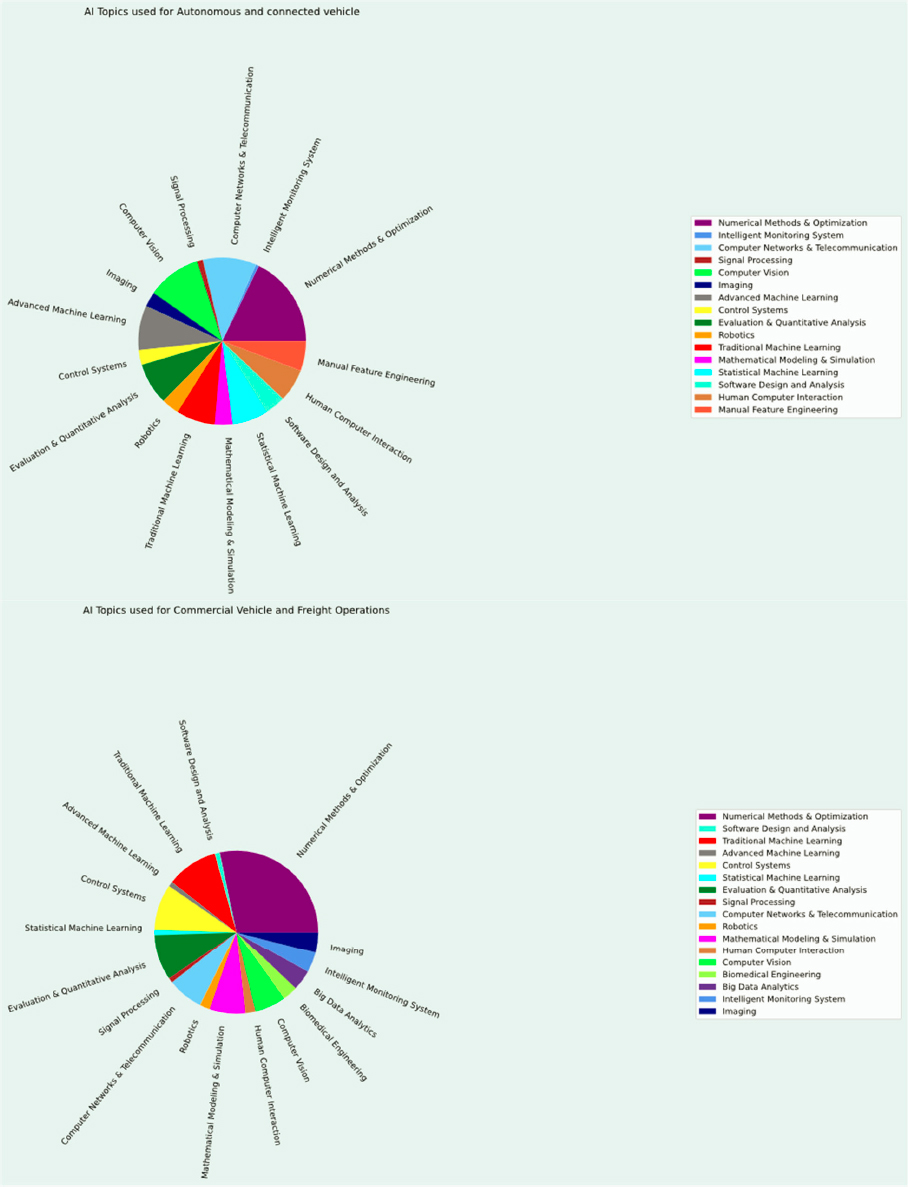
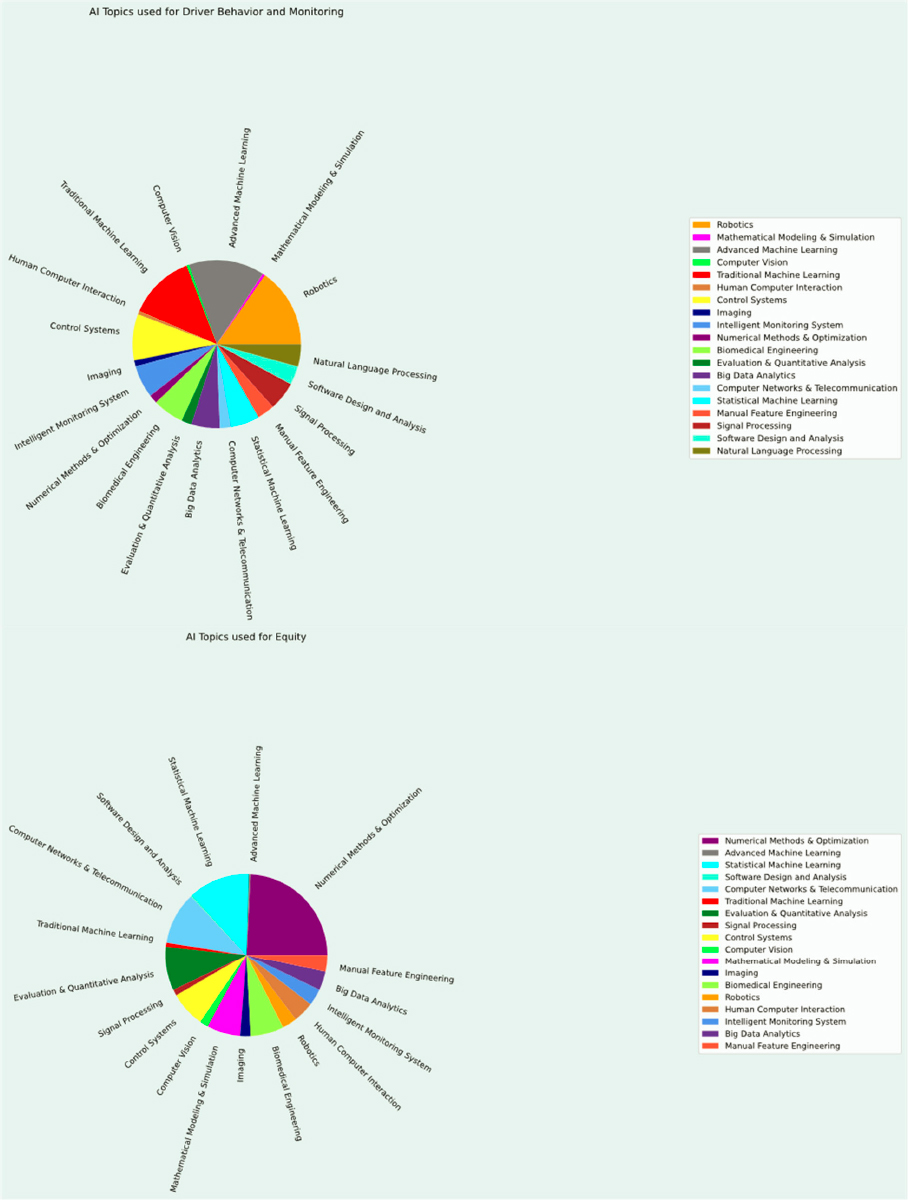
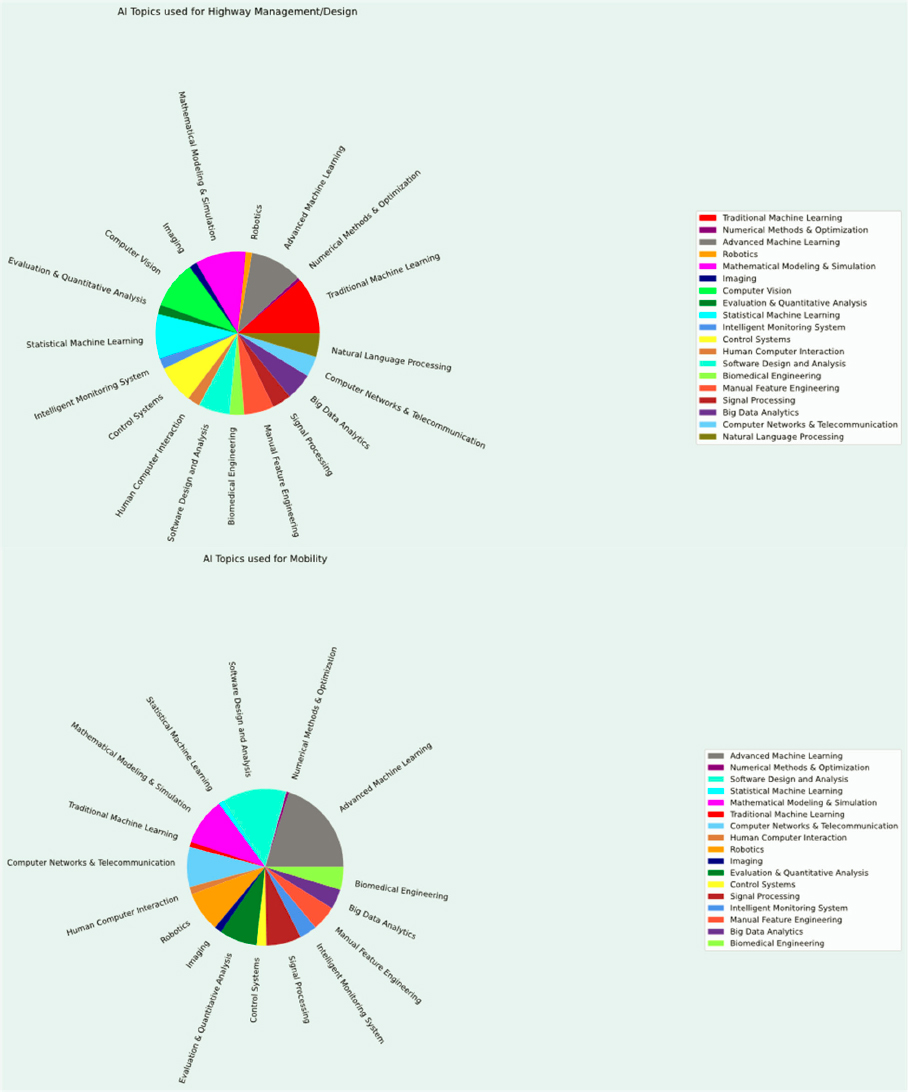
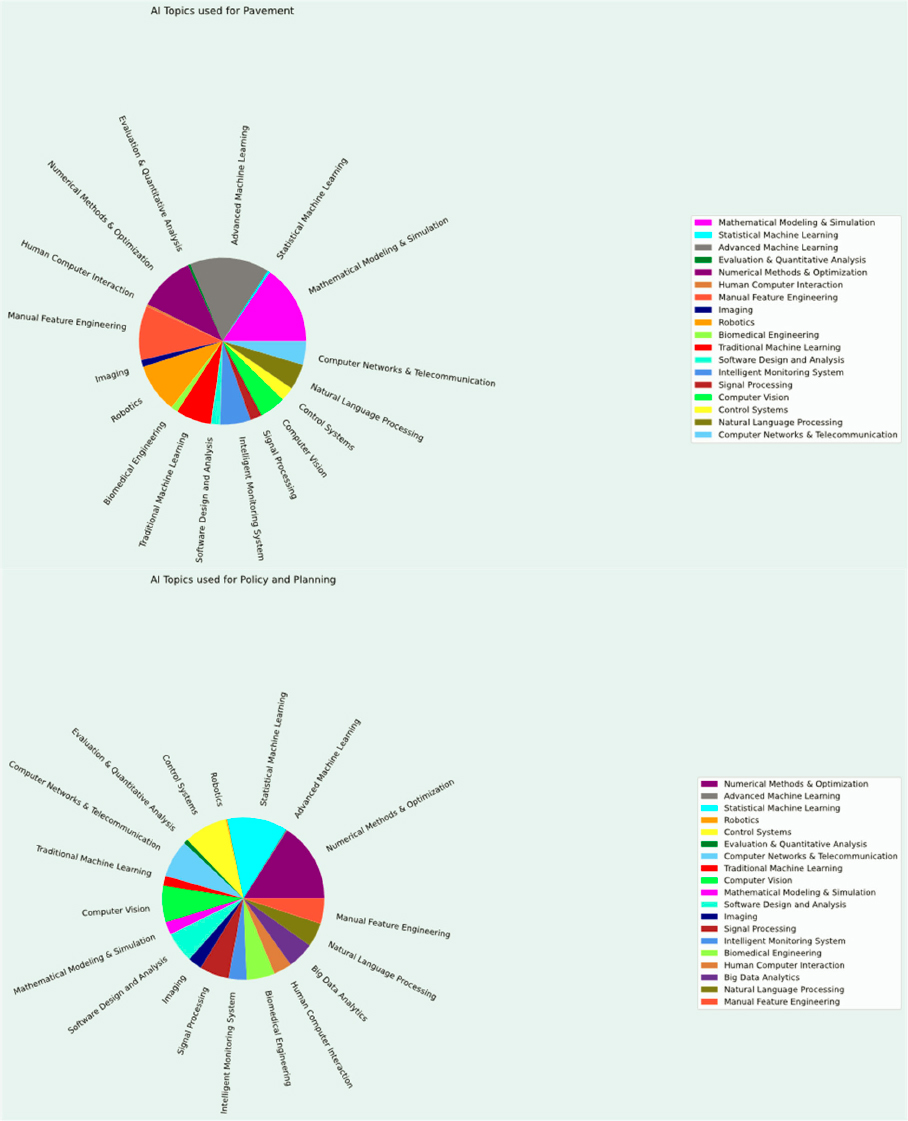
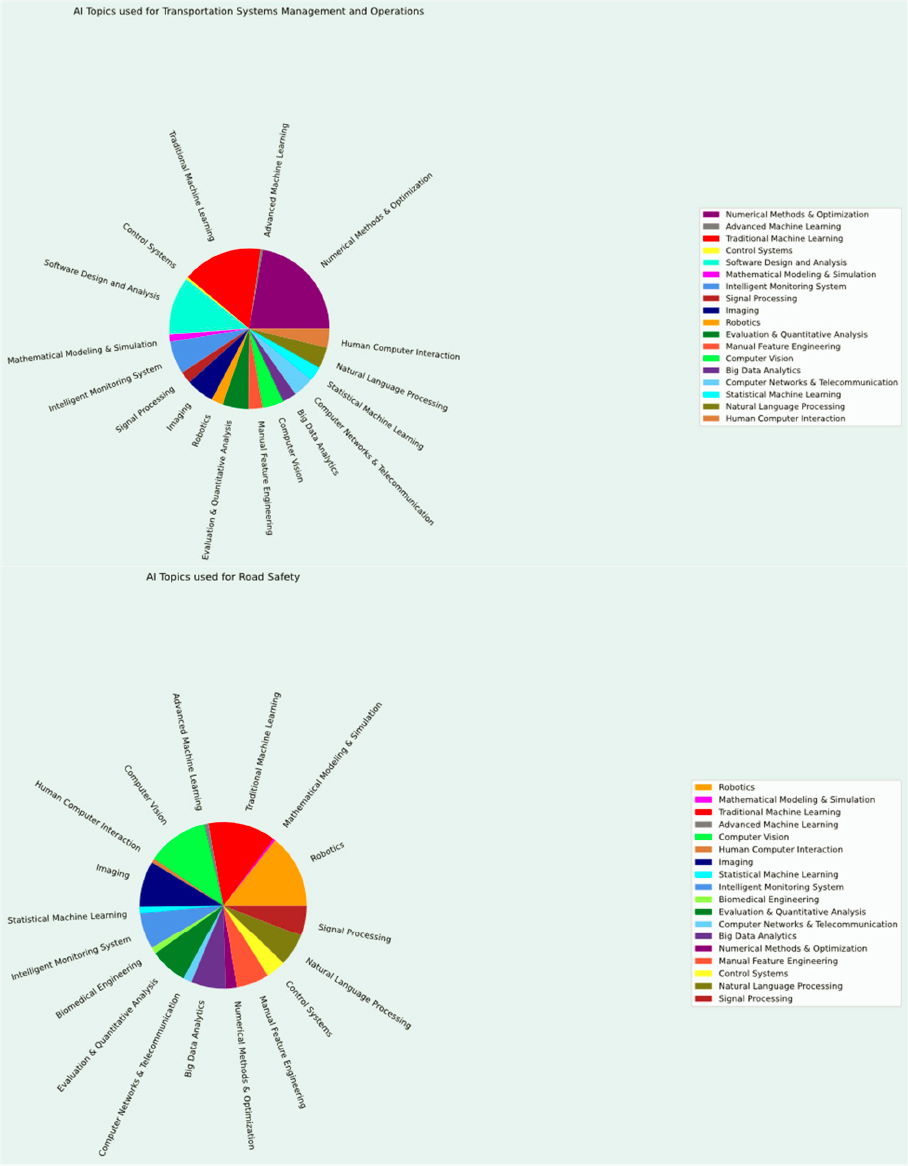
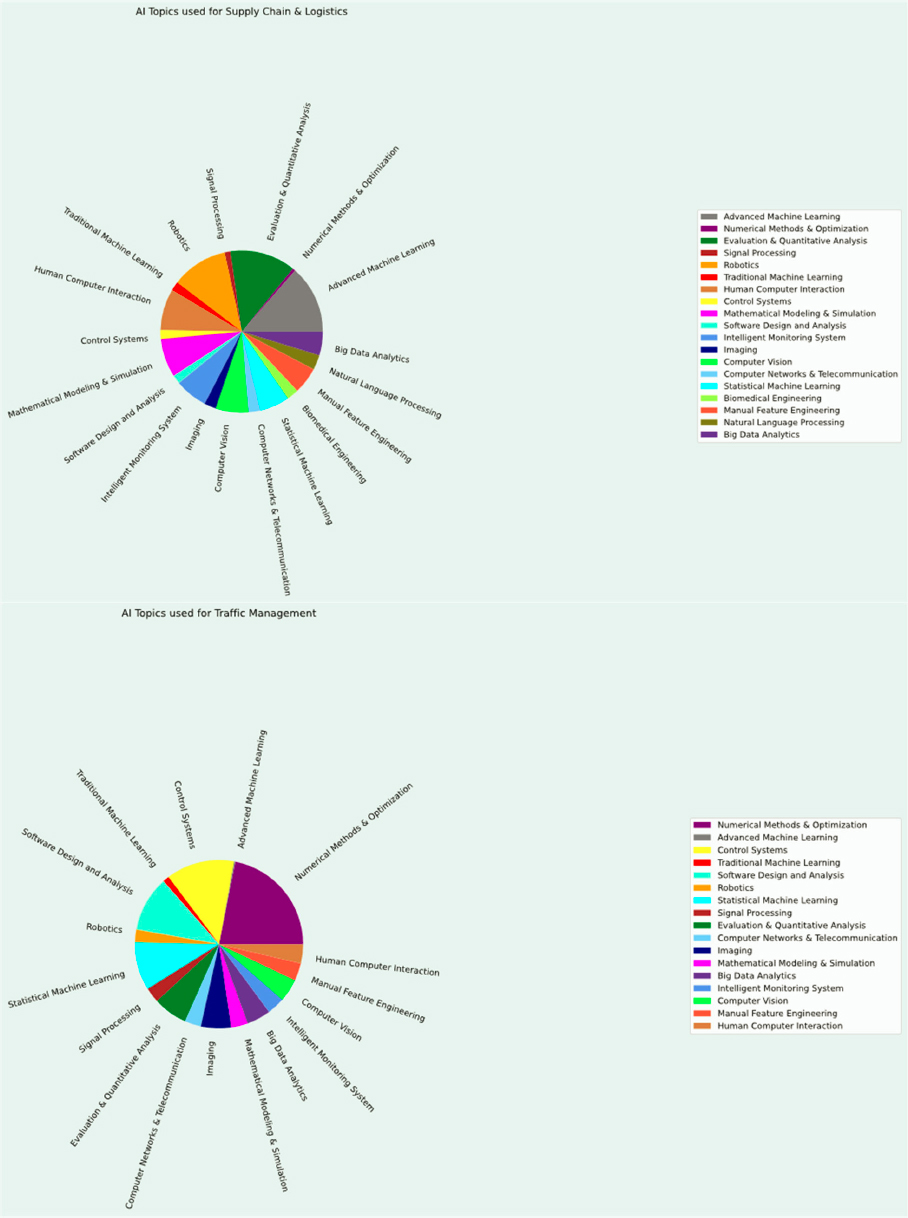

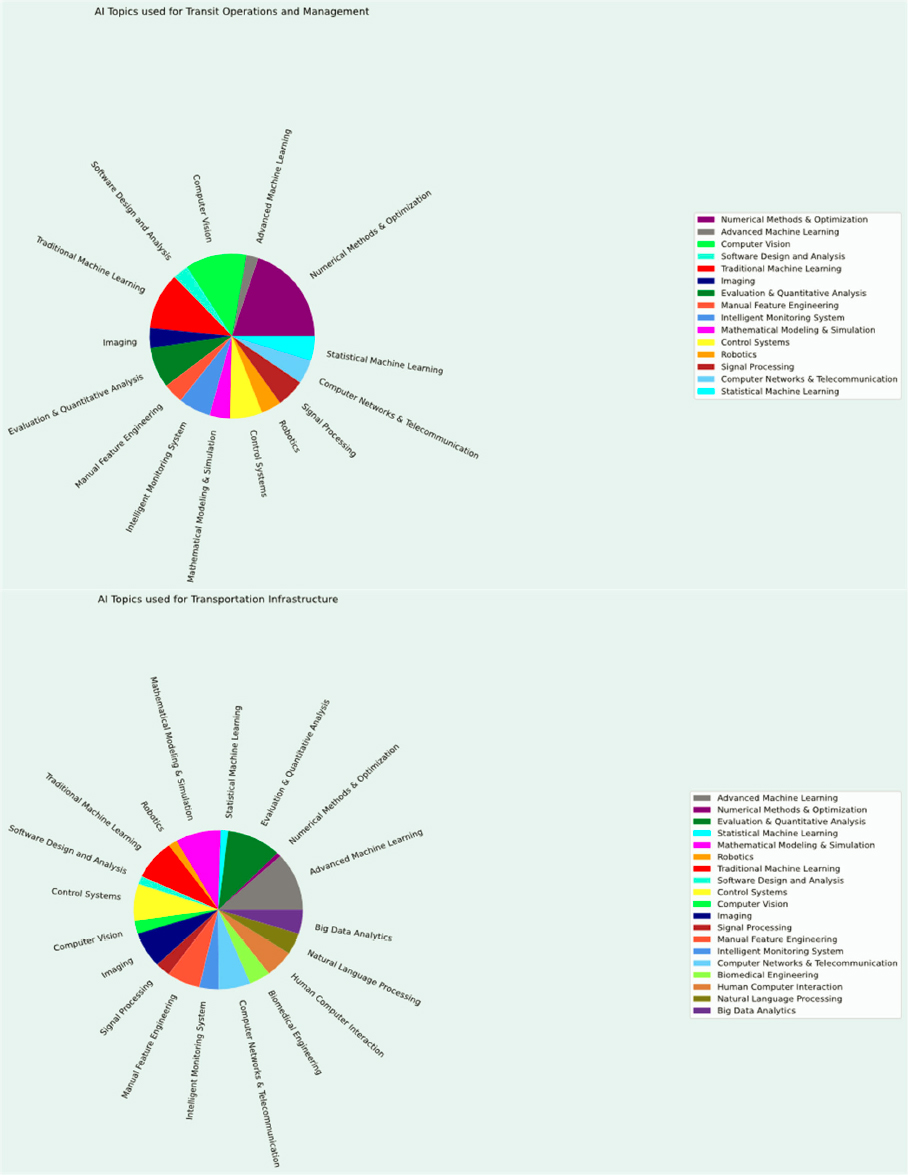
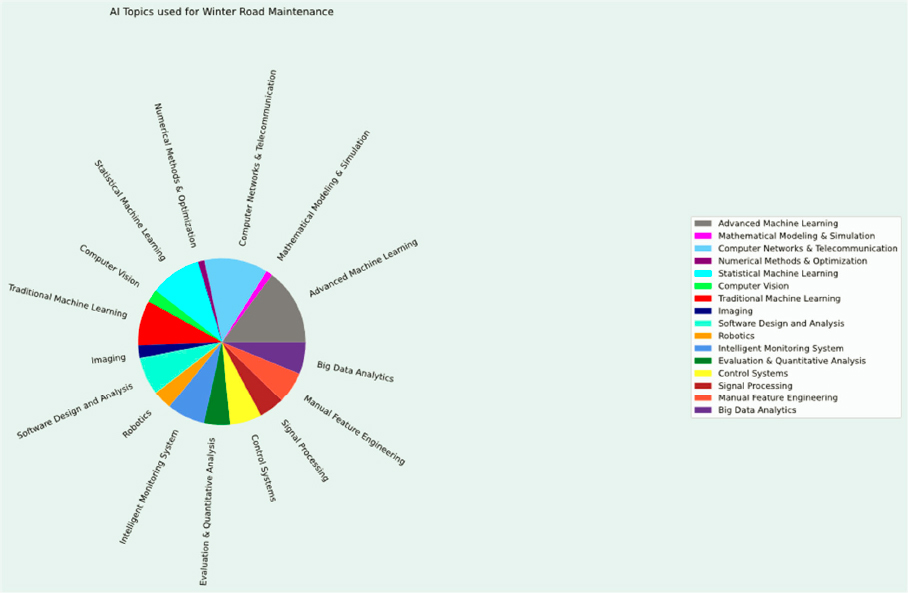
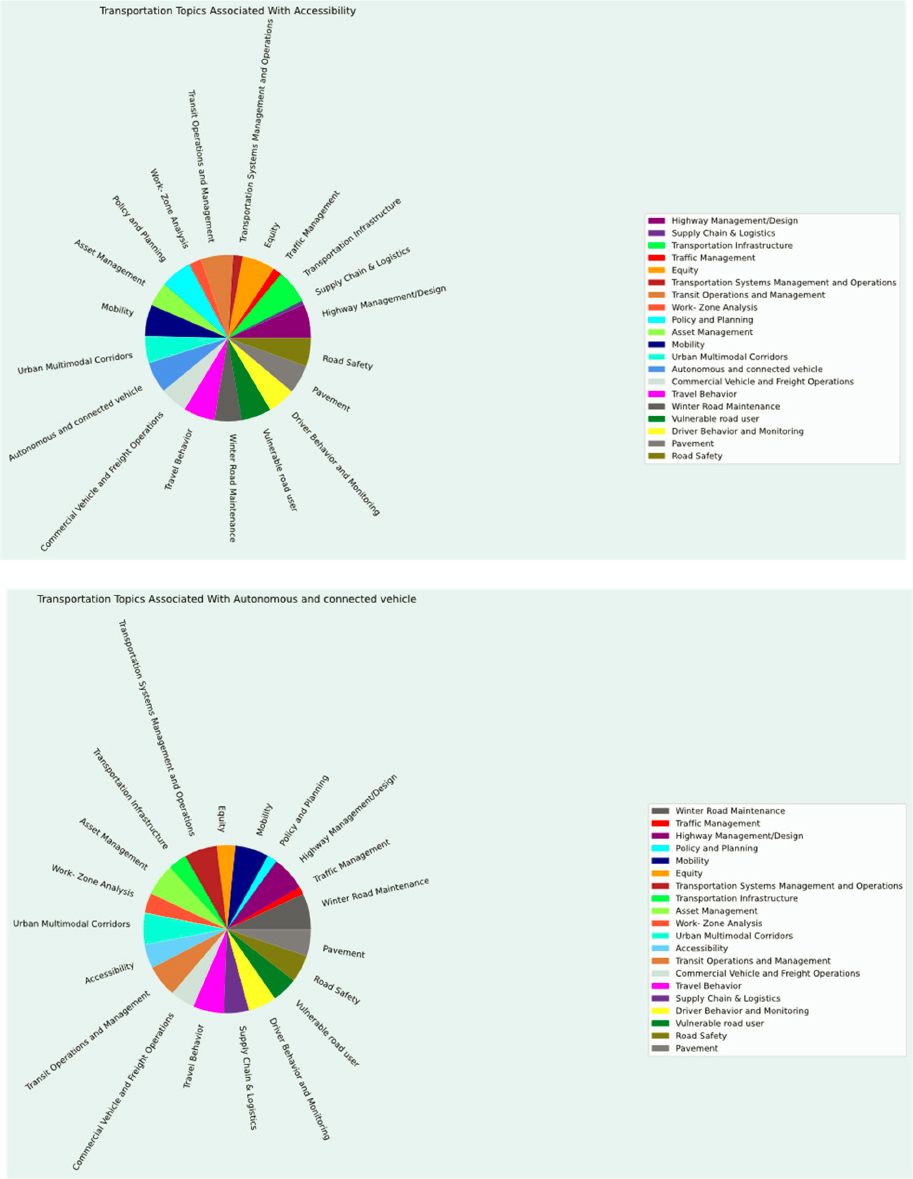
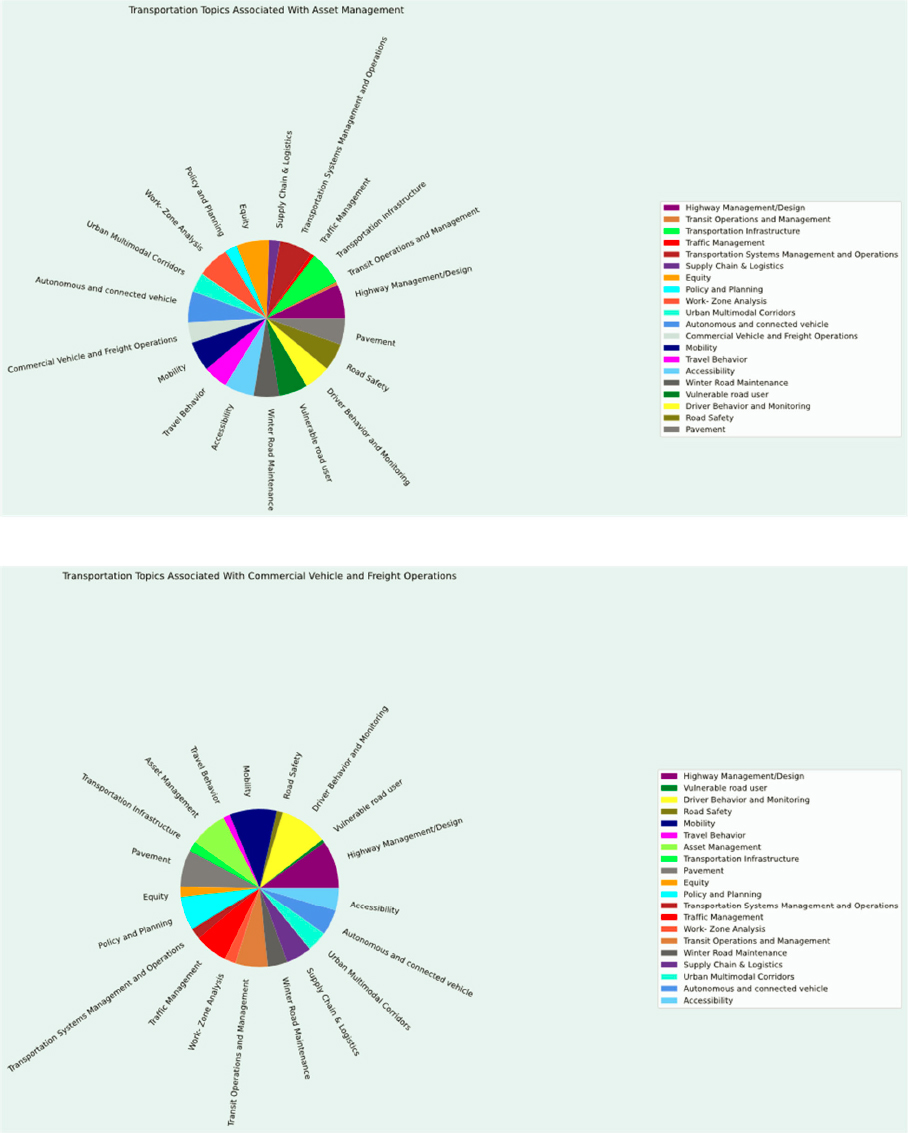


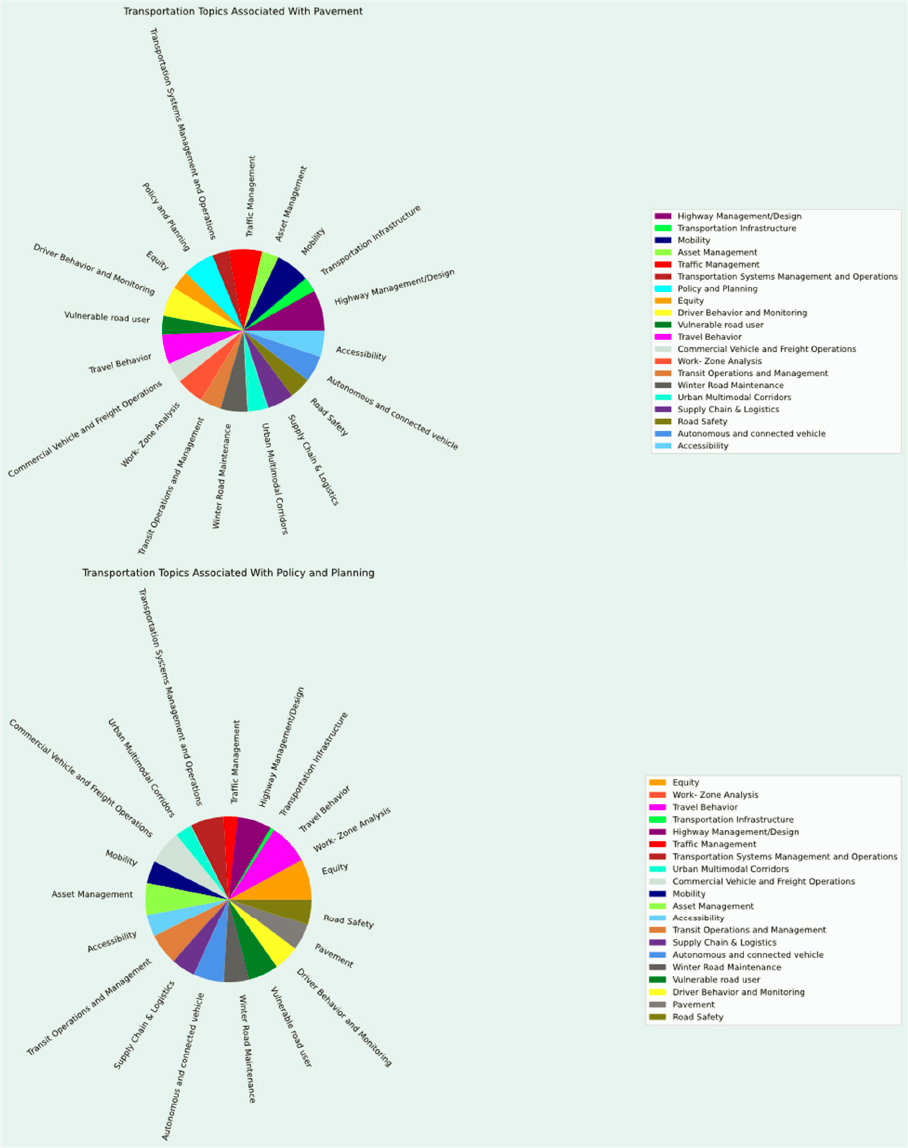
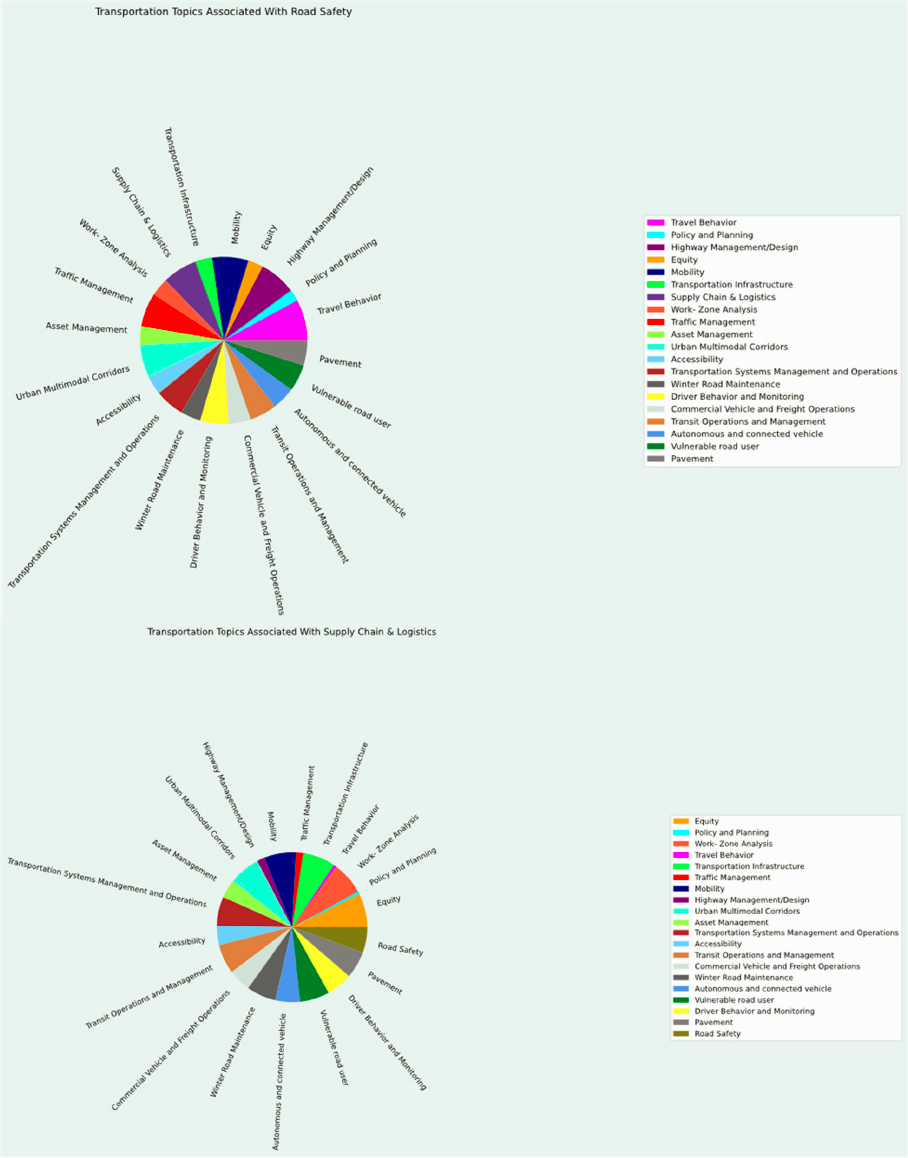
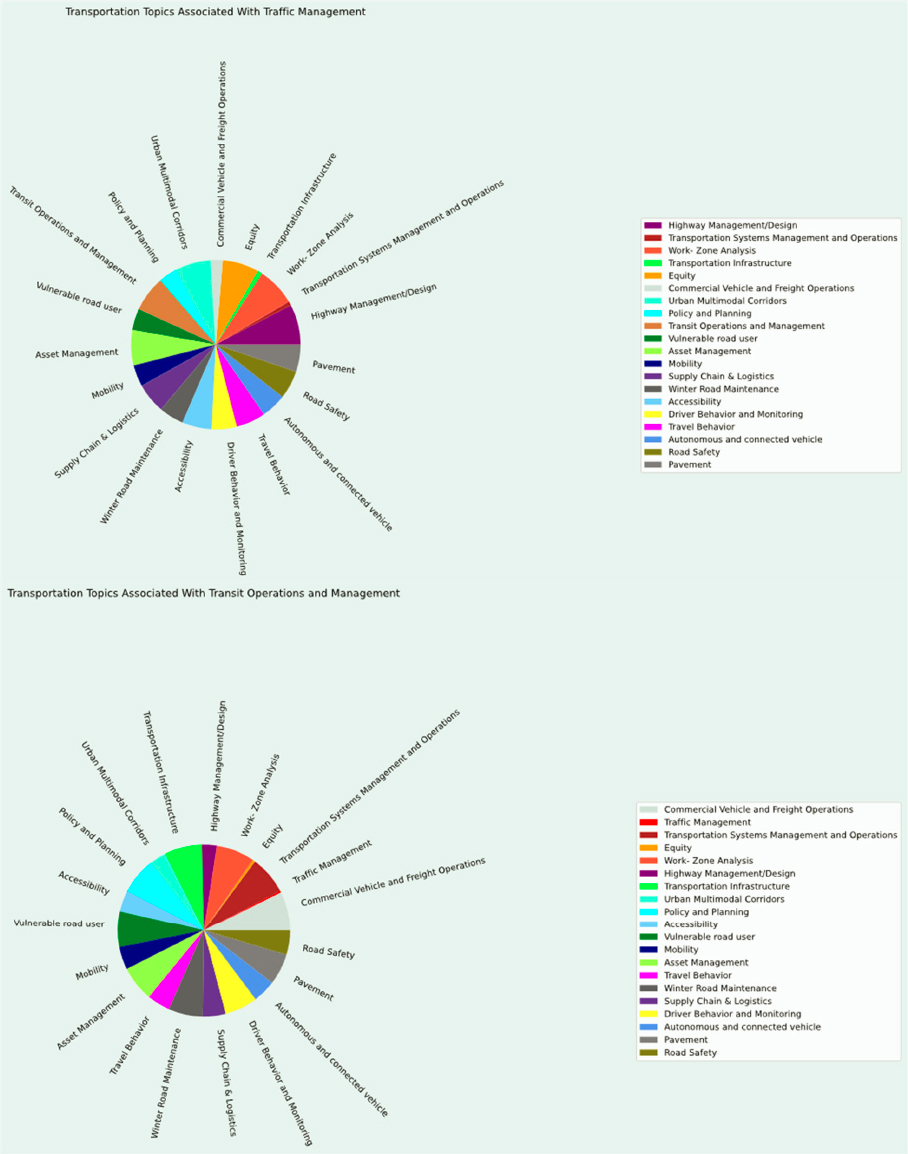

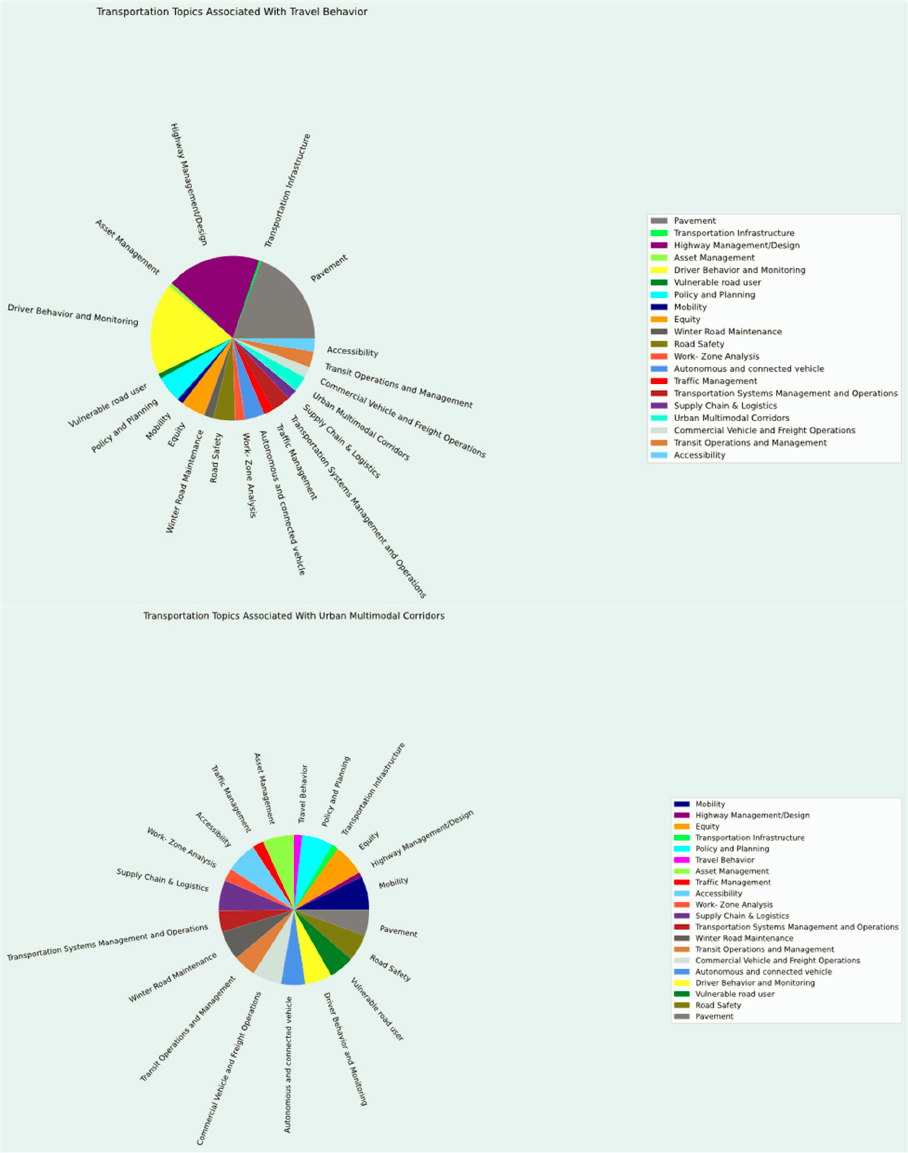

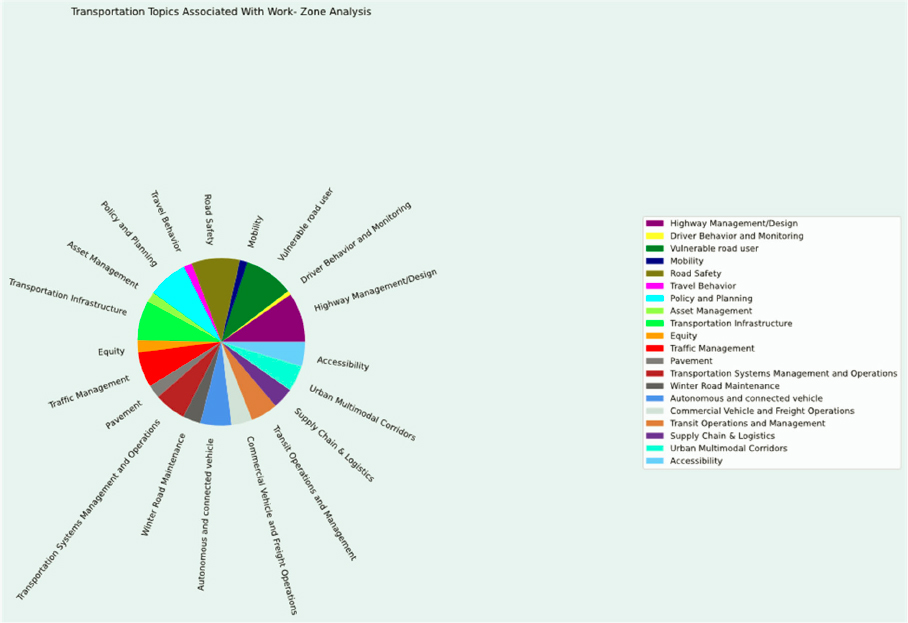
Appendix A3
Table 13. Number of AI topic papers having co-occurrence with transportation topics (Part A).
| Transportation Topic | Traditional Machine Learning | Statistical Machine Learning | Numerical Methods & Optimization | Computer Vision | Advanced Machine Learning | Mathematical Modeling & Simulation | Evaluation & Quantitative Analysis | Control Systems | Imaging | Robotics |
|---|---|---|---|---|---|---|---|---|---|---|
| Traffic Management | 807 | 515 | 2233 | 298 | 1389 | 534 | 1149 | 366 | 190 | 681 |
| Policy and Planning | 867 | 657 | 2945 | 225 | 1505 | 712 | 1525 | 370 | 207 | 758 |
| Highway Management Design | 1413 | 1582 | 2126 | 615 | 2482 | 1226 | 1699 | 485 | 411 | 1462 |
| Transportation Infrastructure | 1042 | 954 | 2606 | 412 | 1863 | 852 | 1501 | 393 | 324 | 986 |
| Pavement | 244 | 431 | 506 | 146 | 515 | 424 | 493 | 106 | 142 | 299 |
| Travel Behavior | 692 | 732 | 1122 | 237 | 1228 | 591 | 831 | 103 | 216 | 663 |
| Vulnerable road user | 905 | 1326 | 686 | 580 | 1645 | 846 | 986 | 235 | 324 | 1489 |
| Driver Behavior and Monitoring | 854 | 1189 | 551 | 529 | 1531 | 862 | 833 | 234 | 282 | 1005 |
| Mobility | 1027 | 1164 | 1665 | 384 | 1826 | 818 | 1210 | 175 | 322 | 1037 |
| Equity | 996 | 865 | 2111 | 385 | 1652 | 798 | 1317 | 254 | 286 | 790 |
| Urban Multimodal Corridors | 613 | 382 | 2040 | 155 | 1091 | 365 | 935 | 199 | 123 | 478 |
| Transportation Systems Management & Operations | 599 | 379 | 1571 | 235 | 1023 | 400 | 779 | 273 | 141 | 614 |
| Asset Management | 948 | 1177 | 1265 | 185 | 1288 | 708 | 1044 | 125 | 215 | 587 |
| Transportation Topic | Traditional Machine Learning | Statistical Machine Learning | Numerical Methods & Optimization | Computer Vision | Advanced Machine Learning | Mathematical Modeling & Simulation | Evaluation & Quantitative Analysis | Control Systems | Imaging | Robotics |
|---|---|---|---|---|---|---|---|---|---|---|
| Road Safety | 448 | 685 | 264 | 186 | 698 | 470 | 436 | 87 | 167 | 412 |
| Work Zone Analysis | 761 | 511 | 2067 | 251 | 1379 | 465 | 1201 | 282 | 188 | 618 |
| Supply Chain Logistics | 466 | 359 | 1275 | 167 | 820 | 452 | 701 | 144 | 117 | 450 |
| Autonomous & connected vehicle | 208 | 198 | 807 | 55 | 348 | 215 | 489 | 112 | 104 | 209 |
| Accessibility | 164 | 93 | 429 | 36 | 300 | 107 | 251 | 36 | 33 | 118 |
| Transit Operations & Management | 301 | 144 | 649 | 214 | 471 | 221 | 391 | 92 | 80 | 330 |
| Commercial Vehicle & Freight Operations | 382 | 233 | 1510 | 128 | 768 | 262 | 615 | 173 | 87 | 384 |
| Winter Road Maintenance | 104 | 82 | 127 | 34 | 179 | 74 | 131 | 20 | 29 | 60 |
| Total | 13841 | 13658 | 28555 | 5457 | 24001 | 11402 | 18517 | 4264 | 3988 | 13430 |
Table 14. AI Topics having co-occurrence with transportation topics (Part B).
| Transportation Topic | Software Design & Analysis | Signal Processing | Biomedical Engineering | Natural Language Processing | Manual Feature Engineering | Big Data Analytics | Intelligent Monitoring System | Computer Networks and Telecommunication | Human-Computer Interaction | Total Topic Papers |
|---|---|---|---|---|---|---|---|---|---|---|
| Traffic Management | 669 | 195 | 88 | 151 | 262 | 406 | 284 | 288 | 133 | 10787 |
| Policy and Planning | 782 | 266 | 105 | 159 | 223 | 362 | 277 | 357 | 177 | 13187 |
| Transportation Topic | Software Design & Analysis | Signal Processing | Biomedical Engineering | Natural Language Processing | Manual Feature Engineering | Big Data Analytics | Intelligent Monitoring System | Computer Networks and Telecommunication | Human-Computer Interaction | Total Topic Papers |
|---|---|---|---|---|---|---|---|---|---|---|
| Highway Management Design | 658 | 265 | 490 | 352 | 499 | 448 | 529 | 366 | 340 | 16508 |
| Transportation Infrastructure | 738 | 347 | 198 | 211 | 377 | 432 | 391 | 261 | 172 | 14026 |
| Pavement | 177 | 81 | 134 | 56 | 152 | 42 | 107 | 38 | 66 | 4554 |
| Travel Behavior | 340 | 153 | 295 | 192 | 216 | 229 | 202 | 232 | 220 | 8216 |
| Vulnerable road user | 246 | 155 | 447 | 291 | 370 | 224 | 576 | 234 | 275 | 8377 |
| Driver Behavior and Monitoring | 227 | 94 | 398 | 262 | 313 | 204 | 311 | 206 | 250 | 7651 |
| Mobility | 537 | 157 | 365 | 272 | 334 | 360 | 341 | 310 | 275 | 11761 |
| Equity | 630 | 249 | 187 | 248 | 349 | 421 | 314 | 320 | 203 | 13139 |
| Urban Multimodal Corridors | 606 | 123 | 52 | 121 | 179 | 356 | 183 | 209 | 111 | 9211 |
| Transportation Systems Management & Operations | 426 | 138 | 75 | 120 | 179 | 265 | 283 | 174 | 79 | 7329 |
| Asset Management | 396 | 131 | 179 | 162 | 220 | 226 | 222 | 172 | 152 | 8937 |
| Road Safety | 121 | 39 | 201 | 130 | 172 | 87 | 145 | 80 | 139 | 4084 |
| Work Zone Analysis | 653 | 289 | 104 | 150 | 216 | 352 | 274 | 311 | 127 | 10070 |
| Transportation Topic | Software Design & Analysis | Signal Processing | Biomedical Engineering | Natural Language Processing | Manual Feature Engineering | Big Data Analytics | Intelligent Monitoring System | Computer Networks and Telecommunication | Human-Computer Interaction | Total Topic Papers |
|---|---|---|---|---|---|---|---|---|---|---|
| Supply Chain Logistics | 354 | 107 | 96 | 113 | 127 | 162 | 128 | 148 | 118 | 6882 |
| Autonomous & connected vehicle | 238 | 216 | 26 | 34 | 40 | 62 | 118 | 156 | 43 | 4050 |
| Accessibility | 124 | 40 | 7 | 23 | 47 | 83 | 44 | 60 | 24 | 2509 |
| Transit Operations & Management | 163 | 82 | 49 | 70 | 102 | 121 | 133 | 68 | 49 | 4005 |
| Commercial Vehicle & Freight Operations | 403 | 86 | 30 | 78 | 110 | 204 | 161 | 149 | 60 | 5835 |
| Winter Road Maintenance | 42 | 12 | 10 | 18 | 37 | 65 | 25 | 17 | 6 | 1102 |
| Total | 8530 | 3225 | 3536 | 3213 | 4524 | 5111 | 5048 | 4156 | 3019 |
Table 15. Correlation of normalized number of papers and years (Part A).
| Transportation Topic | Robotics | Software Design and Analysis | Signal Processing | Biomedical Engineering | Natural Language Processing | Manual Feature Engineering | Big Data Analytics | Intelligent Monitoring System | Computer Networks & Telecommunication | Human Computer Interaction |
|---|---|---|---|---|---|---|---|---|---|---|
| Traffic Management | 0.470079 | -0.04121 | 0.27449 | 0.599584 | -0.27773 | -0.64166 | 0.592429 | -0.77319 | 0.516662 | 0.652022 |
| Transportation Topic | Robotics | Software Design and Analysis | Signal Processing | Biomedical Engineering | Natural Language Processing | Manual Feature Engineering | Big Data Analytics | Intelligent Monitoring System | Computer Networks & Telecommunication | Human Computer Interaction |
|---|---|---|---|---|---|---|---|---|---|---|
| Policy and Planning | 0.316439 | 0.037219 | -0.02916 | -0.17808 | -0.58033 | -0.58626 | 0.699839 | -0.42423 | 0.638181 | 0.137232 |
| Highway Management Design | -0.0028 | 0.002358 | -0.28222 | 0.1249 | -0.55715 | -0.72408 | 0.721817 | -0.68728 | 0.369152 | -0.71919 |
| Transportation Infrastructure | 0.177153 | 0.187003 | -0.60722 | 0.099282 | 0.319154 | -0.27108 | 0.794266 | -0.62566 | 0.606157 | -0.21726 |
| Pavement | 0.103716 | 0.466849 | 0.027322 | 0.305252 | -0.53701 | -0.10424 | 0.574213 | -0.05794 | -0.00257 | -0.46983 |
| Travel Behavior | -0.44307 | 0.637096 | -0.0146 | 0.056522 | -0.72063 | -0.76661 | 0.682385 | -0.27172 | 0.563544 | -0.6148 |
| Vulnerable road user | 0.629832 | 0.082678 | -0.48273 | 0.045252 | -0.50121 | -0.49395 | 0.516228 | -0.48163 | 0.680373 | -0.67763 |
| Driver Behavior and Monitoring | -0.21148 | 0.181661 | -0.49174 | 0.215513 | -0.5225 | -0.67684 | 0.52791 | -0.7964 | 0.37421 | -0.62958 |
| Mobility | -0.48615 | 0.030622 | 0.369301 | -0.07061 | -0.67528 | -0.64776 | 0.688903 | -0.45237 | 0.394638 | -0.80234 |
| Equity | 0.107478 | -0.07824 | 0.173642 | 0.509949 | -0.45248 | -0.49917 | 0.627563 | -0.33109 | 0.259543 | -0.08765 |
| Urban Multimodal Corridors | 0.447512 | -0.40101 | 0.392851 | 0.571312 | -0.14217 | -0.63262 | 0.538717 | -0.52924 | -0.43382 | 0.286855 |
| Transportation Systems Management & Operations | 0.63241 | -0.2801 | 0.041798 | 0.762767 | 0.233389 | -0.35955 | 0.71289 | -0.65047 | 0.677658 | 0.096045 |
| Asset Management | -0.71929 | -0.41091 | 0.403664 | -0.5096 | -0.37054 | -0.54149 | 0.710582 | -0.67458 | 0.039219 | -0.4443 |
| Road Safety | -0.03005 | -0.14498 | -0.35523 | 0.268684 | -0.37223 | -0.53617 | 0.699469 | -0.50779 | 0.353499 | -0.38225 |
| Transportation Topic | Robotics | Software Design and Analysis | Signal Processing | Biomedical Engineering | Natural Language Processing | Manual Feature Engineering | Big Data Analytics | Intelligent Monitoring System | Computer Networks & Telecommunication | Human Computer Interaction |
|---|---|---|---|---|---|---|---|---|---|---|
| Work Zone Analysis | 0.570952 | -0.31777 | -0.18258 | 0.765543 | 0.365522 | -0.43171 | 0.616535 | -0.85256 | 0.491523 | 0.179643 |
| Supply Chain Logistics | -0.24307 | -0.07062 | 0.341099 | 0.240177 | -0.66806 | -0.66165 | 0.361304 | -0.74083 | -0.09783 | -0.41208 |
| Autonomous & connected vehicle | -0.48979 | -0.19852 | 0.003778 | -0.027 | -0.01616 | -0.16578 | 0.626312 | -0.46063 | 0.554643 | 0.174884 |
| Accessibility | 0.265804 | -0.16159 | 0.243946 | -0.02994 | -0.19973 | -0.14758 | 0.542084 | -0.01579 | -0.2895 | 0.290791 |
| Transit Operations & Management | 0.485776 | 0.167717 | -0.12644 | 0.500835 | 0.013702 | -0.25219 | 0.651137 | -0.85417 | -0.00804 | 0.524568 |
| Commercial Vehicle & Freight Operations | 0.59032 | -0.29936 | 0.180035 | 0.41031 | -0.01634 | -0.31257 | 0.652291 | -0.78769 | 0.087721 | 0.542826 |
| Winter Road Maintenance | 0.086724 | -0.1433 | 0.44862 | 0.214227 | -0.3726 | -0.19303 | 0.51446 | -0.67575 | 0.26524 | -0.31213 |
Table 16. Correlation of normalized number of papers and years (Part B).
| Transportation Topic | Traditional Machine Learning | Statistical Machine Learning | Numerical Methods & Optimization | Computer Vision | Advanced Machine Learning | Mathematical Modeling & Simulation | Evaluation & Quantitative Analysis | Control Systems | Imaging |
|---|---|---|---|---|---|---|---|---|---|
| Traffic Management | -0.19384 | -0.7061 | -0.56324 | -0.63434 | 0.827846 | -0.58069 | -0.35785 | 0.22579 | -0.57555 |
| Policy and Planning | -0.4669 | -0.7422 | -0.62076 | -0.61905 | 0.804309 | -0.43583 | 0.515967 | 0.623182 | 0.288461 |
| Transportation Topic | Traditional Machine Learning | Statistical Machine Learning | Numerical Methods & Optimization | Computer Vision | Advanced Machine Learning | Mathematical Modeling & Simulation | Evaluation & Quantitative Analysis | Control Systems | Imaging |
|---|---|---|---|---|---|---|---|---|---|
| Highway Management Design | -0.11311 | -0.83786 | -0.06181 | -0.51768 | 0.697053 | -0.64786 | -0.66133 | 0.672941 | -0.66368 |
| Transportation Infrastructure | -0.00087 | -0.74711 | -0.25977 | -0.00227 | 0.886177 | -0.49992 | -0.29302 | 0.604298 | -0.18278 |
| Pavement | -0.50698 | -0.76104 | 0.145337 | 0.199506 | 0.372531 | -0.37514 | -0.52147 | 0.680121 | 0.414497 |
| Travel Behavior | -0.42107 | -0.80512 | -0.40253 | -0.6671 | 0.199698 | -0.35063 | -0.3148 | 0.117226 | -0.20317 |
| Vulnerable road user | -0.08778 | -0.86246 | -0.47719 | -0.39042 | 0.541405 | -0.55187 | -0.63608 | 0.595249 | -0.53852 |
| Driver Behavior and Monitoring | -0.14477 | -0.86819 | -0.25139 | -0.75195 | 0.321984 | -0.72705 | -0.63847 | 0.855158 | -0.7265 |
| Mobility | -0.10394 | -0.83213 | -0.40899 | -0.76905 | 0.021329 | -0.48751 | -0.69476 | 0.378285 | -0.60427 |
| Equity | 0.047439 | -0.7026 | -0.61652 | -0.37082 | 0.806343 | -0.20382 | -0.35368 | -0.17523 | -0.24438 |
| Urban Multimodal Corridors | -0.15188 | -0.14431 | -0.67671 | -0.39878 | 0.822376 | -0.48771 | 0.051835 | -0.01602 | -0.01511 |
| Transportation Systems Management & Operations | 0.168207 | -0.64032 | -0.29351 | -0.32267 | 0.878813 | -0.67914 | -0.31991 | 0.142806 | -0.34401 |
| Asset Management | -0.36406 | -0.86521 | -0.77945 | -0.535 | 0.215901 | -0.19883 | -0.40353 | -0.56426 | -0.6427 |
| Road Safety | 0.090025 | -0.81936 | -0.29933 | -0.29545 | 0.280278 | -0.25038 | -0.46372 | 0.534191 | 0.120315 |
| Work Zone Analysis | -0.16341 | -0.8591 | -0.60398 | 0.171222 | 0.845926 | -0.57697 | 0.17893 | 0.288932 | 0.361199 |
| Supply Chain Logistics | -0.36124 | -0.71017 | -0.29841 | -0.27965 | 0.64084 | -0.40625 | 0.097591 | 0.495544 | -0.29384 |
| Transportation Topic | Traditional Machine Learning | Statistical Machine Learning | Numerical Methods & Optimization | Computer Vision | Advanced Machine Learning | Mathematical Modeling & Simulation | Evaluation & Quantitative Analysis | Control Systems | Imaging |
|---|---|---|---|---|---|---|---|---|---|
| Autonomous & connected vehicle | -0.23516 | -0.41183 | -0.64428 | 0.317589 | 0.775988 | -0.34462 | 0.341886 | 0.525531 | 0.555899 |
| Accessibility | -0.46913 | -0.59469 | -0.72652 | -0.62126 | 0.609414 | 0.278074 | 0.411462 | 0.001295 | -0.15723 |
| Transit Operations & Management | -0.02891 | -0.65286 | -0.24301 | -0.275 | 0.827684 | -0.54874 | 0.266986 | 0.254894 | -0.39377 |
| Commercial Vehicle & Freight Operations | -0.07255 | -0.40623 | -0.55588 | -0.51243 | 0.74496 | -0.27722 | -0.73385 | 0.06971 | -0.30887 |
| Winter Road Maintenance | 0.322247 | -0.02387 | 0.461926 | -0.65352 | 0.756539 | -0.45068 | -0.22901 | -0.30696 | 0.222196 |