Artificial Intelligence Opportunities for State and Local DOTs: A Research Roadmap (2024)
Chapter: 2 Literature Review
CHAPTER 2
Literature Review
Introduction
The scope of the literature review was divided into two parts. The part one aimed to understand the relationship between a certain transportation research problem (e.g., traffic monitoring) and its solution using AI techniques. The task further identified transportation research trends and AI-based solutions’ maturity. We have summarized research of last 11 years and more than 65000 research articles. Due to the large volume of the literature, we used Topic modeling, a tool from natural language processing. Part two of the task focused on identifying transportation topic trends that are highly researched for AI-applications. Part two targeted at identifying AI application trends in transportation research projects sponsored by state DOTs. Following are the research questions of focus for this task:
- What transportation areas are researched often?
- What transportation topics are trending?
- What AI topics have been used extensively in the last decade? What are the trends of AI-based methods?
- What are some of the AI tools that are required for solving transportation problems?
- What transportation areas have been solved using AI tools?
- How interlinked is each transportation problem with other components of AI?
Part 1. Research Trend Identification Using Topic Modeling and Co-occurrence Matrix
Over the past decade, the field of artificial intelligence (AI) has witnessed remarkable growth, leading to significant advancements across various domains, including its application in the transportation sector by departments of transportation (DOTs). This application encompasses a wide range of areas, such as advanced driver assistance systems, automated vehicles, cybersecurity, accessible transportation, and more. The potential benefits of AI in enhancing traffic safety, reducing congestion, promoting sustainable transportation operations, and improving overall transportation management are significant for DOTs. However, with the exponential growth in articles discussing the intersection of AI and transportation, sifting through all of them manually becomes an impractical task. To address this, we employed automatic text mining and natural language processing (NLP) techniques to facilitate the understanding and adoption of new AI technologies by state and local DOTs.
Our approach involved selecting prominent journals and conferences based on their cite-score and h5 index from Google Scholar. By analyzing a comprehensive dataset of over 65,000 research articles from these reputable sources, we aimed to identify emerging trends, evaluate the maturity of AI-based solutions, and gain insights into how AI is addressing transportation challenges. As keywords serve as representative elements of scholarly articles, we particularly leverage keyword information of scholarly articles. Our approach, which combines topic modeling, query expansion, and co-occurrence analysis, provided a thorough investigation into the intersection of AI and transportation. Leveraging automated techniques, we
examined the co-occurrence of AI and transportation keywords within the dataset and conducted trend analysis to trace the evolution of AI applications in transportation over time.
Results
Our research has revealed several significant findings. Firstly, we have identified the specific AI technologies commonly utilized to address transportation challenges. This understanding helps DOTs with valuable insights into where to focus their efforts when seeking expertise and directing research priorities. Our study also highlights that different AI technologies are employed to varying degrees in solving specific transportation issues. This knowledge can guide DOTs in efficiently allocating resources and selecting the most suitable solutions. Furthermore, our analysis has shown substantial interdependency within transportation topics, enabling DOTs and policymakers to narrow down the research focus. Finally, we’ve assessed the maturity levels of various fields, aiding DOTs in determining the readiness and applicability of specific AI technologies in addressing transportation challenges.
Identification of Transportation Topics
In order to determine the transportation topics of our interest, we identified 21 transportation topics. The subject matter experts (SMEs) defined the topics, and 6-10 primary keywords were given as root keywords for the transportation topics. The selection of topics was specifically limited to roadway transportation, leveraging the technical team’s expertise in areas such as safe driving behavior, automated driving systems, intelligent systems in trucking, and road safety. The query expansion approach was used to generate more relevant keywords on the topic. This enabled us to expand our research scope to observe how keywords cooccur in scholarly research articles.
Identifying AI Topics in Transportation
Through topic modeling approaches, we found out that there are 19 broad AI topics used in transportation research. We used unsupervised learning approaches to find multiple clusters of similar keywords for articles that used AI in solving transportation problems. We also employed manual pruning strategies to remove any noise that might skew our findings. Each cluster was thoughtfully defined and accompanied by relevant explanations to ensure clarity and accuracy.
Interdependencies Within Transportation Topics
The landscape of transportation topics is inherently interconnected, where the relevance and relationships between various domains often overlap. This is particularly evident in practical transportation problem-solving, where interdisciplinary approaches are essential. For instance, highway design isn’t isolated; it inherently involves considerations in policy and planning. Recognizing this, we conducted a quantitative analysis to examine the interconnectedness and coexistence of different transportation topics. Figure 2 illustrates the interconnection between transportation topics, highlighting their significant interdependencies. For instance, Figure 2 shows that “traffic management” exhibits strong interrelations with multiple transportation areas. On the other hand, “winter road management” shows low interrelations with other transportation topics.

Dependency with AI
The traditional approach of conducting an exhaustive literature review to understand the applicability of AI in addressing transportation issues can be laborious and challenging. For this, our approach helps to find what AI technology is used to solve a given problem in transportation. For example, as shown in Figure 3, it can be seen that traffic management, a problem in transportation research, is being solved by multiple AI technologies. Among the AI technologies, there are some technologies like numerical methods & optimization, control systems, statistical machine learning, and software design & analysis which are used to a higher extent than other technologies. Similarly, for highway management/design, AI technologies that are widely used are traditional and advanced machine learning, computer vision, etc. Understanding how AI technologies are used to solve different topics provides DOTs with an overview of important AI technologies and helps to assess their readiness in transportation research.
Maturity of the Field
Through the analysis of maturity levels of various AI topics in the context of addressing transportation problems, DOTs can effectively identify areas where research and development efforts have reached advanced stages and are suitable for practical implementation. Our research showed that AI topics like advanced machine learning, numerical methods & optimization, performance evaluation & quantitative analysis have been used more than other AI topics. The AI topics like natural language processing, and human-computer interaction remain less explored to solve the problems of transportation.

Trend Analysis for Usage of Various AI Topics
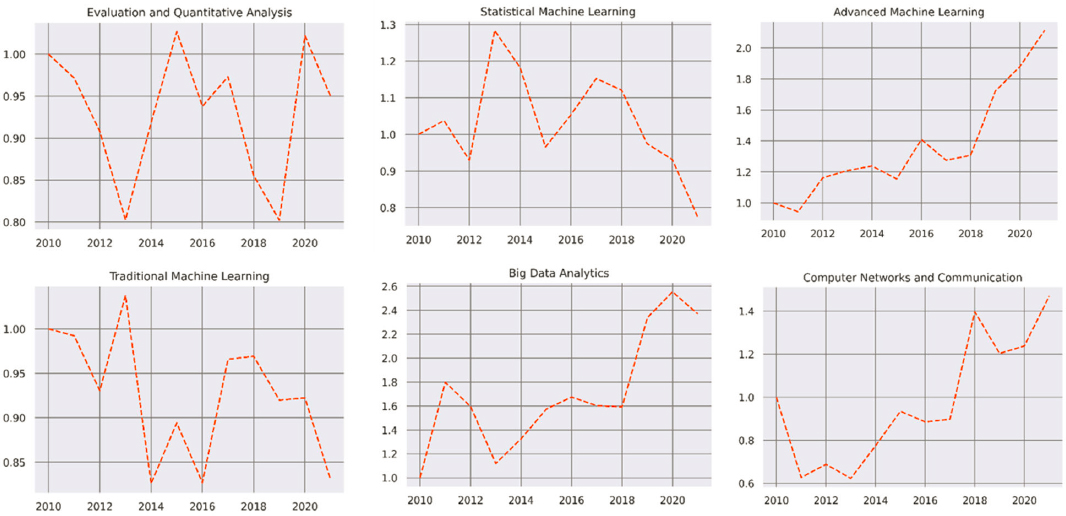
The dynamic landscape of AI in transportation has evolved significantly over the years, reflecting advances in AI technologies and their applications. This temporal analysis enables us to explore these shifting trends and the concentration of AI utilization in the transportation domain. Our findings have uncovered significant insights into the evolving landscape of AI applications in transportation. Notably, certain AI topics, including traditional machine learning and statistical machine learning, have experienced a decline in their application to transportation challenges. In contrast, a clear upward trend emerges in the application of AI topics such as computer networks and telecommunication, big data analytics, and advanced machine learning. The trends found in Figure 4 offer valuable guidance for local Departments of Transportation (DOTs) as they strive to remain at the forefront of AI advancements. Furthermore, awareness of declining trends empowers DOTs to critically evaluate the relevance and potential limitations of specific AI techniques in addressing their unique transportation challenges.
Part 2. Trend Analysis of AI in Transportation Research at DOT Level
Part two focused on understanding the trend of research and use of AI at transportation agencies over the last 5 years. The Transportation Research Board (TRB) database (TRID) was used to search for completed and active projects. Searches were made using keywords related to like AI, machine learning, deep learning, computer vision, and neural networks. SMEs manually selected the projects by reading the project titles and abstracts. Selection of projects was restricted to surface transportation, so projects focused on aviation and water-related transportation were not part of the analysis.
Projects that involved AI-based or machine learning-based applications in resolving transportation concerns related to traffic management, infrastructure improvement, highway maintenance, transportation planning, operations, driving behavior, road weather conditions, pavement performance, and improvement in mobility were selected. The information that was extracted from the TRB database included project title, abstract, sponsor organization, managing organization, program manager, principal investigator, and the status of the project. A total of 106 projects were selected that were either completed or active between 2017 to 2021 (5-year period). The wide representation of transportation focus was ensured during the selection of projects.
The projects were analyzed using abstracts of the projects that were selected. The analysis involved manually annotating the keywords related to transportation and AI. Keywords represent the main concepts of research topic and are the words used in everyday life to describe the topic. Based on the knowledge of SMEs and the literature on transportation research, groups of words related to transportation were assigned a topic. For example, “traffic congestion, traffic flow, signal control, travel time, peak periods, etc.” are mostly associated with traffic management and operations (Sun & Yin, 2017). Thus, in this process, each keyword under transportation signifies a broader transportation focus, and each keyword under AI indicates the tools or applications that were used in the project. The analysis also recorded the number of projects sponsored by state DOTs, the project start year, and states where the project was being pilot tested.
Results
Transportation Focus Areas
Transportation topics discovered under topic modeling formed a basis for associating each keyword found in the project abstracts with topics. Figure 5 represents the frequency of a few of the topics across the projects. There are 43 projects that use AI tools to focus on traffic management concerns, 43 projects that focus on improving transportation infrastructure, and 17 projects that center around road safety. The other topics of interest amongst completed and active research include 22 projects with a focus on mobility, 21 projects on policy and planning, and 15 projects centering around driver behavior and monitoring.

Trend in AI Applications by Year
The team was interested in understanding the trend in AI application research within the transportation area over the years. Figure 6 presents the number of projects started from the year 2017 to early 2022. The graph shows a steady increase in the use of AI tools in transportation research.

Part 3. A Comprehensive Summary of AI Tools and Infrastructure
One major component of AI deployment is the use of different AI-based tools. In recent years, different software tools have been developed that target DNN-based developments. These tools are very efficient in aggregating information, performing ML-based tasks, summarizing data, and visualizing the results. Many of the systems are open sourced, and some of them are paid services. This part of the report summarizes all such AI-related tools and systems that can be used for different applications. The report also provides a list of tool sets for managing big data, processing big data, and their challenges and possible negotiation. we have mainly discussed.
- The typical data processing pipeline, its components, and challenges.
- Structure and components of an AI-based project, along with basic guidelines.
- Key components of AI tools for data-driven advanced analytics.
- Software platforms for AI: Different platforms that can facilitate AI-based methods.
- Big data management: The tools to manage big data either on premises or in the cloud.
- Big data analysis: The tools and processes to perform the actual analysis, including training and testing of ML methods.
- Cost and benefit analysis: The balance of cost and benefit that can help stakeholders choose one tool set over another.
Data-driven AI Ecosystem

The overall AI ecosystem comprises multiple components as shown in Figure 7. While data reside at the center of the system, they are often augmented by input from humans either in a supervisory role or a supportive role as a facilitator. A human is often required for data annotations and validations. The other key components are the data management and the execution of advanced analytics methods such as ML tools. Any AI practice uses continuous improvement through advancements in data collection, development processes, domain expertise, and AI research. Data are collected through a data collection effort or through a public or private data set, then organized onto a data platform where humans can annotate or leverage existing AI tools to enhance AI annotations. Models are trained and tuned using domain expertise. Even minor domain-specific modifications can significantly improve the performance of algorithms for a specific domain. Trained models are validated against collected test data and other data collections on the data platform. Inferencing for unannotated data generates new results that can then be used to analyze collected data in new ways. Human annotation may be used to enrich the results at much lower cost than a completely human process. Finally, the new annotations are added into the data platform and combined with other AI-generated data and collected data to produce analysis for managing infrastructure, developing policy, making business decisions, or automating processes.
Insights from the analysis of the data combined with AI results can improve future data collection. Results from algorithm validation are especially useful to identify underrepresented scenarios in the data that can be improved through new collection protocols or specific collection efforts. As the domain knowledge advances, with help from AI, new insights can be brought into the algorithms to improve performance. Lastly, pure, and applied AI research pushes the envelope of related tasks and creates new algorithm classes and techniques that can be adapted into the developed processes.
Key Components of AI Tools
The AI development lifecycle requires adequate tool sets and software to execute efficiently. In the last two decades, many tools have been developed under different platforms. The challenges of AI development are not limited to developing the algorithm; they are intimately tied to managing data and computing at scale. It is impossible to discuss one without the other, and ultimately this drives the discussion around understanding value and feasibility. This section of the report summarizes the process of AI and the required tools to accomplish AI-related tasks. The main four directions for our review include:
- AI software platforms: We looked at all the software platforms and frameworks used in development, testing, and deployment of AI systems. In this case, we also included traditional ML-based frameworks that are still used by the AI community. The platforms include development platform and language, cloud-based solution services, edge computing and real-world deployment, and open-source toolboxes. We also looked at different visualization and summarization platforms (e.g., Tableau) that may be beneficial for communicating AI-based results.
- Big data management: We live in an era of big data where we collect data from different modalities. For statewide application, it is expected to collect and manage big data. In our survey, we have mainly looked at data management tools, data collection sensors, and data storage mechanisms. We have further investigated their operation modality, security, and limitations.
- Big data processing: It is necessary to understand how to process big data effectively and efficiently. Today, we extensively use high-performance computing through parallelized CPU and GPU computing. However, such processing needs proper coordination, appropriate preprocessing, and scheduling of the data and algorithm. The AI process includes large-scale training and inference, which need to be efficient.
- Cost and benefit: The AI community has been an open community, and that has helped the field to grow. As a result, several AI-based solutions are available open source for research. However, as we move toward more application-focused solutions, enterprises are making more options for paid solutions available. Slowly, subscription- and pay-per-use-based solutions are available from some groups, as are standalone solutions. Availability often depends on the exact solution and the volume and complexity of the intended applications.
Software and other tools are major components of AI development and application. One of the key factors in the AI revolution is the widespread availability of software platforms for seamless deployment and experimentation. Numerous application platforms have been developed by leaders in the AI industry, including Google, Facebook, DeepMind, and MATLAB, along with practitioners and developers from industry and academia. These platforms include Scikit-learn, OpenCV, NLTK, MATLAB image processing toolbox, PyTorch, Keras, TensorFlow, and MXNet. These tools, which are developed in diverse language platforms like Python, R, Java, and MATLAB, are widely used to implement traditional ML techniques, AI-based applications, and advanced DNN models. These models can efficiently communicate with GPU clusters and high-speed storage facilities. In recent years, cloud-based services have emerged to provide these application tools along with storage and computational resources. Such cloud-based services are now provided by Amazon (Amazon AWS), Google (Google Colab), Microsoft (Azure), and NVIDIA, among others.
In this report, we have provided a comprehensive review of different AI tools. We have first provided a comprehensive understanding of the overall data processing pipeline needed for any AI-based development and deployment. Then we discussed each key components of the process, including software tools, data management, and data processing. For the software-based tools, we have discussed all possible tool sets that may be required for advanced data analytics, including statistical analysis, traditional ML, and advanced ML such as DNN. We believe that these sets of tools and their comparative study will provide a
comprehensive understanding to DOTs on the promises and challenges they may expect while implementing any AI-based systems. These tools will also help DOTs to understand the role of AI tools in any upcoming projects and the components needed for them. We believe that this document will also help them to understand the infrastructure and personnel needed to execute such data-driven AI tasks. For more details of all tools and infrastructure, please refer to the interim deliverables on AI tools.
Conclusion
The literature review highlighted that the topics within the transportation domain are interlinked, but the relative interdependence of one topic with another varies a lot. For example, the transportation topic “traffic management” is highly related to other transportation topics, whereas the transportation topic “winter road management” is much less studied and does not show much dependence on other transportation areas. The findings show that AI topics like advanced machine learning, neural methods, and optimization are widely used in most transportation research areas. In contrast, computer networks and telecommunication, big data analytics, advanced machine learning, etc., have increased. This helps us to know the trends of research in the last decade.
The secondary aim of the literature analysis was to explore the extent of AI applications in transportation research in the last 5 years. The results of the TRID database show that most of the AI applications research is around traffic management and transportation infrastructure. Since urban areas constantly face traffic congestion issues, AI tools can provide real-time information from vehicles for traffic management. The other areas where AI applications’ research trend is prevalent include mobility, policy and planning, and safety. We also explored whether there were projects of vital interest to the State DOTs.
There has been an increase in the number of funded projects for AI applications in transportation research over the last 5 years. With the current pace of technological advancement, the trend will keep rising. These research trends show that AI has the potential to revolutionize the way we can approach transportation problems. The literature analysis presents multiple tools that are available for state DOTs, local DOTs, and the stakeholders to apply in various transportation research areas.
Finally, we provide a comprehensive review of a typical AI based project cycle and the required tools and infrastructure. We summarized the available sets of software platforms, associated tools, cost effectiveness of solutions, required infrastructure for big data management, etc. This part of report can be a guideline for DOT personnel to adopt AI in their system.


