Calibration and Development of State-DOT-Specific Safety Performance Functions (2024)
Chapter: Appendix A: Distributed Survey

APPENDIX A
Distributed Survey
As a part of Synthesis Project 20-05/Topic 54-10, NCHRP is synthesizing state and local transportation agency customization of Highway Safety Manual methods. This project will help improve agency decision-making on the calibration of safety performance functions (SPFs) and/or development of jurisdiction-specific SPFs to better reflect unique local conditions. The project includes a review of the literature, survey of state agencies, and the development of case studies of notable efforts.
We have targeted you to take the survey because we believe you may: (1) use SPFs to quantify safety performance, (2) have knowledge of your agency’s efforts to calibrate or develop SPFs and/or, (3) know the right people within your organization that could help you compile the most complete response.
If you could complete the survey and/or forward it to others in your organization that might have additional insights, we would be grateful for your input. In addition, we are seeking to conduct follow-up conversations to learn more about notable efforts. If you are interested in participating in a follow-up conversation, please provide your contact information at the end of the survey.
A PDF copy of the survey can be found at the following link, which may be helpful to coordinate responses across your agency: https://www.dropbox.com/scl/fi/72xclegbcykkf6tbq19i3/54-10-Survey-Word2023.06.30.pdf?dl=0&rlkey=zf93grarw5rg5j8yak4ijzkwn
Please note that we recommend you take a look at the PDF link before entering the survey. The survey asks for details on SPF calibration and development projects that your agency might have performed; having these available ahead of time will reduce the time needed for the survey.
If you have any questions or comments regarding this survey, please contact me using the information below. We would appreciate your response by August 15, 2023.
Regards,
Vikash V. Gayah
Principal Investigator
Pennsylvania State University
Please provide your contact information:
- Name:
- Organization:
- Email address:
- Phone number:
For the remainder of the survey, please consider the following terms/definitions:
Safety Performance Function (SPF) - statistical model/equation used to relate site-specific features to the predicted number of crashes at a site over a given time period (typically one year)
HSM SPF - An SPF that can be found in the first edition of the Highway Safety Manual
Agency-specific SPF - An SPF developed by or for a specific agency using data from sites within their jurisdiction
Part B (Network Screening) SPF - An SPF that is used for network screening purposes and typically only contains segment length and exposure (traffic volume) as input variables.
Part C (Design-level) SPF - An SPF that contains numerous features as input variables, including segment length, exposure (traffic volume), geometric features (e.g., lane width, number of lanes, horizontal curvature information) and presence of safety influencing features (e.g., lighting or rumble strips).
Calibration - Adjusting the output of an SPF to account for agency-specific conditions. (Note this can be done for an HSM SPF or an agency-specific SPF developed by/for another agency but cannot/should not be done for an SPF developed for that specific agency)
Calibration Factor (CF) - Single multiplicative value used to adjust output of an SPF. The HSM CF is defined as the sum of the observed crash frequency for a set of sites divided by the sum of the predicted values obtained from an SPF for those sites.
Crash Modification Factor (CMF) - Value used to adjust the prediction from an SPF for a feature that was not included in that SPF. These can be found in the HSM, FHWA CMF Clearinghouse or other sources. These are typically for features that are NOT INCLUDED as a part of the Part C (Design-level) SPF.
Adjustment Factor (AF) - Value used to adjust for a feature that is included as a part of the Part C (Design-level) SPF.
- Does your agency use SPFs included in the Highway Safety Manual or developed by another agency?
- Yes
- No
IF YOU ANSWERED ‘NO’ TO QUESTION 5, PLEASE SKIP TO
QUESTION 21
OTHERWISE, PLEASE PROCEED TO QUESTION 6
- Does your agency apply calibration factors to these SPFs?
- Yes
- No
IF YOU ANSWERED ‘NO’ TO QUESTION 6, PLEASE SKIP TO
QUESTION 20 (PAGE 8)
OTHERWISE, PLEASE PROCEED TO QUESTION 7.
- If you answered ‘Yes’ to Question 6, please be prepared to upload any reports/documentation describing the process used to estimate calibration factors, including the estimated calibration factor(s) themselves and to which SPFs they are applicable.
7a. Alternatively, you may provide links (URLs) to the reports.
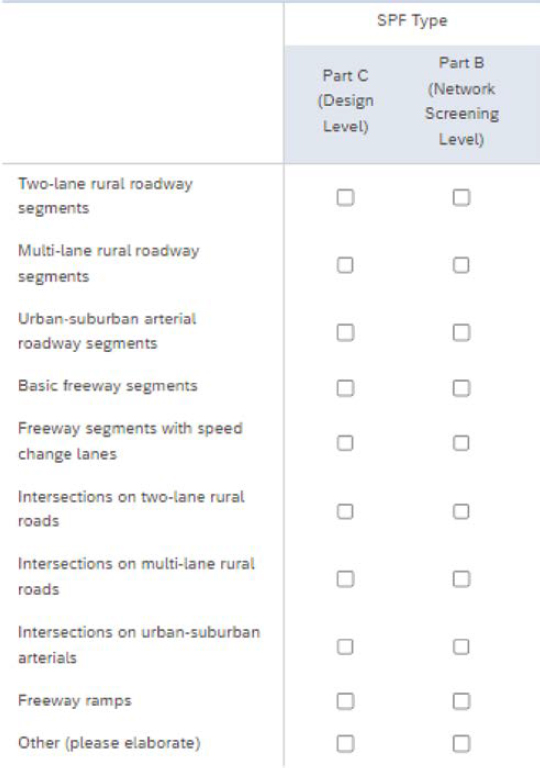
- For what facility types does your agency have calibration factors developed? (Check all that apply.)
- Who developed these calibration factors? (Check all that apply.)
- Someone within your agency
- External consultant
- Academic researcher
- Another state DOT or local agency (please specify)
- What was the approximate cost required to estimate these calibration factors?
- < $ 10,000 per calibration factor
- $10,000 - $25,000 per calibration factor
- $25,000 - $50,000 per calibration factor
- > $ 50,000 per calibration factor (please elaborate)
- Unsure
- What types of tools were used to develop these calibration factors? (Select all that apply.)
- Manual calculations
- Spreadsheet
- FHWA Calibrator Tool
- Other (please elaborate)
- Unsure
- What type of calibration factor does your agency typically use?
- Calibration factor defined in the HSM (single value equal to the sum of observed crash frequency divided by sum of predicted crash frequency)
- Calibration function
- Other (please elaborate)
- Approximately how often are these calibration factors updated?
- Annually
- Every 2–3 years
- Every 4–5 years
- More than every 5 years
- Never, they were only estimated once
- Unsure
- Does your agency estimate multiple calibration factors for a given facility type to account for regional differences across your agency?
- Yes
- No
- Sometimes (please elaborate)
-
Why were calibration factors chosen as the preferred method of adjusting to local conditions? (Check all that apply.)
- Data availability
- Available staff resources
- Available staff skill sets
- Available budget
- Provides the best value for needed precision to support agency decision-making
- So we do not have to develop our own adjustment factors
- Other (please elaborate)
- Are the resulting crash frequency estimates obtained using the calibration factors validated in some way? (Check all that apply.)
- No
- We compare predictions for different facility types
- We compare predictions from uncalibrated and calibrated models
- We examine if calibration factors are within a reasonable range (please elaborate)
- Other (please elaborate)
- How well do the calibrated SPFs represent safety conditions experienced by your agency?
(OPEN RESPONSE)
- What are the biggest challenges to estimating calibration factors for your agency? (Check all that apply.)
- Data availability
- Available staff resources
- Available staff skill sets
- Available budget
- Other (please elaborate)
PLEASE ONLY ANSWER QUESTION 19 IF YOU SELECTED
‘ANOTHER STATE DOT OR LOCAL AGENCY’ IN QUESTION 9
OTHERWISE PLEASE SKIP TO QUESTION 21
- You indicated that you used a calibration factor developed by another agency. How does your agency determine if the calibration factor accurately reflects conditions experienced by your agency? (Check all that apply.)
- We don’t
- Compare predictions for different facility types
- Compare predictions from uncalibrated and calibrated models
- Check if calibration factors are within a reasonable range (please elaborate)
- Other (please elaborate)
PLEASE SKIP TO QUESTION 21
- You indicated that your agency does not estimate/apply calibration factors to externally developed SPFs. Why does your agency not estimate or apply calibration factors? (Check all that apply.)
- Data availability
- Available staff resources
- Available staff skill sets
- Available budget
- Uncalibrated SPFs provide precision needed to support agency decision-making
- Other (please elaborate)
- Has your agency used agency-specific SPFs developed specifically for your agency?
- Yes
- No
IF YOU ANSWERED ‘NO’ TO QUESTION 21, PLEASE SKIP TO
QUESTION 30
OTHERWISE, PLEASE PROCEED TO QUESTION 22
- IF YOU ANSWERED ‘YES’ TO Question 21, please be prepared to upload any reports/documentation describing the process used to estimate agency-specific SPFs, including the final SPFs that were developed.
23a. Alternatively, you may provide links (URLs) for the reports.
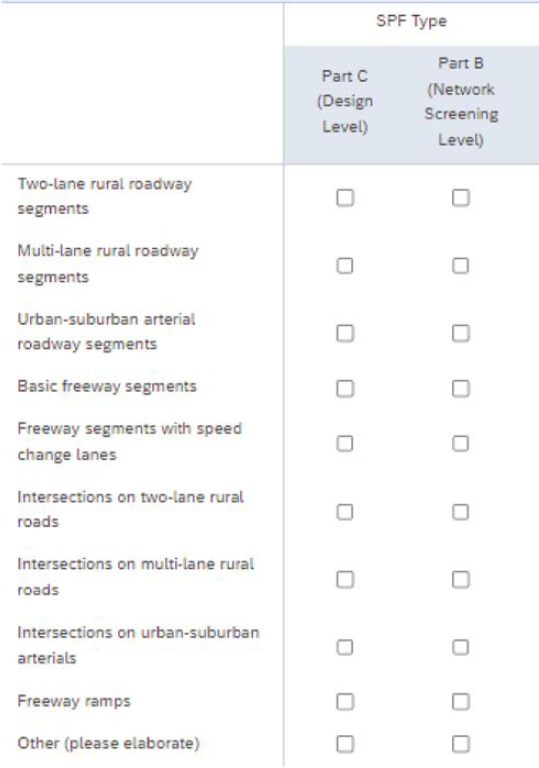
- For what facility types does your agency have agency-specific SPFs? (Check all that apply.)
- Who developed these SPFs? (Check all that apply.)
- Someone within your agency
- External consultant
- Academic researcher
- SPF was developed by another agency (please elaborate on which agency)
- What is the approximate level of effort required to estimate these SPFs?
- < $20,000 per SPF
- $20,000–$40,000 per SPF
- $40,000–$60,000 per SPF
- $60,000–$80,000 per SPF
- $80,000–$100,000 per SPF
- > $100,000 per SPF (please elaborate)
- Approximately how often are these SPFs generally updated?
- Annually
- Every 2–3 years
- Every 4–5 years
- More than every 5 years
- Never, they were only estimated once
- Unsure
- Does your agency estimate multiple SPFs or somehow adjust SPF predictions for a given facility type to account for regional differences across your agency?
- Yes
- No
- Unsure
- Why were agency-specific SPFs chosen as the preferred method for accounting for local conditions? (Check all that apply.)
- Precision needed for crash frequency predictions
- Do not have specific data/variables to apply other SPFs
- Needed to capture regional differences across the state
- Had sufficient in-house expertise to estimate SPFs
- Had sufficient resources available to support project to develop SPFs
- Other (please elaborate)
-
Does your agency combine adjustment factors from SPFs in the HSM with SPFs developed by your agency?
- Yes (please elaborate)
- No
- Unsure
PLEASE SKIP TO QUESTION 31
- Why does your agency not estimate its own SPFs to reflect agency-specific conditions? (Check all that apply.)
- Data availability
- Available staff resources
- Available staff skill sets
- Available budget
- Other methods provide precision needed to support agency decision-making
- Other (please elaborate)
- What are the biggest challenges to estimating SPFs for your agency? (Check all that apply.)
- Data availability
- Available staff resources
- Available staff skill sets
- Available budget
- Other (please elaborate)
- Would you be willing to have a short follow-up chat about your responses to this survey?
- Yes
- No


