Calibration and Development of State-DOT-Specific Safety Performance Functions (2024)
Chapter: Summary

SUMMARY
Calibration and Development of State-DOT-Specific Safety Performance Functions
The first edition of the Highway Safety Manual (HSM), published by the American Association of State Highway and Transportation Officials (AASHTO) in 2010, and its 2014 supplement include a collection of quantitative analysis tools that transportation practitioners may apply to evaluate the safety performance of highways and streets at various phases of the project development process. These tools are integrated into two HSM processes: (1) roadway safety management and (2) predictive methods.
Roadway safety management is a multi-step process that begins with screening a roadway network for sites with potential for safety improvement. Subsequent steps in the process include diagnosing safety problems at candidate sites, identifying countermeasures for implementation, conducting an economic appraisal of the countermeasures, prioritizing sites for safety improvement, and evaluating the safety effectiveness of countermeasure implementation. The safety management process is generally viewed as a planning-level tool. Implementation of the process requires site-specific roadway information along with crash data. The quantitative tools used in the process may include safety performance functions (SPFs) and crash modification factors (CMFs). The predictive methods in the first edition of the HSM are used to estimate the expected annual crash frequency for a variety of roadway facility types. Crash types and severity levels are included in the predictive methods. Because the predictive tools were developed using data from a few states, a calibration process is provided for users to implement the tools within a jurisdiction whose data were not used to develop the tools. The predictive methods also require site-specific roadway information and crash data to apply and are generally intended to be used as either planning- or design-level tools.
Since the release of the first edition of the HSM, state departments of transportation (DOTs) have integrated quantitative safety methods into the transportation project development process at varying levels. Because of this variability, NCHRP Synthesis 54-10 was undertaken to document state DOT practice on calibration factors and the development of jurisdiction-specific SPFs. The specific topics addressed in this report include the following:
- Calibration factors and SPFs that state DOTs have developed;
- Whether calibration factors are developed by in-house staff or consultants, and what respective general levels of effort are required;
- What type of analysis tools (e.g., the FHWA Calibrator) are used for the development of calibration factors;
- Factors, including barriers and challenges, and the decision-making process related to the decision to calibrate existing SPFs or develop jurisdiction-specific SPFs;
- What calibration factors are used and how often they are updated;
- Development of region-specific calibration factors or SPFs (e.g., mountain, piedmont, coastal) and how they are used;
- Metrics and methods of validation for calibration factors;
- Adoption of calibration factors from other states, and metrics and techniques used to assess transferability; and
- Relevant factors, such as crash reporting threshold, which would affect the applicability of state-specific calibration factors or SPFs to other jurisdictions.
Three activities were completed to accomplish the project objectives. First, a literature review of state DOT practices was completed to document the range of SPF development and calibration activities being undertaken across the United States. Next, a survey was developed and distributed to all state DOTs and the District of Columbia DOT to assess their practices relative to the project objectives. Forty-six of 51 DOTs (90.1%) responded to the survey. Finally, five state DOTs (California, Florida, Nebraska, North Carolina, and Washington) were interviewed to document their experiences with customizing the HSM predictive methods.
The major findings from the project are as follows:
- Figure 1 shows the current state of practice for the responding state DOTs with respect to the calibration of HSM SPFs or the development of state-specific SPFs.
- Thirty of 46 responding state DOTs (65%) indicated that they developed their own state-specific SPFs to quantify the safety performance on their highway and street network.
- Thirteen of 46 responding state DOTs (28%) do not currently apply any HSM SPFs or SPFs developed by other state DOTs to quantify safety performance of their highway and street network; instead, they use either their own state-specific SPFs or no SPFs at all. Among the 33 state DOTs that apply HSM SPFs, 22 of these (67%) apply calibration factors as well as state-specific SPFs, while the remaining 11 (33%) use only calibrated HSM SPFs.
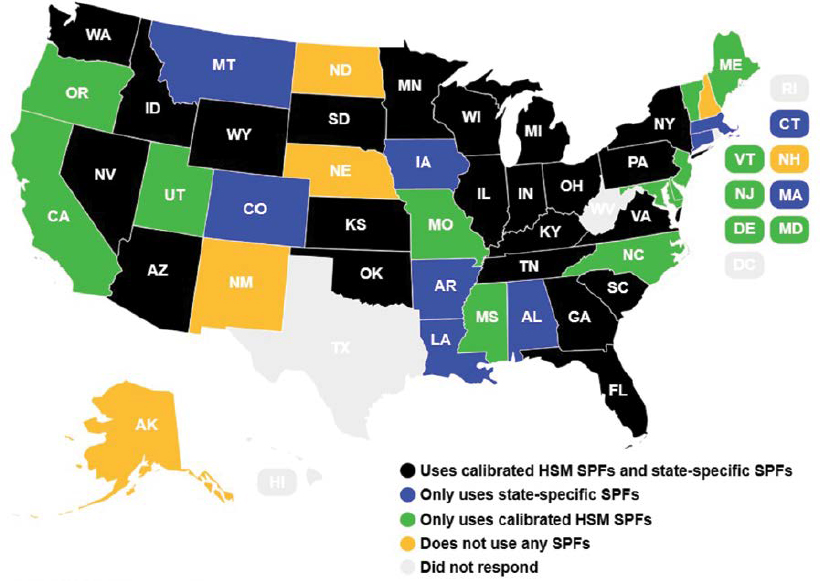
- Among the state DOTs that do calibrate HSM or other state DOT SPFs, the most common roadway types for which these calibration factors were developed include design-level SPFs for rural two-lane, multi-lane rural, and urban–suburban arterial roadway segments and intersections. These roadway types represent the original predictive methods included in the first edition of the HSM. Some state DOTs calibrate design-level freeway segment and ramp SPFs that were subsequently developed as an addendum to the first edition of the HSM, but these calibration efforts are not as prevalent as the calibration efforts for the rural two-lane, rural multi-lane, and urban–suburban arterials roadway segment and intersection calibration efforts.
- Responding DOTs were far more likely to develop calibration factors for design-level SPFs than network-screening-level SPFs. For example, for the HSM SPFs for two-lane rural roadway segments, only 24% (or five of 21 respondents) developed calibration factors for network-screening-level SPFs, while 95% (or 20 of 21 respondents) developed calibration factors for design-level SPFs. Similar differences are observed across all SPF types in the HSM. In general, design-level SPFs were nearly four times more likely to be calibrated than the associated network-screening-level SPF for the same facility type.
- State DOTs typically employ academic partners or consultants to calibrate SPFs, although 14% of DOTs that develop calibration factors (or three of 21 respondents) indicated that they perform in-house calibration efforts. The cost to calibrate SPFs varied widely among survey respondents, ranging from less than $10,000 to more than $50,000 per facility type. While these costs were not broken down between calibrating network-screening-level and design-level SPFs, they are more likely to reflect the costs of calibrating design-level SPFs due to the prevalence of design-level SPFs that were calibrated by state DOTs (as described in the previous bullet).
- Most state DOTs that calibrate SPFs indicated that they use a spreadsheet-based application. Eighty-four percent (or 16 of 19) of DOTs that develop calibration factors apply the calibration factor definition that is consistent with the HSM-recommended method. Of the 19 respondents, one state DOT (5%) indicated that it uses calibration functions, while two state DOTs (11%) indicated that they apply both calibration functions and the HSM calibration factor to calibrate HSM SPFs.
- Half (or 11 of 22) of responding DOTs indicate that they have calibrated SPFs once and have not updated the calibration factors since they were originally developed. Only one state DOT out of 22 (5%) indicated that it updates SPF calibration factors annually, while two of 22 state DOTs (9%) indicated that they update SPF calibration factors every two or three years. Differences in update interval could not be quantified between network-screening-level and design-level SPFs.
- Approximately 28% (or nine of 21) responding state DOTs indicated that they developed regionalized SPF calibration factors for application within their state.
- State DOTs use a variety of methods to validate SPF predictions that are calibrated—the most common method is to compare SPF predictions after calibration to reported crash frequencies for different facility types.
- Table 1 shows the challenges to developing calibration factors reported by state DOTs. The primary challenges are available staff skill sets, resources, budget, and data availability. Differences could not be quantified between network-screening-level and design-level SPFs.
- The state DOTs that do not calibrate SPFs indicate a variety of reasons for not doing so, including data availability as well as staff and other resource limitations.
- Among the state DOTs that develop their own state-specific SPFs, the most common facility types for which these tools are developed include rural two-lane, rural multi-lane, urban–suburban arterial segments and intersections, and basic freeway segments. Few state DOTs develop state-specific SPFs for freeway segments with speed-change lanes or
Table 1. Challenges to developing calibration factors.
| Response | Percent (Number) of Responses out of 21 Total |
|---|---|
| Data availability | 48% (10) |
| Available staff resources | 62% (13) |
| Available staff skill sets | 67% (14) |
| Available budget | 48% (10) |
| Other (please elaborate) | 14% (3) |
- Responding DOTs were slightly more likely to develop state-specific network-screening-level SPFs than design-level SPFs. For example, for two-lane rural roadway segment SPFs, 39%—or 10 of 26—of responding DOTs developed design SPFs, while 62%—or 16 of 26—responding DOTs developed network-screening-level SPFs. Similar differences are observed across all SPF types in the HSM. In general, for a given facility type, network-screening-level SPFs were approximately 1.4 times more likely to be developed by state DOTs than the associated design-level SPFs.
- State DOTs that developed their own SPFs reported that the cost varies widely, ranging from less than $20,000 to more than $100,000 per facility type. The majority of states that developed their own SPFs reported that they do so because of the precision needed for crash prediction. State DOTs that do not develop their own state-specific SPFs cited data availability, along with staff and budget resources, as the primary challenges. Differences in update interval could not be quantified between network-screening-level and design-level SPFs.
freeway ramps. Several state DOTs reported the development of unique SPFs for different crash type–facility type combinations (e.g., design-level SPFs for urban–suburban collector roads).
In addition to the main findings from the literature review and state-of-the-practice survey, future research opportunities to further advance the application of the predictive methods and calibration efforts associated with HSM tools include the following:
- Develop guidance for state DOTs to consider when determining when to develop their own SPFs or apply calibration factors to existing SPFs. The range of current applications suggests that existing guidance is insufficient and should include additional details about how often to update calibration factors/SPFs, the level of accuracy necessary when applying HSM methods, and when to use existing methods versus developing state-specific tools.
- As noted in Chapter 2 of this synthesis report, many state DOTs have published SPFs for a variety of crash types and facility types or developed calibration factors for HSM SPFs. A repository of these SPFs and/or calibration factors and the range of conditions for which they could be applied may be a valuable resource. An example repository that currently exists for highway safety practitioners is the Federal Highway Administration’s Crash Modification Factor (CMF) Clearinghouse.


